Examining information and communication technology use in public primary schools in South Africa from the capability approach
Abstract
In 2015 the Western Cape Government (WCG) in South Africa introduced the e-Learning Game Changer initiative to offer teachers in public schools information and communications technology (ICT) resources to improve their pedagogy. Despite the efforts by the WCG to improve ICT use for teaching in public schools, successful ICT integration hardly takes place in several historically disadvantaged (albeit affluent) schools, which constitute a minority of schools in the Western Cape. The primary aim of this study was to investigate those conversion factors allowing or impeding teachers in two public primary schools in the Western Cape from attaining the potential capabilities required for successful ICT integration. Amartya Sen's capability approach was used as the study's theoretical framework. The study employed a qualitative research method involving 10 educators observed during their lessons and interviewed. The findings confirmed that only a few conversion factors, such as the attainment of ICT skills through a community of practice and university training by the teachers, provided them with capabilities to use ICT to deliver curriculum content and perform basic ICT skills effectively. Several conversion factors, including teachers' age, provincial and school policies, infrastructure and resources, prevented these teachers from realising their ICT potential. This study contends that the White Paper on e-Education (2004) policy might benefit from the results, which could help to build or rethink programmes that encourage continual teacher training. TRANSDISCIPLINARITY CONTRIBUTION: This research shows that policymakers need to take into consideration the conversion factors that may impact teachers' capabilities to deliver curriculum utilising ICTs. This study's findings provide new light on how these conversion factors limit or expand teachers' ICT capabilities.
capabilities; conversion factors; information and communications technology; communities of practice; primary schools; smart classroom
Introduction
Whilst educational technology has been introduced and initiated in state schools in South Africa over the last 27 years, several researchers have acknowledged specific factors as the primary sources causing what Sen calls 'unfreedoms'. These factors prevent teachers' effective information and communications technology (ICT) integration in public schools.1,2311,2456
The Western Cape government (WCG) has introduced various undertakings to promote ICT use in the province's state primary and secondary schools. The e-Learning Game Changer initiative was officially launched on 08 September 2015 to substitute the Khanya Project, which had come to an end after being in existence for over 10 years. Like the Khanya Project, this Game Changer initiative was intended to encourage ICT integration in public schools in the Western Cape province to subsequently transform teaching and learning practices in schools, albeit mainly in mathematics and languages.78
In reaching its objectives, the WCG introduced the Smart School Project through the e-Learning Game Changer initiative, which was intended to operate from 2015 to 2019.77889
What factors enable or deprive public primary school teachers of realising the necessary capabilities for successful ICT integration in their teaching?
This study provides implications for government policies to focus on more than just technology when it comes to guaranteeing the successful use of ICT. This study critically examines why, nearly 27 years into democracy, especially in South Africa's Western Cape province, where the provision of technology in schools is high,101112
The importance of information and communications technology integration in teaching and learning
Information and communications technology integration may be characterised as the hardware and software tools that are often used to transmit information and knowledge in an interactive manner between teachers and learners, as well as between learners and their peers.13144415
Capability deprivation (unfreedoms)
The philosophy of capability deprivation has long helped to assess poverty.161718
According to these descriptions, internal unfreedoms pertain to internal factors or are inherent to teachers and are controlled by them, for this study's purpose. External unfreedoms are factors beyond teachers' control, and in the context of the current study, they forbid teachers from realising those capabilities which are desirable for successful ICT use in teaching and learning. Sen17
External unfreedoms prohibiting effective information and communications technology integration
In separate studies, Chigona et al.192
Makwela20
Some academics have maintained that whenever ICTs are made available at schools, they should also include suitable and broad ICT training of both teachers and learners.3,492
Internal unfreedoms prohibiting effective information and communications technology integration
Theoretical framework
The capability approach has primarily focused on human rights issues such as women's rights and the rights of unemployed people and impaired people.2526,27,28292930
Functionings and capabilities are fundamental theories of the capability approach employed to frame and guide the current study. According to Kuhumba et al.,3131272732
Well-being and agency freedoms are two other theories that bring the capability approach into existence.272633
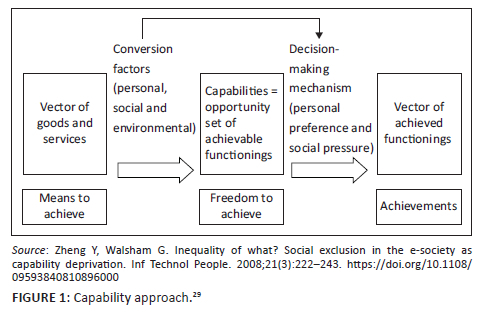
Figure 1 presents how commodities can be transformed into capabilities using personal, social and environmental conversion factors.33
As illustrated in Figure 1, a range of conversion factors influence the capability of a person to make use of resources. The conversion factors influence people's freedoms to transform the features of resources (opportunities) into functionings.629
personal (e.g. abilities or skills of an individual, training situations)
social (e.g. policies concerning ICT usage at a school)
environmental (e.g. available infrastructure, other resources needed for practical ICT usage).
Even though these conversion factors might be interconnected, their causes might differ.
Functionings would be attained through individual decision-making, such as individual choice for benefit. As this study is primarily concerned with capability deprivation in an educational context, the current study focuses only on the first half of the capability approach (Figure 1), that is, conversion factors from commodities to capabilities, excluding the vector of achieved functionings.
Methodology
This study was undertaken in two public primary schools which were purposefully chosen in the Western Cape province of South Africa. These schools are referred to as School A and School B to guarantee anonymity. Both schools are located in a historically 'disadvantaged' township known as Khayelitsha, and both own smart classrooms, which were provided by the local government's e-Learning Game Changer initiative. These two schools belong to the quintile three school category. Schools in quintiles 1-3 are non-fee-paying and receive funding from the South African government.34
Before visiting both schools, ethical clearance was acquired from the Faculty of Education's Ethics Committee at the Cape Peninsula University of Technology (CPUT) and the Western Cape Education Department (WCED). Data were explicitly gathered from participants who signed and presented informed consent forms. A sample of 10 educators was purposefully selected from the population of 70 educators. In this study, the participants are referred to as Teachers A, B, C, D, E, F, G and H, and the principals are referred to as Principals A and B to ensure their anonymity. All 10 participants were cognisant of the planned interviews, whilst all teacher participants were notified of the arranged lesson observations. Four teachers were voluntarily chosen from each school. All eight teachers were teaching between Grades two and six, and specific subjects were recognised as the focus of the local government's e-Learning Game Changer initiative. These subjects included IsiXhosa as home language, English as first additional language (FAL) and mathematics.
A qualitative approach involving an interpretivist paradigm was used to collect the data, including nonparticipant observations for all eight teacher participants and semi-structured one-on-one interviews for all eight teacher participants and two principal participants. An observation protocol was used to record the data during lesson observations, ensuring that the field notes were efficiently organised. The semi-structured interview was a suitable data collection tool as it allowed greater adaptability with the allocated time and afforded the freedom to reorganise the order of the questions and add questions, depending on the participants' responses.3536
Findings
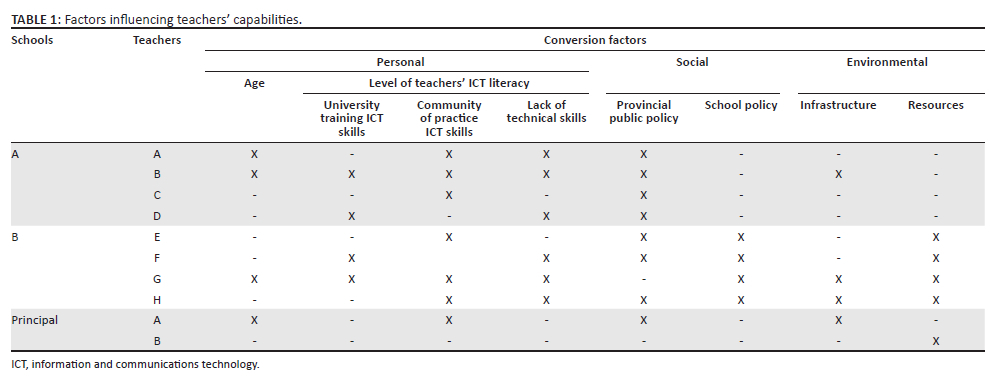
This research aimed to identify and examine factors enabling or depriving public primary school teachers of realising the capabilities essential for effective ICT use. The study's theoretical framework used the capability approach to inform the findings and interpretation or analysis. As emphasised by Chigona et al. and Zheng et al.,19,29 the capability of an individual to make use of resources or goods (commodities), which in this case are ICTs, is influenced by three types of factors, namely personal, social and environmental (see Table 1).
Table 1 illustrates the findings obtained through one-on-one interviews with the participants. The character 'X' in the table represents whether these participants directly or indirectly cited in their interview answers that a specific factor influenced their or other teachers' daily use of ICT in the smart classrooms.
Personal factors and subsequent capabilities
In the interviews, several participants confirmed the construct age (see Table 1) as a significant factor around integrating ICT in the smart classrooms. Three teachers (A, B and G) stated that some of their co-workers are unenthusiastic and unwilling to use the available ICTs in their smart classrooms because of their advanced (unspecified) age (see Table 1). On this point, teachers A, B and G corroborated this finding in their interviews:
'… [T]hen the older teachers in the school, the less they use it [ICT], and they have that belief that children need to write manually using pen [or] pencil and paper.' (Teacher A, School A, 40 years old)
'Teachers who have been teaching for quite many years do not see value on ICTs; thus, they need training, not two weeks' training, not one week training, not one day training but a training longer than two weeks. Older teachers are not comfortable using ICTs. I think once they get the necessary training, that might change.' (Teacher B, School A, 31 years old)
'Honestly, they are old and because they old … Okay, not because they old, let me not say because they old, okay, because maybe they old. Because back in the days, they didn't really use computers. As the years went, they got workshops, and you do get some of the old people who are not good, but they are able to do on their own, but I think that's why, and I think also not - narrow-minded sounds rude, but they're not willing to learn, they telling themselves, 'I won't be able to do this.' (Teacher G, School B, 26 years old)
Principal A echoed this view when answering this question in the interview: 'Do you think your teachers are comfortable teaching with technology?'
'[Laughs] They are not comfortable. Some of them are, but only a few of them. But I know that the majority is not comfortable in using ICTs. Especially the older teachers …' (Principal A, School A, 50 years old)
Findings from the lesson observations of Teachers E and H, who were over the age of 50 years, were consistent with the above participant teachers' responses, confirming these teachers' lack of ICT skills as they were incapable of operating ICTs in their smart classrooms.
During one-on-one interviews, some teachers stressed limited ICT literacy between themselves and teachers as a primary causal factor to their inefficient ICT usage. In answering the interview question: 'How did you obtain your ICT skills?', four teachers (B, D, F and G) reiterated that they possess some ICT skills that they learnt from tertiary institutions (see Table 1) whilst they were studying towards their teaching qualifications. Two teachers (B and G), who had acquired their ICT skills at tertiary institutions, explained:
'I think I first got ICT skills at varsity, that's where I was exposed to ICTs, then I got the skills. Whilst you are there, you are taught on how to operate computers. I did ICT skills as one of the modules in varsity … and the fact that we were almost using computers every day in varsity helped me to have some of the computer skills.' (Teacher B, School A, 31 years old)
'I recently graduated from my studies. At varsity, it's important that you learn to use computers because everything is almost done on computers. From typing your assignment to searching information online. I am confidence [sic] to say that I do have those basic and necessary skills.' (Teacher G, School B, 26 years old)
The findings indicated that novice teachers, despite having little prior teaching experience, had the necessary capabilities to effectively teach utilising ICTs in the classroom. This is despite the fact that novice teachers have less teaching experience. On the other hand, concerning the interview question, 'How do you get support from your school in terms of your skills development?', six participant teachers (A, B, C, G, H and E) were appreciative of the support they received from their coworkers concerning the use of ICTs for teaching and learning. Teacher C commented:
'I obtain my ICT skills by being assisted by other teachers here at the schools, as well as other teachers from other school …' (Teacher C, School A, 32 years old)
Principal A also confirmed Teacher C's comments:
'… like I said, we do have those teachers that are more skilled than others, so we would also ask them to assist those that are less skilled, so that helps a lot.' (Principal A, School A, 50 years)
The teachers reported the kind of support they acquired through a CoP to enhance their capability to use ICTs successfully in the smart classrooms. This finding is proof that a CoP exists amongst teachers at some schools. More specifically, it operationalised how the two selected schools are situated. The existence of a CoP in these schools is as per the recommendations of the Department of Education.22
Six participant teachers (A, B, D, F, G and H) (see Table 1) indicated limited technical skills amongst teachers in the two schools as another personal factor associated with ICT literacy described to have played a significant role in their partial use of ICTs in these schools. This finding is strengthened by participants' answers to the interview question: 'Can you solve any Internet problems or technical problems?':
'Most teachers don't have technical skills to solve computer problems, and that causes them not to use technology. If certain teachers do not use ICT, then that means teachers who use it will not have full support from the rest of the staff. If you cannot solve a technical problem, no one is available at the school to help you.' (Teacher B, School A, 31 years old)
'Since we have smart classrooms and a resource centre at the school, the only problem we have are technical problems. Like, there is no Internet, or struggling to login on laptops because in these laptops you need to connect to the Internet for you to log in …' (Teacher D, School A, 56 years old)
The teachers' unwillingness to use the existing ICTs in their classrooms was because of an absence of knowledgeable and technically skilled teachers in these schools. In this regard, they could not teach without being overwhelmed by technical problems, and thus they could not teach without being adequately suited to resolve some of these technical issues during their lessons. In the observations, this was evident, particularly in the case of teachers A and C at School A, who appeared to grapple with resolving some technical glitches. For example, Teacher A could not establish a Wi-Fi connection during the lesson that was witnessed by researchers. Consequently, she could not use YouTube and other online videos for her lesson as she had envisaged. Therefore, the findings show that ICT illiteracy concerning technical skills deprived these and other teachers of achieving their potential capabilities.
Social factors and subsequent capabilities
Following the provincial policy of the WCED (see Table 1), teachers at some schools and the participant teachers of this study were required to participate in the smart classroom training organised by the WCED. In the interviews, seven participant teachers (A, B, C, D, E, F and H) indicated that they were trained to use the smart classroom ICTs. However, these teachers also underscored that the training was inadequate and insufficient, as a single training session was offered with no follow-up training. On this point, teachers C, D, E and F commented:
'It is not enough, because you will find that other teachers, they never understood everything that was said. And so we needed another training so that we can polish our understanding. It was only a one day training, so that's a little time …' (Teacher C, School A, 32 years old)
'Training of teachers that are raw is not enough, the time is not enough, the training is enough because it almost covers everything. The problem is learning a 2-year work in three days is not enough, so time versus the workload.' (Teacher D, School A, 56 years old)
'The training only happened once; how can we use these things with that kind of training? I think a month would be enough to train teachers.' (Teacher E, School B, 51 years old)
'… those workshops, they are being held at least once a year. I think they are not being held more often so that teachers can be used to them.' (Teacher F, School B, 38 years old)
One principal also reiterated that the teacher developmental training (see Table 1) provided and conducted by WCED on smart classrooms was insufficient:
'When we received these smart classrooms, we had a training, but to me it was not enough. It was just … one Saturday morning from nine o'clock until one o'clock afternoon …' (Principal A, School A, 50 years old)
Some teachers, such as Teacher E, believe this training should last a month. In other words, as a month contains around thirty days, the thirty days may be completed throughout the year, with teachers attending 2-3 training sessions every month.
All four School B participant teachers (E, F, G and H) attribute their partial capabilities to respective policies at their schools (see Table 1) concerning the right to use ICT and length of ICT use in the smart classroom. It was clear from these participants' interviews at School B that not all ICTs were retained for ICT use in the smart classrooms. Following the school's safety and security policy, some ICTs were stored in the deputy principal's office for security. Teachers G and H reported:
'… If we want to use ICTs, we must ask for it in time; that is the rule. If you missed the morning, you might not get it for the rest of the day …' (Teacher G, School B, 26 years old)
'Challenges are that - like today, I wanted to use it, but when I go and ask for it at the office, I was told it's too late. The rule is that I should ask for it before eight in the morning …' (Teacher H, School B, 56 years old)
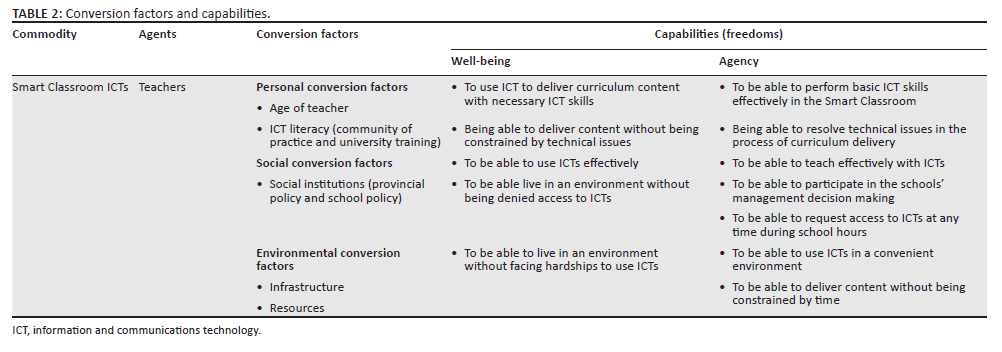
These findings confirm that many teachers, particularly those working in schools similar to those studied, are likely to be denied specific capabilities, such as being capable of using ICTs effectively; living in a setting where access to ICTs is not denied; teaching effectively with ICTs; participating in school management decision-making policies; and freely requesting access to ICTs when required during the school day.
Environmental factors and subsequent capabilities
Power outages because of load shedding were confirmed as an environmental concern connected with infrastructure (see Table 1) by three teachers (B, G and H), as well as one principal (A), in the interviews. Teachers B, G and H commented:
'Load shedding currently is one of the challenges because these resources cannot be used without electricity. Sometimes there is also a problem with Internet server.' (Teacher B, School A, 31 years old)
'… and also we have load shedding, yeah! That's the challenge, that's also a challenge. Because if you had planned a whole nice exercise activity using the smart board, then there is no electricity, it affects the whole lesson. So you always need a plan B.' (Teacher G, School B, 26 years old)
'… you will be willing to use it [ICT], but because of the load shedding, you end up on not using it, and once there's a load shedding in the middle of the lesson, that turns me off from the lesson. You also end up losing your learners' attention …' (Teacher H, School B, 56 years old)
Teachers in the current study could not use ICTs in a comfortable and favourable environment, as they were dissatisfied with power outages. By implication, teachers were deprived of their well-being freedom to work and live in an atmosphere free of adversities in using ICTs. The gathering of ICTs and installation of ICTs in the smart classrooms (see Table 1) proved to be a further environmental problem that hampered the participant teachers (E, F, G and H) at school B from reaching their capabilities. In the interviews, teachers E, F and G expressed:
'Every time we want to use projectors, we have to walk a distance from office to class. I can't put that thing up there on the celling because it's heavy. I have to ask a male teacher to help me. That whole process wastes my teaching time.' (Teacher E, School B, 51 years old)
'Since I don't use technology most of the time, I know that teachers that are using it are complaining because to use it requires a lot of time. The other day one of [my] colleagues from Grade 4 was stressing out because every time when using the [smart boards], he first needs to attach the projector on the frame in ceiling. So teachers avoid using smart boards because they waste time.' (Teacher F, School B, 38 years old)
'… sometimes I don't use it [ICT] because it takes time out of a lesson. Already our lessons are short, especially for maths, because you have mental maths, which takes time. It needs a man because I'm short. I'm a woman, like I can't adjust that thing. The projector because you need to install it up there on the ceiling. So it takes a lot of time, about 15 min - 20 min; even to get it in the morning, I first have to wait after briefings then get it. Like today, my lesson didn't start on time because I had to wait for computer [laptop]. I ended up not even using it anymore.' (Teacher G, School B, 26 years old)
On this point, principal B confirmed these teachers' comments:
'Burglary is a challenge, because every time, now and again, the ICT resources are kept in the strong room. So it's difficult for teachers to leave the technology in their classrooms because of high rate of burglary at the school. We had four burglary instances last year. Even though teachers are complaining that their teaching time is spent on installing and connecting projectors, we have no other choice but to keep these resources in the office because our classes are not safe.' (Principal B, School B, 58 years old)
Based on the teachers' comments, it is reasonable to conclude that the School B teachers' habit of screwing projectors into the ceiling led to their reduced well-being and agency freedom in terms of having the capabilities necessary to incorporate ICTs in their smart classrooms. In addition, teachers, as teacher G said before, have a limited amount of time that is allotted for instructing. Teachers would not enjoy capabilities such as living in an environment free of obstacles in using ICTs or presenting content without being confined by time. Table 2 reviews the relevant factors linked to the teachers' capabilities.
Some conversion factors, namely ICT skills acquired through a CoP and university training, were confirmed to have supported teachers' capabilities. However, most conversion factors, namely age, provincial and school policies, infrastructure and resources, emerged to have had restricted the teachers' capabilities in the current study, preventing them from confidently, freely or fully utilising ICTs in their teaching.
Discussion
In response to the research question, this study discovered significant conversion factors that either enabled or prevented participating individual teachers from efficiently employing ICTs in their smart classrooms. The study aimed to identify the particular conversion factors that enabled or prevented public primary school teachers from realising the capabilities necessary for practical ICT usage in their classrooms. The findings of this study have several implications.
In terms of the capability approach, the findings imply that a CoP, commensurate with adequate university training, can provide teachers with the freedom to present course content using ICTs and to be able to perform basic ICT skills effectively in the smart classroom. Capabilities may be regarded from both an individual and a group perspective. As Vaughan et al.124
The data show that the needs of schools in terms of ICT use by teachers and the training programmes supplied by the WCED for their teachers are not synchronised. These findings are consistent with that of De Silva92
According to the observation and interview data analysis, another reason for their capability deprivation, as evidenced by their inability to tackle technical difficulties in their smart classrooms, was an overall lack of technical skills amongst teachers at the two schools. These findings resonate with Wenger's findings.23
This study's findings demonstrated extrinsic variables outside the control of the participating teachers that a CoP could not resolve. At the time of the current study, social factors such as rigid and dated school policies on ICT use, as well as an environmental factors such as power outages, constantly obstruct successful teaching and learning in poorer public primary schools in the Western Cape, including the two schools chosen for the study. These findings are consistent with Makwela,20
Conclusion
This study shows that, for several reasons, the use of ICTs for teaching in a relatively small sample of individual public primary schools in the Western Cape province is significantly poor. The study revealed that certain conversion factors contributed to capability deprivation amongst public primary school teachers, including personal conversion factors such as teachers' age and level of ICT literacy; social conversion factors such as provincial e-learning policies and school ICT policies; and environmental conversion factors such as school infrastructure and resources. These findings should provide more relevant information to researchers, policymakers, school principals and teachers on the individual factors driving teachers' restricted use of ICTs for teaching and learning, especially in historically poor schools. It is envisaged that this study's findings would contribute practically and theoretically to the development and improvement of the specific teachers' capabilities that emerged during the research, qualities that are critical for effective ICT integration in the classroom. Given that the study was conducted amongst teachers in historically disadvantaged schools in South Africa as a developing country, it is relevant to a global context, particularly in identifying the specific conversion factors that can support or prevent teachers from realising the capabilities required for successful ICT integration in teaching and learning. Given the short sample size of this study, an extensive empirical investigation with a larger sample size and conducted in a divergent environment that additionally analyses teachers' capabilities regarding ICT use may be required. Various circumstances may provide different outcomes. Further research should thus explore bigger sample sizes and possibly a secondary school context to see if the results are similar to or different from the current study.
Competing interest
The authors have declared that no competing interest exists.
Authors' contributions
Z.W. served as the supervisor of L.M. In this regard, he was specifically responsible for assisting with conceptualising the study.
Ethical consideration
Ethical approval to conduct the study was obtained from the Faculty of Education, Cape Peninsula University of Technology (ref. no. EFEC 2-10/2019) and From the Western Cape Education Department (ref. no. 20191009-130).
Funding information
The Faculty of Education at the Cape Peninsula University of Technology will fund the article in the event that it is accepted for publication.
Data availability
Data will be made available using the institution's Data Management Plan tool.
Disclaimer
The views and opinions expressed in this article are those of the authors and do not necessarily reflect the official policy or position of any affiliated agency of the authors.
References
Acknowledgements
The authors express their sincere gratitude to Rose Jackson and Barbara Shaw for proofreading and language editing of this article.
Literature review
- 1. Gunzo FT. Teachers' perceptions, experiences and challenges related to using ICTs in teaching social sciences in marginalised classrooms in the Eastern Cape Province, South Africa [unpublished PhD dissertation]. Grahamstown: Rhodes University; 2020.
- 2. Tiba CA. The ability of newly qualified teachers to integrate technology into their pedagogical practice [unpublished PhD dissertation]. Cape Town: Cape Peninsula University of Technology; 2018.
-
3. Johnston T. Training teachers to bridge the digital divide. WMER [serial online]. 2015 [cited 2019 Dec 06];3(2):4. Available from: https://scholarworks.wm.edu/wmer/vol3/iss2/4.
» https://scholarworks.wm.edu/wmer/vol3/iss2/4 -
4. Umugiraneza O, Bansilal S, North D. Exploring teachers' use of technology in teaching and learning Mathematics in KwaZulu-Natal schools. Pythagoras. 2018;39(1):1-13. https://doi.org/10.4102/pythagoras.v39i1.342
» https://doi.org/10.4102/pythagoras.v39i1.342 - 5. Sen A. Inequality re-examined. Oxford: Oxford University Press: 1992.
- 6. Robeyns I. The capability approach. In: Olsaretti S, editor. The Oxford handbook of distributive justice. Oxford: Oxford University Press, 2018; p. 87-109.
-
7. Republic of South African [RSA]. Media alert: Free high-speed internet at all Western Cape schools by end 2016 [homepage on the Internet]. c2015 [cited 2019 Feb 28]. Available from: https://www.gov.za/speeches/free-high-speed-internet-all-western-cape-schools-end-2016-elearning-game-changer-8-sep
» https://www.gov.za/speeches/free-high-speed-internet-all-western-cape-schools-end-2016-elearning-game-changer-8-sep -
8. Western Cape Government [WCG]. Technology in classrooms: What are smart classrooms? [homepage on the Internet]. c2019 [cited 2020 Apr 30]. Available from: https://www.westerncape.gov.za/general-publication/technology-classrooms-what-are-smart-classrooms
» https://www.westerncape.gov.za/general-publication/technology-classrooms-what-are-smart-classrooms - 9. De Silva CR. Technology integration: Tracing in-service primary teachers' technological, pedagogical, and content knowledge development [unpublished PhD dissertation]. Cape Town: Cape Peninsula University of Technology; 2015.
-
10. Graham MA, Stols G, Kapp R. 2020. Teacher practice and integration of ICT: Why are or aren't South African teachers using ICTs in their classrooms? Int J Instr. 2020;3(2):749-766. https://doi.org/10.29333/iji.2020.13251a
» https://doi.org/10.29333/iji.2020.13251a - 11. Waghid Z, Waghid F. Re-examining instances of cognitive damage in South African universities: Invoking democratic action through educational technology. In: Waghid Y, Davids N, editors. University education, controversy, and democratic citizenship. New York NY: Palgrave-MacMillan, 2020; p. 81-100.
-
12. Vaughan RP, Walker M. Capabilities, values and education policy. J Human Dev Capabil. 2012;13(3):495-512. https://doi.org/10.1080/19452829.2012.679648
» https://doi.org/10.1080/19452829.2012.679648 -
13. Department of Education [DoE]. Draft white paper on e-education: Transforming learning and teaching through ICT. Pretoria: Government Printers [homepage on the Internet]. c2004 [cited 2019 Dec 22]. Available from http://www.gov.za/sites/www.gov.za/files/26734_1.pdf
» http://www.gov.za/sites/www.gov.za/files/26734_1.pdf - 14. Fortner K, Normore AH, Brooks JS. Digital equity and its role in the digital divide. In: Normore AH, Lahera AI, editors. Crossing the bridge of the digital divide: A walk with global leaders. Charlotte NC: Information Age Publishing, 2018; p. 3-18.
- 15. Mugani P. The pedagogical impact of smart classrooms on teaching and learning of grade 11 in the Tshwane South District [unpublished Master's dissertation]. Pretoria: University of South Africa; 2020.
- 16. Sen A. Poverty and famines: An essay on entitlement and deprivation. Oxford: Clarendon Press; 1981.
- 17. Sen A. Social exclusion concept, application and scrutiny. Social Development Papers, No. 1. Tokyo: Asia Development Bank; 2000.
- 18. Waghid Z. Examining an education for decoloniality through a Senian notion of democratic education: Towards cultivating social justice in higher education. In: Manthula CH, Waghid Y, editors. Education for decoloniality and decolonisation in Africa. New York NY: Palgrave Macmillan, 2019; p. 155-173.
- 19. Chigona A, Chigona W. An investigation of factors affecting the use of ICT for teaching in the Western Cape schools. Paper Presented at: 18th European Conference on Information Systems (ECIS). vol. 61. June 7-9, 2010; Pretoria: AIS Electronic Library; 2010.
- 20. Makwela VN. Paperless classroom experiences in Grade 7 science in township schools [unpublished Master's dissertation]. Pretoria: University of Pretoria; 2019.
- 21. Buzuzi AN. Mathematics teachers' integration of technology for pedagogical use in a less affluent high school in the Western Cape [unpublished Master's dissertation]. Cape Town: Cape Peninsula University of Technology; 2020.
- 22. Department of Education [DoE]. Guidelines for teacher training and professional development in ICT. Pretoria: Government Printers; 2007.
-
23. Wenger E. Communities of practice: Learning as a social system. Syst Thinker. 1998;9(5):2-3. https://doi.org/10.1017/CBO9780511803932
» https://doi.org/10.1017/CBO9780511803932 - 24. Mukhari SS. Teachers' experience of information and communication technology use for teaching and learning in urban schools [unpublished PhD dissertation]. Pretoria: University of South Africa; 2016.
- 25. Nussbaum M. Human rights and human capabilities. Harv Hum. 2007;20:21-24.
-
26. Sen A. Well-being, agency and freedom: The Dewey Lectures. J Philos. 1985;82(4):169-221. https://doi.org/10.2307/2026184
» https://doi.org/10.2307/2026184 - 27. Sen A. Inequality re-examined. Cambridge, MA: Harvard University Press; 1995.
- 28. Sen A. Development as freedom. Oxford: Oxford University Press; 1999.
-
29. Zheng Y, Walsham G. Inequality of what? Social exclusion in the e-society as capability deprivation. Inf Technol People. 2008;21(3):222-243. https://doi.org/10.1108/09593840810896000
» https://doi.org/10.1108/09593840810896000 -
30. Madon S. Evaluating the developmental impact of e-governance initiatives: An exploratory framework. Electron J Inf. 2004;20(5):1-13. https://doi.org/1002/j.1681-4835.2004.tb00132.x
» https://doi.org/1002/j.1681-4835.2004.tb00132.x - 31. Kuhumba S. Amartya Sen's capability approach as theoretical foundation of human development. J Sociol Dev. 2018;1(1):127-147.
- 32. Alampay E. Beyond access to ICTs: Measuring capabilities in the information society. Int J Educ Dev Using Inf Commun Technol. 2006;2(3):4-22.
-
33. Grunfeld H, Hak S, Pin T. Understanding benefits realisation of iREACH from a capability approach perspective. Ethics Inf Technol. 2011;13(2):151-172. http://doi.org/10.1007/s10676-011-9268-4
» http://doi.org/10.1007/s10676-011-9268-4 -
34. Ogbonnaya UI, Awuah FK. Quintile ranking of schools in South Africa and learners' achievement in probability. Stat Educ Res J. 2019;18(1):106-119. https://doi.org/10.52041/serj.v18i1.153
» https://doi.org/10.52041/serj.v18i1.153 - 35. Gilbert N. Research, theory and method. In: Gilbert N, editor. Researching social life. 3rd ed. Thousand Oaks, CA: Sage, 2008; p. 21-40.
- 36. Friese S. Qualitative data analysis with ATLAS. ti. Thousand Oaks CA: Sage; 2019.

Accepted: 20 June 2022
Published: 21 Sept. 2022