Small and medium business transformational leadership and supply chain management
Abstract
The performance-related problems facing small and medium enterprises (SMEs) in South Africa are well known. Efforts to find lasting solutions are ongoing and include empirical research focusing on various business practices and models. Applying leadership practices and supply chain management to SMEs provides fertile ground for groundbreaking solutions. This study tested the relationship between transformational leadership, supply chain execution and supply chain performance in manufacturing SMEs in South Africa. The study uses structural equation modelling to examine this empirical connection using data collected from 411 professional employees drawn from SMEs in three South African provinces. The study found that idealised influence and intellectual stimulation exert a positive impact on supply chain execution. Supply chain execution is positively linked to four supply chain performance factors, namely agility, reliability, cost optimisation and responsiveness. TRANSDISCIPLINARY CONTRIBUTION: The study connects transformational leadership, which is an organisational behaviour construct to supply chain management, the latter of which is an emerging business discipline. The study recognises that business strategy is implemented by people whose conduct and practices are pivotal to strategic success. In addition, the study has an entrepreneurship orientation as it addresses the challenges facing manufacturing SMEs in South Africa.
transformational leadership; supply chain execution; supply chain performance; manufacturing sector; SMEs
Introduction
There is a growing significance for small and medium enterprises (SMEs) in most countries and regions of the world.122,34567
Disturbingly, most SMEs in South Africa face a lack of growth, financial bankruptcy and, in most cases, premature business closure.212,75,77638
As businesses require formalised structures as the enterprise grows, leadership is necessary to support transparency, accountability, ethical behaviour and eventual profitability within the SME business.7,895,910
This study aims to determine the influence of transformational leadership on supply chain execution (SCE) and supply chain performance (SCP) within the South African manufacturing SMEs. The study directs its attention to how transformational leadership influences the execution of supply chain strategy in manufacturing SMEs. Furthermore, the study examines how the execution of supply chain strategies contributes to the performance of this supply chain in South Africa. Transformational leadership has been touted as one of the most effective models of SCP improvement within the spectrum of leadership styles.10,1112,13,14
There is much literature on leadership, although only a few address the nexus between leadership and SCP.15,16,1718,19,2021,22
Manufacturing small and medium enterprises s in South Africa
In South Africa, SMEs are establishments or listed companies and are functional in a stable business location with a range of 5-100 paid employees performing their duties at that permanent business premises.23242524
Transformational leadership
The transformational and transactional leadership model was introduced and popularised by Bass in the mid-1980s.1126
Transformational leadership emphasises satisfying basic needs and meeting advanced desires by stimulating followers to offer novel solutions to enhance the workplace.25,262711
Idealised influence aims to advance a shared vision and improve associations with followers.11,272828,2929302830
Within South Africa, organisations, depending on their backgrounds, employ different forms of leadership such as democratic, situational, transactional and autocratic, among others. The success of some companies such as Cummins Africa, Vodacom and Shoprite is linked to their ability to employ a combination of leadership styles.313233
Supply chain execution is a concept linked to SCM and relates to the flow process of tasks and activities involved in the supply chain.9349,3435,36363714
Supply chain performance is the supply chain's ability to supply quality products in the right quantities and at the required time while minimising the total cost involved in supplying these products.38,393839
Supply chain agility is the ability to respond to unanticipated changes.383937,3939,404041,42
Supply chain cost has a place among the primary indicators of SCP and refers to the monetary value utilised in supply chain processes.18,4239643
Supply chain reliability is the aptitude of a supply chain system or component to accomplish its obligatory functions under stated circumstances for a specified period.424345,46,4748
Supply chain responsiveness refers to the swiftness of the supply chain process and the degree to which it meets the varying needs of customers regarding their demand and response to other supply chain matters in the dynamic business setting.4944inter alia lead times, demand for new, varied and innovative products, and market volatilities.4924
Research model and hypotheses
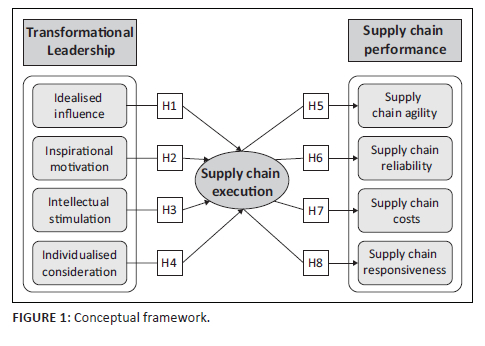
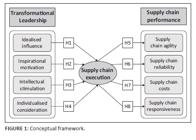
The research model considered in the study is presented in Figure 1. It consists of four predictor constructs (II, IS, IM and IC), SCE as the mediator and SCR as the outcome variable consisting of four measurements (SCA, SCRL, SCC and SCR).
Transformational leadership and supply chain execution
Implementing transformational leadership practices is an essential aspect of strategy execution in many organisations.49,504647,5042,50
H1: II has a significant positive influence on SCE in manufacturing SMEs in South Africa.
H2: IM has a significant positive influence on SCE in manufacturing SMEs in South Africa.
H3: IS has a significant positive influence on SCE in manufacturing SMEs in South Africa.
H4: IC has a significant positive influence on SCE in manufacturing SMEs in South Africa.
Several studies in various environments have linked the effective implementation of supply chain strategies to superior SCP and competitive advantage.24,41,5051
H5: SCE has a significant positive influence on SCA in manufacturing SMEs in South Africa.
H6: SCE has a significant positive influence on SCRL in manufacturing SMEs in South Africa.
H7: SCE significantly optimises SCC in manufacturing SMEs in South Africa.
H8: SCE has a significant positive influence on responsiveness in manufacturing SMEs in South Africa.
Research method and design
The study followed a quantitative survey method based on deductive cognitive and a positivism philosophy, as it required to test link between various concepts and hypotheses.52
Population and sample size
The target population included SCM professionals, managers and owners of SMEs operating in North-West, Free State and Gauteng provinces, South Africa. A sample frame of participating SMEs was obtained from the Small Enterprise Development Agency (SEDA). Up to 180 manufacturing SMEs in different industries were recognised and contacted using this list. From these enterprises, a sample of 411 purposively selected professional employees. Purposive sampling was useful in the selection of those respondents who possessed knowledge about the area of the study. In terms of the inclusion criteria, respondents chosen to participate in the study were holders of matric certificates or higher qualifications. They also had to possess knowledge of SCM. The sampling size was determined using Green's rule of thumb. The rule prescribes the following formulae N ≥ 50 + 8 m (with m representing the number of predictor variables in the model). Using this rule, 82 was expected to be the minimum sample size, given the four transformational leadership constructs that were predictor variables in the study. Hence, a sample size of n = 411 used in this study is consistent with Green's rule of thumb.
Instrumentation and data collection
Measurement scales were operationalised from previously validated scales. Transformational leadership was measured using a 12-item scale adapted from the multifactor leadership questionnaire.112638,53,54,55
Data analysis
The collected data were analysed using the Statistical Package for Social Sciences (SPSS version 27.0) and SMART partial least squares (PLS version 3.0) tools. The key statistical techniques employed in the study include structural equation modelling (SEM) and exploratory factor analysis (EFA).
Ethical considerations
Central Research Ethics Committee: Vaal University of Technology (FRECMS-22072020-042).
Results
Response rate and demographic profile of respondents
A total of 500 survey questionnaires were sent to the respondents targeted in their respective manufacturing SMEs. From the 500 questionnaires, 411 valid questionnaires were available for use in the ultimate analysis, signifying a response rate of 82.2%, which is echoed by several suitable studies.54,55,56p > 0.05). Male respondents dominated the survey with 57.9% (n = 238). In terms of race, 51.8% (n = 213) were black Africans. The majority age group was 34-41 years representing 38.4% (n = 158). Concerning education level status, 45.3% (n = 186) of respondents were holders of diplomas.
Exploratory factor analysis
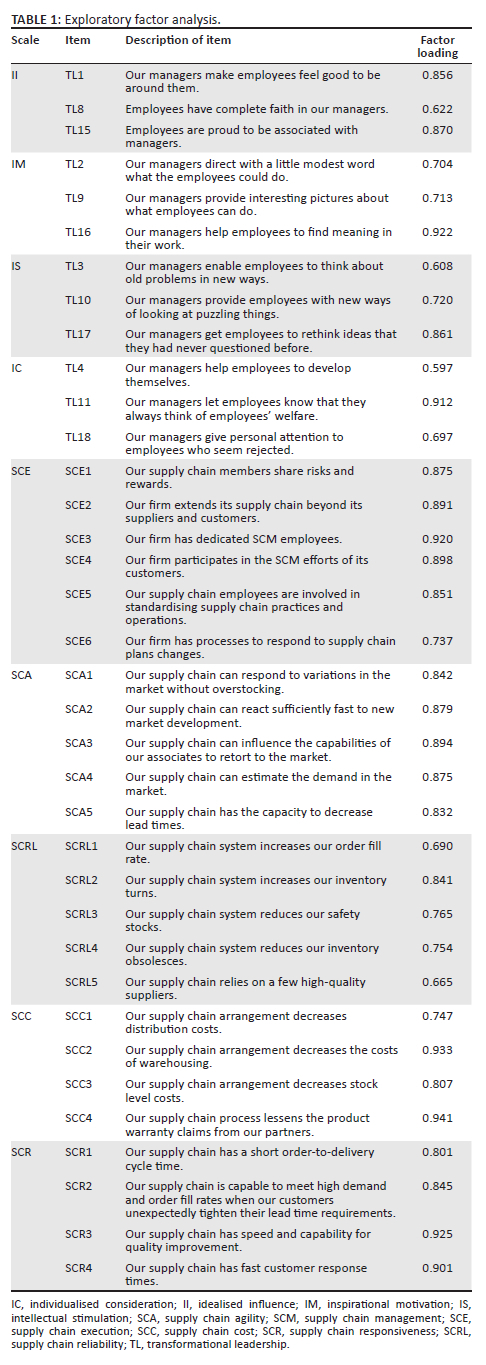
To assess the research constructs' factor structures, EFA was performed. The EFA used the principal component analysis technique, based on varimax rotation. Data factorability was determined using the Kaiser-Meyer-Olkin measure of sampling adequacy (KMO) and Bartlett's test of sphericity. The KMO scores were higher than the 0.5 lowest prescribed value. Bartlett's test results for all constructs were significant at 0.000. Hence, the captured data were deemed suitable for factor analysis.555758Table 1.
As indicated in Table 1, all measurement items achieved factor loadings surpassing the prescribed 0.5 minimum cut-off value.59Table 1 were retained.
Measurement Scale Assessment
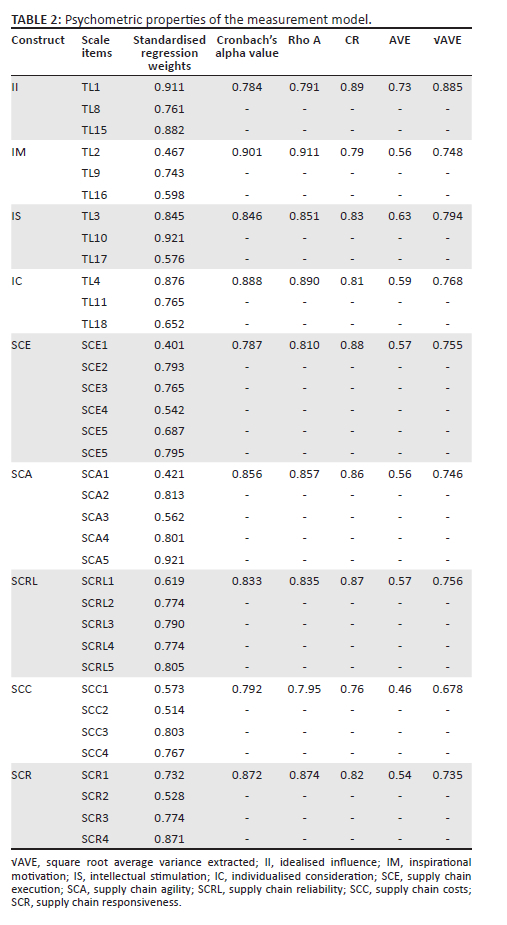
The hypothesised relationships were tested using SEM. This involved first testing the accuracy of the measurement scale for reliability and validity, based on various indicators computed using the PLS technique. The scale accuracy assessment results are indicated in Table 2.
Construct reliability was tested using Cronbach's alpha coefficient, composite reliability and the median Rho A coefficient. All values (Table 2) were above the recommended minimum cut-off value of 0.7, confirming that internal consistency reliability was adequate in the study for all measurement scales. A pilot study was undertaken involving 54 conveniently selected respondents drawn from the Ekurhuleni region to determine the content validity and the preliminary reliability of the questionnaire. Positive reproach was attained from the pilot survey, which specified a few negligible matters that were addressed before the main survey. Convergent validity was tested using the standardised regression weights. A minimum cut-off value of 0.4 was applied as recommended.59
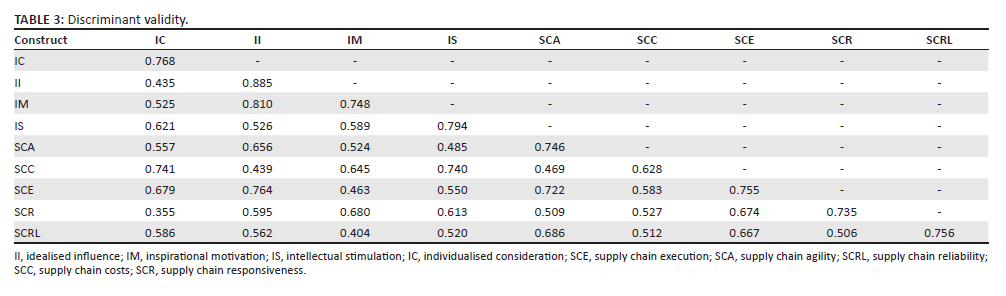
Discriminant validity was tested using the Fornell and Larcker criterion, which prescribes that the square root of the AVE value for each construct must be higher than the highest correction between that construct and the rest of the constructs. As indicated in Table 3, all AVE square root values for each construct were higher than its correlations with other constructs, indicating that the requirement for discriminant validity was satisfied in the study.
Hypotheses tests results
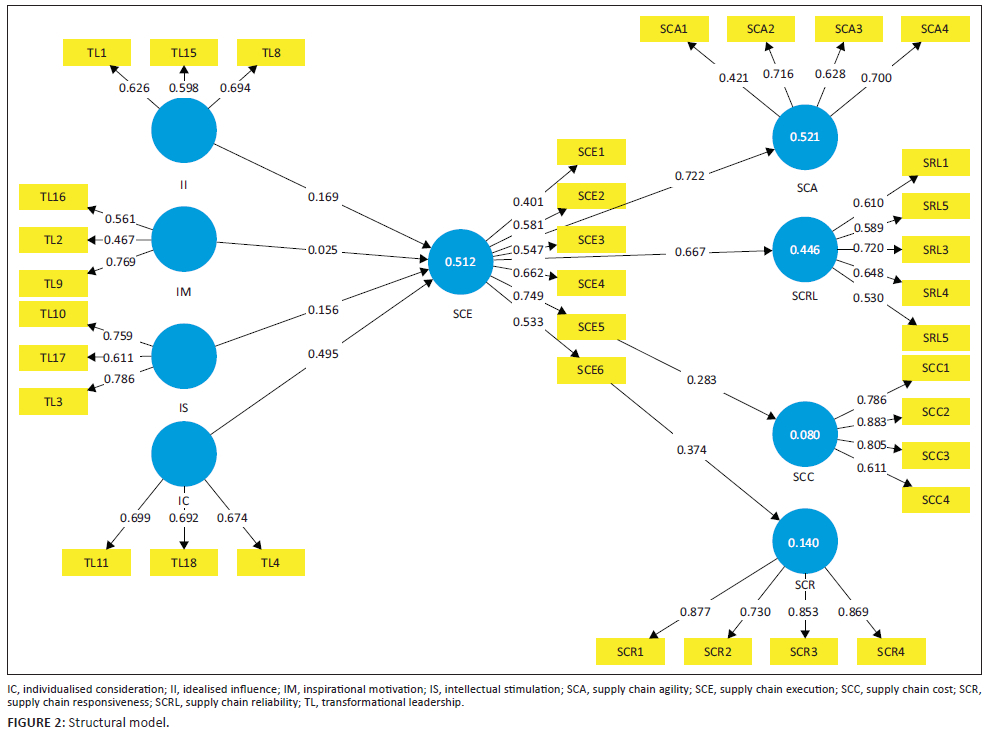
Hypotheses were tested using the SMART PLS technique by testing and examining relationships among the sets of observed variables. The results are presented in the structural model in Figure 2.
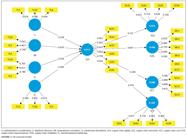
Figure 2 shows path coefficients ranging between 0.025 and 0.772, demonstrating the existence of relationships between some of the constructs. Statistically significant relationships emerged between II and SCE β = 0.169) as well as between IC and SCE (β = 0.495). Supply chain execution exerted a strong significant positive influence on all SCP constructs. The actual results for each hypothesis tested in the study are presented in Table 4.
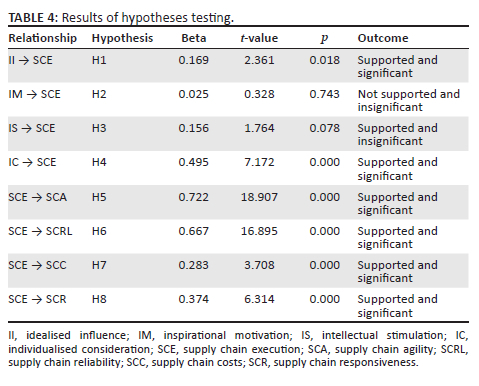
Eight hypotheses were tested in this study, as shown in Table 4. Six of the eight hypotheses were supported. However, two results (H2 and H3) were rejected because of statistically insignificant relationships indicated by p-values higher than the 0.05 significance level.
Discussion
The analysis performed in the study was based on eight proposed relationships among the TL, SCE and SCP constructs. The results show that IM (β = 0.025; t = −0.328; p = 0.743) and IS (β = 0.156; t = 1.764; p = 0.078) were both statistically insignificant in influencing SCE. In other words, IM and IS do not contribute to the execution of supply chain strategy in manufacturing SMEs. Most SMEs are characterised by the dominant role of top management (entrepreneur) in the firm.30,3131
Additionally, most SMEs tend to be managed in an informal way, which again opens a large degree of discretion as to which leadership style to employ or not.50
Moreover, these results could be attributed to the fact that SCM is an emerging concept in most manufacturing SMEs in South Africa. It may be argued that supply chain strategy is still at its inception stage in developing countries such as South Africa.49,50
Among the four leadership practices, II (β = 0.169; t = 2.361; p = 0.018) and IC positively predicted SCE (β = 0.495; t = 7.172; p = 0.000). The positive outcome of this relationship confirms that if manufacturing SMEs in South Africa direct their efforts towards the application of the II and IC leadership practices, there is a greater possibility that the implementation of supply chain strategies and processes can be improved. These practices include a positive work environment, excellent reward and recognition programmes, and training and development. Hence, the stronger the II and IC practices in manufacturing SMEs, the better the implementation of supply chain strategies. Although SCM has been successfully implemented in large manufacturing companies such as Samsung, Cummins and Stryker, it remains essential for manufacturing SMEs to establish the most appropriate transformational leadership mix that can impact positively the management of their supply chains.30
The outcomes also highlight that SCE has a positive significant impact on all of the SCP dimensions considered in the study: SCA (β = 0.722; t = 18.907; p = 0.000); SCRL (β = 0.667; t = 16.897; p = 0.000); SCC (β = 0.283; t = −3.708; p = 0.000) and SCR (β = 0.374; t = 6.314; p = 0.000). By implication, how SCM is implemented has a positive bearing on the agility, reliability, cost structures and responsiveness of manufacturing SME supply networks. Likewise, it has been suggested that improved SCP is a result of more effective planning, good inventory management and supply chain integration in an organisation.47,504846,49
Among the four positive relationships, it is noteworthy to single out the relationship between SCE and SCC as an interesting result. It was found that SCE results in the reduction of SCC drivers, that is, investment, production, procurement, inventory management and transportation costs.45
Conclusion
This study examined the relationship between transformational leadership practices, SCE and SCP in South African manufacturing SMEs. It identified two transformational leadership factors, namely II and IS, which contribute to the successful execution of supply chain strategy and ultimately the performance of manufacturing SME supply chains in South Africa. Implementation of supply chain strategies has the effect of enhancing the agility of optimising the costs and increasing the reliability and responsiveness of the manufacturing supply chain.
The study contributes to the body of knowledge by showcasing the role of leadership practices in the implementation of SCM in manufacturing SMEs. It suggests the importance of applying an appropriate mix of transformational leadership practices while attempting to improve SCM implementation. As the study shows, transformational leadership is a multidimensional factor whose subcomponents may impact differently on supply chain strategy execution. Collaboration between II and IC is likely to improve the effectiveness of SCM implementation, the latter of which is positively associated with the performance of the supply chain in the four areas considered in the study. More precisely, among the four transformational leadership factors, IS exerted the highest influence on SCE (β = 0.495). By implication, more attention should be directed to IS than the other three factors while attempting to improve supply chain strategy execution in manufacturing SMEs. For effective implementation of SCM strategy, emphasis should be placed on understanding and considering the appropriate leadership styles and contexts of SCM infrastructure, support and organisation.
Transdisciplinary contributions
The study's main purpose is to investigate the impact of transformational leadership on the implementation of SCM in manufacturing SMEs. The study may be regarded as transdisciplinary because the research constructs under consideration fall within different disciplines. Leadership, which in the study is represented by its transformational dimension, falls within organisational behaviour while SCM is an emerging stand-alone discipline that has gained prominence in recent times. Additionally, the study also involves the discipline of entrepreneurship or small business management, as its scope was restricted to SMEs. The study reveals that although these disciplines and constructs are distinct, they are interdependent and that optimal SCM performance can be realised through the strategic integration of transformational leadership and SCM practices across manufacturing SME supply chains. Thus, the study augments shared learning for knowledge creation between these disciplines.
The study authenticates the importance of leadership as a strategic driver of the performance of organisations. However, this importance is demonstrable through its interaction with other organisational factors or business strategies, in this case, SCM.
In its nature, SCM is a continuous process requiring the wide-ranging reengineering of business and supply chain processes. This may, at times, involve economically and culturally constructing SCM as driven by the underlying organisational cultures and traditions that direct its implementation within the organisation. In the South African context, manufacturing SMEs face numerous constraints that impede the effectiveness of supply chain processes and operations. Ineffective leadership remains as one of these constraints. However, this study intervenes by invoking the application of comprehensive strategies to assist SMEs to realise the transformative impact of leadership on SCM.
In South Africa, SMEs are regarded as the economic drivers of the country. However, most SMEs either remain stagnant or fail in their first 2 years of operations. Literature indicates that most SMEs' initiatives often fail because of their inability to recognise the link between leadership and entrepreneurship drivers. The study provides insights into how transformational leadership can be harnessed for the improvement of agility, reliability, responsiveness and cost optimisation in manufacturing SMEs. In this way, it generates information to overturn the underperformance of SMEs in South Africa- a matter that has positive macroeconomic implications for the country.
Limitations and suggestions for further research
Generalisation of the study to other environments is limited because the primary data used in the study were gathered in only three South African provinces (Free State, Gauteng and North-West). A qualitative or mixed-methods approach may be applied in future studies to obtain a wider range of results. The study may also be extended to larger corporations, as the constructs used in this research are all applicable and pertinent to businesses of different sizes. Future studies could also test the impact of other leadership practices such as distributed, servant and contingency, among others on SCM in different economic sectors.
Competing interests
The authors declare that they have no financial or personal relationships that may have inappropriately influenced them in writing this article.
Authors' contributions
I.L. is the researcher who led the design and conception, collection of data and manuscript write up. C.M. is the senior researcher who substantially contributed to data analysis, interpretation of results, conception and design of the study and provided guidance in the manuscript write up.
Funding information
The research received no specific grant from any funding agency in the public, commercial or not-for-profit sectors.
Data availability
The data that support the findings of this study are not openly available due to confidentiality and are available from the corresponding author, I.L. upon reasonable request.
Disclaimer
The views expressed in this article are those of the authors and do not necessarily reflect the official policy or position of any affiliated agency of the authors.
References
Acknowledgements
The article stems from a thesis for the degree of PhD in the Faculty of Management Sciences, Vaal University of Technology.
Literature review
-
1.Lekhanya M. Leadership and corporate governance of Small and Medium Enterprises (SMEs) in South Africa: Public perceptions. Corporate Owner Contr. 2015;3(1):1-13. https://doi.org/10.22495/cocv12i3c2p1
» https://doi.org/10.22495/cocv12i3c2p1 - 2.Fatoki O, Garwe D. Obstacles to the growth of new SMEs in South Africa: A principal component analysis approach. Afr J Busin Manage. 2010;4(5):729-738.
-
3.Musabayana GT, Mutambara E. The Implementation of the Broad-Based Black Economic Empowerment (B-BBEE) Policy in South Africa: A Myth or a Reality in SMEs? Aust Account Busin Finan J. 2022;16(1):73-84. https://doi.org/10.14453/aabfj.v16i1.5
» https://doi.org/10.14453/aabfj.v16i1.5 -
4.Statistics South Africa. Poverty trends in South Africa: An examination of absolute poverty between 2006 and 2020 [Home page on the internet]. 2021. Available from: http://www.statssa.gov.za/?p=10341
» http://www.statssa.gov.za/?p=10341 -
5.Burawat P. The relationships among transformational leadership, sustainable leadership, lean manufacturing, and sustainability performance in Thai SMEs manufacturing industry. Int J Qual Reliabil Manage. 2019;121(4):1014-1036. https://doi.org/10.1108/IJQRM-09-2017-0178
» https://doi.org/10.1108/IJQRM-09-2017-0178 -
6.Fekpe ES, Delaporte YYA. Sustainability integration and supply chain performance of manufacturing small and medium size enterprises. Afr J Econ Manage Stud. 2019;11(7):130-147. https://doi.org/10.1108/AJEMS-05-2018-0152
» https://doi.org/10.1108/AJEMS-05-2018-0152 -
7.Van Hoof B, Thiell M. Collaboration capacity for sustainable supply chain management: Small and medium-sized enterprises in Mexico. J Clean Product. 2017;67:239-248. https://doi.org/10.1016/j.jclepro.2013.12.030
» https://doi.org/10.1016/j.jclepro.2013.12.030 -
8.Willis S, Clarke S, O'Connor E. Contextualising leadership: Transformational leadership and management-by-exception-active in safety-critical contexts. J Occup Organ Psychol. 2017;90(3):281-305. https://doi.org/10.1111/joop.12172
» https://doi.org/10.1111/joop.12172 -
9.Kabede AM, Demeke GW. The influence of leadership styles on employees' job satisfaction in Ethiopian public universities. Contemp Manage Res. 2017;13(3):165-176. https://doi.org/10.7903/cmr.17668
» https://doi.org/10.7903/cmr.17668 - 10.Tiwari K, Kumar Sharma A. Transactional leadership in total quality management. Int J Eng Technol Sci Res. 2017;4(3):97-100.
- 11.Bass BM. Leadership and performance beyond expectations. New York, NY: Free Press, Collier Macmillan; 1985, p. 191-220.
-
12.Joshi S, Sharma M. Impact of sustainable supply chain management on performance of SMEs amidst COVID-19 pandemic: An Indian perspective. Int J Logist Econ Global. 2022;9(3):248-276. https://doi.org/10.1504/IJLEG.2022.120811
» https://doi.org/10.1504/IJLEG.2022.120811 -
13.Madzimure J. Examining the influence of supplier integration on supply chain performance in South African small and medium enterprises. S Afr J Entrepren Small Busin Manage. 2020;12(1):7. https://doi.org/10.4102/sajesbm.v12i1.312
» https://doi.org/10.4102/sajesbm.v12i1.312 -
14.Omoruyi O, Akuoma ME. The influence of supply chain management on the performance of small to medium enterprises in Southern Gauteng. Int J Econ Finan Stud. 2020;12(1):172-188. https://doi.org/10.34109/ijefs.202012111
» https://doi.org/10.34109/ijefs.202012111 -
15.Alrowwad A, Abualoush SH, Masa'deh R. Innovation and intellectual capital as intermediary variables among transformational leadership, transactional leadership, and organizational performance. J Manage Dev. 2020;39(2):196-222. https://doi.org/10.1108/JMD-02-2019-0062
» https://doi.org/10.1108/JMD-02-2019-0062 -
16.Arif S, Akram A. Transformational leadership, and organisational performance: The mediating role of organizational innovation. SEISENSE J Manage. 2018;1(3):59-75. https://doi.org/10.33215/sjom.v1i3.28
» https://doi.org/10.33215/sjom.v1i3.28 -
17.Chen L, Li T, Zhang T. Supply chain leadership and firm performance: A meta-analysis. Int J Product Econ. 2021;23(5):108082. https://doi.org/10.1016/j.ijpe.2021.108082
» https://doi.org/10.1016/j.ijpe.2021.108082 -
18.Ojha D, Acharya C, Cooper D. Transformational leadership and supply chain ambidexterity: Mediating role of supply chain organizational learning and moderating role of uncertainty. Int J Product Econ. 2018;197:215-231. https://doi.org/10.1016/j.ijpe.2018.01.001
» https://doi.org/10.1016/j.ijpe.2018.01.001 - 19.Bruwer JP. The relationship(s) between the managerial conduct and the internal control activities of South African fast-moving consumer goods SMMEs. Unpublished Doctoral thesis. Cape Peninsula University of Technology, Cape Town; 2016.
-
20.Jacobs E, Mafini C. Transactional leadership, supply chain quality and business performance in the fast-moving consumer goods industry. J Trans Supply Chain Manage. 2019;13(3):413-442. https://doi.org/10.4102/jtscm.v13i0.442
» https://doi.org/10.4102/jtscm.v13i0.442 -
21.Govuzela S, Mafini C. Organisational agility, business best practices and the performance of small to medium enterprises in South Africa. S Afr J Busin Manage. 2019;50(1):1-13. https://doi.org/10.4102/sajbm.v50i1.1417
» https://doi.org/10.4102/sajbm.v50i1.1417 - 22.Muriithi SM. African small and medium enterprises (SMEs) contributions, challenges, and solutions. Eur J Res Reflect Manage Sci. 2017;5(1):36-48.
- 23.Fekpe ES, Delaporte YYA. Challenges of integrating sustainability into supply chains of small and medium scale firms. Int J Busin Manage Stud. 2017;11(4):25-29.
-
24.Huo B, Ye Y, Zhao X, Zhu K. Supply chain quality integration: A taxonomy perspective. Int J Product Econ. 2019;207(1):236-246. https://doi.org/10.1016/j.ijpe.2016.05.004
» https://doi.org/10.1016/j.ijpe.2016.05.004 - 25.Bhorat H, Asmal Z, Lilenstein K, Van der Zee K. SMMES in South Africa: Understanding the constraints on growth and performance. Development Policy Research Unit Working Paper 201802. DPRU. Cape Town: University of Cape Town; 2018, p. 1-49.
- 26.Burns JM. Leadership. New York, NY: Harper and Row; 1978, p. 19-30.
- 27.Amin M, Shah S, Tatlah AI. Impact of principals/directors' leadership styles on job satisfaction of the faculty members: Perceptions of the faculty members in a public university of Punjab, Pakistan. J Res Reflect Educ. 2017;108(3):97-112.
- 28.Eskandari R, Gholizadeh E, Moharrami E, Mohammadpour A. The effect of managers' leadership styles on job satisfaction: Mediatory role of organisational commitment. Reef Resour Assess Manage Tech Paper. 2018;2(5):402-413.
-
29.Thomson NB, Rawson JV, Slade CP, Bledsoe M. Transformation, and transformational leadership: A review of the current and relevant literature for academic radiologists. Acad Radiol. 2019;32(13):592-599. https://doi.org/10.1016/j.acra.2016.01.010
» https://doi.org/10.1016/j.acra.2016.01.010 - 30.Mittal R. Linking leadership behaviours and information exchange to improve supply chain performance: A conceptual model article in Global. J Flex Syst Manage. 2018;102(5):1-14.
-
31.Purwanto A, Juliana J. The effect of supplier performance and transformational supply chain leadership style on supply chain performance in manufacturing companies. Uncertain Supply Chain Management. 2022;10(2):511-516. https://doi.org/10.5267/j.uscm.2021.12.001
» https://doi.org/10.5267/j.uscm.2021.12.001 -
32.Gosling J, Jia F, Gong Y, Brown S. The role of supply chain leadership in the learning of sustainable practice: Toward an Integrated Framework. J Clean Product. 2019;140(Part 1):239-250. https://doi.org/10.1016/j.jclepro.2016.09.101
» https://doi.org/10.1016/j.jclepro.2016.09.101 - 33.Abbas M, Ali R. Transformational versus transactional leadership styles and project success: A meta-analytic review. Eur Manage J. 2023;41(1):125-142.
-
34.Council of Supply Chain Management Professionals (CSCMP). What is supply chain management? [homepage on the Internet]. 2022 [cited 2023 Feb 06]. Available from: https://cscmp.org/CSCMP/Certify/Fundamentals/What_is_Supply_Chain_Management.aspx?WebsiteKey=0b3f453d-bd90-4121-83cf-172a90b226a9
» https://cscmp.org/CSCMP/Certify/Fundamentals/What_is_Supply_Chain_Management.aspx?WebsiteKey=0b3f453d-bd90-4121-83cf-172a90b226a9 - 35.Kotzab H, Friis A, Busk T. The implementation of supply chain management within organisations: Construct measurement and explorative empirical discussion. Die Unternehmung. 2016;60(2):89-104.
-
36.Jia F, Blome C, Sun H, Yang Y, Zhi B. Towards an integrated conceptual framework of supply chain finance: An information processing perspective. Int J Product Econ. 2020;21(9):18-30. https://doi.org/10.1016/j.ijpe.2019.05.013
» https://doi.org/10.1016/j.ijpe.2019.05.013 -
37.Cantele S, Zardini A. Is sustainability a competitive advantage for small businesses? An empirical analysis of possible mediators in the sustainability financial performance relationship. J Cleaner Product. 2018;182:166-176. https://doi.org/10.1016/j.jclepro.2018.02.016
» https://doi.org/10.1016/j.jclepro.2018.02.016 -
38.Sindhuja PN. Impact of information security initiatives on supply chain performance: An empirical investigation. Inform Manage Comput Security. 2014;29(9):450-473. https://doi.org/10.1108/IMCS-05-2013-0035
» https://doi.org/10.1108/IMCS-05-2013-0035 -
39.Gosling J, Jia F, Gong Y, Brown S. The role of supply chain leadership in the learning of sustainable practice: Toward an integrated framework. J Clean Product. 2017;140:239-250. https://doi.org/10.1016/j.jclepro.2016.09.101
» https://doi.org/10.1016/j.jclepro.2016.09.101 -
40.Loury-Okoumba WV, Mafini C. Supply chain management antecedents of performance in small to medium scale enterprises. S Afr J Econ Manage Sci. 2021;24(1):1-13. https://doi.org/10.4102/sajems.v24i1.3661
» https://doi.org/10.4102/sajems.v24i1.3661 -
41.Pretorius OR, Drewes JE, Engelbrecht WH, Malan GC. Developing resilient supply chains in the Southern African Development Community: Lessons from the impact of COVID-19. J Trans Supply Chain Manage. 2022;16:73-84. https://doi.org/10.4102/jtscm.v16i0.737
» https://doi.org/10.4102/jtscm.v16i0.737 -
42.Belhadi A, Kamble S, Jabbour CJC, Gunasekaran A, Ndubisi NO, Venkatesh M. Manufacturing and service supply chain resilience to the COVID-19 outbreak: Lessons learned from the automobile and airline industries. Technol Forecast Soc Change. 2021;16(3):120-147. https://doi.org/10.1016/j.techfore.2020.120447
» https://doi.org/10.1016/j.techfore.2020.120447 -
43.Aldrighetti R, Battini D, Ivanov D, Zennaro I. Costs of resilience and disruptions in supply chain network design models: A review and future research directions. Int J Product Econ. 2021;23(5):108-121. https://doi.org/10.1016/j.ijpe.2021.108103
» https://doi.org/10.1016/j.ijpe.2021.108103 -
44.Mafini C, Loury-Okoumba WV. Extending green supply chain management activities to manufacturing small and medium enterprises in a developing economy. S Afr J Econ Manage Sci. 2018;21(1): 1-16. https://doi.org/10.4102/sajems.v21i1.1996
» https://doi.org/10.4102/sajems.v21i1.1996 -
45.De Melo J, Twum A. Prospects and challenges for supply chain trade under the Africa Continental Free Trade Area. J Afr Trade. 2020;8(2):49-61. https://doi.org/10.2991/jat.k.210105.001
» https://doi.org/10.2991/jat.k.210105.001 -
46.Weber AN. Responding to supply chain disruptions caused by the COVID-19 pandemic: A Black Swan event for omnichannel retailers. J Trans Supply Chain Manage. 2021;15:15-16. https://doi.org/10.4102/jtscm.v15i0.628
» https://doi.org/10.4102/jtscm.v15i0.628 -
47.Johnson JE, Haug P. Modifications to global supply chain management strategies resulting from recent trade disruptions: An exploratory study. J Glob Operat Strategic Sourc. 2021;14(4):701-722. https://doi.org/10.1108/JGOSS-12-2020-0074
» https://doi.org/10.1108/JGOSS-12-2020-0074 -
48.Butt AS. Understanding the implications of pandemic outbreaks on supply chains: An exploratory study of the effects caused by the COVID-19 across four South Asian countries and steps taken by firms to address the disruptions. Int J Phys Distribut Logist Manage. 2022;52(4):370-392. https://doi.org/10.1108/IJPDLM-08-2020-0281
» https://doi.org/10.1108/IJPDLM-08-2020-0281 -
49.Fabbe-Costes N, Jahre M. Supply chain integration and performance: A review of the evidence. Int J Logist Manage. 2018;19(2):130-154. https://doi.org/10.1108/09574090810895933
» https://doi.org/10.1108/09574090810895933 -
50.Mokhtar ARM, Genovese A, Brint A, Kumar N. Improving reverse supply chain performance: The role of supply chain leadership and governance mechanisms. J Clean Product. 2019;21(6):42-55. https://doi.org/10.1016/j.jclepro.2019.01.045
» https://doi.org/10.1016/j.jclepro.2019.01.045 - 51.Nyaga GN, Whipple JM, Lynch DF. Examining supply chain relationships: do buyer and supplier perspectives on collaborative relationships differ? J Operation Manage. 2010;28(2):101-114.
-
52.Min S, Roath AS, Daugherty PJ, et al. Supply chain collaboration: What's happening? Int J Logist Manage. 2020;16(2):237-256. https://doi.org/10.1108/09574090510634539
» https://doi.org/10.1108/09574090510634539 -
53.Ebrahimi SB, Bagheri E. Optimising profit and reliability using a bi-objective mathematical model for oil and gas supply chain under disruption risks. Comput Indust Eng. 2022;163:807-849. https://doi.org/10.1016/j.cie.2021.107849
» https://doi.org/10.1016/j.cie.2021.107849 -
54.Tarei PK, Kumar G, Ramkumar M. A Mean-Variance robust model to minimize operational risk and supply chain cost under aleatory uncertainty: A real-life case application in petroleum supply chain. Comput Indust Eng. 2022;166(10):31-49. https://doi.org/10.1016/j.cie.2022.107949
» https://doi.org/10.1016/j.cie.2022.107949 -
55.Wang B, Van Fan Y, Chin HH, Klemes JJ, Liang Y. Emission-cost Nexus optimization and performance analysis of downstream oil supply chains. J Clean Product. 2020;266(12):18-31. https://doi.org/10.1016/j.jclepro.2020.121831
» https://doi.org/10.1016/j.jclepro.2020.121831 - 56.Pandey P, Pandey MM. Research methodology tools and techniques. Buzau: Bridge Center; 2015.
-
57.Bartlett MS. The effect of standardization on a chi-square approximation in factor analysis. Biometrika. 1951;38(3/4):337-344. https://doi.org/10.1093/biomet/38.3-4.337
» https://doi.org/10.1093/biomet/38.3-4.337 -
58.Kaiser HF. A second generation little jiffy. Psychometrika. 1970;35(4):401-415. https://doi.org/10.1007/BF02291817
» https://doi.org/10.1007/BF02291817 - 59.Bougie R, Sekaran U. Research methods for business: A skill building approach. West Sussex: John Wiley & Sons; 2019, p. 34-35.

Accepted: 01 Sept. 2023
Published: 30 Oct. 2023