Assessing the integration between disaster risk reduction and urban and regional planning curricula at tertiary institutions in South Africa
Abstract
Urban areas are increasingly being affected by more frequent and severe disasters. It has been argued in theory and international development policy that the integration of disaster risk reduction (DRR) within existing urban planning (UP) curricula would greatly benefit efforts to build resilient urban environments. However, the current status quo and progress of this crucial transdisciplinary integration in the South African University context remain unclear. Through the application of an exploratory mixed method research design, this article established that UP lecturers at South African universities have a good grasp of the theoretical need for the integration of DRR into existing curriculums and have also tentatively started to integrate DRR into some of their modules. However, because of challenges such as full curricula, financial and human resources constraints and integration predominantly happening on postgraduate level, integration has not occurred in sufficient depth while also missing the opportunity to expose the majority of the student cohort and future urban planners to much-needed DRR knowledge. TRANSDISCIPLINARY CONTRIBUTION: This article illuminates the current status of integration across and collaboration between DRR and UP at selected South African Universities.
urban and regional planning; disaster risk reduction; urban planning; curriculums; transdisciplinary integration; universities; South Africa
Introduction
Urban areas are becoming increasingly vulnerable to disaster risks because of population growth, climate change and urbanisation.1,2inter alia include seasonal flooding, veld and informal settlement fires, droughts, mining accidents, oil spills and epidemic disease outbreaks that severely affect communities.3,41,56758
The need to integrate the two fields has been widely debated in academic scholarship and policy considerations, and has been campaigned for since the early 2000s.9,101011
In view of the need for closer integration between DRR and UP and subsequent benefits for addressing urban disaster risks by proactive UP, it is alarming that the issue of DRR and the role of planning is not particularly stipulated as part of the guidelines for core competencies and curricula development at South African tertiary institutions that offer planning qualifications.44
A scoping review of existing literature on the need and possibilities to integrate DRR and UP has revealed a strong campaign for advocating the integration and collaboration of these two disciplines on both the level of academic scholarship and a policy and legislative level. These two perspectives are unpacked in the first two sections of the literature review, while the challenges of the proposed integration are discussed in the third section. The literature review concludes with the role and mandate of higher education institutions (particularly universities) in this movement towards an integrated approach.
Campaigning for integration: An academic scholarship perspective
Various authors such as Pelling,1213141516171816192010,211722
There are several benefits to the integration between UP and DRR. Rivera and Wamsler,231624172325,2614,24
Campaigning for integration: A policy and legislative perspective
In the realm of international policy, there is an urgent need to prioritise the integration of DRR into UP, as it plays a vital role in ensuring sustainable development, enhancing global resilience, and achieving the targets set by international agreements and frameworks. Since the early 1990s, several policies have supported this integration, including the Yokohama Strategy and Plan of Action for a Safer World (1994); the UN Declaration on Cities and Other Human Settlements in the New Millennium (2001); Johannesburg Plan of Implementation (2002), and The Future We Want-Rio+20 (2012). However, the emphasis on integration seems to have intensified in policies related to the United Nations' (UN) 2030 development agenda.27,28
By 2030, significantly reduce the number of deaths and the number of people affected and decrease the economic losses relative to gross domestic product caused by disasters, with focus on protecting the poor and people in vulnerable situations (SDG 11.5).30
Consequently, to achieve this sub-goal of SDG 11, a logical course would be to strive for greater integration between DRR and UP, and combine the various strategies and techniques within the two fields of study and practice to address the systemic drivers of disaster risk and exposure in urban environments.16
The need to integrate DRR into UP is also alluded to in various parts of the Sendai Framework for Disaster Risk Reduction 2015-2030 (SFDRR), which serves as the guiding global policy on DRR.29
The need to integrate DRR and UP is also strongly alluded to in the New Urban Agenda (NUA)3030
In South Africa, the integration of DRR and UP is a critical aspect of policy implementation, aiming to create sustainable and resilient cities. The Spatial Planning and Land Use Management Act (SPLUMA) plays a significant role in guiding this integration. The Act refers to the importance of incorporation of risk reduction measures into land use planning and development processes with the preparation of SDFs (Spatial Development Frameworks).3131173233
Unpacking the challenges towards integrating disaster risk reduction and urban planning
Some of the most common challenges in integrating DRR into UP relate to prevailing perspectives on and misconceptions between UP and DRR, lack of practical experience in the management of disasters, and research and training gaps between the fields. These are briefly discussed below.
Prevailing perspectives on and misconceptions between urban planning and disaster risk reduction
Lack of practical experience in the management of disasters
Chmutina et al.223439inter alia: (1) urban planning departments and disaster management agencies working in silos instead of sharing knowledge that has resulted in a lack of cross-disciplinary understanding and skills development; (2) the lack of acknowledgement in development and planning legislation requiring the integration of DRM and urban planning; or/and (3) the legacy of the Apartheid-era planning where the focus remains on addressing socio-economic disparities and less attention on disaster risk considerations.
Research and training gaps between the fields
Research and adequate skills and capacity building through formal (e.g. university curriculums) and informal training (e.g. short course training programmes) can provide a solid foundation for the integration between related developmental fields such as DRR and UP. However, León and March17242436
It is clear that without addressing these gaps between UP and DRR, the connection between the two fields will remain weakly theorised and integration in practice will continue lagging behind. However, within the context of this article it is argued that universities can play a crucial role in ensuring that strides are made towards addressing at least one of the gaps between UP and DRR that is, research and training gaps between the fields. The mandate to address this specific gap is by ensuring the formulation of UP curriculums that actively integrate concepts, tools, and methodologies related to DRR.
The mandate of universities to develop disaster risk reduction infused urban planning curriculums
Parvin et al.378384041,424344,454647393948,49Key Enabler 2: Education, training, public awareness, and research, states that aspects of DRM should be integrated into existing education programmes and curricula that are relevant to disaster risk.5050
Despite the clear theoretical and legislative push for closer integration between URP, universities in South Africa have been slow to take a leading role in integrating DRR into existing planning curricula. The reason being that the current progress and unique challenges experienced by South African universities in this process are not well known. The rest of this article will explore the current status quo in terms of the integration of DRR into UP curriculums. However, before the results of the study are presented, the research methodology utilised in the study is first elaborated on.
Research methods and design
Research design
A qualitative exploratory investigation was selected to guide this investigation. The main purpose in this case was to seek a contextualised understanding and 'making sense' of the extent to which DRR is integrated in planning curricula by obtaining data from participants (in this case the heads of planning departments and/or groups).5152,535455
Data generation methods
The research design informed the development of the research tools used to collect data from participants. Specifically, the study used a web-based electronic survey conducted on Google Forms.56Box 1.

The participants were sampled through both purposeful and snowball sampling techniques. Sampled participants were chosen for their ability to provide insights into the overall level of integration of DRR in URP curriculums at South African Universities. The first step in securing the research sample was to consult the website of the South African Council for Planners (SACPLAN) to determine the South African Universities that provide courses in URP in South Africa. In total, 11 universities were identified through this process. Subsequently, the researcher contacted the department heads at each of these institutions. These department heads were contacted via email and served as gatekeepers and identified staff members best suited to participate in the study. To be included in the study, potential participants would have to have aspects of DRR already integrated into the modules they teach. Staff members who had no aspects of DRR included in their modules were excluded from participation. Through this process, a total of 18 participants were identified across the 11 institutions.
Data analysis and interpretation
The results of the qualitative data were examined by means of thematic analysis. Thematic analysis aims to identify, interpret and clarify patterns and themes that emerge from qualitative feedback from research participants. This thematic analysis was guided by the six-step process proposed by Maguire and Delahunt.57
1.Becoming familiar with the data
2.Generating initial codes
3.Searching for themes
4.Reviewing themes
5.Defining themes
6.Writing up of theme interpretation
The responses of each question were individually analysed according to each survey section to identify any similarities and themes from the answers. These themes and similarities identified in each section were then cross-referenced and compared to the other answers. Major themes and patterns were then written up.
Ethical considerations
Qualitative research is particularly concerned with ethical issues because of the complexities of researching private lives and placing accounts in the public arena.5859
Results
The section to follow outline some of the major findings and trends that have emerged from the data collection process.
Participant views on the need for integration between disaster risk reduction and urban planning
Literature and policy have indicated that there needs to be closer integration between DRR and UP. Participants in the study echoed this sentiment. Participants unanimously agreed that DRR is a relevant field of study for aspiring urban planners. Most of the responses provided by participants in support of this motion related to urban planners playing a leading role in planning settlements in such a way as to address the drivers of disaster risk and mitigate disaster impacts. Specifically, one respondent indicated that by being aware of the impacts of disasters on people in urban areas would encourage urban planners to plan adequate infrastructure and housing. Another participant supported this opinion, who stated that:
'[S]ettlement planning can aid in mitigating the effects of disasters caused by natural phenomena and man-made hazards.' (Participant from University A)
(Participant from University A). The need to integrate DRR more closely with UP was also framed by some participants through the lens of climate change, its impact on disasters, and the need for UP to adapt to this emerging reality dynamically:
'DRR is relevant for the field of UP because of the dynamically changing natural environment within which UP is practised as a profession. Natural disasters are expected to occur at an unprecedented rate as a result of CC and cities are not exempted from this. Seeing as most of the global population are now living in cities and seeing that cities house most of the financial assets, it is imperative to include DRR as part of the UP process so as to reduce the vulnerability of cities to natural disasters.' (Participant from University B)
Significant benefits were also foreseen in the closer integration between DRR and UP as fields of study by participants. Great emphasis was placed on the ability of urban planners, with the knowledge of DRR, to be better positioned to make more holistic planning decisions to benefit urban environments. In this case, a respondent from University B indicated:
'Yes, it would be beneficial to integrate DRR because every UP graduate is a potential decision-maker whose decisions are likely to impact many lives [positively or negatively depending on their knowledge].' (Participant from University B)
Participants also agreed that integrating DRR into UP is beneficial for ensuring urban resilience and sustainable development. Finally, it was identified that integrating DRR in UP allows lecturers to develop a wider array of practical coursework and case studies, to which UP students could find planning-based solutions:
'UP is a practical subject, and we are currently living in a year affected by floods, fires, etc., so if this is included in the curriculum, lecturers can even give students projects or case studies of what is currently affecting the country.' (Participant from other University)
Curricula as a mechanism to foster integration between disaster risk reduction and urban planning
Participants indicated that to foster greater integration between DRR and UP, adapting existing UP curriculums would be an excellent conduit to facilitate greater integration. For the most part, it was recognised that to build resilient and sustainable cities in future, urban planners would increasingly need to be cognisant of topics related to DRR and climate change adaptation. The following responses encapsulated this notion:
'The increase of disasters has become inevitable, and urban planners are pressured to ensure resilient urban development. This cannot be achieved without DRR measures. Therefore, DRR and climate change adaptation should be included on URP curriculums, thus assisting in the betterment of planners to be proactive in planning projects.' (Participant from University E)
A participant from University J added that in light of the threat posed by climate-driven disasters on urban environments 'that DRR should become a core component of both theory and practice in UP curriculums'.
Status quo in the level of integration of disaster risk reduction in current town and regional planning curriculums
The initial responses by participants aligned well with the theoretical and policy imperatives for greater integration between DRR and UP. However, despite this positive trend, evaluating the current status quo as it relates to the practical integration of the two subject fields in the existing curriculums was also important.
Modules utilised to integrate disaster risk reduction into the curriculum
Participants from most universities indicated that DRR is already included in the existing curriculum. This was facilitated by integrating DRR into some of the existing planning modules. Participants indicated that DRR was being integrated into modules related to sustainable development, environmental planning, spatial planning and resilience, flood planning, urban design and infrastructure, metropolitan planning, planning law, housing and development policy, and city security and safety. Participants indicated that the DRR concepts and topics currently included in their curriculums focussed mostly on disaster prevention, urban disaster resilience and climate change. One such instance relates to a module on flood planning which aims to teach students how to prevent flooding in urban settings at University E:
'Students are required to monitor flood plains, waste management, water management, land or ground typologies, contours or gradient, and similar phenomena that form a crucial part of site analysis and feed into the urban design process.'(Participant from University E).
Other examples of modules integrating DRR are that of urban infrastructure and Metropolitan planning, in this instance a respondent indicated:
'In our Urban Infrastructure class, we teach largely around infrastructure failure and how the state and communities deal with that. Additionally, in our Metro Planning class, we look at how local government is mandated to manage disasters and also how it is accommodated in the spatial development framework.'(Participant from University F)
Share of module allocated to disaster risk reduction teaching
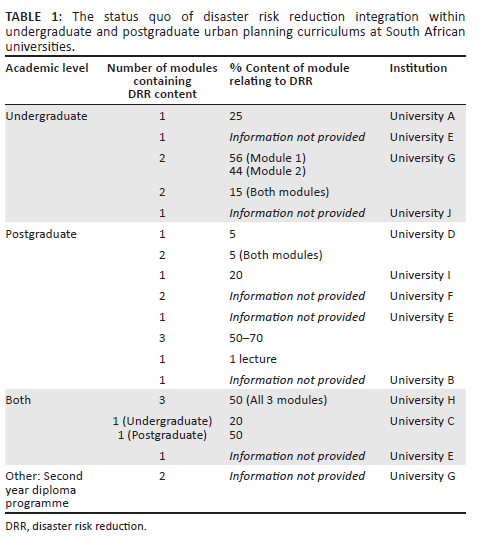
Once it was determined that some modules were already being used to integrate DRR into the existing curriculum, it was also essential to determine what percentage of the modules were being used for DRR teaching. This would give insight into the actual extent of integration of DRR in current curriculums. To achieve this, a set of questions was posed to participants relating to the academic year and/or level DRR is being integrated into the curriculum, the number of modules in their curriculum that currently integrate DRR-related topics, and what percentage of the module participants estimate is dedicated to teaching about DRR. Table 1 summarises the responses given by participants. Most universities indicated that for integrating DRR into their curriculum, an average of one or two modules carry DRR content. The exception to this rule was Universities E and H, which use three modules. Importantly, participants indicated that within the identified 1 or 2 modules, only half or a quarter of the module content is dedicated to DRR-related teaching. Consequently, the depth of DRR integration into existing UP only functions at moderate to low levels. No university in South Africa has a dedicated subject focussing exclusively on DRR. Potential contributing factors to the low levels of integration are discussed later in this article.
Integration at undergraduate vs. postgraduate level
Another trend from the analysis in Table 1 is that DRR within South African UP curriculums has been integrated more at a postgraduate than undergraduate level. It can be argued that the focus on postgraduate integration of DRR into UP has benefits for expanding mutual research between the two fields; however, a significant drawback of this focus is that only a select few students who chose to proceed with their studies are exposed to DRR-related concepts in their curriculum. Consequently, most UP students at South African Universities, who are to be found at an undergraduate level, are either getting limited or no exposure to DRR within their curriculum. Some participants alluded that this trend should be reversed as DRR benefits UP training at all levels:
'Yes, DRR should be included as part of UP courses in undergraduate and postgraduate studies. It is an important component of UP and should form a central component of certain courses, particularly those concentrating on environmental planning and land use management.' (Participant from University E)
Challenges hampering the integration of disaster risk reduction into existing urban and regional planning curriculums
To understand some of the reasons behind the limited integration of DRR in existing UP curriculums, participants were asked if they could identify the challenges that currently hamper the integration of DRR into UP curriculums at South African universities. Participants identified several issues, including, lack of finances, lack of academic resources, lack of understanding of the topic, lack of learning and practical material, lack of exposure to best practices, lack of interest, complexity of the topic, irrelevance of DRR to UP, lack of time and overfull curriculum. To this end, participants identified lack of space and time in the curriculum as the primary factors limiting the integration of DRR into UP planning curricula at South African universities. A participant from University A, elaborated that 'there is limited time, expertise and space to add DRR within the curriculum'. This sentiment was supported by a participant from University E who argued that 'adding DRR to the curriculum would mean there is too much material to cover in the existing planning curricula'. Participants further indicated that the primary issues are made more difficult to overcome because of the financial constraints faced by most institutions that prevent hiring additional staff with the requisite expertise to drive efforts to integrate DRR into existing UP curricula. These budgetary challenges were alluded to in the following participant responses: 'Budget remains the main constraint in bringing on board people with relevant skill sets. Some schools may well-integrate DRR because of resources at their disposal' (Participant University E); 'Most institutions are faced with financial issues because students being unable to pay their fees, and they are running on a tight budget' (Participant University H). The complexity of the topic of DRR and the lack of exposure of most academic staff specialising in UP to DRR was also identified as a constraining factor. As one participant indicated:
'Academics have their specific relatively small fields of specialisation that make it difficult for them to shift to and understand another topic. Most have committed much of their energy to develop a footprint in their own field and won't do it to become an expert in another field (i.e. disaster risk reduction).' (Participant from University G)
Discussion
Rapid urbanisation and the growth of the global population have led to an increase in urban disaster risk. The impact of urban disasters on vulnerable urban communities in South Africa has highlighted the need to strengthen urban resilience. The contribution of UP in an effort to increase reduction endeavours has become more noticeable. The relevance of integrating DRR with UP is supported by the results found in literature and in this research study.
The frequency of disasters has caused a rise in the necessity to integrate DRR with UP theory and practice. Urban planning has a crucial role in contributing to the security of development of a dependable infrastructure and addressing the underlying drives of disaster risks. Especially, since poor UP could lead to an environment that is exposed to hazards leading to an increase in risks. Both scholars and the participants noted that urban planners are crucial in mitigating disaster impacts. This has also been supported in various global and local policies. The benefits of including DRR are linked to the recovery and reconstruction of urban areas that assist in the mitigation of disasters. This is evident among the respondents as they mentioned that these benefits lead to holistic planning and resilient UP. By drawing on existing UP practices and infusing it with DRR concepts and theory that will allow planners to be more risk conscious of an area. Therefore, enabling them to make informed planning decisions that result in urban development that is not only resilient, but sustainable. This will also have a positive effect on the environment, urban infrastructure, socio-economic sectors and urban communities.
Integration leads to a holistic approach that imprints a culture of disaster prevention and resilience among students who will apply this in future practice. Universities taking on the leading role provide opportunities to address the risks and challenges unique to South Africa. Noticeably, the results showed that there is both a need and room for integration in UP curriculums and is becoming increasingly relevant in the field. Currently, the level of integration of DRR in UP curricula is at a moderate level, with DRR being integrated in a diverse variation of modules related to different elements of UP. Therefore, DRR should become a core component in the curriculum to allow both theoretical and practical learning. Especially with modules that focus on DRR concepts such as disaster prevention, climate change and urban disaster resilience. The increasing level of awareness among urban planners does give way to openings and research opportunities on risk integration. This is a crucial finding since literature indicated that some of the misconceptions included a lack of awareness on DRR among urban planners and what that entails, which limits possible exchange of ideas and the engagement of DRR and UP concepts.
The results did correspond with the limitations of the understanding of DRR among planners as indicated in the literature. Existing research on the topic does not provide enough clarity on how to effectively approach DRR and UP integration. Especially in the context of applying it to cities that are not only affected by disasters, but are also left vulnerable because of their socio-economic status. The result supported this where UP lecturers need to increase their level of theoretical understanding of DRR. From the responses collected during this research study it is apparent that universities could assist in bridging some of the gaps mentioned. When integrating DRR in UP curriculums, students are taught DRR through theory and how to apply it critically. This is all to balance theoretical and practical thinking. The inclusion of DRR in UP curricula will allow for more practical learning and application opportunities according to the respondents, which is a crucial element of UP.
Conclusion
It is becoming increasingly important to address South Africa's urban disaster risk profile. Drivers of disaster exposure including unplanned urbanisation, socio-economic inequality and climate change are increasing the variety, frequency and intensity of disasters in South African cities. Urgent action is therefore needed to ensure the effects of urban disasters are reduced. Theory and policy prescripts have indicated that the incorporation of DRR in existing UP curriculums serves as the foundation of building more disaster resilient cities as students would integrate their DRM knowledge into their everyday work as urban planners once they graduate. Urban planning departments at South African Universities therefore need to assume a leading role in the integration process by mainstreaming DRR into existing curriculums. The article has shown lecturers within UP departments at South African Universities, have a solid understanding of the need to integrate DRR and UP more closely. It was universally acknowledged that such an integration is becoming more urgent, as the impact of climate change-related disasters is already being seen in our cites. It also emerged that the majority of universities have already tentatively started to include DRR-related topics in at least 1 or 2 of their modules. However, in spite of these positive trends, concerns emerged relating to the depth of DRR integration in existing curricula. No university indicated a stand-alone subject in DRR being part of their UP curricula and the modules that contain topics related to DRR only spend on average 5% - 20% of the module touching on the issue. Additionally, it was discovered that most universities only integrate DRR at a postgraduate level. As the potential exists that a majority of planning students will not continue with postgraduate studies after they have completed their graduate qualifications, a scenario is created where most qualified urban planners would never have had any exposure to DRR related topics during their university training. Many of the integration issues have been shown to be vested in challenges relating to lack of time and space to include DRR into already full curricula, financial and human resources constraints, and lecturers lacking exposure to theoretical and practical concepts of DRR. These challenges will need to be addressed by developing additional skills and capacity for lecturers, reviewing existing curriculum compositions, and revisiting budget allocations. If these challenges can be addressed, Universities in South Africa can start to produce UP curriculums to foster a culture of disaster-risk awareness and resilience among future UP professionals. In turn, this will contribute to safer and more resilient built environments for all South Africans.
Competing interests
The authors declare that they have no financial or personal relationships that may have inappropriately influenced them in writing this article.
Authors' contributions
T. K. was a masters student who conducted the main research and wrote the article. C.C., L.K. and K.P. were the supervisors who critically revised the article.
Funding information
This research received no specific grant from any funding agency in the public, commercial or not-for-profit sectors.
Data availability
Data sharing is not applicable to this article as no new data were created or analysed in this study.
Disclaimer
The views and opinions expressed in this article are those of the authors and do not necessarily reflect the official policy or position of any affiliated agency of the authors, and the publisher.
References
Acknowledgements
This article is partially based on a thesis submitted in partial fulfilment of the requirements for the degree of Environmental Sciences with Disaster Risk Science at the North-West University entitled 'Urban Disaster Risk: Evaluating Disaster Risk Reduction integration with Urban Planning curriculums at South African Universities'. Supervisor: Prof C. Coetzee, Dr K. Puren, Dr L. Kruger, May 2023. Refer: https://repository.nwu.ac.za/bitstream/handle/10394/42144/Koen_T.pdf?isAllowed=y&sequence=1.
Literature review
-
1.Quesada-Román A, Villalobos-Portilla E, Campos-Durán D. Hydrometeorological disasters in urban areas of Costa Rica, Central America. Environ Hazards. 2021;20(3):264-278. https://doi.org/10.1080/17477891.2020.1791034
» https://doi.org/10.1080/17477891.2020.1791034 - 2.Oe H, Yamaoka Y. A discussion of damage mitigation of natural disasters: How to increase citizens' preparedness. In: 2021 Third International Sustainability and Resilience Conference: Climate Change; 2021 Nov 15; IEEE; p. 18-22.
-
3.United Nations Human Settlement Programme (UN-Habitat). New urban agenda [homepage on the Internet]. 2016 [cited 2021 Sep 17]. Available from: https://unhabitat.org/about-us/new-urban-agenda
» https://unhabitat.org/about-us/new-urban-agenda -
4.Shaw R, Mallick F, Takeuchi Y. Chapter 5 Essentials of higher education in disaster risk reduction: Prospects and challenges. Disaster Educ. 2011;7:95-113. https://doi.org/10.1108/S2040-7262(2011)0000007011
» https://doi.org/10.1108/S2040-7262(2011)0000007011 -
5.Feofilovs M, Romagnoli F. Assessment of urban resilience to natural disasters with a system dynamics tool: Case study of Latvian Municipality. Environ Clim Technol. 2020;24(3):249-264. https://doi.org/10.2478/rtuect-2020-0101
» https://doi.org/10.2478/rtuect-2020-0101 -
6.Jurgilevich A, Räsänen A, Juhola S. Assessing the dynamics of urban vulnerability to climate change: Case of Helsinki, Finland. Environ Sci Policy. 2021;125:32-43. https://doi.org/10.1016/j.envsci.2021.08.002
» https://doi.org/10.1016/j.envsci.2021.08.002 -
7.Grasham CF, Korzenevica M, Charles KJ. On considering climate resilience in urban water security: A review of the vulnerability of the urban poor in sub-Saharan Africa. Wiley Interdiscip Rev Water. 2019;6(3):e1344. https://doi.org/10.1002/wat2.1344
» https://doi.org/10.1002/wat2.1344 - 8.Bosher L, Chmutina K, Von Meding J. Disaster risk reduction as a professional competency. A review of related training and education provision for built environment practitioners in the UK and Australia. In: Proceedings of the International Conference on Building Resilience; 2016 Sep 07-09; Auckland.
-
9.Rani WN, Kamarudin KH, Razak KA, Asmawi ZM. Climate change adaptation and disaster risk reduction in urban development plans for resilient cities. IOP Conf Ser Earth Environ Sci. 2020;409(1):012024. https://doi.org/10.1088/1755-1315/409/1/012024
» https://doi.org/10.1088/1755-1315/409/1/012024 - 10.Vorhies F. The economics of investing in disaster risk reduction. Geneva: UN International Strategy for Disaster Reduction; 2012.
-
11.Pereira RM, Wanderley HS, Delgado RC. Homogeneous regions for rainfall distribution in the city of Rio de Janeiro associated with the risk of natural disasters. Nat Hazards. 2021;111:333-351. https://doi.org/10.1007/s11069-021-05056-2
» https://doi.org/10.1007/s11069-021-05056-2 -
12.Pelling M. Disaster risk and development planning: The case for integration. Int Dev Plann Rev. 2003;25(4):1. https://doi.org/10.3828/idpr.25.4.1
» https://doi.org/10.3828/idpr.25.4.1 - 13.Pelling M, Wisner B. Reducing urban disaster risk in Africa. In: Pelling M, Wisner B, editors. Disaster risk reduction: Cases from urban Africa. New York, NY: Routledge; 2012. p. 43-59.
- 14.March A, Kornakova M, editors. Urban planning for disaster recovery. Butterworth-Heinemann. Cambridge: Elsevier; 2017.
-
15.Galasso C, McCloskey J, Pelling M, et al. Risk-based, pro-poor urban design and planning for tomorrow's cities. Int J Disaster Risk Reduct. 2021;58:102158. https://doi.org/10.1016/j.ijdrr.2021.102158
» https://doi.org/10.1016/j.ijdrr.2021.102158 -
16.Etinay N, Egbu C, Murray V. Building urban resilience for disaster risk management and disaster risk reduction. Proc Eng. 2018;212:575-582. https://doi.org/10.1016/j.proeng.2018.01.074
» https://doi.org/10.1016/j.proeng.2018.01.074 -
17.León J, March A. Taking responsibility for 'shared responsibility': Urban planning for disaster risk reduction across different phases. Examining bushfire evacuation in Victoria, Australia. Int Plan Stud. 2017;22(3):289-304. https://doi.org/10.1080/13563475.2016.1234368
» https://doi.org/10.1080/13563475.2016.1234368 - 18.Barton H, Tsourou C. Healthy urban planning. New York, NY: Routledge; 2013.
-
19.Perrow C. Disasters evermore?: Reducing our vulnerabilities to natural, industrial, and terrorist disasters. Soc Res Int Quart. 2008;75(3):733-752. https://doi.org/10.1353/sor.2008.0029
» https://doi.org/10.1353/sor.2008.0029 -
20.Elmqvist T, Andersson E, Frantzeskaki N, et al. Sustainability and resilience for transformation in the urban century. Nat Sustain. 2019;2(4):267-273. https://doi.org/10.1038/s41893-019-0250-1
» https://doi.org/10.1038/s41893-019-0250-1 -
21.Roy AK, Kaliyath A, Ghosh D. Exploring curriculum for the integration of disaster risk reduction and climate change: The case of planning schools in India. Environ Urban ASIA. 2022;13(2):304-322. https://doi.org/10.1177/09754253221121222
» https://doi.org/10.1177/09754253221121222 -
22.Chmutina K, Ganor T, Bosher L. Role of urban design and planning in disaster risk reduction. Proc Instit Civil Eng Urban Design Plann. 2014;167(3):125-135. https://doi.org/10.1680/udap.13.00011
» https://doi.org/10.1680/udap.13.00011 -
23.The Spatial Planning and Land Use Management Act 16 of 2013 [homepage on the Internet]. [cited 2022 Apr 30]. Available from: https://www.gov.za/sites/default/files/gcis_document/201409/367305-8act16of20.pdf
» https://www.gov.za/sites/default/files/gcis_document/201409/367305-8act16of20.pdf - 24.Sapountzaki K, Michellier C, Pigeon P, Rebotier J, Daskalakis I. A risk-based approach to development planning. In: Disaster risk reduction for resilience: Disaster and social aspects. Cham: Springer International Publishing, 2022; p. 265-311.
-
25.Vermaak J, Van Niekerk D. Disaster risk reduction initiatives in South Africa. Dev S Afr. 2004;21(3):555-574. https://doi.org/10.1080/0376835042000265487
» https://doi.org/10.1080/0376835042000265487 -
26.Ni'mah NM, Wibisono BH, Roychansyah MS. Urban sustainability and resilience governance: Review from the perspective of climate change adaptation and disaster risk reduction. J Region City Plann. 2021;32(1):83-98. https://doi.org/10.5614/jpwk.2021.32.1.6
» https://doi.org/10.5614/jpwk.2021.32.1.6 - 27.Bello O, Bustamante A, Pizarro P. Planning for disaster risk reduction within the framework of the 2030 Agenda for Sustainable Development. Project Documents (LC/TS.2020/108), Santiago, CL: Economic Commission for Latin America and the Caribbean (ECLAC); 2021.
-
28.Santos PP, Pereira S, Zêzere JL, et al. A comprehensive approach to understanding flood risk drivers at the municipal level. J Environ Manage. 2020;260:110127. https://doi.org/10.1016/j.jenvman.2020.110127
» https://doi.org/10.1016/j.jenvman.2020.110127 -
29.Enia J. Is there an international disaster risk reduction regime? Does it matter? Prog Disaster Sci. 2020;7:100098. https://doi.org/10.1016/j.pdisas.2020.100098
» https://doi.org/10.1016/j.pdisas.2020.100098 -
30.United Nations (UN). Sustainable development goals [homepage on the Internet]. 2016 [cited 2021 Aug 06]. Available from: https://sustainabledevelopment.un.org/content/documents/21252030%20Agenda%20for%20Sustainable%20Development%20web.pdf
» https://sustainabledevelopment.un.org/content/documents/21252030%20Agenda%20for%20Sustainable%20Development%20web.pdf -
31.National Disaster Management Framework of 2005 [homepage on the Internet]. [cited 2022 Apr 28]. Available from: https://www.preventionweb.net/publication/south-africa-national-disaster-management-framework-2005
» https://www.preventionweb.net/publication/south-africa-national-disaster-management-framework-2005 - 32.Benson C, Twigg J. Measuring mitigation: Methodologies for assessing natural hazard risks and the net benefits of mitigation. Geneva, Switserland: Provention Consortium; 2004.
-
33.Wamsler C. Mainstreaming risk reduction in urban planning and housing: A challenge for international aid organisations. Disasters. 2006;30(2):151-177. https://doi.org/10.1111/j.0361-3666.2006.00313.x
» https://doi.org/10.1111/j.0361-3666.2006.00313.x -
34.Bosher L. Built-in resilience through disaster risk reduction: Operational issues. Build Res Inform. 2014;42(2):240-254. https://doi.org/10.1080/09613218.2014.858203
» https://doi.org/10.1080/09613218.2014.858203 -
35.Nguyen VN, Ginige K, Greenwood D. Challenges in integrating disaster risk reduction into the built environment - The Vietnam context. Proc Eng. 2018;212:316-323. https://doi.org/10.1016/j.proeng.2018.01.041
» https://doi.org/10.1016/j.proeng.2018.01.041 - 36.Sagar K. Integrating disaster risk reduction and urban planning: Evidence from class III City-Rajgir, India. Int J Adv Res Innov Ideas Educ. 2017;3(1):237-253.
- 37.Parvin GA, Ahsan SR, Shaw R. Urban risk reduction approaches in Bangladesh. Tokyo: Springer Japan; 2013.
- 38.Selby D, Kagawa F. Disaster risk reduction in school curricula: Case studies from thirty countries. Geneva: UNICEF; 2012.
- 39.South African Council of Planners. Guidelines for competencies and standards for curriculum development. South African Council of Planners Online; 2014.
-
40.Thayaparan M, Siriwardena M, Malalgoda CI, Amaratunga D, Lill I, Kaklauskas A. Enhancing post-disaster reconstruction capacity through lifelong learning in higher education. Disaster Prevent Manage. 2015;24(3):338-354. https://doi.org/10.1108/DPM-11-2014-0239
» https://doi.org/10.1108/DPM-11-2014-0239 - 41.Toombs WE, Tierney WG. Curriculum definitions and reference points. J Curr Superv. 1993;8(3):175-195.
- 42.Lunenburg FC. Theorizing about curriculum: Conceptions and definitions. Int J Scholar Acad Intellect Divers. 2011;13(1):1-6.
-
43.Wamsler C, Brink E, Rivera C. Planning for climate change in urban areas: From theory to practice. J Clean Prod. 2013;50:68-81. https://doi.org/10.1016/j.jclepro.2012.12.008
» https://doi.org/10.1016/j.jclepro.2012.12.008 -
44.Bayuo BB, Chaminade C, Göransson B. Unpacking the role of universities in the emergence, development and impact of social innovations - A systematic review of the literature. Technol Forecast Soc Change. 2020;155:120030. https://doi.org/10.1016/j.techfore.2020.120030
» https://doi.org/10.1016/j.techfore.2020.120030 -
45.Didham RJ, Ofei-Manu P. Adaptive capacity as an educational goal to advance policy for integrating DRR into quality education for sustainable development. Int J Disaster Risk Reduct. 2020;47:101631. https://doi.org/10.1016/j.ijdrr.2020.101631
» https://doi.org/10.1016/j.ijdrr.2020.101631 -
46.Hamnett S. 50 years of planning education in Australia: The first planning courses. Aust Plan. 1999;36(1):5-6. https://doi.org/10.1080/07293682.1999.9665714
» https://doi.org/10.1080/07293682.1999.9665714 -
47.Rivera C, Wamsler C. Integrating climate change adaptation, disaster risk reduction and urban planning: A review of Nicaraguan policies and regulations. Int J Disaster Risk Reduct. 2014;7:78-90. https://doi.org/10.1016/j.ijdrr.2013.12.008
» https://doi.org/10.1016/j.ijdrr.2013.12.008 - 48.Khan AN, Ahmed K. Need and importance of DRR education in the context of Pakistan. Asian J Environ Disaster Manage. 2011;3(4):424-435.
-
49.Apronti PT, Osamu S, Otsuki K, Kranjac-Berisavljevic G. Education for disaster risk reduction (DRR): Linking theory with practice in Ghana's basic schools. Sustainability. 2015;7(7):9160-9186. https://doi.org/10.3390/su7079160
» https://doi.org/10.3390/su7079160 -
50.National Disaster Management Centre. National disaster risk management education and training framework [homepage on the Internet]. 2013 [cited 2024 Mar 07]. Available from: http://www.ndmc.gov.za/Frameworks/NATIONAL%20DISASTER%20RISK%20MANAGEMENT %20EDUCATION%20AND%20TRAINING%20FRAMEWORK.pdf
» http://www.ndmc.gov.za/Frameworks/NATIONAL%20DISASTER%20RISK%20MANAGEMENT %20EDUCATION%20AND%20TRAINING%20FRAMEWORK.pdf - 51.Hennink M, Hutter I, Bailey A. Qualitative research methods. Sage; 2020.
- 52.Kothari CR. Research methodology: Methods and techniques. New Delhi: New Age International; 2004.
- 53.Merriam SB, Tisdell EJ. Qualitative research: A guide to design and implementation. San Fransisco: John Wiley & Sons; 2015.
- 54.Creswell JW, Clark VL. Designing and conducting mixed methods research. Sage; 2017.
- 55.Charmaz K. Constructing grounded theory: A practical guide through qualitative analysis. Sage; 2006.
-
56.McPeake J, Bateson M, O'Neill A. Electronic surveys: How to maximise success. Nurse Res. 2014;21(3):24-26. https://doi.org/10.7748/nr2014.01.21.3.24.e1205
» https://doi.org/10.7748/nr2014.01.21.3.24.e1205 - 57.Maguire M, Delahunt B. Doing a thematic analysis: A practical, step-by-step guide for learning and teaching scholars. All Ireland J High Educ. 2017;9(3):3351.
- 58.Miller T. Reconfiguring research relationships: Regulation, new technologies and doing ethical research. Ethics Qual Res. 2012:29-42.
-
59.Brinkmann S, Kvale S. Confronting the ethics of qualitative research. J Construct Psychol. 2005;18(2):157-181. https://doi.org/10.1080/10720530590914789
» https://doi.org/10.1080/10720530590914789
Accepted: 14 Mar. 2024
Published: 24 Apr. 2024
ii . The core competencies include: Settlement history and theory; Planning theory; Planning sustainable cities and regions; Urban planning and place making; Regional development and planning; Public policy, institutional and legal frameworks; Environmental planning and management; Transportation planning and systems; Land use and infrastructure planning; Integrated development planning; Land economics; Social theories related to planning and development; and Research.