(Non)fungibility of socio-cultural capital for rural-based students in South African universities
Abstract
The number of university students coming from rural areas has significantly increased in South Africa in the last two decades. While this is a positive sign of inclusive social growth and development, the fact that 70% of South African universities are still located in urban areas creates challenges for a number of these students. This is also compounded by the fact that most rural schools in South Africa offer sub-optimal preparation for post-school activities. As such, the first barrier for most of these students is negotiating various levels of access to higher education (HE), using forms of social and cultural capital that may be incommensurate with urban-based HE institutions. Using an in-depth review of literature on the subject of rural education, transition to higher education, student success and reflections on the professional experience of the authors in student support services in higher education. This study argues that since most South African universities are "urban enclaves", students from rural areas take time to adapt and accumulate relevant socio-cultural capital to enable them to thrive and succeed. The transition of students from rural schools to urban-based universities is a socio-cultural as much as it is an epistemological mobility. As such, this "troubled transition" of rural students can be ameliorated through a trans-sectoral or transdisciplinary transitional intervention to simultaneously enable epistemological access and create commensurate socio-cultural capital. However, previous interventions on student transition have been generic and lacked the nuanced intersectional analysis of rurality on student access and success. TRANSDISCIPLINARY CONTRIBUTION: The study proposes a trans-sectoral or transdisciplinary transitional space in which education institutions (basic and HE) collaborate with government and non-state partners to ensure sufficient and effective transition, especially for rural school learners.
higher education; socio-cultural capital; rural students; transition; transdisciplinary
Introduction
A priori value of higher education
The difference in educational practices and outcomes between rural and urban areas is conventionally explained in socio-economic parameters. This study focuses on the role of socio-cultural factors that may intervene between the transition, access and success of students from rural schools in semi-urban and urban universities in South Africa. The relationship between education and personal improvement is uncontroversial and has mostly been acknowledged over the years.1,2,3451American Dream. He argued that equality of opportunity as far as HE is concerned was a pre-requisite to individuals' attainment of the American Dream. Most countries accept individual differences that are consequent to individual effort. In fact, Piketty, in his book, Capital in the Twenty-First Century, reflecting on Article 1 of the Declaration of the Rights of Man and the Citizen, argued that 'the only inequality that can be justified is one based on individual effort'.62powerful tool for sustainable development'.789
South Africa is one of the countries with a long-running struggle with poverty and inequality, disaggregating to different groups, according to their race, ethnicity or place of residence.9,12,13a fair, equitable, non-racial, non-sexist and democratic South Africa'14White Paper is imbued with the optimism that expanding access to and attainment of quality education by many will redress the inbuilt inequalities and, at the least, decouple these socio-economic indicators from race.14
The South African policy for HE and training, therefore, contends that the provision of accessible quality HE is a sufficient condition for the attainment of socio-economic returns, or at the least, 'a way of promoting equality of opportunities' across socio-economic divides.1414
The above sentiments may seem true considering the budget allocated to the Department of Higher Education and Training (DHET) compared to the rates of poverty, inequality and unemployment. In the 2019/20 Budget, the DHET was allocated a total of R89.5 billion.15University Education Programme, leaving R16.1 bn to be shared between Administration (R460 million), Planning, Policy and Strategy (R90.8 m), Technical and Vocational Education and Training (TVET) (R12.7 bn), Skills Development (R282.4 m) and Community Education and Training (R2.5 bn). This budget is biased towards university education at the expense of other sectors of HE and training. This begs the question of the strategic importance of university education in the South African socio-economic context. Even when assessing student access, university education has received the highest number of access in the post-apartheid dispensation. From 2015 to 2019, student enrolment in the 26 public universities in South Africa increased by 10.4%, from 969 154 in 2015 to 1 070 000 in 2019.16
The focus of this article is the access and success of students from schools in semi-urban and urban universities in South Africa. As the 'Contemporary challenges and attempts to expand higher education access in South Africa' section and the 'Literature review' section indicate, the article notes that while transformation in South African HE has meant an increase in access by students from previously disadvantaged backgrounds, black students from rural areas still faces challenges in entering, staying and succeeding in HE. The question we attempt to answer is whether the stocks of personal characteristics and experiences - socio-cultural capital - these students bring to university are sufficient to enable them to succeed in semi-urban and urban universities. If not, how can they ensure that their pre-university experiences and characteristics are exchanged for effective social models that will enable them to survive and thrive in a socio-academic context that may be alien to them? In this regard, we factor in our extensive practical experience in student transition into HE, to advocate for a transectoral or transdisciplinary transitional space for students from rural schools.
Contemporary challenges and attempts to expand higher education access in South Africa
Notwithstanding the effort and resources poured into realising the objectives of post-apartheid transformation in the HE system, it became clear soon enough that government policy alone could not effect necessary changes.17Twenty Year Review South Africa: 1994-2014, the office of The Presidency observed that while the overall education budget has increased - constituting above 5% of the gross domestic product (GDP) - resulting in increased access to education for many previously underrepresented groups, the South African education system still performs below its potential. This is because the education system continues to be loaded with low success rates, with low graduation rates, high drop-out rates, and hard sciences and postgraduate programmes still skewed according to gender, race and place of residence.17,1819,2021
Lewin and Mawoyo, in their explanation of the relationship between access and success, borrow Wally Marrow's concept of 'epistemological access', access to the academic ways of knowing that sustain the universities.2022Beyond the University Gates argue that physical access has to be complemented by something more substantial to ensure that students are prepared for academic success in their programmes. McKenna232323
Fisher and Scott, in a report presented to the National Assembly, the Portfolio Committee of Higher Education and Training also observed the need to bridge the articulation gap between students and various critical skills disciplines in HEIs if student success keeps pace with access.242416Twenty-Year Review laid the blame for these success-related challenges on the HEIs, arguing that universities had not done enough in terms of student support, particularly for those students from previously underrepresented groups and areas.1925,26
While these challenges and critiques persist, several interventions have been implemented in universities to mitigate some of these challenges. These academic programmes for underprepared students have taken several forms: tutoring, mentoring, writing centres, the Extended Curriculum Programme (ECP) and First Year Student Experience (FYSE). The FYSE is a blanket intervention for all first-year students registered at the university, aiming at smoothing the transition phase and introducing first-year students to university culture. However, the ECP and other personalised interventions (mentoring, writing or language centres) tend to be long-term, in some cases spanning the rest of the student's academic journey. These are meant to individualise assistance; 'enabling students to develop sound academic and social foundations for succeeding in HE and beyond'1918
The rural schooling system in South Africa: The tale of the other school
While the transformational agenda is a positive trajectory, it is challenging to imagine it yielding equitable results if these changes are not applied uniformly. The challenges of rural schools in South Africa have been over-explored, with studies commenting on long distances to school, overcrowded classes, high student-teacher ratios, lack of resources, and poor linguistic development in the language of learning and teaching, especially for English.2728,29,30181817,21,31,32,33
However, to fully comprehend the need and form of such interventions and support, the dynamics of rural schools must be appreciated. The basic education system, as its HE counterpart, was subject to legislative and policy transformation after the fall of the discriminatory apartheid system. In 1995, the government introduced Outcome-Based Education (OBE), which was a transformative political initiative aimed at improving curriculum focus, and instructional and assessment practices.3435
Despite the transformational efforts engendered by the post-apartheid government, rural schools still possess hurdles for student participants.27,29,3637,383738
The current challenges of rural schooling in South Africa are broad as they are deep. The challenges associated with rural contexts have been extensively highlighted in literature: where rural schools are adversely affected by remoteness, isolation, low socio-economic status of communities and low education of parents.27,29,393938
According to Du Plessis and Mestry393938,39cum professional aspirations of many of getting educated and getting urbanised. Some argue that rural areas are politically and professionally invisible. As such, anyone with professional ambitions will do well to extricate themselves from the rural posting as soon as possible. Otherwise, the longer one remains in a rural school, the more frustrated one becomes, which further compromises rural educational activities and outcomes.
Rural learners are given fewer learning opportunities, as a result of either: (1) infrastructural constraints (electricity, technological resources and extracurricular facilities), (2) contextual challenges (multi-grade teaching and lack of experience) or (3) demand deficit (low student morale or aspirations, low premium put on education by parents and community, and lack of parental monitoring). As a result, rural learners achieve low achievements in terms of academic outputs, and technological and language acquisition. These challenges are further compounded by environmental variables such as violence in schools, distance to school and lack of effective transport, low socio-economic status of the family and low educational levels of parents.34272927,29,40
Apart from these challenges of rural schools associated with resource scarcity, there is also a significant difference between rural and urban schools, mostly ignored in studies, yet equally efficacious in determining learner trajectory. This is the socio-cultural aspect. Rural areas are more than just remote locations that can be sufficiently defined through demographical and socio-economic factors: they are places imbued with specific socio-cultural characteristics.413842
It is uncontroversial, therefore to assume that as rural citizens, rural school learners would have mastered specific socio-cultural capital essential for functioning in the broader rural community, including schools. As shown in Du Plessis and Mestry394343
Socio-cultural capital: An omitted variable bias
The least considered source of challenges in the student's transition from basic to HE is socio-cultural factors. According to Uleanya and Uleanya444445
[S]et of basic beliefs that define, for its holder, the nature of the 'world,' and the individual's place in it, and a range of possible relationships to [the] world and its parts.46
However, the concern in this article is the worldview as it pertains to human nature and behaviour, or what has been referred to as social worldviews.
Social worldviews are influenced by both environmental and genetic factors4545theoretical, household and emotional-psychological), it is vital to note the role of culture in sustaining and transmitting these worldviews from generation to generation within a localised geographical setting. The non-material cultural component of every society embodies a system of values and beliefs, norms (mores, folkways or customs), language and rituals that facilitate a process of identity formation, development and transformation. Through the process of enculturation, young people learn their societal worldviews and use them to navigate day-to-day challenges. This has been called cultural capital.9
As such, 'networking' has become a standard prescription to those who seek personal improvement (through employment and business start-ups), as a short-hand of the almost-pejorative aphorism: it is not what you know; it is whom you know. The quantity and quality of one's socio-capital depend on the size and quality of the network one can effectively mobilise. Although irreducible to economic or cultural capital possessed by each member of the network, Bourdieu9and differential individual welfare] beyond the presence of common capitals (physical, economic, human)'999
While the role of economic capital in one's social progress is conventionally acknowledged, this study focuses on the latter forms of capital: cultural and social - here termed 'socio-cultural' capital. While cultural capital entails the embodiment of natural aptitudes (intelligence) and results of primary and secondary socialisations, and socio-capital is the benefits one gets from the stock of social connections, socio-cultural capital refers to personal characteristics gained and enhanced through social interactions. The nature and quality of socio-cultural capital depend on the time one spends within a significant social context and influences one's view of the social world. The study then argues that for one to succeed in a new social context depends on the extent to which the content of his or her socio-cultural capital is adaptable to the new context and the proximity of that capital to the requirements of success in the new environment. While students' universities with socio-cultural capital enabled them to successfully complete secondary education, their epistemological access and success depend on how the proximity of this capital to university success criteria and their ability to adapt it should there be a need. This is the question of the fungibility (or non-) of students' socio-cultural capital for access and success in HE.
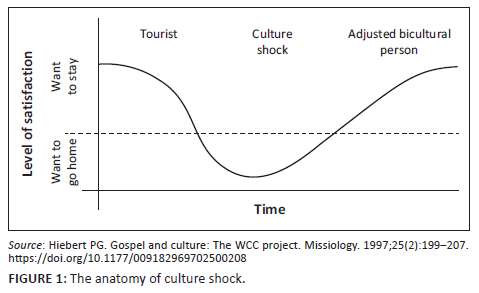
According to Hiebert, an individual leaving their own culture for another will be confronted with a significant amount of confusion and cultural disorientation, in which she or he finds it hard to cope with even the simplest of mundane tasks.48
Suddenly, they have become children who must begin again to learn a whole new way of life. To add to the confusion, cultural landmarks that appear familiar may be foreign, because the same behaviour has a radically different meaning in a different society. Many people respond with contempt for the new society and separate themselves into their cultural ghettos. (p. 36)48
The period of cultural confusion and social disorientation, or what Alves López and Peña Portero have termed rejection and regression, is termed cultural shock which can overwhelm the newcomer with feelings of disengagement, and the need to go home.494948Figure 1.
It is these social benefits derived from the new social ties, and cultural and psychological adjustments, that make the cultural entrant (visitor) retain a semblance of social normalcy in an otherwise new culture which we call socio-cultural capital. These stocks of networks and/or the resultant resources come in different types and forms, and they have been acknowledged to 'help explain the dynamics of differential individual welfare beyond the presence of common capital (physical, economic, human)'.50
Research methods and design
Intervening rural-university transition: A lapse in praxis
Unfortunately, the extant literature on students' success is infused with unrepentant ethnocentrism, in which paradigmatic minorities are condemned and bullied to conform to 'universal' standards without an attempt to understand their position.51
The literature on rural students' outcomes suggests challenges in schooling that make it harder for them to access HE. On the other hand, literature on success in HE indicates challenges for first-year students to survive and thrive at university. The challenges range from purely academic ones that have been explored as part of epistemological access, and socio-cultural ones that have not been sufficiently covered. This article augments an understanding of rural student success in HE by focusing on their socio-cultural capital. The deficiency of academic skills sufficient for articulation from basic to HE has been well explored in literature. As a result, since the early 2000s, efforts have been employed to intervene in this articulation gap, as detailed in the 'Socio-cultural capital: An omitted variable bias' section. However, very little effort, in literature and practice, has been engendered on intervening discrepancies in socio-cultural capital.
The intervention for rural students to effectively transition to HE will have to, necessarily, be bilateral. Firstly, the navigation of rurality and basic education needs to be intervened. According to extant literature,38,42,529
Secondly, from the reviewed literature, it is clear that students from rural settings have distinct socio-cultural capital that, while enabling them social efficacy in their rural settings, makes it challenging for them to cope and thrive in contexts endemic in South African HEIs. The challenge starts with rural schooling, in which urban-based and trained teachers are frogmarched to rural schools where they reluctantly work. Teachers in rural schools complain about social and professional alienation. As such, teachers find themselves transformed by the rural socio-cultural context instead of equipping learners with a social worldview necessary for thriving in academic contexts. For example, language is a major factor in integrating into many universities. However, rural learners have fewer opportunities for developing sufficient levels of linguistic competencies, especially in English, which is the language of instruction in South African universities. While acknowledging an extensive plethora of useful socio-cultural literacies rural learners are equipped with, an intervention to be comfortable with developing linguistic competencies necessary for HE participation will be crucial.
Thirdly, in addition to academic support, career guidance and expansion of information access, rural students require experiential equipment regarding the differences between rural schools and university socio-cultural contexts. In this regard, workshops, campus visits, exchange programmes and similar activities will be necessary to enable students to glean the transformation they have to undergo to effectively participate in HE.2927
Lastly, according to Hiebert4826
While research has focused on the challenges faced by rural students in accessing semi-urban and urban universities in South Africa and comparative contexts, such as Lesotho,41,53
Results and discussion
A trans-sectoral or transdisciplinary transitional space from rural schools to university
The appreciation of human beings as complex and multidimensional is now conventional in many disciplines.5454545555
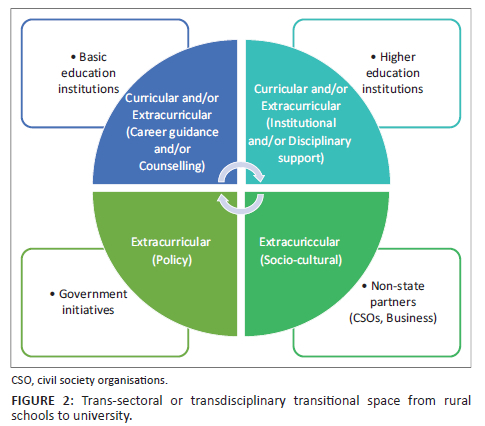
This article argues for a trans-sectoral or transdisciplinary intervention space in aiding learners from rural areas to develop sufficient socio-cultural capital that will aid their effective transition from basic education to university. According to Bourdieu995656
Various institutions have community outreach portfolios whose task is to reach out to feeder schools within their catchment areas to ensure that learners are aware of various programmes and (academic) requirements. In this regard, HEIs cannot be faulted for lack of 'career guidance' expos and 'open days' - yet as we argue in this article, these efforts, while laudable and needed, fall short of meeting the transition needs of many learners from rural schools. This is largely because they are largely reductionist - focusing on academic qualifications within a particular HEI and/or requirements of disciplines. It is as though, contract to recurring empirical evidence when prospective students meet these institutional or disciplinary academic requirements they are meant to survive and thrive once admitted. As such, we argue that these HEI-organised transitional activities are incomplete if they do not: (1) sufficiently address the socio-cultural dimension of the transition, (2) employ a longitudinal and systemic approach to transition, engaging civil society organisations (CSOs) and basic education institutions in their activities and, (3) disaggregate support according to location and type of schools they are dealing with.
We, therefore, propose a trans-sectoral or transdisciplinary transitional space in which education institutions (basic and HE) collaborate with government and non-state partners to ensure sufficient and effective transition, especially for rural school learners (Figure 2).
Rural schools have an integral role to place as nascent incubators of learners. They should ensure that both their curricular and extra-curricular obligations to leaners are met, through the effective use of their own resources and creating networks with other sectors and stakeholders. A close collaboration with the government ensures that quality human, technological and physical resources and infrastructure are availed, whereas a continuous engagement with HEIs and non-state partners will ensure that the curricular and extra-curricular engagement remains relevant and/or sufficient quality and rigour. Higher education institutions, especially within the transformative framework of post-apartheid South Africa, need to ensure that curricular and extracurricular support is available and systematic to feeder schools. Higher education institutions, through their support departments (student development, literacy and career guidance), must ensure that programmes are created on specific socio-cultural capitals prevalent in HE, and those needed for success in various competencies of HE. In these two levels, we borrow insights from Budwig and Alexander's systems approach, in integrating learning sciences, development sciences and HE approaches. As such, a transition from pedagogy to various pedagogical activities (student-centred learning [SDL]), community engagements, knowledge production and application) must be deliberately integrated into the transitional space, informed by current sciences and empirical evidence.
The post-apartheid government has been engaged in various aspects of transforming the educational space. These efforts have taken various dimensions, from human resources, infrastructure development, access and success, to funding. While these have not been without their own challenges, it is hoped that various government levels continue their concerted effort in transforming educational spaces in order to bring them to contemporary relevancy, especially within the context of the Fourth Industrial Revolution. Investment in technological infrastructure, especially in rural schools, still lags behind many comparative middle-income countries. While South African HE is globally competitive, basic education is still faced with many challenges, and incessant inequality, especially between rural and urban contexts. Therefore, the government's role is to ensure that rural schools are brought to the level where they can sufficiently prepare learners to equitably participate in globally competitive university spaces. While the government can engage through policy-making and financing, it is the plethora of non-state actors who are best poised to implement these interventions.
Several CSOs are already involved in various aspects of transition, from student finance to tutorial services. Some of these CSOs have the best transitional frameworks that must be incorporated into conventional practice. These include interaction with both basic and HE spaces, gathering data on student progress and success, as well as employing a holistic perspective on student cum human development. However, because these organisations are regional and constrained with financial and human resources, their practices remain segregated to specific areas and target a portion of students in need.
This article recommends that their activities be incorporated into the mainstream transitional intervention and made accessible to every learner or student. In addition, CSO is also well-positioned to engage local communities in order to assist the development of effective socio-cultural capital for rural learners. Corporate organisations are always peripheral in the educational process, only limiting their corporate social responsibility to funding modalities (for infrastructure development, human capital and human resources). In this way, they remain inconspicuous of the everyday activities of education. The researchers suggest that CSOs can be conspicuously engaged in the transition of rural students from schools to universities. For example, receptacles of the world of work, and their involvement in career guidance forums will be very instrumental and informative, as they have relevant information on current labour practices. Their corporate social responsibility could also involve extending mentorship programmes to rural learners, which will be instrumental in the development of relevant socio-cultural capital needed in the contemporary world of work. In order to breach the gap created in the current transition practices, because of haphazard and discretionary programming and intervention, we suggest this multilevel (curricular or extracurricular) trans-sectoral (education, government policy and non-state) and transdisciplinary (learning sciences, development sciences and HE) space transition from school to university.
Conclusion
The rural-urban disparity in educational outputs has been analysed in socio-economic terms, and access to resources. While this tells part of the important story, starting with the conditions of many rural schools in South Africa, it is not the whole story. In this article, we have argued for, what we think is the other part of the explanatory puzzle: the role of socio-cultural capital. The concept of rurality extends beyond demographics and socio-economic boundaries: it is a place imbued with distinct socio-cultural traits, worldviews and capital. Learners from rural schools are competent in this rural socio-cultural capital and function optimally as effective members of their communities. However, these effective tools of rural existence may not be sufficient in navigating the urban enclaves of university life; students need to adapt to new socio-cultural realities endemic in urban cultures - learn a specific language, demeanour, interpersonal skills, and be able to live and work within and ethnic heterogeneous mix. Interventions for the transition from rural schools to universities must be structured to enable the development (or transformation) of effective socio-cultural capital to survive and thrive within the HE context. It is only then that rural learners will reap the benefits of a transformed HE system.
Competing interests
The authors declare that they have no financial or personal relationships that may have inappropriately influenced them in writing this article.
Authors' contributions
N.P.K. and N.S. contributed equally to this work and wrote the final version of the manuscript.
Ethical considerations
Ethical clearance to conduct this study was obtained from the Durban University of Technology Institutional Research Ethics Committee (reference no.: IREC 220/22).
Funding information
The authors acknowledge the DUT Research Capacity Development for funding this research project through Emerging Researcher's Grant.
Data availability
The authors confirm that the data supporting the findings of this study are available within the article.
Disclaimer
The views and opinions expressed in this article are those of the authors and do not necessarily reflect the official policy or position of any affiliated agency of the authors.
References
Acknowledgements
Literature review
-
1.Sewell WH. Inequality of opportunity for higher education. Am Sociol Rev. 1971;36(5):793-809. https://doi.org/10.2307/2093667
» https://doi.org/10.2307/2093667 -
2.Gregorio JD, Lee JW. Education and income inequality: New evidence from cross-country data. Rev Income Wealth. 2002;48(3):395-416. https://doi.org/10.1111/1475-4991.00060
» https://doi.org/10.1111/1475-4991.00060 -
3.Zwane TT. The causal effect of education on earnings in urban and rural South Africa: A further update. Demogr Soc Econ. 2020;39(1):79-94. https://doi.org/10.15407/dse2020.01.079
» https://doi.org/10.15407/dse2020.01.079 - 4.Sen A. Commodities and capabilities. Oxford: OUP Catalogue; 1999.
- 5.Brunori P, Ferreira FH, Peragine V. Inequality of opportunity, income inequality, and economic mobility: Some international comparisons. In: Getting development right. St Louise: Springer, 2013; p. 85-115.
- 6.Piketty T. Capital in the 21st century. Cambridge, MA: President and Fellows, Harvard College; 2013.
- 7.Grossman DL. Global education. In: The Wiley handbook of social studies research. North Carolina: Wiley Blackwell, 2017; p. 518-568.
-
8.Marginson S. Public/private in higher education: A synthesis of economic and political approaches. Stud High Educ. 2018;43(2):322-337. https://doi.org/10.1080/03075079.2016.1168797
» https://doi.org/10.1080/03075079.2016.1168797 - 9.Bourdieu P. The forms of capital. In: Cultural theory: An anthology. Vol. 1. New York: Greenwood, 2011; p. 81-93.
- 10.Shorish J, Stephenson M, Zargham M. A practical theory of fungibility Vienna: Working Paper Series / Interdisciplinary Research; 2021.
-
11.Noman D, Basiruddin R, Ayesh N, Baroto MB. Resources fungibility as a moderator in the relationship between dynamic capabilities and innovation capability. Int J Bus Soc. 2022;23(3):1378-1403. https://doi.org/10.33736/ijbs.5169.2022
» https://doi.org/10.33736/ijbs.5169.2022 -
12.Piraino P. Intergenerational earnings mobility and equality of opportunity in South Africa. World Dev. 2015;67:396-405. https://doi.org/10.1016/j.worlddev.2014.10.027
» https://doi.org/10.1016/j.worlddev.2014.10.027 -
13.Salisbury T. Education and inequality in South Africa: Returns to schooling in the post-apartheid era. Int J Educ Dev. 2016;46:43-52. https://doi.org/10.1016/j.ijedudev.2015.07.004
» https://doi.org/10.1016/j.ijedudev.2015.07.004 - 14.DHET, DoHEaT. White paper for post-school education and training: Building an expanded, effective and integrated post-school system. Pretoria: Department of Higher Education and Training; 2013.
-
15.Treasury N. Budget review 2017 [homepage on the Internet]. [cited 22 October 2022]. National Treasury Republic of South Africa; 2017. Available from: https://www.treasury.gov.za/documents/national%20budget/2017/review/fullbr.pdf
» https://www.treasury.gov.za/documents/national%20budget/2017/review/fullbr.pdf - 16.Rogan MP, Joy A. Baseline study on the destination of TVET college graduates to strengthen employment promotion in South Africa. Pretoria: Department of Higher Education and Training (DHET); 2020.
-
17.Cloete N. The South African higher education system: Performance and policy. Stud High Educ. 2014;39(8):1355-1368. https://doi.org/10.1080/03075079.2014.949533
» https://doi.org/10.1080/03075079.2014.949533 - 18.National Planning Commission. National development plan: Vision for 2030. Pretoria: South African Government; 2011.
- 19.Council on Higher Education. The aims of higher education. Pretoria: Council on Higher Education; 2013.
- 20.Lewin T, Mawoyo M. Student access and success: Student access and success. Cape Town: INYATHELO the South African Institute for Advancement; 2014.
- 21.Council on Higher Education. VitalStats: Public higher education 2015. Pretoria: Council on Higher Education; 2015.
-
22.Hutchings C, Garraway J. Beyond the university gates: Provision of extended curriculum programmes in South Africa. [homepage on the Internet] c2010 [cited n.d.] Available from https://www.cput.ac.za/storage/services/fundani/beyond_the_university_gates.pdf
» https://www.cput.ac.za/storage/services/fundani/beyond_the_university_gates.pdf - 23.Mckenna S. The context of access and foundation provisioning in South Africa. In: Alternative access to higher education: Underprepared students or underprepared institutions. Cape Town: Pearson, 2012; p. 51-61.
- 24.Fisher G, Scott I. Background paper 3: The role of higher education in closing the skills gap in South Africa. In: Closing the skills and technology gap in South Africa. Washington, DC: The World Bank, 2011; p. 1-54.
- 25.Langa M. Researching the# FeesMustFall movement. In: Hashtag: An analysis of the# FeesMustFall movement at South African universities. S Afr J High Educ. 2017;6-12.
-
26.Shefer T, Strebel A, Ngabaza S, Clowes L. Student accounts of space and safety at a South African university: Implications for social identities and diversity. S Afr J Psychol. 2018;48(1):61-72. https://doi.org/10.1177/0081246317701887
» https://doi.org/10.1177/0081246317701887 -
27.Maila P, Ross E. Perceptions of disadvantaged rural matriculants regarding factors facilitating and constraining their transition to tertiary education. S Afr J Educ. 2018;38(1):1-12. https://doi.org/10.15700/saje.v38n1a1360
» https://doi.org/10.15700/saje.v38n1a1360 -
28.Czerniewicz L, Brown C. The habitus and technological practices of rural students: A case study. S Afr J Educ. 2014;34(1):789. https://doi.org/10.15700/201412120933
» https://doi.org/10.15700/201412120933 -
29.Njoko M. The impact of access to post-secondary education information on 'rural origin' students' access to higher education: A case of three schools in Ntabamhlophe, KwaZulu-Natal. S Afr J High Educ. 2018;32(5):173-189. https://doi.org/10.20853/32-5-2591
» https://doi.org/10.20853/32-5-2591 -
30.Mathebula M. Recognising poor black youth from rural communities in South Africa as epistemic contributors. Crit Stud Teach Learn. 2019;7(1):64-85. https://doi.org/10.14426/cristal.v7i1.181
» https://doi.org/10.14426/cristal.v7i1.181 - 31.Pityana B. The promotion of equality and prevention of unfair discrimination act 4 of 2000. Codicillus. 2003;44(1):2-9.
- 32.Letseka M, Maile S. High university drop-out rates: A threat to South Africa's future. Pretoria: Human Sciences Research Council; 2008.
- 33.Badat S. The challenges of transformation in higher education and training institutions in South Africa. Dev Bank South Afr. 2010;8(1):1-37.
- 34.Mouton N, Louw G, Strydom G. Present-day dilemmas and challenges of the South African tertiary system. Int J Bus Economics Res. 2013;12(3):285-300.
-
35.Ramatlapana K, Makonye J. From too much freedom to too much restriction: The case of teacher autonomy from National Curriculum Statement (NCS) to Curriculum and Assessment Statement (CAPS). Afr Educ Rev. 2012;9(Suppl. 1):S7-S25. https://doi.org/10.1080/18146627.2012.753185
» https://doi.org/10.1080/18146627.2012.753185 -
36.Walker M, Mathebula M. Low-income rural youth migrating to urban universities in South Africa: Opportunities and inequalities. Compare. 2020;50(8):1193-1209. https://doi.org/10.1080/03057925.2019.1587705
» https://doi.org/10.1080/03057925.2019.1587705 -
37.Bozalek V, Boughey C. (Mis) framing higher education in South Africa. Soc Policy Admin. 2012;46(6):688-703. https://doi.org/10.1111/j.1467-9515.2012.00863.x
» https://doi.org/10.1111/j.1467-9515.2012.00863.x -
38.Omidire MF. Experiencing language challenges in a rural school: Implications for learners' life aspirations. Early Child Dev Care. 2020;190(10):1619-1637. https://doi.org/10.1080/03004430.2019.1660963
» https://doi.org/10.1080/03004430.2019.1660963 -
39.Du Plessis P, Mestry R. Teachers for rural schools - A challenge for South Africa. S Afr J Educ. 2019;39(Suppl. 1):S1-S9. https://doi.org/10.15700/saje.v39ns1a1774
» https://doi.org/10.15700/saje.v39ns1a1774 -
40.Sumida S, Kawata K. An analysis of the learning performance gap between urban and rural areas in sub-Saharan Africa. S Afr J Educ. 2021;41(2):1-17. https://doi.org/10.15700/saje.v41n2a1779
» https://doi.org/10.15700/saje.v41n2a1779 -
41.Mgqwashu EM, Timmis S, De Wet T, Madondo NE. Transitions from rural contexts to and through higher education in South Africa: Negotiating misrecognition. Compare. 2020;50(7):943-960. https://doi.org/10.1080/03057925.2020.1763165
» https://doi.org/10.1080/03057925.2020.1763165 - 42.Guiffrida DA. Preparing rural students for large colleges and universities. J School Counsel. 2008;6(14):n14.
-
43.Bhopal K. Addressing racial inequalities in higher education: Equity, inclusion and social justice. Ethn Rac Stud. 2017;40(13):2293-2299. https://doi.org/10.1080/01419870.2017.1344267
» https://doi.org/10.1080/01419870.2017.1344267 -
44.Uleanya C, Uleanya MO. Review of transition experiences of urban and rural learners into rural universities. Multicult Educ. 2021;7(4):1-15. https://doi.org/10.1080/23311886.2019.1653545
» https://doi.org/10.1080/23311886.2019.1653545 -
45.Wallace A, Euler E. Revisiting access to cultural heritage in the public domain: EU and international developments. IIC Int Rev Intellect Prop Compet Law. 2020;51(7):823-855. https://doi.org/10.1007/s40319-020-00961-8
» https://doi.org/10.1007/s40319-020-00961-8 - 46.Guba EG, Lincoln YS. Competing paradigms in qualitative research. In: Handbook of qualitative research. Volume 2. Number 163-194. Thousand Oaks, 1994; p. 105.
-
47.Woolcock M, Narayan D. Social capital: Implications for development theory, research, and policy. World Bank Res Obs. 2000;15(2):225-249. https://doi.org/10.1093/wbro/15.2.225
» https://doi.org/10.1093/wbro/15.2.225 -
48.Hiebert PG. Gospel and culture: The WCC project. Missiology. 1997;25(2):199-207. https://doi.org/10.1177/009182969702500208
» https://doi.org/10.1177/009182969702500208 - 49.Alves López RD, Peña Portero A. Culture shock: Adaptation strategies. Rev Nebrija Lingüíst Apl Enseñ Leng. 2013(13):1-10.
-
50.Schuurman FJ. Social capital: The politico-emancipatory potential of a disputed concept. Third World Q. 2003;24(6):991-1010. https://doi.org/10.1080/01436590310001630035
» https://doi.org/10.1080/01436590310001630035 -
51.Dichaba M, Ndandani M. African researchers and the rural school issues in South Africa: A predatory culture. Mediterr J Soc Sci. 2013;4(14):397. https://doi.org/10.5901/mjss.2013.v4n14p397
» https://doi.org/10.5901/mjss.2013.v4n14p397 -
52.Coleman JS. Social capital in the creation of human capital. Am J Sociol. 1988;94:S95-S120. https://doi.org/10.1086/228943
» https://doi.org/10.1086/228943 -
53.Lefoka P, Tlali T. Rural students' transition in and through a semi-urban university: Experiences from the National University of Lesotho. Scholarship Teach Learn South. 2021;5(2):36-51. https://doi.org/10.36615/sotls.v5i2.195
» https://doi.org/10.36615/sotls.v5i2.195 - 54.Hiebert PG. Transforming worldviews: An anthropological understanding of how people change. Maryland: Baker Academic; 2008.
-
55.Hoinle B, Roose I, Shekhar H. Creating transdisciplinary teaching spaces. Cooperation of universities and non-university partners to design higher education for regional sustainable transition. Sustainability. 2021;13(7):3680. https://doi.org/10.3390/su13073680
» https://doi.org/10.3390/su13073680 -
56.Budwig N, Alexander AJ. A transdisciplinary approach to student learning and development in university settings. Front Psychol. 2020;11:576250. https://doi.org/10.3389/fpsyg.2020.576250
» https://doi.org/10.3389/fpsyg.2020.576250

Accepted: 30 June 2023
Published: 31 Aug. 2023