Predictors of female caregivers' burden: An estimated conceptual model in low income settings
Abstract
Globally, there has been increasing interest in the study of caregiving. Female caregiver predictors or mediators and a multidimensional female caregiver burden (FCG burden) model that incorporates environmental hygiene factors such as toilet hygiene and kitchen are lacking, particularly in low- and middle-income countries. This study evaluates caregiver burden predictors and provides a multidimensional model of unremunerated care burden for family practice and policy in two different population group communities in Cape Town, South Africa. A systematic random sampling (SRS) procedure was employed, and 100 black or African and 100 mixed race female caregivers in two different cultural communities were selected for a reliable cross-section. A questionnaire was used to solicit caregiver burden information. The average age of the female caregivers was 47.9 years (standard deviation [SD] = 11.7 years). About 49.0% of the selected participants were older than 50 years. There was a significant relationship between environmental health (kitchen hygiene and toilet hygiene). Social grant receipt and physical health status of care recipients were predictors of caregiver burden. The overall model explained the largest variation (43.4%) in caregiver burden. This study recommends an increase in the social grants given to caregivers. National health policies should reflect female caregivers' circumstances. TRANSDISCIPLINARITY CONTRIBUTION: This article contributes to the improvement in community health
caregiver burden; burden mediators; regression analysis; modelling; government policies
Introduction
The ageing of the population is an increasing phenomenon, particularly in the low- and middle-income countries.1,23,45,67,8,95,10,11
It is important to comprehend the interaction of the multifaceted domains of influence in the conceptualisation of caregiving in an all-inclusive manner with an in-depth understanding of elements specific to the South African context. The typical South African perspective involves the need for a broader comprehension of the contextual effects of caregiving and how female caregivers may in turn influence their environment. Limited financial and material resources, together with other spheres of the environment, may further compound the female caregiver burden (FCG burden).12,13,14151617,18,1920
In this research, a caregiver (irrespective of age and sex) refers to any person who takes care of a nonbiological child, physically impaired person or a person who needs assistance in activities of daily living. The focus of this research is the informal caregivers, usually women, who play an important role in their dependents' well-being (i.e. care recipients such as children and aged persons) living in the household. Several studies21,22,23242526
Research methods and design
From each of the two different cultural settlements (i.e. black or African and mixed race communities), a total of 100 female caregivers were selected through a systematic random sampling (SRS) procedure; thus, there was a total of 200 participants in this study. Data were collected on each construct emanating from the literature. However, two additional constructs of interest were included, namely: (1) environmental factors and (2) some selected health outcomes of care recipients, to allow for a more complete assessment of their effects on caregiver burden. The data were collected using structured interviews with the primary female caregiver in each household. Two study areas chosen for the study included a predominantly black (New Rest in Gugulethu) and a predominantly mixed race (New Woodlands in Mitchells Plain) settlement that consists of mainly subsidised housing in Cape Town. A pilot survey was used to test the validity and consistency in the questions.
Inclusion criteria were the primary female caregivers who were present during the interview and willing and able to give informed consent. The study defined caregiver as someone having an elderly person and/or a nonbiological child under her care and living in a formal settlement within a defined boundary of the settlement. Further, dwelling units that formed part of the pilot study were not included in the main study.
Outcome variables and measurement
Consistent with the main effects of social research in caregiver studies, the main interest was related to FCG burden or strain. This effect was measured as either being burdened or feeling no burden, using the applicable inventory variables in the study settings.
Data analysis
The fully structured instrument assessed the caregiving burden and used both objective and subjective measures.
Caregiver burden was measured with the aid of self-report information from the recipients. The study used eight questions in the assessment, including: (1) financial strain, (2) insufficient level of funds, (3) a lack of privacy, (4) physical strain, (5) change in lifestyle, (6) difficulties with social life, (7) sleep disturbance and (8) a lack of control over one's life.
Function of the care recipients was examined by using the activities of daily living and instrumental activities of daily living. The former included difficulties the participants experienced with feeding, cooking, dressing, bathing and washing the clothes of care recipients. The latter included the user needs of care recipients (i.e. wheelchair, spectacles, walking stick and transport).
Descriptive statistics were used to depict the sociodemographics of the data and caregiving burden mediators, and the regression method was used to determine predictors of caregiver burden in the study. All statistical analyses were done using Statistical Package for the Social Sciences (SPSS) version 22 (IBM Corporation, Armonk, New York, United States).
Ethical consideration
The Ethical Committee of the Faculty of Applied Sciences of the Cape Peninsula University of Technology (CPUT) gave the ethical clearance for the study (ref. no. 07/2013), and all participants had to complete a consent form.
Results
The reliability test was conducted and the results showed that the Cronbach's alpha for items of activities of daily living was 0.909, and that of instrumental activities of daily living was 0.836. The caregiving burden mediators and regression analysis were preceded by a brief description of the sociodemographic attributes or characteristics of the sample and burden evaluation.
Sociodemographic characteristics of the sample
The sample comprised 50.0% black African and 50.0% mixed race respondents. The mean age of the participants was 47.9 years (standard deviation [SD] = 11.7 years) and about one-third (35.5%) of the caregivers were educated. A total of 61% of the respondents were not in a spousal relationship. Only 2.6% earned R2000.00 or above per month. Almost half (i.e. 49.5%) of the respondents were in the caregiving role, providing care for 30 h or more per week. And only a small percentage (1.6%) indicated using some sort of caregiving burden-alleviating programme associated with the caregiving tasks.
Female caregiver burden evaluation
From the eight caregiverstrain or burdeninventory questions, FCG burden was computed using a composite score with a mean after a reliability test (Cronbach's alpha = 0.819). The mean FCG burden was 27.04 (SD = 5.46), with minimum and maximum scores of 13 and 40, respectively. The percentage of people below the mean caregiving burden was 45.7%, and the percentage of those above the mean score was 54.3%. Caregivers with a score above the mean were presumed to be burdened. The score indicates that the higher the score, the higher the caregiver burden.
Female caregiver burden mediators
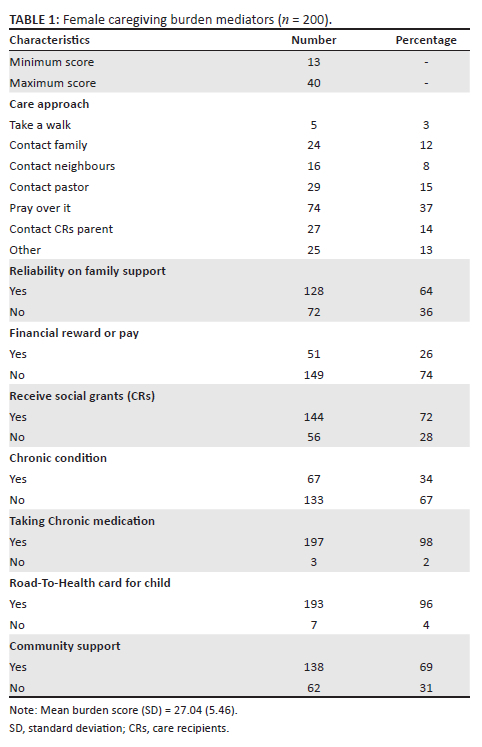
Table 1 presents the socio-economic characteristics, the caregiving contexts and female caregiving burden mediators. The results show that, the average burden score was 27.04% (SD = 5.46), with minimum and maximum scores of 13.0% and 40.0%, respectively.
In terms of a caregiver approach when something goes wrong with the care recipients, a majority of the caregivers reported a spiritual approach (contacting a pastor, 14.5%, and praying over it, 37.0%). A small proportion (12.5%) made use of other approaches. About 20.0% of the caregivers reported approaching their family and/or neighbours, and 13.5% of caregivers reported contacting the care recipient's parents directly. Only 2.5% reported taking a walk to relax as an approach.
For reliability on family support, 64.0% reported that they can rely on their family for support, whereas 36.0% reported that they cannot rely on their family for the necessary support.
Regarding receipt of any financial reward or pay for the caregiving task, 26.0% reported yes and 74.0% reported no to the question.
With respect to receiving social grants for care recipients under their care, a significant proportion of caregivers (72.1%) reported receiving a form of social grant on behalf of the care recipients, while 27.9% reported that they do not receive any form of social grant on behalf of the care recipients. The question was asked because in Cape Town there do exist safety nets such as child support grants.
As informal caregiving takes place in the community, this study explored whether the caregivers could rely on the social networks within their community to give quality care. Interestingly, larger proportions of caregivers (69.0%) reported that they could rely on their settlements for support, whereas 31.0% reported that they could not rely on their settlements for support if and when needed.
For the childcare recipients' health, it is quite striking that as countries seek to achieve full universal coverage of immunisation against childhood diseases in an effort to eradicate both infant mortality and child mortality, some settlements in parts of Africa are sadly reporting low coverage levels. A large proportion of the caregivers (95.9%) in this study reported that they have a 'Road-to-Health card' for the children under their care. It is to be mentioned that a caregiver (respondent) who responded 'yes' to having a health card for the child was asked by the interviewer to show it before it was noted as such.
In terms of care recipients' health evaluation, chronic condition status was used as the health outcome in this study. The caregiver was probed to learn whether any of the care recipients lived with a chronic condition. About one-third of the respondents (33.5%) mentioned that the care recipient has some or other chronic condition, with the remainder (66.5%) reporting that the care recipient has no chronic condition. For verification, those who responded 'yes' on this question were further probed to learn if the care recipients who live with the chronic condition were taking chronic medication. An overwhelming majority (98.4%) of this group indicated that those living with these conditions were on some type of chronic medication. For further verification for this information, the caregiver was asked to show the container of the chronic medication.
Regression analysis with caregiving burden as the dependent variable - An estimated model
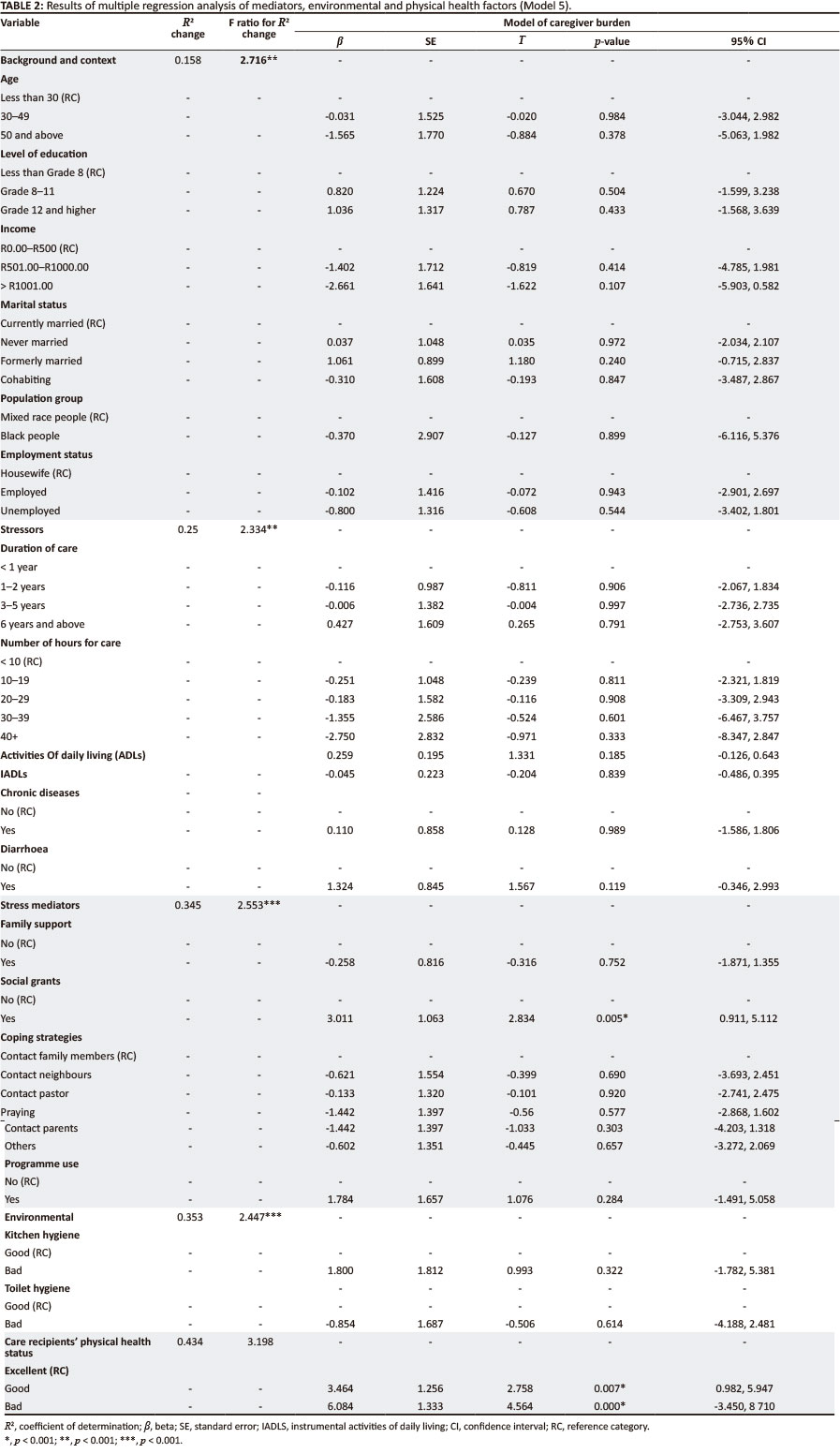
The results of the individual constructs with the set of predictors in five blocks using FCG burden as the dependent variable are presented in Table 2, and the regression model effect on caregiver burden is given in Table 3.
In Table 2, Model 1, the results showed that 15.8% of the variation in caregiver burden (Adj. R2β = 4.805, p < 0.05). Further, in Table 2, about 25.0% of the variation in caregiver burden (Adj. R2β = 2.733, p < 0.05).
In Table 2, Models 3, 4 and 5, controls for constructs 1 and 2, stress mediator variables such as family support, social grants, coping strategies and programme use were introduced. Furthermore, 34.5% of the variation in caregiver burden (Adj. R2β = 4.487, p < 0.05). In Model 4, the environmental factors such as kitchen hygiene and toilet hygiene were added to Model 3. Also, 35.3% of the variation in caregiver burden (Adj. R2β = 4.355, p < 0.001).
The final or overall model (Model 5), adjusting for Models 1-4, is the proposed estimated model (an estimated model of caregiver burden in the study) of FCG burden, with the set of predictors that were statistically significant and jointly explained approximately at 43.4% of the variance in caregiver burden (adj. R2p < 0.05). Considering the four estimated models that preceded Model 5, the results showed that in the models, the variation in caregiver burden was explained by significant variables of the constructs. These variations were as follows: 15.8% for Model 1, 25.0% for Model 2, 34.5% for Model 3 and 35.3% for Model 4.
In each of the models, there were additional predictors of FCG burden, with the exception of Model 4, in which the hypothesised construct (environmental health - kitchen hygiene and toilet hygiene) did not show any effect but slightly increased the variation in caregiver burden from 34.5% to 35.3%. The effect of environmental health factors could be nested in key socio-economic factors such as education and income status. Model 1, the population group of caregivers; Model 2, availability of social support in the form of grants; Model 3, chronic disease status of care recipients; and Model 5, social support and physical health or function of care recipients all significantly predict caregiving burden in the study population.
Discussion
The majority of the researches on caregiver burden involves the meta-analyses of qualitative studies with little quantitative research. This research was largely quantitative and evaluated caregiving burden with prediction possibility constructs. Female caregiver burden was reported among the participants. The study showed a significant statistical relationship between the posited constructs in the study, environmental health (kitchen hygiene and toilet hygiene) in the physical home environment and the care recipients' physical health. Further, this study aided in providing female caregiving burden predictors and estimated a multidimensional model that showed: (1) social grant receipt as a form of safety net and (2) the physical health status of the care recipient being key predictors of female caregiver strain (burden) and explained the largest variation (approximately 43.4%) in caregiver strain in the selected different cultural low-income settlements in Cape Town.
This study evaluated caregiving burden with the aid of the Lazarus and Folkman model2526
The findings of the study indicate that the number of hours of care, daily living activities, instrumental activities of daily living and the chronic disease status of the care recipients were all significantly related to caregiving burden. Thus, female caregivers who spent more hours in care tended to experience less care burden (r = -0.248, p < 0.01). This finding concurs with other studies27,28,29p > 0.05) to caregiving burden. In the case of the care recipient's needs for activities of daily living and instrumental activities of daily living, important carerecipient characteristics were associated with caregiver mental health, such as depression, including problem behaviour and higher dependence in activities of daily living.30,31,3211,18,25,2626r = 0.153, p < 0.05). This corroborates the findings that care recipients' dependence for using the toilet is burdensome.1
These associations suggest that age, cultural differences, differences in education and income levels are important factors regarding experience of infectious or noninfectious diarrhoea in care recipients in the caregiving environment. These findings are supported by studies of the experiences of caregiver burden among Asian-American caregivers,333432
The study showed a statistically significant relationship between environmental health (kitchen hygiene and toilet hygiene) of the home and the physical health of care recipients. It is shown that a majority of the caregivers have a basic education and therefore read and understand basic health information. This means that the caregivers could have access to hygienesensitive information. Thus, one would expect that in these homes, if the kitchen were clean, the toilet too would be hygienically clean. However, it is expected that with a bad home hygiene status, especially if the toilet is not kept clean and regularly disinfected, the care recipients would be exposed to bacterial infections. A preliminary analysis using the chi-square test (bivariate analysis) for environmental factors such as kitchen hygiene and toilet hygiene status found a statistically significant relationship between these factors and the physical health of care recipients. This finding suffices for a conclusion that there is an association between environmental health status and the physical health of care recipients. This was supported by the results of the Pearson correlation analysis.30
The estimated model presented by this study, Model 5, showed that only two variables: (1) social grant receipt as a form of safety net and (2) physical health status of care recipient, predicted female caregiver strain (burden) and explained the largest variation (approximately 43.4%) in caregiver strain. The caregiver strain or burden was reported by caregivers who did not receive social grants on behalf of their care recipients. Categorically, only these two predictor variables made a difference in caregiver strain in the study areas in Cape Town. Thus, social grants and care recipients' physical health status are important community policy factors.
Limitations
A major limitation experienced was that it was not possible to determine the specific or chronic disease for which caregivers were providing care. Soliciting such information would have infringed upon the respondents' privacy, but such data could have helped to determine the effect of each disease on the burden. Because of the complexity of the caregiving situations encountered during the interviews, further probing was not carried out to learn who else was present to provide care in the absence of the main caregiver, nor if there were detergents such as toilet soap in the house. Information on hygiene practices such as washing hands after toileting were not probed for or directly captured in the questions. Adding this element would have allowed for a better understanding of the difference between knowledge and practice among caregivers in the study settings. Also, with the small number of caregivers in the sample, it was not possible to infer the findings to all caregivers in Cape Town. More low-income settlements should be included in future studies on modelling caregiver burden to aid an estimation of national burden model.
Conclusion
On the basis of the current work, future research and healthcare policies by government to help ameliorate FCG burden at the household level should consider the estimated model proposed (Model 5) as a benchmark. The key factors of caregiver burden were the number of hours in the care role, daily living activities, instrumental daily living activities and care recipients' chronic disease status. Families are recommended to support caregivers by providing the needed instrumental support and socio-economic support.
The results of the analyses of the relationships between the constructs provided a critical basis for making recommendations for both policy and future research.
The inclusion of the care recipient's physical health status and the environmental health factors such as kitchen and toilet hygiene statuses in the stress process model2625
Findings from the study shed light on important aspects of informal carers' circumstances, particularly in the low-income settlements in Cape Town. It would make a significant contribution to the realm of public health, specifically on issues of informal caregivers' literature for family practice and policy.
The study recommends government recognition of the increasing importance of care recipients' physical health and thus increase the amount of the social grants given to the caregivers, because it could improve the circumstances of both the caregivers and the care recipients. Also, it could reduce the burden on the government to provide more formal care institutions for care recipients, while it could assist with improving the standard of living of the female caregivers in the population.
Competing interest
The authors declare that they have no financial or personal relationships that may have inappropriately influenced them in writing this article.
Authors' contributions
Y.A.Y. is the lead researcher who led the conception and design, collection and analysis of data, interpretation of results and manuscript write-up. D.W.S. substantially contributed to the conception and design of the study and also provided guidance in the manuscript write-up.
Funding information
The University Research Fund of the Cape Peninsula University of Technology (CPUT) funded the study.
Data availability
The data that support the findings of this study are available from the corresponding author, Y.A.Y., upon reasonable request.
Disclaimer
The views expressed in the article are solely of the authors and not an official position of the affiliated institution or the publisher.
Acknowledgements
References
-
1.James K, Thompson C, Holder Nevins D, et al. Socio-demographic, health and functional status correlates of caregiver burden among care recipients age 60 years and older in Jamaica. J Community Health. 2021;46:174-181. https://doi.org/10.1007/s10900-020-00865-1
» https://doi.org/10.1007/s10900-020-00865-1 - 2.World Health Organization. World report on ageing and health. Geneva: The World Health Organization; 2015.
-
3.Bastawrous M. Caregiver burden: A critical discussion. Int J Nurs Stud. 2013;50(3):431-441. https://doi.org/10.1016/j.ijnurstu.2012.10.005
» https://doi.org/10.1016/j.ijnurstu.2012.10.005 -
4.Sabzwari S, Badini A, Fatmi Z, Shah S. Burden and associated factors for caregivers of the elderly in a developing country. East Mediterr Health J. 2016;22(6):394-403. https://doi.org/10.26719/2016.22.6.394
» https://doi.org/10.26719/2016.22.6.394 -
5.Hu X, Dolansky MA, Hu X, Zhang F, Qu M. Factors associated with the caregiver burden among family caregivers of patients with heart failure in southwest China. Nurs Health Sci. 2016;18(1):105-112. https://doi.org/10.1111/nhs.12253
» https://doi.org/10.1111/nhs.12253 -
6.Mollica MA, Litzelman K, Rowland JH, Kent EE. The role of medical/nursing skills training in caregiver confidence and burden: A CanCORS study. Cancer. 2017;123(22):4481-4487. https://doi.org/10.1002/cncr.30875
» https://doi.org/10.1002/cncr.30875 -
7.Kalysha C, Janan JD, Nathan JL, et al. Sexual self-efficacy and gender: A review of condom use and sexual negotiation among young men and women in sub-Saharan Africa. J Sex Res. 2018;55(4-5):522. https://doi.org/10.1080/00224499.2017.1421607
» https://doi.org/10.1080/00224499.2017.1421607 -
8.Murray CJL. Choosing indicators for the health-related SDG targets. Lancet. 2015;386(10001):1314-1317. https://doi.org/10.1016/S0140-6736(15)00382-7
» https://doi.org/10.1016/S0140-6736(15)00382-7 - 9.Statistics South Africa. Mortality and causes of death in South Africa. Findings from death notification. Pretoria: Statistical release P0309.3; 2015.
-
10.Bekdemir A, Ilhan N. Predictors of caregiver burden in caregivers of bedridden patients. J Nurs Res. 2019;3(24):e24. https://doi.org/10.1097/jnr.0000000000000297
» https://doi.org/10.1097/jnr.0000000000000297 - 11.Bejane SM, Havenga Y, Van Aswegen E. Primary caregivers' challenges related to caring for children living with HIV in a semi-rural area in South Africa. Afr J Nurs Midwifery. 2013;15(1):68-80.
- 12.Gray A, Vawda Y. Health policy and legislation. In: Padarath A, King J, Mackie E, Casciola J, editors. South African health review 2016. Durban: Health Systems Trust; 2016, p. 151-158.
-
13.Demmer C. AIDS and palliative care in South Africa. Am J Hosp Palliat Med. 2007;24(1):7-12. https://doi.org/10.1177/1049909106295288
» https://doi.org/10.1177/1049909106295288 -
14.White J, Morton J. Mitigating impacts of HIV/AIDS on rural livelihoods: NGO experiences of sub-Saharan Africa. Dev Pract. 2005;15(2):186-200. https://doi.org/10.1080/09614520500041757
» https://doi.org/10.1080/09614520500041757 -
15.World Urbanization Prospects. Urban population (% of total population) - South Africa. United Nations Population Division. World Urbanization Prospects: 2018 Revision. 2022. https://data.worldbank.org/indicator/SP.URB.TOTL.IN.ZS?locations=ZA
» https://data.worldbank.org/indicator/SP.URB.TOTL.IN.ZS?locations=ZA - 16.Asmah-Andoh K. Implementation of developmental local government for alleviating poverty & inequality. J Public Adm. 2009;44(1):100-111.
- 17.Swart L, Seedat M, Sader F. Community volunteerism in safety promotion and implications for sustained participation. Afr Saf Promot J. 2004;2(1):1-15.
- 18.Statistics South Africa. Poverty trends in South Africa. An examination of absolute poverty between 2006 and 2011. Report no. 03-10-06. Pretoria: Statistics SA; 2014.
-
19.Clark D, Wright M, Hunt J, Lynch T. Hospice and palliative care development in Africa: A multi-method review of services and experiences. J Pain Symptom Manage. 2007;33(6):698-710. https://doi.org/10.1016/j.jpainsymman.2006.09.033
» https://doi.org/10.1016/j.jpainsymman.2006.09.033 -
20.Pearlin LI, Aneshensel CS. Caregiving: The unexpected career. Soc Justice Res. 1994;7(4):373-390. https://doi.org/10.1007/BF02334863
» https://doi.org/10.1007/BF02334863 -
21.Yakubu YA, Schutte DW. Caregiver attributes and socio-demographic determinants of caregiving burden in selected low-income communities in Cape Town, South Africa. J Compassionate Health Care. 2018;5:3. https://doi.org/10.1186/s40639-018-0046-6
» https://doi.org/10.1186/s40639-018-0046-6 -
22.Carretero S, Garcés J, Ródenas F, Sanjosé V. The informal caregiver's burden of dependent people: Theory and empirical review. Arch Gerontol Geriatr. 2009;49(1):74-79. https://doi.org/10.1016/j.archger.2008.05.004
» https://doi.org/10.1016/j.archger.2008.05.004 -
23.Biegel DE, Milligan SE, Putnam PL, Song LY. Predictors of burden among lower socioeconomic status caregivers of persons with chronic mental illness. Community Ment Health J. 1994;30(5):473-494. https://doi.org/10.1007/BF02189064
» https://doi.org/10.1007/BF02189064 -
24.Harding R, List S, Epiphaniou E, Jones H. How can informal care-givers in cancer and palliative care be supported? An updated systematic literature review of interventions and their effectiveness. Palliat Med. 2012;26(1):7-22. https://doi.org/10.1177/0269216311409613
» https://doi.org/10.1177/0269216311409613 - 25.Lazarus RS, Folkman S. Stress, appraisal, and coping. New York, NY: Springer Publishing Company; 1984.
-
26.Pearlin LI, Mullan JT, Semple SJ, Skaff MM. Caregiving and the stress process: An overview of concepts and their measures. Gerontologist. 1990;30(5):583-594. https://doi.org/10.1093/geront/30.5.583
» https://doi.org/10.1093/geront/30.5.583 -
27.Beach SR, Schulz R, Yee JL, Jackson S. Negative and positive health effects of caring for a disabled spouse: Longitudinal findings from the caregiver health effects study. Psychol Aging. 2000;15(2):259-271. https://doi.org/10.1037/0882-7974.15.2.259
» https://doi.org/10.1037/0882-7974.15.2.259 -
28.Cohen CA, Colantonio A, Vernich L. Positive aspects of caregiving: Rounding out the caregiver experience. Int J Geriatr Psychiatry. 2002;17(2):184-188. https://doi.org/10.1002/gps.561
» https://doi.org/10.1002/gps.561 -
29.Kinney JM, Stephens MAP, Franks MM, Norris VK. Stresses and satisfactions of family caregivers to older stroke patients. J App Gerontol. 1995;14(1):3-21. https://doi.org/10.1177/073346489501400101
» https://doi.org/10.1177/073346489501400101 -
30.Yakubu YA, Schutte W. Socio-economic determinants and environmental hygiene factors of female caregiver burden in two selected low-income communities in Cape Town, South Africa. Pan Afr Med J. 2019;34:80. https://doi.org/10.11604/pamj.2019.34.80.16719
» https://doi.org/10.11604/pamj.2019.34.80.16719 -
31.Piercy KW, Fauth EB, Norton MC, et al. Predictors of dementia caregiver depressive symptoms in a population: The Cache county dementia progression study. J Gerontol B Psychol Sci Soc Sci. 2013;68(6):921-926. https://doi.org/10.1093/geronb/gbs116
» https://doi.org/10.1093/geronb/gbs116 -
32.Pinquart M, Sorensen S. Differences between caregivers and noncaregivers in psychological health and physical health: A meta-analysis. Psychol Aging. 2005;18(2):250. https://doi.org/10.1037/0882-7974.18.2.250
» https://doi.org/10.1037/0882-7974.18.2.250 -
33.Li H. Barriers to and unmet needs for supportive services: Experiences of Asian-American caregivers. J Cross-Cult Gerontol. 2004;19(3):241-260. https://doi.org/10.1023/B:JCCG.0000034221.07028.9a
» https://doi.org/10.1023/B:JCCG.0000034221.07028.9a -
34.Mui AC. Caregiver strain among black and white daughter caregivers: A role theory perspective. Gerontologist. 1992;32(2):203-212. https://doi.org/10.1093/geront/32.2.203
» https://doi.org/10.1093/geront/32.2.203

Accepted: 15 Aug. 2022
Published: 26 Jan. 2023