An investigation into the knowledge-sharing practices for innovation in higher education institutions of developing countries
Abstract
The adoption of knowledge-sharing practices in higher education result in improved decision-making, improved access to information and increased collaboration. A knowledge-sharing culture enables the free exchange of knowledge amongst academics and this drives institutions towards innovation. This study examines the extent to which knowledge-sharing practices have been adopted at higher education institutions (HEIs) of developing countries. The article reports on an inquiry conducted at HEIs in Zimbabwe to determine the knowledge-sharing practices in place. A survey was used to collect quantitative data from 240 purposefully selected academics at the HEIs. The data were analysed using descriptive statistics. This study established that HEIs have not fully implemented the knowledge-sharing practices. Empirical evidence confirms that attendance of conferences is important for knowledge sharing where 43% of the participants approved the proposition. Coaching and mentoring improve academic skills such that 21.7% of the participants approved the premise. Subscribing to international journals increases the visibility of scientific research work and only 18.3% of the participants confirmed that their institutions subscribe to internationally recognised journals. Surprisingly, 60% of the participants confirmed that their institutions do not offer knowledge-sharing workshops. Unremarkably, 23.3% of the participants confirmed that their institutions do not have a knowledge-sharing culture. TRANSDISCIPLINARITY CONTRIBUTION: Higher education institutions have not fully exploited the knowledge-sharing practices that could make them more innovative. The institutions are still at the trial stage of adopting knowledge-sharing practices. This study therefore recommends the creation of communities of practice (COPs) specifically for knowledge sharing
knowledge sharing; communities of practice; academic; higher education institutions; innovation; coaching and mentoring
Introduction
Knowledge sharing basically involves the communication of knowledge to other individuals in an institution.12345
Higher education institutions naturally store and access knowledge in some manner and these institutions are expected to be at the cutting edge of such innovation.16
• Determine the extent to which knowledge-sharing practices have been applied at the HEIs
• Recommend the adoption of knowledge-sharing practices at the HEIs.
Knowledge can only have a positive impact on a HEI if it is shared with others and applied to solve problems in an institutional setting.78
The diffusion of innovations (DOI) theory focuses on understanding how innovative ideas are spread in social systems,911091
Knowledge-application refers to the practical use of knowledge that has been created, captured and put into the KM cycle. Cheng, Ho and Lau113
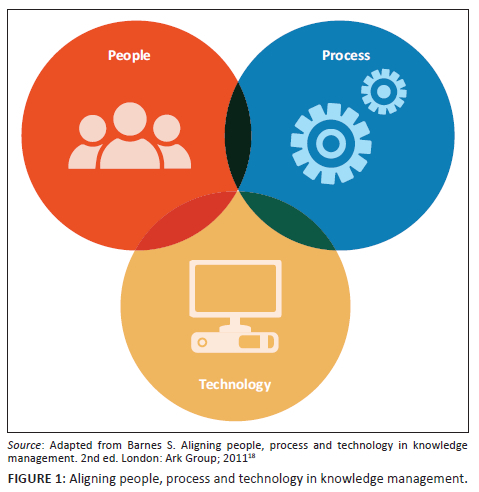
Many institutions of higher learning invest millions of dollars into information and communication technology (ICT) without considering the effective integration of those technologies into shared decision-making processes that ultimately improve academic operations.1718Figure 1 shows the connections amongst these three core resources.
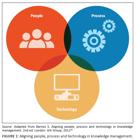
From Figure 1, we can infer that academics in HEIs build a knowledge-sharing culture and they are assisted by different technologies to execute their core functions of teaching, learning, community engagement and research. According to Simmons,1912
Knowledge sharing builds a learning and development culture411
Methodology
After an in-depth literature review on the knowledge-sharing topic, the researchers established that knowledge-sharing practices are not fully embraced in HEIs of developing countries. The research method and procedure adopted to complete the study is explained here in an effort to answer the following questions.
•To what extent have knowledge-sharing practices been applied at HEIs of developing countries?
•Which tools could be recommended for effective knowledge sharing in HEIs?
Research design, paradigm and sampling
A quantitative research design in the form of a survey was conducted at four HEIs in Zimbabwe: a developing country in Africa. The positivist paradigm was used in this research because it is scientific and objective.20
Data collection method
Quantitative data and facts were collected through the use of a structured online questionnaire. The questionnaire was divided into different sections including the demographic section and the knowledge-sharing applications section. The demographic section enabled the researcher to understand the different profiles of the academics. The second section enabled the researcher to understand the extent to which knowledge-sharing practices have been applied at the HEIs in Zimbabwe. Academics were asked to rank statements on a 5-point Likert scale from strongly agree to strongly disagree on the different aspects of knowledge sharing in HEIs. Responses to Likert scale questions are standardised and these are analysed collectively to draw meaningful conclusions.
Data analysis and interpretation
For quantitative data analysis, Microsoft Office Excel 2019 was utilised because of its charting capabilities and user-friendliness. Internal consistency is a measure of reliability,212223
Research results
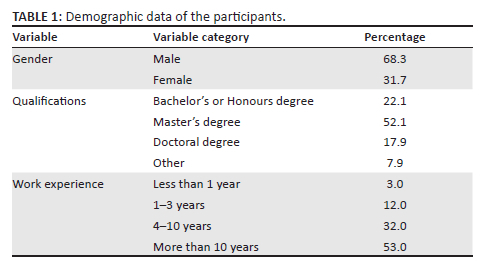
The demographic data of the participants is given in Table 1. According to Potter and Hoque,24
From the data presented in Table 1, we can infer that majority of the participants were higher degree holders with more than 10 years of working experience in HEIs. As the business of HEIs is to teach students and do research,25
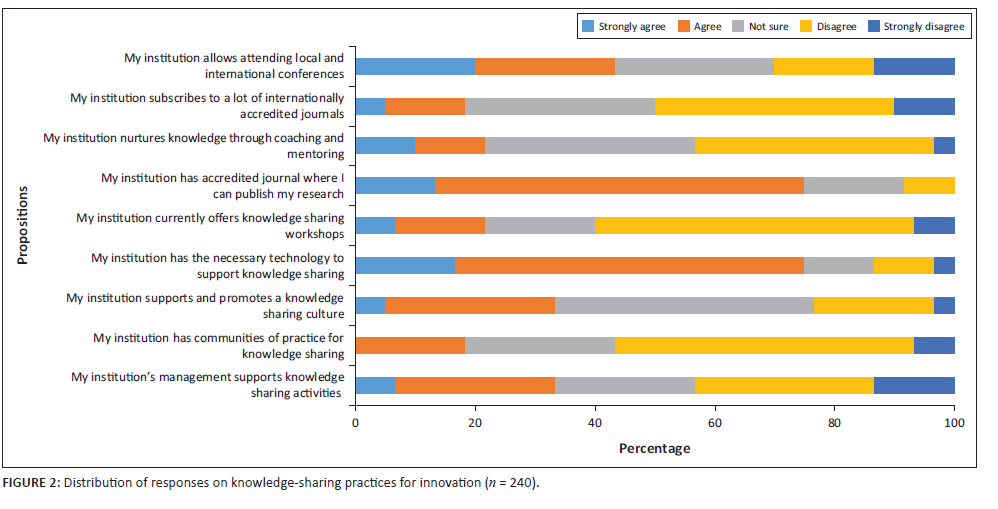
The data analysed and discussed in the next section sought to determine the extent to which knowledge-sharing practices have been applied at the HEIs and also recommend the tools, which could be used for effective knowledge-sharing. The data analysis was guided by the DOI by Rogers,9Figure 2 shows the distribution of responses obtained from the study. It is important to note that the distribution of responses show an effective visual picture on the responses of the participants.
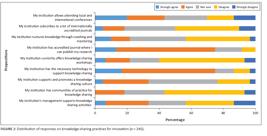
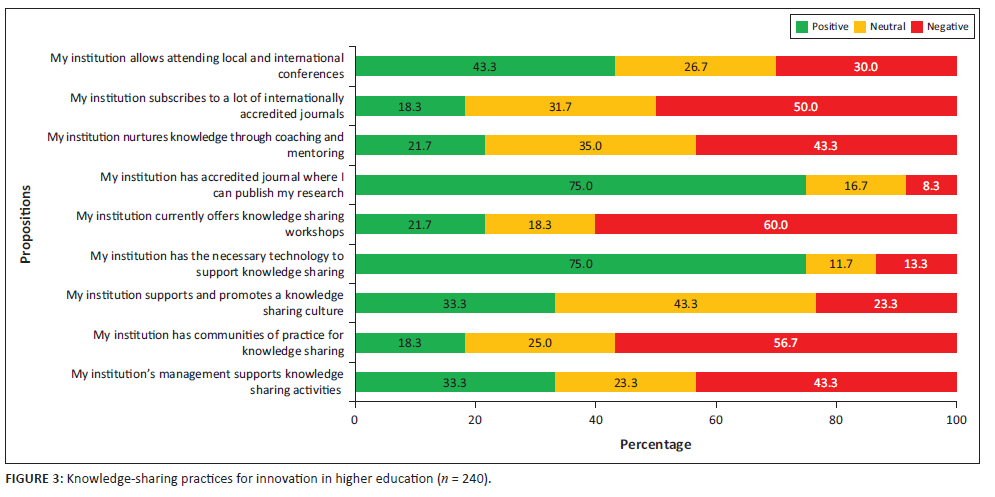
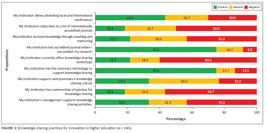
From the distribution presented, Figure 3 presents a summary and analysis of responses obtained from academics at the HEIs in Zimbabwe. In Figure 3, positive responses refer to the participants who strongly agreed and agreed, respectively, to the different propositions on a specific knowledge-sharing aspect. Neutral reflects on the responses where participants were not sure or indecisive of the different propositions. Lastly, negative is a combination of participants who disagreed and strongly disagreed with the propositions on the knowledge-sharing practices in their HEIs. From the descriptive analysis, useful conclusions can be drawn for each individual proposition.
Ethical considerations
The Research Ethics Committee in the College of Science, Engineering and Technology of the University of South Africa approved the study with reference 2021/CSET/SOC/041.
Discussion of results
An institution of higher learning can only be innovative if it allows its academics to attend both local and international conferences.26Figure 3 that 26.7% of the participants were indecisive on their institutions allowing attendance of local and international conferences. On the same construct, exactly 30% of the participants were negative on the proposition that their institutions agree to attending local and international conferences. It therefore becomes explicit that HEIs should allow attendance of conferences for academics to share knowledge. International conferences establish connections and socialisation with acquaintances to gain a plethora of knowledge. The findings here corroborate with Cheng et al.11
In most higher education norms, both locally and internationally, knowledge sharing and transfer is typically performed through peer-reviewed journal publications.27Figure 3. When one shares research results via publications, they essentially become part of the scientific community. Surely one benefits from the critique of other scholars in similar disciplines and exchange of ideas. We can therefore confirm that getting research published in accredited journals holds benefits for both the researcher and the institution hosting the journal.
Some of the most widely used techniques to nurture knowledge in HEIs include coaching and mentoring. As part of knowledge sharing, coaching focuses on immediate problems and opportunities.15
Subscribing to international journals increases the visibility of scientific work. If a journal is on the elite listings for institutions of higher learning, then it is a good journal. Interestingly, 75.0% of the participants agreed that their institutions have accredited journals where they can publish their own research work. Also, 16.7% of the participants were neutral whilst 8.3% were negative on their institutions having accredited journals to publish their research. Reputable journals should provide open access to all peer reviewed articles.28,29
Lee30Figure 3. Surprisingly, a majority (60%) of the participants confirmed that their institutions do not offer knowledge-sharing workshops. From the submissions here, we can infer that institutions of higher learning partially offer knowledge-sharing workshops. Seminars and workshops permit an active interaction between and amongst academics in HEIs. Continuous interaction amongst academics paves a way to generate new knowledge, which will certainly contribute to an institution's innovation capabilities.
Innovation in HEIs is supported by appropriate technologies.11,29
A knowledge-sharing culture may certainly promote innovation in HEIs.31,32
Executive support is imperative to support all knowledge-sharing undertakings30,34
Conclusion and recommendations
In response to the research questions and objectives, this study established that HEIs in developing countries have not yet adopted all the knowledge-sharing practices. The institutions can only be innovative if they allow their academics to attend both local and international conferences for effective knowledge-sharing. Based on the empirical evidence, we can conclude and recommend here that institutions of higher learning should allow attendance of local and international conferences for them to be innovative. As 50% of the participants submitted that their institutions do not subscribe to internationally accredited journals, we can again conclude and recommend that all institutions of higher learning subscribe to internationally accredited journals. Effective knowledge sharing through publications is a catalyst and critical motivator for innovation. It was established by 22% of the participants that institutions of higher education foster knowledge through coaching and mentoring of junior academics. On the other hand, 43% of the participants submitted that their institutions do not nurture knowledge sharing through coaching and mentoring. We can further conclude and recommend that HEIs should immediately implement coaching and mentoring to perfect employee's skills that consequently lead to improved institutional performance. Both techniques focus on the future, creating the necessary change, which is needed by all the institutions of higher learning in developing countries such as Zimbabwe.
Majority (53%) of the participants submitted that their institutions do not offer knowledge-sharing workshops. From these submissions, we can deduce that the institutions of higher learning partially offer workshops for knowledge-sharing, which could be attributed by limited financial resources, a common trend in developing countries. The study therefore recommends adequate funding to transform institutions and improve quality of services. Innovation in higher education is supported by proper technologies and it was confirmed by 75% of the participants that their institutions have all the required technology for effective knowledge-sharing. We can therefore draw conclusions that the investigated institutions of higher education have the necessary technology to support effective knowledge-sharing.
On the premise that a knowledge-sharing culture may promote innovation, 23% of the participants disagreed with the proposition. The findings therefore confirm that the knowledge-sharing culture is not fully embedded in the academics and this may result in a delay to institutional innovation. Based on empirical evidence from HEIs in a developing country, the study recommends a knowledge-sharing culture change to accelerate innovation. To realise innovation in HEIs, policies that support knowledge sharing should be put in place and these require executive support. This study recommends the creation of academic CoP for knowledge sharing in HEIs of developing countries.
Competing interests
The authors have declared that no competing interests exist.
Authors' contributions
A.H.M. collected that from institutions of higher learning and wrote this article. P.M. provided guidance as the supervisor of the study.
Funding information
This research received no specific grant from any funding agency in the public, commercial or not-for-profit sectors.
Data availability
Data sharing is not applicable to this article as no new data were created or analysed in this study.
Disclaimer
The views and opinions expressed in this article are those of the author and do not necessarily reflect the official policy or position of the author's institution or the funders.
References
Acknowledgements
The researchers would like to thank the participants from the higher education institutions identified in Zimbabwe.
Literature review
-
1.Nowacki R, Bachnik K. Innovations within knowledge management. J Bus Res. 2016;69(5):1577-1581. https://doi.org/10.1016/j.jbusres.2015.10.020
» https://doi.org/10.1016/j.jbusres.2015.10.020 -
2.Hassan NM. Increasing the pace towards an innovation economy in the Arab region. Int J Innov Knowl Manag Middle East North Africa. 2016;5(2):61-70. https://doi.org/10.47556/J.IJIKMMENA.5.2.2016.1
» https://doi.org/10.47556/J.IJIKMMENA.5.2.2016.1 -
3.Farinha L, Nunes S, Ferreira JJ, Fernandes A. Understanding the foundations of global competitive advantage of nations. Compet Rev. 2018;28(5):503-517. https://doi.org/10.1108/CR-10-2016-0063
» https://doi.org/10.1108/CR-10-2016-0063 -
4.Ramjeawon P, Rowley J. Knowledge management in higher education institutions: Enablers and barriers in Mauritius. Learn Organ. 2017;24(5):1-24. https://doi.org/10.1108/TLO-03-2017-0030
» https://doi.org/10.1108/TLO-03-2017-0030 -
5.Farooq R. Developing a conceptual framework of knowledge management. Int J Innov Sci. 2019;11(1):139-160. https://doi.org/10.1108/IJIS-07-2018-0068
» https://doi.org/10.1108/IJIS-07-2018-0068 -
6.Moustaghfir K, Schiuma G, Moustaghfir K, Schiuma G, Schiuma G. Knowledge, learning, and innovation: Research and perspectives. J Knowl Manag. 2013;17(4):495-510. https://doi.org/10.1108/JKM-04-2013-0141
» https://doi.org/10.1108/JKM-04-2013-0141 -
7.Zhou G, Luo S. Higher education input, technological innovation, and economic growth in China. Sustain. 2018;10(8):1-15. https://doi.org/10.3390/su10082615
» https://doi.org/10.3390/su10082615 - 8.Rees SJ, Protheroe H. Value, Kaizen and knowledge management : Developing a knowledge management strategy for Southampton Solent. Electron J Knowl Manag. 2009;7(1):135-144.
- 9.Rogers E. Adopter categorizations on the basis of innovativeness. Diffusion of innovations. 5th ed. New York, NY: Free Press; 2003.
-
10.Lee SM, Trimi S. Innovation for creating a smart future. J Innov Knowl. 2018;3(1):1-8. https://doi.org/10.1016/j.jik.2016.11.001
» https://doi.org/10.1016/j.jik.2016.11.001 - 11.Cheng M, Ho JS, Lau PM. Knowledge sharing in academic institutions : A study of multimedia University Malaysia. Electron J Knowl Manag. 2009;7(3):313-324.
- 12.Laudon K LJ. Management information systems: Managing the digital firm. 14th ed. New York, NY: Pearson; 2020.
-
13.Bhusry M, Ranjan J, Nagar R. Implementing knowledge management in higher educational institutions in India: A conceptual framework. Liceo J High Educ Res. 2011;7(1):7-12. https://doi.org/10.5120/3527-4805
» https://doi.org/10.5120/3527-4805 - 14.Wolfenden F. Learning in landscapes of practice: Boundaries, identity and knowledgeability in practice-based learning. London: Routeledge; 2015.
-
15.Hakro AN, Mathew P. Coaching and mentoring in higher education institutions: A case study in Oman. Int J Mentor Coach Educ. 2020;9(3):307-322. http://doi.org/10.1108/IJMCE-05-2019-0060
» http://doi.org/10.1108/IJMCE-05-2019-0060 - 16.Turner T, Lucas MWC. Peer supervision in coaching and mentoring. A versatile guide for reflective practice. 1st ed. London: Routeledge; 2018.
-
17.Xie H, Chu HC, Hwang GJ, Wang CC. Trends and development in technology-enhanced adaptive/personalized learning: A systematic review of journal publications from 2007 to 2017. Comput Educ. 2019;140:103599. https://doi.org/10.1016/j.compedu.2019.103599
» https://doi.org/10.1016/j.compedu.2019.103599 - 18.Barnes S. Aligning people, process and technology in knowledge management. 2nd ed. London: Ark Group; 2011.
-
19.Simmons R. Steps to implementing a knowledge management program at your organisation [homepage on the Internet]. 2013 [cited 2020 Apr 20]. Available from: http://focus.forsythe.com/articles/281/8-Steps-to-Implementing-a-Knowledge-Management-Program-at-Your-Organization
» http://focus.forsythe.com/articles/281/8-Steps-to-Implementing-a-Knowledge-Management-Program-at-Your-Organization - 20.Leedy P, Ormrod J. Practical research: Planning and design. 12th ed. Boston, MA: Pearson; 2016.
-
21.Hernon P, Schwartz C. Reliability and validity. Libr Inf Sci Res. 2009;31(2):73-74. https://doi.org/10.1016/j.lisr.2009.03.001
» https://doi.org/10.1016/j.lisr.2009.03.001 - 22.Salkind N. Encyclopedia of measurement and statistics. 1st ed. Thousand Oaks, CA: Sage; 2015.
-
23.Surmiak A. Should we maintain or break confidentiality? The choices made by social researchers in the context of law violation and harm. J Acad Ethics. 2020;18(3):229-247. https://doi.org/10.1007/s10805-019-09336-2
» https://doi.org/10.1007/s10805-019-09336-2 - 24.Potter L, Hoque M. Emerging techniques in applied demography. Dordrecht: Springer US; 2018.
-
25.Fernández-López S, Rodeiro-Pazos D, Calvo N, Rodríguez-Gulías MJ. The effect of strategic knowledge management on the universities' performance: An empirical approach. J Knowl Manag. 2018;22(3):567-586. https://doi.org/10.1108/JKM-08-2017-0376
» https://doi.org/10.1108/JKM-08-2017-0376 -
26.Obeidat Y, Tarhini A, Masadeh RAN. The impact of intellectual capital on innovation via the mediating role of knowledge management: A structural equation modelling approach. Int J Knowl Manag. 2017;8(3):273-298. https://doi.org/10.1504/IJKMS.2017.10007246
» https://doi.org/10.1504/IJKMS.2017.10007246 -
27.Serdyukov P. Innovation in education: What works, what doesn't, and what to do about it? J Res Innov Teach Learn. 2017;10(1):4-33. https://doi.org/10.1108/JRIT-10-2016-0007
» https://doi.org/10.1108/JRIT-10-2016-0007 - 28.Ebersberger B, Altman A. Universities in change: Managing higher education institutions in the age of globalization. 2nd ed. New York, NY: Springer, 2013.
- 29.Dee J. Universities, teaching and learning. In: Leisyte L, and Wilkesmann U, editors. Organizing academic work in higher education: Teaching, learning and identities. New York, NY: Routledge; 2016; 1-262.
-
30.Lee J. The effects of knowledge sharing on individual creativity in higher education institutions: Socio-technical view. Adm Sci. 2018;8(2):21. https://doi.org/10.3390/admsci8020021
» https://doi.org/10.3390/admsci8020021 -
31.Al-Kurdi O, El-Haddadeh R, Eldabi T. Knowledge sharing in higher education institutions: A systematic review. J Enterp Inf Manag. 2018;31(2):226-246. https://doi.org/10.1108/JEIM-09-2017-0129
» https://doi.org/10.1108/JEIM-09-2017-0129 -
32.Intezari A, Taskin N, Pauleen DJ. Looking beyond knowledge sharing: An integrative approach to knowledge management culture. J Knowl Manag. 2017;21(2):492-515. https://doi.org/10.1108/JKM-06-2016-0216
» https://doi.org/10.1108/JKM-06-2016-0216 - 33.Reaburn P, McDonald J. Creating and facilitating communities of practice in higher education: Theory to practice in a regional Australian University. In: McDonald J, Cater-Steel A, editors. Communities of Practice. Singapore: Springer, 2017; p. 121-150.
- 34.O'Dell C, Hubert CT. The new edge in knowledge: How knowledge management is changing the way we do business. Hoboken, NJ: Wiley; 2011.

Accepted: 27 June 2022
Published: 29 Sept. 2022