Value of global non-profit organisations in solving the 21st-century challenges and leadership development in Africa
Abstract
This study analysed tenets and general characteristics of international service-based non-profit organisations (NPOs) that play a part in addressing 21st-century challenges and leadership development (LD) in Africa. The aim of the study was to analyse the attributes of the NPOs and to investigate their contribution to addressing challenges faced in Africa. The study also aimed to analyse the contribution of the NPOs to LD on the continent. The study focused on NPOs that had a presence in Africa. Data were collected from 13 international service-based NPOs that were randomly selected from the Union of International Associations. Results revealed that NPOs had tenets that focused on making a positive impact on communities. A total of 15 Sustainable Development Goals (SDGs) were addressed by the NPOs that were studied. The NPOs also had LD in their activities. Experiential learning and mentorship were integral components of the NPOs. Experiential learning and mentorship, which characterised LD in these organisations, were observed to be aligned with the leadership needs of the 21st century. This research concluded that international service-based NPOs contributed to solving global problems in Africa through addressing SDGs, as well as presented LD that was relevant to the 21st century, such as the development of citizen and moral leadership skills. This research recommends comprehensive analyses of the efficacy and power dynamics of NPOs, in order to contribute to the body of knowledge of these organisations in Africa. TRANSDISCIPLINARY CONTRIBUTION: The research sought to close the gap on the paucity of knowledge on the transdisciplinary contribution of international service-based NPOs in addressing contemporary global issues across several disciplines. Through their activities, international service-based NPOs had transdisciplinary contributions in solving global issues in environmental, socio-political, socio-economic, sustainable development and LD disciplines
Africa; 21st century; global challenges; international service-based non-profit organisations; leadership development
Introduction
The world today needs effective leaders who are capable of leading in a complex environment.121
Twenty-first-century global challenges
Many of the challenges facing humanity today are fundamentally global in nature233
Climate change is another global challenge which is influencing performance in many sectors. Climate change has devastating effects on the ecological, environmental, socio-political and socio-economic disciplines.445
Another global challenge that is demanding effective leadership in the 21st century is the rapid technological advancement, which is sweeping across the world. Today's leaders are experiencing a transitional wave of technological advancement, which is exerting pressure on organisations to embrace the new epoch and to lead positive change at all levels. The world is going through a new industrial revolution, the Fourth Industrial Revolution, which is characterised by rapid technological advancement.6789
Development of effective citizen leadership is another important societal challenge, which requires attention in the 21st century, as communities increasingly realise the need for active participation of citizens in solving problems facing their communities. The ever-growing pressure emanating from the VUCA environment has sparked the realisation of the need for collective solutions to improve the quality of life for people in communities. The pragmatic definition of citizen leadership is the active involvement of people in issues that influence their communities and quality of life.101112
Societal and organisational challenges related to gender, generational diversity and culture are additional factors that are of top priority in today's global issues and which call for effective leadership to address them. Consideration of gender, generational diversity and cultural issues is significant when building an effective and sustainable leadership strategy in the current era.13
Leadership development in the 21st century
Looking at the challenges affecting continents in the 21st century, leadership can be concluded to be a fundamental phenomenon in societies. This is because at the macro level, leadership wields influence across all sectors and has a great impact on the social, economic and political domains.1415161713
Academic systems play a critical role in LD.18192021,2223,2423,2425
Conceptual framework
The leadership phenomenon has been a subject of research for many years.2627282828
The diverse challenges faced by Africa call for leaders of high quality at all levels within the continent.29,307,1313
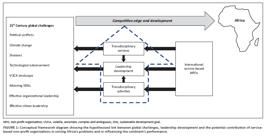
Africa faces many challenges that compromise the delivery of LD in the formal education system. The education system in Africa is crippled by a surfeit of challenges, with resource mobilisation being among the core challenges.31Figure 1 is a conceptual framework diagram showing the hypothesised link between global challenges, LD and the potential contribution of service-based NPOs in solving Africa's problems and in influencing the continent's performance.
Study's aim
This study aimed to investigate the transdisciplinary contribution of international service-based NPOs to addressing challenges faced by Africa in the 21st century, as well as to assess the organisations' contribution to LD on the continent. This study focused on three objectives, namely: (1) to investigate the tenets and general characteristics of international service-based NPOs with operations in Africa; (2) to investigate the global challenges addressed by the NPOs in Africa in the 21st century; and (3) to assess the presence and characteristics of LD in the organisations. The study sought to answer the following research questions: (1) What are the tenets and general characteristics of international service-based NPOs with operations in Africa? (2) Are there any 21st-century global challenges addressed by these organisations in Africa? (3) Do the organisations offer any LD and if so, what are the characteristics of the LD offered?
Research methods and design
Study design
This study was carried out in Africa. It analysed the tenets and general characteristics of international service-based NPOs operating in Africa. An analysis of the tenets and characteristics of service-based NPOs was carried out on 13 organisations that were randomly selected from a pool of international service-based NPOs that operated in Africa. In this research, international service-based NPOs were defined as registered service-based NPOs that had an international thrust and operated in more than one continent. Information on the organisations was obtained from the Union of International Associations (UIA)32
Qualitative research requires few samples to reach saturation.333435
Examination of the tenets and characteristics of the selected organisations, as well as the challenges they addressed in societies, involved assessing various sources, which included published and unpublished literature, websites and respective organisations' materials such as periodicals and pamphlets. All datasets compiled were based on information availed by the respective organisations on public platforms. This data collection approach was used based on the justification that the research adopted a real-life scenario in the acquisition of information. In a real-life scenario, information availed on public platforms is the major source of information that is normally accessed and used by potential subjects to make decisions. Characteristics assessed included membership conditions, subscriptions, organisational structure, organisational thrust, and LD approaches. Descriptive statistics were used to analyse the data and depict the findings.
Inclusion and exclusion criteria
Only international service-based NPOs listed on the UIA platform with operations in more than one continent, including Africa, were included for sampling in this research. Service-based NPOs with operations only in Africa or in only one continent were excluded from sampling. The study only focused on international service-based NPOs operating in Africa in order to explore their value and their relevance to the continent from a global perspective. Service-based NPOs of African origin were not included in this research because they lacked the international integration, which was one of the key aspects to be investigated in this research.
Ethical considerations
Ethical clearance to conduct this study was obtained from the Research Ethics Committee of the University of Zambia Biomedical Research Ethics Committee (No. 5602-2024).
Results
All NPOs analysed in this study had an international thrust with operations in more than one continent. The number of countries in which the NPOs were operating on a global scale varied widely, ranging from less than 20 countries to 207 countries. The observed mean and standard deviation of the number of countries in which the NPOs were operating were 88 ± 57.6. In all, 8% of the NPOs were operating in more than 200 countries, 31% were operating in 100-150 countries, 8% in 80-89 countries, 15% in 60-69 countries, 8% in 40-49 countries, another 8% in 30-39 countries, 7% in 20-29 countries and 15% in less than 20 countries. Presence in African countries also varied greatly among the NPOs, ranging from 1 to 47, with a mean and standard deviation of 18 ± 15.2 countries.
Results revealed that all NPOs analysed in this study had a purpose, mission and goals. Heterogeneity was observed in the purposes. Purposes observed embraced nine broad categories of services to address problems in Africa namely: (1) promotion of humanitarian services, (2) serving children, (3) developing communication and leadership skills, (4) advancing experience, opportunities, networking and partnership, (5) promoting integrity, high ethical standards, peace and goodwill, (6) enhancing gender equality, (7) enhancing women empowerment, (8) advancing sustainable economies and decent work, and (9) advancing climate change and conservation issues (Figure 2). Results revealed that although heterogeneity was observed on the purposes of the NPOs, an organisation could identify with one or more of the categories. Results also revealed that although the purposes varied, all organisations assessed in this study had missions and goals crafted around one theme, which was to make a positive impact on communities through their services and activities.
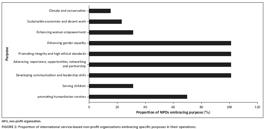
All organisations assessed in this study directly embraced LD, advancing experience, opportunities, networking, partnerships, gender equality, integrity and high ethical standards in their tenets and purposes (Figure 2). A proportion of 69% had purposes that were directly linked to humanitarian services, while 31% had purposes directly linked to serving children, and another 31% had purposes inclined to enhancing women's empowerment (Figure 2). In all, 23% had purposes with a thrust towards sustainable economies and decent work. Climate and conservation issues were least embraced (15%) in purposes of the NPOs. Figure 2 shows the proportion of service-based NPOs that embraced specific purposes in their operations.
All NPOs operated through voluntary membership. Membership was through locally based structures such as clubs, which were affiliated to the parent organisations. The NPOs had clear outlines for membership acquisition and termination. Individual memberships to the parent organisations were through subscriptions. Individual membership subscriptions varied among the NPOs and ranged between US$36 and US$280 per year, with a mean and standard deviation of US$91.17 ± 65.63 per year. In all, 77% of the NPOs had strictly adult membership of above 18 years of age, and 23% had a mixture of adult and non-adult membership. The NPOs also embraced diversity in their membership and were inclusive of participants regardless of gender, professional inclination, academic level and socio-economic class.
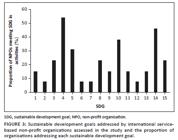
The NPOs studied in this research contributed to solving global problems through their services and activities. Observed activities addressed some of the SDGs listed in the 2030 Agenda of the United Nations. A total of 15 SDGs out of the 17 were addressed in the activities of the organisations. The SDGs addressed were SDG1 (elimination of poverty), SDG2 (elimination of hunger), SDG3 (good health and well-being), SDG4 (quality education), SDG5 (gender equality), SDG6 (clean water and sanitation), SDG7 (affordable and clean energy), SDG8 (decent work and economic growth), SDG10 (reduced inequalities), SDG11 (sustainable cities and economies), SDG13 (climate action), SDG14 (life below water), SDG15 (life on land), SDG16 (peace, justice and strong institutions) and SDG17 (partnership for the goals). The two most common SDGs addressed were SDG4 and SDG16, which were addressed by 54% and 46% of the NPOs, respectively (Figure 3). SDG9 on industry, innovation and infrastructure, and SDG12 on sustainable consumption and production patterns were not covered in the tenets of the 13 organisations that were assessed. SDGs 1, 10, 13 and 15 were each addressed by 15% of the organisations, SDGs 2, 6, 7 and 14 were each addressed by 8% of the organisations, SDGs 3, 8 and 17 were each addressed by 23% of the organisations, while SDG5 was addressed by 31% and SDG11 by 38% of the organisations. Figure 3 shows the SDGs addressed by the organisations assessed in this study and the proportion of organisations addressing each SDG.
Governance of the organisations that were assessed in this research was guided by binding constitutions and terms of reference. The parent organisation was run by a board of directors. The directors were elected into office and served specified durations of terms of office. All organisations exhibited a decentralised approach of governance through districts and/or zones at continental and country levels, and clubs at local levels. The type of governance across different levels was hierarchical, with the highest authority at the global level. Activities at the local scale contributed to the purposes of each organisation. Clubs were under the leadership of locally elected leaders or club officers who served for specified durations. Club leaders received training on leadership and on the operations of the NPOs prior to assuming office. All activities of clubs were carried out in a structured manner. Club activities were variable among the organisations depending on their purposes and goals. However, projects were a common activity used by the organisations to serve communities. Projects were structured to meet local needs and local contexts. Experiential LD was observed to be embedded in the approach taken in projects. The experiential learning embraced the needs of the modern learner through the use of approaches that simplified the learning experience, keeping it focused and practical.
Besides experiential learning, a number of additional LD approaches were observed in the NPOs. Direct approaches included retreats, workshops, seminars and webinars. Durations of these programmes ranged from a few hours, a day, several days, a week to several weeks. Programmes that ran for several weeks followed a consecutive or non-consecutive days approach. All LD programmes were open to members and were run systematically on a regular basis, giving members a platform for continuous learning throughout their membership period with the organisation.
A common direct approach of LD that was observed in all NPOs was the leadership training programmes, which were tailor-made to develop leadership skills in office bearers or leaders of the organisation. These programmes were observed at all levels of the organisations, from the global to the local levels. The training programmes were designed to train incoming leaders and were officiated by trained members of the organisation in collaboration with the past and outgoing leaders of the organisations. These programmes were in the form of retreats, workshops, seminars and webinars and could also take an experiential approach in the form of projects.
Another form of direct LD approach that involved the enrolment of beneficiaries at universities was observed in 54% of the NPOs. Enrolment varied from attending basic leadership courses at universities to attending full undergraduate or postgraduate degree programmes. This was achieved through fellowships that covered all or part of the expenses for the programs. Beneficiaries of fellowships could be members or non-members of the NPOs. In all NPOs offering fellowship programmes, the selection of beneficiaries was through an application process with clearly laid out eligibility conditions.
An indirect approach to LD was observed in the experiential approaches, which were embodied in running of services and activities of the NPOs. The organisations operated using structured formats with mentorship embodied in their activities, which exposed participants to LD. Mentorship was observed to be an integral operational component of all the organisations that were assessed.
Results revealed that NPOs engaged partnerships in their operations. Partnerships varied depending on the purposes of the organisations. Observed partnerships were with other non-governmental organisations, academic institutions, civil groups and local communities that collaborated in the execution of the NPOs' activities. Execution of activities by the NPOs embraced imparting citizen leadership skills to participants, as some projects were crafted around solving local problems.
Funding characterised operations of all the NPOs assessed. All the assessed organisations had membership subscriptions. Donations were also a characteristic source of funding. Some organisations could also carry out fund-raising activities or apply for grants to finance their activities. All the organisations assessed incorporated three values in their funding systems, namely, transparency, integrity and accountability, which contributed to imparting some moral leadership skills to members.
Discussion
International service-based NPOs that were assessed in this research revealed various contributions towards the achievement of SDGs in Africa, covering 15 of the 17 SDGs in their tenets and activities. This was an important observation considering that various challenges have been highlighted in Africa's progress towards the achievement of SDGs. The United Nations Development Program (UNDP) report363636
The low coverage of SDGs related to environmental issues that were observed in this study was a cause for concern, considering the importance of environmental issues in the 21st century. The United Nations Framework Convention on Climate Change (UNFCCC)37373839
Two of the 17 SDGs were also observed to be not covered by the organisations that were assessed in this study. The UNDP report3636
Governance and activities of international service-based NPOs that were assessed in this research were observed to span from local to international levels. This characteristic could be considered as important in LD as the structures, activities and programmes associated with the organisations presented members with exposure to both local and global contexts. This was in line with the New Leadership Theory, which emphasises LD that nurtures effective and adaptive leaders who are situation-oriented and capable of embracing the rapid change and complex environment associated with today's global landscape.2830
International service-based NPOs displayed noticeable strength in LD through their experiential learning approach. This approach is viewed by many researchers as an effective way of training, which is associated with positive learning outcomes.40,41,424240,41
Research has reported on the positive effects of experiential learning on cultural awareness in individuals.424242,4343,44,45
The experiential learning approach that was observed in NPOs in this research embraced the needs of the modern learner through the use of approaches that simplified the learning experience by keeping it focused and practical. Simplified learning approaches have been reported to be effective in the 21st century, as they curb the negative effects of information overload.464748489,469
Another characteristic that was observed in the LD of the organisations that were assessed was the moral leadership approaches, which were present in their standard operating procedures. Nurturing of moral leadership skills could be achieved through participation in the activities of the organisations. Operations of the organisations were observed to be guided by some legally binding constitutions and terms of reference, which were accessible to all members of the NPOs, as well as to the general public. This promoted transparency and nurturing of moral leadership skills.
The governance approaches that were observed in the assessed NPOs, which embraced guidance by some terms of reference when electing new leaders and training of new leaders before assuming office, enhanced democracy and the culture of leadership continuity in these organisations. Effective handover-takeover practices promote transparency in organisations. Poorly managed succession is associated with dissatisfaction in organisations, which is detrimental to organisational performance.49505152
In this research, international service-based NPOs also emphasised transparency, integrity and accountability in their funding systems. This was another important moral leadership behaviour that was imparted to members through participation in the activities of the NPOs. In today's society, financial transparency is increasingly becoming an inevitable requirement for citizen leadership. Financial transparency has become a universal norm of organisational governance in the 21st century, as organisations continue to face admonishment pressure from citizens to be financially transparent, especially on public funds. The current society is facing challenges related to unethical practices and general poor performance, and these challenges could be emanating from the lack of effective leadership.5354,555629,3057
The organisations that were assessed in this research embraced diversity in their membership by accommodating people of different academic levels, professional engagements and socio-economic classes. This attribute had the potential to enhance LD across different classes and different sectors, contributing to the collective expansion of the leadership bandwidth for communities. This attribute also contributed to the establishment of strong citizen leadership skills in communities. It is important to observe that any individual has the potential to engage in leadership roles at family, society, organisational, national and international levels. This reality is important for Africa, considering that the performance of societies, organisations and sectors is influenced by the quality of leadership available in different sectors. Organisational performance is influenced by the quality of leadership in any organisation.53
Mentorship was also observed as a key characteristic of LD in the organisations that were assessed. Mentorship is an important attribute of effective leadership and has been frequently used to meet the needs of a changing environment.9,581391313
The LD programmes offered by the studied NPOs were observed to be continuously open to members, giving members a platform for continuous learning throughout their membership period. Besides the tailor-made LD programmes, which were continuously offered to members, participation in systems and activities of these organisations also presented members with additional learning platforms throughout their membership period. Continuous training of aspects in leadership presented by the organisations kept individuals up to date with new information and new skills in leadership, which is a critical factor in the 21st century. The continuous learning platforms also provided a potential cost-effective means of LD that corporates and professionals in Africa could explore to enhance their competence in their leadership capacity because activities of the NPOs were rendered on a non-profit basis. This implied that participants would not be subjected to exorbitant costs, providing a potential cost-effective means of LD for professionals. This could be achieved through mere subscriptions and participation in the activities of the NPOs. This observation could significantly reduce the huge expenses that are associated with leadership training in the corporate world if fully explored. Research has revealed that globally, corporates expend exorbitant amounts annually on executive training,1315
Results of this study revealed the relevance and significant contribution of international service-based NPOs in LD and in solving problems in Africa. Complementing this effort with contributions of local NPOs presents great potential to enhance the continent's leadership bench-strength and competitive edge in the VUCA environment. Africa has a significant number of NPOs of local origin. Like international service-based NPOs, these local NPOs play important roles in offering services to communities.
Making reference to a specific example, ForAfrika is an Africa-confined NPO with activities that are designed to address community needs. The organisation was founded specifically to help alleviate problems in Africa and has operations in Mozambique, South Africa, Uganda, Rwanda, South Sudan, Ethiopia, Central African Republic and Angola.5959
ForAfrika facilitates the implementation of integrated community-led programmes that enhance transformational community development.5959
Based on the operational insights on international service-based NPOs and Africa-based NPOs as revealed in this research, the importance of these organisations in LD and in meeting societal needs in Africa cannot be overemphasised. Exploring the value they offer has the potential to enhance the continent's performance and competitive edge in the 21st century. However, comprehensive analyses on governance and efficacy of these organisations are grey areas that require attention in order to expand the body of knowledge of NPOs in Africa. Funding, self-reliance, sustainability and accountability issues are some of the governance issues that have been highlighted by researchers to influence the success and impact of NPOs.60
Study's limitations
This research only used information available on public platforms on the NPOs that were sampled. This data collection approach was used based on the justification that the research used a real-life scenario in data acquisition, where public platforms are the main sources of information used by the general public to gain knowledge on a subject. However, the use of information on public platforms only had potential pitfalls of not capturing all the information pertaining to the subject under investigation, especially information on confidential issues. This could have a potential effect on the amount of data collected and conclusions drawn from the study.
Conclusion
In conclusion, based on the findings of this research, international service-based NPOs contributed to solving problems faced by Africa in the 21st century as well as presented means of LD for the African continent. The organisations had LD embedded in their services and activities, which covered a wide spectrum of needs in the 21st century. The observed spectrum included training of special leadership skills for the 21st century, such as citizen leadership skills and moral leadership skills as well as coverage of SDGs. There was, however, a need to assess the efficacy of these organisations in Africa. Comparisons of the operational dynamics and efficacy of international service-based NPOs with Africa-confined NPOs were also necessary to generate information that would contribute to the body of knowledge of NPOs in Africa.
Competing interests
The authors declare that they have no financial or personal relationships that may have inappropriately influenced them in writing this article.
CRediT authorship contribution
Edmore B. Gamundani: Conceptualisation, Methodology, Formal analysis, Investigation, Writing - original draft, Visualisation, Project administration, Software, Validation, Data curation, Resources, Writing - review & editing. Mubanga Mpundu: Supervision. All authors reviewed the article, contributed to the discussion of results, approved the final version for submission and publication, and take responsibility for the integrity of its findings.
Funding information
This research received no specific funding from any funding agency in the public, commercial, or not-for-profit sectors.
Data availability
Datasets for this research are available from the corresponding author, Edmore Bernard Gamundani, upon reasonable request.
Disclaimer
The views and opinions expressed in this article are those of the authors and do not necessarily reflect the official policy of any affiliated agency of the authors, or that of the publisher. The authors are responsible for this article's results, findings, and content.
Acknowledgements
This article is based on research originally conducted as part of Edmore Bernard Gamundani's Doctoral thesis titled 'An analysis of the role of non-profit organisations in leadership development: A case of Toastmasters International High-Performance Leadership Program in Southern Africa', submitted to the Graduate School of Business, University of Zambia in 2025. The thesis is currently unpublished and not publicly available. The thesis was supervised by Mubanga Mpundu. The manuscript has been revised and adapted for journal publication. The author confirms that the content has not been previously published or disseminated and complies with ethical standards for original publication.
References
-
1. Dabić M, Maley JF, Nedelko J. Unappreciated channel of manufacturing productivity under Industry 4.0: Leadership values and capabilities. J Bus Res. 2023;162:113900. https://doi.org/10.1016/j.jbusres.2023.113900
» https://doi.org/10.1016/j.jbusres.2023.113900 - 2. Neji ON. Examining threats to global peace in the 21st century. In: Bogoro ES, Meyer M, Danjibo ND, editors. Readings on peace and conflict. Ibadan: Institute of Peace and Strategic Studies, 2019; p. 498-507.
-
3. Cho J. Making peace by fighting war: Competing versions of conflict management and African agency in the 'new scramble for Africa'. Contemp Secur Policy. 2025;46(3):522-550. https://doi.org/10.1080/13523260.2025.2500262
» https://doi.org/10.1080/13523260.2025.2500262 -
4. Abbass K, Qasim MZ, Song H, Murshed M, Mahmood H, Younis I. A review of the global climate change impacts, adaptation and sustainable mitigation measures. Environ Sci Pollut Res Int. 2022;29:42539-42559. https://doi.org/10.1007/s11356-022-19718-6
» https://doi.org/10.1007/s11356-022-19718-6 - 5. Stern N. The economics of climate change. Cambridge: Cambridge University Press; 2007.
- 6. Schwab K. The Fourth Industrial Revolution. London: Penguin Books Limited; 2017.
-
7. Haleem A, Javaid M, Singh RP. Perspective of Leadership 4.0 in the era of fourth industrial revolution: A comprehensive review. J Ind Saf. 2024;1(100006):1-15. https://doi.org/10.1016/j.jinse.2024.100006
» https://doi.org/10.1016/j.jinse.2024.100006 - 8. Marr B. 14 Essential leadership skills for the 4th Industrial Revolution. New Jersey, NJ: Forbes; 2019.
-
9. Organa M, Sus A. Leadership 4.0: New definition and distinguishing features. Procedia Comput Sci. 2023;225:3701-3709. https://doi.org/10.1016/j.procs.2023.10.365
» https://doi.org/10.1016/j.procs.2023.10.365 -
10. Langone CA. The use of a citizen leader model for teaching strategic leadership. J Leadership Educ. 2004;3(1):82-88. https://doi.org/10.12806/V3/I1/AB3
» https://doi.org/10.12806/V3/I1/AB3 -
11. Javaid A, Falk T. Incorporating local institutions in irrigation experiments: Evidence from rural communities in Pakistan. Ecol Soc. 2015;20(2):28. https://doi.org/10.5751/ES-07532-200228
» https://doi.org/10.5751/ES-07532-200228 -
12. Jack BK, Recalde MP. Leadership and voluntary provision of public goods. J Public Econ. 2015;122:80-93. https://doi.org/10.1016/j.jpubeco.2014.10.003
» https://doi.org/10.1016/j.jpubeco.2014.10.003 - 13. Global Leadership Forecast. 25 research insights to fuel your people strategy. London: Development Dimensions International Inc. Ernst and Young Limited; 2018.
-
14. Mitonga-Monga J, Coetzee M, Cilliers FVN. Perceived leadership style and employee participation in a manufacturing company in the Democratic Republic of Congo. Afr J Bus Manage. 2012;6(15):5389-5398. https://doi.org/10.5897/AJBM11.2443
» https://doi.org/10.5897/AJBM11.2443 -
15. Yemiscigil A, Born D, Ling H. What makes leadership development programs succeed? Harvard Bus Rev [serial online]. 2023 [cited 2024 Dec 16]. Available from: https://hbr.org/2023/02/what-makes-leadership-development-programs-succeed
» https://hbr.org/2023/02/what-makes-leadership-development-programs-succeed -
16. Day DV. Leadership development: A review in context. Leadersh Q. 2000;11(4):581-613. https://doi.org/10.1016/S1048-9843(00)00061-8
» https://doi.org/10.1016/S1048-9843(00)00061-8 -
17. Dinh JE, Lord RG, Gardner WL, Meuser JD, Liden RC, Hu J. Leadership theory and research in the new millennium: Current theoretical trends and changing perspectives. Leadersh Q. 2013;25(1):36-62. https://doi.org/10.1016/j.leaqua.2013.11.005
» https://doi.org/10.1016/j.leaqua.2013.11.005 -
18. Rost JC, Barker RA. Leadership education in colleges: Towards a 21st century paradigm. J Leadersh Stud. 2000;7(1):3-13. https://doi.org/10.1177/107179190000700102
» https://doi.org/10.1177/107179190000700102 - 19. Samoka K, Oginde D, Kiambi D. Leadership development of young professionals for organisational performance in the building industry during the Fourth Industrial Revolution. Int J Educ Res. 2023;11(2):9-22.
-
20. Crawford CB, Brungardt CL, Scott RF, Gould LV. Graduate programs in organisational leadership: A review of programs, faculty, costs and delivery methods. J Leadersh Stud. 2002;8(4):64-74. https://doi.org/10.1177/107179190200800406
» https://doi.org/10.1177/107179190200800406 -
21. Morris S. Defining the nonprofit sector: Some lessons from history. Voluntas. 2000;11:25-43. https://doi.org/10.1023/A:1008950915555
» https://doi.org/10.1023/A:1008950915555 - 22. Hall PD. A historical overview of philanthropy, voluntary associations and nonprofit organizations in the United States, 1600-2000. In: Powe WW, Bromley P, editors. The nonprofit sector: A research handbook. Stanford, CA: Stanford University Press, 2006; p. 32-65.
- 23. Anheier HK. Nonprofit organizations: Theory, management, policy. Milton Park: Routledge; 2014.
- 24. Gustafson JL. Member-driven organizations: A study of nonprofit governance. New York, NY: Chapman and Hall; 2017.
- 25. Mc Cauley CD, Van Velsor E. Introduction: Our view of leadership development. In McCauley CD, Van Velsor E, editors. The centre for creative leadership: Handbook of leadership development. San Francisco, CA: Jossey-Bass, 2010; p. 1-28.
-
26. Anastasiou S. The significant effect of leadership and conflict management on job satisfaction. Acad J Interdiscip Stud. 2020;9(6):9-17. https://doi.org/10.36941/ajis-2020-0107
» https://doi.org/10.36941/ajis-2020-0107 -
27. Sereyrath E. A review of different ideas concerning the characteristics of a good leader and shaping new ideas of an effective 21st century leader. J Gen Educ Humanit. 2023;2(1):13-34. https://doi.org/10.58421/gehu.v2i1.53
» https://doi.org/10.58421/gehu.v2i1.53 -
28. Benmira S, Agboola M. Evolution of leadership theory. BMJ Leader. 2021;5:3-5. https://doi.org/10.1136/leader-2020-000296
» https://doi.org/10.1136/leader-2020-000296 -
29. James R. Leadership development inside-out in Africa. Nonprofit Management Leadership. 2008;18(3):359-375. https://doi.org/10.1002/nml.190
» https://doi.org/10.1002/nml.190 -
30. Hanson KT, Lèautier FA. Enhancing institutional leadership in African universities: Lessons from the AEBF's interventions. World J Entrep Manag Sustain Dev. 2011;7(2/3/4):385-417. https://doi.org/10.1108/20425961201000040
» https://doi.org/10.1108/20425961201000040 -
31. Teferra D, Altbachl PG. African higher education: Challenges for the 21st century. High Educ. 2004;47:21-50. https://doi.org/10.1023/B:HIGH.0000009822.49980.30
» https://doi.org/10.1023/B:HIGH.0000009822.49980.30 -
32. Union of international associations list [homepage on the Internet]. Union of International Associations; 2024 [cited 2024 November 10]. Available from: https://uia.org
» https://uia.org -
33. Boddy CR. Sample size for qualitative research. Qual Mark Res. 2016;19(4):426-432. https://doi.org/10.1108/QMR-06-2016-0053
» https://doi.org/10.1108/QMR-06-2016-0053 -
34. Hennink M, Kaiser BN. Sample sizes for saturation in qualitative research: A systematic review of empirical tests. Soc Sci Med. 2022;292:114523. https://doi.org/10.1016/j.socscimed.2021.114523
» https://doi.org/10.1016/j.socscimed.2021.114523 -
35. Hennink M, Kaiser BN, Weber MB. What influences saturation? Estimating sample sizes in focus group research. Qual Health Res. 2019;29(10):104973231882169. https://doi.org/10.1177/1049732318821692
» https://doi.org/10.1177/1049732318821692 - 36. United Nations Development Programme (UNDP). Accelerating the recovery from the corona virus disease (COVID 19) and the full implementation of the 2030 agenda for Sustainable Development and African Union Agenda 2063 at all levels. New York, NY: United Nations Development Program Publications; 2023.
- 37. United Nations Framework Convention on Climate Change (UNFCCC). The Paris agreement. New York, NY: United Nations Framework Convention on Climate Change Publications; 2016.
-
38. Thyil V, Wise VJ. Impact of climate change issues on businesses: An action plan using a corporate governance approach. Int J Glob Environ Issue. 2012;12(1):91-104. https://doi.org/10.1504/IJGENVI.2012.047890
» https://doi.org/10.1504/IJGENVI.2012.047890 -
39. Sifat RI. Role of leadership for achieving Sustainable Development Goals. GIS Bus. 2019;14(3):5-14. https://doi.org/10.26643/gis.v14i3.1944
» https://doi.org/10.26643/gis.v14i3.1944 - 40. Moon JA. A handbook of reflective and experiential learning theory and practice. New York, NY: Routledge Falmer Taylor and Francis Group; 2004.
-
41. Murat G. The project-based learning approach in environmental education. Int Res Geogr Environ Educ. 2014;24(2):105-117. https://doi.org/10.1080/10382046.2014.993169
» https://doi.org/10.1080/10382046.2014.993169 -
42. Piščalkiene V, Lottrup HI. Benefits of experiential based learning: A case study of student participation in the project 'Villages on move Baltic'. J Public Health. 2018;6:5-15. https://doi.org/10.5200/sm-hs.2018.064
» https://doi.org/10.5200/sm-hs.2018.064 - 43. Kolb DA. Experiential learning: Experience as the source of learning and development. Englewood Cliffs, NJ: Prentice-Hall; 1984.
- 44. Kolb DA, Boyatzis RE, Mainemelis C. Experiential learning theory: Previous research and new directions. In: Sternberg RJ, Zhang LF, editors. Perspectives on cognitive, learning and thinking styles. Mahwah, NJ: Lawrence Erlbaum, 2000; p. 227-247.
-
45. Schenck J, Cruickshank J. Evolving Kolb: Experimental education in the age of neuroscience: J Exp Educ. 2015;38(1):73-95. https://doi.org/10.1177/1053825914547153
» https://doi.org/10.1177/1053825914547153 - 46. Marques RP, Batista J. Information and communication overload in the digital age. Hershey, PA: IGI Global Publishing company; 2017.
-
47. Suhaimi FA, Hussin N. The influence of information overload on students' academic performance. J Exp Educ. 2017;7(8):760-766. https://doi.org/10.6007/IJARBSS/v7-i8/3292
» https://doi.org/10.6007/IJARBSS/v7-i8/3292 - 48. Khalid S, Saeed M, Syed S. Impact of information overload on students' learning: An empirical approach. FWU J Soc Sci. 2016;10(1):58-66.
- 49. Fernández-Aráoz C, Nagel G, Green C. The high cost of poor succession planning. Harvard Bus Rev. 2021;99(3):98-107.
-
50. Fleischmann KR, Wallace WA. A covenant with transparency: Opening the black box of models. Commun ACM. 2005;48(5):93-97. https://doi.org/10.1145/1060710.1060715
» https://doi.org/10.1145/1060710.1060715 -
51. Schnackenberg AK, Tomlinson E. Organisational transparency: A new perspective on managing trust in organisation-stakeholder relationships. J Management. 2014;42(7):1784-1810. https://doi.org/10.1177/0149206314525202
» https://doi.org/10.1177/0149206314525202 - 52. Lewicki RJ, Bunker BB. Developing and maintaining trust in work relationships. In: Kramer RM, Tyler TR, editors. Trust in organisations: Frontiers of theory and research. Thousand Oaks, CA: SAGE Publications, 1996: p. 114.
-
53. Al Khajeh EH. Impact of leadership styles on organisational performance. J Hum Resour Manag Res. 2018;2018:687849. https://doi.org/10.5171/2018.687849
» https://doi.org/10.5171/2018.687849 -
54. Krah R, Mertens G. Financial transparency, trust and willingness to pay in local governments of sub-Saharan Africa. J Public Budget Acc Financ Manage. 2023;35(6):100-120. https://doi.org/10.1108/JPBAFM-06-2022-0110
» https://doi.org/10.1108/JPBAFM-06-2022-0110 -
55. Kim S, Lee J. Citizen participation, process and transparency in local government: An exploratory study. Policy Stud J. 2019;47(4):1026-1047. https://doi.org/10.1111/psj.12236
» https://doi.org/10.1111/psj.12236 -
56. Freeman RE, Wicks AC, Parmer B. Stakeholder Theory and 'the corporate objective revisited'. Organ Sci. 2004;15(3):364-369. https://doi.org/10.1287/orsc.1040.0066
» https://doi.org/10.1287/orsc.1040.0066 - 57. Karthikeyan C. A meta-analytical study on leadership integrity: A leadership ethics perspective. Int J Manag IT Eng. 2017;7(4):240-263.
-
58. Lee J, Sunderman HM, Hastings L. The influence of being a mentor on leadership development: Recommendations for curricular and co-curricular experiences. J Leadersh Educ. 2020;19(3):44-60. https://doi.org/10.12806/V19/I3/R4
» https://doi.org/10.12806/V19/I3/R4 -
59. 40 Years ForAfrika [homepage on the Internet]. 2025. [cited 2025 Nov 07] Available from: https://forafrika.org
» https://forafrika.org -
60. Abdullahi D, Baba YTK. Corporate funding and sustainability of non-governmental organisations in Africa. Games Rev. 2016;2(1):17-37. https://doi.org/10.18488/journal.100/2016.2.1/100.1.17.37
» https://doi.org/10.18488/journal.100/2016.2.1/100.1.17.37

Accepted: 24 Nov. 2025
Published: 30 Jan. 2026