Gendered research grant conditions and their effect on women's application (dis)engagement
Abstract
Men continue to outperform women in obtaining funding through research grants globally, in both science, technology, engineering and mathematics (STEM) and social science, in multidisciplinary and transdisciplinary fields. This article focuses on the role of research grant funding conditions in women's lack of research grant funding. Grant conditions are the rules of participation and funding use set out by grant funders. This study aimed to answer the question: how do grant conditions limit women's propensity to engage with research grant applications? Research grants from the Open 4 Research database were analysed. Research careers with a reproductive life-cycle perspective and four feminist concepts were deliberately gendered. These resulted in a theoretical framework. A content analysis on n = 270 multidisciplinary early career grants for those who already have a PhD was conducted. Grants were selected from both the social science and STEM disciplines. The findings suggest that, overwhelmingly, grant conditions are gender-neutral, assuming no differences between women and men. A comparison between STEM and social science grant conditions also show very little difference. The article provides a framework to guide multidisciplinary and transdisciplinary grant funders in crafting deliberately gendered grant conditions. TRANSDISCIPLINARY CONTRIBUTION: A pre-application phase to the research grant application process by problematising gender neutrality in early-career researcher grant conditions is introduced. It is posited that grants' gender neutrality is discouraging women to consider applying, resulting in self-exclusion early in the pre-application phase.
Grant conditions; research grants; gender; grant applications; research careers; early career researchers; women researchers
Introduction
Parity in the numbers of women and men researchers can be achieved, as there are sufficient numbers of qualified women in most major disciplines of study.1,23,4,5,6h-index than nonrecipients.789,10,11
Grant conditions are the stipulations by grant funders regarding grants, such as the rules, the mode, the place of research collaboration and the inclusion and exclusion criteria of grant holders. This was the focus of the article, as previous research has predominantly focused on three actors, namely: (1) women grant applicants, specifically improving the writing skills of women in science, technology, engineering and mathematics (STEM) careers to write grant applications;12139
Research on these three actors fits into the outline of the three main stages in the funding-productivity nexus,14
Women have 'the tendency to be careful, deliberate, and thorough'.15161718how do grant conditions limit women's propensity to engage with research grant applications?
Theoretical framework
The theoretical framework in the article utilised elements of Christina Hughes's19
The first element of the framework is difference. Not only are there differences between women and men based on their reproductive and hormonal functioning, but there are also vast differences in their societal roles. These facts are commonly acknowledged.20,21222319difference to have 'universal commonality of womanhood',1924
The second element of the framework is care.1925252625272829
The third element of the framework is time. The linear career path of a male scientist should not be assumed for all researchers, and universities and grant-funding institutions should instead 'experiment with life course options'.30313233343219
The final element of the theoretical framework is choice.19353637
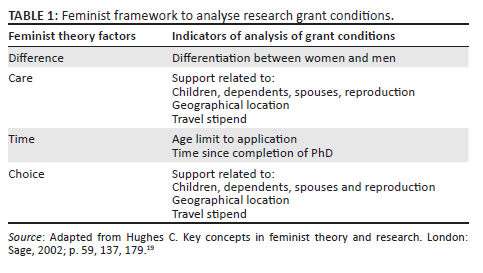
When combined, the four feminist analysis elements create a theoretical framework with indicators that can be utilised to analyse research grant conditions. These are summarised in Table 1.
Gendered fields of study
Funding systems are deemed biased in favour of men, a situation that is compounded by a favouring of 'male-dominated and culturally masculine positions and fields', when in fact, grant funders need to consider a wide range of academic disciplines.3839404142
Research methods and design
The study followed a feminist approach which impacted the elements included in the analysis, the research question and how the data were viewed. From extant literature, the elements that have been found to affect women's intentions to apply for research grants were determined, and a framework of these elements was constructed (Table 1). Thereafter, document analysis to examine available grants internationally was performed, using the framework to expose gender-related hindrances women encounter in considering applying for a research grant.
Data sources
The search terms included grants, women, female and gender. The Open 4 Research database was used to draw a sample of international multidisciplinary and interdisciplinary research funding opportunities for analysis. This article focused on grant opportunities for early-career researchers, as these researchers should already be in possession of a PhD, eliminating problematic comparison between groups with and without a PhD. Obtaining grants within the early-career phase is also very important for the career success of researchers.7
Sample selection
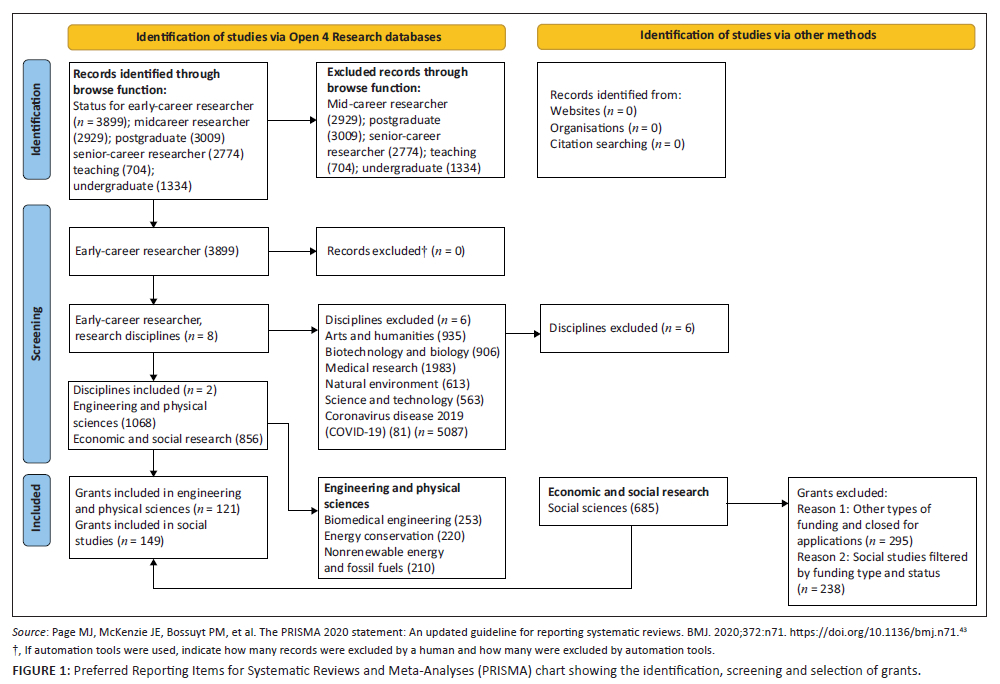
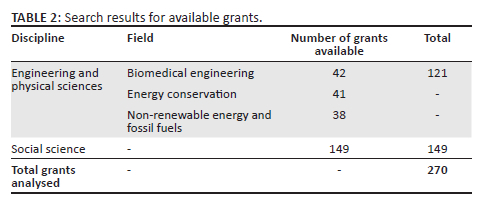
The search was limited to grants that were open as at February 2022. All funding opportunities other than grants and closed grants were excluded. Thereafter, the Browse funding link in the portal menu was used to select the status Early-career researcher. This yielded eight research disciplines, which were filtered to include only Engineering and physical sciences and Economic and social research. Within Engineering and physical sciences, the following interdisciplinary fields were selected: (1) Biomedical engineering, (2) Energy conservation and (3) Non-renewable energy and fossil fuels, representing male-dominated STEM fields. The feminised field of Social science was selected to allow comparison. Relevant funding opportunities for the chosen categories were obtained by clicking the View all category for results on each discipline. This yielded full information on all applicable funds. The results were filtered according to Funding type and Status. The Grant funding option was selected and refined through the selection of Current and Future grant opportunities.
Data collection process
The filtered results were sorted alphabetically on the Open 4 Research platform. To create the report, the grants to be included were identified by placing a tick in the relevant box(es) and then clicking to produce a report. The funding search results were then exported to a Microsoft Word document and then transferred to a Microsoft Excel data-extraction sheet (both by Microsoft Corporation, Redmond, Washington, United States). Document analysis using a content analysis strategy was used to collect data from the grant reports. The grant documents were read while collecting data, and pertinent information was entered into the Excel spreadsheet based on the indicators listed in Table 1 to enable a structured examination of the data. The researchers employed content analysis to extrapolate elements identified in the gendered theoretical framework and other points that could assist in answering the research question. Figure 1 is the Preferred Reporting Items for Systematic Reviews and Meta-Analyses (PRISMA) chart detailing the identification, screening and selection of grants. Table 2 reports the search results. The search yielded a total of n = 270 grant opportunities for analysis.
Data analysis
The selected grants were analysed using an Excel spreadsheet with the following columns: Grant name, Gender, Time since completion of PhD, Age, Geographical location, Travel stipend and Family and other considerations, in line with the four feminist elements as outlined in Table 1. Data analysis followed a systematic process of content analysis, reading and objective reflection during the collection of information from the contextual source. In the analysis stage, the gathered data were sifted and sorted in accordance with the elements identified from literature, shown in Table 1. An inductive process was followed to create data from reading the grant conditions; therefore, points subsequently raised are contextually grounded (i.e. based on data). An abductive process was followed to ascertain whether the framework reflected the collected information.
Ethical considerations
The study utilises secondary data which is publicly available. As such, the study was declared exempt from ethical clearance via the Stellenbosch University, reference number 26079569.
Results
The sections below provide a description of indicators in Table 1, linked to the findings from the related analysis of the conditions within grants.
Age cut-off
Many grants limit the age of researchers who may apply by stipulating an age cut-off point. The present study's analysis found the following in this regard:
• Social science: n = 5 grants specified a cut-off age, namely a maximum age of 30 (n = 1), a maximum age of 40 (n = 3) and '… preference is given to younger applicants' (n = 1);
• Nonrenewable energy and fossil fuels: maximum 40 years (n = 1), maximum 30 years (n = 1) and 'young people or researchers' (n = 4);
• Biomedical engineering: maximum 40 years (n = 1), maximum 30 years (n = 1) and 'young' (n = 4); and
• Energy conservation: maximum 40 years (n = 1), maximum 30 years (n = 1) and 'young' (n = 3).
To determine if this has a limiting effect on women when considering the intersection of age and stages of women's career life cycles as posited by Blackwell and Glover,44
Reproductive life cycle
There was no specific mention of reproductive life cycles in the analysed grant conditions, although age gives us reference to women's most fertile years.45n = 0) referred to any maternity or childbearing provisions.
Care responsibilities
The present researchers examined whether the grants indicated consideration of women's reproductive life cycle and care responsibilities. Not a single grant (n = 0) specified that individuals will be assisted in fulfilling any care duties.
Related to care responsibilities is the reality that the locations of research projects are often abroad in relation to the woman's place of residence. Lubitow and Zippel46
Social science grants (n = 3) indicated a travel stipend but did not indicate that it may be used to visit home, and only one (n = 1) grant noted that the organisation was willing to pay a 'mobility allowance', together with provision for 'family- and long-term leave'. This was also the case for one grant (n = 1) which was available in each of three male-dominated fields: nonrenewable energy and fossil fuels, biomedical engineering and energy conservation.
Time since completion of PhD
Some grants specified a maximum period from the researcher having completed a PhD:
• Social science: 3 years (n = 1); 4 years (n = 1); 5 years (n = 2); 8 years (n = 1); 10 years (n = 16); and 12 years (n = 1)
• Energy conservation: 4 years (n = 2); 5 years (n = 5); and 8 years (n = 2)
• Biomedical engineering: 3 years (n = 1); 4 years (n = 2); 5 years (n = 2); and 8 years (n = 1)
• Nonrenewable energy and fossil fuels: 4 years (n = 2); 5 years (n = 1); and 8 years (n = 1).
Only one grant in each field (n = 4) noted that '[c]areer breaks will not count towards the above maximum'. These grants did not specify that women applicants were sought, only that Particular attention is paid to gender balance.
It is also clear that the STEM fields' cut-off points are earlier than those of social sciences, which is not conducive to attracting more women when considering the compound effect of the other factors women have to bear in mind. This externally imposed limitation is thus another variable that needs to be factored in when considering the research opportunity. While aligned to the career path dominated by men, it may create severe restrictions for women who have to balance the right grant at the right time with all the factors related to their age and thus their career life cycle and reproduction.
A concerning finding is that the vast majority of the grants indicated that the opportunities were '[gender] neutral', and exceptions were few. In the field of energy conservation, n = 3 grants indicated 'attention to gender balance' and n = 1 grant specified 'female researchers'. However, only n = 1 of these grants specified 'mobility allowance and family leave'. In biomedical engineering, n = 3 grants stated 'attention to gender balance', and only n = 1 grant specified 'female', but again, only n = 1 grant specified 'mobility allowance and family leave'. In non-renewable energy and fossil fuels, n = 2 grants noted 'attention to gender balance' and n = 1 grant indicated 'female'. Even in the feminine field of social science, only n = 3 grants noted 'attention to gender balance', while none (n = 0) of the grants indicated 'female', and only n = 1 grant noted 'mobility allowance and family leave'. Ironically, none (n = 0) of the grants that specified 'female researcher' referred to any allowance related to mobility or family leave. Furthermore, it must be noted that all instances of consideration of family were by only one entity - the European Union.
Discussion
The key feminist concepts that formed the theoretical framework in this article - difference, care, time and choice - elucidated the circumstances under which women may self-exclude in the pre-application phase, because of the grant conditions set by grant funders. Analysing the research grant conditions from a feminist perspective enabled us to uncover hindrances women face. The way grant conditions are formulated may create discomfort in women's self-assessment whether to apply for grants or self-exclude themselves before application. The analysis of grant conditions reveal that grant conditions are formulated in a gender-neutral manner. On the face of it, gender neutrality is a safe way of stating conditions, as every grant applicant is provided with exactly the same conditions - thereby eliminating any alleged unfair treatment.1difference between women and men is acknowledged, the gender neutrality argument becomes less egalitarian and more exclusionary. In support of this conclusion, the data shows age cut-offs within childbearing years, no grants providing maternity or childcare benefits, only one grant with a family mobility benefit and only four grants that took career breaks into consideration. Women's career cycles are different from men's, amongst others, because women may need to take a career break to have children and care for them full-time while they are babies.47difference.
When considering that many research grants state a term of up to eight years and require the researcher to conduct fieldwork up to 50% of the time, coupled with staff exchange programmes, the conflict women face in terms of fertility and care becomes glaringly obvious. These requirements become particularly onerous for women who then have to conduct research far away from home without grants providing for childcare support or family travel arrangements. In addition, women of all ages tend to have care responsibilities within the family. It is thus clear that the finding of gender neutrality in grants (i.e. compliance with equality numbers), will not result in equity for women researchers. Only two grant conditions expressly excluded certain researchers (age and time since completion of PhD). However, women researchers' realities (career life cycle, reproductive life cycle and care commitments) may lead to self-exclusion, resulting in women's underrepresentation in applying to receive research grant funding.
There are also several issues involved in the layering of time in grant conditions, for example, age cut-offs and time since completion of PhD. Given the low numbers of grants that move beyond gender-neutrality, it remains disappointing that only 4 grants out of 270 consider career breaks in continuity in respect to time since completion of PhD. Women's gendered roles result in unpaid care work for the elderly and children in families. When considering the pre-application phase of research grants, given the inflexibility of most grants regarding care work, women could make an assessment that the grant will not make provision for their lived realities, resulting in women being unlikely to apply. Grant funders who design and award grants should consider whether age-cut offs are necessary, as well as how restrictive these should be.
When it comes to choice, we argue that women may not be at liberty to choose as freely as is assumed to apply for research grants, as they may feel confined by caregiving responsibilities associated with societal norms. Stating that women therefore choose not to apply for grants, without acknowledging the contextual pressures for such so-called choices, masks the underlying assumptions of grant conditions. The grant conditions of the majority of the funders in the dataset did not acknowledge women's realities. The analysis of grants from disciplines dominated by both men and women (i.e. social sciences and STEM) contradicts the assumption that grant conditions are shaped around the characteristics of the majority researchers in a discipline. Instead, grant conditions in both disciplines dominated by men and women remain gender neutral. We argue that it is within grant funders' ability to address these concerns by differently shaping grant conditions to meet the needs of researchers.
The manner in which grant conditions are currently shaped and stated, has the power to limit women's propensity to apply for research grants. Women may be deselecting themselves before attempting to apply during the pre-application phase by contemplating whether they can effectively balance the demands of domestic activities according to gender norms and the requirements of the grant conditions. Grant conditions are an important yardstick in the pre-application phase, one against which women researchers carefully weigh up their lived realities. While data on the number of women in relation to men who apply for research grants is not readily available, we maintain that there are many women scientists who are simply not able to reconcile their lived experiences with the constraints of grant conditions. Therefore, if grant conditions do not support the realities that women researchers experience, women's tendency to be less optimistic,1517,18
While none of the limitations under study in relation to difference, care, time and choice in isolation seem major, the compound effect is that once a woman has met the external conditions of age and time since completion of her PhD, she then has to consider her career stage. Once these conditions have been satisfied, she has to calculate her window of fertility, bearing in mind family planning and subsequent childcare, and consider how she would meet any care responsibilities she may have, now and in the future. Even if she has been able to negotiate all these obstacles, research abroad without the necessary support through grant funding conditions may simply be impossible without accommodation of the cost of care and family leave.
Limitations and recommendations for future research
The data for the study were drawn from a single source, the Open 4 Research database, at a single point in time. Although the database serves as a comprehensive collection of available grants, future studies could analyse data from multiple database sources. Future studies could also compare trends in the changes of grant condition conditions longitudinally. Trends, especially a lack of change in grant conditions over time, could support the argument that grant funders are not shifting in their thinking about the role that grant conditions play in shaping women researcher's research careers. Grant funding agencies could analyse whether there is an increased trend for women researchers to apply for grants. Gaining access to grant applicant data is difficult, but grant funders could collect such data for descriptive analyses. Research on the decision-making criteria and contexts under which women researchers carefully weigh up their lived realities in the grant pre-application phase will aid grant funders in shaping grant conditions more optimally.
Conclusion
Women who want to embark on a research career have to negotiate multiple realities, intensified by the intersection between grant conditions on the one hand and motherhood and care responsibilities, coupled with their career life-cycle and childbearing years, on the other.45difference, care, time and choice, the article points to several issues that may impede women to seriously consider applying for grants. The self-exclusion may occur during the pre-application phase, which is not open to observation by grant funders. In this manner, grant conditions have the ability to shape women researchers' propensity to deselect themselves.
Competing interests
The authors declare that they have no financial or personal relationships that may have inappropriately influenced them in writing this article.
Authors' contributions
A.B. conceptualised the study, supervised the work, provided the resources, co-wrote the initial manuscript, developed the analysis framework and wrote the final manuscript. G.P. collected the data, conducted data analysis and wrote the initial draft.
Funding information
The authors received no financial support for the research, authorship, and/or publication of this article.
Data availability
The data that support the findings of this study are available on request from the corresponding author.
Disclaimer
The views and opinions expressed in this article are those of the authors and do not necessarily reflect the official policy or position of any affiliated agency of the authors and the publisher.
Acknowledgements
References
- 1.Bosch A. Gender inequality at work. In: Daya P, Aril K, editors. 12 Lenses into diversity in South Africa. Johannesburg: Knowres Resources, 2021; p. 91-104.
-
2.UNESCO. UNESCO research shows women career scientists still face gender bias [homepage on the Internet]. 2021. [cited 21 April 2022]. Available from: https://en.unesco.org/news/unesco-research-shows-women-career-scientists-still-face-gender-bias
» https://en.unesco.org/news/unesco-research-shows-women-career-scientists-still-face-gender-bias -
3.Lauer MS, Roychowdhury D. Inequalities in the distribution of National Institutes of Health research project grant funding. Elife. 2021;10:e71712. https://doi.org/10.7554/eLife.71712
» https://doi.org/10.7554/eLife.71712 -
4.Wang K, Bhandarkar AR, Bauman MMJ, et al. International trends in grant and fellowship funding awarded to women in neurosurgery. Neurosurg Focus. 2021;50(3):E5. https://doi.org/10.3171/2020.12.FOCUS20846
» https://doi.org/10.3171/2020.12.FOCUS20846 -
5.Silva NA, Cerasiello SY, Herendeen JS, et al. Gender differences in NIH grant funding in neurological surgery. J Clin Neurosci. 2020;80:43-49. https://doi.org/10.1016/j.jocn.2020.07.052
» https://doi.org/10.1016/j.jocn.2020.07.052 -
6.Eloy JA, Svider PF, Kovalerchik O, Baredes S, Kalyoussef E, Chandrasekhar SS. Gender differences in successful NIH grant funding in otolaryngology. Otolaryngol Head Neck Surg. 2013;149(1):77-83. https://doi.org/10.1177/0194599813486083
» https://doi.org/10.1177/0194599813486083 -
7.Shaikh S, Emamaullee J, Lal G, Rodriguez L, Hughes M, Tatebe LC. The Association of Women Surgeons research grant: An analysis of the first 25 years. Am J Surg. 2020;220(5):1146-1150. https://doi.org/10.1016/j.amjsurg.2020.06.067
» https://doi.org/10.1016/j.amjsurg.2020.06.067 -
8.Blanchard RD, Kleppel R, Bianchi DW. The impact of an institutional grant program on the economic, social, and cultural capital of women researchers. J Womens Health. 2019;28(12):1698-1704. https://doi.org/10.1089/jwh.2018.7642
» https://doi.org/10.1089/jwh.2018.7642 -
9.Bol T, De Vaan M, Van De Rijt A. Gender-equal funding rates conceal unequal evaluations. Res Policy. 2022;51(1):104399. https://doi.org/10.1016/j.respol.2021.104399
» https://doi.org/10.1016/j.respol.2021.104399 -
10.Sato S, Gygax PM, Randall J, Schmid Mast M. The leaky pipeline in research grant peer review and funding decisions: Challenges and future directions. High Educ. 2021;82(1):145-162. https://doi.org/10.1007/s10734-020-00626-y
» https://doi.org/10.1007/s10734-020-00626-y -
11.Nakamura RK, Mann LS, Lindner MD, et al. An experimental test of the effects of redacting grant applicant identifiers on peer review outcomes. Elife. 2021;10:e71368. https://doi.org/10.7554/eLife.71368
» https://doi.org/10.7554/eLife.71368 -
12.Smith JL, Stoop C, Young M, Belou R, Held S. Grant-writing bootcamp: An intervention to enhance the research capacity of academic women in STEM. Bioscience. 2017;67(7):638-645. https://doi.org/10.1093/biosci/bix050
» https://doi.org/10.1093/biosci/bix050 -
13.Urquhart-Cronish M, Otto SP. Gender and language use in scientific grant writing. GEM Facets J. 2019;4(1):442-458. https://doi.org/10.1139/facets-2018-0039
» https://doi.org/10.1139/facets-2018-0039 -
14.Lawson C, Geuna A, Finardi U. The funding-productivity-gender nexus in science, a multistage analysis. Res Policy. 2021;50(3):104182. https://doi.org/10.1016/j.respol.2020.104182
» https://doi.org/10.1016/j.respol.2020.104182 -
15.Kling KC, Noftle EE, Robins RW. Why do standardized tests underpredict women's academic performance? The role of conscientiousness. Soc Psychol Personal Sci. 2013;4(5):600-606. https://doi.org/10.1177/1948550612469038
» https://doi.org/10.1177/1948550612469038 -
16.Jacobsen B, Lee JB, Marquering W, Zhang CY. Gender differences in optimism and asset allocation. J Econ Behav Organ. 2014;107:630-651. https://doi.org/10.1016/j.jebo.2014.03.007
» https://doi.org/10.1016/j.jebo.2014.03.007 -
17.Donnellan MB, Lucas RE. Age differences in the Big Five across the life span: Evidence from two national samples. Psychol Aging. 2008;23(3):558-566. https://doi.org/10.1037/a0012897
» https://doi.org/10.1037/a0012897 -
18.Ball S, Eckel C, Heracleous M. Risk aversion and physical prowess: Prediction, choice and bias. J Risk Uncertain. 2010;41(3):167-193. https://doi.org/10.1007/s11166-010-9105-x
» https://doi.org/10.1007/s11166-010-9105-x - 19.Hughes C. Key concepts in feminist theory and research. London: Sage, 2002; p. 59, 137, 179.
-
20.Acker J. From sex roles to gendered institutions. Contemp Sociol. 1992;21(5):565-569. https://doi.org/10.2307/2075528
» https://doi.org/10.2307/2075528 -
21.Sidanius J, Levin S, Liu J, Pratto F. Social dominance orientation, anti-egalitarianism and the political psychology of gender: An extension and cross-cultural replication. Eur J Soc Psychol. 2000;30(1):41-67. https://doi.org/10.1002/(SICI)1099-0992(200001/02)30:1%3C41::AID-EJSP976%3E3.0.CO;2-O
» https://doi.org/10.1002/(SICI)1099-0992(200001/02)30:1%3C41::AID-EJSP976%3E3.0.CO;2-O -
22.Linnehan F, Konrad AM. Diluting diversity: Implications for intergroup inequality in organizations. J Manag Inq. 1999;8(4):399-414. https://doi.org/10.1177/105649269984009
» https://doi.org/10.1177/105649269984009 -
23.Felski R. The doxa of difference. Signs. 1997;23(1):1-21. https://doi.org/10.1086/495231
» https://doi.org/10.1086/495231 - 24.Evans J. Feminist theory today: An introduction to second-wave feminism. London: Sage, 1995; p. 13.
-
25.Doucet A. Father involvement, care, and breadwinning: Genealogies of concepts and revisioned conceptual narratives. Genealogy. 2020;4(1):13-14. https://doi.org/10.3390/genealogy4010014
» https://doi.org/10.3390/genealogy4010014 -
26.Chung YB, Young SL, Bezner Kerr R. Rethinking the value of unpaid care work: Lessons from participatory visual research in central Tanzania. Gend Place Cult. 2019;26(11):1544-1569. https://doi.org/10.1080/0966369X.2018.1556611
» https://doi.org/10.1080/0966369X.2018.1556611 -
27.Suleman F, Suleman A. How do household tasks shape employment contracts? The provision of care in Portugal. Fem Econ. 2019;25(1):174-203. https://doi.org/10.1080/13545701.2018.1532594
» https://doi.org/10.1080/13545701.2018.1532594 -
28.Rutigliano R. Counting on potential grandparents? Adult children's entry into parenthood across European countries. Demography. 2020;57(4):1393-1414. https://doi.org/10.1007/s13524-020-00890-8
» https://doi.org/10.1007/s13524-020-00890-8 -
29.Majola T, Dunn S, Maharaj P. Childcare arrangements of migrant mothers in an urban township in South Africa. Gend Place Cult. 2021;1-19. https://doi.org/10.1080/0966369X.2021.2013780
» https://doi.org/10.1080/0966369X.2021.2013780 -
30.Ceci SJ, Williams WM. Understanding current causes of women's underrepresentation in science. Proc Natl Acad Sci U S A. 2011;108(8):3157-3162. https://doi.org/10.1073/pnas.1014871108
» https://doi.org/10.1073/pnas.1014871108 - 31.Browne V. Feminist historiography and the reconceptualisation of historical time [PhD dissertation]. Liverpool: University of Liverpool; 2013.
-
32.Yopo Díaz M. Enacting motherhood: Time and social change in Chile. J Gend Stud. 2018;27(4):411-427. https://doi.org/10.1080/09589236.2016.1223619
» https://doi.org/10.1080/09589236.2016.1223619 -
33.Mills M, Rindfuss RR, McDonald P, Te Velde E. Why do people postpone parenthood? Reasons and social policy incentives. Hum Reprod Update. 2011;17(6):848-860. https://doi.org/10.1093/humupd/dmr026
» https://doi.org/10.1093/humupd/dmr026 -
34.Laudel G, Gläser J. From apprentice to colleague: The metamorphosis of early career researchers. High Educ. 2008;55(3):387-406. https://doi.org/10.1007/s10734-007-9063-7
» https://doi.org/10.1007/s10734-007-9063-7 - 35.Plummer K. Intimate choices. In: Browning G, Halcli A, Webster F, editors. Understanding contemporary society: Theories of the present. London: Sage, 2000; p. 432-444.
-
36.Gill RC. Critical respect: The difficulties and dilemmas of agency and 'choice' for feminism: A reply to Duits and Van Zoonen. Eur J Womens Stud. 2007;14(1):37, 69, 80. https://doi.org/10.1177/1350506807072318
» https://doi.org/10.1177/1350506807072318 -
37.Gatrell C. Boundary creatures? Employed, breastfeeding mothers and 'abjection as practice'. Org Stud. 2009;40(3):421, 442. https://doi.org/10.1177/0170840617736932
» https://doi.org/10.1177/0170840617736932 -
38.Steinthorsdottir FS, Einarsdottir P, Petursdottir GM, Himmelweit S. Gendered inequalities in competitive grant funding: An overlooked dimension of gendered power relations in Academia. High Educ Res Dev. 2020;39(2):362-375. https://doi.org/10.1080/07294360.2019.1666257
» https://doi.org/10.1080/07294360.2019.1666257 - 39.Cohen Miller A, Saniyazova A, Sandygulova A, Izekenova Z. Gender equity in STEM higher education in Kazakhstan. Hyun Kyoung Ro, Frank Fernandez, Elizabeth Ramon (eds.), In: Gender equity in STEM in higher education. Abingdon: Routledge, 2021; p. 140-157.
-
40.Acker J. Inequality regimes: Gender, class, and race in organizations. Gend Soc. 2006;20(4):441-464. https://doi.org/10.1177/0891243206289499
» https://doi.org/10.1177/0891243206289499 -
41.O'Connor P. Why is it so difficult to reduce gender inequality in male-dominated higher educational organizations? A feminist institutional perspective. Interdiscip Sci Rev. 2020;45(2):207-228. https://doi.org/10.1080/03080188.2020.1737903
» https://doi.org/10.1080/03080188.2020.1737903 -
42.Acker J. Hierarchies, jobs, bodies: A theory of gendered organizations. Gend Soc. 1990;4(2):139-158. https://doi.org/10.1177/089124390004002002
» https://doi.org/10.1177/089124390004002002 -
43.Page MJ, McKenzie JE, Bossuyt PM, et al. The PRISMA 2020 statement: An updated guideline for reporting systematic reviews. BMJ. 2020;372:n71. https://doi.org/10.1136/bmj.n71
» https://doi.org/10.1136/bmj.n71 -
44.Blackwell L, Glover J. Women's scientific employment and family formation: A longitudinal perspective. Gend Work Organ. 2008;15(6):579-599. https://doi.org/10.1111/j.1468-0432.2007.00385.x
» https://doi.org/10.1111/j.1468-0432.2007.00385.x - 45.Bosanquet A. Academic, woman, mother: Negotiating multiple subjectivities during early career. In: Thwaites R, Pressland A, editors. Being an early career feminist academic. London: Palgrave Macmillan, 2017; p. 73-91.
- 46.Lubitow A, Zippel K. Strategies of academic parents to manage work-life conflict in research abroad. In: Demos V, Berheide CW, Segal MT, editors. Gender transformation in the academy. New York, NY: Emerald Group Publishing, 2014; p. 63-84.
-
47.Mavin S. Women's career in theory and practice: Time for change? WMR. 2001;16(4):183-192. https://doi.org/10.1108/09649420110392163
» https://doi.org/10.1108/09649420110392163

Accepted: 29 Sept. 2022
Published: 20 Dec. 2022