Towards a definition of 'empathic understanding' in industrial design practice
Abstract
Empathy is often not well defined, particularly in design. While the practice of designers developing a deep understanding of the people who use their products is recommended, the details of how to do this are limited. This problem of vagueness about empathy in design makes it difficult for product designers to take suitable actions to produce best results for the users. Through a strategic examination of a body of literature, across seven databases relevant to design, the systematic literature review adds to a discussion on empathy within the designing process. Study limitations included the complex nature of empathy itself, and multiple uses of the terms design and product. Findings indicate a contradiction of internal and external factors affecting empathy in design, and are considerably more complex than just an 'accepted' part of the design process. Shifting towards user-centred design in industrial design means that a considerably more nuanced understanding of empathy is needed, for implementation in design practice. By better understanding the concept of empathy as a duality, all stakeholders can manage expectations around empathy 'behaviour', and empathy as part of the design process. Empathy needs to be recognised as a complex phenomenological relationship between process (external) and person (internal) within industrial design. Practical, theoretical and societal implications of this concept are discussed. TRANSDISCIPLINARY CONTRIBUTION: Empathy in product design practice represents several fields, related to human behaviour and interactions. This review's contribution is to confirm areas for further research and the importance of developing theory to address the complexity of design practice.
empathic understanding; empathy; industrial design; systematic literature review; user interaction
Introduction: Conceptualising empathy in design research
The industrial design context has for some time been acknowledged to depend heavily on the values of design culture as 'practicality, ingenuity, empathy, and a concern for appropriateness'.1Design Thinking,2Designing Together2How Designers work: Collaboration23for' model; the implication is that the designer is the expert, and designs for a passive, grateful user of the product.4
The emergence of participatory design, co-design, user-centred design (UCD) and service design (among others) has seen a shift in thinking by theorists proposing best practices from the designer as 'expert' to the user-person as the 'expert' in their circumstances. Collaboration and discussion with the users of products have become increasingly important in a focus on UCD, whereby users play a more important role in the design process. In this framing, designers 'designing with' the user in terms of more human-focussed approaches. Although the fields such as inclusive design have matured, practitioners lament that it is not easy to implement its principles and achieve the expected benefits in practical design.5
A changing product design discipline hinges on a more nuanced understanding of what empathy might be in the context of the working environment. Empathy could serve as a basis for a further shift in practice from expert-centred to UCD.
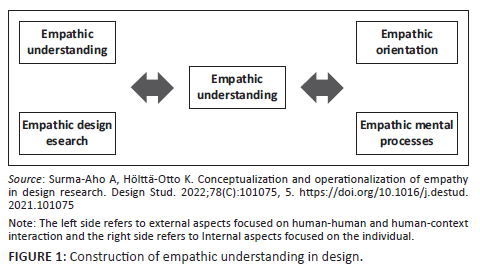
The most complete description of empathy in the design field currently lies in the contributions of Surma-Aho and Hölttä-Otto6Figure 1). Their paradigmatic framing of empathy was designed to bring clarity to the field through the conceptualisation that starts from the premise of designers aiming to understand users and their context. Their model (Figure 1) suggests a productive place to start in providing further depth to the notion of what it means to empathise in the process of design. They placed empathic understanding in the middle of the model - with internal and external factors on either side.
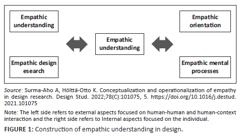
In Surma-Aho and Hölttä-Otto's6empathic design research focuses on methods and processes related to 'empathic design'. Empathic design action refers to the work of designers in considering others, which can result in potential tools for design. Complementing the notion of action, they position empathic orientation as an attitude - a 'conscious preference toward human-centered evidence' - that would impact the behaviour of the designer, and how they treat others. This is not to be confused with empathy as an orientation referred to by Larocco.7,8empathy as mental processes which encompass both the automatic, biological responses (such as caused by mirror neurons) and the controlled, chosen processes by the person. Lastly is empathic understanding as a 'situated phenomenon' impacted by both the internal and external factors described above.66
The details and specifics of what empathic understanding might mean are especially important in the industrial design context. This article aims to add a further dimension to the discussion on empathy in design through an exploration of what to 'do' empathy might mean. This article focuses on the specific context of industrial design practice as an enterprise that exemplifies many kinds of design practices, by focusing on the production of desirable objects that develop by means of relationships between conceptualisers and users. Drouet et al.910
[I]t is unknown to which degree designers and other key stakeholders in an organization are empathic with the users. More precisely, no suitable tools are currently available to support an assessment of empathy and empathy building within service or product development. (p. 1)9
In this article, we present the findings of a systematic review of available literature on empathy in relation to product design practice. The study incorporates a transdisciplinary overview of design and empathy that calls on psychology, neuroscience, the philosophy of relations, and literature on empathy in design practice. The systematic review of literature specifically explores empathy in the relationship between product design practice and users. In this article, we challenge current assumptions about the nature of empathy within the industrial design field - by following a rigorous methodology. The purpose of the systematic review is to seek clarity on the definition of the term empathy within product design practice.
While the term empathy has been used in the design context for many years, the definition thereof remains subjective. As a result of this, a fair amount of background literature is discussed here - to demystify the terms and the field under discussion in the article. For this reason, the literature section in this article refers to the field of industrial design, the concept of empathy in general (as it is referenced in numerous other established fields), and then the vagueness of a definition of design empathy. The methodology section is next. The specific process of a systematic literature review is described in detail, as well as the results of this review, and the strengths and limitations thereof. The findings and discussion follow. Practical implications, such as that there may be behaviours or tools available to designers to assist in situations where they do not easily feel empathy for a user, are considered. Societal implications would include how products could improve, with designers using more tools and methods to better understand the users of products. The formalisation of any form of model of empathy in design would also have theoretical implications, which precede the conclusion of the article.
This literature section covers three areas: establishing the known context of the field of industrial design - the changes in the field have created the space for empathy in relation to users of products. Also discussed is the theoretical construct of empathy, and the complexity of the many notions thereof. Finally, the overview of empathy in industrial design practice sets the scene for the methodology discussed in the following section.
Literature: Industrial design as a petri dish for 'empathic understanding'
All design is arguably about relationships between designers and users. In contrast to bespoke design or design for more rarified usage than the everyday, the nature of industrial design is visibly material, utilitarian and scalable. This makes it an especially useful petri dish for questions of how empathy might encourage the generation of identifiably practical and desirable objects for the users. How 'empathic understanding' fits into design is best explained in terms of how industrial design developed during the industrial revolution in the 18th and 19th centuries. Identical objects could now be rapidly manufactured on a larger scale, moving away from the hand production techniques of craft. The industrial revolution was the first time that 'the act of design became separated from the act of making'.12
During this period, the role of the designer as idea and object generator became more apparent. By 1957, several international organisations had come into being with a focus on industrial design. The tangible object reflected the focus of the industrial designer for much of the 19th and the first half of the 20th centuries. However, as combined product-service-systems became increasingly important, the role of the industrial designer began to change. The designer of the single object began to become intertwined in the facilitation of design with groups of users.13empathy as a key constituent to industrial design practice:
Industrial design … is a trans-disciplinary profession that harnesses creativity to resolve problems and co-create solutions with the intent of making a product, system, service, experience or a business, better … Industrial designers place the human in the centre of the process. They acquire a deep understanding of user needs through empathy and apply a pragmatic, user-centric problem-solving process to design products, systems, services, and experiences. They are strategic stakeholders in the innovation process and are uniquely positioned to bridge varied professional disciplines and business interests. They value the economic, social, and environmental impact of their work and their contribution towards co-creating a better quality of life. (WDO 2019)14
Building on Heskett's view that the discipline of design is continually expanding151616with people. This is a focus for designers of the future - one that will require well-developed interpersonal skills. Imbisi17
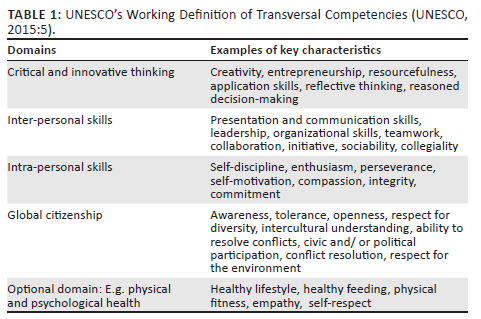
Spotlighting interpersonal skills has been taken up more widely, particularly in the wake of the rapid adoption of artificial intelligence tools, and is reflected in the UNESCO transversal competencies. These are sometimes referred to as '21st century skills', as abilities necessary for youth to navigate a future of uncertain economic, social, technological and environmental changes.18empathy, and other social proficiencies form an important part of the skills required to embrace an undefined future, is clear in Table 1. These social proficiencies include tolerance, collaboration, respect for diversity, self-respect and intercultural understanding.
Literature: Empathy as theoretical construct to underpin 'empathic understanding'
Here, we present some concepts of empathy to inform the idea of 'empathic understanding' needed in design. The UNESCO transversal competencies (as seen in Table 1) and the ability to nurture interpersonal skills are important for designers to facilitate collaborative working in diverse future communities. Collaboration is plainly dependent on the engagement of empathy as an attribute for future designers as they face a future profession that will require even more collaboration. This necessarily means having a deep understanding of what empathy is - as a theoretical construct suitable for implementation in design practice.
UNESCO18empathy as a means to enable people to relate to others in a way that promotes cooperation and unity rather than conflict and isolation. While this is a sound concept, UNESCO does not suggest any specific ways to achieve this. Consequently, a deeper understanding of what empathy means in design practice is elusive. The characteristics and scope of empathy are contentious and much debated, both in popular discourse and across a variety of scholarly fields.
Empathy has been associated with many pro-social behaviours and hailed as the panacea for an ailing global population, as intolerance and hate crimes increase. In terms of a general definition, empathy can be considered as:
n. Psychol. the power of identifying oneself mentally with [and so fully comprehending] a person or object of contemplation.19
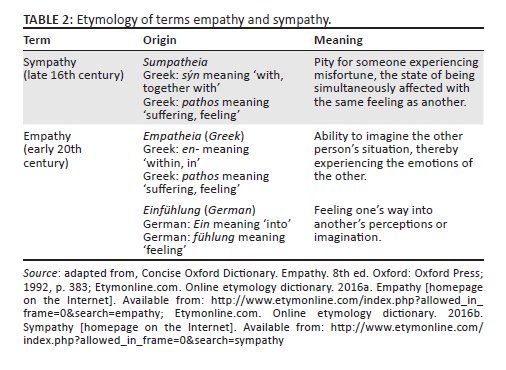
Many attribute the English use of the word 'empathy' to Titchener in 1909, who used the Greek to translate it for his elementary psychology of thought processes. Empathy was used as a translation from the German term Einfühlung and was explained as 'feeling one's way into another's perceptions or imagination'.20,21sympathy is an older term, it seems to be less about understanding the other, and more about feeling pity for the other. In contrast, empathy appears to focus on an understanding of the other (see Table 2 for etymology of the terms).22,23
The idea of empathy has subsequently been defined, described and viewed conceptually in countless different and sometimes conflicting ways. Despite having been researched and debated in fields such as moral theory, medicine, psychology, personality theory, ethical theory, social science, and cognitive neuroscience, no one definition of empathy has been determined.20,21,24
Some themes emerge that provide insight into possible parameters of 'empathic understanding'. Research indicates various perceptions about empathy - as a physical response, such as the mirror neuron response, or an attitude or orientation or as a decision (cognitive). Empathy can be viewed in an overwhelmingly positive light, and as a gateway to prosocial behaviours.2526empathetic reflection in education, suggest that 'emotions are spontaneous, genuine and therefore authentic. If used thoughtfully, emotions can guide the way through the reflective process and help the individual emerge as a reflective practitioner with empathy. However, multiple terms, concepts, attitudes and behaviours labelled 'empathy' create a clouded pool in the neuroscientific, psychological and philosophical literature. Batson27
1.Knowing another person's internal state, including his or her thoughts and feelings (also described as 'cognitive empathy' or 'empathic accuracy').
2.Adopting the posture or matching the neural responses of an observed other (described as 'facial empathy', 'motor mimicry' or 'imitation').
3.Coming to feel as another person feels (also described as 'emotional contagion', 'affective empathy' and 'automatic emotional empathy').
4.Intuiting or projecting oneself into another's situation (described as 'the original definition of empathy' - coined by Titchener in English, 1909).
5.Imagining how another is thinking and feeling (also described as 'imagine other' and 'perspective taking').
6.Imagining how one would think and feel in the other's place (described as 'role taking', 'cognitive empathy', 'projective empathy' and 'imagine self').
7.Feeling distress at witnessing another person's suffering (also described as 'empathic distress' and 'personal distress').
8.Feeling for another person who is suffering (described as 'empathic concern', as well as 'pity', 'compassion' and 'sympathetic distress').
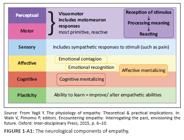
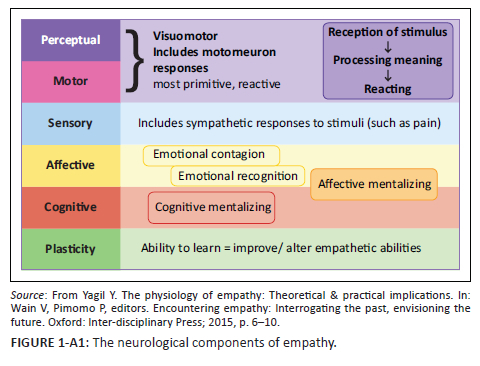
While Batson describes empathy as many internal, psychological actions and responses, Yagil23Figure 1-A1 illustrates these components, and is available in the Appendix 1. Part of the complexity of empathy is how the components behave individually but can also co-respond, react or link to each other.232328
Perhaps controversially, Larocco disputes the view of empathy as always positive, describing it as having been sentimentalised. Larocco2
•Empathy is a combination of emotion and cognition
•Empathy is selective: One does not necessarily empathise with all others, nor all their emotions. One may feel less inclined to empathise with those perceived as antagonistic3
•Empathy is not always positive, and can provoke negative emotions2
•Empathy is an orientation3
[E]mpathy itself is not an emotion or feeling; it is not a content … It is structured 'between' people, having no specific content of its own; whom it imitates and what feelings it mimes are situationally and subjectively specific … (p. 18)2
Thus, empathy orientation is realised as the relationship between people.
[F]eeling a congruent emotion with another person, in virtue of perceiving her emotion with some mental process such as imitation, simulation, projection or imagination. (p. 32)
Empathy is an emotional response [affective], dependent upon the interaction between trait capacities and state influences. Empathic processes are automatically elicited but are also shaped by top-down control processes. The resulting emotion is similar to one's perception [directly experienced or imagined] and understanding [cognitive empathy] of the stimulus emotion, with recognition that the source of the emotion is not one's own. (p. 150)
Literature: The present study - Empathy in industrial design practice
This working definition by Cuff et al.291030
An especially interesting collection of cross-disciplinary embodied perspectives is found in Devecchi and Guerrini,31313131
[S]hift from design WITH empathy to design FOR empathic experiences. The empathic experience, in our view, is per se an end to pursue, rather than a means designers can use to gain insights about end-users'. (p. S4362)
The deep dive into literature, acknowledging the relational, orientational and phenomenological idea of empathy in product design, provides more substance to 'empathic understanding' as presented in the model proposed by Surma-Aho and Hölttä-Otto.6
Research methods and design: Systematic literature review
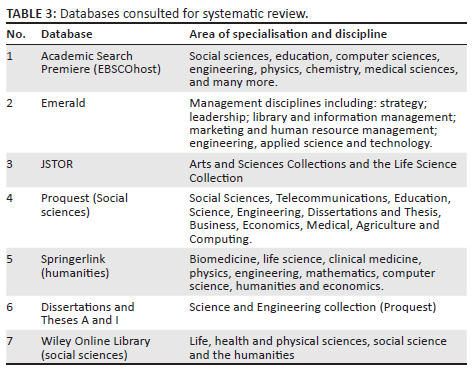
While frequently used as a method for clinical and medical reviews, a systematic review uses a process to identify comprehensively all studies for a specific focused question.32Table 3 and Figure 2), it allows reader(s) to determine their own views on any potential biases.32
The purpose of the systematic review was to add to the details of 'empathic understanding' in design. Given that empathy was mentioned as early as 1997 in relation to design, it was thought that published literature would provide details for design practice. The first step is to determine a sufficiently specific research question or keywords - this is important when dealing with problematic terms such as 'design'. The term 'design' can be used in a variety of ways - as a noun and verb. In addition, it can refer to many fields, and in each field the meaning differs slightly. The research protocol needs to be determined and described - such as which databases or journals to include in the review. This is followed by the literature search, the goal of which is to be exhaustive enough to develop a comprehensive list of potentially relevant studies.33practice, articles discussing projects run with students were also excluded. The final reviewing of the selected articles then reflects a critical analysis of the contents in relation to the research question or terms.33
The search was conducted using the following keywords: 'product design and empathy' and 'industrial design and empathy'. The interchangeable use of the terms 'product design' and 'industrial design' meant that both terms should be searched. The electronic databases that were searched are detailed in Table 3. Chosen databases included sociology, social sciences and engineering, because of the nature of design research as a discipline that is both social and technical. The combination of design with empathy meant that related fields such as health sciences, neuroscience and psychology should also be considered.
To source the most reliable material, peer reviewed journal articles, conference proceedings or academic theses or dissertations were selected, while a focus on relevance meant that it was prudent to choose sources published between 2006 and the end of 2018. The original systematic literature review was conducted at the end of 2016, at the start of the study and in 2019, a further review was conducted, with literature to the end of 2018. The systematic search from January 2017 to the end of December 2018 yielded no results across all databases. For practical purposes, articles written in English were selected.
Systematic literature review: Results
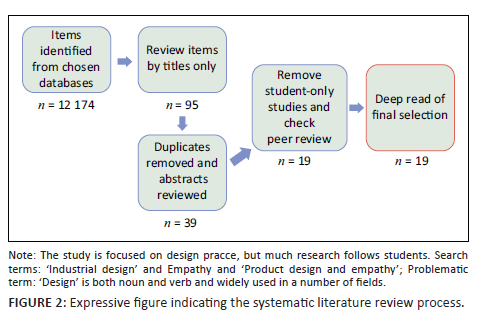
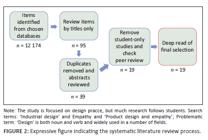
The initial search yielded over 12 000 results. The scale of the results, while considerable (12 174), was appropriate as a wide-net starting point - given the vague nature of the use of the terms 'design' and 'product' in the titles of the articles. The term design is both a verb and a noun in English, which added to the number of results. The term product also frequently includes software or marketing references - outside the scope of product and/or industrial design. Irrelevant fields of design (such as software design, fashion design, service design, textile design and graphic design) were deducted from the body of work based on article titles, which reduced the number of studies to 95. An expressive figure (Figure 2) details this systematic review process.
The second revision was based on relevance and the removal of duplications, as sifted by reading of abstracts that referred to both student and professional designer research subjects, which reduced the number to 39. A third revision removed articles that referenced students (as opposed to professional designers) and engineering design or lacked reference to product design practice - reducing the number to 19. The fourth and final revision used the full text articles to consider whether the article referred to empathy and/or features of empathy in product design practice in user engagement, resulting in a final number of 10 articles.
Systematic literature review: Strengths and limitations
This method brings a scientifically acceptable, rigorous research method into the problem area of vagueness concerning empathy and design. Although the most recent relevant work is highlighted in the introduction of the article, this study is limited in several ways. This is primarily because of the use of the words empathy and design. The term design can be used as both a noun and a verb. In addition, it can refer to many fields, and in each field the meaning differs slightly. These fields include software design, and many computer-related fields, not necessarily product and/or industrial design. In addition, the complex nature of the term empathy itself (as expressed or defined in many different fields, such as neuroscience, psychology, human behaviour, aesthetics) is a limitation. There are also a further two terms that share the vagueness of definition: empathic and empathetic (as discussed by Peter Landwehr34
Ethical considerations
Ethical clearance to conduct this study was obtained from the Faculty of Informatics and Design, Cape Peninsula University of Technology Research Ethics Committee with student no: 191008966, permission granted on 27/ 07/ 2016.
Results: Defining empathy in design practice
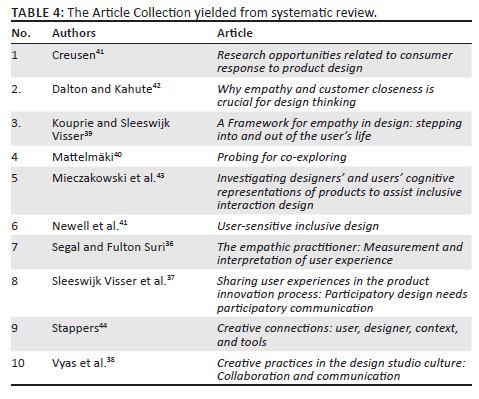
This review identified 10 suitable studies, which yielded only three definitions of empathy or empathy in product design practice. The articles are listed in Table 4. The articles were analysed for empathy and design content. Although the term empathic was used more than 125 times, the meaning remained unclear. In one case, the term empathic was used numerous times, but empathy was never mentioned.35
These articles reveal numerous assumptions about what people understand about empathy, and even the very nature of empathy was vague in description. Empathy appears to be identified as a variety of behaviours, traits, skills or tools. These include empathy as a way of thinking,363637,383837, a quality of the design process,393740393637
Sleeswijk et al.3737means for understanding. Nevertheless, the Model of Communication of User Experiences labels empathy as a quality of communication.
In the study of the complexities of the design studio environment, the term empathy was used numerous times. The importance of designers developing empathy with their users and clients was emphasised.3838empathy is a tool or means for understanding the users.
A small-scale study used small cards as tools - that included information about individual users in a variety of formats, to support empathy, inspiration and engagement.3737identifying with the user, with no indication as to what 'identifying' might mean.
In User-Sensitive Inclusive Design, Newell et al.4545
Although IDEO provides no definition of empathy at all in the paper, they describe their aim of:
'… helping designers feel greater empathy both with the people who will be affected by their decisions, and with the experiences they face.' (p. 795)46
The role of human factors professionals is highlighted here, as people who make the research information accessible to designers. This is achieved by making use of empathy-based strategies for designers:
•Contact with real people (the end users are often different to the designers)
•Gathering information
•Experiencing directly (designers have a genuine experience, e.g. giving blood)
•Roleplaying, improvising and body storming (enactment and empathy tools - such as deafness earplugs for physical simulation of a human physical limitation)
•Storytelling and scenario-building (designers discover product interactions through scenarios)
•Prototyping experience (creating a simulation of an experience).46
However, why these factors listed above are considered 'empathy-based' strategies also remains unclear. This is simply the last-mentioned of the findings, even though it does contribute to the authors' view that the systematic review confirms the lack of clarity around defining the practice of empathy in design.
Discussion: Ideas and definitions of empathy
There were only three definitions of empathy among the 10 papers that were reviewed. Mattelmäki40
Design empathy is the skill of trying to look at the world from another person's perspective, making interpretations and imagining how it could feel or look like. Design empathy supports human-centred design decision-making, but empathic imagination needs backup. (p. 68)
While the rest of the definition falls into perspective-taking (from the field of Psychology), the phrase 'but empathic imagination needs backup' is confusing. Thus, empathy is viewed here as a skill.
Design has moved away from more traditional areas of artefact, environments and graphic symbols. The newer areas of creative practice include well-being, innovation strategies, sustainable development - focus areas that lend themselves to co-design and collaborative practices, and it is here that the user's role is critically and actively interwoven into the design process.40
Although this Segal and Fulton Suri36Human Factors and Ergonomics Society Annual Meeting (1997) falls outside the scope of the study in terms of time (2006-2016), it was included as one of the earliest public mentions of empathy in design practice and is referred to in other peer-reviewed papers. They acknowledge empathy as an important tool in research, for human factors practitioners and designers, and thus open themselves to the possibilities of relying on subjective experience and personal insights as part of the process. They cite an extremely basic definition of empathy:
Empathy: the capacity for participating in the feelings or ideas of another.47
Nonetheless they further assume that 'people cannot not participate in the feelings of others … empathy is a fundamental capacity, one that is essential for our participation in society' (p. 452).36
Empathy is a powerful tool; like all tools, it can be used or misused. Using empathy as a tool has its traps and drawback. The practitioner who uses empathy as a design tool faces a challenge that is well known in other, less strict, fields of psychology: how does one empathize and remain an observer simultaneously? (p. 453)36
This complexity is acknowledged in the labelling of empathy as a way of thinking that should permeate throughout the design process.36
[A]lthough the need is acknowledged, and techniques have emerged, a fundamental understanding is lacking of what empathy in design is, and how it can be achieved. In this study, we review the concept of empathy as discussed in design and in psychology and propose a framework of how empathy can be supported in designing. (p. 438, italics added)39
Empathy is seen as a quality of designing but is certainly undefined. The term 'empathic' has been used as an adjective in relation to design since the 1990s, when companies started to consider that traditional methods of gathering user data were insufficient to develop products successfully, and that they would need to listen more carefully to customers.483940einfuhlung, the authors discuss the affective and cognitive components of empathy, as well as the complexity of perspective taking.39
Implications
Practical implications
If, as suggested by the literature review, empathy is more than simply an intuition and/or inherent ability of the designer - there may be behaviours or tools available to designers to assist in situations where they do not easily feel empathy for a user. Larocco suggests that the greater the difference in personal circumstances, background, race, other factors, the more difficult it becomes for the designer to relate to and/or empathise with or understand the user.35355ethical step, resting upon the assumption that these tools have a profound impact on the quality of the result.54accurate in their empathy, the less likely they were to engage cognitively.2828
Societal implications
The more tools and methods that are available for the designer to better understand the users of products, the better the end products should be. McDonagh55
[T]hat a deeper understanding of users' needs is critical for a designer to respond with more effective product outcomes. By employing empathic modelling strategies, designers can gain insight and shared understanding with their target users. (p. 458)
While the design field has been described 'as a moderator of social change', this idea relies upon designers using empathy to foster deeper understanding and thus enable shared decision-making with stakeholders.56empathy in relation to business growth and innovation. Better designed products and systems have the potential to change society, and this is particularly true considering the new products needed in diverse areas as the world needs to move towards a more sustainable future and the use of innovative materials.
Theoretical implications
If this dichotomous concept of empathy is formalised into a model or theory, it can be disseminated in a more formal manner - for application in industry or higher education. Higher education in design fields would benefit from a very explicit description of empathy, as educators are constantly looking for theoretical means to support professional design studio practice. Van der Walt57
Conclusion
While the need for designers to develop a deep understanding of their users is recommended10,40,45, the details of what empathy means or how to do this have to date been limited. The idea of empathy has not been well demarcated or described, and this vagueness continues to pervade the literature.49250achievement - something to build, model, or reach within design'.
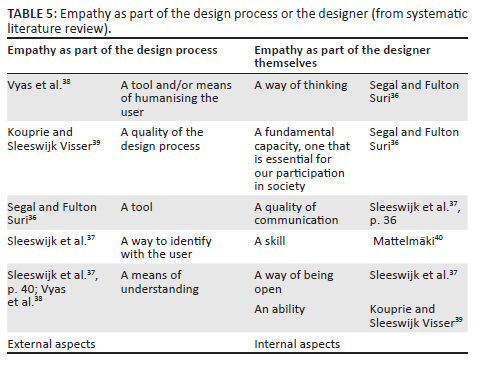
The articles that have been reviewed indicate a variety of views of the term empathy that speak to these notions, with a variety of ideas as to what counts as 'empathic understanding' as suggested by Surma-Aho and Hölttä-Otto.6empathy as part of the design process, and empathy as part of the designer themselves, as visualised in Table 5.
This can be distilled into an internal or external dichotomy, which supports the framing of Surma-Aho and Hölttä-Otto6Figure 1). Internal here meaning the internal or person of the designer - related to thinking, emotional responses, aptitude and similar, in contrast to external ideas - such as behaviours, activities, tools or methods of doing things. Internal ideas such as empathy as a way of being open, an ability, a quality of communication and a fundamental capacity36,37,38external concepts such as empathy as a tool and/or means of humanising the user, a quality of the design process, a means to identify with the user, or a means of understanding, or to identify with the user.37,38,39
This strongly suggests that 'empathic understanding' as proposed by Surma-Aho and Hölttä-Otto65151
While further research is needed into the specifics of the internal and external aspects of the dichotomy of the 'empathic understanding', it remains relevant in the field. Tellez has done research into the place that empathy holds in design practice - and thus in design education. This is echoed by research done into the role of empathy in engineering design education, as explored in Are You Feeling Me? An Exploration of Empathy Development in Engineering Design Education.5253
… Empathy is considered a fundamental ability for designers to acquire an in-depth understanding of people (i.e. end-users and other stakeholders) so that designed products, services, environments, systems, and experiences meet human needs, expectations, and aspirations. Likewise, empathy is integral to the design process; it enables practitioners to approach other people's realities and perspectives, uncover insights, and develop solutions informed and inspired by people's experiences and behavior. Additionally, empathy is considered an ability that promotes 'people-centered' innovation, and a critical competency to deal with the complex socio-technical issues that humanity faces … (p. 1)
To neglect the development and further research into empathic understanding and its components would be irresponsible in terms of developing tomorrow's designers, who hold the key to innovation and the products of the future.
Competing interests
The authors declare that they have no financial or personal relationships that may have inappropriately influenced them in writing this article.
Authors' contributions
V.B. was the primary researcher, while L.J.T. and V.E. contributed to the study design, and supervision. L.J.T. and V.E. also made conceptual contributions, while V.B. did the systematic literature review and subsequent analysis. V.B. wrote the first draft of the article; L.J.T. and V.E. contributed to structure of the draft, as well as making critical revisions thereafter.
Funding information
This research received no specific grant from any funding agency in the public, commercial or not-for-profit sectors.
Data availability
The data that support the findings of this study are available from the corresponding author, V.B., upon reasonable request.
Disclaimer
The views and opinions expressed in this article are those of the author(s) and are the product of professional research. It does not necessarily reflect the official policy or position of any affiliated institution, funder, agency, or that of the publisher. The author(s) are responsible for this article's results, findings, and content.
References
Acknowledgements
Literature
-
1.Cross N. Designerly ways of knowing. Design Stud. 1982;3(4):221-227. https://doi.org/doi:10.1016/0142-694X(82)90040-0
» https://doi.org/doi:10.1016/0142-694X(82)90040-0 - 2.Cross N. Design thinking: Understanding how designers think and work. London: Bloomsbury Academic; 2011.
-
3.Zingoni M. Beyond aesthetics, empathy first. Des J. 2019;22(3):351-370. https://doi.org/10.1080/14606925.2019.1592808
» https://doi.org/10.1080/14606925.2019.1592808 -
4.Sanders E, Stappers PJ. Co-creation and the new landscapes of design. CoDesign. 2008;4(1):5-18. https://doi.org/10.1080/15710880701875068
» https://doi.org/10.1080/15710880701875068 -
5.Lin K-C, Miao W, Wan-Yu L. How to implement inclusive design into distinctive feature hand tool? A design study on fine operation-aid screwdriver. Heliyon. 2022;8(7):e09866. https://doi.org/10.1016/j.heliyon.2022.e09866
» https://doi.org/10.1016/j.heliyon.2022.e09866 -
6.Surma-Aho A, Hölttä-Otto K. Conceptualization and operationalization of empathy in design research. Design Stud. 2022;78(C):101075. https://doi.org/10.1016/j.destud.2021.101075
» https://doi.org/10.1016/j.destud.2021.101075 - 7.Larocco S. Empathy as orientation rather than feeling: Why empathy is ethically complex. In: Wain V, Pimomo P, editors. Encountering empathy: Interrogating the past, envisioning the future. Oxford: Inter-disciplinary Press; 2015, p. 17-24.
- 8.Larocco S. Empathy as orientation rather than feeling: Why empathy is ethically complex. In: Nelems R, Theo N, editors. Exploring empathy: Its propagations, perimeters and potentialities. Leiden: Brill Rodopi; 2017, p. 1-15.
- 9.Drouet L, Bongard-Blanchy K, Koenig V, Lallemand C. Empathy in design scale: Development and initial insights. CHI '22 Extended Abstracts. 2022; April 29-May 05, New Orleans, LA.
-
10.Li J, Surma-aho A, Chang-Arana AM, Hölttä-Otto K. Understanding customers across national cultures: The influence of national cultural differences on designers' empathic accuracy. J Eng Des. 2021;32(10):538-558. https://doi.org/10.1080/09544828.2021.1928022
» https://doi.org/10.1080/09544828.2021.1928022 -
11.Zhan X, Walker S, Hernandez-Pardo R, Evans M. Craft and sustainability: Potential for design intervention in crafts in the Yangtze river delta, China. Des J. 2017;20(suppl. 1):S2919-S2934. https://doi.org/10.1080/14606925.2017.1352802
» https://doi.org/10.1080/14606925.2017.1352802 -
12.Chang K, King S. Understanding industrial design [homepage on the Internet]. Safari Books Online; 2016 [cited 2019 Aug 10]. Available from: https://www.oreilly.com/library/view/understanding-industrial-design/9781491920381/ch01.html
» https://www.oreilly.com/library/view/understanding-industrial-design/9781491920381/ch01.html -
13.Joore P, Brezet H. A multilevel design model: The mutual relationship between product-service system development and societal change processes. J Clean Prod. 2015;97:92-105. https://doi.org/10.1016/j.jclepro.2014.06.043
» https://doi.org/10.1016/j.jclepro.2014.06.043 -
14.World Design Organisation. Definition of industrial design [homepage on the Internet]. World Design Organisation; 2019. Available from: https://wdo.org/about/definition/
» https://wdo.org/about/definition/ -
15.Heskett J. Past, present, and future in design for industry. Des Issues. 2001;17(1):18-26. https://doi.org/10.1162/07479360152103804
» https://doi.org/10.1162/07479360152103804 -
16.Tan L. Perspectives on the changing role of the designer: Now and to the future [homepage on the Internet]. ICSID World Design Congress: Education Conference, Singapore; 2009; 22 November 2009. Available from: http://www.academia.edu/217247/Perspectives_on_the_changing_role_of_the_designer_Now_and_to_the_future
» http://www.academia.edu/217247/Perspectives_on_the_changing_role_of_the_designer_Now_and_to_the_future -
17.Imbesi L. Design for next design. Des J. 2017;20(suppl. 1): S9-S15. 12th EAD Conference Sapienza University of Rome 12-14 April 2017. https://doi.org/10.1080/14606925.2017.1352759
» https://doi.org/10.1080/14606925.2017.1352759 -
18.UNESCO. Transversal competencies in education policy and practice. 2013 Asia-Pacific Education Research Institutes Network (ERI-Net) Regional Synthesis Report [homepage on the Internet]. Paris: UNESCO; 2015. Available from: http://unesdoc.unesco.org/images/0023/002319/231907E.pdf
» http://unesdoc.unesco.org/images/0023/002319/231907E.pdf - 19.Concise Oxford Dictionary. 8th ed. Oxford: Oxford Press; 1992. Empathy; p.383.
- 20.Oxley JC. The moral dimensions of empathy: Limits and applications in ethical theory and practice. Basingstoke: Palgrave Macmillan; 2011.
- 21.Coplan A, Goldie P, editors. Empathy: Philosophical and psychological perspectives. Oxford: Oxford University Press; 2011.
-
22.Etymonline.com. Online Etymology Dictionary [homepage on the Internet]. Empathy; 2016a. Available from: http://www.etymonline.com/index.php?allowed_in_frame=0&search=empathy.
» http://www.etymonline.com/index.php?allowed_in_frame=0& search=empathy -
23.Etymonline.com. Online Etymology Dictionary. Sympathy [homepage on the Internet]. 2016b. Available from: http://www.etymonline.com/index.php?allowed_in_frame=0&search=sympathy
» http://www.etymonline.com/index.php?allowed_in_frame=0& search=sympathy - 24.Yagil Y. The physiology of empathy: Theoretical & practical implications. In: Wain V, Pimomo P, editors. Encountering empathy: Interrogating the past, envisioning the future. Oxford: Inter-disciplinary Press; 2015, p. 3-16.
-
25.Riess H. The science of empathy. Patient Exp J. 2017;4(2):74-77. https://doi.org/10.1177/2374373517699267
» https://doi.org/10.1177/2374373517699267 -
26.Marathe A, Sen A. Empathetic reflection: Reflecting with emotion. Reflect Pract. 2021;22(4):566-574. https://doi.org/10.1080/14623943.2021.1927693
» https://doi.org/10.1080/14623943.2021.1927693 - 27.Batson CD. These things called empathy: Eight related but distinct phenomena. In: Decety J, Ickes W, editors. The Social Neuroscience of Empathy. Cambridge, MA: MIT Press; 2009, p. 3-15.
-
28.Cameron CD, Hutcherson CA, Ferguson AM, Scheffer JA, Hadjiandreou E, Inzlicht M. Empathy is hard work: People choose to avoid empathy because of its cognitive costs. J Exp Psychol. 2019;148(6):962-976. https://doi.org/10.1037/xge0000595
» https://doi.org/10.1037/xge0000595 -
29.Cuff BMP, Brown SJ, Taylor L, Howat DJ. Empathy: A review of the concept. Emot Rev. 2016;8(2):144-153. https://doi.org/10.1177/1754073914558466
» https://doi.org/10.1177/1754073914558466 -
30.McDonagh D, Thomas J. Design + empathy = Intuitive design outcomes. Des J. 2011;14(2):147-150. https://doi.org/10.2752/175630611X12984592779881
» https://doi.org/10.2752/175630611X12984592779881 -
31.Devecchi A, Guerrini L. Empathy and design. A new perspective. Des J. 2017;20(suppl. 1):S4357-S4364. https://doi.org/10.1080/14606925.2017.1352932
» https://doi.org/10.1080/14606925.2017.1352932 -
32.Garg, Amit X, Hackam D, Tonelli M. Systematic review and meta-analysis: When one study is just not enough. CJASN. 2008;3(1):253-260. https://doi.org/10.2215/CJN.01430307
» https://doi.org/10.2215/CJN.01430307 -
33.Wright RW, Brand RA, Dunn W, Spindler KP. How to write a systematic review. Clin Orthop Relat R. 2007;455:23-29. https://doi.org/10.1097/BLO.0b013e31802c9098
» https://doi.org/10.1097/BLO.0b013e31802c9098 -
34.Landwehr P. Empathic design vs empathetic design: A history of confusion [homepage on the Internet]. 2007 [cited 2014 Jun 12]. Available from: http://dataprivacylab.org/dataprivacy/projects/dialectics/designmethods/plandweh.pdf
» http://dataprivacylab.org/dataprivacy/projects/dialectics/designmethods/plandweh.pdf -
35.Luh D-B, Ma C-H, Hsieh M-H, Huang C-Y. Applying an emphatic design model to gain an understanding of consumers' cognitive orientations and develop a product prototype. J Ind Eng Manag. 2012;5(1):229-258. https://doi.org/10.3926/jiem.408
» https://doi.org/10.3926/jiem.408 -
36.Segal LD, Fulton Suri J. The empathic practitioner: Measurement and interpretation of user experience. Proc Hum Factors Ergonom Soc Ann Meet. 1997;41(1):451-454. https://doi.org/10.1177/107118139704100199
» https://doi.org/10.1177/107118139704100199 -
37.Sleeswijk Visser F, Van Der Lugt R, Stappers PJ. Sharing user experiences in the product innovation process: Participatory design needs participatory communication. Creat Innov Manag. 2007;16 (1):35-45. https://doi.org/10.1111/j.1467-8691.2007.00414.x
» https://doi.org/10.1111/j.1467-8691.2007.00414.x -
38.Vyas D, Van der Veer G, Nijholt A. Creative practices in the design studio culture: Collaboration and communication. Cogn Technol Work. 2013;15:415-443. https://doi.org/10.1007/s10111-012-0232-9
» https://doi.org/10.1007/s10111-012-0232-9 -
39.Kouprie M, Sleeswijk Visser F. A Framework for empathy in design: Stepping into and out of the user's life. J Eng Design. 2009;20(5):437-448. https://doi.org/10.1080/09544820902875033
» https://doi.org/10.1080/09544820902875033 -
40.Mattelmäki T. Probing for co-exploring. CoDesign. 2008;4(1):65-78. https://doi.org/10.1080/15710880701875027
» https://doi.org/10.1080/15710880701875027 -
41.Creusen MEH. Research Opportunities Related to Consumer Response to Product Design. J.Prod. Innov. Manag. 2011;28(3):405-408. https://doi.org/10.1111/j.1540-5885.2011.00812.x
» https://doi.org/10.1111/j.1540-5885.2011.00812.x -
42.Dalton J, Kahute T. Why Empathy and Customer Closeness is Crucial for Design Thinking. Des Manag Rev. 2016(2): 20-27. https://doi.org/10.1111/drev.12004
» https://doi.org/10.1111/drev.12004 -
43.Mieczakowski A, Langdon P, Clarkson PJ. Investigating designers' and users' cognitive representations of products to assist inclusive interaction design. Universal Access Inf. 2013(12):279-296. https://doi.org/10.1007/s10209-012-0278-8
» https://doi.org/10.1007/s10209-012-0278-8 -
44.Stappers, Pieter Jan (2006). Creative connections: user, designer, context, and tools. Pers Ubiquit Comput. 2006(10):95-100. https://doi.org/10.1007/s00779-005-0024-9
» https://doi.org/10.1007/s00779-005-0024-9 -
45.Newell AF, Gregor P, Morgan EM, Pullin G, Macaulay AC. User-sensitive inclusive design. Univ Access Inf Soc. 2011;10:235-243. https://doi.org/10.1007/s10209-010-0203-y
» https://doi.org/10.1007/s10209-010-0203-y -
46.Fulton Suri J. Communicating with designers: The role of empathy, evidence and inspiration. Proc Hum Factors Ergonom Soc Ann Meet. 2000;44(38):795-798. https://doi.org/10.1177/154193120004403830
» https://doi.org/10.1177/154193120004403830 - 47.Leonard D, Rayport J. Spark innovation through empathic design. Harvard Bus Rev. Boston, MA: Harvard Business School Publishing Corporation, November - December 1997, p. 102-113.
-
48.Dong Y, Dong H, Yuan S. Empathy in design: A historical and cross-disciplinary perspective. Advances in Neuroergonomics and Cognitive Engineering. Proc the 2017 Int Conf Appl Hum Factors Ergonom (AHFE). 2018;586:295-304. https://doi.org/10.1007/978-3-319-60642-2_28
» https://doi.org/10.1007/978-3-319-60642-2_28 - 49.Bennett CL, Rosner DK. The promise of empathy: Design, disability, and knowing the "other". Proceedings of CHI Conference on Human Factors in Computing Systems Proceedings. 2019; May 4-9. Glasgow, Scotland, UK. ACM, NY; 2019, p. 298, 13 pages.
- 50.Fila N, Hess J. In their shoes: Student perspectives on the connection between empathy and engineering. Proceedings of 123rd American Society for Engineering Education Annual Conference and Exposition 2016: New Orleans, Louisiana, USA, 26-29 June 2016. Paper ID #16286. Red Hook, NY: Curran Associates; 2017.
-
51.Alzayed MA, McComb C, Menold J, Huff J, Miller SR. Are you feeling me? An exploration of empathy development in engineering design education. J Mech Design. 2021;143(11):112301 (14 pages). https://doi.org/10.1115/1.4048624
» https://doi.org/10.1115/1.4048624 -
52.Tellez FA. Developing empathy in the academic design studio: Conclusions from an empirical study in graduate and undergraduate programs in industrial design [homepage on the Internet]. Universidad Jorge Tadeo Lozano Bogota, Colombia; 2019. Available from: http://hdl.handle.net/20.500.12010/8608
» http://hdl.handle.net/20.500.12010/8608 -
53.Baaki J, Tracey M, Bailey E, Shah S. Graduate instructional design students using empathy as a means to an end. J Des Res. 2021; 19(4/5/6):290-307. https://doi.org/10.1504/JDR.2021.124217
» https://doi.org/10.1504/JDR.2021.124217 -
54.Heylighen A, Dong A. To empathise or not to empathise? Empathy and its limits in design. Design Stud. 2019;65:104-124. https://doi.org/10.1016/j.destud.2019.10.007
» https://doi.org/10.1016/j.destud.2019.10.007 -
55.McDonagh D, Thomas J. Rethinking design thinking: Empathy supporting innovation. Aust Med J. 2010;3(8):458-464. https://doi.org/10.4066/AMJ.2010.391
» https://doi.org/10.4066/AMJ.2010.391 - 56.Smeenk W, Sturm J, Eggen B. A comparison of existing frameworks leading to an empathic formation compass for co-design. Int J Des. 2019;13(3):53-68.
-
57.Van der Waldt G. The judicious use of theory in social science research. J Transdiscipl Res S Afr. 2021;17(1):a1039. https://doi.org/10.4102/td.v17i1.1039
» https://doi.org/10.4102/td.v17i1.1039

Accepted: 29 Jan. 2024
Published: 11 Apr. 2024