The management of mountain gorilla tourism in Uganda: Are the socio-economic benefits realised?
Abstract
Despite being endangered, the mountain gorilla (gorilla beringei beringei) is inextricably linked to tourism. With only 1069 primates globally, expanded conservation initiatives need to be extended to allow for continuous and sustainable benefits from gorilla tourism. This unique tourism niche has positively changed the economies of Uganda, Rwanda and the Democratic Republic of Congo (DRC), where they are endemic. Vast opportunities emanate from the management and conservation of the great apes (e.g. poverty alleviation, economic growth, etc.). The study examined the management of mountain gorilla tourism and its socio-economic contribution to selected stakeholders in Butogota, a rural community next to the Bwindi Impenetrable National Park (BINP). To achieve this, structured face-to-face interviews were conducted with six stakeholder groups. In order to gather samples for the study, convenience sampling and snowball sampling were used. Data were collected using an interviewer-administered questionnaire and analysed with the help of the constant comparative method. Key findings show that mountain gorilla tourism activities benefit people in a number of ways, including job creation, entrepreneurial opportunities and expanded local infrastructure. The study highlights key imperatives for the effective management of mountain gorilla tourism, including developing infrastructure, investment in training, empowerment of locals, controlled access, and more conservation and dealing with the persistent corruption problem.
mountain gorilla; conservation; gorilla tourism; primate; Bwindi Impenetrable National Park
Introduction
The mountain gorilla (gorilla beringei beringei), which is one of the two subspecies of the eastern gorilla, has been classified by the International Union for Conservation of Nature (IUCN)'s Red List of Threatened SpeciesTM as 'Critically Endangered' for more than two decades.1,23,4,54,62,37,8,9
Mountain gorillas are endemic to only three African countries, which are the Democratic Republic of Congo (DRC), Rwanda and Uganda.1011222
Uganda's Bwindi forest has afforded opportunities for ecotourism and economic growth through mountain gorilla tourism. Gorilla-viewing or trekking tourism involves tourists visiting the great apes in their natural habitation.11,12131415
The current study examined the management of mountain gorilla tourism and its socio-economic contribution to selected stakeholders in Butogota, a rural community located next to BINP in Uganda. The article starts by delving into the Bwindi forest and presents relevant literature, offering a discussion of the impact of mountain gorilla tourism on communities. It also highlights the management strategies for monitoring mountain gorilla tourism. The article goes on to provide the research design and methodology for the study. The results are then discussed and elaborated, and finally, the conclusions and recommendations drawn from the study's findings are presented.
Bwindi Impenetrable National Park
The BINP is one of the world's oldest, most complex and biologically diverse ecosystems.16171819
Prior to the gazettement of Bwindi to a National Park, rampant uncontrolled human activities (e.g. settlement, logging, hunting, gold mining/panning, honey harvesting, pit sawing, etc.) within the forest threatened biodiversity, thus prompting authorities to strengthen conservation efforts.202021,2223
Strategies for managing mountain gorilla tourism
When it comes to dealing with the disputes that arise between the park and the locals, the Uganda Wildlife Authority (UWA) came up with strategies to ensure that community members benefit from the PA.21192224,25
Benefits of mountain gorilla tourism on communities
The unique mountain gorilla tourism tends to create several benefits to the host communities.12,2627,28,2930102827,2831,3231
The revenue-sharing scheme has also benefited several communities surrounding most national parks.332634
Theoretical frameworks
The Stakeholder Theory (ST) and Social Exchange Theory (SET) contextualise and guide the current study. The successful management of natural resources usually involves many stakeholders who may have a varying degree of interest. For an exchange to happen, there should be a mutual agreement between the stakeholders, thus necessitating the need to adopt two frameworks, the ST and SET to aid the understanding of the management strategies for monitoring gorilla tourism. The ST developed by Freeman353635,37,383940
The SET was established by Ap4142
Research design and methodology
Study location and population
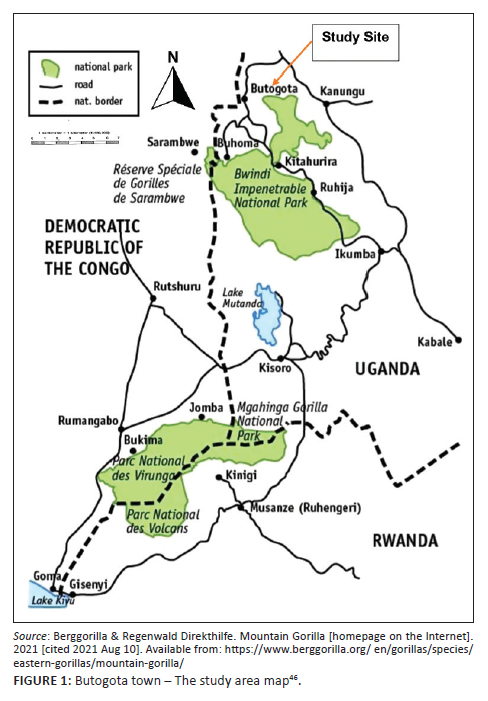
The study was conducted in Butogota Town Council in southwestern Uganda from January 2019 through to April 2019, near the borders of DRC and Rwanda (Figure 1). Butogota is one of the parishes in Kanungu District next to BINP. Bwindi, an Afromontane forest, with much activity from the conservation and protection of the great apes, is part of the Albertine Rift.234319,4445434344
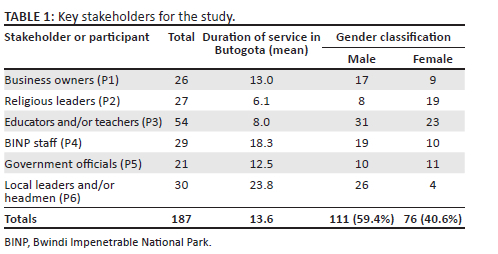
This exploratory and qualitative research study was conducted to identify the socio-economic contributions of mountain gorilla tourism. In addition, the study recommends the management strategies that could be adopted for a sustainable future mountain gorilla tourism development in Uganda. Face-to-face interviews were conducted with selected stakeholder groups in the Butogota area. These stakeholder groups included BINP staff, government officials, business owners, church leaders, educators and/or teachers and local leaders and/or headmen. For reporting purposes, the study participants were allocated an identifying number to help link the responses to the participating stakeholder groups (business owners - P1; religious leaders - P2; educationist and/or teachers - P3; BINP staff - P4; government officials - P5 and local leaders and/or headmen - P6) in the Butogota area. To gather the sample for the study, convenience and snowballing sampling approaches were used.47474849Table 1, along with their gender and the mean years of working in the study area.
Ethical considerations
In complying with research ethics and ensuring the integrity of this study, the researchers first sought permission from the UWA (Reference number: FOD/96/02). Uganda Wildlife Authority is a semi-autonomous government agency in Uganda that deals with the management and conservation of wildlife and natural resources. Secondly, the study was approved by the Cape Peninsula University of Technology's Faculty of Business and Management Sciences Ethics Committee (Certificate Clearance number: 2018FBRC533) as this formed part of a student's master project. The collected data were analysed through the use of the constant comparative method. This analysis technique is frequently used to code and analyse data from the developed concepts.5051
[T]he constant comparative method combines systematic data collection, coding and analysis with theoretical sampling in order to generate theory that is integrated, close to the data and expressed in a form clear enough for further testing. (p. 280)
Four stages of the constant comparative method were followed, and these included comparing incidents, integrating categories, delimiting and writing the theory.52
Results and discussions
Participant profile
To guarantee that data were collected from the appropriate participants, it was critical to include a description of those who took part in the study. Understanding participant profile was crucial as it provides context that could give meaning to the interpretation of the study findings. As a result, this study began by finding stakeholders or participants (P) who held the necessary and pertinent features to supply the researchers with the data necessary to accomplish the study's purpose. A thematic analysis of 187 semi-structured interviews with specified stakeholders was done (see Table 1). As revealed from the study's findings, business owners in the study area had been operating for an average of 13 years. Several community-based organisations (CBOs) in the study area established a variety of tourism ventures including accommodation (hotels, lodges, B&B, etc.), arts and craft market (souvenirs shops), bottle stores, forex exchange services, tour companies and others. The local entrepreneurs and CBOs had been operating in Butogota for a period spanning from 1 year to nearly 4 decades.
Religious leaders who participated in this study had an average of 6.1 years of involvement with church activities in the study area, and this ranged from half a year to slightly above four decades. The majority of religious leaders were Christians, Uganda's most widely practised religion.53
Benefits from mountain gorilla tourism
The study participants indicated how they benefited from mountain gorilla tourism activities in their area. The responses varied from participants with contributions that included job creation, entrepreneurial opportunities, infrastructure development and many other benefits. The researchers were interested in understanding the extent to which mountain gorilla tourism operations benefit the churches in the study area and beyond, hence religious leaders were interviewed. Some religious leaders expressed satisfaction with gorilla tourism activities, for instance, one participant stated that they acquired their 'holy book', as reflected in this remark, '… we were given Bibles a few years ago' (Religious leader, female, 38 years old, 4 years working as a pastor in the study area). Another pastor indicated how mountain gorilla activities benefit the youth, particularly job opportunities. The theme on jobs as seen in the findings is illustrated in the following excerpt, '… some new creativity and innovation have been created hence improving standards of living… money is earned as some do this as full-time jobs or means of making a living' (Religious leader, male, 56 years old male, 7 years of working in study area).
The majority of business respondents admitted that gorilla tourism has impacted their operations in a variety of ways. Some business owners revealed that tourist activities in the area had led to the establishments of marketplaces for their products that aided in the expansion of their businesses. In addition, one business owner highlighted the significance of having tourism activities such as mountain gorilla tourism in the area as it also brings customers to business as evidenced by the following quote; '… tourism in this area has enabled my business to grow and mostly in a positive way … tourists have formed part of my customers' (Business owner, female, 48 years old, lived in the study area for 18 years). From the restaurant and accommodation sector, a guesthouse owner noted that tourists make use of the amenities at their establishments after the mountain gorilla-tracking activity as shown from the following quotation:
'Indeed, mountain gorilla-tourism is helpful to us business-people; look at the number of tourists who come to track the gorillas, most of them, come and have lunch and breakfast at the guest house… I am happy and would like to see this kind of tourism growth. My children are at good schools, and this is possible because of tourism who (sic) support my business….' (Business owner, male, 53 years old, lived in the study area for 16 years)
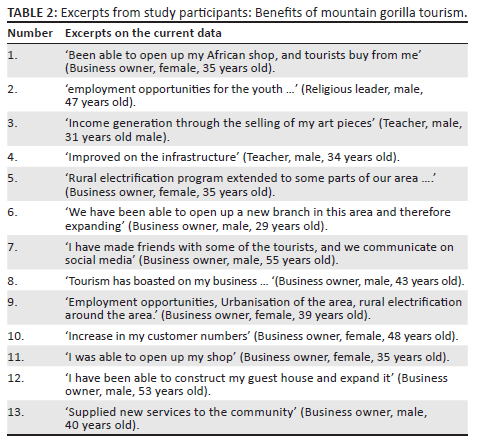
As previously stated, tourism activities in the area have resulted in local tourism products and artefacts finding a market thereby increasing profits for business owners. This was supported by the following excerpt; '… markets have been created thus the development of the business' (Business owner, male, 33 years old, lived in the study area for 9 years), and '… more revenue has been realised from the tourists purchasing from our business' (Business owner, female, 28 years old, lived in the study area for 6 years). Because tourism has provided villagers with several economic opportunities, it has uplifted their standard of living. Local infrastructure, such as road networks, leading to the key tourist attractions, has been renovated, and this has benefited local companies that also rely on this infrastructure. The roads should, however, be maintained and improved regularly. The Butogota town region has benefited from government projects, including rural electricity programs, which most stakeholders who took part in the study attributed to the area's burgeoning tourism industry. Table 2 shows selected excerpts from the study participants highlighting some of the contributions of mountain gorilla tourism activities in Butogota.
Arts and crafts businesses in the area have been supported by activities associated with mountain gorilla tourism taking place in the Botagota area through the buying of souvenirs and other artefacts. However, one responder voiced concern about severe rivalry amongst businesses as extracted from the except, '… some tourists buy from me, but there is also too much competition which requires us to look at ways to become competitive, for example stocking a variety of wares…' (Business owner, male, 41 years old, lived in the study area for 15 years). Because of the strong competition amongst businesses, it also stimulated the delivery of quality products and services. Generally, the findings revealed that whilst others perceived the benefits from mountain gorilla tourism to be more positive to them, the other participating groups do not share the same sentiments.
Management strategies for monitoring mountain gorilla tourism
In determining the ways to improve mountain gorilla tourism activities in the study area, the participants were requested to suggest mountain gorilla tourism management strategies best suited for the sustainability of this unique tourism product. The study revealed seven themes for the desired management for mountain gorilla tourism, and these are summarised below:
•fighting corruption
•controlled access and more conservation
•involving more local participation
•infrastructure development
•deal with poaching
•training of staff
•local empowerment.
Corruption
'Replace the staffs (sic) who are transferred to other centres rather than leaving a few staffs (sic) doing more work, … it is important to train more guides and other staffs (sic) and these need to come from the area - local employment ….' (Government worker, male, 54 years old, 16 years living in the study area)
Conclusion
Sections of this manuscript are published in a thesis submitted by Imelda Amony in partial fulfilment of the requirements for the degree of Master of Technology: Tourism and Hospitality Management in the Faculty of Business and Management Sciences at the Cape Peninsula University of Technology entitled: 'The impact of mountain gorilla tourism: Perspectives of the management of the attraction'. Supervisor: Professor JP Spencer, April 2021. Refer: http://etd.cput.ac.za/bitstream/20.500.11838/3219/1/Imelda_Amony_214288005.pdf.
Competing interests
The authors declare that they have no financial or personal relationships which may have inappropriately influenced them in writing this article.
Authors' contributions
G.M., W.M., C.N.D. and I.A. all contributed equally to this work.
Funding information
This research received no specific grant from any funding agency in the public, commercial or not-for-profit sectors.
Data availability
Data sharing is not applicable to this article as no new data were created or analysed in this study.
Disclaimer
The views expressed in the article are those of the authors and not of the institution or the funder.
References
Acknowledgements
The researchers would like to acknowledge the residents of the Butogota Town Council, for participating in this study. Also, a special mention goes to the Uganda Wildlife Authority for granting permission for the study to proceed.
Literature review
-
1.Hassell JM, Zimmerman D, Cranfield MR, et al. Morbidity and mortality in infant mountain gorillas (Gorilla beringei beringei): A 46-year retrospective review. Am J Primatol. 2017 Oct;79(10):e22686. https://doi.org/10.1002/ajp.22686
» https://doi.org/10.1002/ajp.22686 - 2.Hickey JR, Basabose A, Gilardi KV, et al. Gorilla beringei ssp. Beringei, mountain gorilla: Amendment version. London: The IUCN Red List of Threatened Species; 2020.
- 3.Hickey JR, Granjon AC, Vigilant L, et al. Virunga 2015-2016 surveys: Monitoring mountain gorillas, other select mammals, and illegal activities. Kigali: GVTC, IGCP & Partners; 2019.
-
4.Guschanski K. We don't know how many mountain gorillas live in the wild. Here's why [homepage on the Internet]. 2020 [cited 2021 Feb 28]. Available from: https://theconversation.com/we-dont-know-how-many-mountain-gorillas-live-in-the-wild-heres-why-129632
» https://theconversation.com/we-dont-know-how-many-mountain-gorillas-live-in-the-wild-heres-why-129632 -
5.Rurangwa ML, Whittaker RJ. Making space for birds: Sourcing solutions from the mountain gorilla conservation model in Rwanda. J Nat Conserv. 2020;54(2020):1-10. https://doi.org/10.1016/j.jnc.2020.125797
» https://doi.org/10.1016/j.jnc.2020.125797 -
6.Cannon JC. Mountain gorilla census reveals further increase in numbers [homepage on the Internet]. 2019 [cited 2021 Mar 2]. Available from: https://news.mongabay.com/2019/12/mountain-gorilla-census-reveals-further-increase-in-numbers/
» https://news.mongabay.com/2019/12/mountain-gorilla-census-reveals-further-increase-in-numbers/ -
7.Mukanjari S, Bednar-Friedl BI, Muchapondwa E, Zikhali P. Evaluating the prospects of benefit sharing schemes in protecting mountain gorillas in Central Africa. Nat Resour Model. 2013;26(4):455-479. https://doi.org/10.1111/nrm.12010
» https://doi.org/10.1111/nrm.12010 -
8.Uwayo P, Nsanzumukiza VM, Maniragaba A, Nsabimana AP, Akimanizanye V. Contribution of former poachers for Wildlife Conservation in Rwanda Volcanoes National Park. J Geo Env Protect. 2020;8(4):47-56. https://doi.org/10.4236/gep.2020.84004
» https://doi.org/10.4236/gep.2020.84004 -
9.Watts DP. Responses to dead and dying conspecifics and heterospecifics by wild mountain gorillas (Gorilla beringei beringei) and chimpanzees (Pan troglodytes schweinfurthii). Primates. 2020;61(1):55-68. https://doi.org/10.1007/s10329-019-00735-y
» https://doi.org/10.1007/s10329-019-00735-y -
10.Maekwa M, Lanjouw A, Rutagarama E, Sharp D. Mountain gorilla tourism generating wealth and peace in post-conflict Rwanda. Nat Res Forum. 2013;37(2):127-137. https://doi.org/10.1111/1477-8947.12020
» https://doi.org/10.1111/1477-8947.12020 - 11.Spencer J, Amony I, Dube C. The impacts of mountain gorilla tourism in Uganda: Can participating stakeholders benefit? Paper presented at: 3rd ICTR, Academic Conferences International Limited; 2020 Mar 27-28; Valencia, Spain. p. 355-362.
- 12.Muresherwa G, Amony I, Iwu CG, Dube CN. The impact of mountain gorilla tourism: A residents' perspective. AJHTL. 2020;9(2):1-18.
-
13.Scally A, Dutheil JY, Hillier LW, et al. Insights into hominid evolution from the gorilla genome sequence. Nature. 2012;483(7388):169-175. https://doi.org/10.1038/nature10842
» https://doi.org/10.1038/nature10842 - 14.Shutt KA. Wildlife tourism and conservation: An interdisciplinary evaluation of gorilla ecotourism in Dzanga-Sangha [unpublished dissertation]. Central African Republic: Durham Durham University; 2014.
- 15.Maisels F, Bergl R, Williamson EA. Gorilla gorilla. Gland: International Union for Conservation of Nature; 2016.
-
16.Amusa C, Rothman J, Odongo S, et al. The endangered African Great Ape: Pesticide residues in soil and plants consumed by Mountain Gorillas (Gorilla beringei) in Bwindi Impenetrable National Park, East Africa. Sci Total Environ. 2021;758(2021):1-11. https://doi.org/10.1016/j.scitotenv.2020.143692
» https://doi.org/10.1016/j.scitotenv.2020.143692 -
17.Weber A, Kalema-Zikusoka G, Stevens NJ. Lack of rule-adherence during mountain gorilla tourism encounters in Bwindi Impenetrable National Park, Uganda, places gorillas at risk from human disease. Front Public Health. 2020;8(1):1-13. https://doi.org/10.3389/fpubh.2020.00001
» https://doi.org/10.3389/fpubh.2020.00001 -
18.Richard H. 5 reasons you need to see gorillas in Uganda [homepage on the Internet]. 2018. [cited 2021 Mar 10]. Available from: https://www.nationalgeographic.com/adventure/article/reasons-trek-see-mountain-gorillas-uganda
» https://www.nationalgeographic.com/adventure/article/reasons-trek-see-mountain-gorillas-uganda - 19.Tumusiime DM, Bitariho R, Sandbrook C. Bwindi Impenetrable National Park: A celebrity site for integrated conservation and development in Uganda. In: Sandbrook C, Cavanagh CJ, Tumusiime DM. editors. Conservation and development in Uganda Earthscan conservation and development. New York, NY: Routledge, 2018; p. 61-84.
- 20.Twinamatsiko ME. Linking conservation to the implementation of revenue sharing policy and livelihood improvement of people bordering Bwindi Impenetrable National Park [unpublished dissertation]. Uganda: Mbarara University of Science and Technology; 2015.
-
21.Hamilton A, Cunningham A, Byarugaba D, Kayanja F. Conservation in a region of political instability: Bwindi Impenetrable Forest, Uganda. Conserv Biol. 2000;14(6):1722-1725. https://doi.org/10.1111/j.1523-1739.2000.99452.x
» https://doi.org/10.1111/j.1523-1739.2000.99452.x -
22.Baker J, Milner-Gulland EJ, Leader-Williams NI. Park gazettement and integrated conservation and development as factors in community conflict at Bwindi Impenetrable Forest, Uganda. Conserv Biol. 2012;26(1):160-170. https://doi.org/10.1111/j.1523-1739.2011.01777.x
» https://doi.org/10.1111/j.1523-1739.2011.01777.x -
23.Bitariho R, Sheil D, Eilu G. Tangible benefits or token gestures: Does Bwindi impenetrable National Park's long established multiple use programme benefit the poor? For Trees Livelihoods. 2016;25(1):16-32. https://doi.org/10.1080/14728028.2015.1074624
» https://doi.org/10.1080/14728028.2015.1074624 -
24.Nagarjuna G. Local community involvement in tourism: A content analysis of websites of wildlife resorts. Atna J Tour Stud. 2015;10(1):13-21. https://doi.org/10.12727/ajts.13.2
» https://doi.org/10.12727/ajts.13.2 - 25.Moyo S, Tichaawa TM. Community involvement and participation in tourism development: A Zimbabwe Study. AJHTL. 2017;6(1):1-15.
- 26.Nielsen H, Spenceley A. The success of tourism in Rwanda: Gorillas and more. Washington DC: World Bank; 2011.
-
27.Bergen M. Virunga's mountain gorilla population is growing. Can tourism help sustain it long-term? [homepage on the Internet]. 2019 [cited 2021 Aug 8]. Available from: https://www.rewild.org/news/virungas-mountain-gorilla-population-is-growing-can-tourism-help-sustain-it-long-term
» https://www.rewild.org/news/virungas-mountain-gorilla-population-is-growing-can-tourism-help-sustain-it-long-term - 28.Twinamatsiko M, Nizette P, Baker J, et al. Beyond gorillas: Local economic development through tourism at Bwindi Impenetrable National Park. London: International Institute for Environment and Development (IIED); 2019.
- 29.Amony I. The impact of mountain gorilla tourism: Perspectives of the management of the attraction [unpublished dissertation]. Cape Town: Cape Peninsula University of Technology; 2021.
-
30.Weeden A. Why responsible tourism is the key to saving the mountain gorilla [homepage on the Internet]. 2013 [cited 2021 Aug 08]. Available from: https://news.mongabay.com/2013/05/why-responsible-tourism-is-the-key-to-saving-the-mountain-gorilla/
» https://news.mongabay.com/2013/05/why-responsible-tourism-is-the-key-to-saving-the-mountain-gorilla/ -
31.Ramkissoon H. Perceived social impacts of tourism and quality-of-life: A new conceptual model. J Sustain Tour. 2020;2:1-7. https://doi.org/10.1080/09669582.2020.1858091
» https://doi.org/10.1080/09669582.2020.1858091 -
32.Yanes A, Zielinski S, Cano MD, Kim S. Community-based tourism in developing countries: A framework for policy evaluation. Sustain. 2014;11(2506):2-23. https://doi.org/10.3390/su11092506
» https://doi.org/10.3390/su11092506 -
33.Spenceley A, Snyman S, Rylance A. Revenue sharing from tourism in terrestrial African protected areas. J Sustain Tour. 2019;27(6):720-734. https://doi.org/10.1080/09669582.2017.1401632
» https://doi.org/10.1080/09669582.2017.1401632 - 34.Tusabe R, Habyalimana S. From poachers to park wardens: Revenue sharing scheme as an incentive for environment protection in Rwanda. Mt Forum Bull. 2010;10(1):91-93.
- 35.Freeman RE. Strategic management: A stakeholder approach. Boston MA: Pitman Publishing Inc.; 1984.
-
36.Harrison JS, Freeman RE, Abreu MC. Stakeholder theory as an ethical approach to effective management: Applying the theory to multiple contexts. Rev Bras de Gestão de Negócios. 2015;17(55):858-869. https://doi.org/10.7819/rbgn.v17i55.2647
» https://doi.org/10.7819/rbgn.v17i55.2647 - 37.Freeman RE, Harrison JS, Wicks AC. Managing for stakeholders: Survival, reputation and success. New Haven, CT: Yale University Press; 2007.
-
38.Fransisco de Oliveira G, Rabechini R. Stakeholder management influence on trust in a project: A quantitative study. Int J Proj Manag. 2019;37(1):131-144. https://doi.org/10.1016/j.ijproman.2018.11.001
» https://doi.org/10.1016/j.ijproman.2018.11.001 -
39.Trunfio M, Lucia MD. Engaging destination stakeholders in the digital era: The best practice of Italian regional DMOS. J Hosp Tour Res. 2019;43(3):349-373. https://doi.org/10.1177/1096348018807293
» https://doi.org/10.1177/1096348018807293 -
40.Lazzi A, Pizzi S, Laila L, Turco M. Communicating the stakeholder engagement process: A cross-country analysis in the tourism sector. Corp Soc Responsib Environ Manag. 2019;27(4):1642-1652. https://doi.org/10.1002/csr.1913
» https://doi.org/10.1002/csr.1913 -
41.Ap J. Resident's perception on tourism impacts. Ann Tour Res. 1992;19(4):665-690. https://doi.org/10.1016/0160-7383(92)90060-3
» https://doi.org/10.1016/0160-7383(92)90060-3 -
42.Nunkoo R. Toward a more comprehensive use of social exchange theory to study residents' attitudes to tourism. Procedia Econ Financ. 2016;39:588-596. https://doi.org/10.1016/S2212-5671(16)30303-3
» https://doi.org/10.1016/S2212-5671(16)30303-3 - 43.Uganda Bureau of Statistics (UBOS). Kanungu district local government statistical abstract 2012/13. Kanungu: Government Printer; 2014.
-
44.Donnelly B, Berrang-Ford L, Labbé J, et al. Plasmodium falciparum malaria parasitaemia among indigenous Batwa and non-indigenous communities of Kanungu district, Uganda. Malaria J. 2016;15(1):1-12. https://doi.org/10.1186/s12936-016-1299-1
» https://doi.org/10.1186/s12936-016-1299-1 -
45.Willis R, Jackson D, Nettleton C, Good K, Mugarura B. Health of Indigenous people in Africa. Lancet. 2006;367(9526):1937-1946. https://doi.org/10.1016/S0140-6736(06)68849-1
» https://doi.org/10.1016/S0140-6736(06)68849-1 -
46.Berggorilla & Regenwald Direkthilfe. Mountain Gorilla [homepage on the Internet]. 2021 [cited 2021 Aug 10]. Available from: https://www.berggorilla.org/en/gorillas/species/eastern-gorillas/mountain-gorilla/
» https://www.berggorilla.org/en/gorillas/species/eastern-gorillas/mountain-gorilla/ -
47.Etikan I, Alkassim R, Abubakar S. Comparison of snowball sampling and sequential sampling technique. Biom Biostat Int J. 2016;3(1):55. https://doi.org/10.15406/bbij.2016.03.00055
» https://doi.org/10.15406/bbij.2016.03.00055 -
48.Lozano F, Lobos JM, March JR, Carrasco E, Barros MB, González-Porras JR. Self-administered versus interview-based questionnaires among patients with intermittent claudication: Do they give different results? A cross-sectional study. Sao Paulo Med J. 2016;134(1):63-69. https://doi.org/10.1590/1516-3180.2015.01733009
» https://doi.org/10.1590/1516-3180.2015.01733009 -
49.Schober M. The future of face-to-face interviewing. Qual Ass Ed. 2018;26(2):290-302. https://doi.org/10.1108/QAE-06-2017-0033
» https://doi.org/10.1108/QAE-06-2017-0033 - 50.Taylor SJ, Bogdan R, DeVault M. Introduction to qualitative research methods: A guidebook and resource. 3rd ed. New York, NY: John Wiley & Sons; 2015.
- 51.Crowson RL, Conrad C, Neumann A, Hawarth JG, Scott P. Qualitative research in higher education: Experiencing alternative perspectives and approaches. Qual Res Methods Higher Educ. 1993:176-208.
- 52.Kolb SM. Grounded theory and the constant comparative method: Valid research strategies for educators. J Emerg Trends Educ Res Policy Stud. 2012;3(1):83-86.
-
53.Pariona A. Religious beliefs in Uganda [homepage on the Internet]. 2017. [cited 2021 Sep 20]. Available from: https://www.worldatlas.com/articles/religious-beliefs-in-uganda.html
» https://www.worldatlas.com/articles/religious-beliefs-in-uganda.html -
54.Tumusiime DM, Vedeld P. False promise or false premise? Using tourism revenue sharing to promote conservation and poverty reduction in Uganda. Conserv Soc. 2012;10(1):15-28. https://doi.org/10.4103/0972-4923.92189
» https://doi.org/10.4103/0972-4923.92189 -
55.Olken BA, Pande R. Corruption in developing countries. Annu Rev Econ. 2012;4(1):479-509. https://doi.org/10.1146/annurev-economics-080511-110917
» https://doi.org/10.1146/annurev-economics-080511-110917 -
56.Pfeifer M, Burgess ND, Swetnam RD, Platts PJ, Willcock S, Marchant R. Protected areas: Mixed success in conserving East Africa's evergreen forests. PLoS One. 2012;7(6):1-10. https://doi.org/10.1371/journal.pone.0039337
» https://doi.org/10.1371/journal.pone.0039337 - 57.Aref F, Gill SS, Aref F. Tourism development in local communities: As a community development approach. J Am Sci. 2010;6(2):155-161.
-
58.Arintoko A, Ahmad AA, Gunawan DS, Supadi S. Community-based tourism village development strategies: A case of Borobudur tourism village area, Indonesia. GeoJ Tour Geosites. 2020;29(2):398-413. https://doi.org/10.30892/gtg.29202-477
» https://doi.org/10.30892/gtg.29202-477 - 59.English P, Ahebwa WM. How can tourism become a driver of economic growth in Uganda. Final Report. Kampala: International Growth Centre; 2018.
- 60.Gursoy D, Saayman M, Sotiriadis M, editors. Collaboration in tourism businesses and destinations: A handbook. Bingley: Emerald Group Publishing; 2015.

Accepted: 10 Feb. 2022
Published: 25 Apr. 2022