Pentecostal Moral Bricolage and Women's Survival in Zimbabwe's Kukiya-Kiya Economy: Lessons from Beitbridge Border Post
Abstract
This study examines the ethical considerations of Zimbabwean Pentecostal women in cross-border trade. I examine how they navigate the ethical tensions between religious convictions, which value hard work and moral discipline, and the survival imperatives of an informal economy marked by systemic corruption and punitive policies that penalize the poor. Using a hybrid ethnographic methodology, this study combines in-person and online interviews and participatory observations to gather data from 22 traders. The key finding is that these women do not abandon their faith-based ethics; instead, they engage in moral bricolage. They reinterpret morally ambiguous practices such as bribery and smuggling, through a Pentecostal lens, framing these as divine tests and forms of sowing seeds for future improvisation (kukiya-kiya) in a corrupt system. The study's primary contribution is a nuanced theorization of how Pentecostalism provides a language of justification, enabling agency, and critiquing the state's failure. It moves beyond the binaries of piety and corruption or formality and informality, offering a critical understanding of religious ethics, gendered power, and economic survival in Zimbabwe's crisis. SIGNIFICANCE: This study advances the concept of 'moral bricolage' to move beyond reductive binaries by providing a nuanced perspective on a stigmatized economic sector and underscores the inadequacy of formalization policies that ignore systemic corruption and gendered power dynamics. It highlights the ambivalent role of Pentecostalism, indicating how it can simultaneously empower women and reinforce patriarchal constraints, offering a critical understanding of religious ethics and economic survival in the context of state failure
Zimbabwean Pentecostalism; ethics; informal economy; cross-border trade; moral bricolage
Introduction
Zimbabwe' s socioeconomic crisis has driven a massive shift into the informal sector, with women being the most cross-border traders (Manjokoto and Ranga, 2018, p. 45; Chigudu, 2020, p. 115). The kukiya-kiya economy, a Shona concept describing survivalist improvization amid economic collapse (Jones, 2010, p. 286), navigates punitive customs duties, state corruption, and exploitation at borders. African Pentecostal Churches have gained prominence, offering spiritual support and networks with prosperity theology that help to navigate adversity (Biri, 2020, p. 54; Togarasei, 2016, p. 134). This creates a critical intersection between religious beliefs and economic survival imperatives.
While scholarship has explored Pentecostalism and informality separately, gaps exist in understanding how Pentecostal ethics inform the practices of Zimbabwe's women cross-border traders (WCBTs). Dominant narratives stigmatize their activities as criminal or failing to capture complex ethical frameworks (Kamata, 2020, p. 91; Chari, 2010, p. 30). Patriarchal Pentecostal teachings reinforce this by controlling women's mobility and sexuality (Gudhlanga, Makaudze and Chirimuuta, 2023, p. 112; Kgatle and Kaunda, 2023). This article examines whether these women are good Pentecostals and how their faith helps them to justify and endure the challenges of sex work.
It is my conviction that Zimbabwean Pentecostal cross-border traders use moral bricolage to navigate religious and survival-related tensions. Drawing on bricolage - using available materials for solutions - moral bricolage involves piecing together ethical frameworks to address dilemmas (Brummett and Eberl, 2025; Paudel, 2024; Lévi-Strauss, 1966, p. 17). Women repurpose Pentecostal theology and blend it with kukiya-kiya economy needs, reframing acts such as bribery as spiritually sanctioned perseverance or divine tests. These challenge the piety/corruption binaries in public discourse. By examining traders' experiences and ethical frameworks, this study extends beyond stigmatizing narratives, enhancing the understanding of Zimbabwe's Pentecostal political economy while advocating for policy reforms.
The socioeconomic crisis in Zimbabwe has reshaped the nation' s economic landscape, making informal cross-border trade vital for survival. Women constitute between 70% and 80% of informal traders in Southern Africa (UN Women, 2019, p. 3; Muzondidya, 2021, p. 72). This concurs within Jones' (2010, p. 286) kukiya-kiya economy, which Chagonda (2018, p. 215) describes as a 'complex critique of state failure through daily practice'. African Pentecostal Charismatic churches shape the informal economy by providing spiritual frameworks and support networks for women navigating economic precarity, as indicated by Biri (2020, p. 54) and Togarasei (2016, p. 134). However, these women operate within what Bompani (2015, p. 78) calls a 'complex web of religious empowerment and constraints'.
Scholarship reveals Pentecostalism's ambivalent relationship with economics and gender. Prosperity theology, as analyzed by Gifford (2004, p. 102) as well as Akanbi and Beyers (2017, p. 3 of 9), encourages financial success while framing economic hardship. This doctrine provides what Lauterbach (2017, p. 92) calls 'spiritual capital' that legitimizes economic risk-taking, with Pentecostal entrepreneurs viewing success as 'tangible evidence of divine blessing' (Hasu, 2012, p. 68). While Kgatle and Kaunda (2023, p. 345) document 'radical sharing' challenging inequalities, they also note with Gudhlanga et al. (2023, p. 112) the reinforcement of patriarchal structures, creating 'patriarchal empowerment' where women access economic networks while submitting to conservative gender norms, as found in Lugazia's (2017, p. 89) research.
The literature on informality reveals tensions in understanding women's cross-border trade. While scholars have documented border economies' significance and operational logics, dominant narratives stigmatize traders' activities as criminal (Kamata, 2020, p. 91). This stigmatization serves as a 'discursive strategy for social control' that obscures the ethical frameworks guiding women's practices (Chari, 2010, p. 30). Current scholarship explores how Pentecostal teachings shape economic conduct, with Ranger (2008, p. 112) documenting the religious perspectives on resilience. However, as Dulin (2018, p. 143) and Wariboko (2011, p. 57) suggest, the literature has not adequately examined how Pentecostal ethics inform the moral decision-making of WCBTs in Zimbabwe's economy.
This gap is significant when considering how traders navigate between Pentecostal teachings and survival imperatives in their daily lives. Mbembe (2001, p. 102) theorizes that such contexts require 'constant improvisation', where formal rules become secondary. Comaroff and Comaroff (2000, p. 305) suggest that religious frameworks provide moral scaffolding for economic improvization. While Haynes (2017, p. 129) has explored Pentecostalism's economic practices in Zambia, the mechanisms through which Zimbabwean women sanctify their survival strategies remain underexplored. This study examines the interplay between religious identity, gender dynamics, and economic survival through 'moral bricolage', offering insights into how women navigate Zimbabwe's informal economy while maintaining their religious integrity.
Theoretical Framework
This study integrates state failure theory with survival practices and Pentecostal faith, focusing on moral bricolage (Brummett and Eberl, 2025; Paudel, 2024; Lévi-Strauss, 1966, p. 17). The analysis examines religious ethics, gendered agency, and economic survival in Pentecostal female traders' lives within Zimbabwe's kukiya-kiya economy - a landscape of survival tactics (Jones, 2010, p. 286). This aligns with Mbembe's (2001, p. 102) theory of post-colonial improvization, where failed systems force citizens to create clandestine livelihoods.
These tactics represent a form of political resistance. Scott's (1985, p. xvi) concept of everyday resistance reveals infrapolitical defiance through practices such as hiding goods or using intermediaries. Kukiya-kiya improvization thus functions as a resistance against state power (Jones, 2010, p. 286). Wariboko's (2011, p. 3) Pentecostal principle emphasizes adaptability and meaning-making in chaos, framing material striving as a divine partnership. This principle provides language that sanctifies improvization, where actions such as bribery become 'sowing seeds' for divine return. Through moral bricolage, Wariboko' s principle enables improvization to manifest as theological resistance.
Methodology
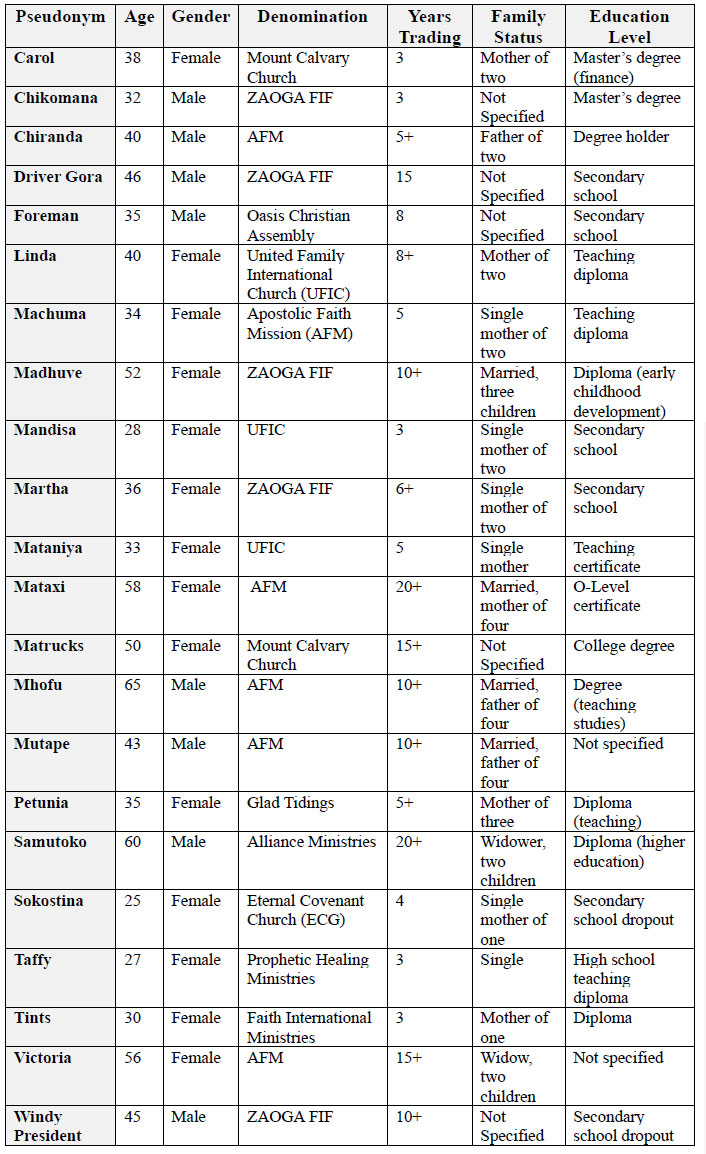
This study employs hybrid ethnography (Przybylski, 2021, p. 15), combining online and offline methods to examine Pentecostal cross-border traders in Zimbabwe through the Beitbridge border post. Beitbridge, the busiest frontier between Zimbabwe and South Africa, is a 'highly negotiated space where formal regulations and informal practices coexist' (Nshimbi and Moyo, 2017, p. 134). The border represents a complex regime marked by 'opacity, unpredictability, and extortion' (Dube, 2020, p. 153). For traders, it serves as both a barrier and an adaptation site. Due to COVID-19 restrictions, while initial meetings occurred in Johannesburg and Pretoria, engagement was primarily conducted through WhatsApp. This approach provides insights into traders' beliefs and practices (Pink et al., 2016, p. 45). Data collection involved 22 semi-structured interviews with 14 women and eight men, each lasting 90 minutes (Kvale, 2007, p. 67). The participants' characteristics are summarized in Table 1.
The gender imbalance reflects Southern African cross-border trading patterns, where women dominate informal trade (UN Women, 2019, p. 3). The male participants provide comparative perspectives with the women's. I conducted digital observations on WhatsApp monitoring the traders' group chats about border conditions and religious language, capturing their 'digital habitus' for business and spiritual support. Participants came from various Pentecostal Churches, primarily Zimbabwe Assemblies of God and Apostolic Faith Mission (five each), United Family International Church (three), and Prophetic Healing Ministries (one). Sampling combined purposive and snowball techniques to ensure denominational variety during the pandemic recruitment (Teddlie and Yu, 2007, p. 89). The ethical protocols included voluntary participation, consent, and identity protection through pseudonyms. For data analysis, the study utilized selected elements of the grounded theory approach (Charmaz, 2014, p. 5), namely open, axial, and selective coding, as well as constant comparison. As a Black Zimbabwean female researcher with cross-border experience, my insider-outsider position influenced data collection. My 'lived familiarity' (Holmes, 2020, p. 3) built trust while maintaining an analytical distance. Having attended mainline and Pentecostal Churches, I understood the participants' theological frameworks. I maintained a reflective journal to document the influence of positionality.
Discussion
Pentecostal Faith as a Moral Economy
African Pentecostalism has become a significant force in shaping economic behavior and entrepreneurial practices (Gifford, 2004, p. 102; Freeman, 2012). For Zimbabwean WCBTs prosperity theology and spiritual resilience provide justification for economic actions, using faith to withstand adversity and to maintain hope. Religious faith operates dialectically, both constraining and enabling agency, requiring culturally attuned policies that recognize religion' s role in survival strategies (Bompani, 2015, p. 78). Prosperity theology reframes hardship as a temporary step toward divine reward. Wariboko (2013, p. 57) specifies how Pentecostal business ethics create an entrepreneurial ethos that is rooted in prosperity and moral discipline. Pentecostal entrepreneurs view material success as a divine blessing, where faithfulness and hard work become morally and economically strategic. This framework shapes collective norms within Pentecostal communities (Hasu, 2012) and is influenced by Zimbabwe's political economy crisis (Chagonda, 2018, p. 215).
While borders are politically imagined as fixed, they are negotiated spaces where formal and informal practices coexist (Nshimbi and Moyo, 2017, p. 134). In this precarious arena, Pentecostal faith serves as a moral compass and source of resilience. Church communities provide essential spiritual and practical support networks in which women share coping strategies and regain strength after facing border harassment and bureaucratic obstacles. As Martha, one of the participants explained:
The churches where I get the strength to go, we pray, share advice about safe drivers, and support each other when someone loses their goods at the border. The church leaders tell us that God understands our struggles, so we can help each other and not judge. In some instances, during Bible study sessions at church, we are told it is okay to pay a bribe because the sin is not with you but with the person who has received and asked for the bribe (Interview Martha, 2021).
Communal faith spaces help women to process ethical stress by reframing difficult choices as divine tests. Women justify operating outside state authority through theological interpretation, aligning with Mbembe' s (2001, p. 110) analysis of post-colonial power. State corruption negates obedience to authority. Women face harassment by corrupt officials at borders and turn to prayer for resilience. They justify breaking rules for family survival, with faith providing psychological relief and reinterpreting acts as divine testing (Burchardt, 2013, p. 152).
In summary, cross-border traders operate in a moral economy where religious teachings both constrain and enable agency. While prosperity theology valorizes faithfulness, pragmatic adaptations such as bribery are reconfigured as temporary but divinely sanctioned strategies. These challenge the stereotype of informality as pure criminality. Pentecostal faith communities function as spiritual and social institutions that sustain women's navigation of moral ambiguity in Zimbabwe's informal trade. Their experiences indicate how informal trade is shaped by structural barriers, exploitation, and resistance, which characterize the kukiya-kiya economy.
Gendered Negotiation and Informal Networks
Cross-border traders in Southern Africa face numerous challenges that impede sustainable trade, including complex customs regulations, harassment, and corruption by border officials (Tevera and Chikanda, 2019, p. 8). The experiences of Zimbabwean Pentecostal women traders demonstrate the challenges of navigating economic hardship and societal expectations during a national crisis. Despite the negative media portrayals of traders as morally compromised individuals, the sector continues to grow (Nyamunda, 2016, p. 1145). This section examines how stigma, economic necessity, and gendered power dynamics shape the lives and identities of these women.
In addition, acute economic hardship, perpetually rising transport costs, and escalating customs duties have compelled some female traders to engage in transactional sexual relationships as a direct means of offsetting the high costs associated with cross-border commerce (Garatidye, 2019, p. 545). Several traders spoke openly about the normalization of such practices within their networks: 'Some are doing their prostitution so they do not have to pay the bus driver; some are doing that so they do not have to pay when these boys are wrapping things for us. They want free things', narrated Mataniya (Interview Mataniya, 2021). While routinely condemned in public discourse, these exchanges are often quietly accepted or at least tacitly understood within intimate trading networks as pragmatic, albeit unfortunate responses to insurmountable structural barriers and immediate survival imperatives. As Machuma observed (interview Machuma, 2021), 'You can really see Sodom and Gomorrah coming little by little because people want free things. If you get R10, you want it all for yourself; you do not want to pay for anything'. These dilemmas are complicated by Pentecostal and Christian teachings on work, sexuality, and divine blessings (Bowler, 2013, p. 158). While prosperity theology emphasizes hard work and faithfulness, it provides resilience amidst poverty (Lauterbach, 2017, p. 92). Thus, religious discourse serves a dual function: Empowering traders while creating moral boundaries that are challenging to maintain in a crisis, potentially causing guilt and shame.
The widespread, albeit morally ambiguous, acceptance of transactional sex as a survival strategy is increasingly reframed within the framework of personal faith. Within the Pentecostal moral economy, even this extreme compromise is navigated through a theology of grace and divine testing. Women may frame these acts not as selling their bodies but as going through a temporary, painful trial, a modern-day fiery furnace, to provide for their children. They rely on the belief in a forgiving God who understands their suffering and sees their heart's intention to be a good mother, thus offering a form of spiritual absolution that the church community might not. Traders like Martha reflect these tensions, holding faith in teachings and intentions despite harsh realities. As Martha explained (Interview Martha, 2021):
In this day and age, people believe that selling their bodies is the solution, but then, if you go to church, you are taught that it does not mean that if you do not have a job or money, you should work with your hands. As you can see, we are selling now because of this phase of depression; people are committing suicide, so they keep teaching you to keep praying in their faith but do not test it. If you just sit at home, not going for interviews or looking for jobs, just lying around thinking a miracle will happen, God helps those who help themselves.
This Pentecostal moral economy conflicts with survival realities in precarious postcolonial contexts marked by structural violence and state failure (Comaroff and Comaroff, 2000, p. 305). Informal strategies such as bribery and transactional sex among Pentecostal traders reflect improvizational survival ethics rather than idealized church conduct. Mbembe (2001, p. 102; 2019, p. 66) views improvization as a core survival mode in African postcolonial settings, where individuals navigate precarity through morally ambiguous adaptation. While Pentecostal faith offers moral frameworks of discipline and divine blessing, the hostile environment necessitates improvizational tactics, which traders frame as trials of prosperity. Pentecostal women embody a moral bricolage (Lévi-Strauss, 1966, p. 17) in which faith shapes survival strategies, transforming pragmatic acts into spiritually legitimate ones.
The impact of these dynamics extends far beyond that of the individual. Many participants spoke of the severe strain that cross-border trading places on family life, with constant accusations of infidelity frequently leading to marital breakdowns and the emergence of single-headed households. As Tints observed (Interview Tints, 2022):
Cross-border has destroyed so many homes because people are not faithful; people are selling their bodies to make a living; not everyone can accept that faith whereby your wife or husband fails to be faithful.
Therefore, these narratives are embedded within the broader structures of power and the political economy. The intersection of gender, poverty, and mobility creates conditions in which women's bodies become sites of exploitation and resources for survival (Sideris, 2004, p. 37). As Garatidye (2019, p. 550) argues, poverty drives transactional sex in trading, while stigma deflects attention from the structural conditions that cause it.
In conclusion, religious norms influence Zimbabwean women's experiences at border posts, reflecting their vulnerability, agency, and negotiation. Their experiences show the interplay between economic survival, gendered power, and moral discourse amid the crisis. Through transactional sex, church networks, and family dynamics, their actions demonstrate constrained resilience. Avoiding discrimination and stereotypes, their actions must be understood within Zimbabwe's political economy of informality, gender, and faith (Bond and Saunders, 2005, p. 10). Addressing structural conditions is crucial for policies that empower women and recognize their economic contributions to society.
The Role of Intermediaries and the Ethics of Bribery
The systematic corruption faced by traders creates a moral dilemma between spiritual values and survival imperatives. High official duties and predatory behavior of officials, as noted by Madhuve (Interview Madhuve, 2021), make formal compliance impossible for most traders. This forces them into a shadow economy where the state is regarded as a predatory force to be outwitted (Mbembe, 2001, p. 129). Corruption and bureaucratic complexity at borders compel traders to develop relationships with intermediaries, primarily bus drivers and conductors, as a strategic response to opacity and extortion threats (Dube, 2020, p. 153). For traders lacking knowledge of the procedures, intermediaries facilitate the clandestine passage of undeclared goods. This reliance on intermediaries and bribes is strategically reframed within Pentecostal economies.
Several women, often lacking detailed knowledge of official customs procedures or fearing punitive and disproportionate repercussions, become dependent on intermediaries, predominantly bus drivers and conductors, to facilitate the clandestine passage of undeclared goods, as one participant, Sokostina, articulated:
At the border entry, you normally arrange with the driver or with the conductor...! have such and such goods you give him the money and if there is any problem with the immigration officers or with the similar officers then those drivers or conductors will be responsible for those negotiations because most of the goods that we send we do not declare them ... so normally negotiations are done through the bus drivers and the conductors because those are the people that the officers at the border know the most because they are at the border almost every day ... they know each other better than you ... you go as an individual and negotiate with these guys, they will not trust you, let us say maybe you are an investigator (Interview Sokostina, 2021).
This reliance on intermediaries represents a strategic response to a border regime marked by opacity, unpredictability, and extortion (Dube, 2020, p. 153). The practice is theologically reframed: Bribe payment is viewed as applying the Pentecostal principle of sowing seeds, transforming a morally compromising act into an act of faith in God's provision.
In addition, this reliance integrates traders into networks with intermediaries, embedded in the informal border economy. These actors collect luggage fees between R100 and R500 per person to bribe customs officials for undeclared goods passage. While these informal payments erode profit margins, traders find them more predictable and cheaper than official tariffs. However, intermediaries can impose arbitrary fees that sometimes exceed the official penalties. Mandisa noted this with frustration:
We also encounter problems because we do not make the declaration. If we make the declaration ourselves, it is cheaper. However, these individuals, the conductors and bus drivers who collect items from South Africa, tend to claim that they have already made the declaration. However, they need more money, so we tend to go in circles, even though we have stated that we are not maximizing our profits (Interview Mandisa, 2021).
Women often rationalize the use of bribes as a form of sowing a seed on God's path, with the understanding that these temporary sacrifices are divinely sanctioned for the greater good of their families or their church community. This is illustrated in the testimony of Sokostina:
When I face border officials, I remember Psalm 23 telling me that God is my shepherd. It gives me the courage to stand my ground and negotiate with patience and prayers. Sometimes, I pay little offerings because God understands my situation. In this way, I honor my faith and survive (Interview Sokostina, 2021).
Sokostina's account illustrates a sophisticated reinterpretation of bribery as a spiritual strategy. She demonstrates how personal faith and scriptural recitation can transform what an outsider would regard as a guilty moral compromise into a faith-infused survival tactic that aligns with the belief in divine understanding and ultimate blessings.
In essence, this system operates as a double-edged sword, enabling women to navigate the punitive aspects of state border control while perpetuating dependency, vulnerability, and diminished economic returns (Kamata, 2020, p. 91). These informal trade networks reinforce systemic corruption and gendered exploitation that necessitate their existence, creating a cycle of informality (Nene, 2021, p. 66). Pentecostal women traders' use of intermediaries and bribery represents moral bricolage: By reframing bribes as 'sowing seeds', they transform ethical compromises into faith-based survival strategies while maintaining spiritual integrity and agency.
Collective Strategies and Everyday Resistance
Pentecostal ethics provide women with tools for survival that transcend economic calculus and help them manage emotional strain. Rather than reinforcing passivity, Pentecostal moral discourse empowers adherents to engage with economic challenges, framing entrepreneurship and resilience as expressions of faith (Anderson, 2014, p. 175; Maxwell, 2006, p. 83). This complicates Western assumptions about informal economies by indicating how Pentecostalism embeds economic practices within spiritual frameworks (Haynes, 2017, p. 129). Beyond individual dealings, cross-border traders employ collective strategies of resistance, sanctified by faith.
Zimbabwean women in cross-border trading operate in harsh, informal environments where borders are constantly negotiated, while traders previously declared goods and paid fees, prohibitive import duties of 40% to 60% of the goods' value made formal compliance impossible (Matsaung, 2021, p. 142). This reality has pushed traders to develop collaborative strategies, such as redistributing goods among travelers to avoid exceeding duty-free limits in the process. Madhuve (Interview Madhuve, 2021) and Mataxi (Interview Mataxi, 2021) echoed this sentiment, with Madhuve stating, 'We would share items among ourselves at the border, after crossing, we would collect our goods back'. This practice highlights the collective and tactical nature of their resistance - a form of solidarity forged in the face of shared precarity.
Participants consistently reported that the high cost of official duties and taxes, often reaching 40% of the value of goods, renders legal compliance economically unviable for small-scale traders (Matsaung, 2021, p. 142). As Madhuve noted, this creates a rational incentive for informality:
Sometimes, you find that 40% is too high to pay for duty, especially if you want to sell it to other people. Therefore, you find ways to hide your stocks and not pay. However, if the odds are not in your favor, your goods can be confiscated until you pay for them at customs. There are countless stories of warehouses burning on the Beitbridge Border. For goodness sake, who knows what will happen next? This creates room for ZIMRA officials to steal from the people, so the government loses thousands because of the funny things (irregular practices) that happen at the border. So, who am I to pay customs when the money benefits individuals and not the entire nation? (Interview Madhuve, 2021).
This testimony shows that official corruption is endemic. Zimbabwe Revenue Authority (ZIMRA) officials routinely solicit bribes and confiscate goods for personal gain. Between 2018 and 2021, 75 ZIMRA employees were arrested for corruption, while audits revealed officers living beyond their means (Bulawayo24, 2022). These revelations reinforced traders' views of an extractive border regime. The 2016 strike, which led to 71 arrests, showed rare overt resistance (The Herald, 2016). However, everyday resistance manifests through negotiations that traders use to navigate hostile environments (Tendi, 2020, p. 55). These practices reflect pragmatic risk assessments. This approach aligns with the Pentecostal prosperity theology. If God intends prosperity, circumventing corrupt systems can be regarded as being faithful. Smuggling becomes a holy hustle to access the promised blessings, making traders vessels of God' s provision. As Carol stated, ' It is both a business notice and a spiritually sanctified step of faith' (Interview Carol, 2021). This represents a complex ethical negotiation, where the kukiya-kiya economy becomes the stage for Pentecostal situational ethics focused on divine outcomes rather than rigid rules.
The findings of this study reveal that cross-border traders are acutely aware of the economic and institutional logics that incentivize corruption. Carol, one of the participants, articulated the systemic awareness with clarity:
The shortage of commodities leads to a high smuggling of goods from one country to another, a situation that leads to what business is. Business notices the need to provide people with what they are looking for, so that is what we are doing. We noticed the need in Zimbabwe; the borders are closed, and other means of transport are being used, and I saw trucks. How can I best help my fellow Zimbabweans obtain the things they need at a lower price than they would pay back home? (Interview Carol, 2021).
This narrative illustrates how smuggling is rationalized not as a criminal act but as an entrepreneurial, even patriotic response to structural scarcity and market demand, filling the vacuum left by the state's failure.
The everyday realities of Zimbabwean WCBTs exemplify Mbembe's (2001, p. 102) concept of power in the post-colony, where state authorities are negotiated and subverted through performance. Borders become spaces where formal regulations are undermined by informal practices, creating zones of ethical ambiguity and moral complexity. Pentecostal women fuse Mbembe' s improvization with their religious worldviews. Their use of intermediaries and bribes, common among Nigerian traders (Mbembe, 2001, p. 102), aligns with Wariboko's (2013, p. 72) principle of adaptability. Sokostina's explanation of using drivers to negotiate with officials demonstrates a spiritually informed pragmatism. Bribery is reframed as God-blessed resourcefulness to overcome a corrupt system of governance. Wariboko (2013, p. 81) notes that Pentecostal ethics create new value systems in chaotic environments. These women' s practice of redistributing goods to avoid duties becomes participation in a divine economy of sharing outside the official system. Their prayers for safe travel serve as a spiritual technology to sanctify risky endeavors. Pentecostal women traders' survival strategies combine economic and spiritual resistance. Through collective action and faith-based frameworks, they challenge trade barriers while maintaining their religious identity. Their experiences demonstrate how sustainable resistance emerges through daily acts of community solidarity.
Implications for Policy and Formalization
This study reveals the tensions between formalization efforts and Zimbabwe's cross-border trade realities. While the Zimbabwe Cross-Border Traders Association's initiatives aims to formalize trade (ZCBTA Report, 2021, p. 5), traders' experiences indicate that addressing informal systems and gendered power dynamics is essential before imposing these formalities (Sachikonye, 2022, p. 88). Systematic corruption defines cross-border trading, influenced by structural drivers, including cumbersome border procedures and differential taxation (Transparency International Zimbabwe, 2021, p. 12), together with Adjibolosoo's (1995, p. 45) 'human factor', which encompasses spiritual, moral, and social capital that shapes corruption. Traders who refuse bribes risk goods confiscation and cannot reclaim them due to high fees and bureaucratic hurdles (ZCBTA Report, 2021, p. 8). Unclaimed goods meant for state auctions disappear into shadow systems, depriving the state of revenue and fostering public cynicism as traders see little incentive to engage with a rigged system. The normalization of corruption is embedded in the political economy of the crisis. The kukiya-kiya logic represents both a response to and a critique of state failure (Jones, 2010, p. 286). Pentecostal Charismatic Churches play an ambivalent role, promoting ethical values while potentially legitimizing survival strategies through theological framing (Bompani, 2015, p. 78).
These findings reveal policy inadequacies and the need for structural reforms. Female crossborder traders' experiences challenge the view of them being either purely economic actors or lawless participants. Their strategies are embedded in a Pentecostal moral economy in which prosperity theology and spiritual resilience are central to navigating economic survival.
In summary, systematic corruption in Zimbabwe's cross-border trade stems from intersecting structural, institutional, and human factors, which are sustained by economic necessity and institutional weakness. Addressing this requires both technical reforms and the transformation of moral economy. Understanding the interplay between religious ethics, gender, and economic survival can help policymakers develop effective strategies to support women facing overwhelming challenges.
Conclusion
This study examined the moral economy of Zimbabwean Pentecostal women being cross-border traders. Their engagement in bribery, smuggling, and transactional sex represents calculated improvization (kukiya-kiya), necessitated by a predatory state and a collapsing economy. Their Pentecostal faith provides the framework through which these survival strategies are legitimized. Prosperity theology allows women to reinterpret morally ambiguous acts as 'sowing seeds' or divine tests, thereby managing the conflict between religious norms and economic necessities. The Pentecostal framework provides a uniquely empowering language of resilience through its emphasis on personal relationships with the Holy Spirit and divine favor. This allows women to sanctify their actions as steps toward a divinely ordained prosperity. The findings challenge simplistic categorizations of informality, revealing women's actions as everyday resistance to state failure. Their pragmatic ethics highlight the inadequacy of formalization policies that ignore root causes such as corruption, prohibitive tariffs, and gender exploitation. Effective interventions must recognize these traders' economic roles and address structural barriers through gender-sensitive reforms in customs procedures and legal protection. These women' s faith-sustained resilience offers critical insights into survival in contemporary Zimbabwe.
References
Literature Review
- Adjibolosoo, S. (1995) The human factor in developing Africa. Westport: Praeger.
-
Akanbi, S.O. and Beyers, J. (2017) 'The role of Pentecostal movement in Nigeria's national development', HTS Teologiese Studies/Theological Studies, 73(4). 9 pages. https://doi.org/10.4102/hts.v73i4.4635
» https://doi.org/10.4102/hts.v73i4.4635 -
Anderson, A. (2014) An introduction to Pentecostalism: Global charismatic Christianity. 2nd ed. Cambridge: Cambridge University Press. https://doi.org/10.1017/CBO9781139524063
» https://doi.org/10.1017/CBO9781139524063 - Biri, K. (2020) 'Pentecostalism and the politics of visibility in Zimbabwe', Studies in World Christianity, 26(1), pp. 52-69.
- Bompani, B. (2015) '"God is not a democrat": Pentecostalism and democratisation in South Africa', Journal of Modern African Studies, 53(1), pp. 59-83.
-
Bond, P. and Saunders, R. (2005) 'Labor, the state, and the struggle for a democratic Zimbabwe', Monthly Review, 57(7), pp. 1-16. https://doi.org/10.14452/MR-057-07-2005-11_6
» https://doi.org/10.14452/MR-057-07-2005-11_6 -
Bowler, K. (2013) Blessed: A history of the American Prosperity Gospel. Oxford: Oxford University Press. https://doi.org/10.1093/acprof:oso/9780199827695.001.0001
» https://doi.org/10.1093/acprof:oso/9780199827695.001.0001 -
Bulawayo24. (2022) 75 ZIMRA officers arrested. June 26, 2022. Available at: https://bulawayo24.com/index-id-news-sc-local-byo-220755.html. (Accessed August 27, 2025).
» https://bulawayo24.com/index-id-news-sc-local-byo-220755.html -
Brummett, A. and Eberl, J.T. (2025) 'Moral bricolage and the emerging tradition of secular bioethics', Theoretical Medicine and Bioethics 46(1), pp. 67-87. https://doi.org/10.1007/s11017-025-09703-8
» https://doi.org/10.1007/s11017-025-09703-8 -
Burchardt, M. (2013) 'Belonging and success: Religious vitality and the politics of urban space in Cape Town', Social Analysis, 57(1), pp. 144-165. https://doi.org/10.1163/9789004249073011
» https://doi.org/10.1163/9789004249073011 - Chagonda, T. (2018) 'The other side of Zimbabwe's crisis: The Black Market and the "Kukiya-kiya" economy, 2000-2008', Journal of Southern African Studies, 44(2), pp. 209-227.
- Chari, S. (2010) State racism and biopolitical struggle: The evitable foundation of the nation. In Serlin, D. and Chazkel, A. eds.: Zimbabwe: The political economy of decline. Discussion Paper 50. Uppsala: Nordiska Afrikainstitutet, pp. 23-45.
- Charmaz, K. (2014) Constructing grounded theory. 2nd ed. London: Sage.
- Chigudu, D. (2020) 'The plight of women in the informal economy in Zimbabwe', African Journal of Governance and Development, 9(1), pp. 112-130.
-
Comaroff, J. and Comaroff, J.L. (2000) 'Millennial capitalism: First thoughts on a second coming', Public Culture, 12(2):291-343. https://doi.org/10.1215/08992363-12-2-291
» https://doi.org/10.1215/08992363-12-2-291 - Dube, G. (2020) 'Informal cross-border trade and SADC: The case of Zimbabwe', Journal of Southern African Studies, 46(1), pp. 149-165.
- Dulin, J. (2018) 'The prosperity gospel and economic agency in Nairobi, Kenya', Journal of Modern African Studies, 56(4), pp. 141-162.
- Freeman, D. (2012) The Pentecostal ethic and the spirit of development. In Basingstoke, D.F. ed.: Pentecostalism and development: Churches, NGOs and social change in Africa. London: Palgrave Macmillan, pp. 1-38.
- Garatidye, T. (2019) 'Transactional sex and livelihood strategies of women cross-border traders in Zimbabwe', Journal of Asian and African Studies, 54(4), pp. 543-558.
-
Gifford, P. (2004) Ghana's new Christianity: Pentecostalism in a globalising African economy. London: Hurst & Company. https://doi.org/10.2979/1804.0
» https://doi.org/10.2979/1804.0 - Gudhlanga, E.S., Makaudze, G. and Chirimuuta, C. (2023) 'Pentecostalism and the empowerment of women in Zimbabwe: A critical analysis', Journal of Gender and Religion in Africa, 29(1), pp. 110-125.
-
Hasu, P. (2012) Prosperity gospels and enchanted worldviews: Two responses to socio-economic transformation in Tanzania. In Basingstoke, D.F. ed.: Pentecostalism and development: Churches, NGOs and social change in Africa. London: Palgrave Macmillan, pp. 67-86. https://doi.org/10.1057/9781137017253_3
» https://doi.org/10.1057/9781137017253_3 -
Haynes, N. (2017) 'Moving by the Spirit: Pentecostal social life on the Zambian Copperbelt', Social Analysis, 61(2), pp. 125-140. https://doi.org/10.1525/califomia/9780520294240.001.0001
» https://doi.org/10.1525/califomia/9780520294240.001.0001 - Holmes, A.G.D. (2020). 'Researcher positionality - a consideration of its influence and place in qualitative research - a new researcher guide', Shanlax International Journal of Education, 8(4), pp. 1-10.
- Interview with Carol. February 13, 2021.
- Interview with Machuma. April 4, 2021 (also April 8, 2021 and May 4, 2021).
- Interview with Madhuve. May 16, 2021.
- Interview with Mandisa. April 18, 2021.
- Interview with Martha. May 24, 2021 (also June 30, 2021).
- Interview with Mataniya. April 18, 2021.
- Interview with Mataxi. May 18, 2021.
- Interview with Sokostina. May 13, 2021 (also August 17, 2021).
- Interview with Tints. January 10, 2022.
-
Jones, J.L. (2010) '"Nothing is straight in Zimbabwe": The rise of the Kukiya-kiya economy 20002008', Journal of Southern African Studies, 36(2), pp. 285-299. https://doi.org/10.1080/03057070.2010.485784
» https://doi.org/10.1080/03057070.2010.485784 - Kamata, N. (2020) Informal cross-border trade and poverty alleviation in Southern Africa. London: Routledge.
-
Kgatle, M.S. and Kaunda, C.J. (2023) 'A Pentecostal theology of radical sharing: Sam-Ae and ubuntu as critical hermeneutics of engaged love', Dialog, 62(4), pp. 344-351. https://doi.org/10.1111/dial.12814
» https://doi.org/10.1111/dial.12814 -
Kvale, S. (2007) Doing interviews. London: Sage. https://doi.org/10.4135/9781849208963
» https://doi.org/10.4135/9781849208963 -
Lauterbach, K. (2017) Christianity, wealth, and spiritual power in Ghana. London: Palgrave Macmillan. https://doi.org/10.1007/978-3-319-33494-3
» https://doi.org/10.1007/978-3-319-33494-3 - Lévi-Strauss, C. (1966) The savage mind. Chicago: University of Chicago Press.
- Lugazia, E. (2017) 'Theology of presence: African Pentecostal Churches and women's experiences in Tanzania', Journal of Religion in Africa, 47(1), pp. 85-107.
- Manjokoto, T. and Ranga, D. (2018) 'Women in the informal sector: The case of cross-border traders in Zimbabwe', Zimbabwe Journal of Economic Studies, 2(1), pp. 45-60.
- Matsaung, L. (2021) The political economy of crisis in Zimbabwe. Harare: University of Zimbabwe Publications.
- Maxwell, D. (2006) African gifts of the Spirit: Pentecostalism and the rise of a Zimbabwean Transnational religious movement. Oxford: James Currey.
- Mbembe, A. (2001) On the postcolony. Berkeley: University of California Press.
-
Mbembe, A. (2019) Necropolitics. Durham: Duke University Press. https://doi.org/10.1215/9781478007227
» https://doi.org/10.1215/9781478007227 - Muzondidya, J. (2021) 'Surviving the crisis: The informal sector and livelihoods in urban Zimbabwe', African Studies Quarterly, 20(1), pp. 71-88.
- Nene, S. (2021) 'Gendered networks of illegality: Women in cross-border trade between South Africa and Zimbabwe', Geoforum, 118, pp. 63-72.
-
Nshimbi, C.C. and Moyo, I. (2017) Migration, cross-border trade and development in Africa. London: Palgrave Macmillan. https://doi.org/10.1007/978-3-319-55399-3
» https://doi.org/10.1007/978-3-319-55399-3 - Nyamunda, T. (2016) '"Madhara" (wheeler-dealers): The Zimbabwean army's alleged involvement in illicit diamond dealing and Marange's political economy of greed', Journal of Southern African Studies, 42(6), pp. 1143-1159.
-
Paudel, D. (2024) 'Conceptualizing the role of ideational bricolage in social value creation for the marginalized', Academy of Management Proceedings, 2024(1), n.p. 13326. Valhalla 10595: Academy of Management. https://doi.org/10.5465/AMPROC.2024.44bp
» https://doi.org/10.5465/AMPROC.2024.44bp - Pink, S., Horst, H., Postill, J., Hjorth, L., Lewis, T. and Tacchi, J. (2016) Digital ethnography: Principles and practice. London: Sage.
-
Przybylski, L. (2021) Hybrid ethnography: Online, offline, and in between. London: Sage. https://doi.org/10.4135/9781071909676
» https://doi.org/10.4135/9781071909676 - Ranger, T. (2008) 'Evangelical Christianity and democracy in Africa: A continental comparison', Journal of Religion in Africa, 38(1), pp. 110-113.
- Sachikonye, L.M. (2022) When a state turns on its citizens: Institutionalized violence and political culture. Johannesburg: Jacana Media.
- Scott, J.C. (1985) Weapons of the weak: Everyday forms of peasant resistance. New Haven: Yale University Press.
-
Sideris, T. (2004) '"You have to change and you don't know how!": Contesting what it means to be a man in a rural area of South Africa', African Studies, 63(1), pp. 29-49. https://doi.org/10.1080/0002018042000226148
» https://doi.org/10.1080/0002018042000226148 -
Teddlie, C. and Yu, F. (2007) 'Mixed methods sampling: A typology with examples', Journal of Mixed Methods Research, 1(1), pp. 77-100. https://doi.org/10.1177/1558689806292430
» https://doi.org/10.1177/1558689806292430 -
Tendi, B-M. (2020) The army and politics in Zimbabwe. Cambridge: Cambridge University Press. https://doi.org/10.1017/9781108561600
» https://doi.org/10.1017/9781108561600 - Tevera, D. and Chikanda, A. (2019) Migration, cross-border trade and development in Africa. Cham: Springer.
-
The Herald. (2016). 71 nabbed over border violence. Available at: https://www.herald.co.zw/71-nabbed-over-border-violence/. (Accessed October 23, 2024).
» https://www.herald.co.zw/71-nabbed-over-border-violence/ - Togarasei, L. (2016) 'The Pentecostal gospel of prosperity in African contexts of poverty: An appraisal', Exchange, 45(3), pp. 123-140.
- Transparency International Zimbabwe. (2021). The state of corruption in Zimbabwe report. Harare: TIZ.
- UN Women. (2019) Informal cross-border trade for women's economic empowerment in Africa. New York: United Nations Entity for Gender Equality and the Empowerment of Women.
- Wariboko, N. (2011) The Pentecostal principle: Ethical methodology in new spirit. Grand Rapids: Eerdmans.
- Wariboko, N. (2013) The Pentecostal principle: Ethical methodology in new spirit. 2nd ed. Grand Rapids: Eerdmans.
- ZCBTA Report. (2021) Annual report on cross-border trade. Harare: Zimbabwe Cross-Border Traders Association.

Revised: October 27, 2025
Accepted: November 7, 2025
Published: December 20, 2025
Editors
Dr. Nelly Mwale
Prof. Lee-Shae Salma Scharnick-Udemans
Funding
No funding was received for this article.