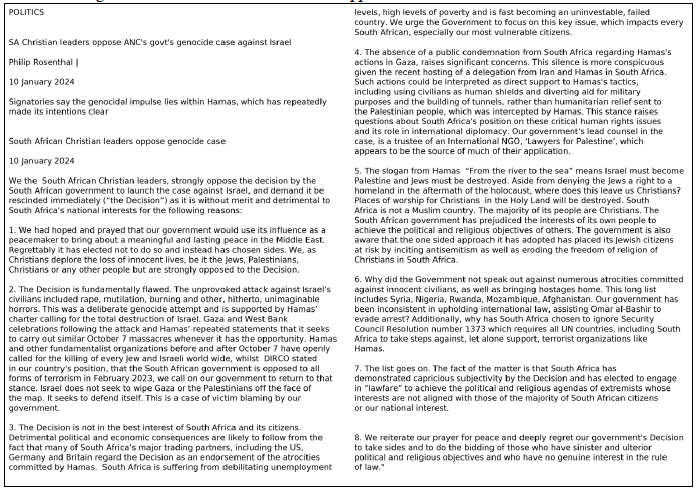
Sanctifying Settler Colonialism: An Intersectional Discursive Analysis of a South-African Christian Zionist Media Statement
Abstract
This paper presents an intersectional discursive analysis of a web statement issued on January 10, 2024 by a group of self-identified South African Christian leaders opposing the South African government's genocide case against Israel at the International Court of Justice. Using a critical discourse analytic framework informed by Michel Foucault's theorization of discourse and power, the paper examines how the statement's pragmatic, ethical, and theological dimensions work together to encourage and legitimize support for Israel through the language of moral and spiritual authority. Across three identified fronts, the statement deploys distinctive rhetorical strategies. On the pragmatic front, it invokes national interest and religious freedom to construct a regime of 'moral reasonableness'. On the ethical front, it appropriates feminist and liberationist vocabularies such as 'victim blaming' to reframe Israel as the victim and Palestine as the aggressor. On the theological front, it redeploys the language of peace characteristic of apartheidera church theology, sanctifying inaction under the guise of neutrality. Additionally, read alongside the Kairos Document of 1985, the analysis situates the 2024 statement within a changing media ecology that transforms how religious authority is produced and circulated. Whereas the Kairos Document emerged from a slow, consultative print culture rooted in collective discernment, radical pedagogy, and liberation theology, the 2024 statement belongs to the fast, affect-driven environment of digital media. Its authority derives not from theological rigor but from rhetorical immediacy and emotional resonance. Drawing on Mitri Raheb's notion of empire's theological 'software', the paper argues that the statement exemplifies how digital media now function as moral infrastructure, transforming emancipatory theologies into instruments of ideological power. In doing so, it advances scholarship on religion and media by tracing the shift from the deliberative textuality of Kairos to the affective immediacy of digital circulation, revealing how the Christian Zionist discourse in South Africa performs a distinct kind of theological labor that both mediates and moralizes empire in the 21st century. SIGNIFICANCE: This article contributes to both the growing field of scholarship exploring the mechanisms through which Christian Zionism operates in the Global South, and to the field of digital religion, considering the ways in which Christian Zionist discourses circulate in the digital age
Christian Zionism; digital religion; media; Kairos Document; Liberation Theology; Palestine
 Thumbnail