Sanctifying Settler Colonialism: An Intersectional Discursive Analysis of a South-African Christian Zionist Media Statement
Abstract
This paper presents an intersectional discursive analysis of a web statement issued on January 10, 2024 by a group of self-identified South African Christian leaders opposing the South African government's genocide case against Israel at the International Court of Justice. Using a critical discourse analytic framework informed by Michel Foucault's theorization of discourse and power, the paper examines how the statement's pragmatic, ethical, and theological dimensions work together to encourage and legitimize support for Israel through the language of moral and spiritual authority. Across three identified fronts, the statement deploys distinctive rhetorical strategies. On the pragmatic front, it invokes national interest and religious freedom to construct a regime of 'moral reasonableness'. On the ethical front, it appropriates feminist and liberationist vocabularies such as 'victim blaming' to reframe Israel as the victim and Palestine as the aggressor. On the theological front, it redeploys the language of peace characteristic of apartheidera church theology, sanctifying inaction under the guise of neutrality. Additionally, read alongside the Kairos Document of 1985, the analysis situates the 2024 statement within a changing media ecology that transforms how religious authority is produced and circulated. Whereas the Kairos Document emerged from a slow, consultative print culture rooted in collective discernment, radical pedagogy, and liberation theology, the 2024 statement belongs to the fast, affect-driven environment of digital media. Its authority derives not from theological rigor but from rhetorical immediacy and emotional resonance. Drawing on Mitri Raheb's notion of empire's theological 'software', the paper argues that the statement exemplifies how digital media now function as moral infrastructure, transforming emancipatory theologies into instruments of ideological power. In doing so, it advances scholarship on religion and media by tracing the shift from the deliberative textuality of Kairos to the affective immediacy of digital circulation, revealing how the Christian Zionist discourse in South Africa performs a distinct kind of theological labor that both mediates and moralizes empire in the 21st century. SIGNIFICANCE: This article contributes to both the growing field of scholarship exploring the mechanisms through which Christian Zionism operates in the Global South, and to the field of digital religion, considering the ways in which Christian Zionist discourses circulate in the digital age
Christian Zionism; digital religion; media; Kairos Document; Liberation Theology; Palestine
Background and Framing
On January 10, 2024, a statement titled 'South African Christian leaders oppose the government's genocide case against Israel' was released by Philip Rosenthal on behalf of Christian View Network and endorsed by a consortium of church groups, ministries, and clergy (Rosenthal, 2024). The statement appeared on Politicsweb and was rapidly circulated through religious networks, digital media, and church mailing lists. The full text of the statement appears below.
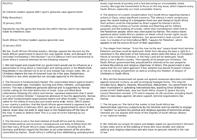
In the statement, the signatories1 declare that they ' strongly oppose' the South African government's decision to bring a genocide case against Israel before the International Court of Justice (ICJ)2, describing the case as ' without merit' and 'detrimental to South Africa's national interests'. The text unfolds through a series of moral and political claims that are presented as self-evident truths. It describes the October 7, 2023 attacks as an 'unprovoked genocide attempt' by Hamas, alleging that 'the genocidal impulse lies within Hamas', and characterizing Israel's military response as legitimate self-defense. The statement accuses the South African government of 'victim blaming', of abandoning its 'Christian majority' to appease 'Muslim interests', and of aligning with 'terrorist organisations' (Rosenthal, 2024). It positions South Africa's support for Palestine as a betrayal of both national and religious identity. Its language appeals to fear - of economic loss, religious persecution, antisemitism, and moral decline - while invoking prayer, peace, and religious freedom as moral anchors.
This combination of religious authority, political pragmatism, and moral urgency makes the statement a revealing media artefact of South Africa's contemporary religious public sphere. It condenses several intertwined discourses: The globalization and intensification of Christian Zionism3, post-apartheid anxieties about belonging and national identity, and the transformation of public religion into a media-driven politics that circulates through appeals to emotion and morality. By calling itself the voice of 'the South African Christian leaders', the statement seeks to fix the boundaries of legitimate Christian opinion and to assert control over the moral narrative of the nation.
This paper first examines the discursive mechanisms through which the statement mobilizes and legitimates support for the state of Israel, while rendering other stances unthinkable, doing this on pragmatic, ethical, and theological grounds. Second, the paper explores how the statement operates as a form of public communication that merges religious conviction with political ideology through a digital media platform. Using a critical discourse analytical framework that draws on Michel Foucault's theorization of discourse and power, the paper investigates how the text constructs moral authority to serve a very particular singular narrative, rendering dissenting voices inconceivable (Foucault, 1981). Foucault's understanding of discourse as a technology of power enables attention to the ways in which language determines what can legitimately be thought, felt, or believed. Mitri Raheb's notion of theological ' software' provides an additional conceptual lens for understanding how the statement performs ideological work (Raheb, 2022). In the context of the Israeli occupation of Palestine, Raheb posits that the occupation is not only sustained by the 'hardware' of Israel's checkpoints, military machinery, and other material instruments of state repression, but is also made possible by the 'software': The ideological, cultural, religious, and discursive mechanisms that do the work of normalizing, justifying, and even sacralizing the occupation could be likened to Louis Althusser's conception of the ' ideological state apparatus' (Althusser, 2014). In Raheb' s analysis, Christian Zionism is a central aspect of this legitimating 'software'.
These conceptual lenses help to frame the statement not as a fringe declaration, but as part of a larger global system of moral reasoning that naturalizes domination through the language of faith and civility. By situating this media statement within South Africa's post-apartheid religious landscape, we argue that the statement, in terms of both its content and form, represents a significant instance of how religion functions as moral infrastructure in a digital age.
Discursive Analysis of the Statement: Three Interlocking Fronts
Building on the background and framing above, we now track how the statement arranges its case across three interlocking fronts. Read as discourse, we argue that the text performs work at the pragmatic, ethical, and theological levels simultaneously, translating support for Israel into moral common sense through specific linguistic choices and affective cues.
The Pragmatic Front: National Interest, Whataboutism, and Manufactured Reasonableness
The statement opens by asserting a collective authority, 'We, the South African Christian leaders', and immediately frames the ICJ case as 'without merit and detrimental to South Africa's national interests', further warning that it is 'not in the best interest of South Africa and its citizens' because it will 'alienate our major trading partners' and carry 'detrimental political and economic consequences' (Rosenthal, 2024).
These formulations instill, in Foucauldian terms, a 'regime of truth' in the way they construct legitimacy and moral authority through selective reasoning. For Foucault, a regime of truth refers to the historically specific systems that determine what counts as truth, how truth is produced, and who is authorized to speak it. Truth, in this sense, is not an abstract or universal constant but a social construct sustained by institutional practices and legitimized discourses. It is ' the types of discourse a society harbours and causes to function as true' (Foucault, 1977, p. 13).
Within the January statement, this 'regime of truth' is enacted through appeals to 'national interest' and ' economic consequence' , which function as the sanctioned vocabularies of reason and morality (Rosenthal, 2024). By claiming these terms as self-evident, the statement installs an economy of truth in which economic discourse overrides ethical argument, and where dissenting perspectives, particularly those grounded in solidarity with Palestine, are positioned outside the bounds of rational speech.
Furthermore, in positioning the authors not as a group of South African Christian leaders but as the South African Christian leaders, the statement claims to speak on behalf of a unified, representative Christian community. This rhetorical move fabricates an imagined homogenous constituency united in opposition to the genocide case. Yet such unity does not exist. While Christian Zionism indeed has a strong presence in South Africa (Gamedze, forthcoming; Nimer, 2025), numerous denominational bodies, congregations, and Christian leaders in this country have openly expressed solidarity with Palestine (Momberg, 2023a; 2023b, Gamedze, forthcoming). The statement's phrasing therefore operates as a discursive mechanism of inclusion and exclusion, implying that to belong to the moral community of Christians, or at least Christian leaders, one must necessarily oppose the government' s position and, by extension, support Israel.
This polemical strategy (Foucault, 1984) aligns with what Foucault terms the 'systems of exclusion which forge discourse' (Foucault, 1981, p. 55) through which authority is maintained by defining who may legitimately speak and what may be stated. Anyone who challenges the discourse is implicitly cast as at best irrational, deviant, or disloyal to the faith. At worst, the challenger is framed as ' an adversary, an enemy who is wrong, who is harmful and whose very existence constitutes a threat' (Foucault, 1984, p. 382) - a mechanism of engagement which shuts down any 'possibility of an equal discussion'. By naming its signatories as 'leaders', the statement also performs what Foucault calls the 'rarefaction of speaking subjects' (Foucault, 1981, p. 61) reserving interpretive authority for a select few who can define moral truth and national interest. Within the context of the church, such rarefaction is especially potent. As Han (2009, p. 16) observes, religious leaders often act as gatekeepers of 'irrefutable truth claims', producing and validating theologies that shape communal belief. Similarly, Michael Apple notes the tendency within evangelical spaces toward an uncritical acceptance of pronouncements issued by recognized authority figures (Apple, 2006).
This rarefaction is also amplified by what Patricia Hill-Collins identifies as the power of ' knowledge validation processes' (Hill-Collins, 2015, p. 751) that reflects and reproduces existing hierarchies. Those already authorized to define truth are the ones whose voices are heard and this often excludes Black women. The statement' s 'we' thus functions not merely as a grammatical marker of collectivity, but as an act of epistemic closure. Therefore, through this linguistic maneuver, the text's repeated invocations of 'we' and 'our' construct an in-group defined by faith and patriotism, while casting the government, Muslim interlocutors, and pro-Palestinian Christians as irresponsible or dangerous others.
A second pillar of the pragmatic case is the pivot to domestic crisis. The statement urges government to focus on 'debilitating unemployment levels' and 'high levels of poverty', implying a zero-sum trade-off between international justice and local welfare, while later enlarging the canvas by asking why South Africa has not intervened in 'Syria, Nigeria, Rwanda, Mozambique, [and] Afghanistan' (Rosenthal, 2024). This is a textbook example of whataboutism, which Allan Dykstra defines as a maneuver that 'turns critique back at the accuser' to deflect scrutiny rather than to deepen analysis (Dykstra, 2020, p. 2). As a media tactic, whataboutism presents as contextual breadth yet functions to ' muddy the waters' and diffuse attention, an effect well described in journalism studies of contemporary public argumentation (Zak, 2017). Here the rhetorical move simultaneously claims moral seriousness about suffering and yet evacuates responsibility for any particular instance of it.
A third pillar of the pragmatic argument imports religion into the register of rational policymaking. The statement warns that the government has 'prejudiced the interests of its own people' and is 'eroding the freedom of religion of Christians in South Africa', before posing the question 'where does this leave us Christians' should 'Israel become Palestine?' and predicting that 'places of worship for Christians in the Holy Land will be destroyed'. These claims rely less on verifiable evidence than on the effective and relational power of language. Their logic is associative rather than causal: The government' s legal challenge to Israel is positioned as a threat to Christian identity itself, both within South Africa and globally.
In this context, the phrase 'freedom of religion' functions as a strategy of ideological polarization, constructing the in-group ('Christians') as under threat and the out-group (the government, Muslims, or supporters of Palestine) as antagonistic to religious liberty. The potency of this rhetoric lies in its historical resonance. 'Freedom of religion' carries the moral weight of South Africa's democratic transition, when struggles against apartheid's Christian nationalism sought to separate state power from religious dominance. Once a value associated with pluralism and liberation, religious freedom is here re-signified as a defensive privilege of a dominant faith community.
Lee Scharnick-Udemans has described this reconfiguration as evidence that religion has become 'the final frontier of the rainbow nation' (Sharnick-Udemans, 2020). Her argument shows how post-apartheid appeals to religious freedom are often mobilized not to advance equality, but to defend Christian cultural privilege in a plural society. Analyzing public controversies such as Christian resistance to 'halaal-friendly' products, she demonstrates that claims of Christian 'persecution' operate as moral inversions: They portray the majority as victims and recast diversity as a threat to Christian identity. The January 2024 statement precisely replicates this pattern. By invoking 'freedom of religion' to oppose the government's stance on Palestine, it converts a constitutional safeguard for religious diversity into a rhetorical weapon for Christian Zionist ideology, thereby, ironically transforming pluralism into perceived persecution.
Taken together, the appeals to national interest, domestic crisis, and religious freedom form a coherent pragmatic strategy that converges to legitimate a singular worldview. Through these discursive maneuvers, the statement positions Christian Zionism as the moral center of the nation, converting a pragmatic argument into an ideological defense. Having established its credibility through this pragmatic appeal the statement shifts from the language of prudence to that of morality. What begins as a discourse of pragmatic concern evolves into a moral indictment, where the government's legal action is no longer simply unwise but recast as unethical and unjust. It is to this moral terrain that the argument now turns.
The Ethical Front: Moral Inversion and Manufactured Victimhood
On the second front, the statement frames its argument against the South African government's decision as an ethical one, positioning the court case as wrong, immoral, and unjust. Many of the arguments here appear almost word for word from Israel's official playbook, reproducing its efforts to reframe Israel as the victim (Aouragh, 2016). The document names what took place on October 7, 2023 as an ' unprovoked attack' , invisibilizing decades of oppression, Israeli settler colonialism, and apartheid, as well as the years of siege on Gaza that have rendered it what Tawil-Souri and Matar (2016) describe as an 'open-air prison'.
The statement also works to establish Hamas as the primary enemy. It describes the events of October 7 as 'rape, mutilation, burning and other, hitherto, unimaginable horrors', designating them as 'a deliberate genocide attempt', and claiming that Hamas has 'openly called for the killing of every Jew and Israeli worldwide' (Rosenthal, 2024). These assertions are presented without verification and rely on unsubstantiated claims that have been widely challenged by international investigations, including those conducted by the United Nations (2024). The rhetorical effect is to shift the moral focus from Israel's structural violence to Hamas' alleged barbarity, thereby positioning Israel's actions as legitimate self-defense.
The statement reinforces this framing by accusing the South African government of 'victim blaming'. This phrase, deeply rooted in feminist scholarship on sexual violence, originally exposed how patriarchal societies hold survivors responsible for the violence inflicted upon them. Scholars such as Susan Brownmiller (1975) conceptualize victim blaming as a mechanism of moral and epistemic inversion that protects perpetrators while silencing victims. In the feminist tradition, then, ' victim blaming' names a practice of power that denies the reality of harm and shields systemic violence from accountability.
The statement's use of this language performs a striking reversal. It appropriates a feminist vocabulary of justice and survival to defend a powerful state accused of genocide. In the same way that 'freedom of religion' is repurposed from its emancipatory history into a defense of Christian privilege, 'victim blaming' is re-signified here to portray Israel, the occupying power, as the morally injured party. This act of rhetorical inversion exemplifies what Sara Ahmed (2017) calls the 'non-performative' use of progressive language, where words of justice are invoked precisely to block the work of justice itself. Through this co-option, moral language becomes a mechanism of control rather than critique.
This moral re-signification is central to the text's persuasive power. As Aouragh notes, Israeli Hasbara4 operates as a 'state-orchestrated effort to manage the increasing public critique that Israel faces' (Aouragh, 2016, p. 275), manufacturing both discontent with Palestinian self-determination and consent for Israel's dominance.
The discursive structure of the statement follows this same pattern. It invokes the familiar biblical and cultural reversal that Nur Masalha identifies as the transformation of the David-and-Goliath story into one of 'a Jewish David and an Arab Goliath' (Masalha, 2009, p. 67). Through this mythic inversion, the occupier is rendered the vulnerable underdog and the colonized are recast as existential threats. The statement thus moralizes Israeli power as virtue and redefines Palestinian resistance as evil. This rhetorical pattern resonates with conservative Christian politics elsewhere. In his study of evangelical education in the US, Apple (2006) observes how conservative evangelicals repeatedly invoke Martin Luther King Jr. and the civil-rights legacy to claim the moral authority of the oppressed while pursuing reactionary goals. Ju Hui Judy Han similarly shows how identification with victimhood functions as ' a rhetorical strategy that helps bind diverse and disparate actors' (Han, 2009, p. 14) allowing those in power to present themselves as morally besieged. The South African Christian leaders' statement performs this same discursive maneuver, positioning Christian Zionists as the persecuted moral minority and the South African government as a betrayer of ethical order.
In its concluding moral gesture, the statement claims that South Africa's actions serve 'sinister and ulterior political and religious objectives' and accuses the government of engaging in 'lawfare' to advance 'the agendas of extremists' (Rosenthal, 2024). The irony is unmistakable: The very discourse that presents itself as a guardian of morality systematically distorts moral meaning. By appropriating the emancipatory language of both feminist justice and religious liberty, the statement transforms words once used to expose oppression into instruments that defend it. Through this ethical front, it turns the pursuit of justice into its opposite, converting accountability for violence into a violation of virtue.
Having established its moral authority through these appropriations, the statement completes its discursive circuit by turning to the register of theology. Here, the moral inversions of the previous section acquire sacred legitimacy - this is the third front to which we turn now.
The Theological Front: Church Theology, Peace, and the Sanctification of Neutrality
Interestingly, even while framed as a response from Christian leaders, the statement is not overtly theological. However, it nevertheless represents the theology, broadly conceived, of those who authored or endorsed it, and it must therefore be analyzed as such. The Kairos Document (1985) provides a valuable framework for this analysis.
The Kairos Document, written in the context of apartheid South Africa, distinguishes between two forms of theology that were prevalent in the church at the time, both of which, in different ways, worked to uphold the apartheid status quo. The first, state theology, did so overtly, brazenly appropriating theological concepts to legitimize the injustices of the system. The second, church theology, functioned through more covert mechanisms. While on the surface critical of apartheid, its critique lacked depth and social analysis, thereby inadvertently reinforcing the very system it appeared to condemn (Kairos, 1985). The document identifies how key theological ideas such as reconciliation, justice, and non-violence were deployed in ways stripped of their social and political dimensions, serving to plaster over structural injustices rather than confront them.
What the Kairos Document terms 'church theology' is evident throughout the statement from the South African Christian leaders. This is most clearly visible in the deployment of the concept of peace. The statement repeatedly invokes 'peace' as a moral and theological ideal, but its use functions less as a call to justice than as a disciplinary mechanism intended to bring the South African government in line. For example, it declares: 'We had hoped and prayed that our government would use its influence as a peacemaker to bring about a meaningful and lasting peace in the Middle East. Regrettably it has elected not to do so and instead has chosen sides' (Rosenthal, 2024), and again: 'We reiterate our prayer for peace and deeply regret our government's decision to take sides and to do the bidding of those who have sinister and ulterior political and religious objectives and who have no genuine interest in the rule of law' .
This is a very particular framing of peace, one that fails to acknowledge the ongoing structural and systemic violence of the Israeli occupation. The authors appear to advocate for what Galtung and Fischer (2013) term 'negative peace', which is the mere absence of overt conflict, while ignoring the deep-seated injustices that underlie it. Such a conception of peace does not challenge oppression; it simply preserves it. In this framing, peace becomes a moral façade that conceals the violence of occupation, offering the illusion of stability, while leaving the roots of injustice untouched.
The statement also equates peace with neutrality. The government's decision to 'take sides', as the statement puts it, is framed as antithetical to peace. Yet the Kairos Document directly criticizes this position, arguing that neutrality in the face of oppression is itself a form of complicity. To refuse to take sides when injustice is being enacted is to side with the status quo. By condemning the government for taking a stand against genocide, the statement reveals its alignment with precisely the form of theology that Kairos warned against - a theology that mistakes disengagement for virtue and silence for moral strength (Nadar, 2025).
This theological orientation is further reinforced through the rhetoric of equivalence. The statement declares: 'We, as Christians, deplore the loss of innocent lives, be it the Jews, Palestinians, Christians or any other people'. The inconsistent and vague grouping of these categories creates a false moral symmetry, obscuring the asymmetrical realities of power and suffering. By equating the experiences of the occupier and the occupied, the statement erases the disproportionate and devastating loss of Palestinian life in Gaza. This rhetorical levelling is a familiar tactic of Israeli Hasbara, which, as Aouragh (2016) has shown, frequently equates the symbolic acts of Palestinian resistance, such as stone throwing or rocket fire, with the immense military power of the Israeli state.
Such theological positioning ultimately functions to obfuscate the realities of occupation and to legitimize inequality under the guise of moral balance. It is a theology that trades in the language of peace and unity but in practice sanctifies the structures of domination. Like the church theology of the apartheid era, it reproduces the conditions of violence it claims to transcend, turning faith into a medium through which empire maintains its moral legitimacy.
Conclusion: Mediating Moral Authority in the Age of Digital Faith
The analysis offered in this paper of the January 2024 statement by South African Christian leaders has indicated how religion and media intersect in new ways to sustain ideological power in the digital era. Through its pragmatic, ethical, and theological dimensions, the statement performs a form of theological labor that translates support for the state of Israel into moral and spiritual discourse. Yet its significance extends beyond its content. As a digital media artefact, the statement signals a profound shift in how religious authority is produced and circulated in post-apartheid South Africa. It demonstrates that the contemporary struggle over theology is inseparable from the struggle over mediation itself.
Whereas the Kairos Document emerged within a print culture that privileged collective deliberation and theological depth in the traditions of liberation theology and radical pedagogy, the January 2024 statement is a product of the accelerated temporality and affective economies of digital communication. The Kairos Document took months to draft and debate, moving through meetings, consultations, and theologically grounded reflection and social analysis before reaching the public. Its authority derived from this process, from the community of discernment that stood behind it. By contrast, the 2024 statement appeared online in a single day, unsigned by recognized church councils such as the South African Council of Churches, yet presented as the unified voice of 'the South African Christian leaders'. Its legitimacy is not institutional but affective and its credibility does not depend on theological rigor but on rhetorical immediacy and digital reach.
This difference marks a broader transformation in how religion operates as a communicative system. As Stig Hjarvard (2011) has argued, religion in the digital age is increasingly mediatized: It is shaped by the logics, formats, and affordances of media technologies. Similarly, Zaluchu (2024, p. 286) notes that 'the face of contemporary Christianity has undergone a significant change', with these forms of digitalization 'changing the way people experience, understand, and practice their faith'. Notably, digital artefacts like this statement, unconstrained 'by geography or time', hold a particular power 'in the translation and transportation of religion online' (Campbell and Connelly, 2020, p. 475). The circulation of the January statement through Politicsweb, WhatsApp, Facebook, and church e-mail lists exemplifies what Couldry (2020) describes as 'deep mediatization', in which media no longer simply convey messages but actively constitute social and moral realities. The statement's power lies in its ability to collapse theological reflection into shareable opinion, reconfiguring belief as a form of participation in a moral public rather than an outcome of doctrinal formation.
This transformation has profound implications for how religious authority functions (Campbell and Connelly, 2020). In the apartheid era when the Kairos Document was written, theology was still largely a print-based discourse, mediated through books, pamphlets, sermons, and ecclesial gatherings. Meaning was slow, negotiated, and cumulative. Today, religious discourse circulates in a public sphere where moral claims compete for attention amid the noise of networked media. Authority no longer flows primarily from ecclesiastical or scholarly structures but from visibility. Instead, to be retweeted or forwarded becomes a new form of moral validation. The January statement has achieved precisely this kind of circulation and authorization: Its moral authority amplifies through shares via digital networks.
This mediatized form of religious communication reshapes the relationship between theology and politics. As Birgit Meyer and Annelies Moors (2006) contend, media are not neutral carriers of religious meaning; they materialize the sacred by rendering it visible, audible, and emotionally felt. In the 2024 statement, the sacred is mediated through discourses of pragmatism, ethics, and theology. The affective charge of phrases such as 'we had hoped and prayed' and 'where does this leave us Christians?' transforms political critique into spiritual anxiety. The discursive effect is to blur the boundary between piety and propaganda.
Through this fusion, digital religion becomes a tool for moral governance and a means of regulating feeling, belonging, and action in ways that align with imperial power. In this regard, the January statement exemplifies what Raheb calls the 'theological software of empire' but updated for the digital age. Where earlier forms of empire relied on theological sanction articulated through institutional churches and missionary movements, digital empire operates through networked belief: The circulation of moralized narratives that render domination as virtue. The statement's invocation of 'freedom of religion', 'peace', and 'victim blaming' precisely performs this function. These terms, detached from their emancipatory origins, become code words in a moral operating system that naturalizes hierarchy while appearing to affirm justice. The medium amplifies the message: Its online dissemination allows this theological software to replicate, mutate, and embed itself within the moral consciousness of believers far beyond traditional denominational structures.
While contributing to growing scholarship on Christian Zionism in South Africa through its analysis of the discursive mechanisms employed in the statement to mobilize and legitimize support for the state of Israel, the paper also contributes to scholarship of religion and media and digital religion by tracing how this digital transformation reconfigures the public function of theology in South Africa's post-apartheid landscape. The Kairos Document has sought to speak to the church and against the apartheid state; the January 2024 statement speaks for the church and against the state opposing apartheid, enacting the very theological capture that Kairos warns against. Yet by means of just the click of a share button it is far easier to circulate, precisely because it operates through the horizontal networks of digital communication rather than through the long and deep processes of collective development, revision, publication, and dissemination.
The implications are significant for both scholarship and practice. For scholars of religion and media, the January 2024 statement invites a reconsideration of how theological discourse operates under conditions of digital acceleration and global asymmetry. It shows that the media of religion are not only channels for transmission but also infrastructures of epistemic power that shape what can be known, felt, and believed. In this regard, this article speaks alongside the work of scholars like Nicky Falkof (2022), who makes visible the ways in which digital media networks can entrench dominant power relations. For theologians and activists, this work poses a challenge to reclaim the moral vocabularies that have been appropriated by empire and to re-root concepts such as peace, freedom, and justice in the material realities of oppression and solidarity.
Ultimately, the comparison between the 1985 Kairos Document and the 2024 statement reveals more than a difference of theology, it reveals a transformation in the very ecology of religious communication. The former sought to mobilize conscience through deliberation and positioned itself as an ' open-ended document which will never be said to be final' (Kairos, 1985, p. 5); the latter mobilizes emotion through circulation, and cements itself in a digital space, bound by neither time nor geography, polemical in its discursive foreclosure of any divergent views. Both are theological texts, but they inhabit radically different media worlds, one grounded in collective praxis, the other in individualized consumption.
In this light, the 2024 statement must be understood as a paradigmatic example of how Christian Zionism is mediated in the 21st century. To resist such sanctified forms of domination requires not only new theologies but new media practices: Ones that repurpose the slow, dialogical, and justice-oriented ethos of Kairos theology within the hypermediated moral economies of the present. For, as long as faith remains entwined with the infrastructures of digital media, the task of liberation theology must expand beyond textual exegesis to include the critical reading of platforms themselves.
Acknowledgement
This research forms part of Thandi Gamedze's postdoctoral research fellowship under the auspices of the Desmond Tutu South African Research Chair (SARChI) in Religion and Social Justice, jointly funded by the National Research Foundation of South Africa and Lund Mission Society (Grant number: 118854).
References
- Ahmed, S. (2017) Living a feminist life. Durham: Duke University Press.
- Althusser, L. (2014) On the reproduction of capitalism: Ideology and ideological state apparatuses. London: Verso Books.
-
Aouragh, M. (2016) 'Hasbara 2.0: Israel's public diplomacy in the digital age', Middle East Critique, 25(3), pp. 271-297. https://doi.org/10.1080/19436149.2016.1179432
» https://doi.org/10.1080/19436149.2016.1179432 - Apple, M.W. (2006) Educating the 'right' way: Markets, standards, God, and inequality. 2nd ed. London: Routledge.
- Brownmiller, S. (1975) Against our will: Men, women, and rape. New York: Simon and Schuster.
- Campbell, H.A. and Connelly, L. (2020) Religion and digital media: Studying materiality in digital religion. In The Wiley Blackwell companion to religion and materiality. Hoboken: Wiley-Blackwell, pp. 471-486.
- Couldry, N. (2020) Deep mediatization: Media institutions' changing relations to the social. In Routledge handbook of digital media and communication. London: Routledge, pp. 257-267.
- Dykstra, A. (2020) 'The rhetoric of "whataboutism" in American journalism and political identity', Res Rhetorica, 7(2), pp. 2-16.
- Falkof, N. (2022) Worrier state: Risk, anxiety and moral panic in South Africa. Manchester: Manchester University Press.
- Foucault, P-M. (1977) 'The political function of the intellectual', Radical Philosophy, 017, pp. 12-14.
- Foucault, P-M. (1981) The order of discourse. In Young, R. ed.: Untying the text: A post-structuralist reader. London: Routledge, pp. 48-78.
- Foucault, P-M. (1984) Polemics, politics, and problematizations: An interview with Michel Foucault. In Rabinow, P. ed.: Foucault Reader. New York: Pantheon Books, pp. 381-390.
- Galtung, J. and Fischer, D. (2013) Johan Galtung: Pioneer of peace research. Berlin: Springer.
- Gamedze, T. (forthcoming) A critique of Christian Zionism in South Africa: An analytical mapping. Journal of Holy Land and Palestine Studies.
- Han, J.H.J. (2009) Contemporary Korean/American evangelical missions: Politics of space, gender and difference. PhD thesis, Department of Geography, University of California, Berkeley.
- Hill-Collins, P. (1989) 'The social construction of black feminist thought', Signs, 14(4), pp. 745-773.
- Hjarvard, S. (2011) 'The mediatisation of religion: Theorising religion, media and social change', Culture and Religion, 12(2), pp. 119-135.
- Isaac, M. (2025) Christ in the rubble: Faith, the Bible, and the genocide in Gaza. Grand Rapids: Eerdmans.
- Kairos. (1985) The Kairos Document: A theological comment on the political crisis in South Africa. Braamfontein: Skotaville Publishers.
- Lazar, M. (2007) 'Feminist critical discourse analysis: Articulating a feminist discourse praxis', Critical Discourse Studies 4(2), pp. 141-164.
- Masalha, N. (2009) The Bible and Zionism: Invented traditions, archaeology and post-colonialism in Palestine-Israel. London: Zed Books.
- Meyer, B. and Moors, B. (2006) Introduction. In Meyer, B. and Moors, A. eds.: Religion, media, and the public sphere. Bloomington: Indiana University Press, pp. 1-25.
-
Momberg, M. (2023a) 'Apartheid then and now - where are we heading? The case of Israel', Stellenbosch Theological Journal, 9(3). 19 pages. https://doi.org/10.17570/stj.2023.v9n3.a1
» https://doi.org/10.17570/stj.2023.v9n3.a1 -
Momberg, M. (2023b) 'Christianity in Africa: The cost of loyalty to Zionism', HTS Teologiese Studies/Theological Studies, 79(2). https://doi.org/10.4102/hts.v79i2.8605
» https://doi.org/10.4102/hts.v79i2.8605 - Nadar, S. (2025) Beyond neutrality: Global theological solidarity demands a preferential option for Palestinians. In Raheb, M. and McGeoch, G. eds.: Theology after Gaza. Eugene: Wipf and Stock, pp. 62-82.
-
Nimer, F. (2025) Christian Zionism in the Global South: The case of South Africa. Policy brief for Al-Shabaka: The Palestinian Policy Network. Available at: https://al-shabaka.org/briefs/christian-zionism-in-the-global-south-the-case-of-south-africa/. (Accessed September 11, 2025).
» https://al-shabaka.org/briefs/christian-zionism-in-the-global-south-the-case-of-south-africa/ -
Palestinian Christians. (2023) A call for repentance: An open letter from Palestinian Christians to Western church leaders and theologians. Kairos Palestine: A Moment of Truth. Available at: https://www.kairospalestine.ps/index.php/resources/statements/a-call-for-repentance-an-open-letter-from-palestinian-christians-to-western-church-leaders-and-theologians. (Accessed September 13, 2025).
» https://www.kairospalestine.ps/index.php/resources/statements/a-call-for-repentance-an-open-letter-from-palestinian-christians-to-western-church-leaders-and-theologians - Raheb, M. (2014) Palestinian Christian reflections on Christian Zionism. In Gunner, G. and Smith, R.O. eds.: Comprehending Christian Zionism: Perspectives in comparison. Minneapolis: Fortress Press, pp. 191-198.
- Raheb, M. (2022) The occupation of the theological mind: The end of innocence. In De La Torre, M.A. and Raheb, M. eds.: Resisting occupation: A global struggle for liberation. Lanham: Lexington, pp. 69-70.
-
Rosenthal, P. (2024) South African Christian leaders oppose ANC 's government's genocide case against Israel. Politicsweb. January 10, 2024. Available at: https://www.politicsweb.co.za/politics/south-african-christian-leaders-oppose-genocide-ca. (Accessed October 2, 2025).
» https://www.politicsweb.co.za/politics/south-african-christian-leaders-oppose-genocide-ca -
Scharnick-Udemans, L.S. (2020) 'Religion: The final frontier of the rainbow nation', Religion and Theology, 27(3-4), pp. 250-274. https://doi.org/10.1163/15743012-02703005
» https://doi.org/10.1163/15743012-02703005 - Smith, R.O. (2014) The quest to comprehend Christian Zionism. In Gunner, G. and Smith, R.O. eds.: Comprehending Christian Zionism: Perspectives in comparison. Minneapolis: Fortress Press, pp. 325-336.
- Tawil-Souri, H. and Matar, D. (2016) Gaza as metaphor. London: Hurst & Co.
-
United Nations. (2024) Report of the Independent International Commission of Inquiry on the occupied Palestinian territory, including East Jerusalem, and Israel. Available at: https://www.ohchr.org/sites/default/files/2022-01/TORs-UN. (Accessed September 22, 2025).
» https://www.ohchr.org/sites/default/files/2022-01/TORs-UN -
Zak, D. (2017) Whataboutism: The cold war tactic, thawed by Putin, is brandished by Donald Trump. Washington Post. August 18, 2017. Available at: https://www.washingtonpost.com/lifestyle/style/whataboutism-what-about-it/2017/08/17/4d05ed36-82b4-11e7-b359-15a3617c767b_story.html. (Accessed September 25, 2025).
» https://www.washingtonpost.com/lifestyle/style/whataboutism-what-about-it/2017/08/17/4d05ed36-82b4-11e7-b359-15a3617c767b_story.html - Zaluchu, S. (2024) 'Digital religion, modern society and the construction of digital Theology', Transformation, 41(4), pp. 285-295.

Revised: December 10, 2025
Accepted: December 12, 2025
Published: December 20, 2025
Editors
Dr. Nelly Mwale
Prof. Lee-Shae Salma Scharnick-Udemans
Funding
Jointly funded by National Research Foundation of South Africa and Lund Mission Society (Grant number: 118854).
1 Supporting organizations were listed as Transformation Africa, Tell Them Ministries International, One in Christ, All Nations, Bridges for Peace, Concerned Clergy Western Cape, Life Change Centre River Word Church, ICEJ, Spirit and Truth, Church on the Move, Three Cord Family Services, Friends From Abroad, Light Ministries International, Church on the Rise, MEP Church, Shalam Christian Centre, Grâce â la Grâce Church, Christian View Network, Mitchells Plain Rebuild Ministers Forum South African Christian Leaders, and Forum African Enterprise South African Friends of Israel.
2 For context, on December 29, 2023, the South African government filed a case at the International Court of Justice, accusing Israel of violating its obligations relating to the 1948 Genocide Convention to which it is party, with regard to its actions in the Gaza strip following October 7, 2023. This was followed by two days of public hearings at the ICJ on January 11 and 12, 2024, after which the court ruled the accusation plausible and issued provisional measures seeking to prevent genocide. The case is ongoing.
3 Christian Zionism (CZ) is popularly understood as Christian support for the state of Israel. Robert Smith, a leading scholar on this topic, refines this understanding, defining CZ as 'political action, informed by specifically Christian commitments, to promote or preserve Jewish control over the geographic area now comprising Israel and Palestine' (Smith, 2014, p. 328). Importantly, Palestinian theologians highlight the central role that Christian Zionism plays in upholding Israeli settler colonial occupation, and thus the ongoing repression and subjugation of Palestinians in the land (Raheb, 2014; Isaac, 2025; Palestinian Christians, 2023).
4 'Hasbara' translates directly from Hebrew as 'to explain' but essentially refers to Israel's widespread diplomacy efforts across various spheres, geared towards creating a positive public image of the state.