Women's Engagement in Decision-Making Processes in Pentecostal Church Leadership in Laikipia County, Kenya
Abstract
Women are often underrepresented in leadership roles in churches due to structural, cultural, and theological factors, and face significant obstacles such as patriarchal norms and limited participation opportunities. Using the context of Pentecostal Churches, this article addresses three objectives, namely 1) to evaluate the influence of women's participation in decision-making in Pentecostal Church leadership in Laikipia County; 2) to determine women's consultation on decision-making; and 3) to evaluate the incorporation of women's voices in decision-making processes of choosing leaders in Pentecostal Church leadership in Laikipia County. Guided by the female leadership theory of Warren Bennis, the article draws on a quantitative descriptive research design which utilized questionnaires to analyze women's engagement in the decision-making processes in Pentecostal Church leadership. The target population was 150 Pentecostal Church leaders within Laikipia County, and the sample size was 45 respondents, representing 30% of the total population who was selected, using the stratified random sampling method. The quantitative data were analyzed using the Statistical Package for the Social Sciences version 25 while descriptive statistics were used to make meaning of women's engagement in decision-making processes in Pentecostal Church leadership. The article indicates that while the majority of the respondents (60%) agreed that women's participation in the decision-making processes was important, 62% of the women were excluded from consultation from church leadership's decision-making processes (while only 38% were consulted). Additionally, most respondents (73%) agreed that women's voices were included in choosing church leadership processes. Given that women's participation in decision-making processes largely revolved around choosing leaders, the article calls for an enhancement of women's representation and implementation of gender inclusive policies in Pentecostal leadership decision-making processes. This can be achieved through mentorship programs, leadership training, and fostering equal opportunities for both men and women in leadership appointments, and promoting inclusive decision-making processes through advisory councils or forums, establishing structured consultation mechanisms in Laikipia County. SIGNIFICANCE: The article empirically contributes to enhancing academic and policy discussions on gender and church leadership by emphasizing and strengthening gender inclusivity in leadership structures and creating more inclusive governance frameworks in the Pentecostal Churches.
Women; participation; leadership; voice; decision-making; church; Pentecostals
Introduction
The trend of women leadership in churches, including priests and bishops, has been increasing in Pentecostal Churches such as the Full Gospel Churches and Kenya Assemblies of God among other churches in Kenya. The concept of Pentecostal Churches is in this article used as conceptualized in existing literature. For example, Asamoa-Gyadu (2005) notes that Pentecostal Churches emphasize salvation as a transformative experience brought about by the Holy Spirit, adding that speaking in tongues, healing practices, and declaring the mighty acts of God are distinctive in Pentecostal Churches around the world. These churches are also widely recognized for their rapid growth, particularly in urban areas and perceived as not only fulfilling spiritual needs but also providing significant socio-economic support within their communities. The article shifts the focus on Pentecostal studies in Kenya (whose history can be read in e.g., Gathogo, 2022; Maseno, 2017) to women's engagement in leadership because despite an early embracing of women leadership and the consequent progress made to foster women leadership in the Pentecostal Churches in Kenya, challenges persist, as there are still a few women in these leadership positions. Nesbitt (2024) also affirms that despite strides to promote women's uptake of leadership roles in churches and religious organizations, only a few women are in these positions in many contexts including Southern Africa. Historically, women were often regarded as inferior to men, leading to their disengagement from decision-making and adherence to male-formulated rules. At the same time, existing research also indicates that there is insufficient participation of women in church leadership in Kenya. This signifies that women's concerns are inadequately addressed, resulting in a knowledge deficit in their participation in decision-making processes. Therefore, this article investigates the influence of women's participation, consultation, and voice incorporation on decision-making processes in Pentecostal Church leadership in Kenya.
This article utilizes the context of urban and rural Pentecostal Churches in Kenya with specific reference to leadership patterns in Laikipia County, Kenya because this region is marked by a robust Pentecostal movement that has experienced considerable transformations in several aspects, including gender relations (Gathogo, 2022). Laikipia County is one of the 47 Counties in the Republic of Kenya whose name (Laikipia) is a Maasai word which means vast plains with pastures reflecting the large highland plateau. The diverse population and changing religious practices in Kenya also made it an ideal study location for understanding women's involvement in church leadership. The region's cultural backgrounds and mix of urban and rural churches further offered valuable insights for discussions on gender equality in religious leadership.
The article addresses the following research objectives which guided the study:
• To assess how women's participation in decision-making influences Pentecostal Church leadership in Laikipia County.
• To determine women's consultation on decision-making in Pentecostal Church leadership in Laikipia County.
• To evaluate how women's voices are incorporated in decision-making in choosing leaders in Pentecostal Church leadership in Laikipia County.
The intent of the key research objectives was to comprehend how gender inclusivity impacts leadership dynamics within Pentecostal Churches in the context of women in leadership. The article proceeds by conceptualizing leadership and women in Pentecostal Churches and providing a brief review of related literature and a theoretical framework. This is followed by outlining the methodology which was adopted for the study before highlighting the key findings of the study and drawing a conclusion.
Conceptualizing Leadership and Women in Pentecostal Churches
Leadership involves influencing or helping others to attain a shared objective (Northouse, 2022). Church leadership entails directing and inspiring individuals to accomplish divine objectives, hence church leaders provide direction, motivation, discipline, and goal-setting, collaborating with congregations to address individual and group needs. According to Rosenbach, Taylor and Youndt (2018, p. 4), church leaders are classified into four categories: 'Builders, fixers, breakers, and maintainers'. Accordingly, women's leadership involves directing, motivating, disciplining, and setting goals to address individual and group needs within the church. However, negative perceptions of women as leaders persist. For example, Rhode (2017) indicates that women in male-dominated communities often encounter scrutiny and interrogation about leadership positions, particularly within the African church, including jobs such as pastor, deacon, associate pastor, youth pastor, music director, elder, and rector.
Since the 19th century, the responsibilities of women in leadership positions within Pentecostal organizations have expanded, including ordination as priests and bishops (M'arimi, 2020). For example, the 19th century saw the first ordination of women in ministry, subsequently embraced by liberal faiths such as Congregationalist, Universalist, Salvation Army, and Methodist Churches, and since then, several Protestant Churches have embraced the ordination of women (Elias, 2018). Today, women still face challenges in securing leadership opportunities in many spheres, including politics, due to cultural and societal barriers, particularly in Africa where biased attitudes towards women's roles persist (Eagly and Carli, 2018; Klenke, 2017). Women's involvement in decision-making is crucial to ensure that their perspectives are considered (Baxter, 2016).
Additionally, Pentecostal Churches are experiencing a rise in women taking on leadership roles, often through their spiritual gifts (Tucker, 2016). However, barriers still exist regarding the number and types of positions women can attain and their decision-making power (Lawless, 2015, p. 355). This can be attributed to numerous historical factors. For example, the traditional African society did not always value or honor women as they were regarded as property and therefore excluded from decision-making processes at both family and communal levels. Women and children were often grouped together, with women's intellectual capacity equated to that of a child, having no say in their own lives, while young girls grew up knowing that the men in their lives would choose their husbands. In religious circles, women were often placed in subordinate roles, such as rainmaking, while men were typically priests. Women were also excluded from specific religious practices such as pouring libations in honor of ancestors (Oduyoye, 2019). Even in childbirth celebrations, boys received four ululations, while girls received only three.
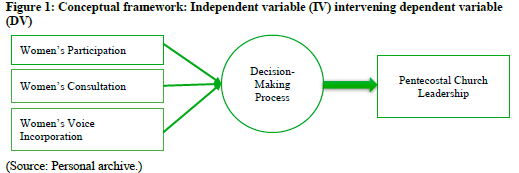
Based on the foregoing, the study used a conceptual framework to evaluate the influence of women's participation in decision-making within Pentecostal Church leadership in Laikipia County as indicated in Figure 1.
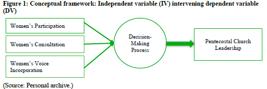
The study investigated how women leading in church governance in Pentecostal Churches influenced the leadership by considering the way decisions are made. For this study, women's participation entailed that they take part in official church organizations and committees, while member participation involves turning up and getting actively involved in what the organization does and how decisions are made. To implement women's consultation, church leaders seek women's help and opinions so that their opinions are intentionally included in the planning process. Women's voices result in incorporating women's views, opinions, and advice into regular customs, guidelines, and choices within the church. The way decisions are made in the organization is the link that helps to explain how women's involvement leads to organizational changes. For example, deliberation, forming consensus, and creating policies are done both in set and casual ways within the church's structure.
The term 'Pentecostal Church leadership' is therefore used to describe how leadership structures are arranged within Pentecostal Churches and includes leading the church as a pastor, being part of the church board, managing specific ministries, and holding key administrative jobs that involve spiritual, administrative, and strategy matters. Both ordained and lay leaders take part in decision-making, introducing doctrine, and shaping the church's management, all within the Pentecostal system, which points out spiritual gifts of God's calling and uses charismatic styles of leading. This conceptual framework postulates that including more women in church governance can create recent and transformative leadership in Pentecostal Churches. Based on the adopted framework, it is assumed that if women have more participation, better consultation, and more say in church matters, the churches would have improved performance and female inclusion in Pentecostal Church leadership as will be explained under the adopted theoretical framework in this article.
This article's focus on women's leadership and church participation therefore aims to foster appreciation and support for the broader agenda of equity, justice, and empowerment for women and girls. Kenyan women, like many other women worldwide, traverse their everyday lives and leadership trajectories inside their cultural environment, acknowledging it as an essential aspect of their identity (Abuga, 2024). Although women constitute the majority inside the church, they are still occupying inferior positions, encountering discrimination, patriarchy, abuse, instability, economic disenfranchisement, and detrimental cultural practices. Notwithstanding these limitations, Kenyan women are advocating for political and cultural transformation within their communities and regions. Further, despite the Church's declared commitment to gender equality, women's voices and involvement often remain excluded (Zuali, 2024) and understudied.
This article's focus on investigating the influence of women's engagement in decision-making in Pentecostal Church leadership in Laikipia County is deemed significant for addressing the knowledge gaps by providing empirical evidence on women's decision-making roles, successful leadership models, and factors influencing women's engagement using quantitative methods from various congregations in Laikipia County. The article further contributes to the knowledge gap by enhancing academic and policy discussions on gender and church leadership by examining women's roles in Pentecostal Churches' decision-making processes. The article also emphasizes strengthening gender inclusivity in leadership structures and the creation of more inclusive governance frameworks for institutional growth and community representation by providing evidence-based insights into women's leadership engagement in the Pentecostal Church in Laikipia County.
Brief Review of Literature
The review of related literature was done in relation to the objectives which guided the study, namely women's participation in decision-making and Pentecostal Church leadership. The Pentecostal movement promotes women's empowerment through the Holy Spirit. However, it faces a complex link between its egalitarian ideology and women's leadership roles. Despite early efforts, modern practices often exhibit patriarchal frameworks, leading to structural obstacles faced by many Pentecostal women preachers, highlighting the discord between the movement's core tenets and contemporary organizational procedures. According to Ilesanmi (2018), leaders of all genders adopt the feminine leadership philosophy which prioritizes empathy, humility, and relationship dynamics in business. It has enabled women's advancement to leadership roles at all levels, including religious and senior executive positions by promoting empathy and humility.
The Beijing Platform for Action has played a crucial role in promoting women's empowerment and participation in decision-making roles, resulting in advancements in Africa, particularly in Kenya (Sukuru and Kiende, 2021). Nevertheless, additional advancements and initiatives are necessary to improve gender equality and women's leadership in a variety of sectors, including religious organizations.
In sub-Saharan Africa, women constitute the predominant demographic of attendees in mainstream and Pentecostal Churches. However, leadership roles continue to be primarily occupied by men. For instance, while the church is primarily characterized by a feminine perspective and composition, it is mostly masculine in leadership and culture. The gender disparity is worsened by cultural norms and traditional behaviors that often designate women as submissive. A study by Njoni (2022) reveals that women in the National Independent Church of Africa are inclined to assume leadership roles, however, with limited appointments and incentives. They participate actively in decision-making processes, integrating their perspectives into final judgments. Women engage in ordinary tasks but are excluded from supervisory positions in significant initiatives in Kenya.
In Kenya, the discussion on women's involvement in church leadership is intertwined with human rights and social justice debates. The principle of equality, supported by various philosophical traditions, underpins the arguments for women's inclusion in decision-making roles, particularly in feminist philosophy, which critiques and dismantles power structures (Nzegwu, 2006). Studies also indicate that Pentecostalism encounters social problems pertaining to gender equality despite women being actively engaged in church activities as their participation in decision-making processes remains restricted. As such, patriarchal views within church leadership still obstruct women's full involvement in decision-making positions, as highlighted by Gathogo (2024).
Women's Consultations in the Decision-making Process and Pentecostal Church Leadership
Women's leadership within the church includes several positions such as pastor, deacon, assistant pastor, youth pastor, music director, elder, and rector. They provide guidance, inspire, establish objectives, and address the needs of people and groups within the church (Klenke, 2017). Historically, women were often raised under male dominance, with submissive roles and domestic responsibilities (Wainaina, 2012). In Kenyan communities like the Luo, widows were forced to marry their deceased husband's eldest brother - a practice that has declined due to HIV/AIDS and increased education. Women also underwent female genital mutilation (FGM) to suppress sexual desires and reinforce homemaking roles, causing significant harm, including childbirth-related death (Mbiti, 2016, p. 125).
In the African traditional religion, women had pivotal positions, often interceding for their families and communities through prayer. Despite their importance, women remain underrepresented in key positions across various sectors in Kenya, including church leadership. The 2010 Kenyan constitution requires women to occupy one-third of all managerial positions across all sectors. However, socio-cultural views and conventional prejudices remain substantial obstacles (Mwai, Mwenje and M'Raiji, 2017). Nonetheless, societal changes have led to an improvement in the role of women leaders in the church, with more women now taking on roles such as departmental heads, congregational leaders, and administrators although gender biases still persist in the church.
Jordan, Yoeli and Rand (2021) discuss the realities that women face in male-dominated societies, including the church, where they encounter structures of injustice, oppression, and discrimination. Similarly, Heath and Weber (2020) observe that women are often expected to be submissive due to social norms, which elevate men to more powerful positions. Male dominance is a key factor contributing to the underrepresentation of women in church leadership. Heath and Weber (2020, p. 15) argue that religion is viewed as a component of African culture, which influences these dynamics. African literature offers a critical perspective on the cultural contexts affecting gender roles, with narratives that challenge and redefine traditional norms (Achebe, 2000). These stories can be powerful tools for advocating for gender equity in religious institutions including Laikipia County for a more women inclusive, just, and equitable society.
Women's Voices Incorporated in Decision-making and Pentecostal Church Leadership
Effective leaders, akin to women, comprehend and manage emotions, enabling them to connect with the sentiments and ambitions of their followers. They are integral to church decision-making, guaranteeing that their perspectives and thoughts are included in the choices. This may be accomplished by the direct or indirect involvement of engaging women leaders and incorporating their perspectives into the church's choices (Eagly and Carli, 2018). Wainaina (2012) found that women in the Presbyterian Church of Nairobi County occupied only a few leadership responsibilities, while being the majority in congregations and possessing significant leadership positions in other sectors. This poses a prevalent problem in male-dominated churches implying that the church takes measures to bring more women into leadership through nominations or appointments.
Studies have also indicated that in Laikipia County, women's involvement in church leadership is shaped by historical, cultural, theological, and philosophical elements, with patriarchal interpretations of religious scriptures and cultural traditions constraining their participation (Ngunjiri, 2010). The COVID-19 pandemic has highlighted gender inequalities but also provided opportunities to re-evaluate these dynamics, as the essential role of women in caregiving has challenged traditional norms (Kameri-Mbote and Meroka-Mutua, 2020). Progressive religious' perspectives and feminist philosophies advocate for gender equity, calling for the reinterpretation of religious texts and ethical frameworks to support women's leadership (Oduyoye, 1995; Nzegwu, 2006). Women perform as leaders attributable to their emotional intelligence, enabling them to empathize with the sentiments and ambitions of their followers in both routine and crisis scenarios. Their role in church decision-making involves bringing women into the decision-making process, either directly or indirectly, to ensure their insights are included.
An analysis of the foregoing studies reveals that existing literature has identified barriers that women face in church leadership and evaluates the effectiveness of existing structures in integrating women's perspectives. However, the existing literature indicates a lack of empirical evidence to inform church policy and advance gender parity in leadership positions as women remain underrepresented in leadership positions. Therefore, this article aims to contribute to providing empirical evidence on how women's engagement can transform church leadership dynamics, advocating for more inclusive practices that empower women within religious contexts in Laikipia County. The article underscores the growing recognition of women's roles in religious leadership and the need to document their contributions systematically. Further, the article offers insights on these dynamics for developing inclusive church governance structures that reflect congregation composition while respecting theological frameworks and decision-making processes in Pentecostal Church leadership in Laikipia County.
Theoretical Framework
This article draws on the female leadership theory as advanced by Chen et al. (2018, p. 195). This theory posits that certain leadership styles correlate with societal notions of femininity, 'including relational, collaborative, consensus-building, intuitive, and transparent approaches'. The theory also states that women are more predisposed than men to exhibit good leadership styles in prevailing circumstances, contesting the prevalent notion that men are the only competent leaders, especially within ecclesiastical settings (Jenni, 2017, p. 79). The female leadership theory focuses on empathy, humility, and relational dynamics in company operations, and the need to be embraced by leaders of all genders. Based on these, it has facilitated women's ascension to leadership posts across all tiers, including church and high-level executive positions by fostering empathy and humility.
The female leadership theory is not without shortcomings. For example, McKenzie (2018) critiques this theory for emphasizing values such as self-awareness, inclusivity, constructive criticism, power sharing, self-care, and the deconstruction of prejudice. She posits that female leaders value the welfare of others more than their male counterparts, indicating a potential advantage in leadership effectiveness (cf. Sumra, 2019). The theory has also been criticized for only advocating women's leadership, which is subjective (Bhat and Sisodia, 2016). Therefore, while there are small differences between the leadership roles of men and women, the overall leadership effectiveness advantage of women is significant. Additionally, the female leadership theory advocates that women prioritize others' welfare and have a leadership effectiveness advantage. Proponents argue that women should have more leadership positions due to their effective leadership style while opponents maintain the traits of the theory of leadership, which suggests that women should be appointed and elected leaders (McKenzie, 2018; Bhat and Sisodia, 2016). Notwithstanding these shortcomings, this theory was utilized to explain the unique leadership constraints encountered by women in leadership positions among Pentecostal Church leaders as the theory provided an understanding of women's participation, consultation, and incorporation of their voices in the decision-making processes in Pentecostal leadership in Laikipia County.
Research Methodology
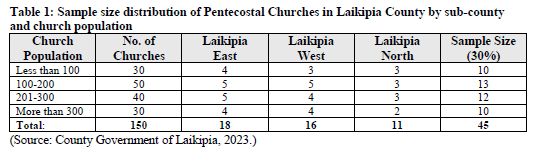
The article draws on a descriptive survey design to examine gender dynamics in church leadership, local customs, and cultural factors influencing women's responsibilities, as well as to elucidate the relationship between gender and religious authority in Laikipia County. The positivism paradigm was adopted to explain the phenomena using a quantitative approach. The design was appropriate based on the overall goal of the aim and nature of the research objectives which guided the study. The target population was 150 Pentecostal Church leaders in Laikipia County. The church leadership was stratified into various positions, each forming a stratum. The stratified simple random sampling technique was employed to ensure equal participation of women in leadership within the stratum. Rahi (2017, p. 4) recommended a sample size between 10% and 30% for a study with a target population under 10,000 people, as a smaller sample size is commendable. The study sampled 45 women in leadership from 30% of the 150 Pentecostal Churches within Laikipia County. The whole of Laikipia was covered by dividing the churches into sub-county regions (Laikipia East, Laikipia West, and Laikipia North), as indicated in Table 1.
Using a 30% proportionate stratified sampling technique among Laikipia East, Laikipia West, and Laikipia North, the sample size was calculated. By rounding off the proportions, the whole-number counts of churches and regional balance were gauranteed.
The study utilized questionnaires as the primary data source, based on the study's objectives and the nature of the data to be collected. Data analysis was conducted using the Statistical Package for the Social Sciences (SPSS) version 25, while the quantitative data were statistically analyzed through descriptive analysis, including frequencies and percentages, and presented in figures such as bar graphs and pie charts.
Results and Discussion of the Study
Women's Participation and Decision-making in Pentecostal Church Leadership
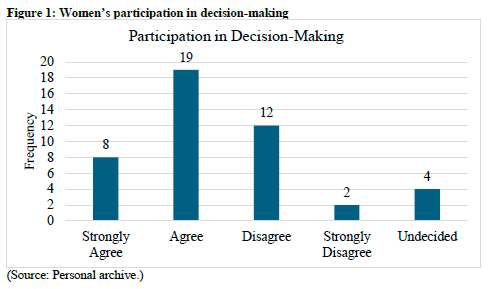
The study sought to determine the influence of 'women's involvement in decision-making' processes in Pentecostal Church leadership in Laikipia County for purposes of ascertaining the participation of women in decision-making processes as explicated in Figure 1.
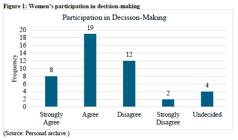
The frequency distribution of responses in Figure 1 indicates that the combined majority of respondents (60%) affirmed women's participation in decision-making while 31% expressed a contrary view, while 9% were uncertain. In this regard, 19 (42%) respondents agreed and 8 (18%) strongly agreed that women formed a part of church leadership's decision-making processes while 12 (27%) disagreed, 2 (4%) strongly disagreed, and 4 (9%) respondents were unsure on 'women's involvement in the decision-making process' within the Pentecostal Church leadership in Laikipia. These findings suggest a general, though moderate, perception that women play an active role in decision-making processes, indicating gradual shifts toward inclusive leadership.
A reasonable explanation for this level of agreement may be attributed to recent institutional and cultural changes within some Pentecostal congregations, such as increased advocacy for gender inclusivity and the recognition of women's contributions to pastoral care and ministry. In congregations where women are visibly involved in ministries such as counseling, welfare support, and youth mentorship, their proximity to church governance may enhance perceptions of their participation in decision-making. The finding also suggests that 'women's involvement in church leadership' demonstrates their value and involvement in decision-making processes ensuring their decisions are incorporated into the final decision-making process.
The acknowledgment of women's participation in decision-making further not only points to the importance of women's involvement in leadership but also suggests the growing recognition of women's engagement in the leadership of the Pentecostal Churches. This also resonates with the theoretical viewpoint about female leadership that women can also be competent leaders within ecclesiastical settings (Jenni, 2017). At the same time, 31% of the respondents who expressed the view that women did not participate in the decision-making processes indicate that gender inequalities still persist, pointing to lingering historical factors which impede women's full participation in decision-making processes in Pentecostal Churches. This is in tandem with the findings of Ngunjiri (2010) that historically, male dominance in leadership roles has been justified by patriarchal 'interpretations' of religious texts and cultural traditions, limiting women's participation. Gender inequalities in church leadership thus present opportunities to re-evaluate these dynamics, as the essential role of women in caregiving has challenged traditional norms. To improve women's leadership representation in the Pentecostal Church leadership, it is imperative for churches to implement policies which promote gender inclusivity, including mentorship programs and leadership training for women, and promoting equal opportunities for both men and women in leadership appointments in Pentecostal Churches in Laikipia County. Such interventions not only affirm women's leadership capacity but also contribute to a more representative and contextually responsive ecclesiastical governance structure.
Women's Consultation and Decision-making Processes in Pentecostal Church Leadership
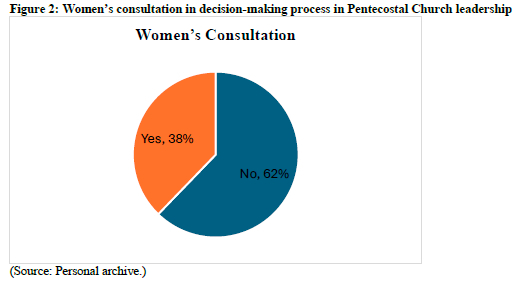
Women's input and involvement in church governance matters within Pentecostalism are very important to gender inclusion. The study also sought to establish 'whether women were consulted in the decision-making process in Pentecostal Church leadership' as indicated in Figure 2.
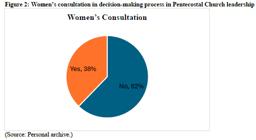
Figure 2 illustrates that 62% of respondents were excluded from the church leadership's decision-making processes, while just 38% were consulted. According to the study, there were no conflicts when women were added to the process of leadership decisions. This scenario indicates that while the majority of the respondents affirmed that women participated in decision-making processes, there were challenges with women's consultation in these processes. As specified in existing literature, many religious institutions are likely to exclude women from leadership because they follow traditional ideas that put men in authority and do not consider women as essential decision-makers (Oduyoye, 1995). The lack of women consultation and engagement therefore underscores a substantial deficiency in inclusive procedures within the studied church leadership framework. The findings also demonstrate that the female leadership principles of fostering gender equality in the consultation processes in decision-making (McKenzie, 2018) are yet to be actualized within the sampled Pentecostal Churches in Laikipia County.
The results prompt apprehensions about the openness and variety of viewpoints in decision-making. Moreover, the 38% of respondents who engaged directly in the decision-making processes pointed out that options for extensive contribution and collaborative discourse are still constrained. Wainaina (2012) also concluded that women in the Presbyterian Church of Nairobi County only occupied a few leadership responsibilities despite being the majority in congregations and possessing significant leadership positions in other sectors.
The findings also affirm that the women are indirectly involved in leadership by consulting female leaders and incorporating their perspectives into decision-making processes. Rectifying this disparity might cultivate a more equal and representative leadership environment in Pentecostal Church leadership in Laikipia County. This finding contradicts Klenke (2017) who claims that women in church leadership provide direction, motivation, and reprimand, setting goals and addressing needs. As such, more needs to be done to give women a voice in the leadership and decision-making processes by directly or indirectly fostering their participation or consultation as argued by Eagly and Carli (2018). Importantly, church leadership can promote inclusive decision-making processes by actively involving women in consultations, such as advisory councils or forums, to ensure their voices are heard and their contributions are considered before making key church decisions in Laikipia County.
Women's Voice Incorporation and Pentecostal Church Leadership
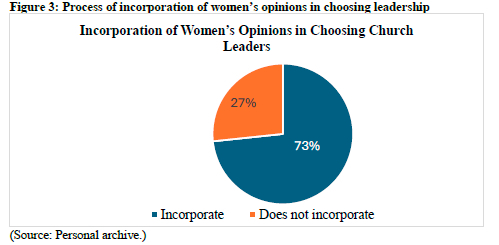
Existing research has indicated that having more female leaders in Pentecostal Church leadership enhances the church's liveliness, diversity in decision-making, and acceptance of new ideas, thus encouraging growth and improvement (Miller, 2018; Yong, 2021). This study therefore further investigated the nature of women's inclusion in church leadership by establishing the 'inclusion of women's opinions in choosing leaders' within Pentecostal Church leadership and how their inclusion or exclusion from the process affects Pentecostal Church leadership in Laikipia County. The findings point out that the majority of the respondents was of the view that women's opinions were included in the process of choosing leaders as indicated in Figure 3.
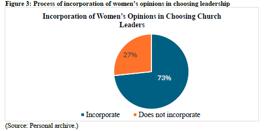
Figure 3 illustrates that while only 27% disagreed, most respondents (73%) agreed that women's viewpoints were taken into account during the process of choosing church leaders. The findings asserted that women's points of view are included in the process of church leadership, making decisions especially in the governance of their churches. The analysis revealed that though there were no consultations, their perspectives were integrated into the final judgments on choosing leaders. This inclusion of women's voices when choosing church leaders can be linked to the fact that women constitute the majority of congregational membership. Further, this phenomenon may arise from the Pentecostal emphasis on charismatic gifts rather than hierarchical traditions. Given that Pentecostalism prioritizes Spirit-led leadership (1 Cor. 12:7-11), the active involvement of women in governance whether through pastoral roles, prophetic ministry, or administrative positions creates structural avenues for their voices to influence decision-making. The data also suggest that when women hold either formal or informal leadership positions, their perspectives are more likely to be integrated into leadership selection processes, supporting findings that indicate a correlation between female representation and deliberative inclusivity (Miller, 2018; Yong, 2021).
However, these findings also signal an inequality, which is apparent in decision-making procedures, as women, despite their numerical presence, mostly engage in choosing males as church leaders in Laikipia County. As indicated by Eagly and Carli (2018), women participate in church decision-making to guarantee that their opinions and insights are included into the choices made. However, there is a need to devise mechanisms which can enable women to contribute to the welfare of the church in a wholistic manner. Such a scenario would enable women to utilize their abilities as framed in the female leadership theory (empathy, humility, and relational dynamics) for the good of the churches. To address this, it is imperative for church leadership to increase women's participation in decision-making processes by implementing structured consultation mechanisms that encourage active participation in discussions and policy-making to prevent passive inclusion in Laikipia County.
Conclusion
The article sought to assess how women's engagement in decision-making influence Pentecostal Church leadership in Laikipia County. Despite their substantial presence in religious congregations, the article has pointed out that challenges in women's engagement in leadership decision-making processes in Pentecostal Churches in Laikipia County persist. This suggests that, despite the recognition of women's contributions and progress made to enhance their participation in decision-making processes, their leadership roles remain constrained. Additionally, the majority of participants (62%) indicated that they were not involved in the decision-making process of church leadership, which highlights a lack of inclusion within governance frameworks. The majority of male influence in decision-making among Pentecostal Church leadership is underscored by the fact that only 38% of the respondents reported being consulted.
The article has also argued that despite the fact that 73% of women concurred that women's perspectives were incorporated into decision-making, the absence of consultations suggests that their perspectives were included in a passive rather than an active manner. This represents a systemic disparity in which women's perspectives are acknowledged but not proactively sought after in leadership processes. This also reveals that within the sampled Pentecostal Church leadership, women, despite their prevalence and accomplishments, primarily serve as supporters in the election of male leaders rather than assuming leadership roles themselves. This requires a more inclusive approach that ensures the full participation of women in both consultative and executive roles within the Pentecostal Church leadership in Laikipia County.
References
-
Abuga, S.K. (2024) Gender-based barriers to women participation gender responsiveness of initiatives and their influence on women participation in coffee cooperatives in Kiambu county. Dissertation, Catholic University of Korea, Seoul. https://doi.org/10.62049/jkncu.v5i1.165
» https://doi.org/10.62049/jkncu.v5i1.165 - Achebe, C. (2000) Things fall apart. London: Heinemann.
-
Asamoa-Gyadu, J.K. (2005) African charismatics: A study of Independent Indigenous Pentecostal movements in Ghana. Leiden: Brill. https://doi.org/10.1163/9789047406303
» https://doi.org/10.1163/9789047406303 - Baxter, J. (2016) Speaking out: The female voice in public contexts. London: Springer.
- Bhat, N. and Sisodia, R. (2016) Shakti leadership: Embracing feminine and masculine power in business. Oakland: Berrett-Koehler.
-
County Government of Laikipia. (2023) 3rd generation CIDP 2023-2027public participation report. Available at: https://laikipia.go.ke/assets/file/b9fc774f-3-rd-generation-cidp-2023-2027-publi.pdf. (Accessed January 25, 2024.
» https://laikipia.go.ke/assets/file/b9fc774f-3-rd-generation-cidp-2023-2027-publi.pdf -
)
» https://doi.org/10.4102/tv.v46i1.121 -
Chen, S., Fang, H.C., MacKenzie, N.G., Carter, S., Chen, L. and Wu, B. (2018) 'Female leadership in contemporary Chinese family firms', Asia Pacific Journal of Management, 35(1), pp. 181-211. https://doi.org/10.1007/s10490-017-9515-2
» https://doi.org/10.1007/s10490-017-9515-2 -
Eagly, A.H. and Carli, L.L. (2018) Women and the labyrinth of leadership. London: Routledge. https://doi.org/10.4324/9780429494000-17
» https://doi.org/10.4324/9780429494000-17 -
Elias, E. (2018) 'Lessons learned from women in leadership positions', Work, 59(2), pp. 175-181. https://doi.org/10.3233/WOR-172675
» https://doi.org/10.3233/WOR-172675 -
Gathogo, J.M. (2024) 'Book review: The paradox of becoming: Pentecostal city, planetary, and Africanity', Journal for the Study of Religion, 37(1). 4 pages. http://dx.doi.org/10.17159/2413-3027/2024/v37n1ar1
» http://dx.doi.org/10.17159/2413-3027/2024/v37n1ar1 -
Heath, K. and Weber, M.J. (2020) Women in leadership and work-family integration: Strategies for fulfillment and well-being. In: Dhiman, S. ed. The Palgrave handbook of workplace well-being. London: Palgrave Macmillan, pp. 1-24. https://doi.org/10.1007/978-3-030-02470-3_35-1
» https://doi.org/10.1007/978-3-030-02470-3_35-1 -
Ilesanmi, O.O. (2018) 'Women's visibility in decision making processes in Africa - progress, challenges, and way forward', Frontiers in Sociology, 3. 7 pages. https://doi.org/10.3389/fsoc.2018.00038
» https://doi.org/10.3389/fsoc.2018.00038 - Jenni, C. (2017) 'Motivation to lead: A contingent approach to female leadership', Journal of Business Diversity, 17(2), pp. 75-81.
-
Jordan, J.J., Yoeli, E. and Rand, D.G. (2021) 'Don't get it or don't spread it: Comparing self-interested versus prosocial motivations for COVID-19 prevention behaviors', Scientific Reports, 11(1), pp. 1-17, https://doi.org/10.1038/s41598-021-97617-5
» https://doi.org/10.1038/s41598-021-97617-5 - Kameri-Mbote, P. and Meroka-Mutua, A. (2020) Gendered impacts of responses to the COVID-19 pandemic in Kenya. Nairobi: University of Nairobi, School of Law.
-
Klenke, K. ed. (2017) Women in leadership: Contextual dynamics and boundaries. Leeds: Emerald Group Publishing. https://doi.org/10.1108/978-1-78743-063-120172001
» https://doi.org/10.1108/978-1-78743-063-120172001 -
Lawless, J.L. (2015) 'Female candidates and legislators', Annual Review of Political Science, 18, pp. 349-366. https://doi.org/10.1146/annurev-polisci-020614-094613
» https://doi.org/10.1146/annurev-polisci-020614-094613 - M'arimi, W.M. (2020) Contributions of the National Independent Church of Africa to socioeconomic development in Kibugu parish, Embu County, Kenya. Dissertation, Kenyatta University, Nairobi.
-
Maseno, L. (2017) 'Prayer for rain: A Pentecostal perspective from Kenya', The Ecumenical Review, 69(3), pp. 336-347. https://doi.org/10.1111/erev.12297
» https://doi.org/10.1111/erev.12297 -
Mbiti, I.M. (2016) 'The need for accountability in education in developing countries', Journal of Economic Perspectives, 30(3), pp. 109-132. https://doi.org/10.1257/jep.30.3.109
» https://doi.org/10.1257/jep.30.3.109 -
McKenzie, B.L. (2018) 'Am I a leader? Female students' leadership identity development', Journal of Leadership Education, 17(2), pp. 1-18. https://doi.org/10.12806/V17/I2/R1
» https://doi.org/10.12806/V17/I2/R1 - Miller, D.E. (2018) 'The case for women's empowerment in Pentecostal Churches', Journal of Pentecostal Theology, 27(2), pp. 145-162.
-
Mwai, W., Mwenje, M. and M'Raiji, J.K. (2017) 'The construction of feminine psychology in Swahili women's nuptial poetry', Journal of Educational and Developmental Psychology, 7(1), 241-248. https://doi.org/10.5539/jedp.v7n1p241
» https://doi.org/10.5539/jedp.v7n1p241 - Nesbitt, P.D. (2024) 'Feminization of the priesthood at fifty - and the journey ahead', Anglican and Episcopal History, 93(2), 280-301.
-
Ngunjiri, F.W. (2010) Women's spiritual leadership in Africa: Tempered radicals and critical servant leaders. New York: New York University Suny Press. https://doi.org/10.1353/book289
» https://doi.org/10.1353/book289 - Njoni, N.N. (2022) Assessment of women participation in church leadership: A case of National Independent Church of Africa (NICA), Kenya. Dissertation, Kenya Methodist University, Starehe.
- Northouse, P.G. (2022) Leadership: Theory and practice. 9th ed. Los Angeles: Sage.
-
Nzegwu, N. (2006) Family matters: Feminist concepts in African philosophy of culture. New York: New York University Press. https://doi.org/10.1353/book5063
» https://doi.org/10.1353/book5063 -
Oduyoye, M.A. (1995) 'Christianity and African culture', International Review of Mission, 84(332-333), pp. 77-90. https://doi.org/10.1111/j.1758-6631.1995.tb02690.x
» https://doi.org/10.1111/j.1758-6631.1995.tb02690.x - Oduyoye, M.A. (2019) African women's theologies, spirituality, and healing: Theological perspectives from the Circle of Concerned African Women Theologians. New York: Paulist Press.
-
Rahi, S. (2017) 'Research design and methods: A systematic review of research paradigms, sampling issues and instruments development', International Journal of Economics & Management Sciences, 6(2), pp. 1-5. https://doi.org/10.4172/2162-6359.1000403
» https://doi.org/10.4172/2162-6359.1000403 - Rhode, D.L. (2017) Women and leadership. Oxford: Oxford University Press.
-
Rosenbach, W.E., Taylor, R.L. and Youndt, M.A. (2018). Contemporary issues in leadership. London: Routledge. https://doi.org/10.4324/9780429494000
» https://doi.org/10.4324/9780429494000 -
Sukuru, C. and Kiende, H.K. (2021) 'Beijing platform for action: Critical milestones to eradication of barriers to women participation in decision making in Kenya', International Journal of Innovative Research and Development, 10(4), pp. 240-242. https://doi.org/10.24940/ijird/2021/v10/i4/APR21071
» https://doi.org/10.24940/ijird/2021/v10/i4/APR21071 -
Sumra, M.K. (2019) 'Masculinity, femininity, and leadership: Taking a closer look at the alpha female', PLoS ONE, 14(4). e0215181. 32 pages. https://doi.org/10.1371/journal.pone.0215181
» https://doi.org/10.1371/journal.pone.0215181 - Tucker, R.A. (2016) Extraordinary women of Christian history: What we can learn from their struggles and triumphs. Michigan: Baker Books.
- Wainaina, E.N. (2012) Factors influencing women's non-participation in church administrative leadership in the Presbyterian Church of East Africa, Milimani Presbytery, Nairobi County, 1908-2012. Thesis, Kenyatta University, Nairobi.
- Yong, A. (2021) 'The Spirit pours out on all flesh: Women's voices and Pentecostal ecclesiology', Pentecostal Studies, 40(1), 22-41.
-
Zuali, Z. (2024) 'Disciplining the female voice: A Foucauldian analysis of the Lairam Isua Krista Baptist Church's (LIKBK) gender dynamics', International Journal of Religion, 5(8), 850-861. https://doi.org/10.61707/gx5ng630
» https://doi.org/10.61707/gx5ng630

Revised: March 3. 2025
Accepted: May 4, 2025
Published: June 23, 2025
Editor/s
Dr. Nelly Mwale
Funding
No funding was received for this article.