Religion Behind Bars: Faith-based Programs in the Rehabilitation of Offenders in the Medium B Westville Correctional Center, Durban
In order to maintain social control and order, several authors perceive religion to be a significant aspect of societal life (Akhverdiev & Ponomarev 2008:1; Stark & Bainbridge 2012:1; Welch, Tittle, & Grasmick 2006:1605). The right to religious practice is considered vital in almost all societies. There is a body of research that suggests that a decline in religious conformity erodes the moral fabric of society and hence perceives its decline to contribute to social degeneration leaving society in a state of disarray (Nwube & Edigbo 2023; Ezeonwumelu 2021; Sekhaulelo 2021; Dick, Ede, & Chiaghanam 2020; Nikolova 2018). A deviation from religious norms and values at an individual level is known to result in anomic behavior ensuing conflict with the law. On the contrary, religious fundamentalism is also known to be contributing to hostility, violence, lawlessness, harmful behavior, and social instability (Gorur & Gregory 2021; Wright & Khoo 2019; Sulaiman 2016; VanAernum 2014). It is in this context that this article reviews religious practices and beliefs among male offenders and its role in rehabilitating their deviant behavior so that they may self-actualize to become good citizens upon release in the South African society. Notwithstanding, the study provides very little support on the notion that correctional centers' inspired faith-based programs indeed impact prosocial behavior as offenders engage with their respective religious belief systems as individuals. This finding refutes the notion contained in the literature study that avers that correctional centers' inspired faith-based programs do in fact yield prosocial behavior.
Religion; chaplain; rehabilitation; incarceration; offender; secularism
Religion Behind Bars: Faith-based Programs in the Rehabilitation of Offenders in the Medium B Westville Correctional Center, Durban
Sultan Khan
School of Social Sciences. University of KwaZulu-Natal. https://orcid.org/0000-0003-2835-4655
ABSTRACTIn order to maintain social control and order, several authors perceive religion to be a significant aspect of societal life (Akhverdiev & Ponomarev 2008:1; Stark & Bainbridge 2012:1; Welch, Tittle, & Grasmick 2006:1605). The right to religious practice is considered vital in almost all societies. There is a body of research that suggests that a decline in religious conformity erodes the moral fabric of society and hence perceives its decline to contribute to social degeneration leaving society in a state of disarray (Nwube & Edigbo 2023; Ezeonwumelu 2021; Sekhaulelo 2021; Dick, Ede, & Chiaghanam 2020; Nikolova 2018). A deviation from religious norms and values at an individual level is known to result in anomic behavior ensuing conflict with the law. On the contrary, religious fundamentalism is also known to be contributing to hostility, violence, lawlessness, harmful behavior, and social instability (Gorur & Gregory 2021; Wright & Khoo 2019; Sulaiman 2016; VanAernum 2014). It is in this context that this article reviews religious practices and beliefs among male offenders and its role in rehabilitating their deviant behavior so that they may self-actualize to become good citizens upon release in the South African society. Notwithstanding, the study provides very little support on the notion that correctional centers' inspired faith-based programs indeed impact prosocial behavior as offenders engage with their respective religious belief systems as individuals. This finding refutes the notion contained in the literature study that avers that correctional centers' inspired faith-based programs do in fact yield prosocial behavior.
Keywords: Religion, chaplain, rehabilitation, incarceration, offender, secularism
Introduction1
20th-century sociologists such as Durkheim (1858-1971) and Weber (1864-1920) postulate that religion serves as a form of moral order and social control. With increasing secularization, the traditional theocratic state, as found in Europe, South Africa, and America, for example, has been rapidly diminishing and religion has moved from the public sphere to the personal (Luckmann 1963:150; Berger 2001:444; Riesebrodt 2002:1). Although many societies consider religion as a personal matter, they have enshrined religious practices and traditions in their respective constitutions. The right to religion has been recognized by the United Nations as a fundamental right as early as 1945. Similarly in the African continent the right to religion is recognized by the African Union while South Africa, a newcomer to global and continental codes of social order is also a signatory. South Africa occupies a special space in human rights violation given its past colonial and apartheid legacy which was dealt with by the Truth and Reconciliation Commission post liberation where an opportunity was provided for perpetrators to confess and be forgiven (Wilson 2000:79). Drakulevski (2017:2) observes that it is no coincidence that the UN Standard Minimum Rules for the Treatment of Prisoners was named the Nelson Mandela Rules which embodies access to religion as a fundamental human right.
Studies on the religion-rehabilitation nexus is only beginning to gain currency in the behavioral sciences since the 20th century (Jang & Johnson 2023:1; Kittrell 2018:16; Gerace & Day 2010:318). There is an emerging body of knowledge that suggests prosocial behavior is contingent on religious practices and beliefs (Jang & Johnson 2024:47; Bryan, Francoa, Angelo, & Sembrero 2016:636; Oxhandler & Pargament 2014:271, Preston, Salomon, & Ritter 2014:149-150). In therapeutic work with offenders, religious and spiritual beliefs are known to result in behavior change for the better. Based on this assertion the study has interrogated a sample of 62 male offenders in the Medium B Prison in Westville, Durban. As a preamble, the study will provide a conceptual framework on religion distinguishing it from the sacred to the profane followed by some theoretical notions on the nexus between religion and social order. The role religion plays in promoting prosocial behavior is then discussed. This is followed by a discussion on the relation between conformity and deviancy through religious practices. Thereafter faith approaches in the recuperation of offenders and a case study are analyzed to ascertain whether organized religious programs impact positively on the spiritual wellbeing of offenders.
Religion - the Sacred and Profane
The view that religion is a social invention which embodies a collective representation of society's ideals has been expounded by the earlier work of sociologist Émile Durkheim in his book The elementary forms of the religious life (Durkheim 1912) which continues to hold theoretical validity. Durkheim, cited by Gofman (2018:26), postulates that religious beliefs serve as a source of social cohesion within society which provides meaning in life. Additionally, it reinforces morals and social norms that are held collectively within society. He further asserts that it is an integral part of the social system that provides social order and solidity. Durkheim, cited in Bellah (1973:1), contends that religion is sacred, uniting adherents into a moral community. Morris (1987:127) further elucidates that religion has a regulatory effect on human behavior which is transmitted over generations.
Although Durkheim views religion to be an important component for societal functioning, Karl Marx (1818-1883) holds a differing view asserting that the purpose of religion is to dull the pain of oppression to prevent people from making demands for social change so that it provides a blissful afterlife through salvation. The bourgeoisie and the church buoyed one another with the former funding the church legitimating inequality as God's will, thus maintaining the established social order. The proletariat, according to Marx, failed to realize this as religion imparts their misery as God's will, resulting in the creation of a sense of false consciousness. According to Outhwaite (2020:426), Marx's critique of religion was a key catalyst in the rise of Communism in 1917 in different parts of the globe until its demise in 1989. After a long absence of religion, traditional churches were able to gain social acceptance after a period of state-enforced secularization (Sarkissian 2009:477). More recently, new religious markets emerged with many people exercising their liberty to pre-communist faiths (Saunders 2022:42-43; Minárik 2021:5-6; Mojzes 2020:8-9).
Conceptualizing Religion and Social Order
Although the classical works of Durkheim, Weber, and Marx continue to serve as a foundation for the explanation of religion and social order, more recent theoretical perspectives provide insight into the criminal deterrence effect of religion. In this respect the most prominent works of Hirschi and Stark (1969), Burkett and White (1974), as well as Higgins and Albrecht (1977), cited by Baier and Wright (2001:3), and Adamczyk, Freilich, and Kim (2017:192-193) postulate the hellfire hypothesis. This hypothesis predicts that religion discourages individual-level deviancy through supernatural sanctions that encourage normative behavior through supernatural rewards. The hypothesis of Stark, cited in Johnson and Jang (2010:118), for instance foretells that conformity to religion would deter deviancy in moral communities. On the other hand, in secularized communities, little or no effect of religiosity would be expected (Johnson & Jang 2010:118). Similarly, Welch, Tittle, and Petee (1991:159-160) hypothesize that 'moral communities' are most effective in promoting moral standards.
Building on the works of Welch et al. (1991), Stark and Bainbridge (2012), in their analysis of religion, postulate that the main purpose of religion is to maintain moral order. They therefore contend that the greater the religious belief is, the greater the likelihood of not breaking the moral code of that society. They view religion as a social rather than a psychological phenomenon, hence their work focuses on the morality of the community as compared to that of the individual. Within the moral community dialogue, individuals have subordinated their selfish impulse to society through social integration which means a shared willingness to adopt a set of norms acceptable for interaction within society (Stark & Bainbridge 2012:4). They further assert that through social integration, individuals form social attachments which are a societal glue that holds individuals together. Based on this assertion it is hypothesized that people will deviate due to having lesser levels of attachments (Stark & Bainridge 2012:4). Although attachments may provide norm coherence and meaning, world religions impose sacred obligations towards the divine, specifically moral demands concerning the behavior of adherents (Stark & Bainbridge 2012:5).
The ecological hypothesis on religion and crime has been expounded by Rose (2002:340) who asserts that the community's capacity for local social control is less likely in more religious contexts. This assumption is predicated on the understanding that community-level religiosity is a form of social control since it represents social responsibility and concentrations of religiously oriented people who create a moral climate which is not conducive to crime. On the contrary, the social control theory gained currency through the work of Benda and Corwyn (2001:58) who hypothesize that there is a relation between religion and undesirable behavior. Notwithstanding, they caution that there is very little understanding as to why there are fewer criminals among atheists and question as to why organized religion increases the magnitude of crime.
There is another assertion that religious individuals can become deviant. The work of Perrin (2001) illustrates that fringe religions such as New Religious Movements (NRMs) provide insight into forms of behavior which are considered deviant. Hence, the normative perspective focuses on non-normative religious behavior which explains why NRMs form and why individuals join (Perrin 2001:136-137). Many NRMs are sects or cults that deviate from mainstream religions which are considered pure, and invent religious innovations which are not in keeping with pure religions grounded in the divine, hence they violate the norms of the parent religion (Moon 2023:5 of 14; Diefenderfer 2020:1; Pretorius 2011:229). NRMs emerge when individuals have lost faith in traditional forms of religion (Coates 2013:1300). Notwithstanding, conformity to traditional forms of religion continue to thrive in almost all societies. For instance, in Africa given the long history of colonialism, the vast majority had to forsake their traditional religion and practices (Ndemanu 2018:70) and are now reverting to their religious roots (Masondo 2011:32). Similarly, the case of the Soviet Union is one such illustration where there is a reversion to traditional forms of religion.
Religion and Prosocial Behavior
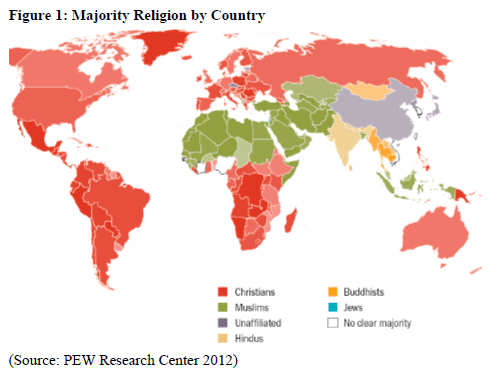
Despite secularization, the global religious landscape in the 21st century suggests that religion is vital in the lives of individuals and communities. More than 80% people identify with a religious group, according to the Pew Research Center's Forum on Religion and Public Life (PEW Research Center 2012:9). In a comprehensive study, the Center has observed that 5.8 billion adults and children in more than 230 countries surveyed, representing 84% of the 2010 world population of 6.9 billion, are affiliated to some form of religious order (PEW Research Center 2012:9). This finding strongly suggests that an adherence to religious values and norms forms an integral part of people's lives as illustrated in Figure 1.
Although an overwhelming percentage (84%) of the world population subscribe to some form of religious affiliation, adherence to faith varies by age. In a more recent survey the PEW Research Center (2012:5) has observed that the younger adults more likely do not conform to religious values compared to their older counterparts. Adults older than 40 are more likely to perceive religion as very important compared to their younger counterparts. This does not only hold true in the lives of more affluent countries and secular countries but also in lesser and more religious countries.
There is also a view that education reduces religious identity and practice (Rachmatullah, Ha, & Park 2019:2). Societies that provide a high standard of education result in the current generation receiving more education compared to their parents and grandparents. Commitment to religion also varies due to differences in the way countries have evolved historically. In Western societies, although organized religion has evolved to a greater extent, religious practices are lesser in extent as compared to poorer nation states. In instances where people face constant vulnerability to material resources and social ailments they tend to place their faith in the supernatural, which provides them with succor from anxiety. According to the American Psychological Association, feelings of distress drive people to religious conformity (Goodman 2020).
There is another notion that countries that are less religious are characterized by lower levels of deviant behavior. In this respect, Wang and Jang (2017:1124) observe that they are less likely to be corrupt with lower levels of deviance compared to their religious counterparts. Crimes such as murder, according to Inglehart (2021:1), are 10 times higher in theocratic countries compared to less religious ones. Access to better material and legal resources makes it safer in poor countries.
Religious Conformity and Deviancy
The assertion that religion is the fundamental fabric upon which behavior is regulated is based on the understanding that society will decay due to being less religious. This will result in crimes escalating, the prevalence of violent behavior resulting in immorality and depravity in once-civilized life. Secular societies which have weaker religious participation tend to have lesser levels of crime compared to those societies that have a strong faith in God (Zuckerman 2015). This trend may be attributed to high levels of poverty that predispose adherence to crime. Tittle and Welch (1983:653) have already noted that environments which are characterized by normative ambiguity, lower social integration, lesser peer conformity, and high religious non-affiliates are not precursors to deviancy. Such an assertion holds true, according to Johnson (2009:866), who asserts that youths who grow up in 'bad places' can still turn out to be 'good kids' if religious beliefs and practices are regular and important in their lives.
Families, kinship, and social networks are important factors that promote religiosity. Individuals who adopt a specific faith since childhood and socialize within communities are more likely to conform to social norms and values. This suggests that the greater the exposure to religion the more people are inclined to conform (Thiruchselvam, Gopi, Kilekwang, & Gross 2017:956). Thiruchselvam et al. (2017:957) provide a more scientific understanding on neural measures and its effect on lowering social conformity among non-religious individuals. They conclude that neural responses to stimuli raised by religious practices result in conforming to religious groups, which is intrinsically rewarding as it creates neural circuitry since it is rewarding to the brain.
Secularization refers to the collapse of specific and dominant religious organizations (Dawson 1988:583). Secularized countries are characterized by enacted laws that are normative to regulate society and are enshrined in their constitution. In this instance, Dawson (1998:583) notes that 'laws fare best in terms of managing crime rates, advancing prosperity, equality, freedom, democracy, women's rights, human rights, educational attainment and life expectancy'. A deviation from secularized notions of what unacceptable behavior is, is subject to sanctions which bring citizens to account for their conduct.
Secularists are not agnostics and believe that God exists, that he is the creator of life, making life incredibly valued. In this instance secularists may argue that the foetus needs to be protected by law as it is life that is innocent.
They may argue similarly that all people are created equally and that racial discrimination is wrongful according to God's moral law and we should care for others who experience material challenges by providing social welfare programs. Hence, Sweetman (2010:2) argues that people like these should not just assert the existence of God, but proposes that it is rational to believe in God. Hence, secularization has proliferated the rise of NRMs (Ibrahim 2013:182).
Religious Approach to the Rehabilitation of the Deviant
A deviation from the norms and values of society, be it based on theocratic or secularist principles, is subject to sanction in different forms, one of which is incarceration. Cavadino and Dignan (1997:114) assert that correctional services serve society by keeping deviants in custody and their duty is to humanely take care of them and assist them to conform to societal laws and lead meaningful lives whilst in custody and beyond. While a variety of secular therapeutic approaches are used towards rehabilitating offenders, the role of religion as rehabilitation is believed in some instances to promote spirituality that will instill a sense of morality that deviates from the norms of society (O'Connor 2004:14).
Religious approaches to the rehabilitation of offenders are pursued through chaplaincy. Sundt, Dammer, and Cullen (2002:64), cited by Khan (2024:11), interrogated 232 chaplains on the rehabilitation of offenders. Chaplains were asked what they think is the best way to rehabilitate offenders. The findings indicated that offenders be provided educational skills development to find a job after incarceration, assistance to cope with their emotional problems that led them to be in conflict with the law, and change in their value system through religion, were important factors. More specifically, 60.2% of the respondents felt that a change in their value system through religion was the most appropriate way for offender rehabilitation. A significant number (90%) asserted that they should be a role model for moral thinking behavior change.
Dammer (2002:35) has investigated reasons for offenders' religious involvement. He has observed that offenders who were sincere found religion to be a motivating factor in their lives. Additionally, Dammer (2002:35) notes that religious observance provides incentives for change, a sense of direction, meaning for life, hope for the future, peace of mind, positive self-esteem, and a change in lifestyle. Insincere offenders are inclined to practice their religion for manipulative purposes in which their behavior does not echo the rules or norms of any formal religion.
Faith-Based Approaches to Rehabilitation in Westville Male Medium B Correctional Center
The study comprised 62 offenders from the Westville Medium B Correctional Center, of which all agreed to participate. The Correctional Center incarcerates offenders who have committed serious offences. They were incarcerated for offences such as murder, rape, armed robbery, drug trafficking, and many more. A structured questionnaire comprising demographic data on the offender, the nature and extent of their engagement with faith-based programs, the frequency of faith-based practices, and six Likert scale questions on the impact of their participation in faith-based programs and their outlook towards life as a result of participation in religious programs were explored.
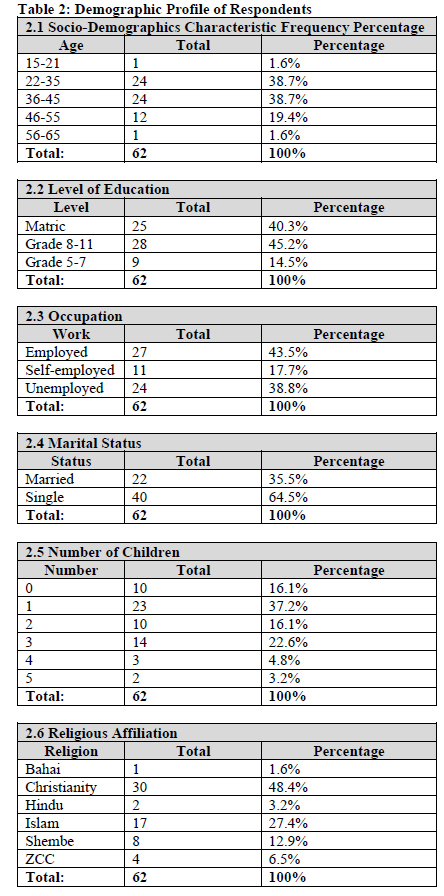
From the demographic data presented in Table 2 a broad overview of offenders can be profiled. The vast majority are below 55 of which 38.7% are between the ages of 22 and 35 and 36 and 45, respectively. Cumulatively they constitute 77.5% of the sample, suggesting that the offenders are relatively young. As far as the educational levels of respondents are concerned, 40.3% have completed their senior certificate examination, 45.2% had Grade 8 to 11 education, while the remaining 14.5% with Grades 5 to 7. Cumulatively, 59.7% of the participants did not complete their senior certificate examination. This finding suggests that offenders varied over a range of educational qualifications, hence education was not a precursor to the nature of offenses committed.
Almost two thirds (61.2%) of the respondents were in gainful employment or self-employed. More than a third (38.7%) of the respondents were unemployed. This pattern suggests that the rate of unemployment among offenders is higher than the country's norm of 33.9%. Notwithstanding, this finding refutes the notion that unemployment is the primary variable in offending. It confirms that irrespective of the material circumstances of offenders, offending is spread among both the employed and the unemployed with greater prominence among the unemployed. Just more than a third (35.5%) of the respondent were married while a significant number (64.5%) were single. Among those who were married only 16.7% had no children. A significant number had one, two, or three children amounting to 37.1%, 16.1%, and 22.6%, respectively. A small number had four or five children making up 4.8% and 3.2%, respectively. This finding suggests that despite having a sense of family responsibility it is not a deterrent to offend.
All respondents in the study were affiliates of some organized form of religion. Offenders within the Christian faith made up close to half (48.4%) of the study population while Islam ranked second with 27.4% and Shembe - a blend between Christianity and indigenous ancestral worship - with 12.9%. Offenders within the Hindu faith comprised 3.2%, Bahai 1.6%, and Zionist Christian Church (ZCC) adherents 6.5%. What is significant in this finding is that Christianity is a dominant religious grouping in the country while Islam constitutes a minority. Islam as a faith group promotes greater rigidity in religious practices and they make up more than half of their Christian counterparts. This variation in religious affiliation suggests that belonging to a particular faith group is not a factor in the nature and extent of offending. It may be further assumed that belonging to a particular faith group does not preclude offending.
Amongst the most prominent crimes committed are house breaking (24.2%), rape (16.1%), and murder (12.9%). The average duration of incarceration for these crimes committed is 30 years. Considering that the current life expectancy rate in South Africa is 64.8 years suggests that offenders will spend almost half of their lifetime in incarceration. Being in isolation from family and society for such a long duration makes reintegration programs a futile exercise as most will be closer to have lived their life span. Such predictions are based on the assumption that the values and norms learnt in incarceration through religious conformity, will add very little social capital to society given the length of their incarceration. Although this may be perceived as being pessimistic, for the offender, faith in religion provides succor within the bars of the correctional center.
Interestingly, 82,3% of the offenders reported that before incarceration they practiced their religion compared to 96.8% who affirmed that they are praying on their own. The fact that an overwhelmingly large percentage reporting adherence to their religion before incarceration, suggests that they were not religiously sterile individuals before serving their sentence. However, there are variations in the frequency with which they pray. A total of 75.8% of the respondents pray daily whereas 12.9% pray occasionally. The remaining 11.3% pray once a week. Irrespective of this variation in the frequency of praying, the fact that they do pray is indicative that they are not lost to religion and faith. With reference to participation in religious programs organized by chaplains only 21% of participants were attracted. This trend suggests that organized religious programs have a low level of appeal, which is supported by the earlier finding that 96.8% of the offenders are praying on their own. Of those who participate in chaplain led religious programs, 54% are praying only on religious occasions, 17.7% sometimes, and 6.5% not at all. The low-level support for chaplaincy led religious programs suggests that commitment to organized forms of religious activity has very little appeal among offenders. Offenders prefer praying on their own and value their faith as individuals, which is supported by the finding that 82.3% reported conformity to their faith before incarceration. This is supported by the finding that 96.8% are praying on their own. The findings suggest that conformity to religion during incarceration is an individual and personal matter between the offender and God.
Seeking forgiveness from God is a motivating factor as to why offenders are praying. In this respect 9.7% strongly agreed as compared to 72.6% who only agreed. Praying regularly helps offenders to make life easier in the correctional center. In this respect a significant 74.2% felt that practicing their religion helped them cope with the challenges accompanying incarceration while 22.6% found no difference followed by 3.2% with no response. A vast majority (91.9%) agreed that they will continue to practice their religion post incarceration while only 6.5% strongly agreed, with 1.6% disagreeing. This finding suggests that irrespective of chaplaincy led religious programs, offenders were and are religiously inclined before, during, and post release. There was a wide agreement (80.6%) that they did not learn much about their religion during incarceration whereas 19.4% disagreed. This trend suggests that offenders come to correctional centers with a strong religious orientation and organized chaplaincy led programs did not further enhance their knowledge about their faith. Exposure to other religious groups and wanting to change their religion gained a fraction of support. A total of 19.4% felt their exposure to other faith groups made them want to change their religion as compared to 72.6% wanting to continue with their faith. Despite the fact that a significant number continued to practice their religion there was overwhelming (88.7%) support with regard to respect for other faith groups. These findings further affirm that offenders are not religiously sterile within the confines of the correctional center.
Conclusion
The study has confirmed that religion is a vital social institution in the organization of societies. With secularization religious practices have diminished to a certain extent. Despite this, secularized societies compared to their theocratic counterparts have lesser levels of deviancy. This brings into question whether religious belief is a constraining factor in deviant behavior. The case study reveals that offenders held strong religious beliefs before their incarceration. The effectiveness of chaplaincy is illustrated by low levels of participation in religious programs which suggests that irrespective of organized religious programs, offenders preserve their religious identity on their own. Whether there is a need for them to learn more about their faith in order to seek succor and comfort during their incarceration is questionable. The fact that an overwhelming number of offenders pray on their own highlights the motivation to be connected with their spiritual self and likely to carry over their faith upon release. These findings strongly suggest that offenders have not been incarcerated as religiously sterile individuals. This is contrary to the literature that asserts that organized faith-based programs are a necessity for pro-social behavior. By all indications there is very little agreement with the assertion that faith-based programs do in fact enhance the religiosity of offenders. With or without such programs, offenders are cognizant of the value of practicing their faith to cope with the challenges and difficulties that accompany incarceration.
References
- Cavadino, M. & J. Dignan 1997. The penal system: An introduction. 2nd ed. University of Michigan: Sage.
-
Coates, D.D. 2013. New Religious Movement membership and the importance of stable 'others' for the making of selves. Journal of Religious Health 53, 1300-1316. https://doi.org/10.1007/s10943-013-9715-0
» https://doi.org/10.1007/s10943-013-9715-0 -
Dammer, H.R. 2002. Reasons for religious involvement in the correctional environment. Journal of Offender Rehabilitation 35, 3/4: 35-58. https://doi.org/10.1300/J076v35n03_03
» https://doi.org/10.1300/J076v35n03_03 -
Dawson, L.L. 1998. The cultural significance of New Religious Movements and globalization: A theoretical prolegomenon. Journal for the Scientific Study of Religion 37, 4: 580-595. http://www.jstor.com/stable/1388142
» http://www.jstor.com/stable/1388142 -
Diefenderfer, M. 2020. Social control and cults. Kent State University. Available at: https://www-s3-live.kent.edu/s3fs-root/s3fs-public/file/Diefenderfer%20Social%20Control%20and%20Cults%202021%20-%20Morgan%20Diefenderfer.pdf?VersionId=46JSmRdV5Zq1QiQr0kZCKjkqpAisSEf. (Accessed on October 23, 2024.
» https://www-s3-live.kent.edu/s3fs-root/s3fs-public/file/Diefenderfer%20Social%20Control%20and%20Cults%202021%20-%20Morgan%20Diefenderfer.pdf?VersionId=46JSmRdV5Zq1QiQr0kZCKjkqpAisSEf - )
- Dick, C.J., V.I. Ede, & O.F. Chiaghanam 2020. Addressing moral decadence in contemporary Nigerian society: The religious option. Discovery 56, 293: 273-280.
-
)
» https://doi.org/10.26650/SJ.2019.39.1.0007 - Durkheim, É. 1912. The elementary forms of the religious life. Oxford: Oxford World's Classics.
- Ezeonwumelu, U.I. 2021. The role of religion in building a morally-conscious society. Sapientia Foundation Journal of Education, Sciences and Gender Studies 3, 3: 149-158.
- Gerace, A. & A. Day 2010. Criminal rehabilitation: The impact of religious programming. Journal of Psychology and Christianity 29, 4: 317-325.
-
Goodman, B. 2020. Faith in a time of crisis. American Psychological Association. Available at: https://www.apa.org/topics/covid-19/faith-crisis. (Accessed on September 23, 2024.
» https://www.apa.org/topics/covid-19/faith-crisis -
)
» https://doi.org/10.1007/s12103-022-09707-3 -
Gorur, A. & J. Gregory 2021. Violence based on religion or belief - taking action at the United Nations. International Order and Conflict. Issue Brief. Stimpson. Available at: https://www.stimson.org/wp-content/uploads/2021/01/PCIC-issue-brief-violence.pdf. (Accessed on July 22, 2024.
» https://www.stimson.org/wp-content/uploads/2021/01/PCIC-issue-brief-violence.pdf - )
-
Higgins, P.C. & G.L. Albrecht 1977. Hellfire and delinquency revisited. Social Forces 55, 4: 952-958. https://doi.org/10.1093/sf/55.4.952
» https://doi.org/10.1093/sf/55.4.952 -
Hirschi, T. & R. Stark 1969. Hellfire and delinquency. Social Problems, 17, I2: 202-213. https://doi.org/10.2307/799866
» https://doi.org/10.2307/799866 - Ibrahim, M. 2013. The rise and proliferation of New Religious Movements (NRMs) in Nigeria. International Journal of Humanities and Social Science 3, 15: 181-190.
-
Inglehart, R.F. 2021. Religion's sudden decline: What's causing it, and what comes next? New York: Oxford University Press. https://doi.org/10.1093/oso/9780197547045.001.0001
» https://doi.org/10.1093/oso/9780197547045.001.0001 - Kittrell, A. 2018. Is religion an effective rehabilitation method? Comparing the results. MA dissertation, Department of Public Policy, Helms School of Government Lynchburg, Virginia.
-
Jang, S.J. & B.R. Johnson 2023. The role of religion in offender rehabilitation and prisoner well-being. Institute for the Study of Religion. Baylor University. Available at: https://www.openaccessgovernment.org/article/religion-offender-rehabilitation-prisoner-well-being/156480/. (Accessed on September 11, 2024.
» https://www.openaccessgovernment.org/article/religion-offender-rehabilitation-prisoner-well-being/156480/ -
)
» https://doi.org/10.4102/hts.v74i1.4633 -
Johnson, B.R. 2009. The role of religious institutions in responding to crime and delinquency. In Clarke, P.B. (ed.): The Oxford handbook of the sociology of religion, 857-875. Oxford: Oxford University Press. https://doi.org/10.1093/oxfordhb/9780199279791.003.0048
» https://doi.org/10.1093/oxfordhb/9780199279791.003.0048 -
Khan, S. 2024. Nexus between faith and therapeutic interventions in the rehabilitation of offenders: A case study of the Muslim minority community in South Africa. Southern African Journal of Social Work and Social Development 36, 2: 1-17. https://doi.org/10.25159/2708-9355/12315
» https://doi.org/10.25159/2708-9355/12315 - Luckmann, T. 1963. The invisible religion: The problem of religion in modern society. New York: MacMillan.
-
Masondo, S. 2011. African traditional religion in the face of secularism in South Africa: Religion and society. Focus 62: 32-38. Available at: https://hsf.org.za/publications/focus/focus-62/Sibusiso%20Masondo_African%20Traditional%20Religion.pdf. (Accessed on August 25, 2024.
» https://hsf.org.za/publications/focus/focus-62/Sibusiso%20Masondo_African%20Traditional%20Religion.pdf -
)
» https://doi.org/10.15700/saje.v39n1a1611 -
Minárik, P. 2021. The economics of religion in a globalizing world: Communist China and Post-Communist Central Europe. SHS Web of Conference 92: 1-9. The 20th International Scientific Conference Globalization and its Socio-Economic Consequences 2020. https://doi.org/10.1051/shsconf/20219207041
» https://doi.org/10.1051/shsconf/20219207041 -
Moon, M. 2023. Toward an integrated analysis of social movements and New Religious Movements research. Sociology Compass 17, 12. e13134. 14 pages. https://compass.onlinelibrary.wiley.com/doi/10.1111/soc4.13134
» https://compass.onlinelibrary.wiley.com/doi/10.1111/soc4.13134 - Morris, B. 1987. Anthropological studies of religion. Cambridge: Cambridge University Press.
- Mojzes, P.B. 2020. Religion in Eastern Europe after the fall of communism: From euphoria to anxiety. Occasional Papers on Religion in Eastern Europe. Thirtieth Anniversary Issue of the Fall of Communism 40, 1: 1-12.
-
Ndemanu, M.T. 2018. Traditional African religions and their influences on the worldviews of Bangwa people of Cameroon: Expanding the cultural horizons of study abroad students and professionals. Frontiers: The Interdisciplinary Journal of Study Abroad 30, 1: 70-84. https://doi.org/10.36366/frontiers.v30i1.405
» https://doi.org/10.36366/frontiers.v30i1.405 - Nwube, N.S. & M.N. Edigbo 2023. Religious boom and moral plummet in rural-urban cities of South East Nigeria. Ikwo Journal of Educational Research 8, 13: 34-47.
- O'Connor, T.P. 2004. What works? Religion as a correctional intervention: Part 1. Journal of Community Corrections 14, 1: 1-17.
-
Outhwaite, W. 2020. When did 1989 end? Social Science Information 59, 3: 425-438. https://doi.org/10.1177/0539018420936043
» https://doi.org/10.1177/0539018420936043 -
Oxhandler, H.K. & K.I. Pargament 2014. Social work practitioners' integration of clients' religion and spirituality in practice: A literature review. Social Work 59, 3: 271-279. https://doi.org/10.1093/sw/swu018
» https://doi.org/10.1093/sw/swu018 -
Perrin, R.D. 2001. When religion becomes deviance: Introducing religion in deviance and social problems courses. Teaching Sociology 29, 2: 134-152. https://doi.org/10.2307/1318713
» https://doi.org/10.2307/1318713 -
PEW Research Center. 2012. The global religious landscape: A report on the size and distribution of the world's major religious groups as of 2010. Available at: http://www.pewforum.org/global-religious-landscape.aspx. (Accessed on September 12, 2024.
» http://www.pewforum.org/global-religious-landscape.aspx -
)
» https://doi.org/10.1086/300104 - Preston, J.L., E. Salomon, & R.S. Ritter 2014. Religious prosociality: Personal, cognitive, and social factors. In Saroglou, V. (ed.): Religion, personality, and social behavior, 149-169. New York: Psychology Press.
-
Pretorius, S.P. 2011. Spiritual abuse under the banner of the right to freedom of religion in religious cults can be addressed. Acta Theologica 31, 2: 219-240. https://doi.org/10.4314/actat.v31i2.11
» https://doi.org/10.4314/actat.v31i2.11 -
Riesebrodt, M. 2002. Religion in the modern world: Between secularization and resurgence. Max Weber Lecture Series. European University Institute. Italy. Available at: https://www.google.com/search?q=Riesebrodt%2C+M.+2002.+Religion+in+the+modern+world%3A&rlz=1C1ASUM enZA928ZA928&oq=Riesebrodt%2C+M.+2002.+Religion+in+the+modern+world%3A&gslcrp=EgZjaHJvbWUyBggAEEUYOTIHCAEQIRigATIHCAIQIRigATIHCAMQIRigATIHCAQQIRigATIHCAUQIRiPAjIHCAYQIRiPAtI BBzk3M2owajeoAgiwAgE&sourceid=chrome&ie=UTF-8. (Accessed on August 22, 2024.
» https://www.google.com/search?q=Riesebrodt%2C+M.+2002.+Religion+in+the+modern+world%3A&rlz=1C1ASUM enZA928ZA928&oq=Riesebrodt%2C+M.+2002.+Religion+in+the+modern+world%3A&gslcrp=EgZjaHJvbWUyBggAEEUYOTIHCAEQIRigATIHCAIQIRigATIHCAMQIRigATIHCAQQIRigATIHCAUQIRiPAjIHCAYQIRiPAtI BBzk3M2owajeoAgiwAgE&sourceid=chrome&ie=UTF-8 - )
-
Rose, D.R. 2002. Social disorganization and parochial control: Religious institutions and their communities. Sociological Forum 15, 2: 339-358. https://doi.org/10.1023/A:1007525709311
» https://doi.org/10.1023/A:1007525709311 -
Saunders, K.T. 2022. Religion and growth in human development in post-communist countries during the twenty-first century. Journal of Biblical Integration in Business 24, 39-49. https://doi.org/10.69492/jbib.v24i1.594
» https://doi.org/10.69492/jbib.v24i1.594 -
Sarkissian, A. 2009. Religious reestablishment in post-communist polities. Journal of Church and State 51, 3: 472-501. https://doi.org/10.1093/jcs/csp096
» https://doi.org/10.1093/jcs/csp096 -
Sekhaulelo, M.A. 2021. The profile and manifestation of moral decay in South African urban community. HTS Teologiese Studies/Theological Studies 77(4). a5422. 12 pages. https://doi.org/10.4102/hts.v77i4.5422
» https://doi.org/10.4102/hts.v77i4.5422 - Sulaiman, K.O. 2016. Religious violence in contemporary Nigeria: Implications and options for peace and stability order. Journal for the Study of Religion 29, 1: 85-103.
-
Sundt, J.L., H.R. Dammer, & F.T. Cullen 2002. The role of the prison chaplain in rehabilitation. Journal of Offender Rehabilitation 35, 3: 59-86. https://doi.org/10.1300/J076v35n03_04
» https://doi.org/10.1300/J076v35n03_04 -
Shy, O. 2005. Dynamic models of religious conformity and conversion: Theory and calibration. Econstor. Available at: https://www.econstor.eu/bitstream/10419/51062/1/501169504.pdf. (Accessed on July 13, 2024.
» https://www.econstor.eu/bitstream/10419/51062/1/501169504.pdf - )
-
Stark, R. & W.S. Bainbridge 2012. Religion, deviance, and social control. New York: Routledge. https://doi.org/10.4324/9780203724217
» https://doi.org/10.4324/9780203724217 -
Sweetman, B. 2010. Secularism and religion in modern democracies. Available at: https://www.e-ir.info/2010/08/04/secularism-and-religion-in-modern-democracies/. (Accessed on October 11, 2024.
» https://www.e-ir.info/2010/08/04/secularism-and-religion-in-modern-democracies/ - )
-
Thiruchselvam, R., Y. Gopi, H.J. Kilekwang, & J.J. Gross 2017. In God we trust? Neural measures reveal lower social conformity among non-religious individuals. Social Cognitive and Affective Neuroscience 12, 6: 956-964. https://doi.org/10.1093/scan/nsx023
» https://doi.org/10.1093/scan/nsx023 -
Tittle, C.R. & M.R. Welch 1983. Religiosity and deviance: Toward a contingency theory of constraining effects. Social Forces 61, 3: 653-682. https://doi.org/10.1093/sf/61.3.653
» https://doi.org/10.1093/sf/61.3.653 -
Wang, X. & S.J. Jang 2017. The relationship between religion and deviance in a largely irreligious country: Findings from the 2010 China general social survey. Deviant Behavior 38, 10: 1120-1140. https://doi.org/10.1080/01639625.2016.1241059
» https://doi.org/10.1080/01639625.2016.1241059 - VanAernum, Z. 2014. Violence in religion. Verbum 11, 2: 63-69.
-
Welch, M.R, C.R. Tittle, & H.G. Grasmick 2006. Christian religiosity, self-control and social conformity. Social Forces 84, 3: 1605-1623. https://doi.org/10.1353/sof.2006.0075
» https://doi.org/10.1353/sof.2006.0075 -
Welch, M.R., C.R. Tittle, & T. Petee 1991. Religion and deviance among adult Catholics: A test of the 'moral communities' hypothesis. Journal for the Scientific Study of Religion 30, 2: 159-172. https://doi.org/10.2307/1387210
» https://doi.org/10.2307/1387210 -
Wright, J.D. & Y. Khoo 2019. Empirical perspectives on religion and violence. Contemporary Voices. Available at: https://www.google.com/search?q=Wright%2C+J.D.+%26+Y.+Khoo+_2019.+Empirical+perspectives+on+religion+and+violence&rlz=1C1ASUMenZA928ZA928&oq=Wright%2C+J.D.+%26+Y.+Khoo+2019.+Empirical+perspectives+on+religion+and+violence&gslcrp=EgZjaHJvbWUyBggAEEUYOdIBBzc4NmowajSoAgCwAgE&sourceid=chr ome&ie=UTF-8. (Accessed on September 12, 2024.
» https://www.google.com/search?q=Wright%2C+J.D.+%26+Y.+Khoo+_2019.+Empirical+perspectives+on+religion+and+violence&rlz=1C1ASUMenZA928ZA928&oq=Wright%2C+J.D.+%26+Y.+Khoo+2019.+Empirical+perspectives+on+religion+and+violence&gslcrp=EgZjaHJvbWUyBggAEEUYOdIBBzc4NmowajSoAgCwAgE&sourceid=chr ome&ie=UTF-8 - )
-
Zuckerman, P. 2015. Op-Ed: Think religion makes society less violent? Think again. Los Angeles Times. October 30, 2015. Available at: https://www.latimes.com/opinion/op-ed/la-oe-1101-zuckerman-violence-secularism-20151101-story.html. (Accessed on June 24, 2022.
» https://www.latimes.com/opinion/op-ed/la-oe-1101-zuckerman-violence-secularism-20151101-story.html