Application of European standards for health and quality control of game meat on game ranches in South Africa
Abstract
The health and quality compliance of game carcasses (n = 295) intended for the South African export market and aspiring to comply with the strict hygiene requirements of the European Union were compared with game carcasses (n = 330) available for the local market and currently not subjected to meat safety legislation. Samples were collected in similar seasons and geographical areas in South Africa from 2006 to 2009. Aerobic plate counts (APC) of the heart blood verified that both groups possessed similar ante mortem bacterial status. For health compliance APC, tests for Escherichia coli, Salmonella spp. and Staphylococcus aureus were performed on the carcasses. Surfaces of the local carcasses were swabbed using the European Enviro-biotrace sponge technique at 3 and 72 h post mortem. Unskinned but eviscerated export carcasses in the abattoir were skinned and sampled by incision using a cork borer 72 h post mortem . Temperature and pH readings were recorded at 3 and 72 h post mortem from the longissimus dorsi muscle and the readings at 3 h differed (P = 0.035). Temperatures at 72 h were lower for export than local carcasses (P < 0.001) because of earlier introduction and maintenance of the cold chain. The pH readings also differed between groups at 3 and 72 h (P < 0.001). APC results for the local group exceeded the maximum permissible count (<105). S. aureus results showed differences (P <0.001), with readings from the local group being higher. The same tendency was exhibited for E. coli (P = 0.008). Imposition of hygiene guidelines for game ranchers producing meat for the local market is therefore recommended.
bacteriological standards; cropping; export; meat quality; safe game meat; trophy hunting
INTRODUCTION
The current health status of game meat available on the local South African market is unknown due to the fact that legislation requiring meat inspection or approved game slaughter facilities is not applied. This has raised concern and speculation as to the health status of this meat27i.e. red meat, poultry, ostrich, game and crocodile. However, the regulation applicable to game has been in draft since 2004 (to be promulgated in the near future under the MSA). This delay is due to the need to address the hunting process that delivers dead game animals to the abattoir and not live animals as required by the MSA (T Bergh, Veterinary Public Health, Department of Agriculture, Forestry and Fisheries, pers. comm., 2009) The Game Regulation originated from the Red Meat Regulation that is applicable to domesticated animals. Further concerns from game ranchers are that such regulations will be impractical and too costly to implement on a game ranch3,27. Cropping and export of game meat from South Africa is done in strict accordance with the guidelines of the Veterinary Procedural Notices (VPN)21-25 issued and annually amended by the Department of Agriculture Forestry and Fisheries in conjunction with the European Union (EU) (countries of import). In contrast, the game carcasses hunted for the local market are uncontrolled and no regulations or guidelines currently apply to such carcasses. The health and quality of export and local hunted game carcasses were investigated in this study to determine how effectively these issues are addressed by the MSA and the abovementioned VPNs. Less than ideal culling and slaughtering techniques are usually associated with meat from locally hunted animals, e.g. trophy animals as opposed to the 'ideal' or benchmark techniques of the export game carcasses. Unfortunately, the standards of slaughter and cooling facilities available for carcasses intended for the local market are usually not on a par with the EU requirements (VPN) for carcasses intended for export. The latter are transported refrigerated and unskinned (transportation time < 72 hours) from the ranch, where initial (partial) primary carcass inspection is done242221
It has been stated that hygiene and safety have been an issue in game meat for export/import for a long time and optimising the primary production level is the key to improving safety and shelf life of wild game meat15
It is speculated that in South Africa, especially during the hunting season, game meat contributes more than 20% towards red meat consumption184
The question may be posed from a public health perspective whether the current local game meat supply systems can provide safe game meat to the consumer.
The envisaged study focused on health and hygiene procedures that are applied following the hunting phase on the ranch and did not include any processing activities away from the ranch. The study will consequently determine the hygienic quality of the meat before the onset of the final phase of processing for human consumption. This latter processing phase is usually not implemented on the ranch9.19.26 and is regulated in South Africa by Regulation R918 published under the Health Act (Act 63 of 1977)20
The study compares the bacteriological status of the carcasses intended for export and local markets during the hunting phase (obtaining a carcass) on the ranch and the conclusions are based on this information. The aim was not to focus on specific micro-organisms, but rather to compare the general bacteriological quality of meat obtained from local and export hunting and cropping procedures.
Index or indicator microorganisms have been used to monitor the hygienic quality of water over the past 100 years and this principle has been extended to a variety of raw and processed foods. Index organisms are used as a measure of the possible presence of pathogens and have a predictive function, whereas indicator organisms are used to assess process integrity and are regarded as general hygiene markers of good manufacturing practices (GMP)5Escherichia coli, Staphylococcus aureus and Salmonella spp. were regarded as 'index' organisms, while the aerobic plate count (APC) was regarded as a measure of 'indicator' organisms.
MATERIALS AND METHODS
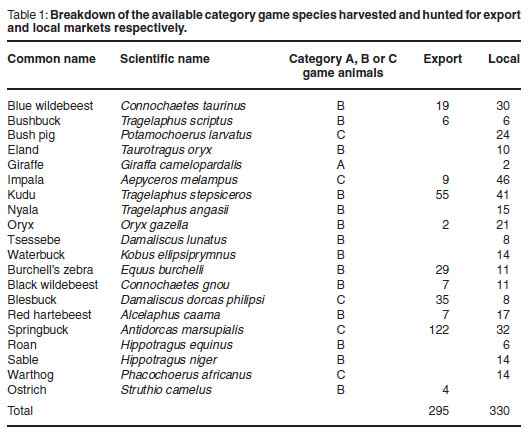
The procedures, readings and sample analysis were performed without consideration of the different game species but only the range of animals that were available during the study period. A breakdown of the categories of game species available in the study for the export and local market respectively is shown in Table 1.
Sampling of heart blood
Heart blood was sampled 3 h post mortem from game carcasses by making a longitudinal incision into the heart to expose the ventricles. Blood was collected asepticallyinto sterile evacuated heparin blood tubes. The filled tubes were transported in an insulated container at <7 ºC to a South African National Accreditation System (SANAS) accredited laboratory (Capricorn Veterinary Laboratories, Polokwane, South Africa) within 12 hours. An APC (ISO 4833; 1991 (E) MI-Meth-003) was obtained for the blood samples by pipetting decimal dilutions in dilution fluid ISO 6887 onto standard plate count agar. Heart blood samples were taken from undamaged hearts not contaminated by shot from 515 out of a possible 625 carcasses over the period 2006 to 2009. Small buck such as impala (Aepyceros melampus, category C) and medium-sized buck such as kudu (Tragelaphus strepsiceros, category B) were selected from carcasses hunted and cropped for the local and export markets. The categories of game animals are according to the MSA, which further prescribe category A inter alia as including big animals such as giraffe (Giraffa camelopardalis) and elephant (Loxodonta africana). The bacterial counts, however, do not reflect those of individual species but refer to a range of game animals.
Temperature and pH measurements
Temperature readings and pH values were taken at 3 h and 72 h post mortem to establish possible quality correlations. All the measurements were taken using a portable, calibrated Testo 205 pH and temperature meter (Unitemp, Johannesburg, South Africa). Measurements were taken and recorded directly after evisceration. The Testo meter was calibrated between readings and taken when the probe was inserted in the middle of both longissimus dorsi muscles. A total of 2500 measurements from a total of 625 carcasses (n = 295 for export and n = 330 for local) were noted for both temperature (temp1) and pH (pH s ) at the 1st and 2nd readings (temp2, pH2).
Aerobic plate count (APC)
APC determinations were done on the carcass surfaces of the local group, (n = 330) using the Enviro-biotrace swabbing technique described in the Food and Agriculture Organization of United Nations (FAO)/World Health Organization (WHO)107,29. One sponge swab was used to swipe each carcass (using 4 anatomical sites on both hind-and forequarters to obtain a sample representative of the carcass surface bacteria). Category A and B animals were sampled on the rump and neck area and category C animals on the perineal area from the base of the tail to the hock and the neck area25n = 660.
The Enviro-biotrace cattle and swine test kit consists of sterilised templates, gloves, resealable sachets with 29 cm2 peptone solution (Analytical & Diagnostic Products, CCPO, Weltevreden Park, South Africa). The dry sponges were soaked aseptically in the peptone solution and the templates were used to swab the 4 quadrants (fore-and hindquarters) of the carcass. Ten horizontal and 10 vertical swabbing movements for each of the quadrants within the confines of the USDA sterile and flexible plastic template (10 × 10 cm) ensured that the recommended carcass surface (100 cm27,12,13,17.
The export carcasses (n = 295) could only be sampled at 72 h (after skinning) through excision sampling, which forms part of the export sampling protocol and was performed by on-site qualified laboratory technicians.
A total of 955 samples taken over the period 2006 to 2009 from both local (n = 330 taken at both 3 h and 72 h = 660) and export carcasses (n = 295) were subjected to the APC.
Isolation of Salmonella spp, Escherichia coli and Staphylococcus aureus
Analyses of the abovementioned samples (APC) included simultaneous analyses for Salmonella spp., E. coli and S. aureus. Over the period 2006 to 2009, a total of 625 samples (export and local group) were taken at 72 h and analysed for the 3 pathogen types.
Data analysis
The overall total data (n = 4275 readings) were used to compute the final results. Statistical analyses were done using Sigma Stat, using the t-test (Shapiro-Wilk) for normality. The Whitney Mann rank sum test was used when tests for normality failed. Differences in median values between the 2 groups (export-cropping and local-hunting) were expressed with P < 0.05 (indicating significance). The Sigma Plot 2 program was used to graphically produce the figures presented in this study.
RESULTS
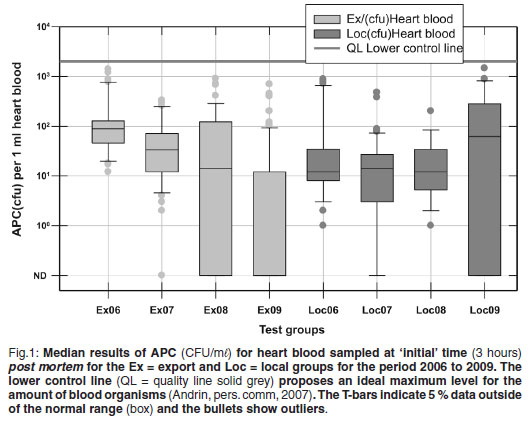
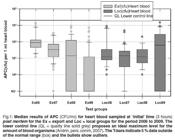
The results of the comparison between APC colony forming units (CFU/m) for heart blood sampled initially from both groups in 2006 to 2009 are illustrated in Fig. 1. The solid grey control line shows the highest acceptable level of bacteria that may be present in the heart blood. This control line indicates that a contamination level of <1 × 10³ is acceptable for the purposes of this study in terms of the sampling method used (M. Andrin, Capricorn Veterinary Laboratories, pers. comm., 2007). Significant differences were not found in terms of the bacterial quality of the heart blood sampled from the 2 groups.
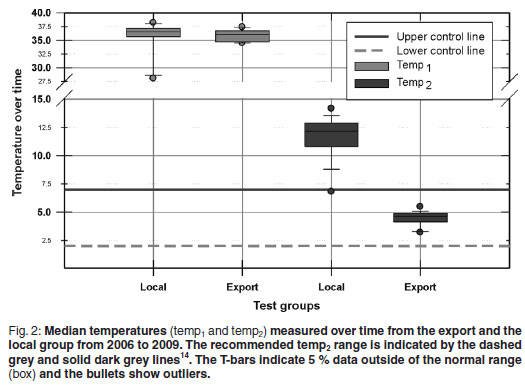
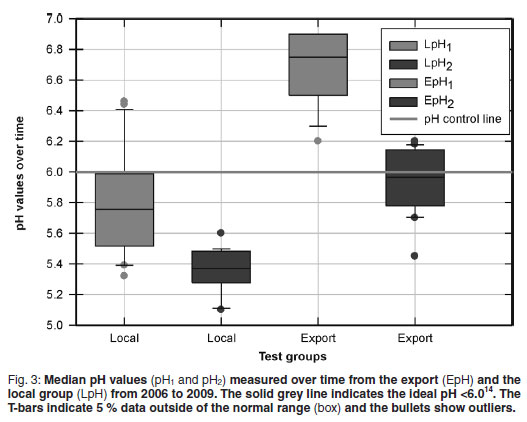
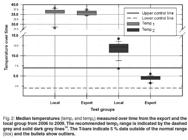
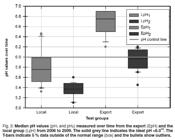
The results of the comparison between the temperature (temp1 and temp2) values of the local and export carcasses are illustrated in Fig. 2. Horizontal lines in this figure are quality lines and not specification lines as they do not indicate legal standards. The recommended temp2 range is indicated by the dashed grey and solid dark grey lines (-1 ºC to 7 ºC), recommended to be not less than -1 ºC (to prevent freezing of the meat). Furthermore, the carcass temperature should be kept above 2 ºC for 24 h for maturation and to reduce the risk of foot-and-mouth disease (FMD)141 and pH2 values of the local and export carcasses are illustrated in Fig. 3. The solid grey line indicates the ideal pH (<6.0) that will together with the reduced temperature minimise the risk of FMD142. Temperature readings and pH values noted for the 2 groups at temp1 and pH1 showed differences. Temp2 and pH2 values also differed (P < 0.001).
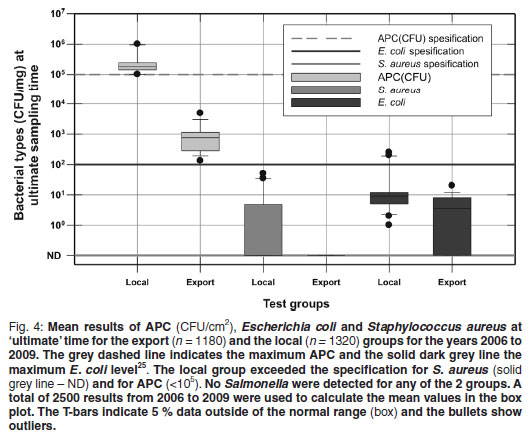
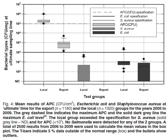
The results of the comparison between APC (CFU/cm2Fig. 4. All horizontal lines are specification lines based on bacteriological standards for game meat intended for the export market25S. aureus. The dashed grey line indicates the maximum APC (CFU/cm2E. coli level. The local group exceeded the specification for S. aureus (ND) and for APC (<105Salmonella were detected on any of the 625 carcasses tested.
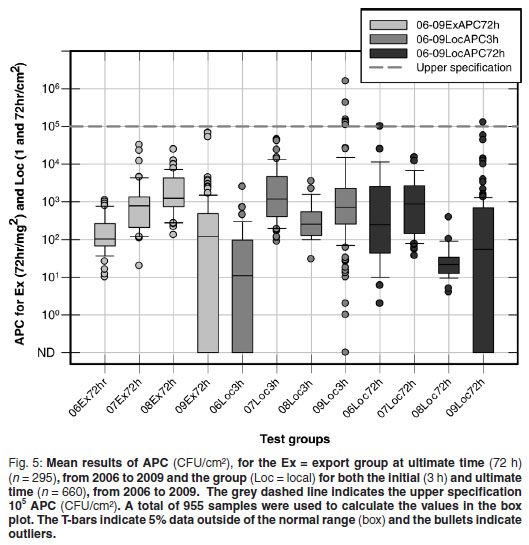
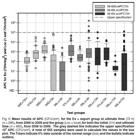
The overall bacterial results (CFU/cm2P = 0.291). However, the results at 3 h for the local group compared with 72 h for the export group showed higher levels (P = 0.006) of both the index and indicator bacteria tested (Fig. 5).
DISCUSSION
The results of the APC performed on the heart blood from the 2 groups were similar (P = 0.693) (Fig. 1). The blood samples should have been taken intravenously to adhere to prescribed aseptic sampling methods, but experience during the study showed that all arteries of the animal collapsed immediately post mortem and no blood could be accessed. Consequently, an incision was made into the heart to expose the ventricles for blood collection. In the process, bacteria on the exposed surface of the heart or bacteria from the environment could have been introduced into the blood sample. However, for the purpose of this study, a standardised sampling method was used with both groups and a similar 3 h bacteriological status for the 2 groups was established. The results do not support the principle of an ideal harvesting or hunting method, but they do indicate a similar initial post mortem bacteriological status. Game animals hunted with the heart as target were not included to exclude possible high bacteria counts as a result of cross contamination.
The bacteriological samples collected from both high and low intensity carcasses were compliant with the legal standards for high intensity carcasses as prescribed in the VPN25<105, but levels as high as 106 are acceptable in the global red meat market6E. coli is 102 and for S. aureus 100 CFU/m (VPN25Salmonella spp., which is in accordance with previous studies2,9. In addition it has been shown that when initial bacterial counts are sufficiently low, carcass tissues are typically sterile when tested at 'ultimate' time1129
The similarity in the E. coli, Salmonella and S. aureus counts between the local and export groups raises questions about the necessity of strict requirements such as the VPN.
The bacterial differences at 72 h can be ascribed to the maintenance of the cold chain and dressing in the case of the export group, where the risk of bacterial multiplication/contamination is decreased. It has been noted that refrigeration had a suppressive effect on the numbers of bacteria such as E. coli and Salmonella1<4 hours post mortem. This is in contrast to the refrigeration period applied voluntarily to the local group (any period up to 24 hours post mortem). The export group readings were lower, most probably thanks to the continuous maintenance of the cold chain. It is the normal procedure to load the carcasses in the field, after evisceration and health inspection, into cold trucks set at 5 ºC with the carcasses being maintained at this temperature until arrival at the abattoir. Here the data logger of the cold truck is inspected and if it complies with the requirements the carcasses are offloaded into a cold room from where they are removed for skinning and further processing (C. De Villiers, Mosstrich Export Game Abattoir, pers. comm., 2008).
The pH values are currently used in the export market for quality and shelf life purposes11ante mortem stress levels, disease or inflammation in the carcass and are therefore recorded and noted at the export abattoir prior to processing1128Salmonella and low numbers of S. aureus, considering the financial costs of such analyses, support the argument that testing for index/indicator organisms in the process of harvesting game carcasses should not be a regulatory requirement as intended by VPN. Such analyses could, however, be used to evaluate Good Hygiene Practices (GHP), Good Manufacturing Practices (GMP) and the Hygiene Management System (HMS) when further processing for the local market is envisaged. Leaving the skin on could be considered as a method of control for bacterial contamination during long periods of transportation. In addition, game carcasses possess less visual surface fat and marbling than domesticated animals and if these carcasses were to be skinned and left in efficient cold rooms for long periods (>24 h), drying out of the surface could occur. This will result in an unattractive appearance as well as larger yield losses during further processing. Dressing or skinning of game carcasses should therefore ideally be conducted after the transportation of the carcasses to the abattoir and prior to processing.
It has been noted that it is of little value to predict the safety of meat based on the levels of APC and/or E. coli found on the carcass6E. coli is found commonly as a contaminant of raw meats, even when produced under hygienic conditions, casts doubt on the specified South African legal level requirements for this organism8
The observance of Good Hygiene Practice (GHP) in the different forms of game harvesting and processing will play a decisive role in determining the microbiological status of the meat1616i.e. cattle and sheep6184
From the results of this study, it can be proposed that the differences in bacterial quality between meat/carcasses from the local and export group could be ascribed to the fact that GHP and GMP have been compromised in the case of local carcasses. The differences are, however, not dramatic enough to justify the application of the export regulations (VPNs) to the local market. For this reason the following recommendations are made: practical and affordable guidelines that emphasise the importance of meat hygiene and the integrity of the cold chain should be followed in the process of obtaining a game carcass on a game farm intended for the local market. In addition, keeping the skin intact could be considered as a method of bacterial control during extended periods of transportation and to ameliorate the negative effects of moisture loss and consequent darker meat. Legally prescribed bacteriological testing will always have a cost implication for those who produce for the local market and its application in terms of hygiene and quality of the meat can be questioned.
ACKNOWLEDGEMENTS
The authors acknowledge and express their sincere appreciation to the following people for their contribution to the study: the management of Wildlife Ranching South Africa for their financial contribution and all the game ranchers that participated in the study; Dr Tertius Bergh for his professional guidance and assistance in the collection of samples. The management of Capricorn Veterinary Laboratories in Polokwane is acknowledged for the training in the use of the Enviro Biotrace sponge technique and their laboratory personnel for the professional analyses of all the submitted samples. Elsa Esterhuizen is acknowledged for the technical editing of the references. In conclusion our gratitude is extended to the management of Mosstrich Game Export abattoir for access to their data and their harvesting teams for allowing us on their cropping projects.
REFERENCES
- 1. Argos P, Rossmann M G, Grau U M, Zuber H, Frank G 1979 Thermal stability and protein structure. Biochemistry 18: 5698-5703
- 2. Atanassova V, Apelt J, Reich F, Klein G 2008 Microbiological quality of freshly shot game in Germany. Meat Science 78: 414-419
- 3. Bekker J L, HoffmanL C, Jooste, P J 2011 Knowledge of stakeholders in the game meat industry and its effect on compliance with food safety standard. International Journal of Environmental Health Research 1: 1-23
- 4. Bothma J du P 2002 Game ranch management (4th edn). Van Schaik, Pretoria
- 5. Brodsky M H 1995 The benefits and limitations of using index and indicator microorganisms in verifying food safety. In FSIS Meeting on the Role of microbiological testing in verifying food safety, Philadelphia, Pennsylvania, 1-2 May 1995: 12
- 6. Brown M H, Gill C O, Hollingsworth J, Nickelson II R, Seward S, Sheridan J J, Stevenson T, Sumner J L, Theno D M, Usborne W R, Zink D 2000 The role of microbiological testing in systems for assuring the safety of beef. International Journal of Food Microbiology 62: 7-16
- 7. Capita R, Prieto M, Alonso-Calleja C 2004 Sampling methods for microbiological analysis of red meat and poultry carcasses. Journal of Food Protection 67: 1303-1308
- 8. Cox L J, Keller N, Van Schothorst M 1988 The use and misuse of quantitative determinations of enterobacteriaceae in food microbiology. Journal of Applied Microbiology 65: 237s-249s
- 9. Deutz A, Volk F, Pless P, Fotschl H, Wagner P 2006 Game meat hygiene aspects of dogging red and roe deer. Archiv für Lebensmittelhygiene 57: 197-202
- 10. Food and Agricultural Organization of the United Nations and World Health Organization 1997 Report of a Joint FAO/WHO Working Group on Microbiological Criteria for Foods. World Health Organization, Geneva
- 11. Gill C O 2007 Microbiological conditions of meats from large game animals and birds. Meat Science 77: 149-160
- 12. Hutchison M L, Thomas D J I, Small A H, Buncic S, Howell M 2007 Implementation of a compulsory HACCP system and its affect on concentration of carcass and environmental surface bacterial indicators in the United Kingdom red meat slaughterhouses. Journal of Food Protection 70: 1633- 1639
- 13. Miraglia D, Ranucci D, D'Ovidio V D, Branciari R, Severini M 2005 Comparison between carcass microbial load recovered by swabbing surfaces of different size and using the reference excision method. Veterinary Research Communications 29: 339-341
- 14. Paton D J, Sinclair M, & Rodriguez R 2010 Qualitative assessment of the commodity risk factor for spread of foot-and-mouth disease associated with international trade in deboned beef. Transboundary and Emerging Diseases 57: 115-134
- 15. Paulsen P, Vodansky M, Winkelmayer P. Smulders F J M (eds) 2011 Game meat hygiene in focus: microbiology, epidemiology, risk analysis and quality assurance. Wageningen Academic Publishers, Wageningen
- 16. Paulsen, P, Winkelmayer R 2004 Seasonal variation in the microbial contamination of game carcasses in an Austrian hunting area. European Journal of Wildlife Research 50: 157-159
- 17. Pepperell R, Reid C-A, Solano S N, Hutchison M L, Walters L D, Johnston A M, Buncic S 2005 Experimental comparison of excision and swabbing microbiological sampling methods for carcasses. Journal of Food Protection 68: 2163-2168
- 18. SAMIC 2009 Annual report. South African Meat Industry Company, Pretoria.
- 19. Smulders F J M 2009 The muscle biological background of meat quality. In Game Meat Hygiene in Focus: International Conference Organized by the International Research Forum on Game Meat Hygiene (IRFGMH), Brno, Czech Republic, 18-19 June 2009: 19
- 20. South Africa 1999 Regulations under the Health Act, No 63 of 1977. Government Gazette 409(20318)
- 21. South Africa: National Department of Agriculture, Forestry and Fisheries 2010 Standard for the registration of game harvesters for harvesting wild game intended for export of game meat: VPN/08/2010-01. Government Printers, Pretoria
- 22. South Africa: National Department of Agriculture, National Directorate Animal Health. 2007. Standard for post-mortem meat inspection and hygiene control at game meat establishments: VPN/10/2007-01. Government Printers, Pretoria
- 23. South Africa: National Department of Agriculture, National Directorate Animal Health 2010 Standard for the inspection of wild game farms for the export of wild game meat: VPN/05/2010-01. Government Printers, Pretoria
- 24. South Africa: National Department of Agriculture, National Directorate Animal Health 2010 Standard for the ante and post mortem meat inspection and hygiene at point of harvest: VPN/09/2010-01. Government Printers, Pretoria
- 25. South Africa: National Department of Agriculture, National Directorate Animal Health 2010 Standard for the microbiological monitoring of meat: VPN/15/2010-01. Government Printers, Pretoria
- 26. Thornton H, Gracey J F 1974 Textbook of meat hygiene (6th edn). Baillière Tindall, London
- 27. Van der Merwe M 2005 The survival potential of Mycobacterium bovis in secondary processed game meat. MTech dissertation, Tshwane University of Technology, Pretoria
- 28. Wiklund E, Andersson A, Malmfors G, Lundström K, Danell O 1995 Ultimate pH values in reindeer meat with particular regard to animal sex and age, muscle and transport distance. Rangifer 15: 47-54
- 29. Zweifel C, Baltzer D, Stephan R 2005 Microbial contamination of cattle and pig carcasses at five abattoirs detemined by swab sampling in accordance with EU Decision 2001/471/EC. Meat Science 69: 559-566
Accepted: September 2011.