Determination of an optimal dose of medetomidine-ketamine-buprenorphine for anaesthesia in the Cape ground squirrel (Xerus inauris)
Abstract
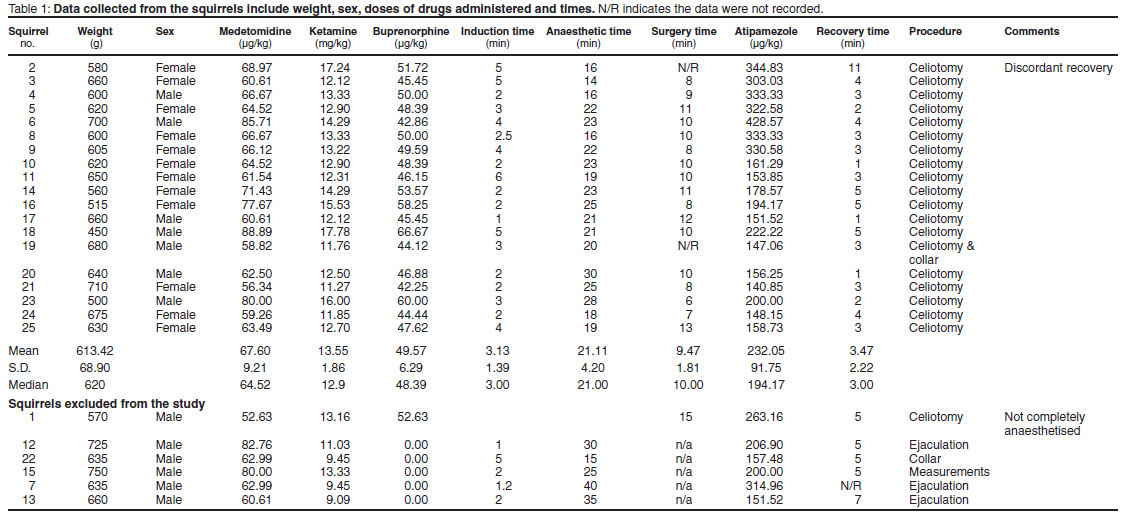
The optimal dose of medetomidine-ketamine-buprenorphine was determined in 25 Cape ground squirrels (Xerus inauris) undergoing surgical implantation of a temperature logger into the abdominal cavity. At the end of anaesthesia, the squirrels were given atipamezole intramuscularly to reverse the effects of medetomidine. The mean dose of medetomidine was 67.6 ± 9.2 µg/kg, ketamine 13.6 ± 1.9 mg/kg and buprenorphine 0.5 ± 0.06 µg/kg. Induction time was 3.1 ± 1.4 min. This produced surgical anaesthesia for 21± 4.2 min. Atipamezole 232 ± 92 µg/kg produced a rapid recovery. Squirrels were sternally recumbent in 3.5 ± 2.2 min.
anaesthesia; atipamezole; buprenorphine; Cape ground squirrel; ketamine; medetomidine; Xerus inauris
INTRODUCTION
The Cape ground squirrel (Xerus inauris) inhabits hot and arid areas of southern Africa. Ground squirrels have been suggested to use both behavioural and physiological means to adapt to the extremes of temperature they encounter. For example, they may use their tail as a parasol to reduce solar radiation1 6 ® DS1922L ± 0.0625 ºC; Thermo chron, Dallas Semiconductors, Maxim Integrated Products, Inc., Sunnyvale, CA) into the abdomen of the squirrels to monitor Tb and relate this to environmental and behavioural data. The anaesthetic requirements for this project were a rapid induction, sufficient anaesthetic duration to complete implantation of the loggers and a rapid recovery before being returned to their colonies. The surgery and anaesthesia were performed in the field where minimal equipment was available.
Ketamine has been used for the immobilisation of the Cape ground squirrel181818Spermophilus richardsonii), ketamine at 86 mg/kg, droperidol (2.6 mg/kg) and fentanyl (52 µg/kg), and pentobarbitone (50 mg/kg) failed to produce surgical anaesthesia15157,8,11,12,14,16,20, cats1752 3,13. Medetomidine-ketamine has been shown to produce a rapid induction, provide adequate analgesia for surgery and a rapid recovery when reversed with atipamezole. On this basis medetomidineketamine was selected for anaesthesia. Antagonism of medetomidine generally results in reversal of the analgesic effects. For this reason, buprenorphine was administered for post-operative analgesia.
MATERIALS AND METHODS
Twenty-five squirrels from the SA Lombard Nature Reserve (3660 ha, 18 km northwest of Bloemhof, South Africa, 27º35'S, 25º23'E) were captured in Tomahawk wire-mesh traps (15 × 15 × 50 cm) as previously described9,18. Thirteen males and 12 females were captured. Their mean weight was 625.2 ± 70.2 g (males 632.2 ± 84.9 g, females 618.8 ± 52.7 g). Females and resident males were trapped for implantation of temperature loggers. Five migratory males were caught. These males were anaesthetised for the placement of radio-collars (1), body measurements (1) and collection of semen (3) and their data were excluded from analysis. An initial dose of medetomidine (Domitor, Pfizer Animal Health) of 0.03 m (50 µg/kg) and ketamine (Anaket V, Centaur Laboratories, Isando) of 0.075 (15 mg/kg) was chosen. If anaesthesia was unsuccessful the doses of medetomidine and ketamine were increased by 0.01 m and 0.025 m, respectively until appropriate anaesthetic levels were achieved. The medetomidine and ketamine were administered in the same insulin syringe (1 m BD U-100 Insulin Syringe, Manta Medical, Bryanston). Buprenorphine (Temgesic, Schering Plough, Isando) was administered at a standard dose of 0.1 m per squirrel in a separate insulin syringe. All injections were given intramuscularly into the lumbar epaxial muscles. Following induction of anaesthesia, the abdomen was shaved and prepared for surgery following standard aseptic techniques. During preparation potassium clavulanate and amoxicillin trihydrate (Synulox RTU, Pfizer Animal Health) (20 mg/kg) was administered subcutaneously. An incision approximately 15 mm in length was made in the ventral midline between the xiphoid and the umbilical scar. The temperature logger was then inserted into the abdomen. The linea alba was closed with 4/0 Nylon (Ethicon, Johnson & Johnson, Midrand) and the subcutaneous tissue and skin with 4/0 PDS (Ethicon, Johnson & Johnson) in a standard fashion. The squirrels' heart rate and respiration were monitored using a multiparameter physiological monitor (Dash 4000, GE Electronics, Midrand) following standard anaesthetic procedures for patient safety. The data are not presented. The anaesthesia was reversed with a volume of atipamezole (Antisedan, Pfizer Animal Health) equal to the total volume of medetomidine administered for immobilisation. Squirrels used for semen collection, measurement and radio transmitter placement did not receive buprenorphine.
The time from injection of medetomidine-ketamine and buprenorphine until loss of response to a paw pinch (induction time), the duration of anaesthesia (induction to recovery), the duration of surgery, the time from induction to the injection of atipamezole (anaesthetic time) and the time to return of the righting reflex following the administration of atipamezole (recovery time) were recorded. Any adverse anaesthetic or surgical events were recorded.
Descriptive statistics were used to describe the data collected. Data were normally distributed. A t-test was used to examine differences between males and females with respect to the following variables: weight, induction time, duration of surgery, recovery time, anaesthetic time and doses of drugs administered per kg. Statistical significance was set at P < 0.05. This study was approved by the Animal Use and Care Committee of the Universities of Central Florida and Pretoria and complied with their guidelines for animal research (UCF IACUC #07-43W).
RESULTS
The male and female groups were not statistically different with respect to weight, induction time, duration of surgery, recovery time, anaesthetic time and doses of drugs administered per kg and their data were analysed together. Data for all 25 squirrels are presented in Table 1. The reason for excluding some data is that buprenorphine was not administered, no surgery was performed and the duration of anaesthesia was variable. Temperature loggers were implanted into 20 squirrels (8 males, 12 females). The 1st squirrel was excluded from analysis as the dose of drugs administered was insufficient to complete the surgery. The doses of medetomidine and ketamine were increased after this squirrel. This left 19 squirrels (7 males, 12 females) in which the procedure was successfully completed with the initial doses administered. The mean dose of medetomidine was 67.6 ± 9.2 µg/kg, ketamine 13.6 ± 1.9 mg/kg and buprenorphine 0.5 ± 0.06 µg/kg. Squirrel no. 2 had a rough recovery characterised by excitement and the dose of ketamine was reduced for the following squirrels by 5 mg/kg. The remaining 18 squirrels were successfully managed with the combination described and had satisfactory recoveries.
DISCUSSION
This study showed that a combination of medetomidine, ketamine and buprenorphine provided rapid surgical anaesthesia that was rapidly reversed at the end of the procedure with atipamezole. Ketamine alone does not completely immobilise Cape ground squirrels at doses between 10 and 25 mg/kg while doses of 40-50 mg/kg are required for complete immobilisation181515154,10,19.
The induction time for xylazine-ketamine was 1.3 min15 15
Recovery times (3.5 min) observed in the present study were faster than those reported for xylazine-ketamine (16-19 min)15
The combination of medetomidine, ketamine and buprenorphine produced satisfactory anaesthesia for 20 min and recovery from anaesthesia was rapid following the administration of atipamezole in Cape ground squirrels. This combination produced an adequate depth of anaesthesia for surgery.
REFERENCES
- 1. Bennett A F, Huey R B, John-Alder H, Nagy K A 1984 The parasol tail and thermoregulatory behaviour of the Cape ground squirrel Xerus inauris. Physiological Zoology 57: 57-62
- 2. Bettschart-Wolfensberger R, Bowen I M, Freeman, S L, Weller R, Clarke, K W 2003 Medetomidine-ketamine anaesthesia induction followed by medetomidinepropofol in ponies: infusion rates and cardiopulmonary side effects. Equine Veterinary Journal 35: 308-313
- 3. Bush M, Raath J P, Phillips L G, Lance W 2004 Immobilisation of impala (Aepyceros melampus) with a ketamine hydrochloride/medetomidine hydrochloride combination, and reversal with atipamezole hydrochloride. Journal of the South African Veterinary Association 75: 14-18
- 4. Celly C S, McDonell W N, Young S S, Black W D 1997 The comparative hypoxaemic effect of four α2 adrenoreceptor agonists (xylazine, romifidine, detomidine and medetomidine) in sheep. Journal of Veterinary Pharmacology and Therapeutics 20: 464-471
- 5. Cruz J I, Loste J M, Burzaco H 1998 Observation on the use of medetomidine/ketamine and its reversal with atipamezole for chemical restraint in the mouse. Laboratory Animals 31: 18-22
- 6. Fick L G, Kucio T A, Fuller A, Matthee A, Mitchell D 2009 The relative roles of the parasol-like tail and burrow shuttling in thermoregulation of free-ranging Cape ground squirrels, Xerus inauris. Comparative Biochemistry and Physiology Part A: Molecular & Integrative Physiology 152: 334-340
- 7. Hellebrekers L J, Sap R 1997 Medetomidine as a premedicant for ketamine, propofol or fentanyl anaesthesia in dogs. Veterinary Record 140: 545-548
- 8. Hellebrekers L J, van Herpen H, Hird J F R, Rosenhagen C U, Sap R, Vainio O 1998 Clinical efficcy and safety of propofol or ketamine anaesthesia in dogs premedicated with medetomidine. Veterinary Record 142: 631-634
- 9. Herron M D, Waterman J M, Parkinson C L 2005 Phylogeny and historical biography of African ground squirrels: the role of climate change in the evolution of Xerus. Molecular Ecology 14: 2773-2788
- 10. Kästner S B R 2006 A2-agonists in sheep: a review. Veterinary Anaesthesia and Analgesia 33: 79-96
- 11. Ko J C H, Fox, S M, Mandsager, R E 2000 Sedative and cardiorespiratory effects of medetomidine, medetomidine-butorphanol, and medetomidine-ketamine in dogs. Journal of the American Veterinary Medical Association 216: 1578-1583
- 12. Ko J C H, Nicklin C F, Melendaz M, Hamilton P, Kuonen C D 1998 Effects of a microdose of medetomidine on diazepamketamine induced anesthesia in dogs. Journal of the American Veterinary Medical Association 213: 215-219
- 13. McLaren G W, Thornton P D, Newman C, Buesching C D, Baker S E, Mathews F, MacDonald D W 2005 High rectal temperature indicates an increased risk of unexpected recovery in anaesthetized badgers. Veterinary Anaesthesia and Analgesia 32: 48-52
- 14. Moens Y, Fargetton X 1990 A comparative study of medetomidine/ketamine and xylazine/ketamine in dogs. Veterinary Record 127: 567-571
- 15. Olson M E, McCabe K 1986 Anesthesia in the Richardson's ground squirrel: comparison of ketamine, ketamine and xylazine, droperidol and fentanyl, and sodium pentobarbital. Journal of the American Veterinary Medical Association 189: 1035-1037
- 16. Serteyn D, Coppens P, Jones R, Verstegen J P, Philipparts C, Lamy M 1993 Circulatory and respiratory effects of the combination medetomidine/ketamine in beagles. Journal of Veterinary Pharmacology and Therapeutics 16: 199-206
- 17. Smith A A, Posner L P, Goldstein R E, Ludders J W, Erb H N, Simpson K W, Gleed R D 2004 Evaluation of the effects of premedication on gastroduodenoscopy in cats. Journal of the American Veterinary Medical Association 255: 540-544
- 18. van Heerden J 1984 Capture and immobilization of the Cape ground squirrel Xerus inauris with ketamine hydrochloride. South African Journal of Wildlife Research 14: 127-128
- 19. Vickery R G, Maze M 1989 Actions of the stereoisomers of medetomidine, in halothane-anesthetized dogs. Acta Veterinaria Scandanavia 85: 71-76
- 20. Wilson D V, Evans A T, Carpenter R L, Mullineaux D R 2004 The effect of four anesthetic protocols on splenic size in dogs. Veterinary Anaesthesia and Analgesia 31: 102-108
Accepted: May 2011.