The effects of adding epinephrine or xylazine to lidocaine solution for lumbosacral epidural analgesia in fat-tailed sheep
Abstract
This blinded, randomised experimental study was designed to compare the analgesic effects of lumbosacral epidural administration of lidocaine-epinephrine or lidocaine-xylazine combinations in fat-tailed sheep. Nine healthy fat-tailed male lambs (mean ± s.d. age, 4.6 ± 0.4 months; weight, 24.6 kg ± 2.5 kg) were randomly allocated into four groups of six sheep: lidocaine 2% (LID), lidocaine-epinephrine 5 mg/mL (LIDEP), lidocaine-xylazine 0.05 mg/kg (LIDXY) or bupivacaine 0.5% (BUP). The onset and duration of flank, perineum and hindlimb anaesthesia and the onset and duration of hindlimb paralysis were recorded. Epidural administration of LID, LIDEP, LIDXY or BUP produced anaesthesia within 6.6 min, 7.6 min, 3.4 min and 8.4 min, respectively. The mean onset of anaesthesia in the LIDXY group was significantly shorter compared with the BUP group (p = 0.02). The mean duration of anaesthesia was 107.9 min, 190.4 min, 147.6 min and 169.7 min for LID, LIDEP, LIDXY and BUP, respectively. The onset of hindlimb paralysis was faster in the LIDXY group than in the BUP group; however, the duration of hindlimb paralysis was shorter in LIDXY compared with LIDEP. Epidural administration of LIDEP or LIDXY provides a comparable duration of local anaesthesia without any adverse effects in fat-tailed sheep. Epidural LIDXY did not appear to be advantageous over epidural LIDEP.
Introduction
Surgical procedures in ruminants are usually performed under local or regional anaesthesia. Lumbosacral (L6-S1) epidural anaesthesia is the most common epidural technique used in sheep, goats and calves for all procedures caudal to the umbilicus.1,2 Lidocaine is the most frequently used local anaesthetic solution for epidural or subarachnoid anaesthesia in small ruminants, which causes a blockage of the sensory, sympathetic and motor fibres, producing hypotension and ataxia.34,5,6,7 Bupivacaine is approximately four times as potent as lidocaine and provides a longer duration of anaesthesia with a slower onset of action.3
Two major groups of drugs are used to increase the depth or duration of local anaesthetics for epidural block: vasoconstrictors (mainly epinephrine) and alpha2-adrenergic agonists. Xylazine is an alpha2-adrenoceptor agonist that is used as a sedative in veterinary practice. It appears to exhibit direct local anaesthetic sensory and motor nerve blocking actions in addition to its spinal cord alpha2-adrenoceptor-mediated analgesic effects.22-agonists can be absorbed from the epidural space and have systemic effects (sedation and cardiopulmonary depression) that are most obvious in the ruminants because of their increased sensitivity to this group of drugs.89,10,11,12,13,14,15 In these studies, a lidocaine-xylazine combination has been compared with lidocaine alone.
To our knowledge, a direct comparison of the effect of epinephrine or xylazine addition on the anaesthetic properties of lidocaine after epidural administration has not been reported previously. Therefore, the objective of the study reported here was to evaluate the analgesic efficacy of lidocaine-epinephrine or lidocaine-xylazine combinations following lumbosacral epidural administration in fat-tailed sheep. Lidocaine and bupivacaine groups have been included for comparison.
Materials and methods
Nine healthy, 4-5-month-old (mean ± s.d., 4.6 ± 0.4 months; range 4.3-5.3 months), fat-tailed Mehraban male lambs, with a body condition score of 3.3 ± 0.3 (range 3-3.5; on a scale of 0-5 units16
The sheep were confined to indoor pens and were given alfalfa, concentrate (grain mix) and water ad libitum and were allowed an acclimation period of 2 weeks prior to the beginning of the study. Their health status was established on the basis of a thorough physical examination and normal complete blood count and total protein. A faecal sample examination revealed no parasite infestation. Sheep were randomly assigned to one of four groups (six sheep per group) and received either 2% lidocaine hydrochloride (LID) (Caspian Tamin Pharmaceutical Co., Rasht, Iran), 2% lidocaine hydrochloride with 5 mg/mL epinephrine (LIDEP) (Darou Pakhsh Co., Tehran, Iran), 2% lidocaine hydrochloride with 0.05 mg/kg xylazine (LIDXY) (Alfasan, Woerden, the Netherlands) or 0.5% bupivacaine hydrochloride (BUP) (Merk Company, Lyon Cedex, France), with at least a 7-day interval between experiments. Lidocaine-epinephrine and lidocaine-xylazine solutions were freshly prepared by adding epinephrine (1:1000) or xylazine (2%) to 2% lidocaine, immediately before use. The pH of the anaesthetic solutions was measured using a pH meter (Crison, Basic 20+).
Animals were fasted for 12 h before the experiment, but water was available for them at all times. Skin overlaying the lumbosacral area was prepared aseptically before placement of an epidural needle. After locating the lumbosacral intervertebral space, 1 mL of local anaesthetic solution was injected using a 22-gauge needle to desensitise the skin and subcutaneous tissue. A 3 cm 16-gauge needle was used as a cannula, minimising skin resistance during the insertion of a 9 cm 19-gauge Tuohy needle (IMS, Tokyo, Japan) through a dorsal midline approach. When the needle tip reached the ligamentum flavum, the stylet was removed and a glass syringe was attached to the hub of the needle. The needle was then inserted slowly into the epidural space with the bevel directed cranially. Entrance into the epidural space was identified by means of the loss of resistance to air injection. After aspiration of the needle to confirm that there was no blood or CSF present, the anaesthetic solution was administered. All drugs were administered slowly over approximately 30 s in each sheep.
The anaesthetic solution consisted of 5 mL of LID, LIDEP, LIDXY or BUP for each epidural block; therefore, all sheep received a fixed total volume of 5 mL of anaesthetic solution. The distance from the skin to the epidural space was determined by measuring the length of the needle (distance between the needle hub and tip of the needle) and subtracting the distance between the skin and needle hub. Following the administration of the anaesthetic solution, the needle was removed and the sheep was placed in a canvas sling in a standing position.
Both the time to the onset and the duration of complete anaesthesia in the flank, perineum and hindlimb was recorded, based on the complete absence of response to painful stimuli including superficial and deep pin pricks with a 25-gauge needle and the pinching of skin with haemostats closed to the first ratchet. The onset and duration of hindlimb paralysis were also determined by flexing the hindlimbs manually to evaluate muscle tone and the animal's ability to support its own weight. In order to determine the time to onset, analgesic testing was performed every 30 s after the completion of the epidural injection. Anaesthesia was evaluated every 10 min until a response was observed. To avoid any bias or potential manipulation of data, the same investigator assessed the anaesthesia in all cases and was unaware of the treatment given.
The arterial haemoglobin-oxygen saturation (SaO2) was measured through a pulse oximetry sensor (Pulse Oximeter, Oxicap 425, Soor Afarinesh Bartar Co., Tehran, Iran) attached to the ear, which was previously shaved. Heart rate (HR) was measured by counting the heart beats over the cardiac area using a stethoscope. The electrocardiogram was monitored using a bas-apex lead with paper speed and sensitivity of 25 mm/sec and 10 mm/mV, respectively (Kenz ECG 110, Suzuken Co. LTD, Nagoya, Japan). Respiratory rate (RR) was measured by counting chest movements per minute and rectal temperature (RT) was measured with a digital thermometer. HR, RR and RT were measured before epidural drug administration (time 0) and at 5 min, 10 min, 15 min, 20 min, 30 min, 40 min, 50 min, 60 min and 75 min after the drug injection and, thereafter, every 15 min until the end of anaesthesia.
All data are presented as mean ± s.d. for each treatment group. HR, RR and RT values were compared using analysis of variance (ANOVA) for repeated-measures, with time and group as factors, followed by Duncan's test. A one-way ANOVA followed by Duncan's test was used to compare the onset and duration of anaesthesia, as well as the distance from the skin to the epidural space. Statistical analysis was undertaken using SPSS Version 10 for Windows (SPSS, MicroMaster, Richboro, PA, USA) and p < 0.05 was considered significant.
Ethical considerations
The Institutional Animal Care and Use Committee approved the protocol for this project.
Results
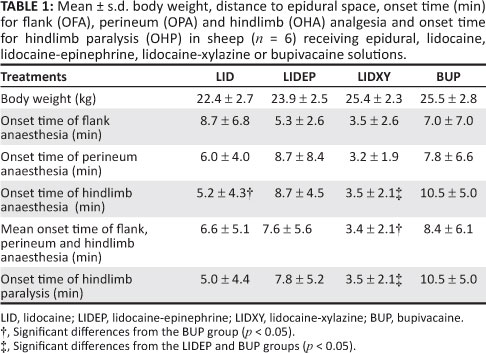
There were no significant differences in body weight between the four groups of sheep (Table 1). No difficulty was encountered in locating the proper site for injection of the local anaesthetic. The procedure for each sheep was completed within 5 min and was well tolerated by all experimental animals. The mean distance from the skin to the epidural space was 3.4 ± 0.3 cm (range 3.0 cm - 3.9 cm). The doses of lidocaine in the LID, LIDEP and LIDXY groups were 5.0 ± 0.6 mg/kg, 5.1 ± 0.5 mg/kg and 4.8 ± 0.4 mg/kg, respectively. The mean dose of bupivacaine in BUP group was 1.2 ± 0.1 mg/kg.
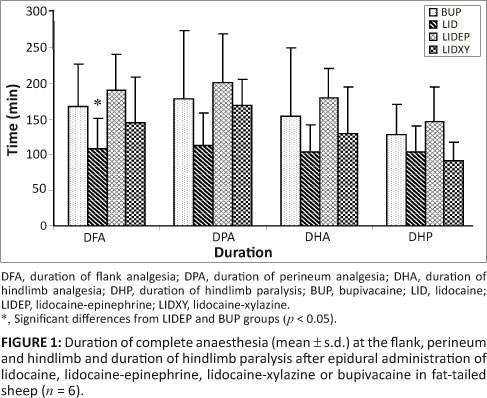
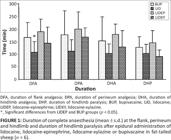
Significant difference was not detected between groups in time to the onset of anaesthesia for the flank and perineum, but the onset of hindlimb anaesthesia for both LID and LIDXY treatments was significantly faster (p < 0.05) than that for BUP (Table 1). The onset of hindlimb anaesthesia was also faster following LIDXY treatment compared to that of LIDEP. Ataxia and hindlimb paralysis were observed in all groups and sheep became recumbent within 15 min. The onset of hindlimb paralysis was significantly longer in the BUP group compared with that of LIDXY. The duration of anaesthesia for the flank was significantly longer (p < 0.05) in the LIDEP and BUP groups compared with that of LID (Figure 1). The mean duration of anaesthesia in the perineum, flank and hindlimb after epidural administration of LIDEP, LIDXY and BUP were 190.4 min ± 51.1 min, 147.6 min ± 24.3 min and 169.7 min ± 57.2 min, respectively. The mean duration of anaesthesia in the LID group (107.9 min ± 39.0 min) was significantly shorter than that of LIDEP (p < 0.05). The onset of hindlimb paralysis was faster in sheep in the LIDXY group (3.5 min ± 2.1 min) than in sheep in the BUP group (10.5 min ± 5.0 min) (Table 1); however, the duration of hindlimb paralysis was shorter in LIDXY (91.5 min ± 25.6 min) compared to LIDEP (146.2 min ± 48.9 min) (Figure 1).
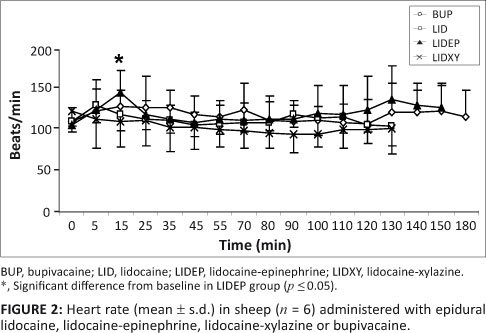
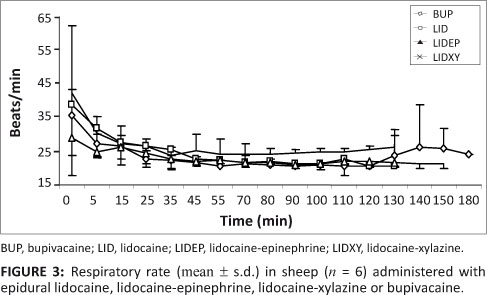
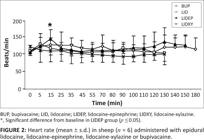
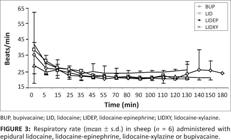
No change in HR was observed in the LID, LIDXY and BUP groups; however, overall HR was lower with the LIDXY treatment. HR decreased to 55 beats/min and sporadic ventricular premature beats were observed in one sheep receiving LIDXY. In the LIDEP group, a significant increase in HR occurred 15 min after epidural administration (Figure 2). A slight reduction in RR and RT in all four groups was deemed insignificant (Figures 3 and 4). Arterial haemoglobin-oxygen saturation was within clinically acceptable limits and was not different between groups. Mild sedation (drowsiness and a slight drooping of the head) and frequent urination were observed in the LIDXY group. The pH of LID, LIDEP, LIDXY and BUP was 6.28, 6.27, 6.26 and 5.56, respectively. No toxic or adverse neurological reactions associated with epidural administration of any of the solutions or obvious signs of systemic toxicity (extensor rigidity, muscle twitching and convulsions) were encountered after performing the epidural block in any of the sheep in this study.

Discussion
Local anaesthetics have the ability to block the sensation of pain completely and have been used clinically as adjuncts to light general anaesthesia in both small and large animals.317
Lumbosacral epidural administration of anaesthetic agents is a classic technique used in small ruminants and swine for procedures including, (1) caesarean section, (2) laparotomy, (3) rumenotomy, (4) repair of rectal, uterine, or vaginal prolapse, (5) repair of abdominal, inguinal, or scrotal hernias and (6) surgery of the prepuce, penis, or hindlimbs.2
Local anaesthetics have been combined with alpha2-adrenergic agonist drugs in epidural or subarachnoid applications to obtain a long-lasting analgesia in sheep1811,12,19 or calves9,20. Epidural lidocaine or xylazine has been used in combination with total intravenous anaesthesia in fat-tailed sheep undergoing hindlimb orthopaedic surgery.212-receptors in the substantia gelatinosa of the dorsal horn of the spinal cord and inhibits the release of norepinephrine and substance P.222-agonist, suggesting the contribution of supraspinal analgesia following systemic drug absorption.23
In epidural anaesthesia, the extent of the anaesthetised area depends on the total dose (volume x concentration) of the anaesthetic administered. The volume of drug(s) used in the present study approximated 0.21 mL/kg (range, 0.19 mL/kg - 0.24 mL/kg). The recommended volume of lidocaine for anterior epidural anaesthesia in sheep and goats is about 0.20 mL/kg - 0.22 mL/kg (1.0 mL per 4.5 kg - 5.0 kg of body weight).213,20 Higher volumes of anaesthetic solutions injected into the epidural space produce a higher cranial migration of analgesics and improve the cranial spread of sensory blockade.24225,26 Studies of the pharmacokinetics of lidocaine and bupivacaine and the effects of epinephrine or xylazine addition on the plasma concentration of local anaesthetics in sheep could provide useful information on systemic toxicity following epidural administration of local anaesthetics.
Gravity may also affect the spread of local anaesthetic solution within the epidural space in a patient in lateral recumbency or in a head-up or head-down position.2
Behavioural responses to painful stimuli are difficult to assess in sheep because of the animals' stoic nature. The use of a simple pain scoring system was chosen because, in most cases, muscle twitch was the only reliable response observed during noxious stimulation of the perineum and flank regions.
Lidocaine, the most commonly used local anaesthetic in clinical practice, has a rapid onset and moderate duration (60 min - 120 min) of action. The addition of epinephrine to lidocaine may slow the onset of action by decreasing the pH of anaesthetic solution and reducing the amount of non-ionised local anaesthetic.33
A delayed onset of analgesia following the epidural administration of xylazine has been reported in goats (mean onset of analgesia, 9.0 min - 9.5 min), buffalo calves (15.0 min), sheep (10.0 min) and cows (17.5 min).10,12,27,28,29 The time required for the drug to reach its site of action in the spinal cord may account for the slow onset of action for xylazine.2230
Epidural administration of LIDEP, LIDXY and BUP induced comparable anaesthesia of the flank, perineum and hindlimb. Although the duration of anaesthesia was not significantly different between LIDEP and the LIDXY groups, sheep in the LIDEP group tended to have a longer duration of action compared with the LIDXY group. A similar duration of action has been reported following subarachnoid administration of LID and LIDXY in goats.
The duration of action for a local anaesthetic is proportional to the time that the drug remains bound to the sodium channels. The addition of epinephrine to a local anaesthetic agent produces vasoconstriction at the injection site, which, in turn, reduces the rate of systemic absorption and prolongs the duration of the local anaesthetic effect.32-adrenoreceptors in the substantia gelatinosa of the spinal cord.313
It has been shown that local anaesthetic combined with alpha2-agonist drugs increases the duration of anaesthesia following epidural or subarachnoid administration.15,18 The lack of significant difference in the duration of anaesthesia between LID and LIDXY groups in the present study may have been attributed to the small sample size of each group or low concentration of xylazine (0.05 mg/kg) added to lidocaine in this study. Following the epidural administration of LIDEP or BUP, anaesthesia can be expected to persist for up to 5 h, which provides an extended duration of surgical anaesthesia and pain management in the early postoperative period. Sheep in the LIDXY group received a full dose of lidocaine (5 mL, 2%) plus 0.05 mg/kg xylazine because it was of interest to compare the effects of the addition of xylazine or epinephrine to the lidocaine solution.
The duration of hindlimb paralysis was significantly shorter in the LIDXY group compared with the LIDEP group. Therefore, an epidural LIDXY block may offer advantages over LIDEP in patients undergoing caesarean section because recovery of motor function in the hindlimbs occurs faster, meaning that the dam would be able to stand and nurse the newborn soon after delivery. Immobility of the hindlimbs and relaxation of abdominal muscles is desirable during surgery because it facilitates restraint and positioning of the animal and prevents abdominal pressure, especially during surgical repair of abdominal hernias in sheep and goats.
A transient increase in HR was observed in sheep given epidural LIDEP, suggesting rapid systemic absorption of epinephrine from the epidural space following drug administration. The highly lipophilic nature of epinephrine allowed for rapid distribution of the drug out of the epidural space by way of the epidural vasculature.322 levels was not significant in the LIDXY treatment; however, sheep in the LIDXY group had a lower HR compared with other groups. Similar results were obtained in sheep that received a subarachnoid combination of lidocaine and clonidine.1811
Sedation and increased urination frequency are commonly observed following epidural administration of xylazine,1133
Neurotoxicity is one of the most serious adverse effects of neuraxial administration of drugs. It has been speculated that the vasoconstrictive effects of alpha2-adrenergic agonists may reduce spinal blood flow, producing spinal ischaemia with neuronal damage. Lumbar epidural clonidine, an alpha2-adrenergic agonist structurally related to xylazine, did not affect regional blood flow to the spinal cord in sheep.3422,35 or clonidine in sheep3637
When appropriate doses are used, lumbosacral epidural anaesthesia with local anaesthetics produces minimal haemodynamic and respiratory changes in conscious animals,22-agonists alone, or in combination with local anaesthetics, has been associated with hypotension, bradycardia, respiratory acidosis, hypoxemia, ruminal hypomotility, salivation and increased urine production.10,19,29,38 Whilst these side effects are generally well-tolerated by young, healthy animals, significant morbidity and mortality may occur in patients having poor cardiopulmonary functions.29
The use of the LIDXY combination apparently offers no clinical advantages over LIDEP for the following reasons. Firstly, xylazine-induced cardiopulmonary depression may be detrimental in poor-risk patients.2939,40 Secondly, systemic administration of alpha2-adrenergic antagonists may not completely reverse xylazine-induced cardiopulmonary depression and sedation.3837
Conclusion
Lumbosacral epidural LIDEP, LIDXY and BUP provide prolonged anaesthesia that may contribute to pain relief in the immediate postoperative period in animals undergoing surgical procedures involving the flank, perineum and hindlimb. The clinical use of epidural LIDXY can be indicated when a concomitant mild sedation is desired. Further studies are required to establish the optimum concentration of epinephrine or xylazine added to local anaesthetic solution for epidural anaesthesia in sheep.
Competing interests
The authors declare that they have no financial or personal relationship(s) which may have inappropriately influenced them in writing this paper.
Authors' contributions
The authors made equal contributions to experimental project design and acquisition of data. N.V. (Shiraz University) was responsible for analysis of data and drafting the article.
Acknowledgements
This research was supported by Grant No. 88-GR-VT-29 from the Research Council of the Shiraz University.
References
- 1. Gray PR, McDonell WN. Anesthesia in goats and sheep. Part I. Local analgesia. The Compendium on Continuing Education for the Practicing Veterinarian. 1986;8:S33-S39.
- 2. Skarda RT, Tranquilli WJ. Local and regional anesthetic and analgesic techniques: Ruminant and swine. In: Tranquilli WJ, Thurmon JC, Grimm KA, editors. Lumb & Jones' veterinary anesthesia and analgesia. 4th ed. Ames, IA: Blackwell Publishing, 2007; p. 643-681.
- 3. Skarda RT, Tranquilli WJ. Local anesthetics. In: Tranquilli WJ, Thurmon JC, Grimm KA, editors. Lumb & Jones' veterinary anesthesia and analgesia. 4th ed. Ames, IA: Blackwell Publishing, 2007; p. 395-418.
-
4. Feldman HS, Dvoskin S, Halldin MH, Ask AL, Doucette AM. Comparative local anesthetic efficacy and pharmacokinetics of epidurally administered ropivacaine and bupivacaine in the sheep. Reg Anesth Pain Med. 1997;22(5):451-460. http://dx.doi.org/10.1016/S1098-7339(97)80033-8
» http://dx.doi.org/10.1016/S1098-7339(97)80033-8 -
5. Hendrickson DA, Kruse-elliott KT, Broadstone RV. A comparison of epidural saline, morphine and bupivacaine for pain relief after abdominal surgery in goats. Vet Surg. 1996;25(1):83-87. http://dx.doi.org/10.1111/j.1532-950X.1996.tb01382.x, PMid:8719090
» http://dx.doi.org/10.1111/j.1532-950X.1996.tb01382.x - 6. Singh K, Kinjavdekar P, Amarpal, et al. Comparison of the analgesic, clinicophysiological and hematobiochemical effects of epidural bupivacaine in healthy and uremic goats. Small Rumin Res. 2007;71(1):13-20.
- 7. Trim CM. Epidural analgesia with 0.75% bupivacaine for laparotomy in goats. J Am Vet Med Assoc. 1989;194:1292-1296. PMid:2722662
- 8. Lemke KA. Anticholinergics and sedatives. In: Tranquilli WJ, Thurmon JC, Grimm KA, editors. Lumb & Jones' veterinary anesthesia and analgesia. 4th ed. Ames, IA: Blackwell Publishing, 2007; p. 203-239.
-
9. Condino MP, Suzuki K, Taguchi K. Antinociceptive, sedative and cardiopulmonary effects of subarachnoid and epidural xylazine-lidocaine in xylazine-sedated calves. Vet Anaesth Analg. 2010;37:70-78. http://dx.doi.org/10.1111/j.1467-2995.2009.00494.x, PMid:20017822
» http://dx.doi.org/10.1111/j.1467-2995.2009.00494.x -
10. DeRossi R, Junqueira AL, Beretta MP. Analgesic and systemic effects of ketamine, xylazine, and lidocaine after subarachnoid administration in goats. Am J Vet Res. 2003;64:51-56. http://dx.doi.org/10.2460/ajvr.2003.64.51, PMid:12518878
» http://dx.doi.org/10.2460/ajvr.2003.64.51 - 11. DeRossi R, Junqueira AL, Beretta MP. Analgesia and systemic effects of xylazine, lidocaine and their combination after subarachnoid administration in goats. Jl S Afr vet Ass. 2005;76:79-84. PMid:16108526
- 12. Kinjavdekar P, Singh GR, Amarpal, Aithal HP, Pawde AM. Physiologic and biochemical effects of subarachnoidally administered xylazine and medetomidine in goats. Small Rumin Res. 2000;38:217-228.
- 13. Lewis CA, Constable PD, Huhn JC, Morin DE. Sedation with xylazine and lumbosacral epidural administration of lidocaine and xylazine for umbilical surgery in calves. J Am Vet Med Assoc. 1999;214:89-95. PMid:9887947
-
14. Mpanduji DG, Mgasa MN, Bittegeko SBP, Batamuzi EK. Comparison of xylazine and lidocaine effects for analgesia and cardiopulmonary functions following lumbosacral epidural injection in goats. J Vet Med A. 1999;46:605-611. http://dx.doi.org/10.1046/j.1439-0442.1999.00250.x, PMid:10638298
» http://dx.doi.org/10.1046/j.1439-0442.1999.00250.x - 15. Singh P, Pratap K, Amarpal, Kinjavdekara P, Aithala HP, Singh GR. Effects of xylazine, lignocaine and their combination for lumbar epidural analgesia in water buffalo calves (Bubalus bubatis). Jl S Afr vet Ass. 2005;76:151-158.
-
16. Rankins Jr. DL, Ruffin DC, Pugh DG. Feeding and nutrition. In: Pugh DG, editor. Sheep and goat medicine. 1st ed. Philadelphia, PA: WB Saunders, 2002; p. 19-60. http://dx.doi.org/10.1016/B0-72-169052-1/50004-1
» http://dx.doi.org/10.1016/B0-72-169052-1/50004-1 - 17. Hubbell JAE. Anesthesia, analgesia and immobilization of selected species and classes of animals: Horses. In: Tranquilli WJ, Thurmon JC, Grimm KA, editors. Lumb & Jones' veterinary anesthesia and analgesia. 4th ed. Ames, IA: Blackwell Publishing, 2007; p. 717-729.
-
18. DeRossi R, Righetto FR, Almeida RG, Medeiros Jr U, Frazilio FO. Clinical evaluation of clonidine added to lidocaine solution for subarachnoid analgesia in sheep. J Vet Pharmacol Ther. 2006;29:113-119. http://dx.doi.org/10.1111/j.1365-2885.2006.00722.x, PMid:16515665
» http://dx.doi.org/10.1111/j.1365-2885.2006.00722.x - 19. Kinjavdekar P, Aithal HP, Amarpal, Pawde AM, Pratap K, Singh GR. Potential effect of romifidine with lidocaine administration in goats. Small Rumin Res. 2006;64:293-304.
-
20. Meyer H, Starke A, Kehler W, Rehage J. High caudal epidural anaesthesia with local anaesthetics or a-agonists in calves. J Vet Med A. 2007;54:384-389. http://dx.doi.org/10.1111/j.1439-0442.2007.00942.x, PMid:17718813
» http://dx.doi.org/10.1111/j.1439-0442.2007.00942.x - 21. Vesal N, Oloumi MM. A preliminary comparison of epidural lidocaine and xylazine during total intravenous anesthesia in Iranian fat-tailed sheep. J Vet Med A. 1998;45:155-167.
- 22. LeBlanc PH, Caron JP, Patterson JS, Brown M, Matta MA. Clinical use of epidural injection of xylazine for perineal analgesia in horses. J Am Vet Med Assoc. 1988;193:1405-1408. PMid:3209451
- 23. Prado ME, Streeter RN, Mandsager RE, Shawley RV, Claypool PL. Pharmacologic effects of epidural versus intramuscular administration of detomidine in cattle. Am J Vet Res. 1999;60:1242-1247. PMid:10791937
-
24. Johnson RA, Lopez MJ, Hendrickson DA, Kruse-Elliot KT. Cephalad distribution of three differing volumes of new methylene blue injected into the epidural space in adult goats. Vet Surg. 1996;25:448-451. http://dx.doi.org/10.1111/j.1532-950X.1996.tb01442.x, PMid:887911
» http://dx.doi.org/10.1111/j.1532-950X.1996.tb01442.x -
25. Morishima HO, Pedersen H, Finster M, et al. Toxicity of lidocaine in adult, newborn, and fetal sheep. Anesthesiology. 1981;55:57-61. http://dx.doi.org/10.1097/00000542-198107000-00012, PMid:7247058
» http://dx.doi.org/10.1097/00000542-198107000-00012 -
26. Morishima HO, Pedersen H, Finster M, et al. Bupivacaine toxicity in pregnant and nonpregnant ewes. Anesthesiology. 1985;63:134-139. http://dx.doi.org/10.1097/00000542-198508000-00003, PMid:4025863
» http://dx.doi.org/10.1097/00000542-198508000-00003 -
27. Aminkov BY, Dinev D, Pascalev M. The anti-nociceptive and cardiopulmonary effects of extradural fentanyl-xylazine in sheep. Vet Anaesth Analg. 2002;29:126-132. http://dx.doi.org/10.1046/j.1467-2995.2002.00080.x
» http://dx.doi.org/10.1046/j.1467-2995.2002.00080.x - 28. Singh V, Amarpal, Kinjavdekar P, Aithal HP. Effect of bupivacaine on epidural analgesia produced by xylazine or medetomidine in buffaloes (Bubalus bubalis). Vet Anaesth Analg. 2009;36:77-85.
- 29. St. Jean G, Skarda RT, Muir WW, Hoffsis GF. Caudal epidural analgesia induced by xylazine administration in cows. Am J Vet Res. 1990;51:1232-1236. PMid:2386320
- 30. Grubb TL, Riebold TW, Huber MJ. Evaluation of lidocaine, xylazine, and a combination of lidocaine and xylazine for epidural anesthesia in the llamas. J Am Vet Med Assoc. 1993;10:1441-1444.
-
31. Curatolo M. Is epinephrine unfairly neglected for postoperative epidural mixtures? Anesth Analg. 2002;94:1381-1383. http://dx.doi.org/10.1213/00000539-200206000-00001
» http://dx.doi.org/10.1213/00000539-200206000-00001 - 32. Ramanathan S, Desai NS, Zakowski M. Systemic vascular uptake of epinephrine from the lumbar epidural space in parturients. Reg Anesth. 1995;20:199-205. PMid:7547655
- 33. Plumb DC. Xylazine HCl. In: Plumb DC, editor. Veterinary drug handbook. Stockholm, IA: Pharma Vet Inc., 2008; p. 935-938.
-
34. Eisenach JC, Grice SC. Epidural clonidine does not decrease blood pressure or spinal blood flow in awake sheep. Anesthesiology. 1988;68:335-340. http://dx.doi.org/10.1097/00000542-198803000-00003, PMid:3344989
» http://dx.doi.org/10.1097/00000542-198803000-00003 -
35. Fikes LW, Lin HC, Thurmon JC. A preliminary comparison of lidocaine and xylazine as epidural analgesics in ponies. Vet Surg. 1989;18:85-86. http://dx.doi.org/10.1111/j.1532-950X.1989.tb01046.x, PMid:2929142
» http://dx.doi.org/10.1111/j.1532-950X.1989.tb01046.x -
36. Eisenach JC, Dewan DM, Rose JC, Angelo JM. Epidural clonidine produces antinociception, but not hypotension, in sheep. Anesthesiology. 1987;66:496-501. http://dx.doi.org/10.1097/00000542-198704000-00008, PMid:3565815
» http://dx.doi.org/10.1097/00000542-198704000-00008 -
37. George LW. Pain control in food animals. In: Steffey EP, editor. Recent advances in anesthetic management of large domestic animals [document on the Internet]. Ithaca, NY: International Veterinary Information Service. 2003 [cited n.d.]. Available from http://www.ivis.org/advances/Steffey_Anesthesia/george/IVIS.pdf
» http://www.ivis.org/advances/Steffey_Anesthesia/george/IVIS.pdf - 38. Skarda RT, St. Jean G, Muir WW. Influence of tolazoline on caudal epidural administration of xylazine in cattle. Am J Vet Res. 1990;51:556-560. PMid:2327614
- 39. McDonell WN, Kerr CL. Respiratory system. In: Tranquilli WJ, Thurmon JC, Grimm KA, editors. Lumb & Jones' veterinary anesthesia and analgesia. 4th ed. Ames, IA: Blackwell Publishing, 2007; p. 117-151.
- 40. Muir WW. Considerations for general anesthesia. In: Tranquilli WJ, Thurmon JC, Grimm KA, editors. Lumb & Jones' veterinary anesthesia and analgesia. 4th ed. Ames, IA: Blackwell Publishing, 2007; p. 7-30.
Nasser Vesal
Department of Veterinary Clinical Sciences
Shiraz University
Shiraz 713451731, Iran
Accepted: 12 Jan. 2012
Published: 02 Mar. 2012