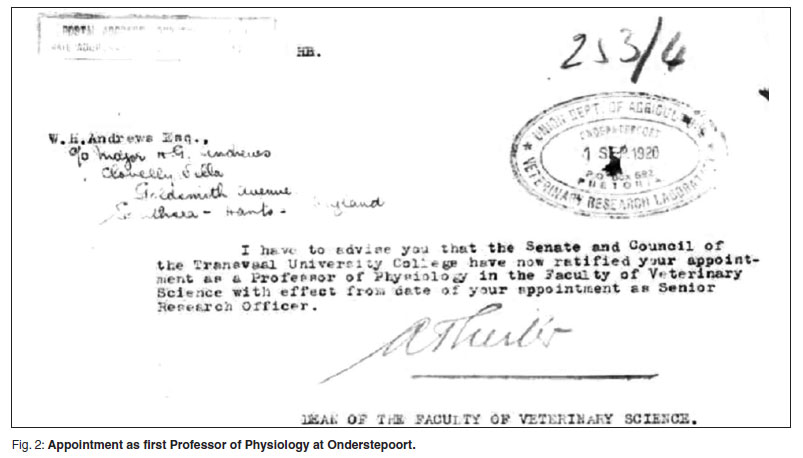
William Horner Andrews (1887-1953) - first Professor of Physiology at Onderstepoort
W H Andrews qualified as a veterinarian in London in 1908 and was recruited soon after, in 1909, by Sir Arnold Theiler to join the staff of the newly established veterinary laboratory at Onderstepoort. After initial studies on the treatment of trypanosomosis and on snake venoms he was deployed by Theiler in 1911 to start research on lamsiekte (botulism) at a field station on the farm Kaffraria near Christiana, where he met and married his wife Doris. After a stint as Captain in the SA Veterinary Corps during World War I he succeeded D T Mitchell as head of the Allerton Laboratory in 1918, where he excelled in research on toxic plants, inter alia identifying Matricaria nigellaefolia as the cause of staggers in cattle. When the Faculty of Veterinary Science was established in 1920 he was appointed as the first Professor of Physiology. After the graduation of the first class in 1924, and due to health problems, he returned to the UK, first to the Royal Veterinary College and then to the Weybridge Veterinary Laboratories of which he became Director in 1927. After his retirement in 1947 he returned to South Africa as a guest worker at Onderstepoort where he again became involved in teaching physiology when Prof. Quin unexpectedly died in 1950. Andrews died in Pretoria in 1953 and was buried in the Rebecca Street Cemetery.
first Professor in Physiology; Onderstepoort Faculty; W H Andrews
HISTORICAL ARTICLE HISTORIESE ARTIKEL
William Horner Andrews (1887-1953) - first professor of physiology at Onderstepoort
D W VerwoerdI,*; W J H AndrewsII
IFaculty of Veterinary Science, Private Bag X04, Onderstepoort, 0110 South Africa
IIGreat-grandson of W H Andrews
W H Andrews qualified as a veterinarian in London in 1908 and was recruited soon after, in 1909, by Sir Arnold Theiler to join the staff of the newly established veterinary laboratory at Onderstepoort. After initial studies on the treatment of trypanosomosis and on snake venoms he was deployed by Theiler in 1911 to start research on lamsiekte (botulism) at a field station on the farm Kaffraria near Christiana, where he met and married his wife Doris. After a stint as Captain in the SA Veterinary Corps during World War I he succeeded D T Mitchell as head of the Allerton Laboratory in 1918, where he excelled in research on toxic plants, inter alia identifying Matricaria nigellaefolia as the cause of staggers in cattle. When the Faculty of Veterinary Science was established in 1920 he was appointed as the first Professor of Physiology. After the graduation of the first class in 1924, and due to health problems, he returned to the UK, first to the Royal Veterinary College and then to the Weybridge Veterinary Laboratories of which he became Director in 1927. After his retirement in 1947 he returned to South Africa as a guest worker at Onderstepoort where he again became involved in teaching physiology when Prof. Quin unexpectedly died in 1950. Andrews died in Pretoria in 1953 and was buried in the Rebecca Street Cemetery.
Keywords: first Professor in Physiology, Onderstepoort Faculty, W H Andrews.
After attending the 9th International Veterinary Congress in The Hague in 1909, Sir Arnold Theiler visited the UK to check on the progress of the 1st batch of South African students, P R Viljoen, G de Kock and G F Marais, sent by the government to study veterinary science. During this trip he took the opportunity to recruit 3 promising young British researchers to strengthen the staff of the newly-established 'Veterinary Bacteriological Laboratories of the Transvaal', as it was then called131111, 14. By December 1909 he had been appointed Assistant Government Veterinary Bacteriologist in South Africa by Theiler11
There is some uncertainty as to the date of his arrival at Onderstepoort. Gutsche relates a widely-told story that when Theiler fetched Andrews from the Pretoria station in 1910 he utilised the 10 mile drive to Onderstepoort to inform him of his duties, which would take every hour of every day, concluding with 'and in your spare time you will study snake venom'131111
His first task was to complete a study started by Sieber on the treatment of trypanosomosis with 3 newly-available drugs. Two of these were found to be 'useful' in treating T. congolense -type infections in horses, cattle and sheep, although the cattle remained carriers. This work was reported in the 2nd report of the Director of Veterinary Services in 191212SA Journal of Science in 19133Journal of Agriculture in 19236
By 1911 lamsiekte had become the most important animal disease in South Africa, effectively preventing cattle farming in the arid western parts of the country, and Onderstepoort was widely criticised for its inability to find a solution. In reaction Theiler established a field station on a farm called Kaffraria near Christiana in the then western Transvaal and put Andrews in charge, probably in October 1911, when he left Onderstepoort according to the postcard mentioned above. For the next 6 years he conducted feeding experiments there, apparently with little success, although Theiler later acknowledged his contribution to lamsiekte research on 2 occasions. Later in 1911 the farm Armoedsvlakte near Vryburg was offered to Theiler free of charge for a year for experimental purposes and when it was eventually bought by the government in 1916 for establishing a permanent lamsiekte experimental research station, Kaffraria was apparently phased out1313
In 1912, following the union of the South African colonies and the Boer republics of the Transvaal and the Orange Free State, he was appointed Veterinary Research Officer in the new Division of Veterinary Research of the Union of South Africa. Of interest from this time is a 5-page handwritten history of the SA veterinary service, entitled 'The Veterinary Profession in South Africa', probably dated 1912. During this period Andrews met and in 1916 married his wife Doris Alice Brinks Burls, who was living at Burlington farm adjoining Kaffraria, near Christiana11
According to a brief biography published in The Veterinary Record in 1927, he joined the South African Veterinary Corps as Captain and Officer-in-Charge of No. 1 Section in 1914, seeing service in German South West Africa and being mentioned in dispatches1141113
In the spring of 1918 Montgomery, who had succeeded Theiler as Director, faced a staff crisis.PRViljoen had left Armoedsvlakte for a position at the Transvaal University College, D Kehoe returned to Ireland, F Veglia had not yet returned from Italy where he performed military duties, G De Kock had decided to study medicine and J Walker had moved to Kenya to replace Montgomery. Walker was replaced in turn by D T Mitchell from Allerton, leaving both Armoedsvlakte and Allerton laboratories leaderless13Matricaria nigellaefolia as the cause of 'staggers' in cattle5Adenia digitata Burtt-Davy, in collaboration with H H Green1213
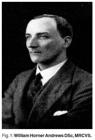
When the establishment of a Veterinary Faculty at Onderstepoort was approved early in 1920, Andrews was nominated as Professor in Physiology by the newly-appointed Dean, Arnold Theiler, although he also remained a Senior Research Officer13Fig. 2). As in the case of Theiler and the other appointees he was awarded a year's study leave abroad to prepare himself for his new duties. He studied advanced Physiology at the University of London and in 1921, according to a surviving letter from its registrar, had a DSc in Science conferred upon him1113
In fact he had already received an offer in January 1924 to become Senior Assistant at the Research Institute of the Royal Veterinary College in London. Following his return to the UK he was in addition offered a Clement Stephenson Research Scholarship to enhance his salary at the Royal College117
Following the death of the Chief Veterinary Officer in the UK, Sir Stewart Stockman, the duties of that post were split and W H Andrews was appointed as Director of Research and Head of the Weybridge laboratories. His referees were Sir John McFadyean and Sir Arnold Theiler, and he took up his post in 1927. During this period of his career he worked more closely with medical colleagues, lecturing at the Royal Society of Medicine on plant poisoning in 19268911
In 1929 Andrews was appointed as Director of the Imperial Bureaux of Animal Health at Weybridge and also attended the Pan African Agricultural and Veterinary Congress in Pretoria as United Kingdom representative11, 14. His achievements during the 1930s consisted of building up Weybridge and also establishing the satellite station at Pirbright where, as Director of Weybridge, he was responsible for its research work. This included its activity as the main research arm of the Foot-and-Mouth Disease Research Committee as reported in its 3rd, 4th (1931) and 5th (1935) reports10
During 1931 Andrews encountered serious recruitment problems at both Weybridge and Pirbright and wrote to the Chief Veterinary Officer to highlight the problem, explaining that veterinary workers should be treated differently from agricultural workers in terms of pay and conditions. Despite these difficulties Andrews was successful in expanding facilities at Weybridge. Wings were added to the west and east of the main building, projecting northwards and providing much laboratory space, and additional adjacent farmland of 133 acres was purchased. In his position as Director of Veterinary Research he had to give many lectures on a variety of topics, including 'Vaccination against Bovine Contagious Abortion' and 'The Relation of this Disease to Undulant Fever of Man' at the N.V.M.A. Congress 1932. At the 11th International Veterinary Congress in London he lectured on current thoughts on foot-and-mouth disease11,14.
During this period he continued to serve on other eminent bodies. In March 1931 he was selected as a UK representative at the Second International Congress of Comparative Pathology (held in Paris in October 1931), supporting Sir Walter Fletcher, KBE, CB, FRS. By 1932 he served on the Council of the Royal Society of Tropical Medicine and Hygiene and was present at the opening of their new headquarters Manson House by the Prince of Wales in March of that year.
Ill health was to trouble him again, apparently triggered by funding difficulties for the laboratories, and he went off sick in October 1937. Nevertheless, during World War II he served as an officer in the Home Guard, rising to the rank of Lieutenant in 'C' Company, 3rd Battalion, First Surrey Home Guard. In 1941 he moved to the Ministry of Agriculture and Fisheries in London to assist with the management of veterinary matters during the war, necessitating his resignation as head of the Imperial Bureaux in Weybridge and as Lieutenant in the Home Guard.
Retiring from the Ministry aged 60 in June 19471411
During his final years he spent much time at Onderstepoort, living at the Wonderboom Government Village at Ficus, north of Pretoria, and began further research activity on neuromuscular transmission. When Dr J I Quin, Professor of Physiology at the Faculty of Veterinary Science and newly appointed Director of Onderstepoort, unexpectedly died in service in March 1950, Dr Andrews was fortunately available to take over his teaching duties until a permanent appointment could be made. He died on 17th March 1953 in Pretoria and is buried in the Rebecca Street Cemetery, Pretoria West11
REFERENCES
- 1. Andrews W H 1912 Some experiments on the drug treatment of trypanosomiasis. Second Report of the Director of Veterinary Services and Animal Industry, Union of South Africa, pp. 262-283
- 2. Andrews W H 1912 Experiments with snakes. Second Report of the Director of Veterinary Services and Animal Industry, Union of South Africa, pp. 406-483
- 3. Andrews W H 1912 On the effects of the bite of certain opisthoglyphous snakes. South African Journal of Science 8: 269-276
- 4. Andrews W H 1914 Bloed pens in lambs. Department of Agriculture Pamphlet No. 71, Pretoria, pp. 3-4
- 5. Andrews W H 1923 The so-called 'Staggers' or 'Pushing Disease' of cattle in Natal: an intoxication due to the ingestion of Matricaria nigellaefolia, D.C. 9th and 10th Reports of the Director of Veterinary Education and Research, pp. 123-220
- 6. Andrews W H 1923 Snake-bite. Journal of Agriculture VII: 47-59
- 7. Andrews W H 1926 Animal disease in southern Africa. Veterinary Record 8: 447-458
- 8. Andrews W H 1926 Some recent advances in our knowledge of plant poisoning. Proceedings of the Royal Society of Medicine XIX (Section of Comparative Medicine): 2-11
- 9. Andrews W H 1927 Special discussion on trypanosomiasis in man and animals. Proceedings of the Royal Society of Medicine XX (Section of Comparative Medicine and Section of Tropical Diseases and Parasitology): 95-100
- 10. Andrews W H, Dobson N, Bannatyne T, Simmins G B, Watkins C V, Evans J T, Davies G O 1931 Detailed report of work done at the Experimental Station, Pirbright, and at the Veterinary Laboratory of the Ministry of Agriculture and Fisheries. 4th Progress Report of the Foot and Mouth Disease Research Committee, pp. 88-140
- 11. Anon. Other documents and letters referred to are in the possession of C J H Andrews, a grandson. Copies have been filed in the ARC-OVI archives
- 12. Green H H and Andrews W H 1923 The toxicity of Adenia digitata Burtt-Davy. 9th and 10th Reports of the Director of Veterinary Education and Research, pp. 381-392
- 13. Gutsche T 1979 There was a Man. The Life and Times of Sir Arnold Theiler K.C.M.G. of Onderstepoort. Howard Timmins, Cape Town
- 14. Jones B V 2011 W H (Horner) Andrews (In press) In Twentieth century veterinary lives. Granville Penn Press, London, UK