Analysing the energy consumption according to the type of dump scroll track during skip discharging of an inclined shaft hoist in an open pit mine
Abstract
This paper analyses the energy consumption according to the type of dump scroll track during skip discharging in an inclined shaft hoist for an open pit mine. For the purpose of the project, it was necessary to set up an equation for a geometrical locus of a skip dump scroll track, and from the need for technical engineering and study purposes, to derive equations for two track types by using cam design theory (cosine track and linear accretion track). Skip discharging is analysed using discrete element method software, and dynamic simulation of its run is performed using Visual Nastran software. The energy consumption during skip discharging can be calculated from the rope tension obtained by dynamic simulation, and graphs obtained from the simulated results using discrete element method and Visual Nastran software. From this, the study demonstrates that the energy consumption at the cosine track is always lower than that at the linear accretion track, without regard to the property change of a payload depending on grain size distribution.
open pit mine; inclined shaft hoist; dump scroll track; skip discharging
Introduction
A mine hoist is an essential part of an underground mine. In addition to extracting the ore from the mine, this machine transports the miners from the surface to the various underground levels of the mine (Giraud, Galy, 2018).
Skip hoists are the main haulage units transporting minerals on the surface. Tiley (2011) recognised six drum hoist arrangements (single drum, divided single drum, differential drum, double drum, double-drum Blair, and bicylindrical conical) and two friction hoist arrangements (ground-mounted Koepe and tower-mounted Koepe). Bail-type and most uni-body skips use fixed dump scroll tracks to initiate skip discharge. These tracks are mounted to the headframe structure, and the skip travels into them by interfacing with rollers on the skip (Gorzalczynski, 2014). Rokita (2016) precisely describes the computational models developed for the currently used sheaves in mine skip hoists and presents the results of the strength calculations. Plachno (2018) has carried out a mathematical model of transverse vibration experienced by high-capacity mining skips due to misalignment of the guiding tracks in the hoisting shaft while traversing it.
Until now, dynamic research on the skip dump cycle has received much attention because of the large dynamic force presented by the skip discharging via the dump scroll track. Most studies have focused on the skip structure, kinematics, and skip dynamics during discharging.
Many attempts have been made to determine the relationship between structural dimensions such as cross-section and rib distance; after which, they determine optimised structural parameters and main factors affecting the strength coefficient of the skip (Jin, Zhang, 2014).
Yan (2012) further demonstrated the utility of virtual design by completing 3D modelling, virtual assembly, and motion simulation of an up-open fan gate mine skip using Pro/Engineer software. This approach allows for the early detection of static and dynamic interference faults prior to manufacturing, thereby facilitating design optimisation, shortening the development cycle, and reducing costs. According to Gorzalczynski (2014), the largest force on the skip structure comes from redirecting the discharging muck stream from the bucket into the headframe dump chute. In addition, under poor alignment conditions of guide rollers and wear shoes, severe impact forces can be imparted into the roller assembly and scroll tracks upon negotiating the skip dump cycle. Gorzalczynski has reported that this loading slowly moves the guide from its theoretical position and affects the alignment requirement between the scroll entry point and the dump roller on the skip.
More recently, Yin et al. (2022) investigated the impact wear characteristics of the skip liner, a primary component subjected to direct impacts and friction from coal. By designing a skip tester and combining it with experimental analysis, they found that liner failure results from both impact and abrasive wear, with higher impact velocities and coking coal causing greater wear severity. Their study provides valuable insights into the optimisation of liner materials and parameters to improve service life.
Yan and Liu (2007) have proposed a smoothness of skip discharging for optimisation aimed to improve the balance grade of the impulsive force between the skip and the dump scroll track during the dump cycle of an overturning skip of a shaft hoist and have established an optimal design model for a dump scroll track. Based on this model, they determined that an optimal solution can be found through the use of ideal point law; the impulsive force on the dump roller and the acceleration of the dump roller were decreased, and the smoothness of discharging was also enhanced.
Several studies have analysed the influence on kinematics and dynamics of a skip by the type of dump scroll track. More recent evidence showed that the larger the frictional coefficient between the coal and the skip's arc gate and the skip's initial speed, the larger the impulsive force on the dump scroll track. Yan et al. (2006) analysed the motion of the skip's arc gate as it travels along the dump scroll track, which is composed of a straight line, a curve, and another straight line. Building on this kinematic analysis, they conducted a dynamic analysis of the impulsive force between the dump roller and the dump scroll track using LabVIEW software. Their results demonstrated that a larger frictional coefficient between the coal and the arc gate, as well as a higher initial skip speed, lead to a greater impulsive force on the dump scroll track.
Xiao and Zhang (2003) have described the advantages and disadvantages of a movable dump scroll track and a fixed dump scroll track for overturning the skip. They analysed the problems using two dump scroll tracks and determined the transverse force on the guide of skip through theoretical analysis and mathematical derivation. Also, they determined the allowable creep speed of the skip and suggested the method of calculating the radius of a dump scroll track.
It is well known that energy problems are presented as a pressing issue. So, in the design branch, energy consumption in the operation process becomes the main design parameter, and studies to reduce energy consumption are being identified. As described in the aforementioned, similar research data for energy consumption during skip discharging at an inclined shaft hoist in Unryul open pit mine is limited. This paper presents the results of investigations into how the type of dump scroll track influences energy consumption during skip discharging. The linear accretion and cosine curves are selected as the geometrical locus of dump scroll tracks for a skip from cam design theory, which has a small acceleration variation. Then, the skip discharging process on two dump scroll tracks is simulated using DEM and Visual Nastran software, which provided an evaluation of comparison.
Structure of the skip
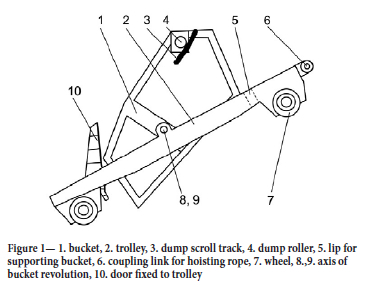
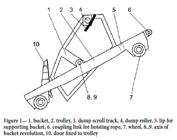
The detailed structure of the skip of the inclined shaft hoist in an open pit mine is shown in Figure 1. As shown in Figure 1, the skip consists of a bucket (1) and trolley (2), and there is an axis of the bucket revolution (8 and 9) during skip discharging, and the dump roller (4) moving via the dump scroll track. Also, a trolley consists of the door (10), which prevents the outflow of the payload when loads skip with a payload and the skip moves on the subgrade, a bearing of the bucket, a coupling link for the hoisting rope (3), as well as a wheel (4) and lip (5) for supporting the bucket. During the loading and moving of the skip, two points of bearing and lip support the bucket, and the distance between the bucket and the door fixed to the trolley is very small so that rocks do not spill out. In the discharging area, the skip will move at 1 m/s with a creep speed of 0.5 m/s, the dump roller enters into the dump scroll track and the bucket rotates around a bearing. Then, the distance between the bucket and the door gets bigger, and the payload begins to be discharged.
Selecting a geometrical locus of dump scroll track
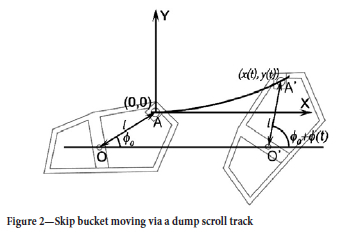
A geometrical locus of dump scroll track must be designed in order to simulate the skip discharging process (Figure 2).
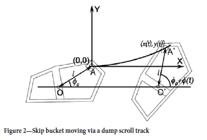
The equation for the geometrical locus of a dump scroll track can be described as shown in the following:

Where ø(t) is the rotation angle of the skip bucket over time; x(t) and y(t) are individually x, y- coordinates of a geometrical locus at any time t; vo is the initial speed of the skip entering into the dump scroll track, m/s; α is the deceleration of the skip during skip discharge, m/s2; l is the distance from the dump roller to the rotation centre of the bucket, m; 0o is the angle between (AO) - and (OO') -, °; ø(t) is a function of the rotation angle of the bucket.
As shown in Equation 1, x(t) and y(t) can be obtained by ø(t) When a geometrical locus of a dump scroll track for a large capacity skip is designed, the following condition must be adhered to, that is, a derivative at the starting point of a geometrical locus must be equal to zero. If not, at the specific moment that the skip enters the dump scroll track, the scroll rollers will not run smoothly, and the impact load occurs. Therefore, to analyse and select the geometrical locus of a dump scroll track from an energy consumption point of view, two lows of change of 0(t) are introduced, namely (Rothbart, 2004):
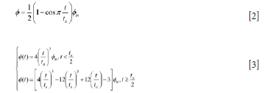
Where ta is the discharging time of the skip, s; øm is the maximum rotation angle of bucket, °.
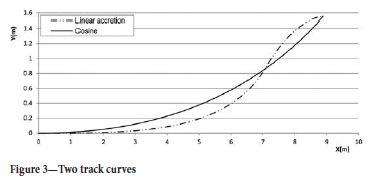
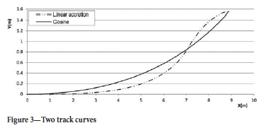
Equation 2 is derived from the simple harmonic motion curve and Equation 3 is derived from the 2-3 polynomial cam curve (Rothbart, 2004). These expressions are substituted into Equation 1, and then, two equations for a geometrical locus of dump scroll tracks can be obtained, respectively. Ultimately, in this paper, they are called the cosine track and linear accretion track, respectively. These track curves are shown in Figure 3.
Simulation and analysis of the skip discharging process by discrete element method (DEM)
For a dynamic simulation of the skip discharging process, the discharging characteristic must be analysed, which results in analysing the change characteristic of the mass of the skip payload. Many factors affect the discharging characteristics, which differ for each skip load. In this section, assuming that the cherty limestone with a certain grain size distribution is loaded on the skip bucket, the skip discharging process is simulated, whereafter the change of the discharging characteristic for the change of the grain size distribution of the payload is considered.
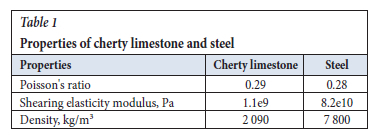
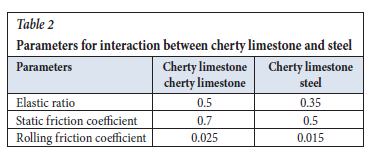
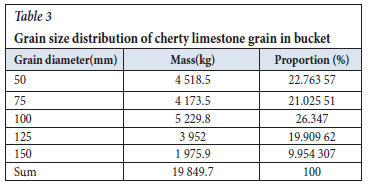
Cherty limestone is selected as the material for simulation, as it is the principal component of the top rock of the Youth ore district in the Unryul mine. Material properties needed for simulation are shown in Tables 1 to 3 (Gang, 2018).
In the simulation, it is assumed that the type of payload grain is rectangular due to the operational load and that its size is not less than 50 mm, after which the skip discharging process on two dump scroll tracks is simulated.
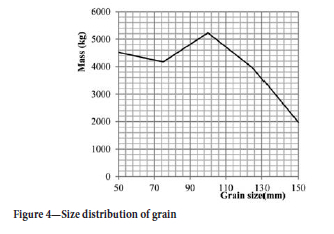
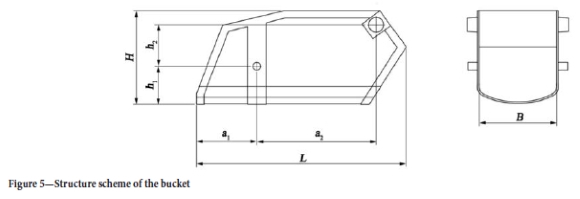
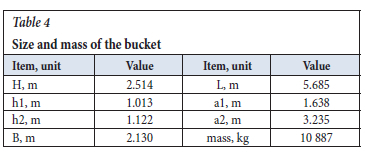
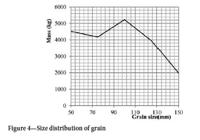
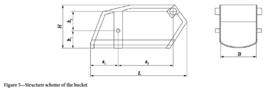
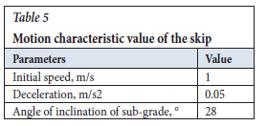
The data for cherty limestone shown in Table 3 and Figure 4 are obtained by repeatedly measuring in the exact same position. The structure scheme of the bucket is shown in Figure 5, and the structural parameters and motion characteristic values are given in Tables 4 and 5.
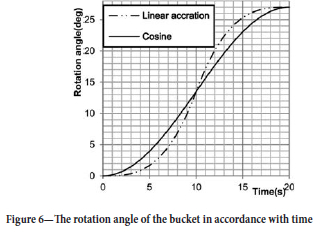
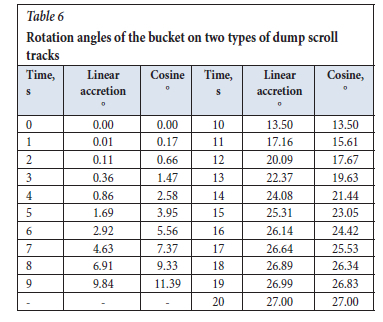
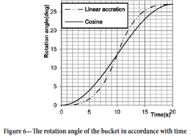
In the simulation, the area of the dump scroll track is divided into 100 partitions, and the rotation angles of the bucket at 20 positions are listed in Table 6 and Figure 6.
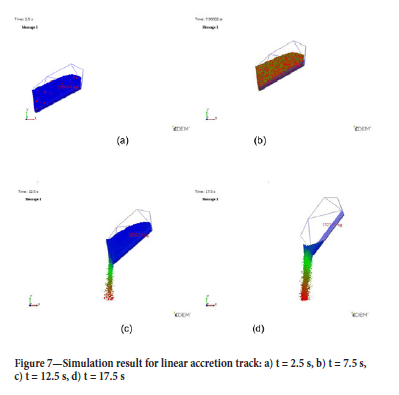
The simulation results for the skip discharging process on the linear accretion track and cosine track are shown in Figures 7 and 8, respectively.
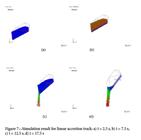
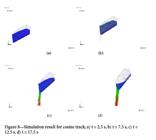
As seen in the aforementioned figures, much more payload is unloaded from a bucket on the cosine track than on the linear accretion track, that is, 12.5 s, and much more on the linear accretion track than on the cosine track, that is,17.5 s.
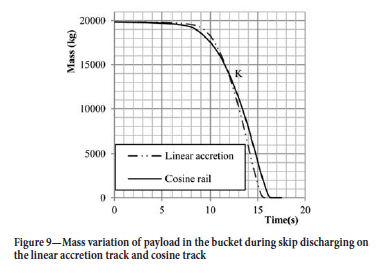
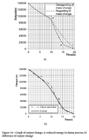
The mass variation contrast of payload in the bucket during the skip discharging is given in Figure 9.
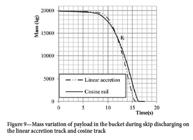
During the simulation, the time needed to create material is from 0 seconds to 2.5 seconds, so the base point of the graph is 2.5 s, as shown in Figure 9. Figure 9 illustrates that the mass variation of the payload in the buckets is different from each other in accordance with time on two types of dump scroll tracks. From this, a discharging speed graph may be obtained. The discharging speed at any moment is:

Where Q is the discharging speed, kg/s; mn-1 and mn the mass of the payload in the bucket at the calculation steps n - 1 and n, respectively, kg; and ∆t is the time distance, s.
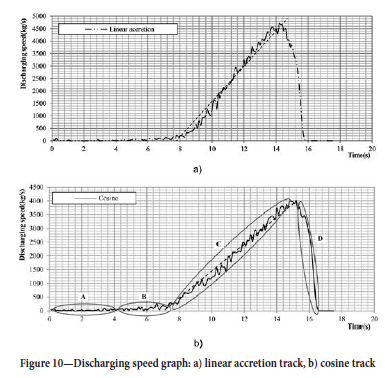
The discharging speed graphs of a loaded skip moving via the linear accretion track and cosine track are given in Figure 10.
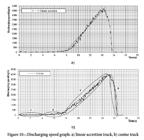
For a definite analysis, the graph in Figure 10 b) is divided into four sections, i.e., A, B, C, and D.
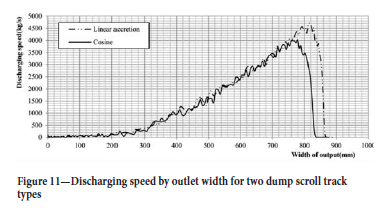
Section A of the graph is not located in the discharging area, and section B is the starting area of discharging. In this section, the distance (an outlet width) between the fixed door and the bucket is too small, and the effect of the grain size on the discharging characteristics is considerable. Section C is the basic discharging area, so the outlet width is large enough to discharge, and the effect of the grain size on the discharging characteristics can be ignored in this section. Here, the discharging speed is related to the outlet width, which is illustrated clearly through the discharging speed graph, as shown in Figure 11.
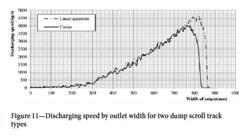
These graphs clearly show that, regardless of the variation characteristic of a dump scroll track, the discharging speed of a skip on two types of dump scroll tracks are equal under the same outlet width, thus, in this section the discharging speed is not influenced by the grain size, namely the grain size distribution.
Section D is the final area for skip discharging. The effect of the grain size change in section C, together with the discharging area, is considered. As the grain size increases, the longer it takes for section C to start, the discharging section in the graph is moved to the right on the time-axis (See Figure 9). In contrast, with the smaller grain size, the sooner section C starts, the discharging area is moved to the left. In both these cases, the gradients of the mass variation graph are almost the same as in the simulation. It is important to consider the position change of point K, as shown in Figure 9, when the grain size decreases. Up until point K, the quantity discharged on the cosine dump track is much more than that on the linear accretion track, and after point K, the quantity discharged on the linear accretion track is much more than on the cosine track. If the grain size of the payload gets smaller, point K is moved to the right in Figure 9.
The discharging speed on the cosine track is higher than on the linear accretion track, up to 10 s, while point K in Figure 9 occurs at approximately 12 s. Thus, with smaller grain sizes, section C on the cosine track starts sooner, moving point K to the right on the time-axis.
Dynamic simulation and energy analysis during skip discharging
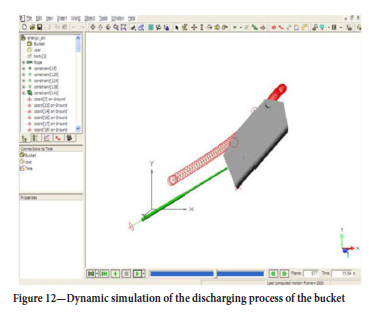
To analyse energy consumed in skip-hoisting rope systems during skip discharging, dynamic simulation is carried out by using MSC Visual Nastran software. The dynamic simulation model for the discharging process is given in Figure 12.
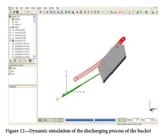
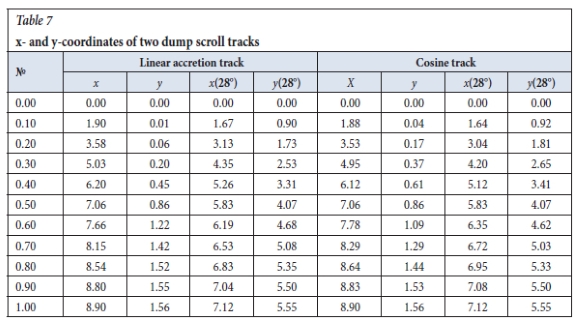
The model is composed of a bucket and the payload, as well as the dump scroll track and the hoisting rope. The trolley and fixed door are ignored in the simulation because they do not affect energy change. "Revolute on slot" restraint is applied to the rounded support of the bucket to induce translation and rotary motion on the bucket. The gravity acceleration acts on the y-axis as -9.81 m/s2, and the influence of friction is ignored. The x- and y-coordinates for ten points of two dump scroll tracks are listed in Table 7, where x (28°) and y (28°) are the x- and y-coordinates rotated by 28° because the loaded skip moves on the sub-grade inclined by 28°.
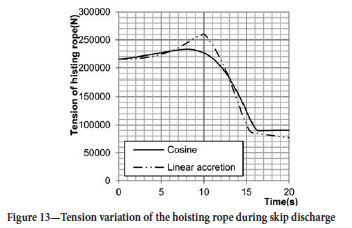
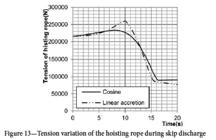
From Figure 13, the energy consumed during a skip discharging is expressed as follows:

Where A is the energy consumed in the system, J; Ft is the tension of the hoisting rope at any time t, N; St is the distance travelled by the loaded skip via the dump scroll track at time t , m; and τ is the motion time, s.
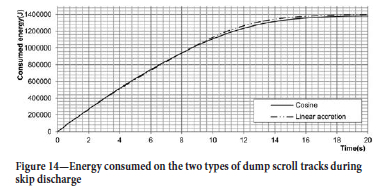
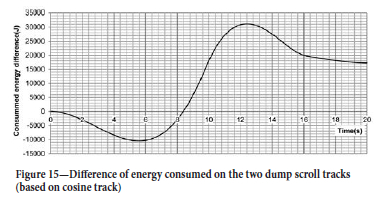
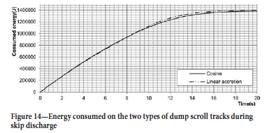
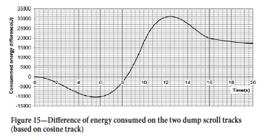
The energy that is consumed while the loaded skip discharges via the two dump scroll tracks is illustrated in Figure 14, and the difference between the energy consumed on the two dump scroll tracks is illustrated in Figure 15, respectively. The energy consumption in the entire section of discharging is 1 398 622 J on the linear accretion track and 13 813 32 J on the cosine track, so it is illustrated that the energy consumed on the linear accretion track is more significant, by 17 290 J, than that on the cosine track.
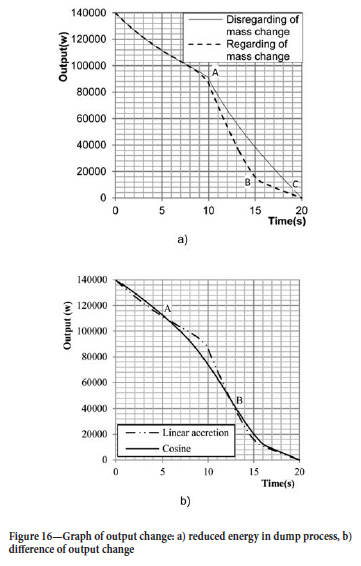
Thus, the output of the hoisting system during skip discharging

Where At is the simulation step, s; ν is the translation velocity of skip at time t, m/s; and Nt is the system output at time t, W
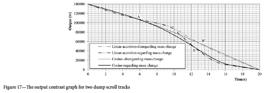
Figure 16 a) shows both output changes in the case of disregarding the mass change. Regarding the mass change, the area of closed district indicates the energy consumed during skip discharging (for the purpose of this paper, the effective area of mass variation). Figure 16 b) represents the difference of output change between the two dump scroll tracks, based on the cosine track; the output for the cosine track is significant in the section where the closed district is located below (for the purpose of this paper, the cosine inferiority area) and in contrast with this, is small in the section where the closed district is situated above (for the purpose of this paper, the cosine superiority area). As illustrated in Figure 16b, the difference in the energy consumption of the two dump scroll tracks is calculated by subtracting the area below the zero line (cosine inferiority area) from the area above the zero line (cosine superiority area) on the output difference graph.
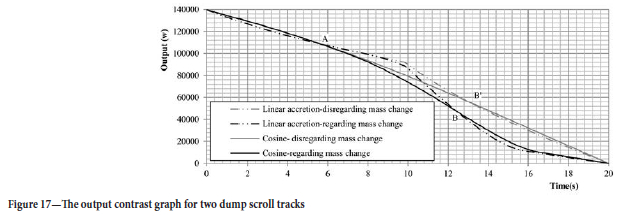
Under this condition, the variation of energy difference depending on the property of the payload is estimated. If the commencing moment of discharging is moved to the right because the grain size gets bigger or the humidity increases, the effective area of mass variation decreases, and point B is moved towards point B'. Therefore, the energy consumption is higher on linear accretion dump scroll tracks than on cosine dump scroll tracks.
In contrast with this, namely, if the grain size of the payload is smaller than the one in the simulation, the effective area of mass variation increases and point A in Figure 17 is moved to an earlier time. Point K in Figure 9 is moved to the right on the time-axis of a point in the simulation. This illustrates that the energy consumption on the cosine dump scroll track is less than that of the linear accretion dump scroll track. The movement of point K to the right makes point B move to the right. The smaller the grain size is, the larger the area of the cosine superiority area, and the smaller the area of the cosine inferiority area. Thus, the energy difference gets higher.
Investigating the actual operation situation in field
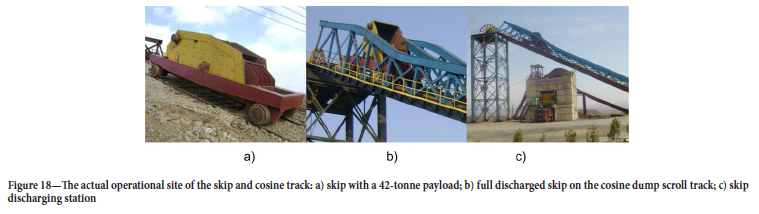
At the time of preparing this manuscript, the inclined shaft hoisting system was in the final installation and commissioning stages. A 1600 kW rock winder with a 42-tonne capacity skip operating at a speed of 4 m/s was utilised. It is confidently anticipated that the system, once in service, will demonstrate the incremental improvements which have taken place in the Unryul mining context. Figure 18 shows a skip with a 42-tonne payload and cosine track installed at the Youth Ore district in Unryul mine.

As shown in Figure 18, the skip discharges its payload on the asymmetrical truss girder where the cosine track consists of the upper chord. Compared with the simulation results, the bucket fully discharges by rotating at 27° and then the angle of inclination between the bucket and the surface is 55°.
Conclusions
This paper has attempted to analyse the energy consumption according to the type of dump scroll track during a skip discharge at an inclined shaft hoist in an open pit mine.
When a skip discharges, the energy consumption is mainly related to the type of dump scroll track; namely, should a skip move via a dump scroll track, and the scroll rollers do not run smoothly, and the acceleration variation thereof is high, at the moment when the impact load occurs, the energy consumption of the system increases.
In this paper, the linear accretion curve and the cosine curve were selected as the geometrical locus of dump scroll tracks for a skip from cam design theory, which has a small acceleration variation. The skip discharging process on two types of dump scroll tracks was simulated by using DEM and Visual Nastran software and a comparison evaluation was provided.
In conclusion, it can be said that the energy consumption on the cosine track is less than on the linear accretion track, regardless of the property of the payload during skip discharge.
Further work is required to fully map the relationships for a design parameter of a skip dump, a scroll track, and energy.
Data availability
The data used to support the findings of this study are available from the corresponding author upon request.
Conflict of interest
The authors wish to confirm that there are no known conflicts of interest associated with this publication, and there has been no significant financial support for this work that could have influenced its outcome.
Credit author statement
In Chol Paek: Conceptualisation, methodology, software; Un Chol Han: Data curation, writing, original draft preparation; Il Kwang Tae: Investigation; Kwang-Sok Jong: Supervision, funding; Chang-Il Kim: Writing, reviewing and editing; Phyong Jon Thak: software.
Acknowledgements
This study is financially supported by the Scientific and Technological Advance of DPR Korea (Grant No. 2017-08-730621).
References
- Gang, G. 2018. Study on the application of rational combined haulage system in deep open pit mine. PhD thesis, Kim Chaek University of Technology, DPR Korea.
-
Giraud, L., Galy, B. 2018. Fault tree analysis and risk mitigation strategies for mine hoists. Safety Science, vol. 110, pp. 222-234. https://doi.org/10.1016/j.ssci.2018.08.010
» https://doi.org/10.1016/j.ssci.2018.08.010 -
Gorzalczynski, S. 2014. Lightweight skips-Factors influencing operational reliability. In Proceedings of the Seventh International Conference on Deep and High Stress Mining, Australian Centre for Geomechanics, Perth, pp. 533-543. https://doi.org/10.36487/ACG_rep/1410_37_Gorzalczynski
» https://doi.org/10.36487/ACG_rep/1410_37_Gorzalczynski -
Jin, H. W., Zhang, X. 2014. The Structural Optimization of Large Capacity Skip Based on ANSYS. In Advanced Materials Research, vol. 1037, pp. 75-78. Trans Tech Publications, Ltd. https://doi.org/10.4028/www.scientific.net/amr.1037.75
» https://doi.org/10.4028/www.scientific.net/amr.1037.75 -
Plachno, M. 2018. Mathematical model of transverse vibrations of a high-capacity mining skip due misalignment of the guiding tracks in the hoisting shaft. Archives of Mining Sciences, vol. 63, no.1, pp. 3-26. https://doi.org/10.24425/118882
» https://doi.org/10.24425/118882 -
Rokita, T. 2016. Tests and examination of drive sheave in mine skip hoist. Archives of Mining Sciences, vol. 61, no. 2, pp. 415-424. https://doi.org/10.1515/amsc-2016-0030
» https://doi.org/10.1515/amsc-2016-0030 - Rothbart, H.A. 2004. Cam design handbook. McGraw-Hill, pp.27-91.
- Tiley, P. 2011. Hoisting systems. In SME Mining Engineering Handbook. 3rd ed. Littleton, CO: SME. pp.20-1296.
- Xiao, Y., Zhang, Z. 2003. Some issues need to be noticed in dump track design of bottom dumping skip. Nonferrous Mines, vol. 32, no. 3, pp. 25-27. (in Chinese).
-
Yan, M. 2012. 3D Modeling and Motion Simulation of Mine Skip Getting through Dump Rail Based on Pro/E. Advanced Materials Research, Vols. 557-559, pp 2176-2180. https://www.scientific.net/AMR.557-559.2176
» https://www.scientific.net/AMR.557-559.2176 - Yan, M., Liu, L. 2007. Optimal design of dump rail curve parameter of skip with up- open fan gate. Journal of China Coal Society, vol. 32, no. 10, pp. 1102-1104. (in Chinese).
- Yan, M., Liu, L., Shi, B. 2006. Dynamic stress analysis of dump rail during skip with up-open fan gate getting through dump rail. Journal of China Coal Society, vol. 31, no. 3, pp. 391-395. (in Chinese).
-
Yin, Z., Li, T., Wang, N., Mi, Z. 2022. Experimental study on impact wear characteristics of the skip liner under different impact velocities and coal types. Advances in Mechanical Engineering, Vol. 14(6), pp. 1-16. https://doi.org/10.1177/16878132221106914
» https://doi.org/10.1177/16878132221106914
Revised: 8 Feb. 2025
Accepted: 2 Mar. 2026
Published: May 2026