Seismic hazard associated to mine planning strategies: A novel application of the Gutenberg Richter distribution and the extreme value theory illustrated in a deep mine case study
Abstract
The increasing global demand for metals compels the mining industry to optimise production methods and planning to meet rising needs. However, as mining operations extend deeper, the risks associated with mining-induced seismicity and rockburst hazards become more critical. Effectively managing mining rates is essential for controlling induced seismicity and mitigating these risks. This paper presents a novel and practical methodology for integrating seismic hazard considerations into mine production planning. By analysing historical seismic and mine production data, the methodology develops actionable guidelines for addressing short-term planning challenges. In contrast to traditional reliance on unwritten miner experience or time-intensive numerical modelling solutions, this approach offers a streamlined and timely framework for decision-making. The proposed framework is applied to a case study of a Peruvian polymetallic mine utilising the sublevel stoping method with backfill. The results demonstrate the methodology's ability to optimise short-term operational decisions, striking a balance between production efficiency and safety standards, and highlighting its potential for broader application in the mining industry.
Seismicity; mine planning; seismic hazard; rockburst
 Thumbnail
 Thumbnail
 Thumbnail
 Thumbnail
 Thumbnail
 Thumbnail
 Thumbnail
 Thumbnail
 Thumbnail
 Thumbnail
 Thumbnail
 Thumbnail
 Thumbnail
 Thumbnail
 Thumbnail
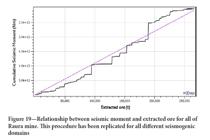 Thumbnail
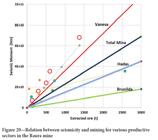 Thumbnail
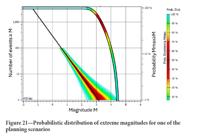 Thumbnail
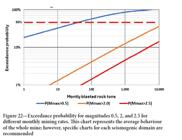 Thumbnail