Comparison of the Committee for Mineral Reserves International Reporting Standards Template-based mineral reporting codes with implications for mine planning in mineral development projects
Abstract
From 2022 to 2040, the global demand for mineral commodities is projected to increase by four-fold to six-fold, largely due to traditional drivers such as population growth and urbanisation compounded by the adoption of decarbonisation technologies that are more mineral intensive than fossil fuel technologies. To meet this projected demand, companies operating in the minerals industry should accelerate the development of mineral projects. Since most of the companies generally operate in multiple geographical, regulatory or legislative jurisdictions, it is critical that the information on Mineral Resources and Mineral Reserves they report on in the public domain should be comparable and consistent across different jurisdictions. The Committee for Mineral Reserves International Reporting Standards fosters alignment of national and regional mineral reporting codes through an internationally accepted template that creates common technical understanding of definitions, classification, estimation processes and the Public Reporting of Exploration Results, Mineral Resources, and Mineral Reserves. The Committee for Mineral Reserves International Reporting Standards Template-based codes guide reporting at respective national and regional levels. Since mine planning is critical in the conversion of mineral resources to mineral reserves, a shared technical understanding should aid comparability of mine planning results. However, differences persist in the way mine planning results are reported. Unlike most previous studies, which have primarily focused on comparing mineral reporting codes, this paper updates and extends such comparisons by exploring how similarities or differences in reporting should influence the mine planning process. It also recommends some principle and process changes to assist mine planning professionals to improve consistency and comparability in reporting mine planning results.
CRIRSCO; national reporting codes; mine planning; Competent Person (CP); Competent Person's Report (CPR); Public Reporting
Introduction
The International Energy Agency (2022) estimated in 2022 that to meet the global targets outlined in the 2016 Paris Agreement, the demand for mineral commodities essential for clean energy technologies, could increase four-fold by 2040. Alternatively, in a more accelerated energy transition scenario aiming for net-zero greenhouse gas emissions by 2050, demand could increase up to six-fold compared to 2022. This surge would be driven by the growing need for minerals required for energy transition applications, including electric vehicles, solar panels, and data centres supporting artificial intelligence systems. This projected growth in mineral demand is largely due to traditional drivers such as population growth and urbanisation, compounded by the implementation of decarbonisation technologies that are more mineral intensive than fossil fuel technologies. Therefore, it is critical for mineral industry companies to expedite mineral development projects to meet the anticipated increase in the demand for minerals (Govreau, 2022). However, in trying to fulfil the projected demand through expedited mineral resources and mineral reserves management, it is also important to satisfy various stakeholder expectations of companies operating in the minerals industry. Such stakeholders include customers, financiers, regulators, local communities, native and indigenous peoples, non-governmental organisations and social groups as well as employees, management and shareholders. Stakeholder expectations impose some emerging constraints such as the rising global demand for environmental, social, and governance (ESG) compliance and stewardship to ensure acceptable development and continued operation of mining projects (Sides, Allington, 2024). Typically, mineral industry companies operate mineral development projects at various stages across multiple geographical jurisdictions. However, they must navigate these constraints to secure and maintain their social license to operate.
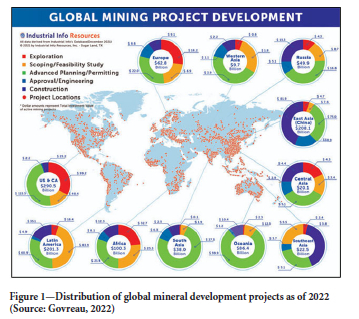
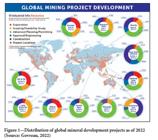
The various stages of mineral development projects include exploration, technical studies such as scoping studies (SS), pre-feasibility studies (PFS), feasibility studies (FS), and engineering and construction works. If successfully actioned and implemented, the result will be the profitable extraction of raw materials or minerals that will be used in the mid- and down-stream stages of the mineral value chain. The evaluation of exploration results typically ends with the declaration and reporting of mineral resources. Subsequently, various technical studies such as SS, PFS, and FS, that are undertaken during mine planning aim to determine optimal ways for extracting the mineral resources. The technical studies culminate in the declaration and reporting of Mineral Reserves, thus, guiding multi-million (or sometimes billion) dollar investment decisions on project advancement. Therefore, mine planning is an important process that is undertaken when converting mineral resources to mineral reserves, which are then reported in Public Reports. Figure 1 is a snapshot of the global distribution of mineral development projects, at various stages of development, as of 2022.
Globally, there are several national and regional mineral reporting codes that guide Public Reporting at national and regional levels. For example, at a regional level some mining companies operating in the European Union (EU) countries report mineral information using the Pan-European Reserves and Resources Reporting Committee (PERC) Standard. It must be noted though, that in the EU it is a company decision to report using the PERC Standard because it is a standard and not a regulatory requirement and the Financial Conduct Authority (FCA) does not specify the code or standard to use, provided it is recognised by CRIRSCO (Sides, Allington, 2024). However, the Critical Raw Materials Act (CRMA), which is a European Commission (EC) legislation, requires the use of the United Nations Framework Classification for Resources (UNFC) (Lepley, 2024).
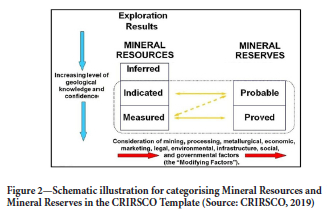
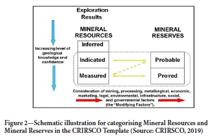
Companies operating in the minerals industry often operate in multiple geographical, regulatory or legislative jurisdictions, which have different jurisdiction-specific requirements. This requires consistency in the Public Reporting of information on Mineral Resources and Mineral Reserves so that meaningful comparisons can be made across different jurisdictions. The challenge to standardise the reporting process so that there is common technical understanding across different regulatory jurisdictions led to the establishment of a global committee in 1994, known as the Committee for Mineral Reserves International Reporting Standards (CRIRSCO). A broad mandate for CRIRSCO is to ensure the alignment of national and regional minerals reporting codes. To achieve this goal, CRIRSCO published a template (the Template) in 2006, which was later updated in May 2013 (Sides, Allington, 2024). At the time of writing this paper, the most current version of the Template had been published in 2019, and that version is also referred to as the International Reporting Template (IRT) (CRIRSCO, 2019; 2024). The Template has gained global acceptance and propelled, inter alia, by the increasing globalisation of investors on different stock exchanges, securities exchanges and equity investors, including royalty and streaming companies. As part of their duty of care, stock and security exchanges must protect their investors by putting systems in place to ensure that the information published by companies listed on those exchanges is, as far as possible, not misleading or false (Njowa et al., 2014). Figure 2 schematically illustrates the CRIRSCO approach to categorising Mineral Resources and Mineral Reserves. Each country under the CRIRSCO umbrella must use the same definitions for comparability in reporting. For example, the definition of an Inferred Mineral Resource in one code must have the same definition in one of the other CRIRSCO Template-based codes, although only the additional guidance may vary, i.e., additional text added to assist and guide the reader as to what additional detail, if any, is required in that respective reporting jurisdiction.
Why it is necessary to compare national and regional minerals reporting codes for mine planning purposes
Unlike previous studies, such as those by Camisani-Calzolari (2004) and Rupprecht (2017a), which primarily focus on comparing mineral reporting codes, this paper updates these comparisons and explores how reporting similarities and differences should inform the mine planning process. This approach aims to promote more consistent and comparable reporting of mine planning results. With this extension, considerations are made regarding how the CRIRSCO Template-based mineral reporting codes can be utilised for better alignment in the Public Reporting of mine planning results.
At a national level, mineral resources and mineral reserves have long been viewed as each country's mineral endowment that is normally assigned to the custodianship of governments on behalf of the country's citizenry. The mineral endowment is an attraction for international investment that contributes towards driving the economic growth of the respective country endowed with such mineral resources. For any company operating in the minerals industry, mineral resources and mineral reserves are among the most significant assets, if not the most critical (IASB, 2010; Njowa, Musingwini, 2018). They serve as the lifeblood and foundation of a mining company, determining its future economic viability (Deloitte, 2023). However, if these resources are not reported appropriately, this can mislead investors into making incorrect investment decisions and such reporting fails to comply with ethical and governance expectations of investors. Cases of misleading reporting and associated consequences of such practices were instrumental in driving the development of the CRIRSCO Template. These scandals exposed the dangers and risks associated with a lack of accountability, incompetency, or misleading reports due to the absence of a guiding framework for consistent and comparable Public Reporting of mineral assets. These scandals include the much-publicised Poseidon nickel bubble as well as the Bre-X scandal (Camisani-Calzolari, 2004; Rupprecht, 2017a; Sides, Allington, 2024).
The Poseidon nickel bubble was a stock market bubble that unfolded between 1969 and 1970, driven by speculation around the Australian exploration company Poseidon NL. The company's share price soared after it announced that drilling had uncovered high-grade nickel ore. However, the ore was later found to be of much lower quality, leading to a sharp decline in the stock's value.
Similarly, the Bre-X scandal was a mining fraud that occurred between 1995 and 1997, involving the Canadian company Bre-X Minerals Ltd. The company's stock price surged after it claimed to have discovered a substantial gold deposit at the Busang mine in Indonesia. However, the gold samples were later revealed to be fraudulent, causing the stock to collapse.
To prevent the occurrence of similar scandals in the future, statutory and professional bodies in some leading mineral-rich countries collaboratively developed, together with their respective stock exchanges, standards and codes for guiding the Public Reporting of mineral assets (Njowa et al., 2014). The guidance includes the use of standardised definitions as well as recommendations on the minimum level of experience that the Competent Person (CP) must possess (Njowa et al., 2014). However, it is important to note that neither the CRIRSCO Template nor any of the CRIRSCO Template-based codes prescribe how to estimate, or provide methods to use for the classification of Mineral Resources and Mineral Reserves.
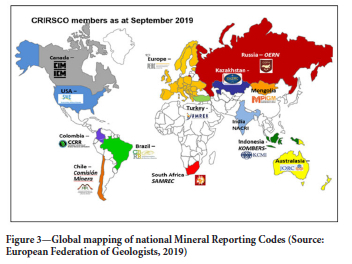
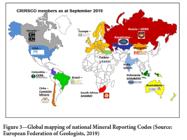
Figure 3 illustrates the national reporting codes or standards that currently exist worldwide and are aligned with the CRIRSCO Template, at the time of writing this paper. Additional countries are in the process of applying to CRIRSCO, and it is anticipated that the application of the CRIRSCO Template definitions will become mandatory for either national reporting purposes or will be required by all stock exchange regulators.
Despite there being adequate high-level commonality among the various national and regional mineral reporting codes due to their alignment with the CRIRSCO Template, there are subtle, but important differences that can be identified due to jurisdiction-specific requirements, which impact comparable and consistent reporting. The country-specific requirements are the result of:
> Cultural and social contexts
> Legislative and regulatory requirements
> Historical legacies
> Loss in meaning due to language translations to and from English.
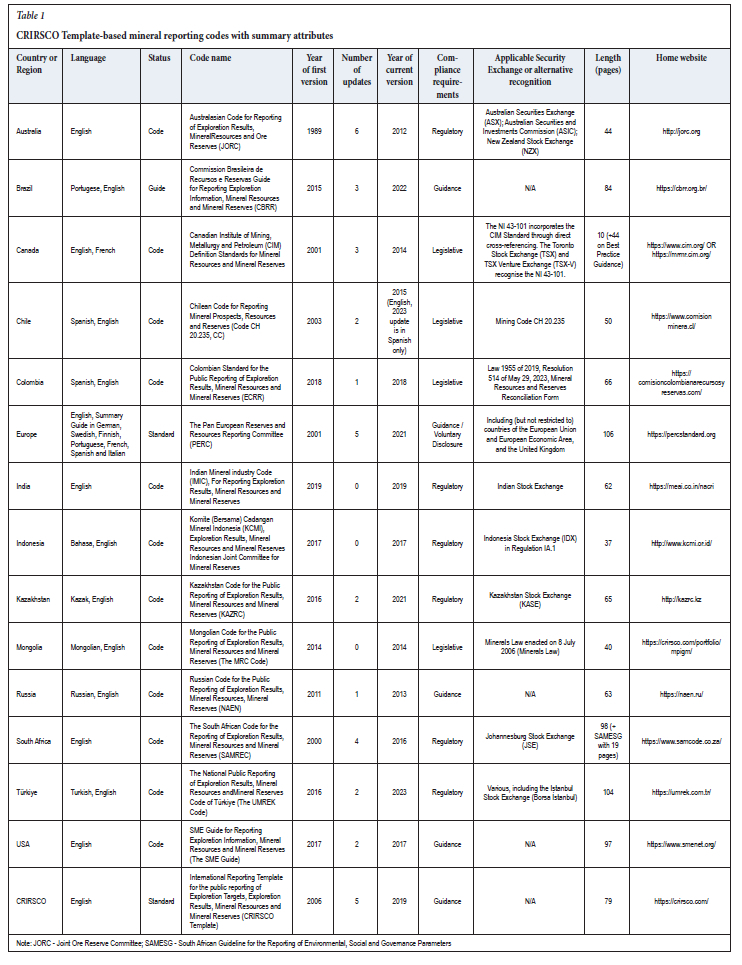
In addition, the CRIRSCO Template and various national and regional mineral reporting codes have undergone revisions or updates since their inception (Table 1). What can be observed from these changes is that:
> As national mineral reporting codes develop, they become increasingly detailed as they tend to provide more guidance, explanations and checklists.
> Generally, the revisions are driven by changes in the legislative or regulatory environments as a reaction to fraudulent and other sub-standard practices that may have impacted investors and government revenues.
> Generally, as understanding in using these codes has increased, industry leading practice has also evolved and been adopted by CRIRSCO member countries.
> Requirements for the social license to operate have meant that civil society concerns are making an impact on what and how exploration and mining companies should report into the public domain. A recent example is the ESG reporting requirement, which exploration and mining companies should now report on as part of their published annual reports so that they can demonstrate their ESG compliance and stewardship.
> The reporting codes do not stipulate the estimation methodologies to be applied in estimating mineral resources and mineral reserves, hence inconsistencies will always arise depending on the estimation and classification approaches followed.
> The reporting codes cater for Public Reporting purposes, yet reports can be prepared for reasons other than solely for Public Reporting. Therefore, the reports may contain different levels of detail or emphasis depending on their intended purpose, hence independent reviews are indispensable in trying to minimise inconsistency in reported information or any possibility of information that can be deemed misleading.
One of the achievements of CRIRSCO has been in promoting international mineral reporting, leading practice through standardising definitions for terms used in the reporting of exploration results, mineral resources and mineral reserves (or ore reserves). This standardisation provides high-level assurance to investors who invest across different geographies that there is reporting commonality as the CRIRSCO Template currently provides 16 standard definitions that are used in all the related codes. For example, reference to an Inferred Mineral Resource Report for a hard rock lithium mineral property in Western Australia should have a similar meaning when applied to a hard rock lithium mineral property in Africa, provided that both mineral properties report under CRIRSCO affiliated codes. The commonality of definition allows global investors to compare different mineral properties and choose which property is the preferred investment option when comparing it on a like-for-like technical basis.
Table 1 summarises the 14 mineral reporting codes that fall under the umbrella of the CRIRSCO Template and the dates when the original codes were introduced, together with dates of latest versions, at the time of writing this paper. The mineral reporting codes have used the CRIRSCO Template as a common reference but with additional adjustments that cater for requirements peculiar to a country or region. In the different jurisdictions, national and regional mineral reporting codes may either have legislative or regulatory authority, or merely serve just as guideline documents. However, they all adhere to the same fundamental definitions, guidelines, and terminologies outlined in the CRIRSCO Template for the reporting of exploration results, mineral resources and mineral reserves. However, outside the ambit of the CRIRSCO Template-based codes there are other standards pertaining to mineral reporting but are not the focus of this paper. These include the:
> United Nations Framework Classification for Resources (UNFC), which is a universal standard that can be used for the sustainable management of all energy and mineral resource endowments to address needs of different stakeholders, such as in policy formulation, capital allocation, and corporate business processes (Hokka et al., 2020).
> Pan African Public Reporting Standard for Minerals and Energy Resources (PARC), which was developed under the auspices of the African Minerals Development Centre (AMDC) as part of a process to coordinate and oversee a continent-wide implementation of the Africa Mining Vision. The PARC Standard seeks to enhance processes for certification of competence in the minerals industry in Africa and harmonise policies and regulatory frameworks relating to the reporting of mineral endowments at a continental level (AMDC, 2023).
> National Instrument 43-101 (NI 43-101), which is a regulatory instrument in Canada to ensure compliance with listing requirements for companies listed on the Toronto Stock Exchange (TSX) and TSX Venture Exchange (TSX-V).
> SK-1300, which is a regulatory instrument in the United States of America (USA) to comply with Regulation S-K [17 CFR 229.1301 - 229.1305] as required by the New York Stock Exchange (NYSE) and US Securities and Exchange Commission (SEC).
According to CRIRSCO (2024), the Template seeks among other things to:
> Integrate the minimum standards that should be adopted in national and regional mineral reporting codes and standards.
> Provide recommendations and interpretive guidelines for disseminating and promoting effective and well-tested leading practices for Public Reporting.
> Follow a global trend towards more stringent corporate governance and regulation, considering the global amplification of ESG compliance and stewardship expected from companies operating in the minerals industry.
Therefore, this paper sought to compare the CRIRSCO Template-based mineral reporting codes, to highlight their similarities and differences and infer implications for mine planning processes in mineral development projects. The comparison can assist in fostering better comparability in the reporting of mine planning results and in recommending some principle and process changes that can enhance comparability of mine planning results.
Comparison of CRIRSCO Template-based mineral reporting codes
This paper utilised the CRIRSCO Template guidelines to compare how well the national and regional mineral reporting codes align with international leading practice when publicly reporting Exploration Results, Mineral Resources and Mineral Reserves. The comparison considered the degree of alignment with the CRIRSCO Template, deviations from the Template, and similarities or differences among the codes. The relevant comparison categories based on the overall architecture of the CRIRSCO Template included scope, terms and definitions, competence and qualifications of a CP and recognised professional organisations (RPOs), principles and guidelines, and Public Reporting requirements. The codes being evaluated are those listed previously in Table 1.
Scope
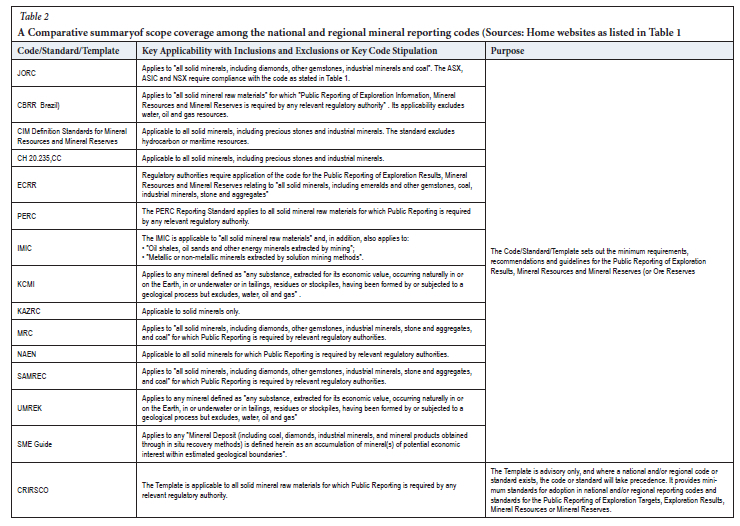
The scope of each national and regional mineral reporting code addresses the required minimum standards for the Public Reporting of solid minerals classified as metallic and non-metallic minerals (Table 2). Therefore, water or geothermal energy resources and non-solid energy minerals, such as oil and gas resources, have been excluded and are not considered in the comparisons made in this paper. Under the CRIRSCO Template, it has been globally accepted that it covers solid minerals, and includes, but is not limited to, diamonds, coal, gemstones, industrial minerals, sand, stone, and aggregates. In addition, oil shales, oil sands, or other energy minerals extracted by mining, as well as metallic and non-metallic minerals extracted using solution mining methods, are also included.
The national and regional mineral reporting codes are similar in scope in the following areas:
> They all cover solid minerals only but have some differences in definitions and guidelines to account for local circumstances and conditions. For example, in India, where oil shales are mined, the scope includes guidance on oil shales.
> They utilise the same definitions for the reporting of Exploration Results, Mineral Resources, and Mineral Reserves, including classifications.
> They are not explicit on how to define and report uncertainty inherent in mineral resource estimation and classification, which subsequently impacts how mine planning will be executed, since mine planning is undertaken on declared mineral resources. The uncertainty creates risks associated with the mine planning process.
Generic terms and definitions including equivalents
The language of communication within CRIRSCO is English. If the native language is not English, then the national and regional mineral reporting code should be available in both English and the respective native language of communication. The language translations to and from English can impact the reporting terminology, as meaning may be lost despite best efforts to ensure accurate translation. Therefore, it is important to compare terms and definitions to ensure common technical understanding, which is important for:
> Recognising the international nature of mining and mining investments.
> Comparing technical aspects of exploration and mining projects on a 'like-for-like' basis (e.g., in terms of risk, uncertainty, and opportunity).
> Effective communication.
> Education and training in the reporting of Mineral Resources and Mineral Reserves.
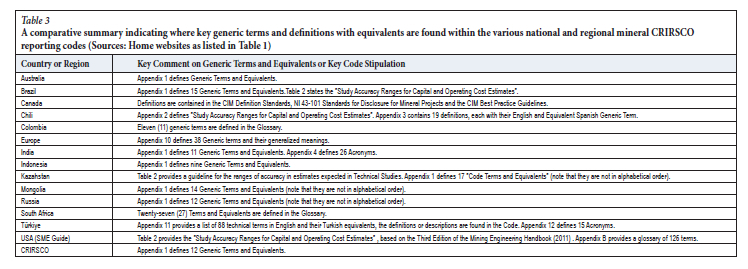
The CRIRSCO Template has 16 standard definitions that must be used in all CRIRSCO member national reporting codes. Table 3 provides commentary on where key terms and definitions are found in the various CRIRSCO reporting codes. These key terms and definitions ensure commonality in technical understanding. It should be noted that the national and regional codes utilise the generic terms and definitions from the CRIRSCO Template but include additional requirements peculiar to their respective jurisdictions. For example, the national reporting codes in Brazil, Chile, and the USA have added guidance on expected ranges of accuracy in estimates of capital and operating cost in technical studies.
The standardisation of the generic terms and equivalents across the national and regional mineral reporting codes has ensured that CRIRSCO can promote industry leading practice in the international Public Reporting of Exploration Results, Mineral Resources and Mineral Reserves. For example, CRIRSCO, (2014) noted that its existence "recognises the truly global nature of the minerals industry and the agreed need for international consensus on reporting standards".
Competence and qualifications of CPs and RPOs
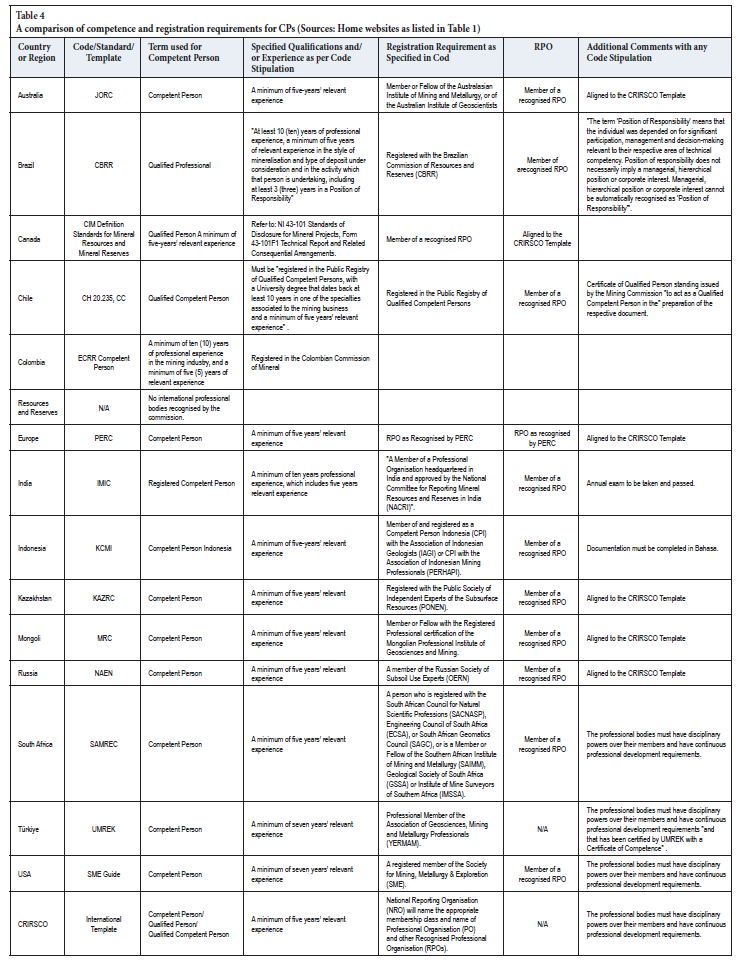
Competence is one of the key requirements that must be satisfied in the reporting of Exploration Results, Mineral Resources and Reserves. The estimation, classification, and reporting of Mineral Resources and Mineral Reserves must be done by a CP who possesses necessary qualifications, training, and experience in the estimation and reporting of Exploration Results, Mineral Resources and Mineral Reserves. Requisite qualifications and minimum experience for a CP are requirements common to all the mineral reporting codes, although there are minor differences in the term used for a CP (note that in the JORC code the acronym CP is also reserved for a Chartered Professional). The minimum experience differs across codes (Table 4). For example, a CP is referred to as a Qualified Professional (QP) in Brazil, Qualified Person (QP) in Canada, Qualified Competent Person (QCP) in Chile, Registered Competent Person (RCP) in India, and Competent Person Indonesia (CPI) in Indonesia.
The CRIRSCO Template stipulates that CPs must possess "a minimum of five years' relevant experience in the style of mineralisation or type of deposit under consideration and the activity", which a CP is undertaking (CRIRSCO, 2019). The CRIRSCO Template-based reporting codes generally require five years of relevant experience. However, some countries have modified this requirement. For example, Brazil, Colombia, and India mandate ten years of professional experience in the mining industry, with at least five years being relevant experience. Meanwhile, Türkiye and the USA have adjusted the requirement to seven years of relevant experience. These differences bring into question whether the minimum number of years can be interpreted as a meaningful measure of competence, based on a CP's curriculum vitae. Table 4 summarises requirements for competence and registration for a CP across the different CRIRSCO affiliated codes.
In a recent global study by Waltho et al. (2022), the Australian Securities and Investments Commission (ASIC) highlighted the issue of 'relevant experience' as being interpreted differently by individual CPs worldwide. This concept remains misunderstood, to such an extent that: "Relevance also needed to be extended beyond experience with different styles of mineralisation and be clearer on requiring Competent Persons to report within their field of expertise (e.g., geologists should not assess non-geological modifying factors which could be more appropriately addressed by a mining engineer, metallurgist or other professional)" (Waltho et al., 2022). In the same perspective, other professionals should do the same by only assessing modifying factors appropriate to their respective field of expertise.
The national and regional mineral reporting codes have subtle differences in the following areas when defining competence:
> Registration with a statutory body or membership of a professional body that has disciplinary powers.
> Licensing.
> Relevant education and training in the reporting of Exploration Results, Mineral Resources and Mineral Reserves.
The codes are similar in that there is a requirement for professional registration or membership of a professional body that has disciplinary powers. Reciprocity relationships between countries, through the recognised overseas professional organisations (ROPO) framework, though not always guaranteed, may allow CPs to be recognised across different jurisdictions (Njowa et al., 2014). However, in relation to rules for defining a Qualified Person, Waltho et al. (2022) noted that the disclosure requirements in the USA differed from other CRIRSCO Template-based codes in the way they define Qualified Persons and how the ROPO principle is articulated.
Given the preceding observations, it can be noted that the interpretation and application of the requirement on competence remain a challenge. As a result, different jurisdictions have applied various interim solutions to mitigate or address this issue.
Guiding principles and additional guidance
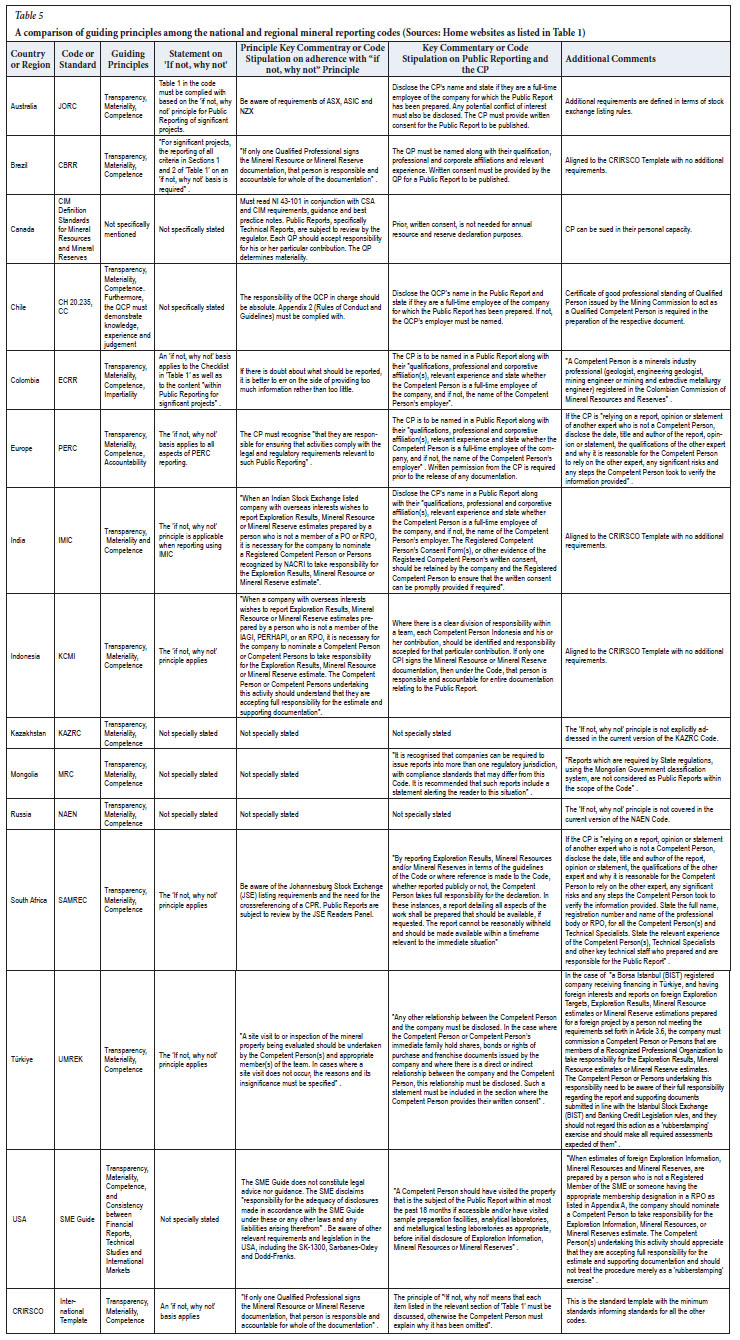
Transparency, materiality, and competence in the CRIRSCO Template, are the core principles that guide the estimation and reporting of Exploration Results, Mineral Resources and Mineral Reserves. The CRIRSCO Template-based codes uphold these three principles (Njowa et al., 2014). It should be noted that the Canadian Institute of Mining, Metallurgy and Petroleum (CIM) Definition Standards, including the associated NI 43-101, do not explicitly mention the three core principles. However, the three core principles implicitly apply since the CIM Definitions Standards comply with the CRIRSCO Template.
Table 5 outlines how each of the codes directly addresses these principles on an 'if not, why not' basis, including their implications for the CP. A fundamental reason for the 'If not, why not' requirement is to deter ambiguity and selectivity in reporting; hence, improve 'transparency' and 'materiality' of Public Reports and build more confidence in the Public Reports. The 'If not, why not' requirement also assists CPs in including all aspects that a reasonable stakeholder, investor, and professional advisor would reasonably expect to find in a Public Report. This reporting requirement also assists CPs in providing details pertaining to all relevant risks and uncertainty. Table 5 also indicates where a code does not explicitly address the three core principles and how that is addressed through other provisions.
Each item under the Checklist appended as a table with the title 'Table 1' to the national and regional codes has been considered using the 'if not, why not' basis and any material year-on-year variance is to be explained in a Competent Person's Report (CPR) or Qualified Competent Person's Report (QCPR). It should be noted that very few of the CRIRSCO codes have opted to exclude the 'if not, why not, basis for reporting. These include codes from Canada, Chile, Kazakhstan, Mongolia, Russia, and the USA. The Checklist appended to the codes as 'Table 1' is a comprehensive checklist of several technical aspects that must be considered to declare Exploration Results, Mineral Resources, or Mineral Reserves in that specific jurisdiction. In this regard, Lomberg and Rupprecht (2017a,) argued that: "The use of the checklist for every declaration is considered best practice and if completed properly it can provide the Competent Person with assurance that no technical inputs or practices have been omitted. It also provides users with confidence that the declaration is fully compliant and can be relied upon". Most of the national and regional mineral reporting codes have included a requirement to report against the 'Table 1' Checklist on an 'if not, why not' basis for maiden declarations or when a material change has occurred for a mineral project or mining operation that would have a material impact on the project or the parent company. Where aspects of the Checklist of 'Table 1' have not been included in the Public Report, the CP should explain why those aspects have been omitted.
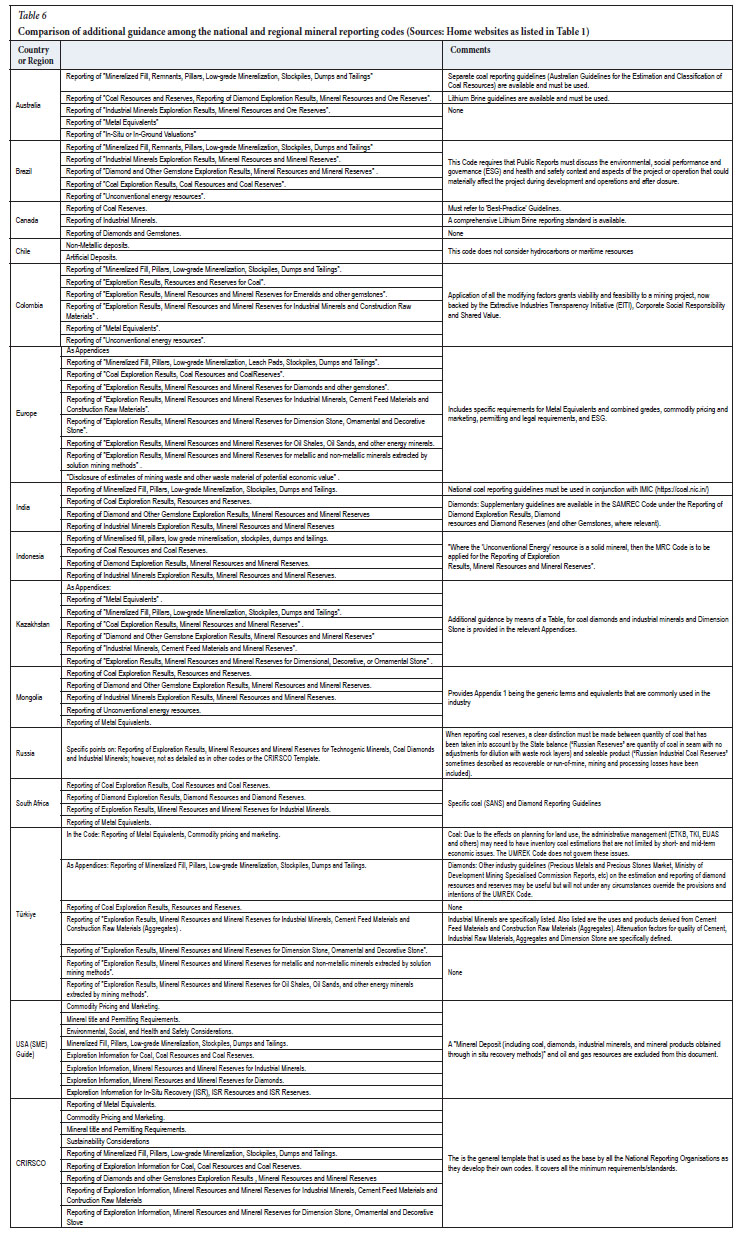
Table 5 provides some guiding principles contained in the national and regional mineral reporting codes and Table 6 indicates some aspects of additional guidance where these are specified in some of the codes.
Table 6 Comparison of additional guidance among the national and regional mineral reporting codes (Sources: Home websites as listed in Table 1)
Additional guidance has been included in the national and regional mineral reporting codes that fall under the CRIRSCO Template, aimed at providing guidance to the CP and readers of Public Reports. For example, with respect to guidance on commodity prices and metal equivalents, the CIM has a leading practice document for metal prices, hence, discrepancies exist despite the codes having the same definitions and guidance. If additional guidance across codes is not carefully adopted, some differences in interpretation and variations in disclosure can cause misinterpretation of reported results.
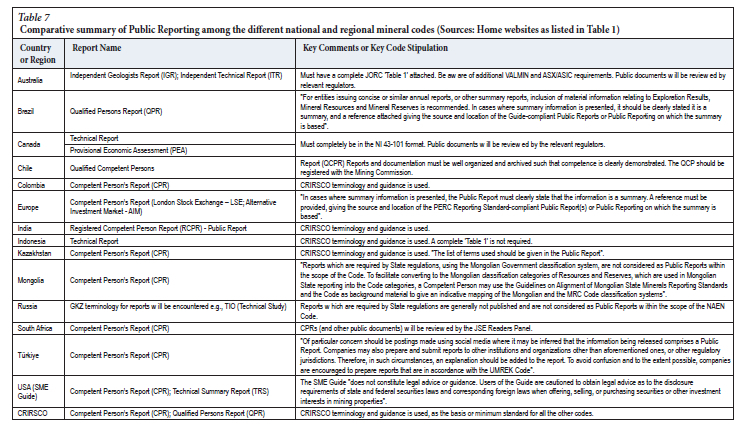
Public Reporting
It is important that the reporting of Exploration Results, Mineral Resources and Mineral Reserves, whether in the public domain or as per industry leading practice, should foster common technical understanding, regardless of differences that may arise due to jurisdiction-specific requirements. Table 7 outlines how the different codes address the issue of Public Reporting. All CRIRSCO Template-based codes specify that a minimum of a PFS or FS should be completed as part of the process of estimating and declaring Mineral Reserves (or Ore Reserves), while some jurisdictions specify that a mine planning output in the form of a life of mine (LOM) plan and production schedule should also be included when declaring Mineral Reserves.
Implications of similarities and differences in reporting codes to reporting of mine planning results
Links between mine planning and mineral reporting codes
The Checklist of 'Table 1' in the codes assists as a reference framework when developing mine plans. Kapageridis (2007) demonstrated how to use mineral reporting code guidelines to estimate Mineral Resources and Mineral Reserves using a software package. Generally, the mine planning process is linked to mineral reporting codes for several reasons which include:
> Mining company Chief Executive Officers (CEOs) make public pronouncements on issues such as production guidance that are primarily informed by outputs from the mine planning process. These outputs are generated following guidance from mineral reporting codes, thus highlighting the link between mine planning and Public Reports.
> Regulatory authorities typically require applications for mining licenses or mining rights at the mineral development stage to be accompanied by appropriate mine plans. These plans indicate how the part of the Mineral Resource, which will be extracted as Mineral Reserves are taken through the process of conversion from Mineral Resources to Mineral Reserves following guidance from CRIRSCO affiliated reporting codes.
> Compliance with the listing requirements of a stock exchange is required when companies want to list, or remain listed on the respective stock exchange. Companies that want to list must comply with reporting requirements set out in the mineral reporting code recognised by the respective stock exchange that they want to list on. However, unlisted companies do not need to comply with listing requirements on stock exchanges, so their mineral reporting does not need to be code-compliant, and this exacerbates inconsistencies in mineral reporting.
> During mergers and acquisitions, due diligence is conducted on the respective mining companies that are party to the transactions. This includes performing due diligence on mine plans and publicly reported Mineral Resources and Mineral Reserves, which should have been reported, or must be evaluated, following the guidelines of the respective mineral reporting code.
> For operating mines, Mineral Resources and Mineral Reserves are depleted annually and ongoing exploration must be undertaken to replace the depleting Mineral Resources for later conversion to Mineral Reserves. This is reflected in the company's published annual reports, that are prepared as part of the company's annual reporting cycle, wherein Mineral Resources and Mineral Reserves are declared or reported following requirements specified in the applicable mineral reporting codes.
The preceding sections have outlined some key similarities or differences among the different national and regional mineral reporting codes. When Mineral Resources have been reported, the subsequent process of mine planning is impacted by the subtle, but important differences arising from jurisdiction-specific requirements, which impact comparable and consistent reporting. The various national and regional mineral reporting codes are not prescriptive in how the information used in estimating Mineral Resources should be collected and analysed. Some of the issues related to the estimation of in situ Mineral Resources include the following:
> Data limitations, for example, widely spaced data points that limit available geological information, incomplete or poor-quality sampling, and poor-quality assaying techniques that affect accuracy of estimations.
> Geological complexity, for example, irregular shapes and variable grade distributions that reduce the reliability of resource estimations.
> Differences in the assumptions made by the CP conducting the estimation(s), based on their previous experiences and qualifications. There is no standardised approach to estimating Mineral Resources, hence, the selection of the estimation method, input parameters, and even the cut-off grades chosen can introduce biases and influence the reliability of the results and subsequent mine planning process.
> Different software used for the estimations can give different results, depending on the architecture of the software, thus, impacting on the subsequent mine planning results.
To investigate the effect of these, the Australasian Institute of Mining and Metallurgy (AusIMM) Parker Challenge was initiated (K2fly, 2023; AusIMM, 2023), which was initially sponsored by Rio Tinto in 2023 and subsequently by Barrick in 2025. The instruction to entries into the 2023 challenge was to: "develop a classified and reportable mineral resource estimate from the supplied data. The estimate will be used to inform long-term mine planning and investment decisions" (K2fly, 2023). The entries were reviewed to consider the differences in estimation approaches, the range of outcomes and the differences in classification decisions using the same copper (Cu) dataset. In total, 29 submissions compiled by either individuals or teams, who estimated and classified the resource, were made. The results highlighted differences in how different CPs arrived at different resource estimates using the same dataset. These differences directly impact the subsequent process of mine planning and the reported mine planning results.
The estimated metal volumes between the different submissions were quite varied (Dunham, 2023a). For example, when considering estimates classified at the Measured and Indicated levels of confidence, the reported Cu grades ranged from 0.59% to 1.13%, whilst the total ore tonnage ranged from 180,000 Kt to 1,900,000 Kt. The average estimated Cu metal content was estimated to be 5,930 Kt, whilst the difference between the lowest and highest was close to 10,000 Kt (from 2,000 Kt to 11,340 Kt). The lowest metal content estimates were 66% below the average, whilst the highest estimates were 91% above the average, and these results were after excluding outliers that could distort the results (Dunham, 2023a). The variability displayed in the estimated grades and volumes can lead to significantly different mine plans as well as economic outcomes.
The similarities and differences already discussed in this paper affect how mine planning results are reported in the public domain. As noted from the AusIMM Parker Challenge, despite the existence of mineral reporting codes, comparable reporting of mine planning results remains a challenge. This discrepancy may be ascribed to how different CPs interpret the reporting code requirements, the assumptions that they make as well as the way in which they interpret the available data. This is why this paper seeks to highlight how the subsequent process of mine planning will be impacted by the similarities and differences in reported Mineral Resources estimates. To outline how the similarities and differences impact the mine planning process the same comparison categories already discussed in this paper were utilised. These categories are scope, terms and definitions, competence, and qualifications of a CP and RPOs, principles and guidelines and Public Reporting requirements.
Implications of code scope to mine planning
Mine planning is undertaken to evaluate mineral industry development projects and producing mineral properties. The scope of each of the codes limits their application to solid minerals on which mine planning is undertaken. The scope implication is that there is clear guidance to mine planning in the type of mineral on which mine planning and design is undertaken. However, the scope is not explicit on how to define and report uncertainty inherent in the estimation and reporting processes, resulting in risk, which creates differences in reported mine planning results and the way the results are reported. Therefore, the mine planning process must consider the uncertainty that exists in the Mineral Resource estimates on which it is undertaken and seek to minimise risk from additional uncertainty arising from subjectivity in assumptions that must be made by the CPs for other mine planning input parameters. Therefore, mine planning results should reflect the existence of uncertainty.
Implications of generic terms and definitions to mine planning
The various reporting codes do not prescribe how the CP should classify an in situ Mineral Resource into each of the Measured, Indicated, and Inferred Resources categories. Classification is based on understanding and evaluating the uncertainties related to the in situ estimations and considering the risks associated with the uncertainties. Whilst the various codes give broad guidelines for classifying Mineral Resources into the three categories, these should ideally provide clear guidance for classification methodologies because clustering of data does not necessarily equate to accuracy (K2fly, 2023; Dunham, 2023b). Despite the importance of estimating Mineral Resources reliably, since the process has a knock-on effect on mine planning, the methods used to assess uncertainty in Mineral Resource estimates are applied inconsistently across the mining industry. This is because the parameters used in the process are often subjectively chosen by the CP responsible for the report (Owusu, Dagdelen, 2024).
Considering the results of the Parker Challenge, there is variation in both the estimation and classification of Mineral Resources that significantly impact reported results (Dunham, 2023a). A recent study of 45 technical reports published on the System for Electronic Document Analysis and Retrieval (SEDAR+) has shown that CPs provide reasons for choosing their classification parameters (Owusu, Dagdelen, 2024). The study from the SEDAR+ platform further assumes these are acceptable as per the CIM leading practice guidelines for public disclosures but acknowledges that the impact of applying different assumptions by CPs to the same dataset can result in discrepancies regarding grades, tonnages, and metal contents. These can result in misleading public disclosures and affect project outcomes. The study emphasises the need for a uniform classification framework with specific parameter ranges tailored to different deposit types, based on available geological and geometallurgical data. Such a framework would reduce the impact of individual CP assumptions, thus, improving investor confidence in mining projects (Owusu, Dagdelen, 2024). If such discrepancies in Mineral Resource estimates can be minimised, this will in turn positively impact mine planning results.
Implications of competence and qualifications of CPs for mine planning
The tools and skills used in estimating in situ Mineral Resources are different compared to those required for converting the in situ Mineral Resources into Mineral Reserves. Geologists tend to dominate the resource estimation space. However, a review of bachelor geology curriculum at a range of universities from the USA, Europe, South Africa, and Australasia show that although statistics is a common subject, geo-spatial data science and geostatistics are rare (Keystone, 2024a). Even MSc degrees in Geology and programmes focused on mining and geological engineering tend to have geo-spatial data science as an elective, rather than as a core subject (Keystone, 2024b). Therefore, the education and training of geology graduates should incorporate geo-spatial data science and geostatistics which are tools that assist in reducing uncertainty that creeps into the mine planning process.
The process of converting Mineral Resources into Mineral Reserves is a function of applying modifying factors, which are generally grouped under the following broad categories:
> Mining technical factors;
> Mineral processing and metallurgical factors;
> Environmental factors;
> Location and infrastructure considerations;
> Market and economic factors;
> Legal considerations including land tenure, and third-party ownership;
> Social considerations; and
> Governmental and regulatory requirements.
The modifying factors are associated with uncertainty and introduce risk into the Mineral Reserve estimation process. Therefore, an understanding of the risk associated with mine planning decisions requires the mine planning CP to decide how to classify Mineral Reserves into either the Proven or Probable category. The CP must ensure that the inputs used are realistic and not overly optimistic or overly conservative. It is advisable that technical specialists support the CP in verifying the accuracy of these inputs and identifying potential risks. Key factors to consider include ramp-up schedules, development rates, mining loss and dilution estimates (such as run-of-mine grades), metallurgical recovery rates, price assumptions, operating and capital costs, and identification of risks (Rupprecht, 2023). These observations indicate that a single CP is unlikely to have the necessary range of skills to cover both the Mineral Resources as well as Mineral Reserve components, as also confirmed by the Waltho et al. (2022) study. In addition, an independent review of the assumptions, process and procedures followed will assist in mitigating the risk so that a more reliable estimation and reporting of Mineral Reserves can be achieved.
A key issue raised by the Parker Challenge is the level of experience. Perhaps, the issue is that less experienced estimators are more likely to rely on procedures of estimation than having many reference points to calibrate and benchmark outcomes. Importantly, experience is not simply a time-related issue, although that may play a part, but that the breadth and depth of experience of geostatistics applied to very different geological mineralisation styles and modes is important (Hutton, 2024). The more experience someone is, the less likely they are to classify a resource at the Measured level of confidence (Hutton, 2024). On the other hand, less experienced individuals are more likely to classify a resource as 'Inferred' due to limited confidence arising from limited experience (Hutton, 2024). Also, resource estimates are more consistent as the classification level increases and when a resource is more certain, there is less guesswork, leading to fewer personal biases and, therefore, less variation in the estimates (Dunham, 2023b).
Without explicit knowledge of the mineralisation style and an adequate description of how the estimator decided on how to estimate a deposit with due recognition for domains, estimations are more likely to lack credibility. As Harry Parker stated, "In general, an ounce of geology is worth a pound of geostatistics; this may be disappointing to geostatisticians with no geological background; tough' (Searston, Smith and Verly, 2020). An estimation hypothesis should be the beginning of all estimations, as are geological and structural models to underpin the thesis. The foregoing observations highlight how uncertainty and risk in the Mineral Resource estimation and reporting process will impact the reliability of the subsequent mine planning process.
Implications of guiding principles and additional guidance to mine planning
Based on the three principles of transparency, materiality and competence, it is important to note that since there are different purposes or reasons for preparing Public Reports, the level of detail and focus or emphasis of a report will depend on its intended purpose. Therefore, it is important to have independent reviews since CPs generally must determine the contents of a report so that the report is appropriate for its use, unless the report is prepared following a prescribed format such as the one provided by NI 43-101. This has a direct bearing on the principle of materiality enshrined in the codes. Another challenge is related to the poor application of 'Reasonable Prospects of Eventual Economic Extraction (RPEEE)' for Mineral Resource Classification at the date of declaration. Therefore, it is important to include a discounted cash flow (DCF) analysis to demonstrate that Mineral Reserves are 'economically mineable' at the date of declaration and the cut-off grade used must be realistic not optimistic. This indicates that mine planning assumptions directly impact Mineral Reserves which must be reported according to mineral reporting codes (Rupprecht 2017b).
Implications of Public Reporting requirements to mine planning
Mineral development projects and operating mines inherently contain significant risks associated with the process of estimating and declaring Mineral Resources and Mineral Reserves, although these must be reliably estimated, consistently reported and competently managed (Deloitte, 2023). However, while Public Reporting codes acknowledge the risk in mineral reporting, they generally stipulate deterministic reporting of estimates (Mullins et al., 2023). The uncertainty associated with reported resource and reserve estimates, introduces inconsistencies in reporting such as those noted among mines from different mining companies mining the same or similar type of mineral deposit regarding how Mineral Resource cut-off grades are applied. For example, Sibanye-Stillwater applies a generic resource cut-off grade of 400 cmg/t for its Kloof and Driefontein operations (Sibanye-Stillwater, 2023). A financial cut-off grade and all the modifying factors are then taken into consideration when declaring the Mineral Reserve. However, Harmony, which mines gold reefs that are like those mined by Sibanye-Stillwater, calculates a financial cut-off grade using the current metal prices and cost structures for its Witwatersrand gold mines. This financial cut-off grade is applied as the mineral resource cut-off grade and is effectively the reserve cut-off grade too (Harmony, 2023). How mines interpret the requirement to justify the Mineral Resource requirement for RPEEE at the date of declaration is open to interpretation and the codes are not clear on which approach would be considered more appropriate in a case such as this one. What is important is that the cut-off grade used is realistic.
It is also noted that some companies only report the Mineral Resources including the Mineral Reserves, whilst others present the Mineral Resources including Mineral Reserves and then as a separate table, the Mineral Resources excluding the Mineral Reserves. These variations indicate the different interpretations of 'inclusive vs. exclusive' reporting of Mineral Resources and Mineral Reserves. From the schematic illustration for categorising Mineral Resources and Mineral Reserves (Figure 2) in the CRIRSCO Template, it should be clear that Mineral Reserves are a subset of Mineral Resources with the modifying factors applied. With some companies reporting Mineral Resources excluding Mineral Reserves, it indicates that there are different interpretations to what should be a clearly defined CRIRSCO concept.
The language that a CPR should be written in should be aimed at investors and their advisors, rather than subject experts like geologists and mining engineers. It is noted that technical reports containing complex language, sales pitches, and unrealistic or misleading statements are a common phenomenon in recent years (Rupprecht, 2023).
Whilst inadequate reporting of ESG considerations has been highlighted as a problem, there is often duplication between what the various reporting codes require and what the regulators require (Rupprecht, 2023). Environmental impact assessments already require extensive social and environmental reporting and CRIRSCO runs the risks of competing with these other established guidelines. Therefore, it is important for timeous and appropriate incorporation of these parallel guidelines into the CRIRISCO reporting frameworks, so that mine planning results are aligned with relevant contemporary developments.
Some recommendations on principle and process changes to mine planning related to mineral reporting codes
Given the inconsistencies that exist in the estimation and Public Reporting of Exploration Results, Mineral Resources and Mineral Reserves, despite the existence of mineral reporting codes, some principle and process changes may assist in further minimising the frequency and magnitude of the inconsistencies. Some principle and process changes are the following:
> LRegulatory authorities should make compliance with mineral reporting codes mandatory, whether a mining company is or not listed on a stock exchange as this will foster awareness of the need to align with the CRIRSCO Template for comparable and consistent reporting of Exploration Results, Mineral Resources and Mineral Reserves.
> LTo avoid inconsistencies emanating from the different interpretations of the 'inclusive vs. exclusive' reporting, it should be preferable to report Mineral Resources inclusive of Mineral Reserves and then report Mineral Reserves separately so that it is clear from the 'if not, why not' basis that certain portions of Mineral Resources were not converted into Mineral Reserves during the mine planning process.
> LIt is important to minimise the 'fear' of CPs being sued especially for discrepancies relating to reported Mineral Resources and Mineral Reserves, despite inclusion of disclaimers allowed for by the mineral reporting codes since investors can exercise their right to come after the CPs. It is recommended that codes mandate independent technical reviews of mine planning process controls and procedures before a company declares its Mineral Resources and Reserves estimates. This recommendation will minimise unintended consequences to mine planning CPs and reduce their 'fear' and this will also resonate with the Mineral Resources and Mineral Reserves governance framework recommended by Deloitte (2023).
> LBased on the arguments presented by Waltho et al. (2022), the definition of a CP's relevant experience should be limited to their area of expertise. When converting Mineral Resources to Mineral Reserves, geologists should desist from assessing non-geological modifying factors since mining engineers, metallurgists or other specialists can more appropriately evaluate such factors (Waltho et al., 2022). Similarly, other professionals should avoid assessing modifying factors beyond their own expertise. This change requires clear recognition that the Mineral Reserve estimation should be undertaken as a team effort comprising multidisciplinary technical specialists within a well-structured Mineral Resource Management organisational structure.
Concluding remarks
Generally, for ensuring international comparability, any committee responsible for developing or updating a national and regional mineral reporting code must collaborate with other members of CRIRSCO so that the respective code is compatible with the CRIRSCO Template and other CRIRSCO Template-based codes (CRIRSCO, 2019; 2024). However, no single code can cover all accepted industry practices, eliminate risks inherent in Mineral Resources estimation and reporting thereof, nor assist with all possible unforeseen situations that are encountered in the estimation and reporting of Exploration Results, Mineral Resources and Mineral Reserves. Consequently, there will invariably be challenges associated with consistent and comparable estimation and reporting of Mineral Resources and Mineral Reserves. Therefore, the CRIRSCO Template exists to provide guidance on the best current knowledge regarding reporting practices, thus, fostering more comparable mineral reporting with minimised risk. CPs must exercise competency and diligence when applying a national or regional mineral reporting code by carefully balancing industry leading practices and a mineral deposit's unique circumstances and characteristics. Although codes are in place, it does not remove the need for CPs to be able to defend their work before their peers as they must take responsibility for their findings and interpretations. Therefore, there is strong emphasis on the implementation of a safety net that requires independent technical reviews before results are publicly reported.
The CRIRSCO Template has been recently updated considering leading practice in the world. However, there remains some unresolved issues that practitioners would need to make a choice and make disclosures based on the selected option, for example, the reporting of Mineral Resources inclusively or exclusively of Mineral Reserves. There is no right or wrong way of reporting, hence CRIRSCO decided to leave the Template open to both options. The issue of licensing and registration of CPs into a centralised database has been left to CRIRSCO member countries to address considering peculiar circumstances specific to their different jurisdictions. The effort required for CPs to comply with the updated CRIRSCO Template must not be underestimated, but the minerals industry should see changes to the Template improving understanding and communication to facilitate the accelerated development of mineral projects to meet the projected global demand for mineral commodities.
By analysing the different CRIRSCO Template-based mineral reporting codes, this paper contributed to the important area of Public Reporting of Exploration Results, Mineral Resources and Mineral Reserves. Additionally, the comparison of the codes was made with implications to mine planning so that there can be an improvement in consistency in mine planning processes across different jurisdictions and operations, hence foster comparable conversion of Mineral Resources to Mineral Reserves among the mine planning fraternity. An issue associated with consistency in the application of the reporting codes is centered on ethical and governance compliance expected within ESG frameworks. It is assumed that, to meet ethical and governance expectations within an ESG framework, the reporting requirements must promote ethical reporting. Their comprehensive checklists are intended to reinforce ethical practices and help prevent future scandals. However, reporting codes do not entirely prevent false or misleading reporting, as loopholes exist within the requirements. Variations in the interpretation of these requirements can lead to inconsistencies. Therefore, principle and process recommendations such as those presented in this paper can help minimise these discrepancies, hence assist the mine planning fraternity in undertaking the important role of converting Mineral Resources to Mineral Reserves.
Credit authorship contribution statement
Mark Burnett conceptualised the research study and designed the research methodology; Mark Burnett, Cuthbert Musingwini, Godknows Njowa and Clinton Birch conducted the literature review, analysed the CRIRSCO Template-based codes, evaluated mine planning implications and participated in compiling both the original draft paper and the final submitted version of the paper.
Declaration of conflict of interest
The Authors declare that there is no conflict of interest in the production of this work.
Funding declaration
Not applicable.
Ethical compliance considerations
The work reported in this paper did not make use of any human or animal participants, hence did not require ethical clearance. However, care was taken to conduct the work ethically.
Declaration of generative AI and AI-assisted technologies
The authors utilised Grammarly and ChatGPT to review grammar and readability only.
References
-
African Minerals Development Centre (AMDC) 2023. The Pan African Public Reporting Standard for Minerals and Energy Resources. Available at: https://au.int/sites/default/files/documents/43674-doc-PARC_EN.pdf [Accessed: 19 February 2025].
» https://au.int/sites/default/files/documents/43674-doc-PARC_EN.pdf -
Australasian Institute of Mining and Metallurgy (AusIMM). 2023. The Parker Challenge. Available at: https://www.ausimm.com/conferences-and-events/mineral-resource-estimation/the-parker-challenge/ [Accessed: 17 September 2024].
» https://www.ausimm.com/conferences-and-events/mineral-resource-estimation/the-parker-challenge/ - Camisani-Calzolari, F.A., 2004. National and international codes for reporting mineral resources and reserves: Their relevance, future and comparison. The Journal of the Southern African Institute of Mining and Metallurgy, vol. 104, no. 5, pp. 297-305.
-
Committee for Mineral Reserves International Reporting Standards (CRIRSCO), 2014, Terms of Reference updated October 2014, pp 2. Available at: https://crirsco.com/wp-content/uploads/2024/04/crirsco_terms_of_reference_20141126.pdf. [Accessed: 17 September 2024].
» https://crirsco.com/wp-content/uploads/2024/04/crirsco_terms_of_reference_20141126.pdf - Committee for Mineral Reserves International Reporting Standards (CRIRSCO), 2019. International Reporting Template for the Public Reporting of Exploration Targets, Exploration Results, Mineral Resources and Mineral Reserves. November 2019, p. 11.
-
Committee for Mineral Reserves International Reporting Standards (CRIRSCO), 2024, International Reporting Template for the Public Reporting of Exploration Targets, Exploration Results, Mineral Resources and Mineral Reserves. Available at: https://crirsco.com/wp-content/uploads/woocommerceuploads/2024/06/CRIRSCO_International_ReportingTemplate_Tune2024_Update_Approved_for_Release_20240627-dl8515.pdf [Accessed: 10 July 2024].
» https://crirsco.com/wp-content/uploads/woocommerceuploads/2024/06/CRIRSCO_International_ReportingTemplate_Tune2024_Update_Approved_for_Release_20240627-dl8515.pdf -
Deloitte 2023. The importance of reliable Mineral Resources and Reserves reporting: The bottom line for investors. Available at: https://www.deloitte.com/content/dam/assets-zone1/za/en/docs/services/consulting/2023/za-POV-Resources-Doc-LS-with-bleed.pdf [Accessed: 10 July 2024].
» https://www.deloitte.com/content/dam/assets-zone1/za/en/docs/services/consulting/2023/za-POV-Resources-Doc-LS-with-bleed.pdf -
Dunham, S. 2023a. Parker Challenge thoughts (the first bit). Available at: https://www.linkedin.com/pulse/parker-challenge-thoughts-first-bit-scott-dunham/?trackingId=0rAuxsI%2BS5qsoq6fT5Ao5g%3D%3D [Accessed: 17 September 2024].
» https://www.linkedin.com/pulse/parker-challenge-thoughts-first-bit-scott-dunham/?trackingId=0rAuxsI%2BS5qsoq6fT5Ao5g%3D%3D -
Dunham, S. 2023b. The Parker Challenge (ii). The interaction of uncertainty and classification. Available at: https://www.linkedin.com/pulse/parker-challenge-ii-interaction-uncertainty-scott-dunham/?trackingId=BhRPVd%2FlQyiIgH%2Fb%2BJL0LQ%3D%3D [Accessed: 17 September 2024].
» https://www.linkedin.com/pulse/parker-challenge-ii-interaction-uncertainty-scott-dunham/?trackingId=BhRPVd%2FlQyiIgH%2Fb%2BJL0LQ%3D%3D -
European Federation of Geologists, 2019. CRIRSCO virtual meeting. Available at: https://eurogeologists.eu/crirsco-virtual-meeting/ [Accessed: 17 March 2024].
» https://eurogeologists.eu/crirsco-virtual-meeting/ - Govreau, J., 2022. Mining industry embraces decarbonization sea change in 2022: Capex for mining projects continues to grow. Engineering and Mining Journal (E&MJ), January 2022, pp. 18-24.
-
Harmony Gold Mining Company Limited. 2023. Mineral Resources and Mineral Reserves report. Johannesburg. Available at: https://www.har.co.za/23/download/HAR-RR23.pdf [Accessed 20 April 2024].
» https://www.har.co.za/23/download/HAR-RR23.pdf - Hokka, J., Eilu, P., Ahtola, T., Kivinen, M., Konnunaho, J., Kuusela, J., Lintinen, P., Törmänen, T. 2020. Application of the UNFC resource code in Finland practical guidelines. Geological Survey of Finland.
- Hutton, C. 2024. Estimating ore deposits. A CEO's insights. (Discussion document). Unpublished.
- International Accounting Standards Board (IASB) (2010). Discussion Paper: Extractive Activities (DP/2010/1). London, United Kingdom, 183p.
-
International Energy Agency, 2022. The Role of Critical Minerals in Clean Energy Transitions. Available at: https://iea.blob.core.windows.net/assets/ffd2a83b-8c30-4e9d-980a-52b6d9a86fdc/TheRoleofCriticalMineralsinCleanEnergyTransitions.pdf [Accessed: 17 March 2024].
» https://iea.blob.core.windows.net/assets/ffd2a83b-8c30-4e9d-980a-52b6d9a86fdc/TheRoleofCriticalMineralsinCleanEnergyTransitions.pdf - Kapageridis, I. 2007. Implementation of reporting code guidelines for mineral resources and mineral reserves using a general mine planning package, in 3rd International Conference on Sustainable Development Indicators in the Minerals Industry, June 2007, Milos Island, Greece, pp. 1-6.
-
K2fly. 2023. A Guide to the Parker Challenge. Available at: https://www.scribd.com/document/744448056/A-Guide-To-The-Parker-Challenge [Accessed: 17 September 2024].
» https://www.scribd.com/document/744448056/A-Guide-To-The-Parker-Challenge -
Keystone. 2024a. Best Bachelor Degrees in Natural Sciences Earth Science Geology 2024. Available at: https://www.bachelorstudies.com/bachelor/geology [Accessed: 17 September 2024].
» https://www.bachelorstudies.com/bachelor/geology -
Keystone. 2024b. Best Masters of Science (MSc) in Natural Sciences Geographic Sciences 2024. Available at: https://www.masterstudies.com/msc/geographic-sciences [Accessed: 17 September 2024].
» https://www.masterstudies.com/msc/geographic-sciences -
Lepley, B. 2024. Understanding the European Commission's new Critical Raw Materials Act (CRMA). Available at: https://www.slrconsulting.com/afr/insights/understanding-the-european-commission-s-critical-raw-materials-act-crma/ [Accessed: 19 February 2025].
» https://www.slrconsulting.com/afr/insights/understanding-the-european-commission-s-critical-raw-materials-act-crma/ - Lomberg, K., Rupprecht, S.M. 2017. The 2016 SAMREC Code. The Journal of the Southern African Institute of Mining and Metallurgy, vol. 117, no. 12, pp. 1095-1100.
-
Mullins, M.P., Carey, C.G., Hodson, D. 2003. Mineral resource risk assessment in BHP Billiton capital investment process, in Proceedings of Application of Computers and Operations Research in the Minerals Industries, South African Institute of Mining and Metallurgy, pp. 217-222. Available at: https://www.saimm.co.za/Conferences/Apcom2003/217-Mullins.pdf [Accessed: 17 September 2024].
» https://www.saimm.co.za/Conferences/Apcom2003/217-Mullins.pdf - Njowa, G., Musingwini, C. 2018. A framework for interfacing mineral asset valuation and financial reporting. Resources Policy, vol. 56, (June 2018), pp. 3-15.
- Njowa, G., Clay, A.N., Musingwini, C. 2014. A perspective on global harmonisation of major national mineral asset valuation codes. Resources Policy, vol. 39, (March 2014), pp. 1-14.
- Owusu, S., Dagdelen, K. 2024. Impact of Competent Persons' judgements in Mineral Resources classification. The Journal of the Southern African Institute of Mining and Metallurgy, vol. 124, no. 7, pp. 371-382.
- Rupprecht, S.M. 2017a. Good reporting practices, The Journal of the Southern African Institute of Mining and Metallurgy, vol. 117, no. 12, pp. 1105-1111.
- Rupprecht, S.M. 2017b. Mine planning and its relevance to the SAMCODES, in Proceedings of the 7th International Platinum Conference, Polokwane, South Africa, 18-19 October 2017, The Southern African Institute of Mining and Metallurgy, pp. 341-350.
-
Rupprecht, S.M. 2023. The Competent Person. Available at: https://www.saimm.co.za/journal-comments/973-the-competent-person [Accessed: 17 September 2024].
» https://www.saimm.co.za/journal-comments/973-the-competent-person -
Searston, S., Smith, L.B., Verly, G. 2020. Farewell to Harry M. Parker (1946-2019). Mathematical Geosciences, vol. 52, no. 4, pp. 447-450. DOI: 10.1007/s11004-020-09865-2. [Accessed: 17 September 2024].
» https://doi.org/10.1007/s11004-020-09865-2 -
Sibanye-Stillwater. 2023. Mineral Resources and Mineral Reserves report. Johannesburg. Available at: https://www.sibanyestillwater.com/business/reserves-and-resources/ [Accessed: 17 September 2024].
» https://www.sibanyestillwater.com/business/reserves-and-resources/ -
Sides, E., Allington, R. 2024. Mineral Reporting Standards: PERC's Role in CRIRSCO and Its Relevance to the European Mining Sector. Earth Science, Systems and Society, vol. 4 (March 2024), pp. 1-19. Available at: https://www.lyellcollection.org/doi/full/10.3389/esss.2024.10080. The Geological Society of London. [Accessed: 17 September 2024].
» https://www.lyellcollection.org/doi/full/10.3389/esss.2024.10080 -
Waltho, A., Stoker, P.. Ténière, P. 2022. JORC Competent Person -A baseline review in a global context, June 2022. Australasian Institute of Mining and Metallurgy and the Australian Institute of Geoscientists, p. 3 Available at: https://www.ausimm.com/globalassets/downloads/jorc-competent-person---a-baseline-review-in-a-global-context-june-2022-final.pdf [Accessed: 17 September 2024].
» https://www.ausimm.com/globalassets/downloads/jorc-competent-person---a-baseline-review-in-a-global-context-june-2022-final.pdf

Revised: 5 Feb. 2026
Accepted: 20 Feb. 2026
Published: March 2026