
 For the year ended 30th june 2011
Introduction
As Chairman, I am pleased to report on the activities of the Johannesburg Branch of the SAIMM for the period July 2010 to June 2011. Our committee considers the past year to have been reasonably successful. Our events were well attended and we enjoyed a diverse range of topics. The Branch's programme for the coming year promises to be as eventful. We have already identified a pipeline of events which remains constantly under review.
Committee
Membership of the committee has been relatively stable with representation across various mining companies and consulting professionals.
Julian Upshall has joined our committee and we look forward to his contribution. Although not on the committee, it is important that we all appreciate the work done by our caterers who never fail to perform on the day.
On behalf of both myself and the committee, I would also like to register a special thanks to the SAIMM Secretariat for their dedicated support of the Johannesburg Branch.
Events
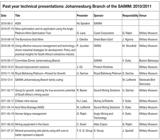
The table captures the specific range of technical topics we were fortunately able to enjoy.
Roger Baxter and Mariette Liefferink spoke particularly well, encouraging a good degree of audience participation.
Finances
Despite numerous profitable events, the SAIMM has had to fund a deficit in the cashflow of R6 134.71. The attendance of student contingents from both the University of Johannesburg and the University of the Witwatersrand continues to be welcomed. Negotiations with the incumbent caterers has allowed the Branch to limit sponsorship requests for the venue and catering facilities to only R9 500.
AGMThe Branch AGM will be held on Thursday 18 August 2011, where I expect that the committee will continue as is for an additional year. Emphasis will be placed during the coming year on recruiting new committee members for a better representation in terms of gender, race, and qualifications.
This ends my first year as Chairman and I would like to make special mention of Ian Ashmole, Graham Stripp, Mike Woodhall, Udo Sachse, and Gary Ralph, who together with Ginette Oliver and my personal assistant, Anne-Marie McCrate, contributed materially to the success of the past year.
4.1.4 Namibian Branch
B.M. Litana, Chairman
| H. Anyolo | A. Kalili |
| F. Chitonga | R. Nyambe |
| L. Emvula | T. van der Linde |
Introduction
The Drill and Blast school held in Windhoek on 21 of June was a success, although I couldn't make it due to other commitments. It is still my wish to get the Namibian professionals to contribute to these events not just by attending but also by giving presentations and submitting papers. There were no other activities planned for this year.
Committee
The Branch committee will be meeting on the 23rd of July 2011 in Swakopmund to discuss the upcoming Uranium Conference planned for next year, membership issues, and how the branch can involve academics and students in its activities.
Events
The next event to be held by the Branch is the much anticipated Uranium Conference. The first draft of the conference programme should be available before the AGM in August 2011.
Finances
The Branch needs to increase its membership and organize more events. There is not much to report on the finances at this stage.
AGMThe Branch is planning to have its first AGM before the end of this year to discuss the events planned for 2012 and how to get more professionals become members of SAIMM.
4.1.5 Pretoria Branch
O. Mothibi, Chairman
| D. Groot | J. Steenkamp |
| T. Mahlngu |
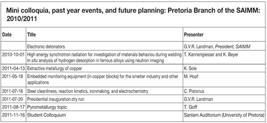
The SAIMM Pretoria Branch in the period July 2010 to date organized monthly seminars in conjunction with the departments of Materials Science and Metallurgical Engineering and Mining Engineering. These seminars were given by presenters from outside the University of Pretoria, with the audience being principally students and lecturers of the two departments and occasionally professionals.
The main highlight of the year was the presentation by the incoming President of the Southern Africa Institute of Mining and Metallurgy, Dr Gys Landman.
Special thanks to the committee members, the heads of departments for both Mining (Professor Ronny Webber-Youngman) and Materials Science and Metallurgical Engineering (Professor M. du Toit) for being excellent hosts for the Branch. Last, but not least, I would specially like to thank the people that worked behind the scenes and really put in a special effort to keep the SAIMM Pretoria Branch alive, namely Sarah Havenga and Daleen Gudmanz.
4.1.6 Western Cape Branch
S.M. Bradshaw, Chairman
M. Aziz, Vice Chairman
J. Petersen, Secretary
| G. Akdogan | J.-P. Franzidis |
| A. Burger | T. Ojumu |
| C. Cutler | J. Sweet |
| D.A. Deglon | E. Thyse |
The activities of the Western Cape Branch are centered largely on those of the academics and students from the three main tertiary institutions in the region, viz. Cape Peninsula University of Technology, Stellenbosch University, and the University of Cape Town. As such, the branch events are focused on promoting mineral processing as a career path for students and providing a forum for both students and academics to discuss their research within the broader mineral processing community.
The annual Mineral Processing Conference, held in August and attended by between 150 and 200 delegates from across the country, provides support for the mineral processing research being undertaken in the region. The event has grown over the last 30 years from beginnings as a small, researchbased colloquium to the current two-day event that attracts both international and industry speakers. The conference is the highlight of the year's activities, and the branch AGM and annual dinner take place at the same time. An annual student evening for final year students from all three institutions aims to promote mineral processing as a career path, and also serves to provide the opportunity for social interaction.
Mineral Processing 2010 Conference
The two-day conference, the 28th in the series, was held successfully at The Vineyard Hotel in Cape Town In August. The conference was preceded by a one-day workshop. Given the rightful attention that safety in the mining and mineral processing industries is receiving both nationally and worldwide, the workshop theme was Safety and Risk Management in the Mineral Processing Industry. Wynand van Dyk and Carel Roode presented an excellent workshop to 26 delegates. In 5 modules spread through the day, delegates were taken through risk management concepts, through a discussion of human factors, via a case study to a look at leading practice in the field.
Roger Paul of Mintek presented the first plenary session of the conference, in a thought-provoking and extremely interesting study entitled "The Impact of Risk Analysis on the Adoption of New Technologies". In the risk-averse era of the new millenium, in which funding decisions are made by financial institutions, the talk highlighted the great opportunities that exist for research as we tackle the alarming growth in demand for metals in the face of declining ore grades and the drive for more efficient use of energy. Paul Jourdaan presented the second plenary paper entitled 'Towards a Resource-based African Technology Strategy', showing how Africa's exceptional resources can form the basis for a growth and development strategy if exploitation concessions are handled correctly. The conference sessions covered themes such as physical processes, bio-, hydro- and pyrometallurgy, as well as comminution and flotation. In 42 oral presentations, 24 poster snapshots and with almost 20 posters on display, a rich variety of work was presented, ranging from newly started postgraduate projects to mature industrial process developments. With 159 registered delegates, the conference once again proved an ideal forum for interaction between industry and academia. The students presenting their research work at the conference were also afforded an opportunity to get valuable feedback from experienced researchers and practitioners. It is clear by the support for the conference in a challenging financial environment that it is viewed by many as an essential part of the annual mineral processing calendar.
Student evening 2011
This year the student evening was hosted by Stellenbosch University. Steven Bradshaw from Stellenbosch University addressed the students on the role of the SAIMM in promoting the profession and urged students to become a part of the Institution. Engineers from Lonmin then made presentations, outlining the challenges and opportunities facing graduate engineers when starting out in the mineral processing industry, and providing great insight into the years immediately following graduation. A pleasant social event rounded out the evening.
Other activities
The Postgraduate Fund of the Western Cape Branch was launched in 2007 to assist postgraduate students to attend national or international conferences. Two awards were made, to Bulelwa Ndlovu of UCT and Christie Dorfling of Stellenbosch University to enable them to present at IMPC in Brisbane in September 2010. A single award of R 15 000 was made in the first half of 2011 for Mr H. Appa to present his work at the 8th International Conference on Computational Fluid Dynamics to be held in Trondheim, Norway in June 2011. A further award for attendance at a conference in the second half of the year will be made by the trustees of the Fund from the remaining strong applications.
The SAIMM Prestige Prizes for the best final year students in Mining and Metallurgy at each of the three tertiary institutions were presented at the 2010 conference dinner by Gys Landman, the President Elect of the SAIMM. The recipients were Mohamed Yaseen Gani (CPUT), Chris Biley (Stellenbosch), and Tapiwa Chimbganda (UCT).
4.1.7 Zambian Branch
S.C. Mulenga, Chairman
E. Theron, Vice-Chairman
| W. Banda | F. Simwanza |
| P. Haken | H. Zimba |
| S. Simukanga |
Committee meeting
The SAIMM Zambian branch held a committee meeting on 25 August 2010. The meeting was called to discuss the Zambian event that was planned for 15 September 2010.
Zambian branch event
The Zambian branch event was successfully held on 15 September 2010 at the Protea Hotel in Chingola. A number of technical papers were presented during the event and the SAIMM President, Dr. Landman graced the occasion.
Zambian events for 2011
A committee meeting for the SAIMM Zambian branch was held on 1 February 2011 with a view to planning and scheduling the Zambian events for the year 2011. The first event was planned for early May 2011 to coincide with the Zambian Mining and Energy Indaba that was to be held in Lusaka. The committee resolved that SAIMM should exhibit its activities during this occasion. However, the Indaba was postponed to June 2011 at short notice and as such SAIMM could not participate. The committee is, however, planning to hold the next Zambian event in early November 2011.
General
The Chairman, Dr Sixtus Mulenga, attended the South African Mining Indaba in Cape Town in February 2011. This was meant to give a feel to the Chairman as to how mining Indabas are organized as he was involved in the organization of the Zambian Mining Indaba planned for May/June 2011. The Secretary, Mr. Henry Zimba, was selected by SAIMM to referee a paper on 'The estimation of Platinum Flotation Grade from Froth Image Features by using Artificial Neural Networks.' The Secretary also attended the SAIMM Council meeting held in Johannesburg on 18 February 2011.
Note: Eric and Peter were co-opted onto the committee during the year to replace John Mutambo and Julian Taylor who left Zambia on other work-related assignments.
4.1.8 Zimbabwean Branch
W. Kutekwatekwa, Chairman
| S. Gaihai | S. Mandoza |
| M. Gumbie | S. Ndiyamba |
| E. Gwane | I. Nyamukondiwa |
| L. Mabiza | M. Sowa |
The Zimbabwe branch was launched on 7 May 2010 in Harare. This inaugural event was attended by 127 people.
The branch committee for 2010/2011 comprised the Chairman Wenceslaus Kutekwatekwa, and committee members Stephen Ndiyamba, Simon Mandoza, Masimba Sowa, Irvin Nyamukondiwa, Louis Mabiza, and Edwin Gwaze.
The objective for the year under review was to hold quarterly branch events, especially at the mines but this was not achieved. A half-day event was held in Harare on 3 December 2010.
The Branch organized a full day Branch conference at the School of Mines in Bulawayo on 19 July, 2011 where nine technical papers were presented, and 35 new membership applications were received.
Membership has grown phenomenally during the year and an improvement is expected on branch activities during the coming year.
4.1.9 Zululand Branch
W.R.J. Erasmus, Chairman
| E. Clare | C. Mienie |
| S. Gracie | J. Selby |
| B. Maramba |
The Zululand Branch of the SAIMM had a very exiting year in 2010. There were no major conferences in the area this year.
The Branch once again maintained its association with the other professional institutes in the KZN area. Members from Richards Bay Minerals, Exxaro Sands KZN, and the Bayside and Hillside Smelters have supported Branch activities. Suppliers to these industries such as Mineral Technologies and Spectrum Technical have also given us great support during the year.
Branch technical activities
Technical meeting this year.
South African electricity supply issues, both current and future by David Erasmus –
Delegates attending this presentation were more focused on electricity and the future of the commodity. Attending this presentation by David Erasmus were 19 delegates.
Site visits
➤ RBCT-Richards Bay Coal Terminal—We had a great turn out of about 27 members. The visit lasted for 3 hours and at the end of the visit all of us had a better understanding of what happens to all the coal that is mined in RSA.
➤ Bell Equipment—There were 15 delegates attending the visit to Bell. Bell Equipment manufactures and distributes an impressive range of equipment articulated dump trucks, front end loaders, tractor loader backhoes, tri-wheeled loaders (timber/sugarcane harvesting and loading machines), haulage tractors, dozers, graders, excavators, and a wide range of forestry equipment.
Branch social activities
In December 2010 we planned a branch braai as part of the year-end function but due to weather conditions it was cancelled.
The year ahead
The following activities are planned for the year ahead.
| ➤ Richards Bay Harbour site visit | 21 June 2011 |
| ➤ Electrostatic separation. Denham Ferguson of RBM will present a paper | 18 to 21 July 2011 |
| ➤ Water in RSA A presentation on the climate/ water availability/supply and use. Whiskey tasting following the presentation on water | 24 August 2011 |
| ➤ Forensic Analysis (Megchem). Megchem is a group of physical metallurgists and chemical/ mechanical engineers that had a management buy-out with Sasol. They have a couple of interesting case studies (mechanical failures on boilers, pressure vessels, pipeline, casting moulds, etc.) that they will share with us | 21 September 2011 |
| ➤ ESKOM This presentation will be a follow on from David's presentation, where Eskom will come and share their views with us |
26 October 2011 |
| Year end function The committee will meet and plan for this event in July. | November 2011 |
5 Engineering Council of South Africa (ECSA)
Professional Advisory Committees
PAC Mining
J.A. Cruise, Chairman
M.H. Rogers, Vice Chairman
| J. du Plessis | G.L. Smith |
| F.M.G. Egerton | T.R. Stacey |
| R.P. Mohring | P. Tobias |
| M.J. Mothomogolo | J.N. van der Merwe |
| C. Musingwini | D.J. van Niekerk |
| J.C. Ngoma | R. Webber-Youngman |
| R.C.D. Phillis | L. Zindi |
| V. Seboni |
PAC Metallurgy
R.F. Sandenbergh, Chairman
| N.A. Barcza | G. Jonck |
| R.D. Beck | R.T. Jones |
| L.A. Cramer | K.C. Mistry |
| M. Dworzanowski | J. Phiri |
| M. du Toit | W.H. van Niekerk |
| R.H. Eric | M. Vermaak |
| I.J. Geldenhuys |
Professional Advisory Committee (PAC)
One of the critical functions of ECSA is to ensure that, through a peer evaluated system of quality assurance, persons working within the profession are educated and trained according to widely accepted standards, so as to render a professional service for the benefit of the public and the country as a whole.
The Professional Advisory Committees of ECSA are responsible for evaluating applications for registration as professional engineers within their disciplines and also for contributing to wider policy matters as required.
The Institute nominates members to the PAC's for Mining and Metallurgy.
During the past year the PACs for mining and metallurgy continued their important work of evaluating the qualifications and experience of applicants for registration as Professional Engineers. The Institute also provides the administration and assessors for the Professional Reviews, a prerequisite for registration.
The Identification of Engineering Work: compulsory registration
The Identification of Engineering Work Steering Committee again drafted proposed regulations for compulsory registration of persons conducting 'identified engineering work'
These draft regulations were submitted to the Council for the Built Environment (CBE) and other interested and affected parties for their comment. The CBE have again rejected these draft regulations as they contend that the ECSA submission does not conform to their requirements that a common template be used for all the Built Environment professions. ECSA disagree with this contention. ECSA and the CBE are currently still attempting to resolve the impasse.
Recognition of voluntary associations
The SAIMM is a recognized Voluntary Association in terms of ECSA's policy. An important benefit to members of the SAIMM is that registered persons are entitled to a significant reduction in their ECSA annual fees.
Continuing professional development (CPD)
Renewal of registration (on a five-year cycle) through undertaking acceptable CPD became mandatatory on 1 January 2006. Registered Persons were required to start undertaking and recording CPD activities as from 1 January 2006.
The implication of the introduction of CPD is that Registered Persons are required to present evidence of continuing professional development at predetermined intervals in order to maintain their registration.
The SAIMM is an approved provider of CPD activities and is tasked with vetting all outside courses for CPD purposes in mining and metallurgy.
Details can be obtained on ECSA's website (www.ecsa.co.za).
PAC Mining
The National Society for Black Engineers challenged the legitimacy of the appointments to Council and took the Minister of Public Works, the Council for the Built Environment, the Engineering Council, and all fifty appointees of ECSA to court.
At the request of the Minister for Public Works, a compromise was reached, in that new criteria were drafted for appointment to Council, resulting in the event that the current Council will be dissolved at the end of this year and a new Council appointed.
Measures have been taken by ECSA to accelerate the registration process for professional engineers, and these are now showing results.
PAC Metallurgy
The mission of ECSA is to ensure, through a co-operative process of quality assurance, that persons entering the profession are educated and trained according to widely accepted standards, so as to be able to render a professional service for the benefit of the public and the country as a whole. The Professional Advisory Committees of ECSA contribute to this mission by considering matters specific to the discipline and also contributes to wider policy matters as required.
During 2010/2011 the PAC Metallurgical Engineering again considered applications for registration as Professional Engineers by means of paper evaluations and interviews, in which volunteers from the SAIMM participated. The requirement for Continuing Professional Development of Professional Engineers for all registered persons opens up opportunities for the SAIMM to support the profession by offering seminars and conferences. The Committee wishes to record its thanks to the organizing committees and the secretariat of the SAIMM for the issuing of CPD certificates.
6. State Liaison
Portfolio Holder: D.J. van Niekerk
6.1 Outcomes-based Education and Training (OBET)
Mining Qualifications Authority (MQA)
The main achievements for the Mining Qualifications Authority (MQA) as Sector Education and Training Authority (SETA) for the SA Mining and Minerals Sector (SAM&MS) for the year under consideration include the following:
➤ The Classification of Mines Task Team (CoMTT) of the SGB for Mining and Minerals (M&MSGB) has succeeded in developing a draft Occupational Health and Safety related Risk-based Model to classify mines. This model is intended to be used to determine, amongst others, the appropriate competency standards for practitioners at mines for level 4 through 8 on the National Qualifications Framework (NQF)
➤ QCTO-complaint profiles are being finalized for mining occupations (practitioners) inclusive of Team Leader, Miner/Rockbreaker, Shift Overseer/Shift Boss/Mining Foreman, and Mine Overseer/Operations Overseer. Following the ratification of the said progression of Mining Profiles/Occupations, the Community of Expert Practitioners (CEPs) will embark on developing the complete QCTO qualifications
➤ The M&MSGB has resolved, at its meeting held on 12 May 2011, that the SAM&MS do not require a Policy: How to deal with Supervisory/Management and Leadership competency (SML) standards for persons who have a dual competency profile i.e. combined Technical and SML components. This means that the status quo will persist i.e. mining companies will use their own company-specific programmes and courses to develop SML competencies for their employees who will, regrettably, not enjoy portability and recognition of SMLrelated competencies
➤ The work of the Certificated Engineering Steercom has been resumed following an engagement between the Chief Executive Officer of the MQA and a Mines' Professional Associations' (MPAs) delegation. The said Steercom assisted by two working groups will develop appropriate and generic Stage 2 (professional development) programmes intended to be used by employers in the SAM&MS.
Mine Planning and Design (MP&D)
The main achievements pertaining to Mine Planning & Design Practitioners in the SAM&MS include the following:
➤ ABEEDA Associates has been appointed by the MQA to undertake a needs analysis for generic and portable MP&D competency standards for levels 2 through 8 on the NQF for use by the SAM&MS. The MP&D Steercom assisted the consultants with the finalization of the questionnaire and list of persons/institutions to be consulted/involved in the said survey. A MP&D workshop was held on 12 and 13 April 2011 to consider the consultants' preliminary progress report/findings
➤ The M&MSGB at its meeting held on 12 May 2011 approved the said Report's conclusion that 'The SA Mining and Minerals Sector needs generic and portable competency standards for MP&D practitioners for levels 2 to 8 on the 10-level NQF'. The M&MGSB resolved, as the way forward, to appoint an appropriately composed technical reference group (TRG) to develop the said competency standards
➤ It should be noted that MP&D practitioners substantially practising engineering work (yet to be legislated) at the following levels would need to be registered in the appropriate professional category in terms of Section 18(2) of the Engineering Profession Act 2008 Act 46/2000:
- Engineering Technician: Well-defined Engineering Work (level 6 on the NQF)
- Engineering Technologists: Broadly-defined Engineering Work (level 7 on the NQF)
- Engineering (level 8 on the NQF): Complex Engineering Work (Level 8 on the NQF).
The Engineering Standards Generation Body (ESGB)
The main achievements of the ESGB for the year under consideration include the following:
➤ The ESGB developed a level 7: Advanced Diploma in Engineering and a level 8: B. Eng. Tech (Honours) to complete the framework of qualifications specifically required for learners in the Technology pathway
➤ The ESGB has established a task team that will investigate the appropriateness of using Quality Council for Trades and Occupations (QCTO)-compliant qualifications for the training and development (Stage 2) of engineering practitioners in the professional categorie; and
➤ The ESGB in collaboration with the Mines' Professional Associations (MPAs), of which the SAIMM is a member, has developed a Position Document: A New Model for Certificated Engineers.
Outstanding/unresolved OBET-related issues
The following OBET-related issues need to be resolved:
➤ The development of OBET-compliant training and development (Stage 2) programmes for certificated managers and engineers in the SAM&MS
➤ Replacement of the Government Certificates of Competency (GCCs) for managers and engineers with registration in the appropriate category with the Engineering Council of SA (ECSA) as the appropriate and preferred means of regulating the Engineering Professional in the SAM&MS (refer New Model for Certificated Engineers)
➤ Compulsory Licensing (authorization) and registration in the SAM&MS
➤ Compulsory Currency-of-Competency in the SAM&MS
➤ The appropriateness of using QCTO-compliant qualifications for the training and development (Stage 2) of engineering practitioners in the professional categories
➤ The development of appropriate generic and portable OBET-compliant competency standards at levels 2 to 8 on the 10-level National Qualifications Framework for Mine Planning and Design practitioners in the SAM&MS.
Regulation of the engineering profession in the SAM&MS
The progress made with the regulation of the Engineering Profession included the following:
➤ In terms of section 20.(1)(b) of the Built Environment Act 2000, Act No 43 of 2000 'the Council must consult with any person, body or industry that may be affected by the identification of Engineering Work
➤ In terms of section 20.(2) of the Built Environment Act the Council must, after consultation with the Competition Commission and in consultation with the Councils for the professions, identify the scope of work for every category of registered person
➤ The registration of the said 'Proposed IDoEW Regulations' have to date been delayed by the Council for the Built Environment (CBE) for a period of nearly 24 months. A Joint ECSA and CBE Task Team has been established to resolve the current impasse in regard to the said IDoEW
➤ Geology, Mine Environmental Engineering, Rock Engineering, Mine Surveying, and Mine Planning and Design practitioners who substantially perform identified engineering work are expected to be the most affected by the implementation of the said IDoEW Regulations
➤ The Council for the Built Environment (CBE) has notified the COO: ECSA that it intends proceeding with its own version of the proposed Identified Engineering Work (IEW) regulations. This means that the CBE rejects and disregards the IDoEW Regulations proposed by ECSA.
Potential implications: regulation of the engineering profession
The employer grouping and the participating MPAs have jointly undertaken an 'Acid Test Survey' to determine the potential implications of the imminent promulgation and implementation of the proposed IDoW regulations in the SA Mining and Minerals Sector. The report concluded that the majority of persons who are considered to be performing Identified Engineering Work would be eligible to register with ECSA, but that only about 22% of the said persons are in fact currently registered in the appropriate category with ECSA.
7. International liaison
Portfolio Holder: J.C. Ngoma
Key Performance Areas
To achieve its objectives, the SAIMM
➤ Participates in and represents South Africa on bodies such as the Mining, Metals & Minerals Society (TMS), and together with Mintek on Infacon
➤ Appoints corresponding members in areas such as Australasia, Botswana, Brazil, Canada, Chile, Europe, the Far East, Ghana, New Zealand, United Kingdom, and the United States of America, and interacts with sister institutions in other countries to promote international exchange of scientific and technical information.
7.1 APCOM
F.A. Camisani-Calzolari, Chairman
The AusIMM, through its Illawarra Branch, in association with the University of Wollongong, will be hosting the 35th APCOM Symposium. The Symposium will be held from 26–30 September 2011, at the University of Wollongong, Australia. The 35th APCOM is aimed at maintaining the common APCOM goal of playing a significant part in contributing to effective decision-making processes in the mineral industries.
The proceedings will cover the following fields:
➤ Geological modelling
➤ Resource estimation and geostatistics
➤ Process optimization and control
➤ Mine design
➤ Mine planning and production scheduling
➤ Mine ventilation
➤ Rock mechanics and ground control
➤ Information systems and data management
➤ Mine automation
➤ Health, safety, and environment
➤ Investment planning, project
➤ E-commerce
➤ Remote sensing/GIS/GPS applications
➤ Simulation
➤ Artificial intelligence and neural networks applications
➤ Visibility, tracking, and traceability applications
➤ Mineral policy analysis
➤ Mineral processing
➤ Metal production
➤ Nanotechnology applications.
Selected high-quality papers may be submitted for publication in one of the prestigious AusIMM/IOM3 Transactions journals: Mining Technology, Applied Earth Science, or Mineral Processing and Extractive Metallurgy.
These papers will also qualify for consideration for the AusIMM Best Paper Prize, which is awarded annually at the AusIMM Awards Dinner.
For information please contact Ms Kristy Pocock, Manager, Publications, the AusIMM. Telephone: +61 3 9658 6155 | Facsimile: +61 3 9662 3662 Email: kpocock@ausimm.com.au, or the Organising Committee Chairman Associate Professor Ernest Baafi, APCOM 2011 Symposium, Email:
7.2 INFACON
N.A. Barcza, Chairman
International Committee on Ferroalloys
The INFACON Congress was founded in South Africa in 1974 by the SAIMM, Mintek and the Ferroalloy Producers Association (FAPA). The first INFACON was held in Johannesburg. INFACON has already been held three times in South Africa, the last being in Cape Town in 2004. However the most recent Congress, INFACON XI, was held in Helsinki in 2010. The next Congress, INFACON XIII, will be held in Almaty in Kazakhstan in 2013.
The International Committee on Ferroalloys (ICFA) was founded by the participating ferroalloy producing regions that attended the first INFACON with encouragement and support from the SAIMM, FAPA and Mintek. Mintek provides the secretariat for ICFA.
The primary objectives of the International Committee on FerroAlloys (ICFA) which was formed during the first INFACON, is to promote the holding of the INFACON Ferroalloy Congress every three years in appropriate locations and to ensure that the high technical standard is maintained.
ICFA arranges the meeting of representatives from ferroalloy producing and consuming countries during each INFACON to discuss the relevant technical content for INFACON and decide on the country that will host the subsequent INFACON Congress. Prospective host countries are invited to make submissions in advance to ICFA accordingly. Criteria for selection include the appropriate professional standing of the organizing entity, the suitability of the location, and the necessary level of local and regional support from stakeholders such as industry, government, and relevant technical institutions.
The current members of ICFA include ABRAFE (Brazil), CSM (Chinese Society for Metals – China), IFPEO (Europe, including Scandinavia), IFAPA (India), JFA (Japan), TFA (North America), FAPA (South Africa), and invited attendees include Russia, Kazakhstan, and the Ukraine.
INFACON has been held on 12 occasions in the following countries and locations:
➤ Brazil (1) in 1986 in Rio de Janeiro by ABRAFE
➤ Canada (1) in 2001 in Québec City by the TFA
➤ China (1) in 1998 in Beijing by the CSM
➤ Finland (1) in 2010 in Helsinki by Outotec
➤ India (1) in 2007 in New Delhi (IFAPA)
➤ Japan (1) in 1983 Tokyo by the JFA
➤ Norway (1) in 1995 in Trondheim by SINTEF
➤ South Africa (3) in 1974, 1992, and 2004 in Johannesburg (1), Cape Town (2) by FAPA, Mintek, and the SAIMM
➤ Switzerland (1) in 1980 in Lausanne by IFPEO
➤ USA (1) in New Orleans in 1989 by the TFA
INFACON contributes to the exchange of research and development information by publishing refereed papers covering the major and minor ferroalloys. Participants include universities and technical colleges, research and development organizations, suppliers of services, engineering and equipment and the industry, who have contributed to this wealth of knowledge since INFACON was founded in 1974.
INFACON XIII was awarded to Kazakhstan during INFACON XII at the ICFA meeting in Helsinki held in June 2010.
The host organization for INFACON XIII is the Chemistry and Metallurgy Institute based in Karaganda, Republic of Kazakhstan. Professor Manat Tolymbekov is the Chairman and Mr Sergey Kim the Congress Secretary. The Organizing Committee for INFACON XIII has been formed and is following the lead of INFACON XII in establishing an Extended Technical Programme Committee with participation from previous INFACON organizers and stakeholders including ICFA. Outotec has already provided valuable assistance to the INFACON XIII Organizing Committee
The SAIMM is the custodian of the INFACON Bursary Fund, which contributes primarily to postgraduate research and development in the field of ferroalloys. The Fund was established from the surplus generated from the previous INFACON XI Congress in South Africa. Contact the SAIMM directly for further details.
| INFACON XIII Contacts: | ICFA Contacts: |
| INFACON XII Organizing Committee | Mr Tom Curr |
| Professor Manat Tolymbekov | Secretary General |
| Congress Chairman | ICFA c/o Mintek |
| Mr Sergey Kim | |
| Congress Secretary | |
| Chemistry and Metallurgy Institute (CMI) | Dr Nic Barcza |
| 63 Ermekov str., 100009, Karaganda, | Chairman |
| Republic of Kazakhstan | ICFA |
| phone/fax: +7 7212 433161 | |
7.3 SAMREC/SAMVAL
M.F. O'Brien, Chairman
Meetings of the Main SSC Committee were held in June and November 2010 and March 2011. Minutes of the meetings may be found on the SSC website (http://www.samcode.co.za).
The revised CRIRSCO set of standard definitions to be considered in updates and revisions of the various National Reporting Organisations (NROs) was received and reviewed. Revision of the JORC (AusIMM) and NI43-101 (Canada) standards are reaching finality, so it is anticipated that a revision of the SAMREC Code will be due in 2012. The SAMVAL Code is intended to be reinvigorated with a dedicated task team under the SAMREC/SAMVAL Working Group. A response by the SSC to the Committee of European Securities Regulators (CESR) proposed amendments to CESR's recommendations for the consistent implementation of the European Commission's Regulation on Prospectuses regarding mineral companies was submitted by the SSC in June 2010.
Mike O'Brien is moving overseas with effect from end-June 2011, and the role of Chairperson of the SSC has been passed to Ed Swindell (BHP Billiton and Council Member of the GSSA).
Ongoing activity:
➤ Marketing and Education (The codes need to maintain their visibility in the industry)
- Conference presentations should be used as an opportunity to place the codes in the limelight (ongoing in any case)
- More education of government organs (DMR particularly), would be beneficial in the light that application of government regulation, and especially where it impacts on security of tenure, are critical modifying factors for Mineral Reserve definition.
➤ Challenges:
- Managing perceptions that some members of the Working Groups are driving their own agendas
- Maintaining interest in internationally accepted Mineral Resource and Reserve Reporting Codes in a local industry beset with critical governance and tenure issues.
SAMREC/SAMVAL working group
Dr Alastair Moyes has taken the reins as Chairperson of the Working Group. An issues paper on 'Reporting standard and format of mineral reserves' was developed and will be useful for the next revision of the codes.
The JSE/SSC readers panel
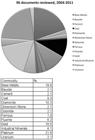
This panel reviews Competent Person Reports submitted to the JSE for compliance with the Listing Rules (incorporating requirements from the SAMREC and SAMVAL Codes). Changes to the mandate of the Panel have been proposed by the JSE and these proposals are to be reviewed by the Readers Panel and the SSC. While compliance with the minimum public reporting standards described in the codes is important, there is some debate about the level of technical scrutiny that should be applied to CPRs to reduce the risk of providing misleading information to the investment community.
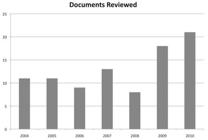
Review of mineral company documents by the Readers Panel has increased significantly since the 2008 crash.
8. Management and administration
Portfolio Holder: G.V.R. Landman
The Secretariat consists of:
Miss Julie Dixon (Manager)
Mr Alf Bettoni (Accountant)
Mrs Mirelle Cain-Mtshali (Switchboard/Receptionist)
Miss Edith Dube (Journal and Subscriptions Co-ordinator)
Miss Caron Lance (Junior Conference Co-ordinator)
Miss Portia Malatji (Accounts Assistant)
Mrs Zuliakha Malgas (DTP Operator)
Miss Nazli Mamdoo (Publications Co-ordinator)
Miss Kelly Matthee (Assistant to the Institute Manager)
Mrs Ginette Oliver (Membership and Subscriptions Supervisor)
Mrs Anna Panana (Conference Assistant)
Mrs Apathia Sello (Administration Clerk)
Miss Keabetswe Shumba (Membership Assistant)
Mr Raymond van der Berg (Conference Co-ordinator)
Mrs Dawn van der Walt (DTP Supervisor)
Mrs Jacqui van der Westhuizen (Head of Conferencing)
The SAIMM, office bearers, and Council record their appreciation to the above for their service.
8.1 Finance
J.L. Porter, Honorary Treasurer
While writing this year's financial report I found it all too easy to get lost in the business of analysing the numbers; trying to anticipate questions, identifying trends, looking for risks. But the real story behind these numbers is actually all about people: the SAIMM staff, your Council, our sponsors, and in particular our members. It is a story that I am delighted to be able to tell because we all like a good success story and it is a real credit to all those in the cast.
So, once upon a time in a treasurer's office far far away ...
The 2010 to 2011 financial year saw a number of performance records set in the key areas of:
➤ Total assets: R27 106 868 (up 33%)
➤ Total reserves: R25 077 818 (up 32%)
➤ Total revenue: R21 062 185 (up 112%)
➤ Income from conferences: R 17 713 742 (up 185%)
➤ Cost of sales: R13 723 262 (up 67%)
➤ Operating expenses: R4 823 471 (up 204%)
➤ Operating surplus: R2 515 452 (up 2 704%)
➤ Total surplus: R5 900 497 (up 130%).
This record financial performance of the SAIMM in the year under review is the result of key decisions made cumulatively in recent years. These decisions have been about investments: investment in the quality of our conferences and publications, investment in recruiting and developing our staff, investment in expanding our membership footprint throughout Southern Africa, and decisions about how to make our excess of income over expenditure work for the Institute. Therefore, considered and well implemented decisions by your elected Council Members have built, over several years, a momentum of consistent financial results.
I would like to make some further comments of explanation to the abovementioned key results:
The balance sheet shows that non-current assets rose by an impressive 52% to R18 790 094 (R12 368 945) with current assets increasing marginally to R8 316 774 (R7 981 978). Growth is largely as a result of our investment activities growing by 54% to R18 017 773 (R11 701 438). It is worthwhile noting that the total investment growth of R 6 313 335 is made up of:
➤ Fair value adjustment (42.2%)
➤ New investments (54.0%)
➤ Other (3.8%).
The 32% jump in reserves is attributable to the increase in accumulated surplus from the operating activities as the reserves held in the various SAIMM funds (R4 191 930) have remained static, with the exception of earned interest of R180 514.
Turning to the Income Statement (as at 30 June 2011), we can report that total revenue rose to R21 062 185, the highest turnover in our history and driven by several large and successful conferences. It is of some concern that revenue from our Company Affiliates has fallen by 47%, but some of this is offset by a 16% increase in revenue from new members. However, Company Affiliate organizations are a cornerstone of the SAIMM and this will require investigation.
Cost of sales has increased substantially due, in large part, to additional spending on the larger conferences and capacity to manage the workload. I am sure that you will agree that the increase in CoS of 67% is justified against the 185% growth in conference revenues. In addition, operating expenditure or overheads has increased in order to build the capacity to handle the additional workload. For example, of particular note is the fact that staff and Office Bearers now need to allocate time for travelling to support and mentor the newly established Regional Branches.
The net result is a surplus of R5 900 497 in comparison to the previous years' R2 564 365.
In my view there are three areas that require specific commendation.
Firstly, the performance of our Technical Programme Committees. Through the efforts of the Conference organizers we saw a 26% increase in the physical number of delegates attending our conferences, which translated into a 30% rise in revenues from all conference activities.
Secondly, strict credit control management. The professional manner in which our Conferencing and Membership Departments now manage the collection of payments due by delegates, sponsors, and members has impacted positively on cash flow. The value of unpaid debtors older than 60 days is at an all-time low of just 3% of the total invoiced value. Ladies and Gentlemen—this is an excellent business!
Thirdly, the hard work that has gone in to restructuring our financial discipline and management. This has had a considerably positive impact on cash flow, and has enabled us to make more frequent contributions to our investment fund to the extent of R3 412 384 for the year.
As I mentioned at the beginning, it is the activities of people in their various roles that have written this year's story. The enthusiasm of members in the new Regional Branches, the dedication of our hard working staff, and the time given by our Council members and Branch organizations. It is unfortunate that these accolades for our staff are only recognized once a year at the AGM.
At this point I think that it is prudent to caution our members that the performance of last year is not likely to be repeated. The reasons are that there are not as many large events in the year ahead, and also it is very unlikely that we will see a repeat of the growth in our investment portfolio. Of course the SAIMM is a non-profit organization; our purpose is not to grow a balance sheet. Having said that, it has been a very clear objective of the Institute for several years to build its investments and cash reserves to the point where we have a very secure and stable future. It is now time to consider how we can make these resources work for the Institute and its membership in alignment with our Constitution.
Thank you to Alf Bettoni, our accountant; Robert Kitching, our auditor; Julie Dixon, our Manager, and all of the wonderful cast in this story for assisting me in my first year as your Treasurer. It is a great honour for me and lastly thanks again to John Cruise, the master storyteller ... I have a long way to go.
New Members
Fellows
J. De Bruin, S. Harrison, C.I.A. John, C.G. Knobbs, M.D. MacFarlane
Members
B. Adebayo, D.I. Adebiyi, M.J. Andrews, N. Andrews, M. Aziz, N. Bagirathi, I.N. Bamusi, P. Batsotsi, L.S. Bbosa, D. Bester, N.T. Beukes, M.J.P. Bierman, Z. Borowitsh, A.A. Brown, A.J. Bukanga, D.J. Burger, T. Chagonda, I.T. Chalale, T.O. Chengu, O. Chihota, T.M. Chisanga, N.I. Chliakova, C.F. Christmas, I.C. Claassen, R.F. Coelho, K.C. Corin, D.A. Cowen, D.J. Crafford, J. Dandadzi, J. de Kock, S. Deb Roy, A.M. Deiss, E.G. De Villiers, C. du Plessis, S.C. du Plessis, D.A. Elder, B. Elezaj, P.A. Escorcio, L.B. Fengu, P.D. Finney, R.H. Gamatham, G. Ganizani, E. Garcia, G. Gips, P.A. Gonkgang, P.D. Haken, J. Hamuyuni, R. Hayes, W. Hefer, M.B. Hobbs, E. Hove, R. Ilgner, J.M.C. Itlhobogeng, H. Jacobs, P.W. Jordaan, K. Kabaah, T. Kadakure, T.E. Kanyimo, A. Karigani, M. Karonga, K. Kereke, I.E. Kitchin, T.N. Kotze, V. Kurup, J.I. Kwofie, G.P. Labuschagne, S.A.B. Laubscher, P.J.K. Leeuw, A.E. Lewis, A. Lubbe, K.T. Luden, S.B. Madolo, A. Madzhia, V. Mahwire, P. Man'ombe, M.R. Masakona, N. Mavhunga, K.D. Meiring, C. Mhlanga, N. Midzi, D.P. Mitchell, M. Miya, E.N. Mkhize, E. Mnisi, R.T. Moalosi, S.M. Modiselle, J.W. Molokoane, M. Mostert, O.T. Mothibi, M. Motuku, N.C. Mouton, D. Muchena, T.R. Muganyi, L.L. Muller, J.G. Murgatroyd, H.S. Mutamba, P. Naidoo, M.N. Ndlala, B.M. Ndlovu, L.M. Ntondini, A.R. Nundlall, H.T. Nyamagodo, V. Nyamondo, S.C. Nyoni, A. O'Callaghan, S. Opoku, C. Pogisho, J.J. Prinsloo, S. Reid, S.K. Robottom, T. Rogers, B. Ruzive, I. Rwatirera, T. Samanga, S.W. Sebokedi, P.I. Segatto, A. Shemi, D. Sibanda, A. Sithole, M. Sithole, V. Sithole, J.D. Slabbert, S. Slabbert, K.K. Smith, J. Smuts, A.A. Strydom, A. Supriyanto, C.D. Swanepoel, S.R. Takavingei, G. Takundwa, R.M. Tayelor, J.C. Terblanche, R.C. Thomas, M.T.D. van de Steen, M.M. van den Bosch, J.V. van Rooyen, H.P. van Staden, T.A. van Zyl, B. Vorster, E.J. Walls, J. Waters, J. Van Breda, D.P. van den Berg, J.F. van Graan.
Associates
C. Acheampong, G.T. Achmat, J.R. Adapa, H.K. Anyolo, M.S. Babusi, B.J. Bane, M. Becker, W.M. Bester, D.S.P. Bille, Z. Buthelezi, C.S. Bwalya, N.M. Chalibbulaca, D. Chamunorwa, E. Chanda, P. Charingira, N. Chembe, S. Chidziya, H.M. Chikashi, Y. Chikonkolo, C.E. Chikuka, W. Chileshe, I. Chiluba, P. Chimbodza, P. Chishaya, K.D. Chitaukire, J. Cunningham, B. Daka, N. Dawson, E.L. De Beer, J.F. Du Toit, G.C. Edwards, A. Enslin, C.C. Enslin, T.J. Faber, J.M. Felix, J.D. Fourie, M.T. Frans, J.P. Gous, T. Gowera, R. Green, M. Gumbie, T. Guveya, K.T. Hamadziripi, E. Hamman, G. Harper, A.M. Harris, P.S. Hlabela, P. Iyambo, B. Jacobs, S.R. James, Y. Janse van Rensburg, C. Jansen van Vuuren, M.B. Kabandama, M. Kabwe, S.P. Kadhila-Amoomo, R. Kahn, T. Kale, M. Kalenga, S. Kalombo, J. Kasonde, S. Katena, L.C. Kayuni, M.J. Khoase, T.M. Khumalo, I.M.-B. Kime, Q. Kleinhans, J. Kruger, R. Lahee, W.J. Laing, A.K. Lal, T. Legau, R.C. Lubaine, M.P. Mabelane, W.V. Madzimure, S. Magomo, J.S. Mahlaba, S. Makhubela, C.M.L. Makobe, J. Makotsi, A.D. Makurumidze, L. Malindi, R. Malogwa, K. Mandanji, A. Mandeya, A.T. Manuwa, J.A. Maritz, P. Masimira, B.D. Masisi, M. Matimba, A. Matongera, E.N. Matsau, N. Mavimbela, J.P. Mayungo, A. Mboma, R.A. Meyer, G. Michalakis, M.W. Molepo, T.R.P. Molepo, P.W.A. Moller, M.R.B. Mounde, J.P. Mubita, E. Mugova, M. Mulela, P. Mulenga, S.K.M. Mulenga, J. Muller, K.M. Mushonga, T. Mutezo, T. Mwanza, R. Mweemba, A. Narain, S. Ndlovu, T.M. Nemavhola, H. Netshifhire, A. Neveling, C. Ngulube, N.T. Nkosi, W. Nyamachi, M. Nyamhuga, F. Ochonogor, C. O'Keefe, E. Oosthuyzen, O.P. Oshokoya, A. Pandey, F.C. Passarelli, M. Penny, J.M. Phiri, D. Rakometsi, L.S. Ramane, A. Reid, M. Richter, P.P. Sambo, C.C. Shonongo, T.T. Shumba, N. Siamwiza, M.K. Sichone, R. Sigwadhi, N.N. Simunika, R.K. Sinha, N.I. Siseho, J.J. Smith, M.B. Songo, J.L.G. Stoop, J.J. Talja, P. Tembo, P.deH. Theunissen, M.R. Tirivabaya, M. Toure, K. Tshimanga, M.B. Twala, D. van Heerden, V. van Schalkwyk, A.L. van Wyk, J.-C. van Zyl, T.E. Vere, B.F. Viriri, A.K. Williams, R.P. Zindoga, N. Ziphethe, L. Zulu, T.N.L. Zwane, H.N. Abraham, P.H. F. Bouwer, P. De Bruin, J. Du Plessis, H.P. Jansen van Vuuren, N.J. Kobe, P.J. Lotter, N.I. Nhlengethwa, E.L. Seome.
Students
F. Abbasy, D.M. Angus, H. Baco, S. Behbahani, C. Bhondayi, T. Bokaba, H.D.O. Brodner, L. Chipise, K.P. Chulo, G.C. Coetzee, A. De Pretto, B.P. Dibetso, B.P.G. Dikotsi, . Dladla, P.W. Du Plessis, S. Fani, T. Gangen, S.A. Ghoreishi Madiseh, E. Govender, K.A. Jephthah, N. Joka, C.M. Kabwe, P. Katakwa, V.E. Katjatenja, A.H. Kebe, M. Kermani, S.J. Kgakoa, D.M. Kharibe, N.P. Khoza, E.L.J. Kleynhans, D.N. Kubyana, T. Kwenane, S.B. Langa, S.N. Lebogo, T.D. Lekalakala, P.S.J. Lubelo, R.J. Madilola, D. Madzivha, J. Mahlangu, M.V. Mahlauli, V. Mafemani, M.L. Makhaye, S.B. Malete, S.M. Maluleka, K.K. Mampe, L.R. Manganye, C. Masinamela, L. Masuba, S. Mayisela, M. Mbulawa, J. Mishra, I.S. Mnisi, T.G. Molefi, E. Molobi, F.M. Molokomme, B.E. Moloto, K. Monageng, B.R. Montshiwa, T.N. Mosepele, O. Mosikare, O. Mosime, M.S. Motlhabane, N.M. Mthimunye, F.K. Mulenga, M.P. Ndaba, S.E. Ndlovu, O.M. Ndou, S.C. Ngwenya, L.N. Nkoane, N.J. Nkogatse, B. Obadele, A.K.B. Opitz, B.I. Persens, W.L. Petersen, K. Phala, K.E. Phukubye, W.E. Poole, P.A.N. Qaku, J. Radebe, J. Radingwana, T. Ramahali, C.T. Raseala, L.S. Ratau, M.C. Ratshefola, M.C. Seema, T.S. Sekhaolelo, L. Sentso, M.M. Shabalala, V.N. Tawane, V.B.Teffo, T. Tholana, P.B. Thotse, C.K. Thubakgale,V.N. Tikwayo, F.M. Tjia, L.A. Tsime, F.D.L. Uahengo, S. van Rheede, A. Zarassi, P.J. Zeelie, M.V. Zimu, F.Y. Zitha, L. Zombene.
Company Affiliates
Air Products SA (Pty) Ltd, Caledonia Mining Corporation, Elbroc Mining Products (Pty) Ltd, Modular Mining Systems Africa, Nalco Africa (Pty) Ltd, Roymec Technologies, Sedgman South Africa, Thyssen Krupp, Trucking & Engineering.
Resignations
Fellows
F.B.J.M. Burks, T.O. Hagan, G.A.J. Jordaan, F.W. Kluckow, D.M. Pheiffer, A.J.S. Spearing.
Honorary Fellows
N. Segal.
Retired Fellows
D.H. Deacon, G.A. Fourie, K.A. Van Gessel.
Members
H.J. Holl, L.J. Meyer, L.A. Nienaber, P.M. North, J.L. Osborne, P.A. Rossouw, J.A. Shuttleworth, J.D.S. Vieler, C.A. Walker.
Retired Members
I.F. Buchan, A. Granville.
Associates
W. Ahmed, M. Antoniades, E.R. Aylmer, A. Barnard, H. Bester, N. Burger, M. Coetzer, S.G. Dawe, G.I. du Randt, G.J. Grobler, E.S. Irvia, A.P. Klein, A.S. La Grange, S.V. Langa, J.G. Le Roux, T. Lessard, M.L. Makgaka, A. Mandeya, P. Mashimane, S.P. Mnisi, E.L. Moolman (nee du Toit), S.J. Moribame, M.R.B. Mounde, O.O. Oyekola, N.B. Parag, J.J.J.P. Pretorius, T. Punzul, A. Robberts, G.V. Rorke, A.L. Segoe, N. Sewdayal, S. Sewdayal, M.D. Sigama, M.J. Sole, H. van der Walt, F.E. van Jaarsveld, G.L. van Rooyen, M.J.U.T. Van Wijngaarden, D.R.O. Venter, T.E. Waterston, J.A.S. Woolfe.
Students
F.B. Ameer, J. Barnard, J.J. Bezuidenhout, E. Dadoo, Q. Fakir, H. Froneman, B.D. Human, K. Kabezya, P.G. Kekana, S. Kekana, H.W. Kleinhans, J.W. Knight, J. Krzyzanowska, G.R. Lakey, M.C. Lamola, D.S. Le Roux, K.I. Lebelo, K. Lerumo, T.B.L. Letsogo, T.R. Mabebe, E.P. Magogodi, S. Makaka, A.F. Makhese, K.T. Maubane, F.F. Mbhungele, S.B. Mbonani, K.M. Mekgwe, L.B. Mmesi, L.M. Moagi, L. Modise, D.K. Moteme, K. Munsamy, F.K. Munyai, R. Nedone, O. Netshifamadi, M. Osman, L. Pearce, J.C. Phehla, N.W. Phumo, J.A. Potgieter, J.C. Radebe, T. Rademeyer, K. Ramakuwela, P. Ramjee, T.R. Richards, M.N. Roomanay, P. Scheepers, R.M. Teffo, M. Thanwane, R. Thothela, T. van den Berg, P.J. van den Heever, F. van der Merwe, H.J. van Niekerk, R. van Wyngaard, K. Zwane.
Company Affiliates
Ausenco Securities (Pty) Ltd, Engineering &, Project Company Ltd, Grinaker-LTA Civil Engineering, Johannesburg Water, Sable Data Works (Pty) Ltd.
Members transferred to Higher Grade
Transfer from Member to Fellow
B.K. Belle, M. Chilambe, R.G. Dimitrakopoulos, S.R. Flatman, C.R. Fredericks, M.N. Glasspool, S. Ilhan, C.I.A. John, G.J. Jonck, J.D. Whillier.
Transfer from Associate to Fellow
J.C.G. Baker, K.L. Bright.
Transfer from Associate to Member
C. Bedesi, M.J.P. Bierman, I.S. Bornman, M.M. Brown, B.J. Bruwer, W.W. De Graaf, S.Y. Eshun, E.C. Luyke, O. Matlala, W.N. Meijer, V.L. Nkuna, I.T. Nyamukondiwa, G. Nyawo, I.O. Ogunniyi, M.G.L. Ramashilabele, N.R. Rhodes, T.C. Sebutsoe.
Transfer from Student to Associate
T. Hoyi.
Automatic transfer to Associate
J. Bernitz, P. Chabalala,G. Crawley, E.H. De Vos, Z.M. Dire, B.W. Dladla, C.H. Du Buisson, M.W. Erwee, R. Escherich, T.H. Hattingh, A.J. Jacobs, S. Kamlana, O.R. Kelehetswe, N.G. Khoza, M.P. Khumalo, T.E. Kosana, J.J. Kroon, A.J. Kruger, D.J. Kruger, T. Kuriwa, S.V. Langa, D.C. Lebopa, C.M. Leburu, L.F. Lekoba, T.D. Lekoko, P. Letsie, J.M. Letsoalo, L.L. Lijojo, M.O. Links, P.D.M. Lourens, M.M. Mabasa, M.L. Mabitsela, N.S. Mabunda, R.S. Mabuza, S. Madondo, R. Mafiri, S.P. Magwaza, A.P. Mahlangu, V.A. Maimela, P.J. Maisha, B.A. Makaka, M.W. Makamu, G.M. Makatong, M.I. Makola, M. Mangere, V.N.L. Manyathi, T. Marcus, T.A. Martins, L. Mashele, M.T. Moloto, S.L. Nkomo, M.E. Ramfolo, W.H. Taylor, K.G. Tshilombo, T. Chikosha, D. Dempers, M. Janse van Rensburg, I. Magagula, .D. Makgala, M.N. Makhonjwa, M.P. Maloma, T.V. Mangope, K. Masehlela, L.A. Maseko, M.G. Masesane, N.F. Mashinini, N.D. Mashitisho, D.M. Matlou, B.J. Mavuso, S.V. Mkhatshwa, M.P. Mmofele, S.M. Mogopa, M.L. Mohatli, M.M. Mohutsiwa, M.P. Mojapelo, L.F. Mokgantshang, L.M. Mokgethi, T.D. Mokoena, J. Monama, R.I. Montshonyane, M.S. Monyemangene, E. Moodley, O.D. Mosetlhe, R.S. Mosimanyana, M.R. Mothiba, N.J. Mothibe, I.B. Motshwaedi, B. Msikisi, M. Mtsoeni, R. Mudogwa, K.G. Musisinyani, J. Naude, S.N. Ndiweni, T. Netshirando, A.B. Ngobese, B.P. Ngubeni, S. Nhleko, A.T. Nkolele, N.A. Nkosi, S.M. Nkosi, S. Nortje, T. Ntlwana, S. Nxele - Mntambo, S.W.S. Nxumalo, S. Nyirenda, D.N. Nyungu, J. Oosthuizen, O.O. Oyekola, N.N. Phahlamohlaka, N.A. Phala, M. Phetoe, N.E. Pheza, H.J. Pretorius, J.A. Rabe, I.C. Rabeng, T.I. Radebe, L.J. Ramashala, O. Ramogotsi, R. Rampersadh, N.T. Ratshitaka, M.A. Ratshoshi, U. Rau, A.I. Ruiters, I.K. Segatlhe, N. Segatlhe, A.L. Segoe, E.B. Sekgokong, L. Seshibe, I. Sibisi, N. Simelane, T. Singh, L.N.S. Sithole, P.V. Sithole, W. Steinberg, S. Swanepoel, J.T. Tebele, M.L. Tseka, K. Ubisi, A.A. van den Berg, M. van den Berg, D. van der Merwe, M.P. van Rooyen, D.J. van Wyk, R.L. Williams, A.M. Radingwane, A.L. Shabalala, L.C. Smith, A.Z. Van der Westhuizen, L.J. Otto, R. Baloyi, T.N. Buthelezi, A.P. De Beer, R.P. Makola, M.P. Maloma, T. Moyo, T. Ndlovu, T.E. Nyabela, P.T. Pabwe, A.O. Prinsloo, A. Rabumbulu, M. Kgomo, E.S. Links, Z. Mabalabala, M.B. Magakwe, S. Mahlangu, N.W. Makgobelele, N.P. Makhwathana, V. Malele, K.A. Moagi, K. Mokoena, T. Molokwane, R.B. Mposi, K.E. Segoe, O.N. Mpyatona, S. Mtombeni, S. Mtshakaza, A. Muller, A. Naude, M. Ngobo, J. Nhiwatiwa, R. Niehaus, K. Ntsoane, S.T. Ntumba, D. Nyabadza, K. Phage, M.N. Phasha, C.L. Phillips, S.J.R. Rapelego, P.A. Sejake, V.I. Shikwambana.
Transfer from Retired Fellow to Fellow
F.M.G. Egerton.
Members who retired
Fellows
A.B. Addison, G.F. Balderson, J.J. Coetzee, D.R. Davis, I.P. Douglas, W.F. Heinz, J.S. Hope, P.J.D. Lloyd, P.G.P. Mrkusic, M.A. Patterson, J.L. Pretorius, M.P. Sterne.
Members
H.J. Greeff, W.A. Hustrulid, E.H.O. Meyer, L.C. Stilwell Pr Eng.
Deceased
Honorary Life Fellows
S.P. Botha, J.K.E. Douglas, C.S. Macphail.
Fellows
A.R. Dykes, J.W. Oberholzer.
Retired Fellows
J.R.F. Handley, P.J. Ryan, H.A.G. Slater, P.J. Van der Walt, C.J. Van Niekerk.
Retired Members
J.L. Alderton, A.E. Hall, W.H. Stheeman, D.W. Stofberg.
Members
S.B. Chantler, J.M.A. Geldenhuis, S.J.J. van Heerden.
Life Fellow
E.H.D. Carman.
Members who were reinstated
Reinstated as a Member
C.P. Brits, B.J. Bruwer, C. Chibwana, E.R. Klue, C.J. Lourens, S.M. O. Matlala, K. Mekani, M. Mungazi, A.J. Murdoch-Eaton, W. Mvula, T.C. Sebutsoe, G.S. Simate, S.N. Surujhlal.
Reinstated as Associates
M.W. Arthur, M. Coetzee, A.N. Helberg, S. Heukelman, M.R.C. Kevane, H. Kotze (Du Plooy), N. Maseko, T.M. Miya, K. Mohanlal, M.R.B. Mounde.
Reinstated as a Fellow
K.K.J.C. Kabongo, R.H.A. Plaistowe, P.R. Thorburn.
Reinstated as Company Affiliate
BASF Holdings SA (Pty) Ltd, BKS (Pty) Ltd, Precious Metals Refiners. ◆
