Synthesis of Pt-based alloy nanostructures
Abstract
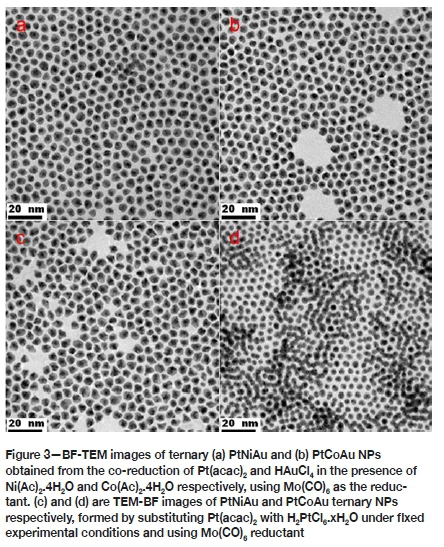
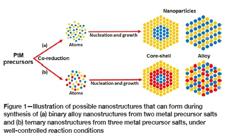
Optimizing the catalytic performance of multimetallic nanoparticle (NP) catalysts demands a concrete understanding of their design, while preferentially deploying wet chemical synthesis procedures to precisely control surface structural properties. Here we report the influence of reductants such as hydrogen-rich tetrabutylammonium borohydride (TBAB) and carbon monoxide-rich molybdenum carbonyl (Mo(CO)6) on the shape and morphological evolution of Pt-based binary (PtNi and PtCo) and ternary (PtNiAu and PtCoAu) nanostructures derived from a homogeneous solution of amine-based surface active agents (surfactants) in a high boiling point solvent. We successfully synthesized nanostructures exhibiting well-defined and composition-controlled surfaces deploying a one-pot synthetic approach. The development of the surface properties was, however, observed to be alloy-specific. The resultant highly monodisperse alloy NP with narrow size distributions and facet-oriented surfaces are expected to display enhanced functionality as catalysts for utilization in specific chemical reactions.
catalyst; platinum alloy; nanoparticles; synthesis; mixed-metal nanostructure
 Thumbnail
 Thumbnail
 Thumbnail