Technology evolution in the Southern African Ni-Cu-Platinum Group Metals (PGM) smelting industry
Abstract
The Southern African Ni-Cu-PGM smelting industry has evolved significantly from 1937 to date. As demand for platinum group metals has increased, smelting technology development has been closely linked to the need to process more concentrate, but also to changes in the chemistry and mineralogy of concentrates from the various platinum group metals-containing reef types. Early technologies relied on blast furnaces and Great Falls converters, but from the late 1960s, electric furnaces and Peirce Smith converters were commissioned. In the early 1990s, the introduction of water-cooled copper plate coolers into the slag zones of the primary furnaces enabled greater power intensity and throughput, with further intensification from the early 2000s requiring the use of deep-cooled copper coolers. Converting technology was also modernised to include a top submerged lance converter in one instance. Approaches to converter slag cleaning have evolved from recycling slag to the primary furnaces, to milling and flotation or electric furnace slag cleaning as the Cr2O3 content in slags has increased. The shift in the 1990s from Merensky ore derived concentrates to those from UG2 ores impacted the process design for the primary furnaces, with UG2 concentrates having lower matte falls and higher Cr2O3 levels. Conversely, concentrates derived from Platreef and Great Dyke ores, with high matte falls and lower Cr2O3 levels, have introduced other challenges. Furnace designs and operating philosophies have been improved to better handle these ranges of concentrates, the resulting slags and superheated mattes, the containment of which is non-trivial. The smelting of non-roasted concentrates in the primary furnaces gave rise to rapid corrosion of the copper coolers, and triggered development of corrosion mitigation strategies. Advances in SO2 emissions control have transitioned from single contact sulphuric acid plants in the 1970s, to the adoption of double contact acid plants, tailgas, and dual-alkali scrubbing in the early 2000s. Low SO2 strength off-gas streams from primary furnaces are abated in some cases, with technologies such as the Sulphacid process introduced from the early 2000s and the Wet-gas Sulphuric Acid process from the early 2020s. With advances in process intensification, increases in operating temperatures and throughputs, and use of water cooling, consequences of furnace failures have become more severe. Water leaks into the molten material environment, primary furnace containment, and slag granulation have been particularly challenging. Technologies, operating, and maintenance philosophies have been developed for prevention and mitigation of failures, and the adoption of process safety management approaches has yielded systematic benefits. With the outlook in demand for PGMs changing as a function of automotive requirements, smelting technology will continue to evolve for further enhancement of safety and environmental protection, reduced costs, and greater efficiencies.
Pyrometallurgy; smelting; converting; acid plants; slag cleaning; Platinum Group Metals (PGM)
Introduction
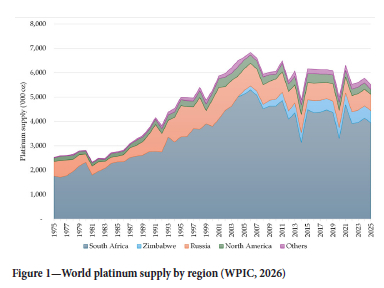
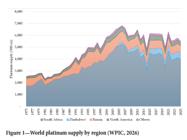
Southern Africa has dominated the supply of platinum group metals (PGM) into world markets, given the resource endowments associated with the Bushveld Igneous Complex in South Africa and the Great Dyke in Zimbabwe. The overall supply from South Africa has contributed on average 75% of the world's platinum from 1975 to 2008, and from 2008 to date, South Africa has contributed ~72% and Zimbabwe ~7% of the supply. The significant growth in absolute supply from South Africa from the 1970s to 2007 was brought about by major expansions in the mining and processing operations in the country, and more recently in Zimbabwe (Figure 1). The focus of this paper is on the evolution of technology and flowsheets within the smelting operations of the Southern African PGM industry players, as a function of the changes in capacity requirements, concentrate feedstock types, and changes in legislation.
Early history
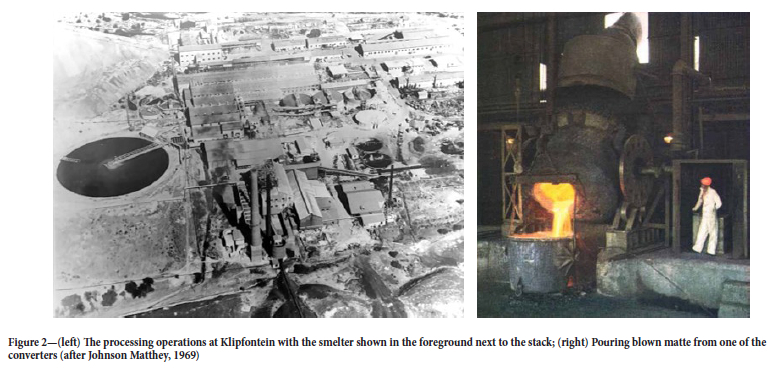
The discovery of the Bushveld Igneous Complex platinum deposits in 1924 brought about investment in mining and processing operations by the newly founded Rustenburg Platinum Mines (RPM, later owned by Anglo Platinum, then Anglo American Platinum, and now Valterra Platinum ). In 1931 the first recovery plant using gravity concentration and flotation was commissioned, with concentrates exported to England to be smelted and refined at the Johnson Matthey (JM) works in Brimsdown and Royston. The platinum price collapse in 1932, induced by the Great Depression, momentarily slowed production output but increased demand for PGMs soon followed, resulting in higher tonnage mined with a greater proportion of sulfide-bearing ore and flotation concentrates. This posed a new challenge for metallurgists: to implement a treatment method which would reduce bulky shipments overseas and render the concentrate suitable for refining. A variety of treatment methods were considered, and it was found that smelting the flotation concentrate to produce a nickel-copper matte, as used at scale by JM in Brimsdown, was most successful and achieved high PGM recovery (Beath et al., 1961). In 1937 the first smelting operations were commissioned at Klipfontein in Rustenburg (Figure 2), with initially one small blast furnace and a Great Falls converter (Hochreiter et al., 1985). Converter matte was then shipped to the JM works for further treatment to produce refined PGMs.
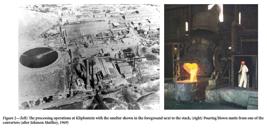
Mined ore production had increased from 7,500 tonnes per month in 1931 to 25,000 tonnes per month between 1939 and 1945 resulting in 40,000 platinum ounces per annum produced (Beath et al., 1961; Bruce, 1996). The relatively low required smelting rate led to the selection of the blast furnace at Klipfontein. As production rates increased, reverberatory furnaces were considered, but given the ability to readily stop and start the blast furnaces, they were retained, with additional furnaces installed as production needs increased. Feed preparation involved filtering of flotation concentrates in 2.4 m x 2.4 m drum filters and then various methods were initially used to produce a competent feed for the furnaces. These included sintering on a small Dwight Lloyd machine and also making briquettes after mixing with slaked lime and flue dust. The method eventually used was to dry the drum filter cake in Büttner turbo dryers and then pelletise in Lurgi pelletising pans. Green pellets, along with coke, iron ore, and limestone were fed to four blast furnaces. The water jacketed furnaces were 3.05 m long and 0.91 m at the tuyeres and operated in a modular fashion to meet variable production demands. Slag was granulated in a wet launder, separated from water in a rake classifier and then conveyed to a slag dump as is practiced by various smelters today (Beath et al., 1961). Matte was transferred by ladle to three Great Falls-type converters (Figure 2), 3.05 m in diameter, and blown to white metal containing 74% copper plus nickel, cast in moulds, crushed to -76 mm and placed in bags of 68 kg each for shipment (Gouldsmith, Wilson, 1963). Converter slag was cast and returned with other recycles to the blast furnaces.
A doubling of production occurred between 1947 and 1949, in part due to the acquisition of Union Platinum Mining Co., whereafter a further doubling in 1951 led to the formation of Matte Smelters (Pty) Ltd., jointly owned by JM and RPM. At this facility, commissioned at Rustenburg during 1954 and 1955, a portion of the converter matte was then also treated, with the balance exported to JM's Brimsdown plant (Bruce, 1996). Both facilities used the Orford process utilising sodium sulfate and coke as reagents in the first step. Blast furnaces and reverberatory furnaces were used in tandem, with careful temperature control to achieve efficient separation of phases. The molten stream from the blast furnace ran into the settler where the copper sulfide or sodium sulfide 'tops' layer and a PGM-rich nickel sulfide 'bottoms' layer were formed. The 'tops' layer was run into a ladle and then charged to a Bessemer converter, where the sodium sulfate blown off was recovered to be recycled to the blast furnace feed. After fluxing iron oxide with silica, the remaining copper sulfide was blown to blister, further refined in reverberatory furnaces, and cast into anodes for electrorefining. The 'bottoms' layer was tapped intermittently, cast, crushed, and ground fine in ball mills. Sulphur was removed by roasting to nickel oxide and then it was briquetted with coal and charged to reverberatory furnaces to form nickel metal and cast into anodes for electro-refining. Pure copper and nickel cathodes were produced from the electro-refining processes and sold locally. The anode slimes from each were further enriched to 65% PGMs by roasting and leaching with sulphuric acid and then sent along with the Rustenburg gravity concentrates to Royston, England, for further refining of gold and PGMs (Gouldsmith, Wilson, 1963).
During the 1960s, further demand for PGMs led to expansion and new entrants in the South African platinum industry. RPM responded with production increases reaching 1 million ounces by 1970 and installation of another jointly owned facility with JM to refine PGMs in Wadeville. The commensurate additional smelting capacity needed could not be installed at Klipfontein, resulting in RPM's decision to construct a new facility at Waterval (also in Rustenburg) in 1969, and the later construction of Mortimer Smelter at Swartklip (near Northam) in 1973. The change in location offered an opportunity to consider new technologies and RPM ultimately selected two Elkem designed 19.5 MVA rectangular electric furnaces and Peirce Smith converters in 1967, which were then installed at Waterval in 1969 (Hochreiter et al., 1985). Concurrently, Impala Platinum had started their mining operations in 1968 and by January 1969 their first 7.5 MVA electric furnace was commissioned, with two more 7.5 MVA furnaces in 1972 and 1973, and a fourth 15 MVA furnace in 1974 (Watson, Harvey, 1992). Converter matte produced by their Peirce Smith converters was treated in a newly built refinery in Springs, utilising the Sherritt Gordon pressure-leaching process. In 1971, Western Platinum-later part of Lonrho, then Lonmin, now part of Sibanye Stillwater (SSW)-started their operations, installing a 12.5MW furnace with converter matte exported to Norway for refining (Eksteen et al., 2011; Hochreiter et al., 1985). A new era had started in the South African PGM industry with the three major role players at the time all using rectangular electric furnaces coupled with Peirce Smith converters.
The selection of electric furnaces was driven by several perceived benefits. Firstly, a move away from blast furnaces due to difficulties preparing competent pellets, increasing operational costs related to coke and labour, and the introduction of more stringent anti-pollution laws, which would have required costly modifications to capture the 1% - 2% sulphur dioxide emissions. Secondly, in comparison to reverberatory furnaces, electric furnaces presented significant benefits in energy efficiency and construction costs. The heat generation through Joule (I2R) heating in the slag bath, rather than convective and radiant heating from a flame above the bath, was far more efficient in melting concentrates, with Mostert and Roberts (1973) estimating thermal efficiencies of 60% for electric furnaces, versus 30% for reverberatory furnaces. Heat transfer, both up and down from slag to charge and slag to matte, resulted in higher matte temperatures compared to reverberatory furnaces with the benefit of also reducing magnetite formation on the hearth and at the slag/matte interface, which could impact matte tapping. The electric furnace also operated with comparatively lower roof temperatures, which impacted furnace design and refractory selection, resulting in a cheaper and more robust solution. Furthermore, and perhaps most significantly, electric furnaces were able to achieve the higher temperatures needed to maintain fluidity of the slags with relatively higher magnesium oxide (MgO) in feeds (Cramer, 2001; Hochreiter et al., 1985; Mostert, Roberts, 1973).
Peirce Smith converters replaced the Great Falls-type converters owing to the inherent advantages of their cylindrical shape and horizontal orientation. "In the vertical orientation, the tuyere immersion varied with their location on the barrel, while in the horizontal design, all tuyeres are at the same depth giving uniform immersion and blowing rates" (Nelson et al., 2018). Furthermore, the acid linings used in the Great Falls converters were seen as far more inferior to the basic chrome-magnesite bricks used to line the new Peirce Smith vessels for the corrosive slags being processed. At Waterval Smelter, furnace matte tapped into 12 tonne cast steel refractory lined ladles was transferred to the Peirce Smith converters along with silica flux and furnace aisle reverts. Converter matte was poured into moulds, cooled, and then crushed to -25 mm and bagged. Converter slag was returned to the electric furnace by means of a cast launder (Mostert, Roberts, 1973).
During the 1970s, the 'slow cooling' process was developed by RPM and JM, whereby the iron content and cooling rate of cast converter matte were controlled such that a PGM-rich Ni-Cu-Fe magnetic alloy was formed separately from a PGM-free nickel-copper matte. The converter matte was cast into a mould, covered with a lid and allowed to cool for approximately 5 - 6 days before being removed and crushed. Subsequent grinding and magnetic separation allowed for the PGMs and base metals to be recovered separately in the base metals and precious metals refineries, which were commissioned in 1981 and 1989, respectively. Following this new process for converter matte treatment, all the RPM smelter downstream processing to produce refined PGMs was conducted at Rustenburg in South Africa.
The impact of concentrate composition
The smelting and converting of nickel-copper PGM concentrates is greatly influenced by the origin of the ore, and targeting of high concentrator PGM recoveries, given the value of the precious metals (yielding high gangue content in the concentrate). These aspects have been covered widely in literature, and a brief overview is provided here as it has meaningfully driven changes in technology. The concentrates are derived from the following reef types in Southern Africa:
> The Merensky Reef reserves, which were exploited initially, are largely depleted. Merensky Reef-derived concentrate is characterised by good PGM and base metal grades, 110 g/t - 150 g/t and 5.5% - 6.3% Ni+Cu, respectively (Mostert, Roberts, 1973), with low chromium oxide (Cr2O3) content. This concentrate type was the predominant feed type influencing the operation of the electric furnaces from the 1970s to late 1990s. During that time, furnace power densities were relatively low, resulting in relatively low operating temperatures, with matte temperatures ranging from 1150 °C to 1260 °C (Forbes, 1977; Watson, Harvey, 1992) and slag temperatures ranging from 1300 °C -1460 °C (Mostert, Roberts, 1973; Watson, Harvey, 1992). Mostert and Roberts (1973) note the high MgO content bringing about 'slags with high formation temperatures, in comparison to the matte with low formation temperatures of ~1000°C. The importance of this difference was further noted with respect to the design of the furnace hearths and transformers.
> The Upper Group 2 (UG2) Reef is associated predominantly with chromitite, with very low base metal content (3.3% Ni+Cu), but high PGM (140 g/t - 340 g/t) and Cr2O3 (2.6% - 2.8%) contents (Jones, 1999). The concentrate gives rise to very low matte falls / collector volumes (typically < 10%) when smelted. The high Cr2O3 content in the UG2 concentrates has a marked influence on the smelting behaviour in the primary furnaces, which is elaborated on in the following.
> The Platreef ore body on the northern limb of the Bushveld Complex is mined by Valterra Platinum at the Mogalakwena mine, and more recently by Ivanplats. Platreef concentrate is characterised by relatively low PGM grades (60 g/t - 90 g/t), high base metal contents (up to 7% Ni+Cu+Co, according to Shaw et al., 2014), and low chromium oxide content. This concentrate results in high matte falls in the primary furnaces (typically 15% - 30%). The future of the South African PGM industry is likely to become more dominated by concentrates from these northern limb deposits, as new mines are developed in this area.
> Concentrates from Great Dyke Reef deposits in Zimbabwe, are somewhat similar to the Platreef concentrates in terms of having relatively low PGM grades, high base metal content (6.4% Ni+Cu), and low chromium oxide content (0.3%) (Mabiza et al., 2011). This concentrate type also gives rise to high matte falls in the primary furnaces (typically > 30%).
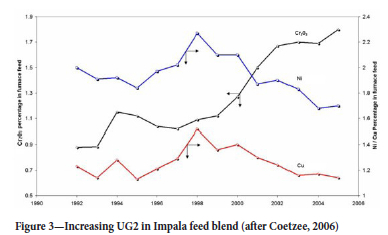
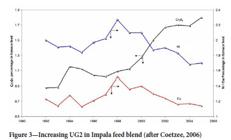
The change in the concentrate feeds to the PGM producers had a marked impact on the smelting operations, particularly towards the late 1990s and early 2000s, as declining Merensky concentrate volumes were replaced with increasing UG2 concentrate volumes.
This led to an increase in the Cr2O3 concentrations in the feed (Figure 3), and hence, slag and matte of the primary furnaces, with numerous negative impacts.
The impacts of Cr2O3 on the primary furnaces are well documented (Watson, Harvey, 1992; Jones, 1999; Merkle, McKenzie, 2002; Nell, 2004; Coetzee, 2006; Eksteen et al., 2011; Shaw et al., 2014), with a summary of the key issues provided in the following:
> Combined with the high MgO content in the slags, the Cr2O3 drives up the slag liquidus temperatures, and hence, operating temperatures. Slag operating temperatures transitioned from 1300 °C - 1460 °C for Merensky-dominant feeds to 1500 °C - 1680 °C (Eksteen et al., 2011), and at times higher, for UG2-dominant feeds. The higher slag operating temperatures greatly elevate the matte operating temperatures to as high as 1600 °C. Given the much lower matte liquidus and solidus temperatures (850 °C - 1000 °C and ~650 °C, respectively) (Eksteen et al., 2011, Rivera Li Kao, Garbers-Craig (2025), the very high matte superheat creates challenges in containment of the matte, particularly for activities around the matte tapholes (Shaw et al., 2014). The other impact of the high slag operating temperatures is increased slag electrical conductivities, which lead to shallower electrode immersions for furnaces with transformers with constrained secondary current capability, particularly when FeO-rich converter slag is returned to the primary furnaces.
> Chromium spinel forms in the furnaces due to limited solubility of the Cr2O3 in the slag. Merkle and McKenzie (2002) discuss Cr2O3 solubility being a function of slag composition and oxidation state, with higher solubility under slightly reducing conditions. Given the density of the spinels being higher than the slag and matte densities, spinel accumulation on the hearths leads to reduced volume. Watson and Harvey (1992) noted a significant concern of 'severe' build-up for Cr2O3 levels above 1%, albeit with furnaces operating at relatively low power densities, and motivated the increase in hearth power density on Impala F5. Later, with more intensely powered furnaces, chromium oxide solubility levels of 1.8% are mentioned, with which the Impala operation was coping (Coetzee, 2006). The presence of spinels when processing concentrates with Cr2O3 contents of up to 4% also drove the decision to install large transformers on the RPM Polokwane furnace (3 × 56 MVA) to allow for deep electrode immersions (75%), with the intention of enabling stirring and melting of hearth build-up (Nelson et al., 2005).
> Hearth build-up has been linked to higher entrained matte losses in slag, and significant concern around matte being tapped out slag tapholes, particularly with water granulation of slag (Watson, Harvey, 1992). The reduced amount of matte collector with UG2-rich concentrate blends also negatively impacts base and precious metal recoveries (Nell, 2004).
> Increases in hearth build-up, particularly in the colder, more quiescent areas of the furnaces (typically the tapping ends of rectangular furnaces), lead to matte tapping difficulties, with slow tapping rates and mixtures of matte, intermediate layer, and slag being tapped. In addition, spinel precipitation in launders and ladles creates both practical tapping problems of keeping the launders and ladles clean, but also leads to reverts generation (Eksteen et al., 2011).
> Intermediate, spinel-rich layers between matte and slag lead to poor matte-slag separation and difficulty in distinguishing between the two liquid layers on a sounding bar for level measurement.
> Cr2O3 in furnace matte is transferred to the converters, where the high incoming matte temperatures, combined with spinel precipitation around the tuyeres leads to reduced campaign lives of the converter refractories (Eksteen et al., 2011).
> Cr2O3 in the converter feed reports to the slag, and historical practice involved returning the slag to the primary furnaces. The recycle of both magnetite and chromite spinels to the primary furnaces further exacerbated the build-up issues in the furnaces, along with high slag operating temperatures and shallow electrode immersions. This ultimately led to the South African PGM producers discontinuing converter slag return (Coetzee, 2006).
A further feature of the smelting of the Southern Africa Ni-Cu-PGM concentrates is that they are dried and then directly smelted in the primary electric furnaces. The implication of this is that the base metal and iron sulfide mineral phases thermally decompose in the furnaces, giving rise to labile sulphur (Mabiza et al., 2011). The bulk of the labile sulphur reacts with oxygen in the freeboard of the furnace and is emitted to the off-gas system as SO2, however, some elemental sulphur persists in the concentrate bed ('blacktop') inside the furnace. Prior to 1991, when furnace power densities were low, and few copper coolers were installed, the presence of the elemental sulphur was not problematic. However, when copper plate coolers, and later deep-cooled copper coolers were introduced, their cold surfaces allowed for the condensation of gaseous species on the copper. This led to sulfidation of the copper - a process that is accelerated by the presence of chlorides also present in the concentrate, which has led to the failure of coolers, as detailed by Shaw et al. (2014), and in turn the solutions, which were explored and implemented. Additional details are provided further on in this paper.
The impact of processing greater volumes of Platreef and Great Dyke concentrates have been twofold. The first relates to the quantity of input sulphur into the furnaces, exacerbating copper corrosion issues, and the second relates to the quantity of matte that needs to be tapped. Historically, the primary smelting furnaces only had two matte tapholes. However, with greater volumes of highly superheated matte requiring tapping, the frequency with which matte tapholes needed repairs increased. The time taken for matte taphole repairs started to impact overall furnace availability, prompting the need for the installation of a third matte taphole on several furnaces handling higher matte volumes. A fourth matte taphole has been included in a recent furnace installation.
Concentrate handling and drying
The move to electric furnaces in the late 1960s required new drying and feeding systems to prepare the material. RPM and Impala initially selected 'wet' feeding systems. These included a drying stage, and a pelletising stage in RPM's case. The initial installation at Impala consisted of drum filters and coal-fired turbo-tray dryers to produce 6% - 8% moisture (Watson, Harvey, 1992). This material was fed to the furnace via a conveyor and feed bin system. This method of feeding created significant operating challenges, which included difficulties in transporting the concentrate, heaping inside the furnace, which required manual rabbling, frequent furnace 'blow-backs, high dust losses, and a very poor working environment. In addition, the drawback of wet feed to the furnace contributed to a high specific energy consumption of 967 kWh/t in the early 1970s (Plasket, Ireland, 1976).
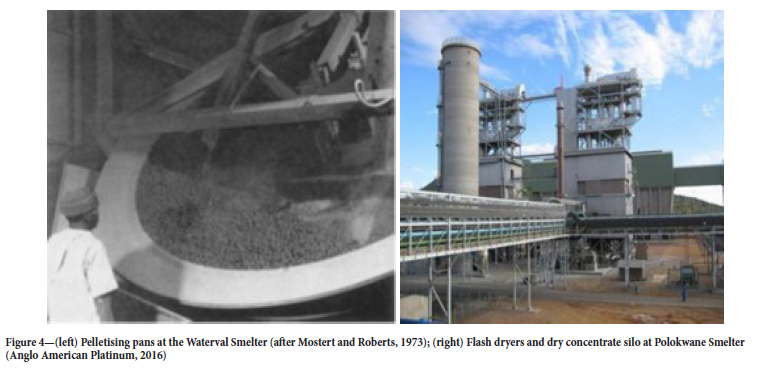
RPM's Waterval Smelter configuration included drying and pelletising, in an attempt to improve furnace operations and working conditions. The concentrate was dried in Buttner dryers from 21% to 7% moisture. Coal-fired furnaces were used to provide the drying energy. The dried concentrate was fed to the pelletising process (Figure 4) and then dried further to produce dried pellets of 2% moisture (Mostert, Roberts, 1973). These dried pellets were fed with fluxes and reverts via conveyors, feed bins, and shuttle conveyors to the furnace. The move to pellets was calculated to increase smelting capacity by 25% (Mostert, Roberts, 1973) and reduce dust losses and blow-backs. Another benefit, when combined with sufficient feeding ports (4 around each electrode and one between the electrode and each wall), was more complete coverage of the furnace bath. This lowered freeboard temperatures and reduced stresses on the furnace roof and off-gas systems.
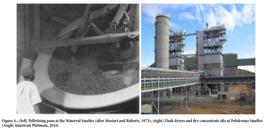
In 1972 Impala introduced the first spray drying tower (Niro spray tower) to produce concentrate of less than 0.5% moisture (Watson, Harvey, 1992). Coal-fired hot gas generators provided the energy and the hot gas contacted with the concentrate slurry in a counter-current process to produce dry product. High-efficiency filters on the back end of the dryer system minimised losses in the drying process. The challenge of feeding dry concentrate to the furnace was managed by combining the dry material with the concentrate pulp, in paddle mixers, to produce a damp feed of ~5%. This enabled the continued use of the existing furnace feed systems and eliminated manual rabbling, however, the operational challenges of the wet feed, mentioned already, remained.
The first implementation of 'dry' feeding to Impala's furnaces occurred in 1986. Pneumatic conveying technology enabled the contained transport of dry material to furnace feed bins. Additional modifications to the furnace charging systems and a significant reduction in the number of feed ports accompanied the change. The dry feeding used the very low angle of repose of dry concentrate to create a blacktop across the entire surface of the molten slag, through the significantly reduced number of feed ports (28 ports down to 4 - 6 per furnace side). The dry feeding enabled a 12% -15% increase in furnace efficiency (Watson, Harvey, 1992). Further improvements included reduced blow-backs and off-gas volumes from a reduction in water content. The CaO content in the primary furnaces was controlled using limestone at that stage, and the introduction of the contained pneumatic conveying systems also allowed for a change to burnt lime, which also provided an energy-efficiency benefit.
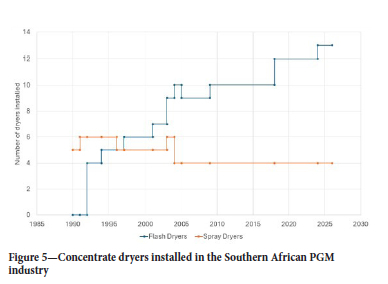
RPM introduced flash dryers into the Waterval flowsheet in 1992. Coal-fired hot gas generators also provided the energy requirement for the drying process, which involved hot gas and wet concentrate filter cake being combined in a co-current drying column to produce a dry product of less than 0.5% moisture. The flash dryer achieved 90% - 95% thermal efficiency, significantly higher than traditional spray dryers, which achieve 45% - 65% thermal efficiency (Cheng et al., 2018; Kemp, 2012). Cyclones and baghouses are used to provide the solid-gas separation and prevent significant dust losses, although the first installation at Waterval utilised a wet venturi scrubber process for the final dust recovery step. This change to dry feed eliminated the pelletising process, boasted lower capital, maintenance, and labour costs, and has a more effective dewatering capacity when compared to the other drying technologies previously used.
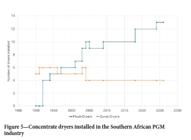
Currently all PGM smelters in Southern Africa utilise the flash dryer or spray drying process to produce the dry concentrate for feeding in the furnaces (Figure 5). Flash drying technology is favoured due to better energy efficiencies.
Electric furnace development
All the early electric furnaces, from the end of the 1960s, were rectangular in design with six electrodes set in a line. Both Impala and Western Platinum (SSW) made use of Barnes-Birlec designs while RPM used an Elkem design. All electrodes were Soderberg designs and are still retained today. The furnace and electrode designs were selected based on the relatively low power density requirement for Merensky sourced concentrates, cheap electricity costs in South Africa, and the cheaper operating cost of Soderberg electrodes relative to pre-baked graphite electrodes. Additional rectangular furnaces were installed by Impala and RPM in the 1970s, based on the successes of the initial installations with some improvements. To counter the impacts of the increased UG2 feed and spinel formation in the furnaces in the 1980s and 1990s (Figure 3), the route followed was to increase the stirring within the furnace by increasing the power density, and in other cases a preference for circular furnaces emerged. SSW were the first to install two circular furnaces in 1982 for UG2 concentrate smelting and later installed three more circular furnaces in 1991. These furnaces operated successfully and prompted SSW to continue using circular furnaces and also formed the basis for their scale-up to larger furnaces.
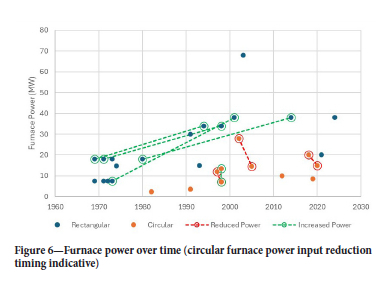
The PGM industry saw an increase in demand for its metals from the early 1990s to early 2000s, driven predominantly by vehicle autocatalyst and jewellery markets (Figure 1), and supply needed to increase to match this demand. This was achieved by increasing mining and concentrating capacity, which then required additional smelting capacity, resulting not only in the installation of new furnaces, but also the increase in capacity of existing furnaces. Rectangular furnaces were amenable to increased power levels (Figure 6), where the power ratings of three furnaces were approximately doubled from their original installed capacity with little change to hearth area (Waterval Furnace 1 and 2 and the Mortimer furnace with power increases from ~18 to 34 MW - 38 MW). Impala Platinum also increased furnace power from 7.5 MW to 38 MW, but this had a substantial increase in hearth area. In 2003, RPM also commissioned the largest PGM furnace (68 MW) to date at Polokwane, driven not only by market demand, but also by location and projected reserves. Larger circular furnaces were also installed at this time, however, operated at significantly lower power than planned.
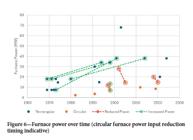
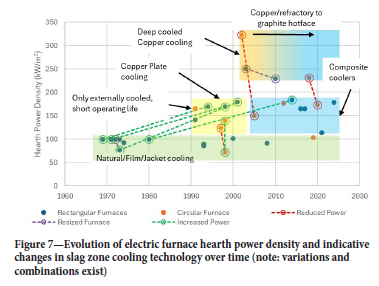
Almost all installations prior to 1991 had hearth power densities of less than ~100 kW/m2. These earlier furnaces made use of magnesite refractories for lower side walls, upper and lower hearths, while fireclay bricks were used for the hearth infill, upper walls, and roof (Watson, Harvey, 1992). The walls were either uncooled (natural convection), water film cooled, or water jacket cooled, while the hearths were forced-draft air cooled.
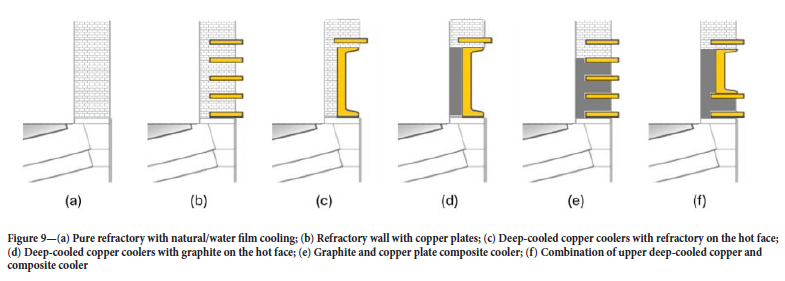
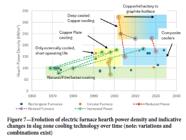
From the 1990s onwards, higher powered furnaces were installed, with increased hearth power densities of up to 175 kW/ m2. The increase in operating temperatures and the chemical aggressiveness of both matte and slag increased, and so lower side wall and upper hearth refractories were changed to chrome-magnesite qualities. Also associated with the increase in the power input to the furnaces at this time, sidewall cooling was introduced in the form of water-cooled copper plate coolers (Watson, Harvey, 1992). The wall cooling allowed for a slag freeze lining to form on the wall hotface, which then protected the refractory from slag attack (Sarvinis et al., 1999). As power intensities increased further in the early 2000s, with hearth power densities exceeding 200 kW/ m2, wall cooling intensity was increased to cater for increased wall heat fluxes (Figure 7). To achieve this, deep-cooled copper coolers were introduced, designed for peaks of up to 440 kW/m2 (Nelson et al., 2005).
Deep-cooled coolers easily managed the thermal duty for maintaining slag freeze linings. However, their useful lives were short due to the rate of chloride-accelerated sulfidation corrosion (Shaw et al., 2014) and much less copper between the cooler hotface and the internal water passages, compared to plate coolers. The Polokwane furnace experienced a cooler failure within a year in 2005 (Hundermark et al., 2014). Work commenced on improving corrosion resistance of the deep-cooled coolers during which graphite was trialled on the hot face of the copper, which proved to be effective at reducing the rate of corrosion (Eksteen et al., 2011; Shaw et al., 2014). The key technology developments, which arose in response to the corrosion issues were:
1. Reduction in the copper cooler sizes to enable more rapid replacement of corroded sections, saving on both replacement costs and time.
2. Automated, regular pressure testing of the copper coolers for early detection of leaking components.
3. Corrosion protection barriers, particularly graphite, were installed on the hotface of the copper, which have proven to be very effective in slowing the corrosion rate (Shaw et al., 2014). The use of graphite on the hotface has extended the copper component campaign lives, however, sulphur access to the sides, top, and bottom of the copper gives rise to the need to replace coolers periodically.
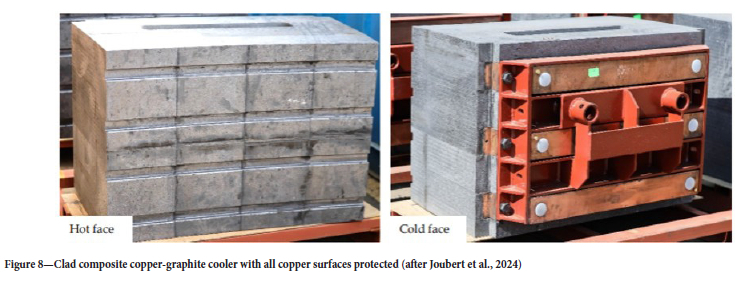
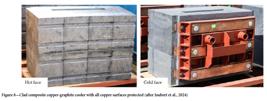
4. Following the success of graphite on deep-cooled coolers and recognising the corrosion of shallow-cooled plate coolers, graphite was also introduced into the plate-cooled furnaces from 2014 onwards by sandwiching graphite between the plates forming a 'composite cooler'. Earlier trials of composite coolers were undertaken at Polokwane from 2011. This transition from plate coolers to composite coolers has increased the useable life of these coolers on the lower power intensity furnaces, however, sulfidation corrosion of any exposed copper surfaces persists. This has led to the latest development, which included cladding the copper cooler on the sides, top, and bottom with graphite (Figure 8), and appears to be effective (Joubert et al., 2024; 2025).
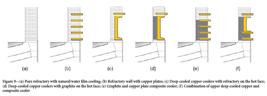
The evolution of the side wall cooling technology is shown graphically (Figure 9), with copper plate coolers introduced and then deep-cooled copper coolers. The incorporation of graphite into designs then followed, with various configurations in use.
Furnace dimensioning considerations
Rectangular furnace dimensioning considerations include length-to-width ratio and end-wall-to-electrode-distance, while for a circular furnace, the diameter is a ratio of electrode diameter or electrode spacing. The process defines the electrode spacing, size of electrode, and hearth power density required, and thus approximate dimensions are determined (Nelson et al., 2015). In earlier days, dimensioning guides were developed largely from commodities other than PGMs and have thus required optimisation over time, based on operating experience. Examples of this are the 2010 matte wall extension performed at Polokwane, and the modifications to the No. 1 circular furnace installed by SSW.
Two high hearth power density primary electric furnaces were installed in 2001 and 2003, namely, a circular furnace by SSW (320 kW/m2) and a rectangular furnace by RPM (251k W/m2) at Polokwane, respectively. RPM also installed a circular slag cleaning furnace in 2003 with a power density of ~260 kW/m2, which is discussed further on in this paper. The SSW circular furnace experienced containment difficulties and the nominal operating power was reduced from a design power of 28 MW to 14.5 MW (Joubert et al., 2024), bringing the hearth power density down to ~155 kW/m2, and in line with the hearth power densities of many of the other PGM furnaces. Operating at lower intensity resulted in improved furnace integrity.
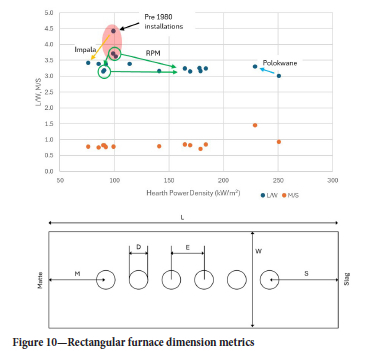
RPM's Polokwane furnace also faced containment challenges, experiencing corrosion of copper coolers (discussed in the aforementioned section), and high refractory wear rates of the matte endwall (Hundermark et al., 2014). The furnace was originally designed with the typical design ratio of 0.93 for electrode centre-to-matte-wall/electrode centre-to-slag-wall distances. The wear rate of the slag wall was deemed acceptable while the matte wall was found to wear at an unacceptably fast rate to the point of experiencing a catastrophic failure after just 9 months of operation after an end wall replacement in 2008. This prompted moving the matte endwall in 2010 by 2.7 m farther away from the closest electrode, increasing the matte-end-to-slag-end ratio to 1.45. There were fears of not being able to tap matte from the furnace, but these concerns have proved to be unfounded. Since then, consistent operation at full power (68 MW) has been possible on the Polokwane furnace at a hearth power density of ~230 kW/m2 and with very good campaign lives on the matte endwall. With the exception of the Polokwane furnace, furnace sizing has favoured similar power densities to those in the 1990s of around 175kW/m2. Currently, the Polokwane furnace is the only primary PGM furnace, circular or rectangular, operating at a power density above 190 kW/ m2.
Some basic design metrics of the rectangular furnaces are shown in Figure 10, namely ratios of length:width (L/W), electrode centre-to-matte-wall:electrode centre-to-slag-wall (M/S). The early installations had L/W ratios of 3.6 - 4.4, implying long and narrow furnaces. Impala discovered early that having the side walls too close to the electrodes was detrimental to side wall life (~5y) and quickly changed to a lower L/W ratio by widening their next installations from ratios of 4.4:1 to 3.4:1. This was more in line with the other rectangular furnace installations in the industry (range from 3.2:1 to 3.7:1), and the resultant furnace life was doubled (Watson, Harvey, 1992). RPM started changing L/W metrics when the furnaces were upgraded, which involved changes to refractory design, power input increase, and later changes in wall cooling technology. For all these furnaces, the M/S ratio was quite consistent (~0.75 to 0.9) other than for Polokwane, where the matte endwall was moved farther from the closest electrode in 2010 and increased the ratio to 1.45. One of the goals of the design change at Polokwane was to achieve a similar local-hearth-power-density to the smaller rectangular furnaces in the RPM fleet (Nelson et al., 2015), which also brought about a similar 'linear power density' (linear electrode face to wall power density in kW/m).
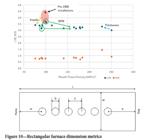
Of note is that the diameter of the SSW circular furnace discussed earlier has recently been increased (Joubert et al., 2024; 2025) based on the linear power density metric proposed by Nelson et al. (2015). This has now enabled sustained operation of the furnace at > 15 MW.
The importance of adequate matte volume inside the furnace is a further dimensioning consideration (Nelson et al., 2015), where insufficient volume may yield higher matte temperatures and potential wear of hearth refractory by slag if the matte taphole elevation relative to the top of the hearth skewback brick is too low. For circular furnaces in particular, raising the matte taphole farther above the top of skewback brick, and thereby creating greater matte volume, has been demonstrated to be beneficial (Joubert et al., 2024; 2025).
Impact of furnace operating temperatures and intensities on hearth design
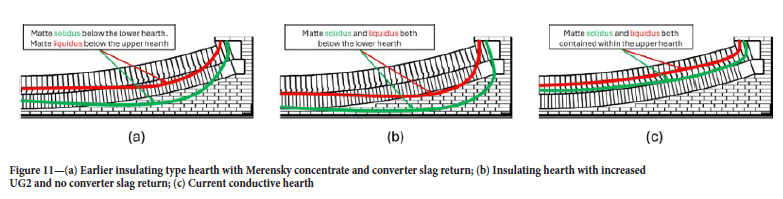
Prior to 1991, PGM electric furnaces with low power densities, converter slag recycle (containing magnetite), and chromium spinel accumulation experienced hearth build-ups, which were problematic (Watson, Harvey, 1992). This was despite the low solidus and liquidus temperatures of the primary furnace mattes. Given excess build-up in the earlier furnaces, hearth designs were relatively more insulating with the use of fireclay infill bricks and magnesite-chrome refractories in the upper and lower hearths.
As the furnace hearth power densities increased, and converter slag recycle was discontinued, build-up on the hearths no longer occurred. This is a key differentiator when compared to other commodities, where frozen heels are intentionally factored into the furnace design to promote hearth integrity, and maintaining the solidus isotherm within the upper hearth. With retention of the earlier insulating hearth designs at the time that furnace power, UG2 concentrate inputs, and matte temperatures increased, in addition to no build-up on the hearth, the matte solidus temperature isotherm moved well below the upper hearth. The implication was that liquid matte could infiltrate deep into the lower hearth and infill bricks (Figure 11). With thermal cycles on the furnace, ratcheting of the hearth occurred due to infiltration of liquid matte into brick joints, and contributed to continuous hearth growth, limiting the life of the hearth and allowing for hearth containment incidents (Shaw et al., 2014; Hundermark et al., 2020). The importance of furnace binding systems in minimising furnace growth is stressed by Watson and Harvey (1992), Shaw et al. (2014), and Nagorski et al. (2025).
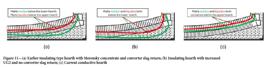
With improved understanding of the importance of hearth thermal profiles associated with higher powered furnaces with no build-up, hearth refractory selection has improved. These changes aim to contain the matte solidus isotherm within the upper hearth refractories (Nagorski et al., 2025). Upper hearth refractories remain magnesite-chrome while the lower hearth refractory has changed from magnesite-chrome to more thermally conductive magnesite. Hearth infills have changed from the insulating fireclay to magnesite-based refractory, with an even higher conductivity silicon carbide infill trialled on one of the rectangular furnaces. Another circular furnace has no infill, with a dished hearth in use. Even with improved furnace hearth designs, the importance of furnace operating stability needs to be emphasised, with hearth growth being very sensitive to process and thermal cycling.
Converting
Survey information on converting in the Southern African PGM smelting industry is provided by Jones (1999; 2005), and the evolution of converting technology has been comprehensively reviewed by Nelson et al. (2018). A summary is provided in the following. With the change in primary smelting technology from blast furnaces to electric furnaces in the late 1960s, the quantity of furnace matte produced increased, and the converting technology was changed from Great Falls to Peirce Smith converters. The converting operations utilised by each PGM producer are as follows:
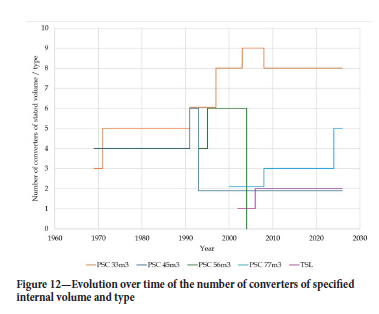
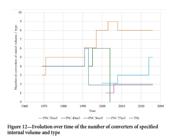
> RPM installed four 3.05 m × 6.1 m (~45 m3 internal volume) converters in 1969 (Mostert, Roberts, 1973), the lengths of which were extended to 7.6 m (~56 in 1993, and two more converters of the enlarged dimensions were added in 1995 to bring the total to six converters, aligning with the increased furnace matte production requiring converting. These Peirce Smith converters were decommissioned in April 2004, following the successful ramp up of the top submerged lance (TSL) converting process.
> Impala Platinum installed three 3.05 m × 4.57 m (~33 converters in 1969 (Plasket, Ireland, 1976), later a fourth, and in 2000, added two larger converters of 3.66 m × 7.32 m (~77 m3) (Coetzee, 2006).
> Lonmin (now SSW) installed two Peirce Smith converters in 1971 of 3.05 m × 4.57 m and later installed a third of the same dimensions in 2003 (Eksteen et al., 2011).
> Northam Platinum installed two Peirce Smith converters of 3.05 m × 6.1 m in 1992 (Jones, 1995).
> Zimplats operate two 3.05 m × 4.57 m Peirce Smith converters (Mabiza, 2006) and have recently installed two larger 3.66 m × 7.32 m converters (Crafford et al., 2025), in conjunction with the expansion of the primary smelting capacity with the addition of the new 38 MW furnace.
> Two 2t top blown rotary converters (TBRC) were utilised at Crocodile River briefly from 1989 to 1991 (Nelson et al., 2018).
Technology enhancements associated with the Peirce Smith converters include:
1. Use of flame optical emission spectroscopy (Bezuidenhout et al., 2017) for iron endpoint control.
2. Plant trials of sonic injection (Kapusta et al., 2012; Chibwe et al., 2015) were carried out on the SSW converters, however, to the authors' knowledge, the technology has not yet been adopted.
The evolution of the number of converters, their sizes (expressed as internal volume) and technologies for converting are summarised in the following (Figure 12).
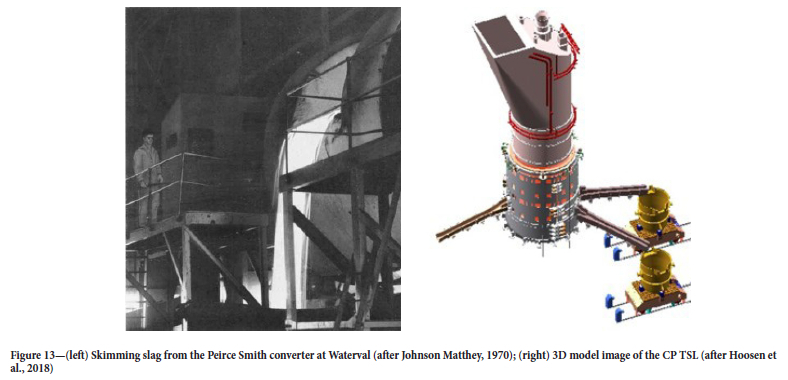
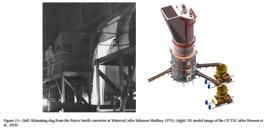
Two factors determined the next evolution in converting technology, those being increased throughput requirements, and environmental emissions control of SO2. With the expansion of production capacity at RPM in the late 1990s and early 2000s, particularly with the development of mines and concentrators on the eastern limb, Polokwane Smelter was commissioned in 2003 with the resultant Polokwane furnace matte requiring converting. From the mid-1990s RPM developed a new converting process based on Ausmelt TSL technology (now Metso). The Converter Plant (CP) was constructed adjacent to Waterval Smelter, and was commissioned in 2002 (Viviers, Hines, 2005), with a standby phase added in 2006. Novel technologies introduced in the converter included the use of deep-cooled waffle coolers in the slag zone of the crucible and a three-dimensional binding system (Figure 13). The CP receives solid matte feeds from each of the primary smelting operations and converts it to Waterval converter matte. The stationary TSL crucible allows for greatly improved off-gas capture compared to Peirce Smith converters and has enabled the facility to comply with the minimum emission standards for SO2, with the use of a double contact acid plant. The benefit of a centralised converting facility enabled greater furnace matte throughput in a single vessel and reduced the number of converters and acid plants that would otherwise have been required, had Peirce Smith converting been retained.
Slag cleaning
Base and precious metals are lost to slag through entrained matte losses and oxidic losses. Entrained matte droplets in slag account for the bulk of the PGM losses. By contrast, the base metals may report to slag through both mechanisms, with the oxidic losses being highly dependent on the oxidation state in the process step in question.
In the primary furnaces, the extent of the PGM losses is dependent on the quantity of the matte collector phase (Nell, 2004) as a function of the probability of matte droplets colliding, coalescing, and disengaging (Nelson et al., 2005), and the quantity of slag generated. For concentrates with lower matte falls, there is a greater quantity of slag generated, and lower probability of matte droplets disengaging into the bulk matte layer. Base metal losses in the primary furnaces are governed by thermodynamic relationships between iron and base metal sulfides and iron and base metal oxides (Grimsey, 2021). With greater levels of iron reporting to slag in low matte fall concentrates (UG2), so the base metal recoveries decrease. Sakaran et al. (2024) have developed correlations of base metal recoveries as a function of feed composition, with clear differences observed depending on the predominant feed type to several primary smelting operations.
The approach to cleaning of primary furnace slags has typically been a function of the grade of the slag, and whether it is economic to clean the slag or to stockpile it. In more integrated operations where both primary smelting and converting takes place, and the historic practice of returning converter slag to the primary furnaces occurred, slag milling and flotation plants have mostly been installed. For smelting operations with primary furnaces only, in some cases the quantum of the slag losses has not justified the installation of a slag milling and flotation plant, and in other cases it has.
With more oxidising conditions present in converting, and the manner in which the matte and slag are separated through skimming in the case of Peirce Smith converters, the cleaning of converter slags is important for minimisation of losses. With the early Peirce Smith converter operations and Merensky concentrate feeds to the primary furnaces, the converter slag was traditionally returned to the primary furnaces. This practice contacted the oxidised converter slag with the incoming concentrate feed, allowing for reduction of the base metal oxides in the converter slag, and also the disengagement of mechanically entrained matte from the converter slag into the bulk matte layer in the primary furnace. This practice was discontinued by the South African industry players in the 1990s and early 2000s, as discussed earlier. For the Zimbabwean industry players, with the Great Dyke type concentrates having low Cr2O3 contents, return of converter slag to the primary furnace has continued (Mabiza et al., 2011; Crafford et al., 2025). In South Africa, cleaning of Peirce Smith converter slags therefore transitioned to milling and flotation, which allow for good recoveries of the entrained matte, but limited recovery of any base metal oxides. Given the batch nature of Peirce Smith converter operations, the 'slag blow' batches of slag should have relatively low oxidic losses, and it is only the final 'finishing blow' batch of slag that may have higher oxide losses.
For the RPM CP slag, the stationary crucible has two matte tapholes and one slag taphole, with tapping allowing for cleaner separation of the matte and slag, relative to skimming of Peirce Smith converters. However, the CP is operated in a continuous mode, and the converter slag is more oxidised, with higher base metal oxide losses as well as entrained matte droplets. For this reason, RPM installed a slag cleaning furnace (SCF) at the Waterval complex (Joubert et al., 2005; Jacobs, 2006), which was commissioned in 2003 in conjunction with the CP. The SCF is a circular, three electrode electric furnace of 12 m diameter, with 3 MVA × 10 MVA transformers. The nominal hearth power density of the furnace is 266 kW/m2, although it is more typically operated in the range of 200 kW/m2 - 220 kW/m2, which is more intense than the other circular, primary furnaces. Deep-cooled copper coolers are installed in the slag zone of the furnace to allow for the higher sidewall heat fluxes associated with the high hearth power density on the furnace. Concentrate is added as a sulphur source and the MgO and SiO2 assist in fluxing the FeO content in the converter slag. Metallurgical coke is added into the furnace for reduction of the base metal oxides. Due to the reductive smelting within the furnace, the matte produced is more alloy rich and so has a higher liquidus temperature (~1150 °C) relative to the primary furnace mattes. Matte is tapped at a temperature of ~1200 °C, and with the low superheat causing challenges with build-up in ladles and launders.
SO2 abatement
The requirement to capture sulphur from smelter off-gas systems has been driven by the need to reduce impacts on ambient air quality, and by legislative requirements, with installations currently needing to comply with a defined emissions rate/limit based on the category definition of the operation. The selection of an abatement technology needs to consider the SO2 concentration in the off-gas, as well as numerous project and operational factors, including capital and operating costs and effluent generation. Kruger (2004), Eksteen et al. (2011), and Ndlovu et al. (2023), describe approaches to evaluating the technologies available and how each is suited to the process conditions.
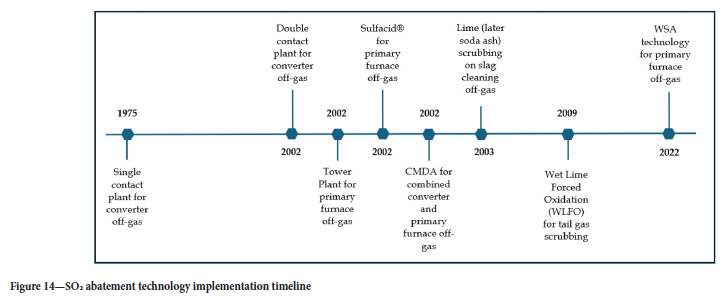
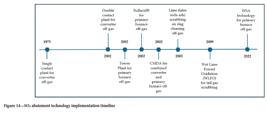
Early furnace off-gas cleaning focused on the removal of particulate matter from furnace off-gases. With increased production rates, leading to increased SO2 concentrations in off-gas, companies moved towards the installation of SO2 abatement technologies. In 1975, Impala Platinum commissioned the first single contact sulphuric acid plant in South Africa on a PGM operation, coupled with appropriate gas conditions stages for dust removal (Plasket, Ireland, 1976). RPM followed in 1976 with the installation of a single contact plant to treat Peirce Smith converter off-gas (Jacobs, 2006). These installations focused on the converter emissions as these are the highest concentration gases emitted on the smelter site (> 3 vol% SO2). Impala Platinum performed further upgrades to the single contact plant in 2002 due to an increased number of converters installed (Coetzee, 2006).
Further increases in capacity and changes in concentrate origins caused primary furnace emissions to start increasing, both in mass load emissions and in concentrations. In particular, the significant increase in production throughputs at all of the PGM smelting operations in the Rustenburg region in the 1990s, necessitated a strong drive to improve environmental controls from each of the industry players. Consequently, SO2 abatement equipment needed to be installed on the primary furnaces to manage ambient air quality. Fugitive emissions abatement was another important consideration to manage local ambient conditions around the smelting sites. Technologies used for primary furnace abatement were well suited to treating fugitive gases and therefore the duties could be combined (Wescott, 2007).
In 2002 RPM commissioned the converter plant (CP) at the Waterval facility. This change in process was accompanied by significant upgrades in gas cleaning technologies. A new single contact plant was installed to support the converter operation. Due to operational challenges experienced, described by Viviers and Hines (2005), the single contact plant was upgraded to a double contact double adsorption (DCDA) plant in 2005. In 2002 a novel Petersen-Fattinger Tower plant was also installed at Waterval to treat the primary furnace off-gas from both the primary furnaces. The Tower plant also treated the tailgas from the contact plant to manage final emissions to atmosphere. The Tower plant installation uses a nitric acid catalyst to remove SO2 and produces a ~76% sulphuric acid product. Significant upgrades to the Tower plants materials of construction were also made to improve asset integrity during the same period. Significant work has been performed to better understand the materials and the maintenance of the plant, as described by Fouche (2017).
The installation of a second novel technology took place in 2002, with Impala installing a Sulfacid* plant to treat the primary furnace off-gas (Kruger, 2004). The technology relies on an activated carbon catalyst to produce a < 20% sulphuric acid product (Coetzee, 2006). Impala required further upgrades to its installed equipment to meet changed legislation and in 2009 commissioned two tailgas scrubbers based on MECS DynaWave* reverse-jet technology (Impala Platinum Limited, 2025). The technology utilises wet lime-forced oxidation to produce a gypsum product and relies on the oxidation of calcium sulfite to calcium sulfate in the sump of the vessel to ensure the quality of the gypsum.
The first installations of wet scrubbing plants for SO2 abatement purposes were also introduced in the early 2000s. In 2002, SSW (Lonmin at that time) installed a concentrated mode dual-alkali (CMDA) plant to treat the combined off-gas streams from the Peirce Smith converters and primary electric furnaces (Bezuidenhout et al., 2012). This system was selected due to its ability to handle large variations in off-gas flow and SO2 strength and an intention to co-dispose the plant product (a combination of CaSO3 and CaSO4 referred to as CaSOx) with the concentrator tailings, however, challenges were faced in disposing of the product. Options trialled included purpose-built dams and use in mine back fill and hazardous waste disposal, with the latter being practiced (Bezuidenhout et al., 2012). In 2003 RPM commissioned a wet lime scrubber for treatment of the SCF off-gas at Waterval. Significant operational challenges relating to scaling and choking of off-gas ducts necessitated the change from lime to sodium carbonate (soda ash) scrubbing, which significantly improved operations.
The next and latest technology implementation was the first installation of the Wet-gas Sulphuric Acid (WSA) technology at Valterra Platinum's Polokwane Smelter, which was commissioned in 2021 (Ndlovu et al., 2023). The plant uses the Topsoe technology to produce a > 96% sulphuric acid for sale into the market and was selected due to its low operating costs and minimal effluent production. Zimplats have also selected the WSA technology for implementation at the new expanded Selous Metallurgical Complex. Delays in approvals and construction indicate the plant could be operational by H2 2028 (Implats, 2025).
Risks and management
With the intensification of smelting processes, increasingly sophisticated controls have been introduced to manage the risks. Risk management in the PGM smelting operations is an extensive effort, which cannot all be covered in this paper; only the key issues will be covered here. Loss of containment and steam explosions caused by molten material interaction with water have historically been some of the highest consequence unwanted events in the smelting industry, and the PGM furnaces have been no exception to this. Exposure of people to the energies associated with these unwanted events results in life-threatening scenarios, which have been experienced and documented by the PGM smelting industry in various publications.
Slag granulation systems may be subject to steam explosions caused by improper process conditions. Water-slag ratios of 15:1, nozzle pressures of 550 kPa, water temperature, and launder design are listed as key variables for effective granulation as per Mostert and Roberts in 1973. These are also important today where increased automation is being used to measure these and other variables online and, in some cases, implement equipment and process interlocks to prevent unsafe conditions. Substitution of water by air in slag granulation was implemented at Northam in 2018 for converter slag (Hatch, 2018) and is being planned for implementation at the Mortimer Smelter in 2027. This has resulted in a step-change reduction in the risks associated with slag granulation. Northam have furthermore changed from wet slag handling on their primary furnace slags to dry slag handling (Northam, 2024).
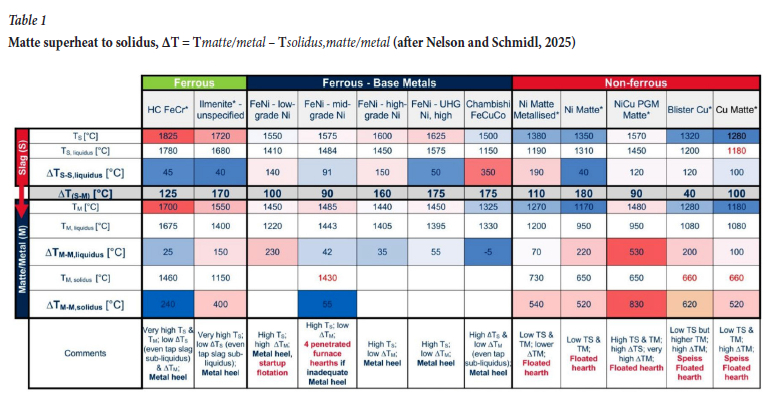
In the design of the furnaces, two key factors that have impacted operational risks are high matte superheats and copper cooler corrosion. Smelting intensity has increased and process metallurgy has changed with higher MgO and Cr2O3 concentrations driving rising slag temperatures and, consequently, matte superheats (Shaw et al., 2014). The extreme matte superheat is a key differentiator for PGM smelting when compared to other industries (Table 1) and in addition, high thermal conductivity and convective heat transfer coefficients make the formation of reliable matte freeze linings practically unattainable. The implication is that copper coolers will melt in direct contact with PGM matte and therefore the reliance on competent refractory materials is essential to protect them in the matte zones of the furnace.
Despite the implemented design interventions, cooler failure and the resulting steam explosions continue to pose a significant hazard. The PGM smelting industry has adopted process safety management (PSM) principles, which provide a solid framework for managing these risks. However, practical challenges still arise, such as the reliance on procedural controls, gaps in process safety information, the complexity of hazard and operability study (HAZOP) and layer of protection analysis (LOPA) methods, and the difficulty of defining clear safe operating envelopes (Valiyev et al., 2025). Alongside the application of inherently safe design principles, enhanced monitoring and automation have formed a key component of the implemented approach.
Monitoring systems have been developed as a means to detect abnormal conditions and water leaks. Simple point temperature monitoring to measure copper and water temperatures has long been employed to detect unexpected heat flux conditions. These methods are limited in their ability to detect localised problems. In the early 2000s, the use of fibre optic lines cast into the copper element was first used, which would detect the highest temperature along its length and indicate imminent failure (Sakaran et al., 2018; Van Beek et al., 2014; Hopf, Rossouw, 2006). Leak detection methods have been deployed, which use automated pressure testing and more recently, continuous tundish level monitoring. Both methods have proven to be sufficiently reliable and sensitive in detecting actual water leaks. Measurement of moisture in the off-gas to detect water leaks using tuneable diode laser absorption spectroscopy (TDLAS) has been used at the Valterra Platinum converter (Govindsamy et al., 2021) and will also be installed at the slag cleaning furnace. Advanced statistical methods have been developed where 'event detection' monitors the trends of the online instrumentation (e.g., temperatures) and identifies deviations from history using principal component analysis (PCA) (Groenewald, 2018). There are two legs to the PCA-based technique; the first detects sharp/sudden changes while the second detects drifts. System errors or events detected are communicated to the operations staff. It was first trialled on the matte wall and tap blocks at Polokwane and quickly proved to be highly reliable as well as sensitive in detecting deviations. It has since then been rolled out to include all walls and hearths of all Valterra Platinum furnaces.
Separation of people from the hazards has required significant automation. Measurement of top of furnace feed level using radar (Hundermark et al., 2018) has proven successful in multiple instances but is not yet widely used. Automated sounding systems to obtain buildup, matte, and slag levels are currently being trialled by various operations (Goff et al., 2011). The combination of these two technologies would remove the operator completely from the furnace roof where they are currently still required to perform soundings. On the tapping floor, the replacement of hand-held pyrometers with online thermal cameras led to a 21% reduction in exposure of the operator to the open taphole while offering real-time continuous temperature measurement of the tapping process (Sanker Jawohir et al., 2022). As early as 1969, the first electric furnaces at RPM made use of clay guns to close the matte and slag tap holes (Mostert, Roberts, 1973). Subsequently, tap hole drilling and plugging machines have become more powerful and sophisticated, allowing more consistent drilling open, without damaging the refractories, and more reliable plugging (Dienenthal, 2014). Alternatives to drilling and plugging machines have proven impracticable and this remains best practice in the PGM smelting industry. Use of emergency systems for tapping operations have improved: push buttons have allowed closure of cooling water supply and air purge to matte taphole face plates in the event of damage (Van Beek et al., 2014). A hydraulically actuated slag shut-off valve has been implemented as an alternative to closing the slag hole with a clay gun in emergencies (Essack, 2014). Emergency water granulation systems have been installed, which provide back-up gravity-fed water in the event of supply failure by pumps. Further separation of people from the hazards has been achieved by using remotely located control rooms. State-of-the-art facilities, as implemented at all the Valterra Platinum smelters, utilise in-plant cameras in critical areas, which provide visibility for operators.
Operational best practices have proven important in managing risk where operation within the design envelope is proceduralised via 'smelting rules' and stable power control is prioritised over stock management. Furthermore, routine maintenance interventions are planned such that vulnerable areas of the furnace are replaced prior to potential failure. Historically 'cold shuts' were performed and in 2009 the first 'hot shut' was implemented at Polokwane where low power inputs were maintained during furnace wall replacement, which prevented a deep thermal cycle and considerably reduced the ratchet on the hearth (Snodgrass et al., 2024).
Conclusion
Significant technological advances have been made in the PGM smelting industry across all unit operations including drying, primary smelting, converting, slag cleaning, off-gas handling, and risk management. These have resulted in improved safety, better efficiencies, and reduced costs.
With the outlook in demand for PGMs changing as a function of automotive demand requirements, smelting technology will need to continue to evolve. Existing challenges, which require future work include:
• Mitigation of copper corrosion of other copper coolers above and below the main slag-concentrate zone, where corrosion rates are considerably slower, however, still limit component campaign lives, where components are reused. Examples of such coolers are upper plate coolers (above the slag zone), matte tap blocks and flanker coolers.
• Further enhancements are required to improve electrical energy efficiencies, with the cost of electricity being a major contributor to overall smelting costs. Increased use of renewable sources to power the smelting operations will aid in reducing Scope 2 emissions.
• More cost-effective technology solutions for SO2 abatement are required. With the possibility of further tightening of legislation, increased production, changes in feed metallurgy, technology advancements are required, which may further improve SO2 capture efficiency, reduce capital and operating costs, and generate saleable byproducts.
• Further automation around the molten materials environment is required to improve engineering controls and further remove personnel from proximity to the hazards.
Acknowledgments
The authors wish to thank Valterra Platinum for permission to publish this paper.
References
-
Anglo American Platinum. 2016. Anglo American Site Visit: Processing and Polokwane Smelter. https://www.angloamerican.com/~/media/Files/A/Anglo-American-Group/PLC/media/presentations/2016pres/anglo-american-site-visit-processing-and-polokwane-smelter-241116-v2.pdf [accessed 2026-02-08].
» https://www.angloamerican.com/~/media/Files/A/Anglo-American-Group/PLC/media/presentations/2016pres/anglo-american-site-visit-processing-and-polokwane-smelter-241116-v2.pdf - Beath, C.B., Cousins, C.A., Westwood, R.J. 1961. The exploitation of the Platiniferous Ores of the Bushveld Igneous Complex with Particular Reference to the Rustenburg Platinum Mines, VIIth CMMI Congress (Johannesburg: South African Institute of Mining and Metallurgy), pp. 238-241.
- Bruce, J.T. 1996. Rustenburg and Johnson Matthey, An Enduring Relationship. Platinum Metals Review, vol. 40, no. 1, pp. 2-7.
- Bezuidenhout, G.A., Eksteen, J.J., Akdogan G., Van Beek, B., Wendt, W., Persson, W. 2017. Implementation of flame optical emission spectroscopy system for converter Fe end-point control associated with Ni-Cu-S-PGM converter mattes. Minerals Engineering, vol. 100, pp. 132-143.
- Bezuidenhout, G.A., Davis, J., Van Beek, B., Eksteen, J.J. 2012. Operation of a concentrated mode dual-alkali scrubber plant at the Lonmin Smelter. Journal of The Southern African Institute of Mining and Metallurgy, vol. 112, pp. 657-665.
- Cheng, F., Zhou, X.,Liu, Y. 2018. Methods for improvement of thermal efficiency during spray drying. E3S Web of Conferences vol. 53, pp. 01031.
- Chibwe, D.K., Akdogan, G., Bezuidenhout, G.A., Kapusta, J.P.T., Bradshaw, S., Eksteen, J.J. 2015. Sonic injection into a PGM Peirce-Smith converter: CFD modelling and industrial trials. Journal of The Southern African Institute of Mining and Metallurgy, vol. 115, May, pp. 349-354.
- Coetzee, V. 2006. Common-Sense Improvements to Electric Smelting at Impala Platinum. Southern African Pyrometallurgy 2006, South African Institute of Mining and Metallurgy, Johannesburg, March, pp. 43-62.
- Crafford, M., Monobe, M., Erasmus, G., Matutu, S. 2025. Commissioning of the Zimplats Smelter expansion. 9th International PGM Conference. Southern African Institute of Mining and Metallurgy, Rustenburg, October, pp. 185-197.
- Cramer, L.A. 2001. The extractive metallurgy of South Africa's platinum ores. JOM. pp. 14-18.
- Dienenthal, A. 2014. A short history of the development of tapping equipment. Proceedings of the Furnace Tapping Conference 2014. Southern African Institute of Mining and Metallurgy, pp. 203-216.
- Eksteen, J.J., Van Beek, B., Bezuidenhout, G.A., 2011. Cracking a hard nut: An overview of Lonmin's operations directed at smelting of UG2-rich concentrate blends. Southern African Pyrometallurgy 2011, edited by R.T. Jones & P. den Hoed, Southern African Institute of Mining and Metallurgy, Johannesburg, March, pp. 231-252.
- Forbes, J.E. 1977. Oxygen enrichment of the converter air at Rustenburg Platinum Mines. Journal of the South African Institute of Mining and Metallurgy, vol. 77, no. 6, pp. 132-136.
- Fouche, P.M. 2017. An example of the use of advanced fibre-reinforced plastics in sulphuric acid plants. The Journal of the South African Institute of Mining and Metallurgy, vol. 117 no.11, pp. 1023-1029.
- Goff, T.J., Brogden, N., Nilsson, J.P., Bloemer, P., Lyons, A. 2011. 'Implementation of an alternative matte-level measurement solution at Lonmin Marikana Smelter Division for improved process monitoring', Proceedings of the SAIMM Pyrometallurgy 2011 Conference, Johannesburg, South Africa, 9-10 March 2011. The Southern African Institute of Mining and Metallurgy, pp. 269-278.
- Gouldsmith, A.F.S., Wilson, B. 1963. Extraction and Refining of the Platinum Metals, A complex cycle of smelting, electrolytic and chemical operations. Platinum Metals Review, vol. 7, no. 4, pp. 136-143.
- Govindsamy, D., Georgalli, G.A., Hoosen, A. 2021. Leak detection at Anglo Platinum Converting Process using Digital Twins. IFAC PapersOnLine 54-21 (2021), pp. 192-197.
- Grimsey, E.J. 2021. A comparison of two novel non-ferrous metal recovery equations: Development similarity and industrial significance. Metallurgical and Materials Transactions B. vol. 52 no. 5, pp. 2817-2820.
- Groenewald, J.W.D., Nelson, L.R., Hundermark, R.J., Phage, K., Sakaran, R.L., Van Rooyen, Q., Cizek, A. 2018. Furnace integrity monitoring using component analysis: an industrial case study. The Journal of the South African Institute of Mining and Metallurgy, vol. 118, no. 4, pp. 345-352.
-
Hatch, 2018. Website article: Northam Converter Dry Slag Granulation. https://www.hatch.com/Projects/Metals-And-Minerals/Northam-Converter-Dry-Slag-Granulation
» https://www.hatch.com/Projects/Metals-And-Minerals/Northam-Converter-Dry-Slag-Granulation - Hochreiter, R. C., Kennedy, D. C., Muir, W., Woods, A. I. 1985. Platinum in South Africa (Metal Review Series no. 3). Journal of the South African Institute of Minerals and Metallurgy, vol. 85 no. 6, pp. 165-85.
- Hopf, M., Rossouw, E. 2006. New Opportunities - Exhaustive Monitored Copper Coolers for Submerged Arc Furnaces. Southern African Pyrometallurgy 2006 International Conference, Cradle of Humankind, South Africa, 5-8 March 2006. pp. 89-100.
- Hoosen, A., Sichone, M., Rambiyana, I. 2018. Improvements to the Anglo Converting Process (ACP) tap-block management. Furnace Tapping2018. Edited by J.D. Steenkamp and A. Cowey, Southern African Institute of Mining and Metallurgy, pp. 49-56.
- Hundermark, R.J., Nelson, L.R. 2014. Redoubling platinum group metal smelting intensity - operational challenges and solutions. Proceedings of EPD Symposium in Honor of David G.C. Robertson, TMS, San Diego, CA, pp. 189-96.
- Hundermark, R., Van Rooyen, Q., Van Manen, P., Steyn, C., Sadri, A., Chataway, D. 2018. Development of Continuous Radar Level Measurement for Improved Furnace Feed Control. Proceedings of Extraction 2018. The Minerals and Metals Society, 2018. pp. 287-302.
-
Hundermark, R.J., Nelson, L.R., Berger, B. 2020. Thermal conductivity measurements of solid mattes containing Fe-S-Ni-Cu-Co from 100-450°C. The 11th Molten Slags, Fluxes, and Salts [MOLTEN 2020], Seoul, Korea, May. Implats. 2025. Annual Integrated Report. https://www.implats.co.za/pdf/annual-reports/annual-integrated-report/2025/integrated-report-2025.pdf
» https://www.implats.co.za/pdf/annual-reports/annual-integrated-report/2025/integrated-report-2025.pdf - Jacobs, M. 2006. Process Description and Abbreviated History of Anglo Platinum's Waterval Smelter. Southern African Pyrometallurgy 2006, South African Institute of Mining and Metallurgy, Johannesburg, March, pp. 17-28.
- Johnson Matthey. 1969. Platinum Mining at Rustenburg, Growth of the World's Largest Producer. Platinum Metals Review, vol. 13, no. 1, pp. 15-22.
- Johnson Matthey. 1970. New Electric Smelter at Rustenburg, A further stage in the expansion programme. Platinum Metals Review, vol. 14, no. 2, pp. 48-49.
- Jones, R.T. 1999. Special issue on Platinum in South Africa to commemorate the 75th anniversary of the discovery of the Merensky Reef. South African Journal of Science. vol. 95, November/December, pp. 525-534.
- Jones, R.T. 2005. An overview of Southern African PGM smelting. Nickel and Cobalt 2005 Challenges in Extraction and Production. 44th Annual Conference of Metallurgists of CIM. Calgary, pp. 147-178.
- Joubert, H., Nourse, R.B., Masters, B., Hundermark, R.J. 2005. Copper cooling design, installation and operational results for the slag cleaning furnace at Waterval Smelter, Rustenburg Platinum, South Africa. Nickel and Cobalt 2005 Challenges in Extraction and Production, Edited by J. Donald and R. Schonewille, 44th Annual Conference of Metallurgists of CIM, Calgary, Alberta, Canada pp. 19-35.
- Joubert, H., De Villiers, G., Mbedzi, P., Davis, J. 2024. Composite Copper-Graphite Cooler for PGM Furnace Sidewall. Advances in Pyrometallurgy, G. Alvear et al. (eds.), The Minerals, Metals and Materials Society, pp. 51-65.
- Joubert, H., De Villiers, G., Nel, J., Senekal, D., Mbedzi, P., Davis, J. 2024. PGM furnace crucible upgrade and performance. Southern African Pyrometallurgy 2024, Johannesburg, South Africa, March 2024, pp. 221-234.
- Joubert, H., De Villiers, G., Nkosi, P., Mokgwamme, E. 2025. PGM furnace crucible performance following design upgrade. Ni-Co 2025, 6th International Symposium on Nickel and Cobalt, pp. 875-889.
- Kapusta, J.P.T., Davis, J., Bezuidenhout, G.A., Lefume, S., Chibwe, D.K. 2012. Industrial evaluation of sonic injection in a Peirce-Smith converter at the Lonmin Platinum Smelter. Towards Clean Metallurgical Processing for Profit, Social and Environmental Stewardship. Proceedings of the 51st Annual Conference of Metallurgists. Niagara Falls, pp. 43-58.
- Kemp, I.C. 2012. Fundamentals of Energy Analysis of Dryers. Modern Drying Technology, Volume 4: Energy Savings, Edited by Tsotsas, E. and Mujumdar, A. S., 1st edn. Weinheim: Wiley-VCH, pp. 1-32.
- Kruger, B. 2004. Recovery of SO2 from low strength off-gases. International Platinum Conference 'Platinum Adding Value. The South African Institute of Mining and Metallurgy, Sun City, South Africa, 3-7 October. Johannesburg, pp. 37-46.
- Mabiza, L. 2006. An overview of PGM smelting in Zimbabwe -Zimplats Operations. Southern African Pyrometallurgy 2006, South African Institute of Mining and Metallurgy, Johannesburg, March, pp. 63-76.
- Mabiza, L., Picas, R., Nell, J., Matsetela, B., Erasmus, G. 2011. Characterisation of SO2 in offgas at Zimplats smelter. Southern African Pyrometallurgy 2011, Edited by R.T. Jones and P. den Hoed. Southern African Institute of Mining and Metallurgy, Johannesburg, March, pp. 161-171.
- Merkle, R.K.W., McKenzie, A.D. 2002. The Mining and Beneficiation of South African PGE ores - An Overview. The Geology, Geochemistry, Mineralogy and Mineral Beneficiation of Platinum-Group Elements. Edited by Cabri, L.J., Special Volume 54. Montreal: Canadian Institute of Mining, Metallurgy and Petroleum, pp. 793-810.
- Mostert, J.C., Roberts, P.N. 1973. Electric smelting at Rustenburg Platinum Mines Limited of nickel-copper concentrates containing platinum-group metals. Journal of the South African Institute of Mining and Metallurgy, April, 290-299.
- Nagorski, M., Van der Merwe, M., Mulder, G., DeGorter, M., Kingsley, T. 2025. Factors influencing campaign life of PGM furnace hearths. 9th International PGM Conference. Southern African Institute of Mining and Metallurgy, Rustenburg, October, pp. 117-128.
- Nell, J. 2004. Melting of platinum group metal concentrates in South Africa. Journal of the South African Institute of Mining and Metallurgy, vol. 104, (no. 7, pp. 423-428.
- Nelson, L.R., Stober, F., Ndlovu, J., De Villiers, L.P.vS., Wanblad, D. 2005. Role of technical innovation on production delivery at the Polokwane Smelter. Nickel and Cobalt 2005: Challenges in Extraction and Production. 44th Annual Conference of Metallurgists, Calgary, Alberta, Canada, August. pp. 91-116.
- Nelson, L.R., Hundermark, R.J., Van der Merwe, K. 2015. Observations on the impact of furnace dimensioning and power density on tap-hole integrity. The 54th Annual Conference of Metallurgists (COM2015), CIM, Toronto, August.
-
Nelson, L.R., Georgalli, G.A., Hines, K.L, Hundermark, R.J. 2018. Converter processing of platinum group metals, Mineral Processing and Extractive Metallurgy, DOI: 10.1080/25726641.2018.1506272.
» https://doi.org/10.1080/25726641.2018.1506272 - Nelson, L.R., Schmidl, J. 2025. Short Course: Pyrometallurgical Processes in Copper and Nickel/Cobalt Extraction: Furnace Integrity, Extraction 2025, Phoenix, AZ.
- Ndlovu, M., Marsden, G., Bezuidenhout, J., Hundermark, R., Erasmus, G. 2023. SO2 abatement at the Polokwane Smelter -The project and the process'. The 8th Sulphur and Sulphuric Acid Conference 2023. The Southern African Institute of Mining and Metallurgy Cape Town, March, pp. 1-3.
- Northam. 2024. Summarised Financial Results, 30 June 2024.
- Rivera Li Kao, O., Garbers-Craig, A. 2025. Decomposition of sulfide phases and subsequent matte collection in the black top of a Platinum Group Metal smelter. Mineral Processing and Extractive Metallurgy Review, vol. 46, (no. 5), pp. 616-625.
- Plasket, R.P., Ireland, D.A. 1976. Ancillary smelter operations and sulphuric acid manufacture at Impala Platinum Limited. Journal of the South African Institute of Mining and Metallurgy, August, pp. 1-10.
- Sakaran, R. L., Van Rooyen, Q., Van Manen, P. K., Mukumbe, P.P. 2018. Analysis and interpretation of fibre optic temperature data at the Polokwane Smelter. Journal of the Southern African Institute of Mining and Metallurgy, vol. 118 (no. 4), pp. 337-344.
- Sakaran, R.L., Le Roux, J.D., Garbers-Craig, A.M. 2024. The impact of feed composition on the recovery of base metals in an electric furnace. Southern African Pyrometallurgy 2024. Southern African Institute of Mining and Metallurgy, Johannesburg, pp. pp. 321-334.
- Sanker Jawohir, A., Van der Merwe, K., Potgieter, H.P. 2022. Replacement of hand-held pyrometers with on-line thermal cameras on the tapping floor. Proceedings of the 8th International PGM Conference. The Southern African Institute of Mining and Metallurgy. Sun City, November. pp. 87-97.
- Sarvinis, J., De Vries, S., Joiner, K., Van Mierlo, C., Voermann, N. 1999. Improvements to BHP Hartley Platinum's Smelting Furnace. Proceedings of the Copper 99 - Cobre 99 International Conference: Vol. V. Smelting Operations and Advances. Phoenix, Arizona, USA, 10-13 October. Warrendale, PA: The Minerals, Metals & Materials Society (TMS), pp. 235-250.
- Shaw, A., De Villiers, L.P.vS., Hundermark, R.J., Ndlovu, J., Nelson, L.R., Pieterse, B., Sullivan, R., Voermann, N., Walker, C., Stober, F., McKenzie, A.D. 2014. Challenges and Solutions in PGM Furnace Operation: High Matte Temperature and Copper Cooler Corrosion, Journal of the Southern African Institute of Mining and Metallurgy, vol. 113, no. 3, pp. 251-261.
- Snodgrass, R., Marsden, G., Van der Merwe, K., Shoko, S. 2024. Recent developments at Anglo American Platinum's smelting operations. Southern African Pyrometallurgy 2024. Southern African Institute of Mining and Metallurgy, Johannesburg, March, pp. 207-224.
- Valiyev, A., Hines, K., Maharaj, J., Laher, I. 2025. Fahrenheit 3214: PSM in Electric Furnace Smelting Operations - Challenges and Opportunities, Proceedings of the 2025 AIChE Spring Meeting and 21st Global Congress on Process Safety. Houston, TX, 6-10 April.
- Van Beek, B., Goff, T.J., Nel, P.E., Rex, E. 2014. An overview of the design, operation, and maintenance practices relating to tap-hole management on a PGM smelting furnace. Journal of the Southern African Institute of Mining and Metallurgy, vo. 116, no.1, pp. 27-34.
- Viviers, P., Hines, K. 2005. The new Anglo Platinum Converting Project. First Extractive Metallurgy Operators' Conference. Brisbane, Australia, 7-8 November. Carlton, Victoria: Australasian Institute of Mining and Metallurgy (AusIMM), pp. 1-8.
- Watson, G.B., Harvey, B.G. 1992. A common-sense approach to process improvements to electric smelting of nickel-copper concentrates at Impala Platinum. Proceedings of the International Symposium on Non-ferrous pyrometallurgy. The Metallurgical Society of CIM. Edmonton. pp. 289-304.
-
World Platinum Investment Council (WPIC). 2026. Supply and Demand historical data. https://platinuminvestment.com/supply-and-demand/historic-data [accessed 14 January 2026]
» https://platinuminvestment.com/supply-and-demand/historic-data

Published: July. 2026