The influence of N on hot ductility of V-, Nb-, and Nb-Ti- containing steels using improved thermal simulation of continuous casting
Abstract
SYNOPSIS The hot ductility of in situ melted tensile specimens of micro-alloyed steels having C contents in the range 0.12-0.17% (mass %) have been examined over the 700-1000ºC temperature range. An improved testing method for simulating the continuous casting process was used, which takes into account both primary and secondary cooling conditions. Increasing the N content to electric arc furnace levels (0.01% N) was found to cause a serious deterioration in ductility. V-N steel gave better ductility than Nbcontaining steels due to less precipitation. From a cracking perspective, low- N steels are generally recommended but, when not feasible, a combination of Nb and V gives even better ductility. However, to be sure of avoiding transverse cracking in higher N steels a small addition of Ti is required. This resulted in a decrease in the fraction of fine particles and in accord with this better ductility. Transverse cracking of industrial slabs was then avoided
hot ductility; continuous casting; steel; N; V; Nb; Ti additions
SYNOPSIS
The hot ductility of in situ melted tensile specimens of micro-alloyed steels having C contents in the range 0.12-0.17% (mass %) have been examined over the 700-1000ºC temperature range. An improved testing method for simulating the continuous casting process was used, which takes into account both primary and secondary cooling conditions. Increasing the N content to electric arc furnace levels (0.01% N) was found to cause a serious deterioration in ductility. V-N steel gave better ductility than Nbcontaining steels due to less precipitation. From a cracking perspective, low- N steels are generally recommended but, when not feasible, a combination of Nb and V gives even better ductility. However, to be sure of avoiding transverse cracking in higher N steels a small addition of Ti is required. This resulted in a decrease in the fraction of fine particles and in accord with this better ductility. Transverse cracking of industrial slabs was then avoided.
Keywords: hot ductility, continuous casting, steel, N, V, Nb, Ti additions.
Introduction
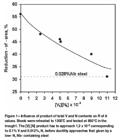
Previous work1Figure 1) that for V- containing steels within the peritectic C range, the [V] [N] product has to approach 1.2 x10⁻³, corresponding to 0.1%V and 0.012% N before ductility approaches that given by a low -N, Nb containing steel; the latter steel being very susceptible to transverse cracking during continuous casting. When working with low-N steels it can be seen from Figure 1 that, for improved hot ductility, there is a definite advantage in using V where possible as the microalloying addition rather than Nb. However, it has been suggested by one of the authors (BM) that, because the precipitate influencing the hot ductility is VN in Vcontaining steels and Nb(CN) in Nbcontaining, i.e. the precipitation is solely nitride in the V steel and mainly carbide in the Nb- containing steel, that V steels may be prone to a greater deterioration in hot ductility than Nb steels at the higher N levels found in electric arc furnace (EAF) steels2
Experimental
The composition of commercially cast steels 1-10 in Table I can be divided into two carbon groups; peritectic steels 3-9 having a C level of ~0.14% C and hyper-peritectic steels 1,2, and 10 being Nb- containing steels with a higher C content of ~0.17%. In terms of microalloying content, steels 3, 4, and 10 were Nb-only, steels 1,2, and 6 were Nb-Ti, steels 7-9 were Nb-Ti-V, and steel 5 was V only with a high (100 ppm) N level. The N contents in steels 4 and 8 were also fairly high (>80 ppm) and typical of EAF levels.
Tensile specimens were machined from plates in the rolling direction and tested on a Gleeble machine using approximate 240 mm thick slab thermal cycles3Figure 2).

It can be seen from Table I that many of the steels contain Ti. Recent work3in situ melt and b) cool the specimens using a cooling path shown in Figure 2, i.e. a regime that includes both primary and secondary cooling3Tm in the mould is interrupted at the foot-rolls, after which there is a rise in the surface temperature due to the large thermal gradient between the strand centre and surface. For this reason, the cooling rate at the strand surface during secondary cooling is slow. In contrast to commercial experience which has shown that, under the correct conditions, Ti can be a very good element to add to reduce the problem of transverse cracking22, 4-6. Introducing the undercooling step in laboratory tests, as shown in Figure 2, not only improves ductility, but this is often sufficient to improve ductility over that of a Ti-free, Nb-containing steel of otherwise similar composition3Figure 3). This is particularly true when a slow secondary cooling step is included rather than a faster average cooling rate throughout the cooling schedule used in earlier, simpler simulations3

In this way, laboratory and commercial experience on adding Ti can be reconciled. It should be noted that for plain Nb- or V- containing steels, a simpler cooling regime is generally adequate, such as was used in the earlier work shown in Figure 1, and that melting is not required as the precipitates will all be in solution on reheating to ~1300ºC. Nevertheless, the commercial cooling regime shown in Figure 2 is preferred in order to make accurate forecasts of the likelihood of a steel being susceptible to transverse cracking.
The primary cooling rate in Figure 2, from the melting point Tm to Tmin, was taken as 600 K/min, and the average secondary cooling rate from Tmax to Tu, the start of unbending, was 12 K/min. The steels were tensile tested over the temperature range 700-1000ºC and strained to failure using a strain rate of 3 x10⁻³s-1. The reduction-of-area (R of A) was taken as the measure of hot ductility. After failure the fracture surfaces were cooled at rates of ~20ºC/s to below 400ºC. Carbon replicas were extracted from selected samples close to the point of fracture and examined with a transmission electron microscope (TEM).
Results and discussion
Review of the influence of N on Nb-containing steels within the peritectic C level
Nb- containing steels are found to be one of the steel groups most prone to transverse cracking during continuous casting for the following reasons:
1. Nb has a powerful influence in decreasing the Ar3 (dynamic transformation start on cooling), thus widening the trough at the low temperature end by increasing the temperature range in which the thin soft film of deformation induced ferrite is present surrounding the austenite (γ) grains, allowing strain concentration to occur2
2. Nb precipitates out very rapidly as Nb(CN) in a fine form in the γ upon deformation in the temperature range of the straightening operation. The increased matrix strength encourages grain boundary sliding in the γ and void formation in the ferrite film, thus so increasing the depth of the trough. The precipitates at the boundaries make it easy for cracks to interlink, resulting in inter-granular failure2
3. Often there are coarser NbCN precipitates at the γ grain boundaries, which are surrounded by a soft, precipitate-free zone. These precipitate-free zones behave in a similar manner to the ferrite film so that strain concentration again occurs, resulting in poor ductility which continues for temperatures in excess of the Ae3 (equilibrium transformation start), so widening the trough at the high temperature end2
Nb is, of course, added for its ability to refine the γ grain size and induce precipitation hardening so that high strength and toughness can be achieved in the final product. However, the same precipitation of Nb(CN) which causes these desirable qualities also makes it more difficult to cast these steels.
Previous work by Ouchi and Matsumoto7
Ouchi and Matsumoto78Figure 4). In their case it was likely that only Nb(CN) was present rather than NbC, which precipitates out at temperatures below those normally used when straightening.
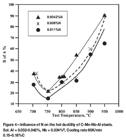
In the present work using the commercial cooling schedule in Figure 2, increasing the N from 0.005% to 0.0095%, (steels 3 and 4, respectively) resulted in a greater deterioration in ductility than had been noted by Mintz and Arrowsmith (Figure 5). It should be noted here that the lower N steel, steel 3, has a higher Nb content so that the deterioration would be expected to be even more marked than if the Nb levels had been similar. The movement of the hot ductility curve to higher temperatures (compare Figure 4 and steel 4 in 5) is probably related to the peritectic C content of steel 4 and the slower cooling rate increasing the transformation temperature.
Influence of V at high N levels on the hot ductility of peritectic steels
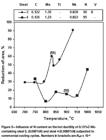
It can be seen from Figure 6 that the V- containing(0.052%V) high- N steel, steel 5, has better ductility than a high- N, Nb-containing steel, steel 4. Previous work1
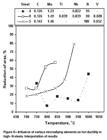
Recent work9Figure 6 shows that in order to achieve this in steel 4, the straightening temperature near the carrier would need to be in excess of 950ºC, a rather high temperature to accommodate. Previous work10,11 has shown that Nb-V combinations give better ductility than either Nb or V steels. Furthermore, the addition of enough Ti to combine completely with the high N, as in steel 8, gives R of A values in excess of the critical 35% at temperatures in excess of 800ºC (Figure 6). Such a steel has been found not to exhibit transverse cracking.
Thus, although the ductility is considerably better when V is the sole microalloying addition, it is still not optimum and the presence of Nb,V, and Ti are needed to ensure freedom from cracking (Figure 6). A 35% R of A has been based on tests where an average cooling rate to the test temperature has been used, and not on tests which include both primary and secondary cooling conditions, which simulates the commercial cooling schedule more accurately. The work to date has suggested that when using this simulation a reduced R of A value, such as 15-20 per cent, may be acceptable to avoid transverse cracking. For example, steels 8 and 5 did not crack under normal industrial casting conditions, but steel 4 did. Further work is required to establish a more precise critical value that can be used for predicting the likelihood of a steel being susceptible to transverse cracking.
Ductility in microalloyed steels has been shown to be very dependent on the fineness of the precipitation2Neff, that is present during the straightening operation that controls the volume fraction of fine precipitation and hence ductility. The finer the precipitation in the matrix, the greater is the stress acting on the grain boundaries, encouraging grain boundary sliding and intergranular failure. Finer precipitation at the boundaries also reduces the spacing between precipitates so making it easier for cracks developing along the boundaries to interlink2
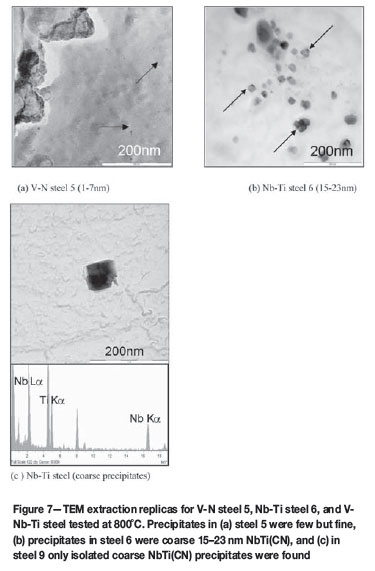
Previous work11Figure 7). At these V and N levels, one might have expected a larger volume fraction and coarser precipitation of VN. This implies that only a small amount of VN precipitation had occurred during unbending. A possible explanation is that the unbending strain is insufficient to induce copious VN precipitation. VN precipitation is sluggish in undeformed austenite.

Many of the present results can be explained by the work of Akben et al.12, who have examined a Ti- free 0.05% C, 1.2% Mn steel at the 0.035% Nb and 0.115%V levels with 0.006% N. They showed that the kinetics of dynamic precipitation of both Nb and V are fast (Figure 8), with the V steel showing the slower kinetics. When present singly, the nose temperature was ~ 900ºC for the Nb- (0.035%) containing steel and slightly lower at 880ºC for the V- (0.115%) containing steel. Nb- precipitated out more rapidly than V at temperatures above 880ºC. At the nose it needed about 5 min to complete precipitation for the Nb containing steel and 8 min for the V steel. However, when the 0.035% Nb and 0.115% V were together in combination the rate of precipitation at the nose (900ºC) was considerably slowed down, the time taken for completion of precipitation being 15 min. In the work carried out by Mintz and Abushosha1et al.12113143

In the previous work32Neff, is then able to precipitate out as the carbonitride in a fine form on deformation which is detrimental to the ductility. The less N available for forming Nb(CN), i.e. the higher the Ti/N ratio, the better therefore will be the ductility. This is in good agreement with Triolet et al.15, who found Ti/N ratios above 3 improve ductility. It can be seen from Figure 9, which shows all the results, that in accord with this argument, as the Neff value (the N available in solution after the Ti has combined with the N) decreased from 0.01%N to zero, the ductility improves.

In the present instance, when Ti was present in the Nb-V steel 9 no V- containing precipitates were observed. Presumably the N had combined with the Ti as relatively coarse NbTi precipitates. The V, therefore, is probably in solution and is able to retard the precipitation of Nb. This results in the absence of the finer detrimental carbonitride precipitation that occurs in the V- free Nb-Ti- containing steel, leaving only the coarser Nb-Ti precipitates that are formed on slow cooling prior to deformation.
It is probable that both V and Nb precipitate out as carbides at temperatures below that used for straightening. The superior ductility shown in the Ti- Nb-V- containing steel can therefore be ascribed to 1) the absence of fine detrimental carbonitride precipitation that occurs upon deformation and 2) the presence of only coarse precipitates that are formed during the slow cooling at 12 K/min prior to deformation. From previous work2
Finally, under industrial conditions, while transverse cracking was observed in the Nb-Ti steels in this C range, the addition of V to these steels has been found to eliminate this problem.
Conclusions
1. A high- N, Nb(0.02%)- containing steel of peritectic C content showed very poor ductility, R of A values being <20 per cent at temperatures in the range 800-950ºC.
2. All steels containing Ti had better ductility than the Nb-only steel above 750ºC. However, below 750ºC the R of A was still below the 35 per cent currently thought to be the minimum value to avoid transverse cracking. This minimum value is probably lower for the thermal routes followed in this work.
3. high- N, Nb-V- containing steel with sufficient Ti to combine with all the free N had good ductility at temperatures above 750ºC and transverse cracking was not observed.
4. Ductility depended on the amount of fine Nb(C,N) or VN precipitation that occurs upon deformation during secondary cooling. If sufficient Ti is present to combine with all the N, the slow secondary cooling allows it to coarsen so that the precipitates have no influence on the ductility. VN and Nb(CN) cannot form upon deformation, and VC and NbC precipitate at temperatures below the straightening temperature range, so transverse cracking cannot occur.
5. When Ti is not present, Nb(CN) precipitates more rapidly upon deformation than VN, and even slower when Nb and V are present together.
Acknowledgements
Two of the authors (KMB and AT) would like to thank Angela Coetzee at ArcelorMittal Vanderbijlpark Plate Mill for valuable discussions and specimens. Thanks are also expressed to ArcelorMittal for permission to publish.
References
- 1. MINTZ, B. and ABUSHOSHA, R. The influence of vanadium on the hot ductility of steel. Ironmaking and Steelmaking, vol. 20, 1993. pp. 445-452.
- 2. MINTZ, B. The influence of composition on the hot ductility of steels and to the problem of transverse cracking. Iron and Steel Institute of Japan International, vol. 39, 1999. pp. 833-855.
- 3. BANKS, K.M., TULING, A., and MINTZ, B. The influence of V and Ti on the hot ductility of Nb containing steels of peritectic C contents. Materials Science and Technology, vol. 27, no. 8, 2011. pp. 1309-1314.
- 4. COMINELI, O., ABUSHOSHA, R., and MINTZ, B. Influence of titanium and nitrogen on hot ductility of C-Mn-Nb-Al steels. Materials Science and Technology, vol. 15, 1999. pp. 1058-1068.
- 5. ABUSHOSHA, R., COMINELI, O., and MINTZ, B. Influence of Ti on hot ductility of C-Mn-Al steels. Material Science and Technology, vol. 15, 1999. pp. 278-286.
- 6. LUO, H., KARJALAINEN, P., PORTER, D., LIIMATAINEN, H.M., and ZHANG, Y. The influence of Ti on the hot ductility of Nb-bearing steels in simulated continuous casting process. Iron and Steel Institute of Japan International, vol. 42, 2002. pp. 273-282.
- 7. OUCHI, C. and MATSUMOTO, K. Hot ductility in Nb-bearing High-Strength Low-alloy steel. Transactions of the Iron and Steel Institute of Japan, vol 22, 1982. pp. 181.
- 8. MINTZ, B. and ARROWSMITH, J.M. Hot-ductility behaviour of C-Mn-Nb-Al steels and its relationship to crack propagation during the straightening of continuously cast strand. Sheffield International Conference on Hot Working and Forming Processes. Sellars, C.M., and Davies, G.J. (eds.). Metal Society of London, vol. 9, 1979. pp. 99.
- 9. MINTZ, B. Hot ductility of steels and its relationship to the problem of transverse cracking in continuous casting. International Materials, Reviews, vol. 35, no. 3, 2010. pp. 168-196.
- 10. MINTZ, B. and ABUSHOSHA, R. The hot ductility of V, Nb/V and Nb containing steels. Proceedings of the International Conference on Materials, San Sebastian, Spain, 1998. Microalloying in Steels. Rodrigues, J.M., Guiterrez, I., and Lopez, S. (eds.). Switzerland. Materials Science Forum, vol. 284-286, 1998. pp. 451-468.
- 11. BANKS, K., KOUSARIS, A., VERDOORN, F., and TULING, A. Precipitation and hot ductility of low C,V and low C,V-Nb microalloyed steels during thin slab casting. Materials Science and Technology, vol. 17, 2001. pp. 1596-1604.
- 12. AKBEN, M.G., BACROIX, B., and JONAS, J.J. Effect of vanadium and molybdenum addition on high temperature recovery, recrystallization and precipitation behaviour of niobium-based microalloyed steels. Acta Metallurgica, vol. 31, 1983. pp. 161.
- 13. WAGNER, Z. Theory of precipitate change by redissolution. Zeitschrift für Elektrochemie, vol. 65, 1961. pp. 581.
- 14. TURKDOGAN, E.T. Causes and effects of nitride and carbonitride precipitation in HSLA steels in relation to continuous casting. AIME Steelmaking Conference Proceedings, Warrendale, PA. The Metals Society, 1987. vol. 70, pp. 399.
- 15. TRIOLET, N., POELMANS, K., MABELLY, P., and LE PAPILLON, Y. Prevention of corner cracks in slab continuous casting. Revue de Metallurgie, no. 11, 2009. pp. 508-517.