Extraction of Rare Earth Elements from Phalaborwa phosphogypsum
Abstract
Rare earth elements (REE) are present at concentrations of approximately 0.36 % in phosphogypsum stacks located in Phalaborwa, South Africa. The REE are present in the phosphogypsum in solid solution in the gypsum and as fluorine and aluminium rich precipitates. Recovery of the REE offers opportunities for valorization and reducing the environmental impact of the phosphogypsum waste. This paper presents the results of investigations into the leaching behaviour of rare earth elements and other impurities from phosphogypsum using aqueous sulfuric acid. The effects of acid concentration, temperature, residence time, and the influence of impurities were evaluated for their impact on the solubility of rare earth elements in a sulfate medium. It was found that a significant fraction of the REE can be leached from the phosphogypsum in a range of conditions much less severe than traditional hard rock rare earth processing conditions. The REE were leached at a sulfuric acid concentration of 110 g/l, temperature of 30°C - 40°C and a residence time of approximately 8 hours.
rare earth elements; phosphogypsum; Phalaborwa; extraction; sulfuric acid
Introduction
Demand for rare earth elements (REE) has increased in the last two decades, particularly those required in relatively large quantities for permanent magnets and other modern electronics. These elements include light rare earth elements (LREE) such as neodymium (Nd), praseodymium (Pr), and heavy rare earth elements (HREE) such as terbium (Tb), and dysprosium (Dy). The global drive particularly towards non-fossil fuel-based power generation and electrification of transport, has led to projections that between 2020 and 2030, annual demand will increase by 6.4% for Nd, 6.7% for Pr, 7.4% for Dy, and 33.4% for Tb. Argus Media estimates that by 2030, there will be a 25% supply deficit of critical rare earth elements, even if pipelined projects come online within schedule (Rainbow Rare Earths, 2022).
Typical hard-rock phosphate/carbonatite deposits require mining, comminution, concentration, hydrometallurgical extraction, purification, and separation to produce rare earth oxide products suitable for manufacture of magnets, etc. Ionic clay deposits are lower grade and may pose environmental risks by the way in which rare earths are leached, sometimes through the use of in-situ leaching, which can contaminate large areas of land. Recovery of rare earth elements from secondary sources and recycling of rare earths from electronic waste offers the opportunity to produce rare earth products without the need for mining or other costly, intensive, and hazardous extraction processes. The phosphogypsum (PG) residue stacks located near the town of Phalaborwa in South Africa contain approximately 0.43% total rare earth oxide (TREO) equivalent, one of the highest REE-grade phosphogypsum resources described in literature (Lambert et al., 2018; Li et al., 2021). PG produced from the treatment of sedimentary phosphate deposits typically contain 0.02% - 0.05% w/w REE, whilst PG from igneous sources such as those found in Poland, Russia, and Brazil may contain 0.43% - 0.73% w/w REE. Igneous sources are fewer however, and sedimentary sources such as those found in Florida, Spain, and Canada are far more abundant. The Phalaborwa PG contains high concentrations of REE due to the upgrading of REE in the igneous complex over long periods of time, and the subsequent concentration of phosphate rock for processing into phosphoric acid on site over the course of several decades from the 1960s to 2013. The rare earths are present in phosphate minerals in the area, apatite in particular, which is decomposed with sulfuric acid and heat to form gypsum and phosphoric acid. It is estimated that approximately 85% of the rare earths report to the phosphogypsum which is deposited as waste on unlined stacks.
The recovery of REE from PG at Phalaborwa presents several key benefits: The REE grade is high compared to other phosphogypsum residues around the world, processing costs can be kept comparatively low due to the resource being located above ground and not requiring blasting, mining, fine grinding, or concentration; recovery of REE can be achieved with less severe processing conditions and reagent consumption compared with traditional methods, the processing and rehabilitation of unlined, and acidic PG stacks will offer significant environmental benefits to the area that is known for its natural beauty and diversity.
Background
The extraction of rare earths from phosphogypsum has been studied significantly by various investigators in the past. Phosphoric acid plants are widespread, and the phosphate mineral feed contains concentrations of rare earth elements, of which the majority reports to the PG waste. However, phosphate deposits vary in nature and origins, as well as in REE content: 0.03% - 2.78% on RE oxide basis (Wu et al., 2018). The composition of the feed phosphate rock, as well as the specific conditions in the various phosphoric acid processes produce PG with widely varying physical characteristics and chemical makeup. The result of these compounding variations is that there are no two PG sources that are identical and in fact, PG from different processes behave quite differently when subjected to hydrometallurgical treatment to extract REE. The manipulation of several key parameters has been shown to affect the leaching of REE from PG and are discussed below.
Acid type
The mineral acids generally evaluated for the leaching of REE from PG are hydrochloric acid, nitric acid, and sulfuric acid. In work comparing the acids directly, nitric, and hydrochloric acid have been shown to be significantly more effective than sulfuric acid at leaching REE (Li et al., 2021; Lu and Liu., 2023; Walawalkar et al., 2016; Al-Thyabat and Zang, 2015; Ismail et al., 2015; Cánovas et al., 2019). The significantly lower leach efficiencies achieved by sulfuric acid have been ascribed to the suggested mechanism by which REE is leached from the PG, which is heavily dependent on the solubility of calcium sulfate in the various acids. Calcium sulfate is sparlingly soluble in solutions of sulfuric acid due to the common ion effect, but more soluble in solutions of nitric and hydrochloric acid (Azimi et al., 2007). However, sulfuric acid remains an economically attractive choice due to its lower cost, higher availability, generally lower corrosivity, and its comparative ease to store and handle. For example, Lu and Liu (2023) achieved 49.93% - 68.8% REE extraction from Indonesian PG with nitric and hydrochloric acid, and only 37.45% - 45.79% extraction with sulfuric acid under similar conditions. Lutke et al. (2022) found that sulfuric acid does, however, perform better than citric acid. Acids such as malic acid, boric acid, and citric acid have been tested to leach REE from Egyptian PG, but could only achieve <25% extraction and is considered less effective than mineral acids such as hydrochloric, nitric, and sulfuric (Gasser et al., 2019). Cánovas et al. achieved 46% - 58% REE extraction from Spanish PG (345 mg/kg REE) with 0.5 M H2SO4, and 82% - 86% REE extraction with 3 M HNO3.
Acid concentration
Sulfuric acid concentration has been found to have a positive effect on REE dissolution, but only up to a maximum of approximately 1.3 mol/l, after which an increase in acid concentration has a negative effect on REE dissolution (Li et al., 2022). Lokshin et al. (2010) found a positive correlation between REE leaching and sulfuric acid concentration in the range of 0.5% - 4% H2SO4 in solution, which is lower than what has been observed to be the maximum beneficial acid concentration. The phenomenon has been observed with hydrochloric acid, where acid concentrations above 0.25 mol/l was found not to increase REE extraction (Lu et al., 2023). Rychkov et al. (2018) in contradiction found that REE leaching from Russian PG reached a maximum at an acid concentration of 5 mol/l, but it is worth noting that the total REE extraction only reached around 30%. It may be that this particular PG responds to a high acid concentration due to the specific nature of the REE precipitation or co-crystallization within the gypsum. Ismail et al. (2015) found that at sulfuric acid concentrations of up to 5 mol/l, there was a constant positive effect on REE leaching from Egyptian PG fertilizer. Gasser et al. (2019) used the same Egyptian PG and leached with boric, malic, and citric acid and found that a lower acid concentration is beneficial to REE extraction in the range of 0.1 mol/l - 3 mol/l. This suggests a similar mechanism to what is seen with particularly sulfuric acid, i.e., that higher acid concentrations do not necessarily translate into higher REE leaching.
Temperature
Higher temperature has been found to benefit the leaching of REE (Lutke et al., 2022; Lambert et al., 2018), and also the solubility of calcium sulfate in the presence of sulfuric acid (Azimi et al., 2007). In water however, gypsum solubility increases up to a temperature of approximately 40°C, after which there is a decline in gypsum solubility. It is worthwhile noting that the presence of sulfuric acid affects this behavior, as at concentrations of up to 3 mol/l sulfuric acid, increasing temperature continues to have a positive effect on the solubility of gypsum. Ismail et al. (2015) found that leaching efficiency with nitric acid decreases as the temperature is increased beyond 55°C, and that leaching efficiency increases up to a temperature of 85°C with hydrochloric acid. Ismael's work on sulfuric acid contradicted some other work done, showing that temperature did not influence the leach extraction significantly when using sulfuric acid.
Residence time
Leaching of REE from PG has been shown to have kinetics that are relatively fast, typically reaching equilibrium within an hour (Lu and Liu, 2023; Hammas-Nasri et al., 2019; Hammas-Nasri et al., 2016; Al-Thyabat and Zang, 2015; Lutke et al., 2022; Walawalker et al., 2016). However, there are contradicting references in literature, however. Ismail et al. (2015) leached Egyptian low-P2O5 PG with hydrochloric, nitric, and sulfuric acid, and found that leaching with nitric and hydrochloric reached completion within 2 hours, but REE continued leaching with sulfuric acid for up to 8 hours. Gasser et al. (2019) found that the time effect is dependent on the specific acid, having a negative effect with malic and citric (after approximately 30 min.), but that leaching increases with time with boric acid. Cánovas et al. (2019) found that with 0.5 M H2SO4 and with 3 M HNO3, leaching was ~ 90% complete within 2 hours.
Solid/Liquid Ratio
In most cases, a smaller solid/liquid ratio has proven to benefit the leaching of REE (Lu and Liu, 2023; Li et al., 2021; Lutke et al., 2022; Walawalker et al., 2016). Once again, better REE leaching at lower ratio of solids to solution suggests a solubility effect of calcium sulfate. A higher total mass of PG can dissolve if the solid/ liquid ratio is lower. However, decreasing the solid/liquid ratio has economic implications, leading to a higher volume of lixiviant to prepare and leach slurry to handle. Due to the concentration effect of acid, higher solution volumes also require higher quantities of acid.
Presence of resin in the leach
Due to their mostly trivalent cationic oxidation state in acidic solution, REE can be loaded onto cation exchange resin and thereby selectively removed from solution. Virolainen (2019) evaluated the use of resin-in-leach (RIL) techniques to extract REE from Finnish PG containing approximately 1686 mg/kg REE. Virolainen used two sulfonic strong acid cation exchange resins and an aminophosphonic chelating resin and achieved approximately 60% recovery of REE from the PG after only one stage of RIL leaching with sulfuric acid, and at considerably lower acid concentrations than was required without resin (5 g/l vs 20 g/l). This indicates that to some extent, there is a solubility effect which retards the leaching of additional REE from the PG, where there is already high REE in the solution. Continuously depleting the aqueous REE concentration with resin has a positive effect on the leaching of REE. However, calcium co-loaded to a significant extent onto the resin leads to the logical consequence of higher PG mass loss during the leach. It is not clear whether the increased REE leaching is caused by higher calcium sulfate solubility, or the depletion of REE from solution. It has further been shown that several strong acid cation exchange resins are selective for REE over Ca, and that in consecutive leaching stages, REE substitutes for Ca on the resin and loads almost to capacity in REE in 10 g/l of sulfuric acid (Kurkinen et al., 2021). Yahorava et al. (2016) showed that leaching of South African PG containing 3387 mg/kg REE in sulfuric acid without resin could achieve the same REE extraction (approximately 17%) as with RIL, but RIL achieved the extraction at a much lower acid concentration. The work also showed that at higher acid concentrations, both REE and Ca loading on the resin decreased, indicating that a higher acid concentration may not be optimal for RIL applications.
Sample characterization
For the test work performed, several different samples of PG were used, gathered from the PG stacks located at Phalaborwa, South Africa. For each test or series of tests using the same feed sample, a feed sample chemical assay is given.
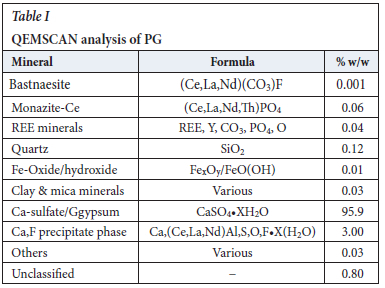
QEMSCAN and energy-dispersive X-ray spectroscopy (EDS) analyses were conducted on a composite PG sample at the Australian Nuclear Science and Technology Organization (ANSTO). The analysis (Table I) revealed that the PG comprised primarily of gypsum, as expected, but contained approximately 3% of what could be identified as a precipitated REE-rich Ca, Al, F phase. Only minor quantities of residual phosphate mineralization were detected, but a significant quantity of quartz was detected, presumably the residual from quartzitic mineral carryover into the primary upstream phosphate mineral concentration.
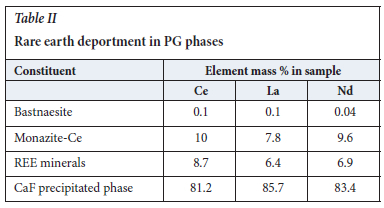
From the QEMSCAN results, REE deportment was calculated using known phase compositions in the QEMSCAN software database. The calculations suggest that the majority of REE is contained within the precipitated Ca, F phase, and that only minor quantities of REE is associated with gypsum, indicating a low degree of isomorphic substitution of Ca with REE in the calcium sulfate crystal lattice. EDS analyses of randomly selected calcium sulfate particles confirmed that REE is not contained within the calcium sulfate particles, as is the case with other PG sources (Lokshin et al., 2010; Wu et al., 2018). Results from REE deportment calculations are shown in Table II.
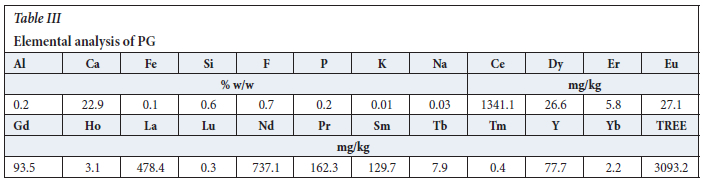
Elemental composition was determined via fuse-digest-ICP. As illustrated in Table III, the PG analysed had considerable quantities of fluorine, aluminium, silicon, and phosphorus residual from the fluorapatite mineral that is also the source of REE in the PG. Other base metals present in lower concentrations include magnesium and iron. The REE grade of the published resource statement is substantially higher than that of other PG sources described in literature at 0.43% TREO - equivalent to approximately 3500 mg/kg REE (Rainbow Rare Earths, 2022).
Experimental
Leaching test work campaigns were conducted at ANSTO and at Mintek in South Africa, using different PG samples. For each of the leaching tests described below, the feed PG assay is also given. For all leaching tests, solution samples were analysed for REE with ICP-MS, for base metals with ICP-OES, for fluorine and phosphate with an ion-selective electrode (ANSTO), and ion chromatography (Mintek). Solid samples were dried at 105°C before fusion with sodium hydroxide and sodium peroxide, followed by a nitric acid digest and ICP-MS/ICP-OES. Solid samples were dried at 105°C because at lower drying temperatures, it was found that gypsum was not fully dehydrated, and that varying degrees of hydration may influence the consistency of results. Leach residues were filtered under vacuum with a Buchner funnel, and then washed with gypsum saturated water before drying and analysis. Temperature control, where applicable, was achieved by measuring the reactor temperature with a thermometer and adjusting the temperature control set point on a water heater, which circulated water through a water bath in which the leaching vessels were placed. Leaching tests were performed under ambient pressure conditions in open reactor vessels.
Results and discussion
Effect of acid concentration and temperature on calcium sulfate solubility
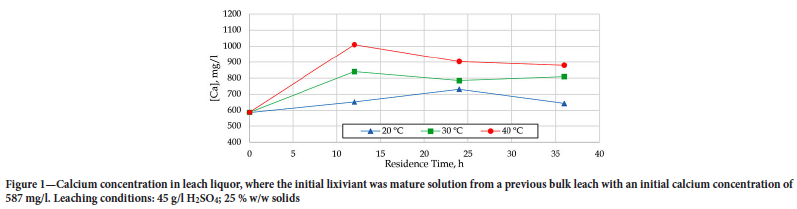
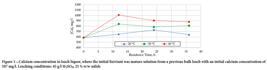
The solubility behavior of calcium was observed from results of REE leaching tests. Temperature was found to have a positive effect on the solubility of calcium, which was also used as a proxy for the solubility of calcium sulfate, as shown in Figure 1. It is notable that calcium concentration in solution reaches a peak, after which the concentration decreases with time. One proposed explanation for this is that calcium sulfate hemihydrate is relatively more soluble than the dihydrate (gypsum), and therefore that any hemihydrate that is present and dissolves, increases the calcium concentration in the solution beyond the solubility of calcium sulfate dihydrate, which drives the precipitation of gypsum. Literature references the competing calcium sulfate precipitation side reaction as a reaction that may decrease the final extraction of REE from PG.
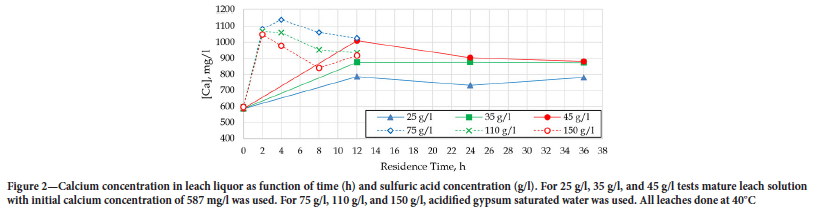
Further tests were conducted at 40°C but at varying acid concentrations. Calcium solubility was observed to increase with an increase in acid concentration up to 150 g/l H2SO4 (Figure 2). Figure 2 shows the calcium concentration with time for six different tests. For acid concentrations 25 - 45 g/l, the leach solids density was 25g % w/w. For 75 - 110 g/l the solids density was 30% w/w, and for 150 g/l the solids density was 34% w/w. The differing solids densities were not expected to affect the solubility of calcium sulfate. At low acid concentrations (25 - 45 g/l), calcium concentration increased with an increase in acid concentration. At higher acid concentrations (75 - 150 g/l), that behaviour is reversed, suggesting an inflection point somewhere between 45 and 75 g/l sulfuric acid, where calcium concentration starts decreasing with an increase in acid concentration, correlating well with findings presented by Azimi et al. (2007). There is, however, also a time-dependent change in calcium solubility. For all acid concentrations tested, calcium concentration in solution increased initially but decreased with time, suggesting re-precipitation of calcium. This phenomenon is more pronounced at higher acid concentrations, indicating a faster and higher degree of calcium mobility. For the 150 g/l test, a second increase in calcium concentration was observed between 8 and 10 hours.
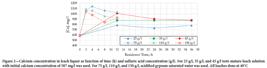
The optimal residence time based only on the solubility of calcium sulfate is therefore a function of acid concentration. For high acid concentrations (75 - 150 g/l), a short residence time of 2 - 4 hours is suggested. For lower acid concentrations (25 - 45 g/l) a residence time of approximately 12 hours is suggested, after which the decrease in calcium concentration indicates a possible nett re-precipitation regime. This may translate into REE losses in a sulfuric acid leach due to co-precipitation of REE that was initially solubilised but are then precipitated as the calcium solubility decreases.
Effect of solid/liquid ration on rare earth extraction
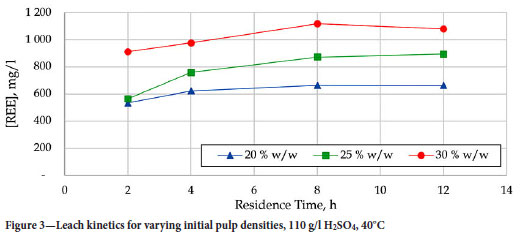
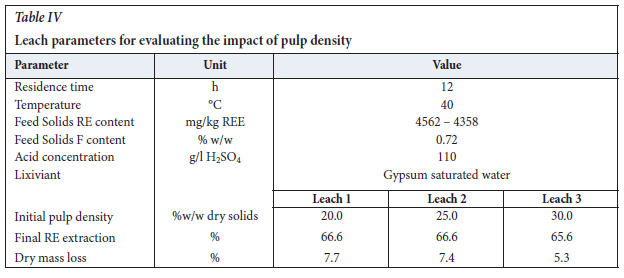
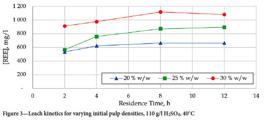
Three leaches were done to evaluate the effect of pulp density on the kinetics and ultimate RE extraction when leaching at 110 g/l H2SO4 for 12 hours. Key leach parameters are given in Table IV.
Within the range of solids densities tested, there was no significant impact on the leaching of REE. Leach solution samples were taken throughout the leach to determine the reaction kinetics, which is shown in Figure 3. In all three tests, the leach reaction reached completion by 8 hours, which correlates well with the 8 to 10 hours suggested by the calcium sulfate solubility shown in Figure 2. Mass loss of PG during the leach does decrease with an increase in solids density, likely due to the lower dilution and potential for gypsum to dissolve.
Effect of temperature and acid concentration on rare earth extraction
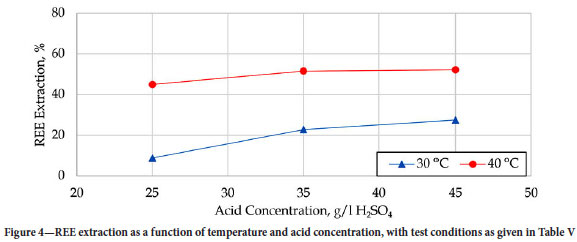
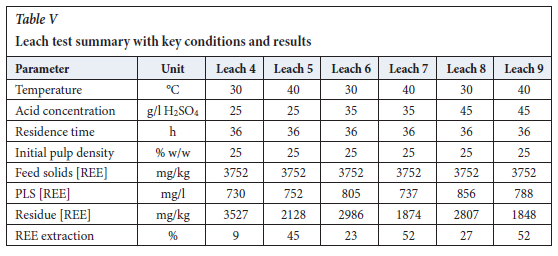
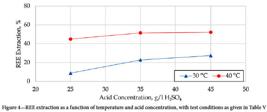
Six leaching tests were conducted to evaluate the impact that acid concentration and temperature has on the extraction of REE at concentrations of 25 g/l - 45 g/l H2SO4. The key results are presented in Table V.
Figure 4 is a graphical representation of the extractions achieved with the leaching conditions given in Table V. Leach extractions are favoured by higher temperature and higher acid concentration. However, temperature has a significantly larger effect on the ultimate REE leaching. At 40°C, the difference in extraction from 25 g/l to 45 g/l sulfuric acid is small, whereas at 30°C, there is three times more leaching of REE at 45 g/l acid than there is at 25 g/l.
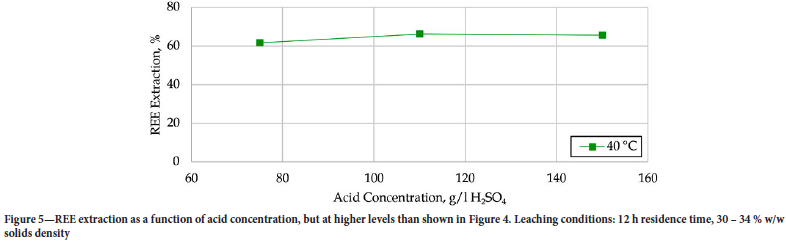
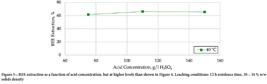
Similar results were achieved when leaching at 40°C but varying the acid concentration between 75 g/l and 150 g/l H2SO4, shown in Figure 5. At 40°C, there is a relatively small difference between leach efficiency at 75 g/l and 150 g/l. This indicates that at any given acid concentration, the leaching of REE is more dependent on the temperature than on the acidity. This is consistent with what is reported in literature, being that for a given acid type, the acid concentration and temperature are the most influential factors. In the leaching tests performed, acid is seen to have an impact, but this impact becomes smaller and smaller as the temperature is increased. Based on this work, temperature is the most influential factor. This is consistent with what is reported in literature for calcium sulfate solubility, further reinforcing the hypothesis that REE dissolution is favored in conditions that also favor highest calcium sulfate solubility.
Effect of resin in leach
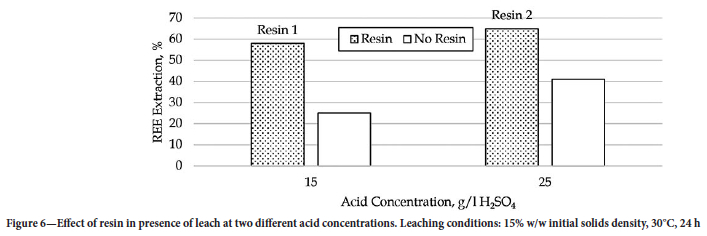
Four tests were conducted, testing two different resins. Resin 1 is a weakly acidic cation exchange resin with a chelating aminomethylphosphonic functional group and a theoretical capacity of 2.3 eq/l. Resin 2 is a strong acid cation exchange resin with a sulfonic functional group and a theoretical capacity of 2.3 eq/l. Resin concentration in the leach was 0.27 and 0.54 ml of resin per gram of dry solids respectively for Resin 1 and Resin 2. The final extraction of each of the four leaches is graphically presented in Figure 6. An exhaustive study on optimal RIL conditions was not conducted, due to the fact that the resin loading was low at approximately 8.1 and 4.6 g REE/l resin respectively for Resin 1 and Resin 2. Theoretically, resin with a capacity of 2.3 equivalents per litre could load approximately 100 grams of REE per litre of resin, which means that the total resin utilization for REE was low. This means that on commercial scale, the movement of large resin volume due to poor loading will become problematic and loading and elution equipment will become very large. With large volumes of resin, resin replacement costs will escalate.
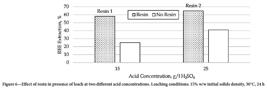
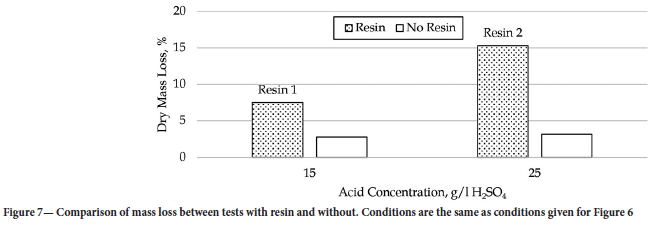
The economic implications of using resin for REE recovery aside, it is interesting to note the considerably higher REE extraction using resin, compared with leaching without resin in the same conditions. Due to the resin being a cationic exchange resin, it will most likely load large quantities of other dissolved cations including Ca. It is proposed that the continuous depletion of Ca from the solution allows for more dissolution of gypsum, in turn allowing for higher extractions of REE. The dry mass loss for the same four tests is shown in Figure 7.
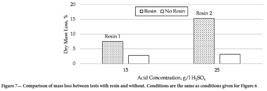
The considerably higher mass loss for the tests using resin confirms that the presence of the resin enhances the dissolution of calcium sulfate due to the continuous depletion of Ca from the leach solution, and thereby maintaining a concentration gradient between the PG and the liquid phase and driving the dissolution of gypsum. The correlation between mass loss and REE extraction strongly suggests that the dissolution of gypsum also drives the dissolution of REE, even from a PG source where the majority of the REE is present as a precipitated phase as opposed to co-crystallized in the calcium sulfate matrix. This is consistent with the mechanism suggested by Li et al. (2022).
Effect of recycling of leach solution
Due to the relatively high acid concentrations required to leach any quantity of REE from the PG, it is critical to be able to recycle leach solution several times. The recycling of leach solution facilitates the increase in concentration of REE, which favors any subsequent precipitation or other recovery process. It also allows acid to be reused, but leach solution can only be recycled if it does not adversely affect the leaching of REE.
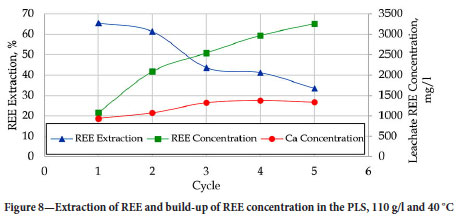
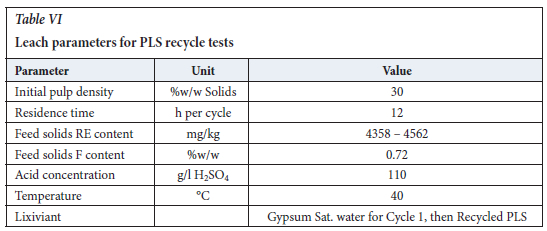
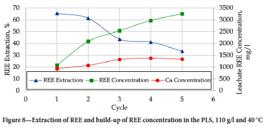
Five cycles of concentrated acid leaching were performed on PG. The first cycle used fresh phosphogypsum and acidified gypsum saturated water, whereafter the leach solution from the first cycle was used for the next cycle, and so forth. Leach residues from each cycle were analysed. Acid titrations were performed on the leach solution after each cycle, and acid was added to maintain 110 g/l acid per cycle.
Figure 8 shows how the leaching performance decreases cycle by cycle. It is seen that REE extraction in the first cycle is approximately 65% but decreases gradually to around 32% by the 5th cycle. REE concentration in the leach solution does build up and is still increasing by the 5th cycle, at which point the REE concentration reaches approximately 3250 mg/l.
The mechanism by which the leach solution's ability to leach REE from fresh PG decreases with recycle is not yet understood in great detail. As shown in Table III, there are significant quantities of Si, F, Al, and P in the PG, residual from the phosphate concentrate and carried over to the PG during the phosphoric acid process. These elements may lead to the formation of other weak acids in solution alongside any sulfuric acid that is added.
The phenomena that REE extraction from the PG decreases cycle by cycle, and that the REE extraction decrease correlates well with a buildup and eventual stabilization of Ca in solution, suggests that the capacity of the leach solution to accommodate soluble REE depends also on the leach solution's capacity to accommodate calcium as well.
Conclusions
The PG at Phalaborwa is characterized by a high concentration of REE, present in the solid as a distinctly precipitated phase that is rich in REE, Ca, F, and Al, among others. The leaching of REE from the Phalaborwa PG has been shown to be favored by higher temperatures, and higher concentrations of sulfuric acid. In the range of temperatures tested (20°C - 40°C), temperature appears to have the highest impact on REE extraction. Approximately 65% REE extraction was achieved at 40°C and an acid concentration of 110 g/l H2SO4. The effect of pulp density was tested at 110 g/l and 40°C and was shown not to affect REE extraction.
Pulp density similarly also did not have a significant effect on the kinetics of leaching, as leach solution concentrations reached a plateau after approximately 8 hours, but with no significantly steeper or flatter gradient, depending on the pulp density. The introduction of a cation exchange resin into the leach led to considerably higher dry mass loss during the leach, as well as higher REE extraction. An extraction of 65% could be achieved with RIL at 25 g/l H2SO4, substantially lower than what is otherwise required to achieve similar extractions without resin. Recycling of leach solution decreased REE extraction in subsequent leaching stages, and the suggested mechanism by which REE leaching decreases, is that calcium becomes saturated in solution and cannot facilitate dissolution or recrystallization of fresh PG.
Calcium was seen to reach steady state concentrations of approximately 1400 mg/l in the leach solution after the third solution recycle stage, after which there was no further observable increase. This correlated well with the decrease in REE extraction. The data provides strong evidence that leaching of REE is dependent on conditions that maximize calcium sulfate solubility.
References
- Al-Thyabat, S., and Zhang, P. 2015. REE extraction from phosphoric acid, phosphoric acid sludge, and phosphogypsum, Mineral Processing and Extractive Metallurgy, vol. 124, no. 3, pp. 143-150.
- Azimi, G., Papangelakis, V.G., Dutrizac, B. 2007. Modelling of calcium sulphate solubility in concentrated multi-component sulphate solutions. Fluid Phase Equilibria, vol. 260, pp. 300-315.
- Cánovas, C.R., Chapron, S., Arrachart, G., Pellet-Rostaing, S. 2019. Leaching of rare earth elements (REEs) and impurities from phosphogypsum: A preliminary insight for further recovery of critical raw materials. Journal of Cleaner Production, vol. 219, pp. 225-235.
- Gasser, M.S., Ismail, Z.H., Elgoud, E.A., Hai, F.A., Ali, O.I., Aly, H.F. 2019. Process for lanthanides-Y leaching from phosphogypsum fertilizers using weak acids. Journal of Hazardous Materials, vol. 378, 120762 p.
- Hammas-Nasri, I., Horchani-Naifer, K., Férid, M., Barca, D. 2016. Rare earths concentration from phosphogypsum waste by two-step leaching method. International Journal of Mineral Processing, vol. 149, pp. 78-83.
- Hammas-Nasri, I., Horchani-Naifer, K., Férid, M., Barca, D. 2019. Production of a rare earths concentrate after phosphogypsum treatment with dietary NaCl and Na2CO3 solutions. Minerals Engineering, vol. 132, pp. 169-174.
- Ismail, Z., Abu Elgoud, E.M., Abdel Hai, F., Ali, I.O., Gasser, M.S., Aly, H.F. 2015. Leaching of some lanthanides from phosphogypsum fertilizers by mineral acids. Arab Journal of Nuclear Science and Applications, vol. 48, no. 2, pp. 37-50.
- Kurkinen, S., Virolainen, S., Sainio, T. 2021. Recovery of rare earth elements from phosphogypsum waste in resin-in-leach process by eluting with biodegradable complexing agents. Hydrometallurgy, vol. 201, pp. 105569.
- Lambert, A., Anawati, J., Walawalkar, M., Tam, J., Azimi, G. 2018. Innovative application of microwave treatment for recovering of rare earth elements from phosphogypsum. ACS sustainable chemistry & engineering, vol. 6, no. 12, pp. 16471-16481.
- Li, S., Malik, M., Azimi, G. 2021. Extraction of rare earth elements from phosphogypsum using mineral acids: process development and mechanistic investigation. Industrial & Engineering Chemistry Research, vol. 61, no. 1, pp. 102-114.
- Lokshin, E.P., Tareeva, O.A., Elizarova, I.P. 2010. A study of the sulfuric acid leaching of rare-earth elements, phosphorus, and alkali metals from phosphodihydrate. Russian Journal of Applied Chemistry, vol. 83, pp. 958-964.
- Lu, S.B., Liu, J.C. 2023. Recovery of rare earth elements from phosphogypsum using subcritical water extraction. Chemical Engineering and Processing-Process Intensification, vol. 190, pp. 109433.
- Lütke, S.F., Oliveira, M.L., Waechter, S.R., Silva, L.F., Cadaval Jr, T.R., Duarte, F.A., Dotto, G.L. 2022. Leaching of rare earth elements from phosphogypsum. Chemosphere, vol. 301, 134661 p.
-
Rainbow Rare Earths. 2022. Phalaborwa Rare Earths Project Preliminary Economic Assessment https://www.rainbowrareearths.com/wp-content/uploads/2022/10/PHALABORWA-RARE-EARTHS-PROJECT-PEA-FINAL.pdf
» https://www.rainbowrareearths.com/wp-content/uploads/2022/10/PHALABORWA-RARE-EARTHS-PROJECT-PEA-FINAL.pdf - Rychkov, V.N., Kirillov, E.V., Kirillov, S.V., Semenishchev, V.S., Bunkov, G.M., Botalov, M.S., Smyshlyaev, D.V. and Malyshev, A.S. 2018. Recovery of rare earth elements from phosphogypsum. Journal of Cleaner Production, vol. 196. pp. 674-681.
- Virolainen, S., Repo, E., Sainio, T. 2019. Recovering rare earth elements from phosphogypsum using a resin-in-leach process: Selection of resin, leaching agent, and eluent. Hydrometallurgy, vol. 189, 105125 p.
- Walawalkar, M., Nichol, C.K., Azimi, G. 2016. Process investigation of the acid leaching of rare earth elements from phosphogypsum using HCl, HNO3, and H2SO4. Hydrometallurgy, vol. 166, pp. 195-204.
- Wu, S., Wang, L., Zhao, L., Zhang, P., El-Shall, H., Moudgil, B., Huang, X., Zhang, L. 2018. Recovery of rare earth elements from phosphate rock by hydrometallurgical processes - A critical review. Chemical Engineering Journal, vol. 335, pp. 774-800.
- Yahorava, V., Bazhko, V., Freeman, M. 2016. Viability of phosphogypsum as a secondary resource of rare earth elements. Proceedings of the XXVIII International Mineral Processing Congress Proceedings, Quebec City, QC, Canada, pp. 11-15.

Accepted: 4 June 2024
Published: October 2024