An update to the strain-based approach to pit wall failure prediction, and a justification for slope monitoring
Abstract
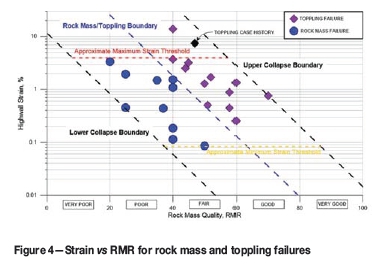
Effective management and mitigation of pit slope instability in open pit mines begins with a comprehensive slope monitoring programme. The ability to differentiate between non-critical pit wall movements due to rebound or relaxation of the excavated slopes and movements that may be indicative of slope failure is important for maintaining a safe working environment and maximizing production. Slope failure prediction methods using velocity, acceleration, and strain criteria have been introduced and put into practice over the past few decades. Forty-eight slope failures with surface monitoring data are presented and assessed using the strain-based failure prediction approach, with consideration of the quality of the rock mass and the potential failure mechanism. The results indicate that the strain-based approach can be used to provide general guidance regarding strain thresholds for pit walls for a variety of failure modes in diverse geological environments. The advantages and potential drawbacks of the strain-based and other slope failure prediction methods are discussed. The importance of implementing a pit slope monitoring and performance evaluation system early in mine development is also emphasized.
open pit slopes; slope monitoring; failure prediction; pit wall strain; strain criteria; strain thresholds
 Thumbnail
 Thumbnail
 Thumbnail
 Thumbnail
 Thumbnail
 Thumbnail