Effects of acid and reductants on iron salt leaching of copper-cobalt oxide ore: A case study from Zebesha Mine, Zambia
Abstract
Although the conventional acid-reductive leaching method effectively extracts copper (Cu) and cobalt (Co) from Cu-Co oxide ores, efforts to enhance hydrometallurgical performance are ongoing. This study evaluates the influence of sulphuric acid (H2SO4) and sodium metabisulphite (Na2S2O5) on metal extraction from Zebesha Cu-Co oxide ore using ferrous sulphate heptahydrate (FeSO4-7H2O) and ferric sulphate (Fe2(SO4)3) as lixiviants. Ore samples (<150 μm) were leached at ambient temperature for two hours, and metal concentrations were determined via X-ray fluorescence analysis. In the FeSO4-7H2O system, Co, Mn, and Ni recoveries increased w=ith Na2S2O5 concentration, reaching a maximum of approximately 80% Co at 150 kg/t, while Cu recovery remained below 5%. Conversely, with Fe2(SO4)3, Cu recovery peaked at 88% at 50 kg/t Na2S2O5, then declined to 79% at 150 kg/t. The addition of H2SO4 improved metal recoveries in both systems. Notably, 60 kg/t H2SO4 yielded 92% Cu extraction in Fe2(SO4)3, while Co, Ni, and Mn remained below 40%. However, in FeSO4-7H2O, Co recovery improved from 40% to 84%. These findings suggest Na2S2O5 is more effective for cobalt extraction with FeSO4-7H2O, whereas H2SO4 enhances copper extraction in Fe2(SO4)3.
copper-cobalt oxide ore; heterogenite; sodium metabisulphite; copper-cobalt extraction; sulphuric acid
Introduction
In recent years, there has been growing interest in the hydrometallurgical extraction of copper-cobalt (Cu-Co) oxide ores from the Central African Copperbelt (CAC) (Crundwell et al., 2011, 2020; Dehaine et al., 2021; Fisher, 2011; Lutandula et al., 2020; Sole et al., 2018; Thabane, 2018; Welham et al., 2015). This surge in attention has been driven by the increasing demand for cobalt and related battery minerals, largely propelled by advancements in electronic technologies, including mobile phones and electric vehicles (Dehaine et al., 2020; Xu et al., 2021).
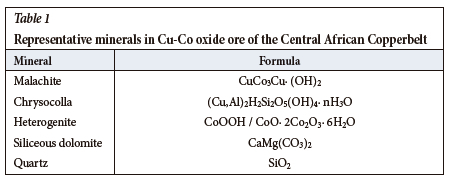
The primary Cu-Co oxide minerals in the CAC include malachite, the major copper oxide phase, and heterogenite, the dominant cobalt oxide phase, which also contains associated copper, manganese (Mn), nickel (Ni), and iron (Fe) (Crundwell et al., 2011; Sole et al., 2018; Uahengo et al., 2022). Table 1 lists representative Cu-Co oxide minerals from the region. Heterogenite often contains cobalt in both divalent (Co2+) and trivalent (Co3+) states (Mwema et al., 2002; Stuurman et al., 2014). The average copper content in CAC ores typically ranges between 2%-4% Cu, while cobalt grades range from 1%-3% Co (Annels, Simmonds, 1984; Seo et al., 2013; Slack et al., 2017; Sole, Tinkler, 2016), although local variability exists, for example, the Zebesha Mine in north-western Zambia contains approximately 3.5% Cu and 1.3% Co.
The conventional leaching approach for Cu-Co oxide ores involves the use of sulphuric acid (H2SO4) in the presence of a reductant. Trivalent cobalt (Co3+) exhibits low solubility in aqueous media, leading to poor leach efficiency from heterogenite (Crundwell et al., 2020). A suitable reductant is therefore required to reduce Co3+ to the more soluble Co2+ form. Commonly used reductants include sodium metabisulphite (Na2S2O5), sulphur dioxide (SO2), and ferrous sulphate (FeSO4) (Ferron, Henry, 2008; Kafumbila, 2018; Mwema et al., 2002; Ntakamutshi et al., 2017; Stuurman et al., 2014).
Of these, Na2S2O5 is widely favoured in the Copperbelt due to its efficacy in reducing Co3+ to Co2+, its environmental acceptability, ease of handling, and logistical suitability for remote sites (Abreu et al., 2012; Bwando, Kanz, 2018; Crundwell et al., 2011; Kafumbila, 2018; Mwema et al., 2002; Stuurman et al., 2014; Sutcliffe et al., 2011; Thabane, 2018; Tshipeng et al., 2017). Its reductive mechanism proceeds through hydrolysis and subsequent SO2 evolution, as shown in Equations 1 to 4:
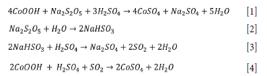
Like Co3+, manganese in high oxidation states (e.g., Mn4+ in MnO2) also dissolves under acidic-reductive conditions (Ferron, 2006; Zheng et al., 2023), as shown in Equation 5. Additionally, iron oxides may be reduced to ferrous sulphate under similar conditions (Equation 6):

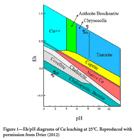
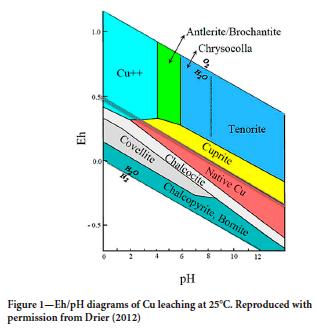
Copper minerals - including hydroxides, oxides, sulphides, sulphates, carbonates, and silicates - typically dissolve in acidic-oxidative environments, albeit at variable rates depending on mineralogy (Dreier, 2012). Ferric sulphate, especially when combined with H2SO4, is often used to facilitate this dissolution.
Despite its effectiveness, Na2S2O5 has fallen out of favour due to its high consumption rates, which elevate operating costs (Mwema et al., 2002). Additionally, Na2SO4 build-up from Na2S2O5 degradation contributes to excess Na+accumulation in leach circuits. Environmental concerns are also raised by the release of SO2 gas, especially at higher concentrations (Asadi Dalini et al., 2020; Carvalho et al., 2011). As such, research efforts are increasingly focused on alternative reductants or ways to optimise Na2S2O5 usage.
Furthermore, sulphuric acid, though effective, is costly and corrosive. In the Copperbelt, challenges related to sourcing, transporting, and handling H2SO4 are exacerbated by inadequate infrastructure, particularly in remote mining areas of Zambia and the Democratic Republic of the Congo (Sole, Tinkler, 2016; Thabane, 2018).
Chemical and mineralogical analysis
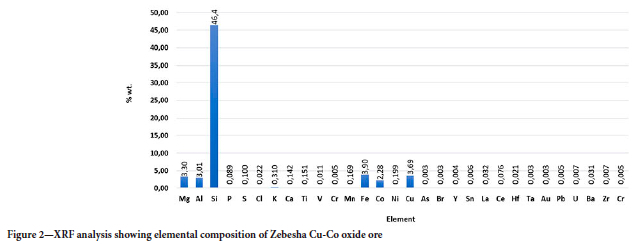
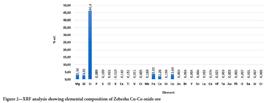
The Cu-Co oxide ore sample used throughout the study was sourced from Zebesha Mine, a relatively new copper-cobalt mining operation located in Zambia's North-Western Province. This region forms part of the southern extension of the Central African Copperbelt (CAC), extending from the Democratic Republic of Congo (DRC). To characterise the Zebesha ore, both X-ray fluorescence (XRF) and scanning electron microscopy (SEM) analyses were performed. XRF results revealed relatively high metal content, with average values of 3.69% Cu, 2.28% Co, 0.199% Ni, 0.138% Mn and 3.90% Fe. Figure 2 shows a full elemental distribution thereof.
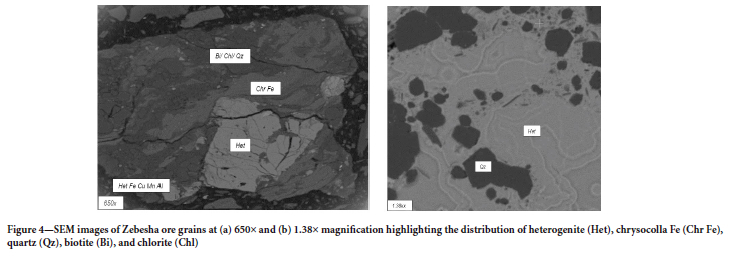
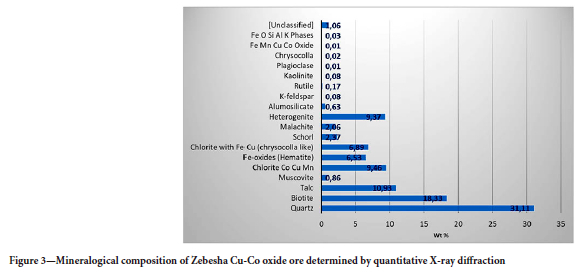
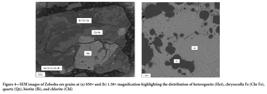
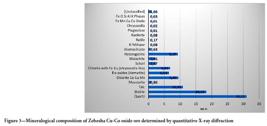
Mineralogical analysis indicated that copper occurred mainly as malachite, while cobalt was hosted in heterogenite, alongside associated Ni, Mn, and Fe. Quartz, biotite, and talc were identified as the principal gangue minerals, with quartz comprising ~31 wt.%, suggesting a significant silica content (Figure 3). The mineralogy is comparable to other CAC oxide ore deposits (Decree et al., 2015; Shengo et al., 2016; Stuurman et al., 2014). SEM micrographs in Figure 4 revealed the presence of heterogenite (Het), chrysocolla Fe (Chr Fe), quartz (Qz), biotite (Bi), and chlorite (Chl), among others.
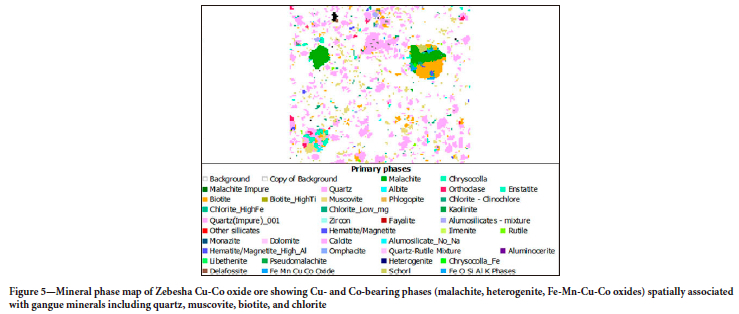
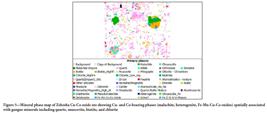
As illustrated in Figure 5, a closer inspection of the mineral phase map reveals that Cu- and Co-bearing phases, such as malachite, heterogenite, and related oxides, are frequently embedded in or rimmed by silicate gangue minerals including quartz, muscovite, biotite, and chlorite. This spatial association suggests partial physical encapsulation of valuable metal phases within the gangue matrix. Such intergrowths may hinder reagent accessibility and contribute to the observed variability in extraction efficiency during leaching. These textural relationships are characteristic of supergene enrichment in deeply weathered oxide terrains typical of the Central African Copperbelt.
Methodology
Materials, reagents and chemicals
The same Cu-Co oxide ore used in the preliminary study was employed in this investigation. All reagents were of analytical grade. Sulphuric acid (98%, Primark Chemicals, South Africa), sodium metabisulphite (Na2S2O5), ferrous sulphate heptahydrate (FeSO4-7H2O), and ferric sulphate (Fe2(SO4)3) were sourced from Associated Chemical Enterprises, South Africa. Iron salt solutions were prepared in distilled water at a concentration of 400kg/t, as determined through preliminary optimisation. Sulphuric acid was added directly in its concentrated form, while Na2S2O5 was introduced as a solid.
Experimental design
All experiments were conducted at laboratory scale under ambient conditions (~25°C). The ore was oven-dried, homogenised, and ground to 100% passing 150μηι. For feed elemental analysis, a 1kg bulk sample of the Zebesha Cu-Co oxide ore (<1mm) was homogenised and reduced using coning and quartering, followed by rotary splitting to obtain representative subsamples for leaching tests. Initial grade determination was performed by analysing multiple samples using a NEXCG energy dispersive X-Ray fluorescence (EDXRF) instrument to characterise the full feed composition. Subsequently, a handheld X-ray fluorescence (XRF) analyser was used to scan ore samples directly from the sample bag prior to each leaching test.
Preliminary study
Prior to the current investigation, preliminary leaching tests were conducted to establish baseline behaviour and inform reagents selection. The objective of the preliminary study was to evaluate the leachability of Zebesha Cu-Co oxide ore using alternative lixiviants to the conventional acid-reductive method. Specifically, iron-based reagents, that is, FeSO47H2O and Fe2(SO4)3, were investigated without the addition of sulphuric acid or other reductants/oxidants.
Ferrous and ferric iron salts are known to promote the leaching of certain metals: FeSO4 reduces Co3+ to the more soluble Co2+, whereas Fe2(SO4)3, acting as an oxidant, facilitates copper solubilisation. For example, CuS and Cu2S may be leached by Fe2(SO4)3 at ambient pressure, as shown in Equations 7 and 8 (Ferron, 2006):

Preliminary laboratory leaching tests were conducted using analytical-grade FeSO47H2O and Fe2(SO4)3 (Associated Chemical Enterprises, South Africa). These tests were performed at ambient temperature, with variations, initially in preliminary leaching time of 30, 60, 90, and 120 minutes, lixiviant concentrations of 200 kg/t and 400 kg/t, and particle sizes of 80% passing 75 μm, 106 μm, and 150 μm. However, the final preliminary leaching test conditions were fixed at the following parameters:
> 100% passing 150 μm
> 400 kg/t reagent concentration
> 120-minute leaching time
> 33% solids (based on Xu et al., 2023; Zheng et al., 2023).
Leaching tests
Leaching tests were carried out at 33% solids for a fixed duration of 120 minutes under continuous agitation using an overhead stirrer. Each test was conducted in triplicate to ensure reproducibility.
The study aimed to assess the individual effects of Na2S2O5 and H2SO4 on the leaching performance of FeSO47H2O and Fe2(SO4)3. Two separate test series were performed:
> Na2S2O5 series: Iron salt concentration fixed at 400kg/t; Na2S2O5 varied at 0kg/t, 50 kg/t, 100 kg/t, and 150kg/t.
> H2SO4 series: Iron salt concentration fixed at 400kg/t; H2SO4 varied at 0 kg/t, 30 kg/t, 40 kg/t, 50 kg/t, and 60kg/t.
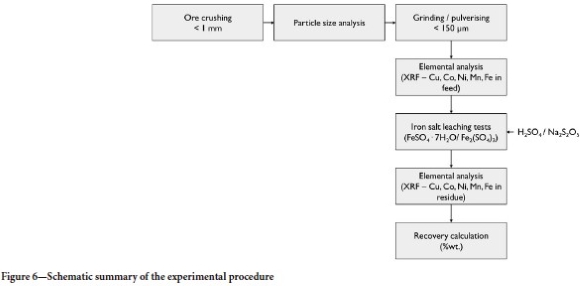
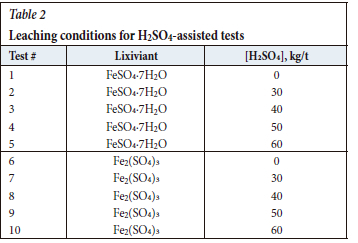
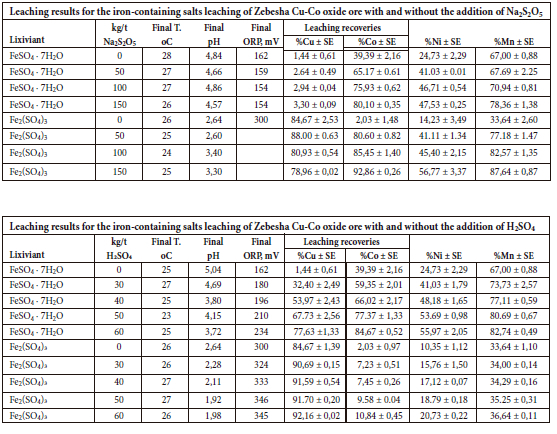
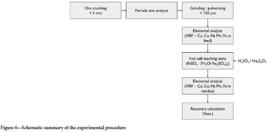
FeSO47H2O and Fe2(SO4)3 were applied individually as lixiviants. While leach solutions were not actively pH- or ORP-controlled, measurements of pH, oxidation-reduction potential (ORP), and temperature were recorded at 0, 30, 60, 90, and 120 minutes. Table 2 summarises the leaching conditions for the H2SO4-assisted tests. The Na2S2O5 series followed a similar matrix. A schematic of the overall procedure is presented in Figure 6.
Analytical procedure and recovery calculations
Following leaching, each pulp was filtered, and the resulting leachates were analysed for Cu, Co, Ni, Mn, and Fe content using X-ray fluorescence (XRF). Each experiment was conducted in triplicate, to confirm the consistency and repeatability of the observed outcomes. The average metal extraction values are reported together with their respective standard errors (SE).
Metal recovery was calculated by mass balance, using Equation 11:

Where:
%F = % metal content in the feed,
mF = mass of feed (g),
%R = % metal content in residue,
mR = mass of residue (g).
Results and discussion
This study investigated the extraction behaviour of Cu, Co, Ni, and Mn from Zebesha Cu-Co oxide ore using combinations of iron-based salts, FeSO4-7H2O and Fe2(SO4)3, with either Na2S2O5 or H2SO4 at varying reagent concentrations. The data obtained revealed distinct trends in metal extraction efficiency depending on the lixiviant-reagent combination used. Results show that reagent selection critically influences metal selectivity and recovery.
Preliminary test results
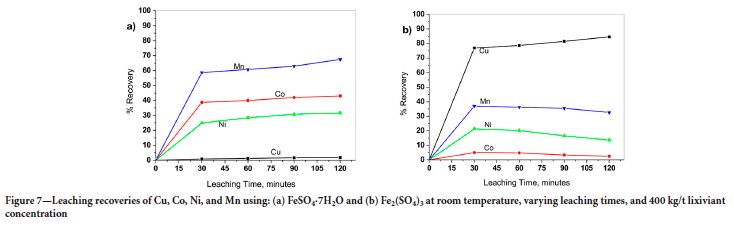
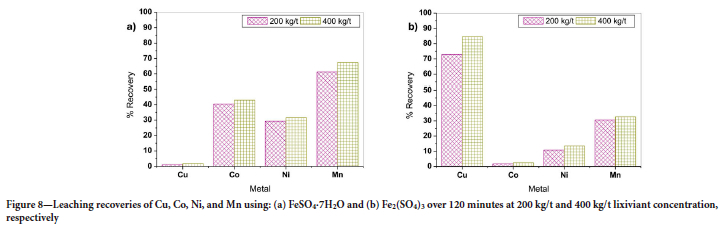
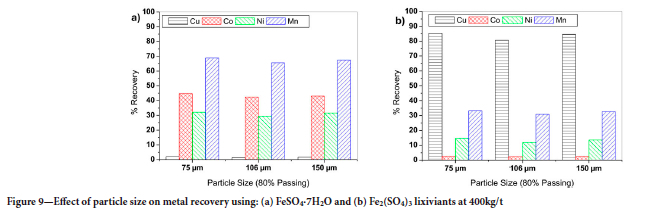
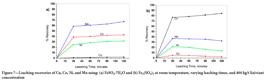
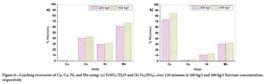
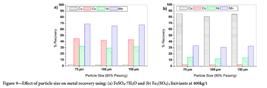
The initial preliminary leaching results showed that most metals were leached within 60 minutes, with maximum recoveries observed at 120 minutes using a lixiviant concentration of 400 kg/t, (Figure 7 and Figure 8). Cu and Co extraction showed minimal sensitivity to particle size (Figure 9), and cobalt was hardly leached with Fe2(SO4)3.
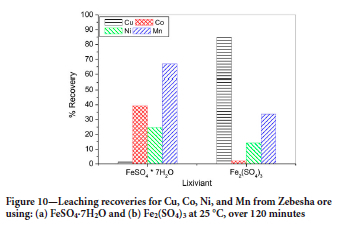
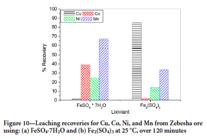
Final preliminary leaching results shown in Figure 10 demonstrated that FeSO4-7H2O yielded promising recoveries for Co (43%), Mn (68%), and Ni (35%), but only about 1% for Cu. Conversely, Fe2(SO4)3 resulted in high Cu recovery (80%), with substantially lower yields for Co (3%), Ni (13%), and Mn (33%).
Both iron salts hydrolyse to generate H2SO4, contributing to their leaching behaviour, as shown in Equations 9 and 10 (Ekmekyapar et al., 2015; Tyrocity, 2012; Welham et al., 2015):

As FeSO4-7H2O acts as a reductant and Fe2(SO4)3 as an oxidant, their contrasting chemistry yields different extraction profiles. Co3+ is reduced to soluble Co2+ by FeSO4-7H2O, accounting for its superior cobalt recovery. Conversely, Fe2(SO4)3 facilitates copper extraction due to its lower pH (<3.0), whereas FeSO4-7H2O leaching pH exceeds 4.5, which is above the optimum range for Cu solubility, which is typically <3.5 (Meshram et al., 2020).
Wang et al. (2021) also demonstrated the effectiveness of Fe2(SO4)3 in extracting Cu from malachite, although their material did not include Co, Ni, or Mn.
These preliminary findings highlight the potential of FeSO4-7H2O for cobalt-selective leaching and Fe2(SO4)3 for copper-selective leaching. The study concluded with the recommendation to further investigate ways to enhance overall leaching efficiency. Accordingly, the current study focuses on evaluating the individual effects of H2SO4 and Na2S2O5 on Cu-Co oxide ore leaching in the presence of iron sulphate salts at ambient conditions.
Effects of sodium metabisulphite addition on metal extraction
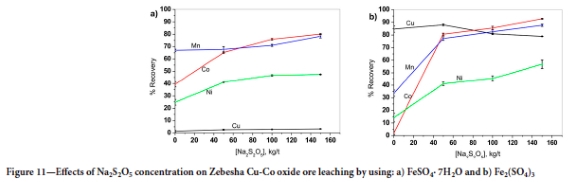
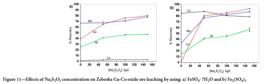
Figure 11 illustrates the effect of Na2S2O5 concentration on the dissolution of Cu-Co oxide ore using 400 kg/t of either FeSO4-7H2O or Fe2(SO4)3. For both lixiviants, cobalt, nickel, and manganese recoveries increased substantially with rising Na2S2O5 concentrations, while copper exhibited little to no improvement. In Fe2(SO4)3 systems, copper recovery showed a slight decline with higher Na2S2O5 levels, whereas in FeSO4-7H2O, it consistently remained below 5%. The greatest gains in metal recovery from FeSO4-7H2O leaching were observed for cobalt (~40 %pt.), followed by nickel (~23 %pt.), and manganese (11 %pt.) over the tested concentration range.
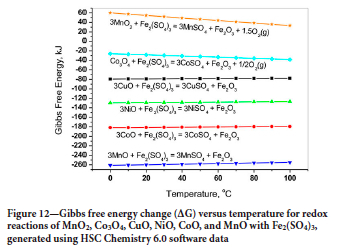
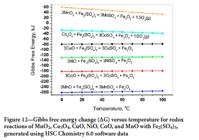
When ferrous sulphate reacts with metal oxides in aqueous solution, it oxidises to ferric sulphate. However, in the presence of Na2S2O5, ferric ions are reduced back to ferrous, as illustrated by Equation 12 (Crundwell et al., 2020). This redox cycling effectively increases the concentration of active ferrous ions in solution, enhancing the dissolution of metals that are more readily leached under ferrous-acidic conditions. Additionally, Na2S2O5 reduces Co3+ and Mn4+ to their soluble divalent forms, promoting their extraction in Fe2(SO4)3 systems. These redox-mediated transformations account for the observed increase in Co, Ni, and Mn recoveries across both iron-based lixiviants. Thermodynamic support for these reductions is shown in the Gibbs free energy plots in Figure 12.

Increasing the Na2S2O5 concentration in the FeSO4-7H2O leaching system resulted in a marked improvement in cobalt recovery, rising from approximately 40% in the absence of Na2S2O5 to nearly 80% at 150 kg/t. Concurrently, manganese and nickel recoveries also increased, with Mn leaching improving from ~67% to 78% and Ni from ~25% to 48%, as shown in Figure 11a. The most significant gains were observed between 0 kg/t and 50 kg/t Na2S2O5, where cobalt and nickel recoveries rose by 25% and 15%pt., respectively. A further increase of 15%pt. Co and 5%pt. Ni was achieved by increasing Na2S2O5 to 150kg/t. In contrast, copper recovery remained consistently low, increasing only slightly from ~1% to below 5% across the tested Na2S2O5 range.
Conversely, the addition of 50kg/t Na2S2O5 to Fe2(SO4)3 leaching led to a modest increase in copper recovery from ~85% to 88%, after which it declined to ~79% at 150kg/t, as shown in Figure 11b. In contrast, Na2S2O5 addition substantially improved cobalt, nickel, and manganese recoveries. Cobalt extraction increased markedly from ~2% to ~80% with 50kg/t Na2S2O5, reaching a maximum of ~93% at 150 kg/t. Nickel and manganese recoveries followed similar trends, rising from ~14% to 57% Ni and 44% to 88% Mn, respectively, across the tested range. Notably, the greatest improvements in metal dissolution for Co, Ni, and Mn occurred between 0 kg/t and 50kg/t Na2S2O5, highlighting the strong initial reactivity of the reductant with Fe3+ species and metal oxides in this concentration interval.
As observed in the preliminary iron salt leaching tests, copper exhibited minimal solubility in FeSO4-7H2O but was readily extracted in Fe2(SO4)3 solutions. This discrepancy can be attributed in part to the reductive action of Na2S2O5, which converts ferric ions (Fe3+) to ferrous (Fe2+), thereby reducing the availability of ferric sulphate - a key oxidant for copper dissolution. Additionally, effective copper leaching typically occurs under acidic conditions (pH < 2). At higher pH values (e.g., >4), especially in the presence of excess Na2S2O5 or SO2, copper may precipitate as Le Chevreul's salt (CuSO3-Cu2SO3-2H2O) according to Equation 13 (Crundwell et al., 2020; Ferron, 2006; Ntakamutshi et al., 2017). This precipitation mechanism likely contributed to the low copper recoveries observed in FeSO4-7H2O systems, even at elevated Na2S2O5 concentrations.

Effects of sulphuric acid addition on metal extraction
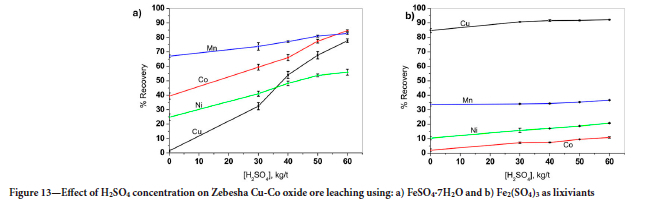
Varying concentrations of sulphuric acid were introduced into the leaching system, with both FeSO4-7H2O and Fe2(SO4)3 solutions maintained at 400kg/t to assess the effect of H2SO4 on metal extraction efficiencies. The results, presented in Figure 13, show that metal recoveries improved with increasing acid concentration across both systems. However, the enhancement was significantly more pronounced in the FeSO4-7H2O leaching system, while Fe2(SO4)3 exhibited a more subdued response.
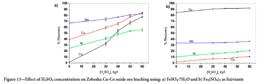
The addition of H2SO4 to FeSO4-7H2O leaching significantly improved copper extraction, increasing from ~1% (in the absence of acid) to ~78% at a dosage of 60 kg/t. Concurrently, nickel, manganese, and cobalt recoveries also increased, with Ni rising from ~25% to 56%, Mn from ~67% to 83%, and Co from ~39% to 85%, as shown in Figure 13a. These results indicate that H2SO4 addition noticeably enhanced metal solubility in ferrous media, particularly for copper, which otherwise shows limited dissolution in FeSO4-7H2O alone. This enhancement effectively diminished the initial selectivity gap between Cu and Co under ferrous leaching conditions.
The observed increase in cobalt recovery may also be attributed to acid-driven regeneration of the lixiviant. Under acidic conditions, heterogenite reacts with ferrous sulphate via mechanisms such as shown in Equations 14 and 15:

These reactions suggest that both acid strength and lixiviant regeneration contribute to improved leaching performance. Despite the substantial gains in copper recovery, the highest recoveries were achieved for cobalt (85%) and manganese (83%) under these conditions.
In contrast, the effect of H2SO4 addition on Fe2(SO4)3 leaching was less pronounced than in the FeSO4-7H2O system. At 60 kg/t H2SO4, copper recovery peaked at ~92%, while cobalt, nickel, and manganese reached ~10%, 18%, and 36%, respectively, as shown in Figure 10b. Manganese recovery increased by only ~3 percentage points across the acid range, while Cu, Co, and Ni each rose by ~8 %pt.
The enhanced copper dissolution can be attributed in part to acid-driven pH reduction, from ~2.7 (without H2SO4) to below 2.0 at 60 kg/t, creating more favourable conditions for malachite dissolution. This is reflected in the acid-mediated reaction between malachite and ferric sulphate (Equation 16):

In contrast, cobalt, nickel, and manganese showed only modest improvements, likely due to their limited presence in readily soluble divalent forms under Fe2(SO4)3 leaching conditions. This highlights the relative selectivity of Fe2(SO4)3-H2SO4 systems for copper over other base metals.
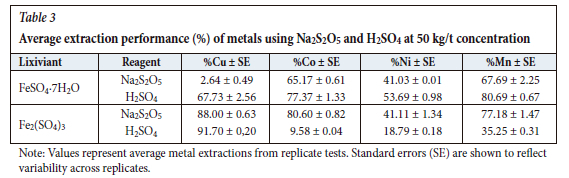
The performance comparison of H2SO4 and Na2S2O5 reagents addition on leaching Zebesha Cu-Co oxide ore with iron sulphate salt showed that the acid performance was higher in most cases compared to sodium metabisulphite performance. As presented in Table 3, for instance, at a reagent concentration of 50 kg/t. Ferric-based leaching with H2SO4 achieved the highest copper recovery (91.70%), while ferrous-based leaching with Na2S2O5 favoured cobalt extraction (65.17%) with minimal copper dissolution (2.64%). H2SO4 addition generally improved extraction performance across all metals, with FeSO4-7H2O + H2SO4 yielding high recoveries for both Co and Mn. While the overall objective was to enhance recoveries, particularly for Cu and Co, the ability to selectively leach these elements remains equally important for potential process optimisation.
These findings underscore the synergistic effects of lixiviant-reductant combinations on selective metal extraction. While H2SO4 consistently enhanced metal recovery, Na2S2O5 exhibited greater selectivity for cobalt relative to copper. Understanding these interactions is essential for optimising leaching conditions to achieve targeted metallurgical outcomes.
The low standard error values observed across most data points, such as 91.70% ± 0.20% Cu using Fe2(SO4)3 + H2SO4 and 77.37% ± 1.33% Co with FeSO4-7H2O + H2SO4 (Table 3), indicate high precision and reproducibility in the experimental procedures. Slightly higher variability in certain cases such as manganese extraction (67.69% ± 2.25% Mn), likely reflects intrinsic differences in leaching behaviour but remains within acceptable limits for laboratory-scale studies. Overall, the data affirm the reliability and repeatability of the extraction process under the tested conditions.
Conclusions
This study examined the selective leaching of copper and cobalt from Zebesha Cu-Co oxide ore using iron-based salts in combination with sodium metabisulfite (Na2S2O5) or sulphuric acid (H2SO4). The leaching behaviour differed depending on the oxidation state of the iron salt, that is, ferric iron promoted copper extraction, while ferrous iron favoured cobalt recovery, suggesting that a sequential leaching approach may be effective. The addition of Na2S2O5 significantly enhanced cobalt recovery, achieving up to 80%, whereas copper extraction remained limited. Introducing H2SO4 markedly improved the dissolution of Cu, Co, Ni, and Mn, with copper and cobalt recoveries reaching 78% and 84%, respectively, at 60 kg/t H2SO4. Ferrous sulphate combined with H2SO4 outperformed ferric solutions, particularly for cobalt, nickel, and manganese. The findings demonstrate the potential for environmentally and economically sustainable metal recovery through tailored reagent selection and process design. However, additional investigation is required to understand the leaching kinetics and validate the feasibility of sequential processing strategies. These insights offer a foundation for developing more efficient and environmentally responsible extraction techniques for Cu-Co ores.
Credit author statement
Foibe D.L. Uahengo: Experimental work and original draft (PhD student)
Yotamu R.S. Hara: Reviewing and editing (main supervisor) Olga Bazhko: Reviewing and editing (co-supervisor).
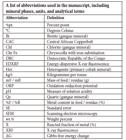
Nomenclature
Acknowledgments
We extend our gratitude to the Copperbelt University - Africa Centre of Excellence for Sustainable Mining (CBU-ACESM) for funding this project, and we thank all the staff members of Yotamu Consultation Service (YCS). Special thanks to the metallurgical laboratory staff in the Department of Civil, Mining and Metallurgy at the Namibia University of Science and Technology, the Hydrometallurgy Department at Mintek, South Africa, as well as the metallurgical staff at Alfred H Knight Kitwe for their technical and laboratory assistance. Mostly, all glory be to God for preserving us throughout this study.
References
- Abreu, C.M.R., Mendonça, P.V., Serra, A.C., Coelho, J.F.J., Popov, A.V., Guliashvili, T. 2012. Inorganic sulfites: Efficient reducing agents and supplemental activators for atom transfer radical polymerization. ACS Macro Letters, vol. 1, no.11, pp. 1308-1311.
- Annels, A.E., Simmonds, J.R. 1984. Cobalt in the Zambian Copperbelt. Precambrian Research, vol. 25, no. 1-3, pp. 75-98.
-
Asadi Dalini, E., Karimi, G., Zandevakili, S., Goodarzi, M. 2020. A Review on Environmental, Economic and Hydrometallurgical Processes of Recycling Spent Lithium-ion Batteries. Mineral Processing and Extractive Metallurgy Review, vol. 42, no. 7, pp. 451-472. https://doi.org/10.1080/08827508.2020.1781628
» https://doi.org/10.1080/08827508.2020.1781628 -
Bwando, P., Kanz, T. 2018. Laboratory Column Leaching of Cobalt using Raffinate and Sodium Metabisulfite. In: Copper Cobalt Africa, incorporating the 9th Southern African Base Metals Conference, Livingstone, Zambia, 10-12 July 2018, Southern, Livingstone, 2018, pp. 263-272. Southern African Institute of Mining and Metallurgy. Available at: https://www.saimm.co.za/Conferences/Copper-Cobalt-2018/27-Bwando-263-272.pdf
» https://www.saimm.co.za/Conferences/Copper-Cobalt-2018/27-Bwando-263-272.pdf - Crundwell, F.K., Moats, M.S., Ramachandran, V., Robinson, T.G., Davenport, W.G. 2011. Chapter 30 - Production of Cobalt from the Copper-Cobalt Ores of the Central African Copperbelt. In: Extractive Metallurgy of Nickel, Cobalt and Platinum Group Metals. Elsevier; pp. 377-391.
- Crundwell, F.K., Du Preez, N.B., Knights, B.D.H. 2020. Production of cobalt from copper-cobalt ores on the African Copperbelt -An overview. Minerals Engineering, vol. 156 (May). Elsevier: p. 106450.
-
da Costa Machado Matos Carvalho, I,M,, Cavalcante, A.A., Dantas, A.F., Pereira, D.L., Rocha, F.C., Oliveira, F.M., Da Silva, J. 2011. Environmental mutagenicity and toxicity caused by sodium metabisulfite in sea shrimp harvesting in Piauí, Brazil. Chemosphere, vol. 82, no. 7, pp. 1056-1061. doi: 10.1016/j.chemosphere.2010.10.042. Epub 2010 Nov 5. PMID: 21056453
» https://doi.org/10.1016/j.chemosphere.2010.10.042 - Decree, S., Pourret, O., Baele, J-M. 2015. Rare earth element fractionation in heterogenite (CoOOH): implication for cobalt oxidized ore in the Katanga Copperbelt (Democratic Republic of Congo). Journal of Geochemical Exploration. vol. 159. Elsevier B.V.: pp. 290-301.
-
Dehaine, Q., Michaux, S., Pokki, J., Kivenin, M., Butcher, A.R. 2020. Battery minerals from Finland: Improving the supply chain for the EU battery industry using a geometallurgical approach. European Geologist, vol. 49, pp. 36-41. doi:10.5281/zenodo.3938855
» https://doi.org/10.5281/zenodo.3938855 -
Dehaine, Q., Tijsseling, L.T., Glass, H.J., Törmänen, T., Butcher, A.R. 2021. Geometallurgy of cobalt ores: A review. Minerals Engineering, vol. 160, p. 106656. https://doi.org/10.1016/J.MINENG.2020.106656
» https://doi.org/10.1016/J.MINENG.2020.106656 -
Dreier, J.E. 2012. The Geochemistry of Copper Leaching. Available at: https://www.911metallurgist.com/wp-content/uploads/2018/09/The-Geochemistry-Of-Copper-Leaching-Jdep3-12-2012.pdf (accessed 17 July 2024).
» https://www.911metallurgist.com/wp-content/uploads/2018/09/The-Geochemistry-Of-Copper-Leaching-Jdep3-12-2012.pdf -
Ekmekyapar, A., Demirkıran, N., Künkül, A., Aktaş, E. 2015. Leaching of Malachite Ore in Ammonium Sulfate Solutions and Production of Copper Oxide. Brazilian Journal Of Chemical Engineering, vol. 32, no. 1, pp. 155-165. https://doi.org/10.1590/0104-6632.20150321s00003211
» https://doi.org/10.1590/0104-6632.20150321s00003211 - Ferron, C.J. 2006. Iron Control in Hydrometallurgy: The Positive Side of the Coin. Sgs Minerals Services Technical Bulletin: pp. 1-10.
-
Ferron, C.J., Henry, P. 2008. The use of ferrous sulphate to enhance the dissolution of cobaltic minerals. In: Hydrometallurgy 2008: Proceedings of the Sixth International Symposium (ed. CGA and YC Courtney A. Young, Patrick R. Taylor), Colorado, 2008, pp. 1088-1097. Society for Mining, Metallurgy and Exploration, Inc. Available at: https://books.google.co.zm/books?id=1etfSdk55SYC&printsec=frontcover (accessed 22 February 2020).
» https://books.google.co.zm/books?id=1etfSdk55SYC&printsec=frontcover -
Fisher, K.G. 2011. Cobalt Processing Developments. In: The Southern African Institute of Mining and Metallurgy 6th Southern African Base Metals Conference 2011, Canada, 2011, pp. 237-258. 911metallurgist. Available at: chrome-extension://efaidnbmnnnibpcajpcglclefindmkaj/https://www.911metallurgist.com/blog/wp-content/uploads/2016/02/Cobalt-processing-developments.pdf
» chrome-extension://efaidnbmnnnibpcajpcglclefindmkaj/https://www.911metallurgist.com/blog/wp-content/uploads/2016/02/Cobalt-processing-developments.pdf -
Kafumbila, J. 2018. Dissolution of cobalt (III) using simultaneously ferrous and sulfur dioxide as reducing reagents performed in open agitated tank: Kinetic model. Available at: https://www.researchgate.net/publication/323028144_Dissolution_ofcobalt_III_using_simultaneously_ferrous_and_sulfur_dioxideas_reducing_reagents_performed_in_open _agitated_tankKinetic_model (accessed 14 February 2020).
» https://www.researchgate.net/publication/323028144_Dissolution_ofcobalt_III_using_simultaneously_ferrous_and_sulfur_dioxideas_reducing_reagents_performed_in_open _agitated_tankKinetic_model - Lutandula, M.S., Kitobo, W.S., Kime, M.-B., Mambwe, M.P., Nyembo, T. K. 2020. Mineralogical variations with the mining depth in the Congo Copperbelt: technical and environmental challenges in the hydrometallurgical processing of copper and cobalt ores. Journal of Sustainable Mining, vol. 19, no. 2, pp. 96-114.
- Meshram, P., Prakash, U., Bhagat, L., Abhilash, Zhao, H., van Hullebusch, E.D. 2020. Processing of Waste Copper Converter Slag Using Organic Acids for Extraction of Copper, Nickel, and Cobalt. Minerals, vol. 10,, no. 3, p. 290.
- Mwema, M.D., Mpoyo, M., Kafumbila, K. 2002. Use of sulphur dioxide as reducing agent in cobalt leaching at Shituru hydrometallurgical plant. Journal of The South African Institute of Mining and Metallurgy, vol. 102, no. 1, pp. 1-4.
-
Ntakamutshi, P.T., Kime, M.B., Mwema, M.E., Ngenda, B.R., Kaniki, T.A. 2017. Agitation and column leaching studies of oxidised copper-cobalt ores under reducing conditions. Minerals Engineering, vol. 111, pp. 47-54. doi:10.1016/j.mineng.2017.06.001
» https://doi.org/10.1016/j.mineng.2017.06.001 - Seo, S.Y., Choi, W.S., Kim, M.J., Tran, T. 2013. Leaching of a CuCo ore from Congo using sulphuric acid-hydrogen peroxide leachants. Journal of Mining and Metallurgy, Section B: Metallurgy, vol. 49, no. 1, pp. 1-7. doiSerbia.
- Shengo, L.M., Gaydardzhiev, S., Kalenga, N.M. 2016. Malachite and heterogenite behavior during the locked-cycle recycling of process water in flotation of copper-cobalt oxide ores. International Journal of Mineral Processing, vol. 157. Elsevier B.V.: pp. 152-162.
-
Slack, J.F., Kimball, B.E., Shedd, K.B. 2017. Cobalt. In: Critical Mineral Resources of the United States-Economic and Environmental Geology and Prospects for Future Supply. U.S. Geological Survey. Available at: https://doi.org/10.3133/pp1802. (accessed 14 December 2020).
» https://doi.org/10.3133/pp1802 - Sole, K.C., Tinkler, O.S. 2016. Copper solvent extraction : status , operating practices , and challenges in the African Copperbelt. The Southern African Institute of Mining and Metallurgy, vol. 116, July 2015): pp. 6-8.
- Sole, K.C., Parker, J, Cole, P, Mooiman, M.B. 2018. Flowsheet options for cobalt recovery in African copper-cobalt hydrometallurgy circuits. ALTA Nickel Cobalt Copper Conference, 1-21. This paper was also presented at the International Solvent Extraction Conference (ISEC) 2002 and was published in the proceedings, notes Google Scholar.
- Stuurman, S., Ndlovu, S., Sibanda, V. 2014. Comparing the extent of the dissolution of copper-cobalt ores from the DRC region. Journal of the Southern African Institute of Mining and Metallurgy, vol. 114, no. 4, pp. 347-353.
-
Sutcliffe, M.L., Johnson, G.M., Welham, N.J. 2011. 'Method For Leaching Cobalt from Oxidised Cobalt Ores'. Available at: https://patents.google.com/patent/WO2011014930A1
» https://patents.google.com/patent/WO2011014930A1 -
Thabane, S. 2018. Hydrometallurgical Extraction of Copper and Cobalt from Oxidised CopperCobalt Ore Using Ammonia Solution. University of Witwatersrand, South Africa. Available at: http://wiredspace.wits.ac.za/bitstream/handle/10539/26002/Thabane_Seliee_Final_Submission.pdf?sequence=2&isAllowed=y
» http://wiredspace.wits.ac.za/bitstream/handle/10539/26002/Thabane_Seliee_Final_Submission.pdf?sequence=2&isAllowed=y - Tshipeng, S.Y., TshamalaKaniki, A., Kime, M-B. 2017. Effects of the Addition Points of Reducing Agents on the Extraction of Copper and Cobalt from Oxidized Copper-Cobalt Ores. Journal of Sustainable Metallurgy, vol. 3, no. 4. Springer: pp. 823-828.
-
Tyrocity. 2012. Mohr's Salt Or Ferrous Ammonium Sulphate FeSO4(NH4)2 SO446H2O). Available at: https://tyrocity.com/chemistry-notes/mohrs-salt-or-ferrous-ammonium-sulphate-feso4nh42-so46h2o-1cnb (accessed 19 May 2022).
» https://tyrocity.com/chemistry-notes/mohrs-salt-or-ferrous-ammonium-sulphate-feso4nh42-so46h2o-1cnb -
Uahengo, F.D.L., Hara, Y.R.S., Hara, R., Fumpa, N., Old, A., Kaluba, G. 2022. Leaching Cobalt from a Nickel-Containing Copper-Cobalt Zebesha Ore. In: Zhang, M., et al. Characterization of Minerals, Metals, and Materials 2022. The Minerals, Metals & Materials Series. Springer, Cham. https://doi.org/10.1007/978-3-030-92373-0_13
» https://doi.org/10.1007/978-3-030-92373-0_13 -
Welham, N.J., Johnston, G.M., Sutcliffe, M.L. 2015. AmmLeach » A New Paradigm in Copper-Cobalt Processing. In: Copper Cobalt Africa, incorporating the 8th Southern African Base Metals Conference, Livingstone, Zambia, 6-8 July 2015, pp. 207-216. Southern African institute of Mining and Metallurgy. Available at: https://www.saimm.co.za/Conferences/BM2015/207-Welham.pdf (accessed 22 February 2020).
» https://www.saimm.co.za/Conferences/BM2015/207-Welham.pdf - Xu, P., Tan, D.H.S., Chen, Z. 2021. Emerging trends in sustainable battery chemistries. Trends in Chemistry, vol. 3, no. 8. Elsevier Inc.: pp. 620-630.
- Zheng, C., Jiang, K., Cao, Z. 2023. Agitation Leaching Behavior of Copper-Cobalt Oxide Ores from the Democratic Republic of the Congo. Minerals, vol. 13. no. 6, p. 743.

Revised: 27 May. 2025
Accepted: 19 Aug. 2025
Published: October 2025