Determination of rhodium from fire assay using lead collection with the addition of co-collector, followed by acid dissolution to enhance recovery and analytical accuracy
Abstract
This study explores the use of co-collectors to enhance the recovery and determination of rhodium during fire assay with lead collection, followed by acid dissolution using conventional hot plate methods. Rhodium, a critical platinum group metal, poses analytical challenges due to its low natural abundance and complex chemistry. Among the co-collectors tested, palladium and tellurium demonstrated significantly improved rhodium recoveries, ranging between 100% and 120%, whereas silver resulted in poor recovery and higher error margins. These findings highlight that co-collectors can enhance the efficiency and sensitivity of platinum group metal analysis, although their effectiveness is dependent on the chemical interaction with the target element. Acid dissolution was essential to ensure complete digestion of prills prior to analysis, enabling accurate quantification of rhodium. Overall, the findings suggest that palladium and tellurium are effective co-collectors for rhodium determination in fire assay, while silver and lead flux alone are unsuitable. This work provides important insight into optimising fire assay procedures for reliable rhodium analysis, with potential benefits for platinum group metals recovery and economic evaluation.
Platinum group metals (PGM); rhodium; co-collector; fire assay; dissolution; recovery
Introduction
Rhodium is recognised as one of the most scarce and precious elements found in the Earth's crust, with an estimated average occurrence of merely 1 part per billion (ppb). Despite its rarity, rhodium has a wide range of high-value industrial uses due to its unique physicochemical characteristics, the most important of which is electroplating, where thin, uniform metallic coatings can be produced with rhodium salts. These rhodium layers are particularly prized for their superior reflectivity, outstanding resistance to corrosion and tarnishing, as well as their impressive hardness and durability. Consequently, rhodium plating is widely employed in the jewellery sector to improve the aesthetic appeal and longevity of white gold and silver pieces (Shyam, Dhruve, 2019). In addition to its decorative uses, rhodium electroplating is also vital in the electronics and aerospace sectors, where components frequently encounter severe conditions. With the help of rhodium coatings, components' contact efficiency is enhanced, their lifespan is prolonged, and they act as protective shields. Due to their ability to produce coatings that are strongly adherent and resistant to wear, immersion plating techniques using rhodium have attracted attention beyond conventional electroplating methods. These coatings not only enhance surface characteristics but also play a significant role in maintaining the functional integrity of mechanical and electronic components that endure continuous mechanical stress and oxidative environments (Kane et al., 2016).
Compared to both platinum and palladium, the market price of rhodium is significantly higher, which makes it not only one of the rarest, but also one of the most expensive platinum group metals (PGM). Given its substantial economic significance and limited availability in nature, the extraction and recycling of rhodium from discarded materials have gained paramount importance. Rhodium recovery is crucial for reducing dependence on primary sources, reducing production costs, and minimising environmental impact. However, significant challenges remain in the process. Considering its application in a diverse range of uses-from catalytic converters and electroplating to electrical contacts and chemical catalysts-recovery methods often require customisation to fit the specific material or product type. These approaches may involve intricate chemical processes, such as selective dissolution, precipitation, solvent extraction, and high-temperature refining techniques. In order to sustainably utilise rhodium, it is imperative to develop efficient, selective, and economically viable recovery methods (Mohammadi et al., 2013).
Because of their low concentrations in many natural ore bodies, determining PGMs and gold (Au) accurately remains a significant analytical challenge. Prior to quantification, preconcentration is necessary since trace levels often fall below the detection limits of direct instrumental analysis. In the mining and metallurgical industries, fire assay is the most commonly used technique for this purpose. To collect or concentrate target metals into smaller, easier-to-analyse phases in fire assays, nickel or lead fluxes are typically used. Despite its widespread use, fire assay's efficiency varies according to matrix composition and the particular elements of interest, leading researchers to develop alternative flux compositions and co-collectors to enhance its efficiency (Masasire et al., 2022).
Several co-collectors have been used to separate and preconcentrate gold and PGMs, including palladium (Pd), tellurium (Te), silver (Ag), cobalt (Co), and copper (Cu). Adding these metals to the fire assay process can significantly increase analytical sensitivity, which is crucial given the growing market and industrial demand for these critical metals-among which rhodium is particularly important (Ndovorwi, 2016). Rhodium (Rh) is an uncommon metal belonging to the PGM with an exceedingly low natural occurrence, generally found as a minor component in platinum-containing ores. It displays several oxidation states, with Rh3+ being the most stable, and forms various complexes in both acidic and alkaline environments. Given its low levels and intricate chemistry, the trace analysis of Rh poses significant challenges. The distinctive chemical characteristics of rhodium require the use of specialised analytical methods that are specifically designed for its unique attributes (Ni et al., 2021).
An increasing demand in the automotive and industrial sectors, along with a limited global supply, has driven rhodium's price up recently. The rise in value of rhodium has attracted investors within the PGM industry, prompting them to devote more capital to rhodium-related projects and products. Consequently, rhodium has become a highly valuable investment asset not only as a critical industrial commodity, but also as a precious metal with significant industrial applications. Given its rarity, high economic value, and growing industrial demand, the recovery and recycling of rhodium from various waste and secondary resources have become increasingly important (Ivo Iavicoli, 2022).
Accurate determination of PGMs, including rhodium, as well as gold (Au), is often hindered by their low concentrations in ores and complex host matrices. Most metal preconcentration techniques for these metals employ fire assay methods using nickel or lead as collectors (Services, 2013). However, analytical sensitivity can be enhanced through the introduction of co-collectors such as palladium (Pd), tellurium (Te), silver (Ag), cobalt (Co), and copper (Cu). These co-collectors facilitate the separation and preconcentration of PGMs and Au, improving recovery efficiency (Masasire et al., 2022; Mogomots, 2017). In this study, we demonstrate the collection of rhodium using fire assay with lead as the primary collector, followed by acid dissolution via conventional hot plate methods. This approach enables effective isolation of Rh from complex matrices, addressing the analytical challenges associated with its determination and supporting efforts to meet the increasing industrial and market demands for this critical metal.
Experimental
Sample preparation
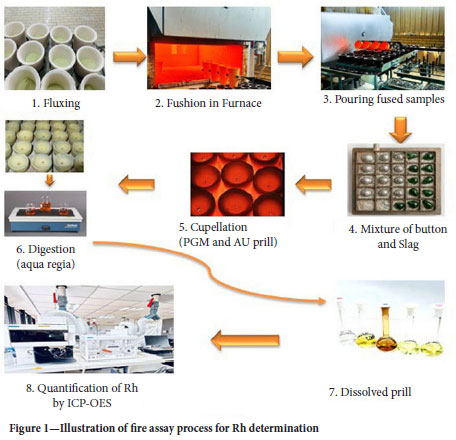
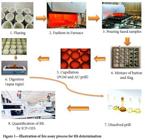
Two PGM certified reference materials (CRMs)-SARM 107 and AMIS 314-were used in this investigation. Sample preparation followed the traditional fire assay fusion process, 5 g - 30 g of sample were weighed and mixed with a lead-based flux as the primary collector, with an additional 2 ml co-collectors (Ag, Pd, Te) added to enhance rhodium recovery. The fusion was carried out at 1100°C, after which the samples were dislodged and subjected to the cupellation process at 1000°C. The resulting prill was transferred to a beaker, heated on a hot plate at 200°C, and digested using aqua regia (Green et al., 2004). As a result of fire assay, the acid dissolution step was critical to determining rhodium. In the prills obtained with different co-collectors, rhodium was found in metallic or alloyed form with silver, palladium, or tellurium after cupellation. In order to accurately quantify rhodium using inductively coupled plasma-optical emission spectrometry ICP-OES, the prills needed to completely dissolve in solution.
In controlled conditions, both metallic alloys and silicate phases originating from the flux were broken down by a mixture of concentrated nitric acid and hydrochloric acid. A partial dissolution would have led to poor recovery, high variability, and bias in the results. Consequently, enhancing the acid dissolution process was crucial to confirm the fire assay technique and to showcase the efficacy of palladium and tellurium as appropriate co-collectors for the determination of rhodium. Final analysis of rhodium content was performed using ICP-OES, as illustrated in Figure 1.
Reagents
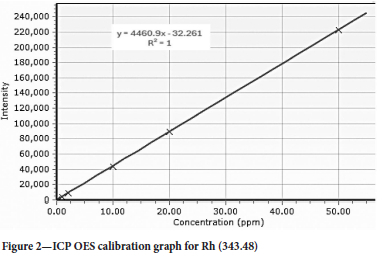
All solutions were prepared using ultrapure water (resistivity: 18 MΩ-cm) obtained from a Milli-Q purification system provided by MilliporeSigma (Bedford, MA, USA). Digestion solvents included concentrated nitric acid (HNO3, 65% w/w), hydrogen peroxide (H2O2, 50% w/w), hydrofluoric acid (HF, 48% w/w), and hydrochloric acid (HCl, 37% w/w), all supplied by Merck, Sigma-Aldrich (South Africa). A 100 ppm stock solution containing multiple platinum group elements (Ir, Os, Rh, Pd, Pt, Au) from VHG Labs (Manchester, NH, USA) was used for calibration. Calibration standards were prepared in the range 0.05 ppm -50 ppm for ICP-OES analysis by diluting the 100 ppm stock with 0.05% (w/w) HNO3 to maintain stability and prevent precipitation of the analytes process.
Instrument conditions for analysis
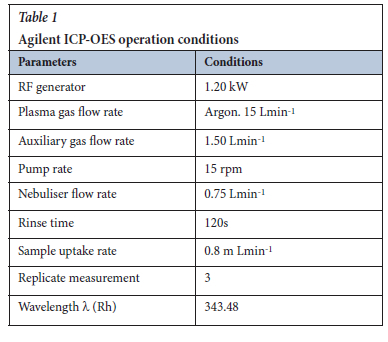
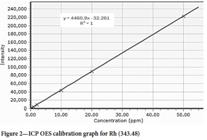
To quantify rhodium concentration in the different collectors, ICP-OES (Agilent 5800) intensity was measured under optimum operating conditions. Based on calibration with rhodium standards ranging in concentration from 0.05 ppm to 50 ppm, a linear correlation coefficient (R2 = 1) was calculated for the fire assay method. This excellent linearity confirms the reliability of the method for rhodium determination, as illustrated in Figure 2.
Results and discussion
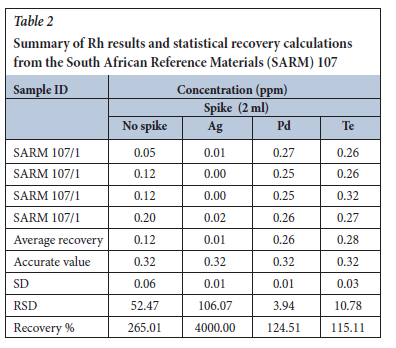
The analytical performance of the fire assay method for rhodium determination was further assessed using the SARM 107 Certified Reference Material (CRM) under different collector conditions (Table 2). When no co-collector was applied, the method produced a relative standard deviation (RSD) of 52.47 with a recovery of 265.01%, suggesting that the use of lead flux alone is insufficient for reliable rhodium recovery. This poor precision and inflated recovery are likely attributed to the limited affinity of rhodium for lead, leading to incomplete collection during cupellation.
The introduction of a silver spike was expected to improve rhodium collection due to the high affinity of silver for noble metals. However, the results showed an even greater variability, with an RSD of 106 and a recovery exceeding 4000%. Such anomalous recoveries suggest potential issues of matrix interference, over-collection, or contamination effects during the assay process. The excessive recovery values further indicate that silver may not provide selective enrichment of rhodium under the studied conditions and, instead, may cause co-precipitation of additional elements that artificially elevate the measured rhodium concentration (Asendorf, 2017).
In contrast, both palladium and tellurium spikes yielded improved analytical performance. For SARM 107, the RSD values were 3.94 and 10.78, with corresponding recoveries of 124.51% and 115.11%, respectively. These results demonstrate that palladium and tellurium serve as more effective co-collectors for rhodium, offering both higher precision and recoveries closer to expected values.
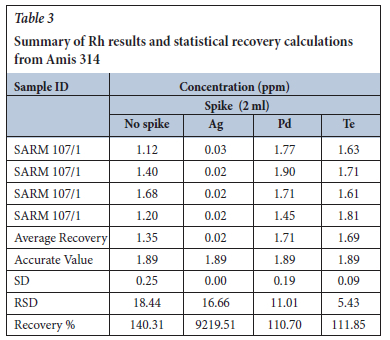
A similar trend was observed with the Amis 314 reference material (Table 3). When no spike was used, the recovery was 140.31%, while the silver spike led to a drastic overestimation, with a recovery of 9219.51%. In comparison, palladium and tellurium spikes again demonstrated more reliable performance, producing recoveries of 110.70% and 111.85%, respectively, with significantly improved RSD values. This improvement can be attributed to the strong chemical affinity of palladium and tellurium towards platinum-group metals, which promotes more efficient capture of rhodium during the fusion and cupellation stages. Their ability to stabilise rhodium under high-temperature fire assay conditions likely prevents losses that occur with silver or lead collectors, making them more reliable co-collectors for rhodium quantification.
Conclusion
Rhodium can be accurately determined by assay fire with the help of the right co-collector, according to this study. In addition to poor precision and excessively high recovery values, silver spikes and lead flux alone are not suitable for rhodium analysis. In contrast, palladium and tellurium spikes consistently produced recoveries close to 100% and low RSD values across both SARM 107 and Amis 314 certified reference materials. These findings confirm that palladium and tellurium are effective and reliable co-collectors for rhodium determination, offering greater accuracy and reproducibility compared to conventional collectors. In order to improve rhodium quantification in geological and metallurgical samples, fire assay combined with acid dissolution is recommended as a reliable approach for analytical determination.
References
- Asendorf, S. 2017. Analysis of platinum group metals with the Thermo Scientific iCAP 7400 ICP-OES. 1-4.
- Green, B.R., Smit, D.M.C., Maumela, H., Coetzer, G. 2004. Leaching and recovery of platinum group metals from UG-2 concentrates. July, 323-332.
-
Ivo Iavicoli, V.L. 2022. Chapter 28 - Rhodium (M. C. Gunnar F. Nordberg (ed.); Fifth Edit). Handbook on the Toxicology of Metals (Fifth Edition). https://doi.org/10.1016/B978-0-12-822946-0.00025-8
» https://doi.org/10.1016/B978-0-12-822946-0.00025-8 -
Kane, S.N., Mishra, A., Dutta, A.K. 2016. Preface: International Conference on Recent Trends in Physics (ICRTP 2016). Journal of Physics: Conference Series, vol. 755, no. 1. https://doi.org/10.1088/1742-6596/755/1/011001
» https://doi.org/10.1088/1742-6596/755/1/011001 -
Masasire, A., Rwere, F., Dzomba, P., Mupa, M. 2022. A new preconcentration technique for the determination of PGMs and gold by fire assay and ICp-OES. Journal of the Southern African Institute of Mining and Metallurgy, vol. 122, no. 1, pp. 29-36. https://doi.org/10.17159/2411-9717/1638/2022
» https://doi.org/10.17159/2411-9717/1638/2022 - Mogomots, M. 2017. Atomic Spectroscopic Techniques for The Determination of Platinum Group Metals and Base Metals in Concentrate Samples.
- Mohammadi, S.Z., Shamspur, T., Afzali, D., Taher, M.A., Karimzadeh, L. 2013. Atomic absorption spectrometric determination of trace amount of rhodium by using ligandless dispersive liquid-liquid microextraction based on solidification of floating organic droplet. Gazi University Journal of Science, vol. 26, no. 1, pp. 11-19.
-
Ndovorwi, F. 2016. Determination of platinum, palladium, rhodium and gold in ores and concentrates using iridium and ruthenium as co-collectors by fire assay. https://ir.uz.ac.zw/xmlui/handle/10646/2568
» https://ir.uz.ac.zw/xmlui/handle/10646/2568 -
Ni, W., Mao, X., Yao, M., Sun, Q., Guo, X., Zhang, H., Liu, L. 2021. Bismuth-Remaining Cupellation Fire Assay Preconcentration Combined with Inductively Coupled Plasma Mass Spectrometry for the Simultaneous Determination of Ultratrace Au, Pt, Pd, Ru, Rh, and Ir in Geologic Samples. International Journal of Analytical Chemistry, 2021. https://doi.org/10.1155/2021/9960673
» https://doi.org/10.1155/2021/9960673 - Services, A. 2013. Fire Assay Gold. 9-10.
-
Shyam, T.S., Dhruve, H. 2019. Comparative Analysis of Methods Employed in Rhodium Recovery. Journal of Chemical Reviews, vol. 1, no. 4, pp. 282-286. https://doi.org/10.33945/SAMI/jcr.2019.4.4
» https://doi.org/10.33945/SAMI/jcr.2019.4.4

Published: February 2026