Barriers and drivers towards the approval and implementation of new technology in mining: A dilemma and exit strategies framework
Abstract
The implementation of new technology in mining can be likened to a paradoxical situation or dilemma, where, on one hand, major mining projects are not able to solicit investor funding unless it is proven that the business cases were developed using tried and tested mining methods. On the other hand, new and innovative mining technology and mining methods need first to demonstrate and prove themselves under real production conditions over a reasonable period before they can be considered bankable feasibility studies in the mining industry. This dilemma locks new mining technology investments in a continuous cycle of underinvestment. Technological innovations are particularly relevant to the mining industry, which deals with the challenges of depleting access to resources, requiring new solutions to remain sustainable and competitive. In the last decade, the mining industry has come to realise that technological innovations can directly contribute to its sustained competitive advantage (Sanchez, Hartlieb, 2020), helping to reduce costs, lessen environmental impact, increase production, and improve mineral recovery. While understanding barriers and drivers for technology adoption is important for the success of technology implementation efforts and the sustainability of the mining sector (Muduli et al., 2013), this paper suggests strategies to exit the dilemma, proposing a preliminary framework.
new technology development; hard rock cutting; barriers and drives for new technology adoption
Introduction
Mining can be seen, from a basic perspective, as involving breaking in situ rock and hauling the broken rock out of the mine while ensuring the health and safety of all key stakeholders, profitability, and sustainability of the operation. Presently, mine operators are exploring ways to achieve both net zero and net profit to stay sustainable. Since the early 1900s, a relentless search has been underway for new and innovative mining technologies that can improve health, safety, environmental conditions, and productivity (Vogt, 2016). From a historical perspective, mining extraction technology has evolved over time and includes milestones such as the invention of the safety lamp, the safe use of explosives for fragmentation, the safe use of electrical energy, the development of continuous miners for cutting coal, the invention of rock bolts for primary and secondary support, open-pit mining technology for mining massive low-grade deposits, the introduction of longwall coal mining, and recently, in situ mining, automated mining, and robotic mining systems (General Kinematics, 2019). Through these achievements, it became apparent in the earlier years that integrating technological innovation into mining practices can result in reduced costs, increased productivity, and improved worker safety. It later became apparent that the mining sector needs to foster innovation to remain competitive.
New mining technology adoption barriers
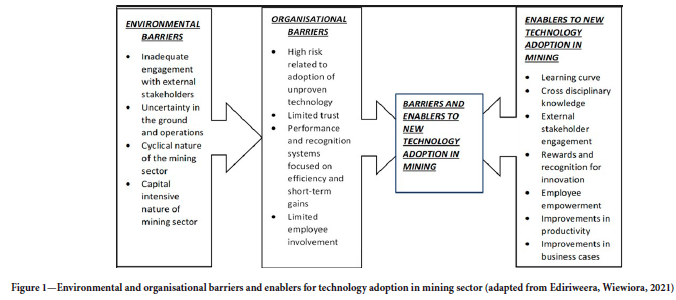
Understanding barriers and drivers for technology adoption is important for the success of technology implementation efforts and the sustainability of the mining sector. Numerous past studies conducted on technology adoption have focused mainly on organisations in the manufacturing and service sectors. When companies in the mining industry identify new technologies that could make step changes in performance, these companies are often faced with organisational resistance because the organisational incentives set up for production output, work against them (Deloitte, 2016). One would expect operations to jump at the new technology, but if companies are incentivising operational personnel for short-term production performance (Deloitte Monitor,2016), the risk inherent in the technology adoption works against the industry (Deloitte, 2016). The mining industry, in general, relies on third parties to take the lead in the development of new mining technologies. These third parties, such as original equipment manufacturers (OEMs) of mining equipment, are very reluctant to change as this would impact their existing equipment offerings, such as drill rigs, bolters, load haul dumps (LHDs), and dump trucks, among others (Olvera, 2021). The study conducted by Ediriweera and Wiewiora (2021) on barriers and enablers of technology adoption in the mining industry, revealed the following findings, as shown in Figure 1.
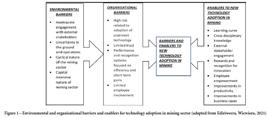
Mining projects are very capital-intensive, and mining methodology is locked in once access excavations start (Nanda, Kumar, 2013). Operational procedures become entrenched, and it may be complex to implement new technologies when they involve disruption to these existing operational routines (Nuur et al., 2018). Additionally, and to a greater extent than in other industries, mining operations are often undertaken in geographically remote and isolated areas, adding further challenges (Hall, 2017). These mining operations have a tremendous direct and indirect effect on communities and the environment, posing specific requirements in terms of their operations and approach to climate and social responsibility matters (Fordham et al., 2017). These aspects are also reflected in the emergence of the concept of 'social licence to operate', describing the requirement for civil society to accept and approve mining projects (Prno, Slocombe, 2012). The more mining-related drivers and barriers of innovation suggest that primitive models, or typical tried and proven methods of value-creating innovations, will deter the diffusion of innovation (Soderholm, Svahn, 2015). Successful demonstration projects help to make the benefits of an innovation visible and tangible, which can positively affect its diffusion (Stewart, Malatji, 2018).
This is significant given the large capital and operational investment costs associated with mining operations (Olvera, 2021). In addition, operational demands can present both drivers and barriers for the diffusion and adoption of innovation. If a technology that was previously used, like drill and blast, becomes obsolete or local conditions require other solutions, this may be a driving factor for the adoption of innovation (Amadi-Echendu et al., 2011). On the other hand, the complexity involved in implementing an innovation at a potentially remote mine site may result in considerable barriers to its adoption (Nanda, Kumar, 2013). Corporate and social responsibility (CSR) motivates the implementation of new technology due to the imperatives mining companies face to create benefits in terms of safety, sustainability, or reduced emissions (Nasirov, Agostini, 2018).
New mining technology drivers
One of the most dominant drivers for new technology development in the mining industry noted in the literature is employee health and safety (Deloitte, 2016). This includes the pursuit of safety goals, health concerns, and companies striving for environmental and social improvements, all of which may drive the adoption of innovations that have the potential to improve organisational health and safety standards. The second most common driver for the development of new technology noted in the literature is the aim to increase productivity (Olvera, 2021). Hard rock mining presently is a batched process, using drill and blast systems (Vogt, 2016), which leaves room for improvement such that any anticipated productivity improvements triggered by the adoption of new technology is an important motivator for fast-tracking new technology rollout. Thirdly, sustainability, mainly characterised by environmental concerns (Ediriweera, Wierwiora, 2021), has the potential to drive the adoption of innovation in the mining environment. Other frequently noted drivers include increasing efficiency (Gruenhagen, Parker, 2020), the availability of human capital (Macfarlane, 2001), cost reductions (Deloitte, 2016), collaboration (Ediriweera, Wiewiora, 2021), and market pressure (Gruenhagen, Parker, 2020).
Race for net zero
Several major mining companies are aligned with global climate goals, which have been agreed upon in international pacts such as the Paris Agreement. A number of these significant mining companies that have committed to supplying the raw materials required to build the low-carbon future have declared their own targets to reduce carbon dioxide emissions by 30% to 40% by 2030 and net zero by 2050 (Lasley, 2022). This is because mining investors, manufacturers that buy metals to build their products, and the public that use those goods are increasingly demanding that minerals and metals be produced with the highest environmental, social, and governance standards (Lasley, 2022). This implies that mining companies need to investigate innovative ways of maximising value and minimising waste. Moreover, it suggests that for a company striving towards zero-footprint mines, this should be a prerequisite embedded in its strategy. For instance, by electrifying the mobile fleet (IntelliSense.io, 2022), increasing remote operations (International Institute for Sustainable Development, 2021), smart tracking (Institute for Sustainable Development, 2021), and optimised extraction methods (Institute for Sustainable Development, 2021), much of the environmental degradation seen in mining operations could be avoided.
Reduction in grades
Mining depletes the natural mineral resources and in a strict sense is therefore inherently unsustainable. One can argue, for instance, that there is only a finite amount of copper in the Earth's crust, and each unit of copper extracted increases the fraction of the total copper depleted from the ground.
This reduction in rich mined ore grades means that more low-grade ore needs to be processed to produce the same amount of metal, leading to a rise in energy requirements and, thus, greenhouse gas emissions (Norgate, Haque, 2010). This implies that use of innovation in search for new minerals increases in importance over time as humanity demands for more materials to satisfy its growing needs and strategic minerals become increasingly exhausted, with ore grades rapidly declining.
Requirement for the increase in mining productivity
During the height of the mining boom (Eleven, 2021), record-breaking commodity prices notionally supported the development of marginal, high-cost, low-productivity mineral deposits (Jacobs, 2016). As commodity prices dropped over the past few years, companies responded by slashing costs, a traditional response to this ever-shifting market cycle (Eleven, 2021).
Productivity is about maximising throughput per unit of time, per unit of quality, and per unit of cost (Macfarlane, 2001). Mining companies may wish to apply a better use of technology to achieve these goals. To do so, they need to seek out innovative technologies capable of unlocking deposits and improving productivity on the mine site.
Cost reduction
Miners cannot control the vagaries of the world economy that shift currencies and commodity prices; however, they can control how they operate. As mining companies refocus on becoming lowest-quartile cost producers, they will need to move away from reactionary cost-cutting and towards sustainable cost management programmes. To prevent this constant cycle of cost reduction and high cost creep, miners must go beyond traditional cost-cutting measures. Labour productivity in mining is often measured by output per mining company employee over a given period, such as a year (Vogt, Hatting, 2016), where output typically is the content of the main metal product contained in the ore. Miners need to raise productivity before companies can reclaim shareholder support and deliver bottom line value. Mine operators could scale operations to suit individual projects. Furthermore, they could build stronger funding practices by better understanding the difference between a project's value and the price the market sets.
Energy efficiency
Energy efficiency improvement programmes in mining are widespread and target all aspects of mining. These include capturing waste heat, managing electricity demand, mine drainage, ventilation, and generating energy from by-products (Levesque et al., 2014). Hence, opportunities for energy efficiency in mines can be explored in specific mines using innovative ways. However, comminution and material handling (including loading and hauling) operations have been identified to have the highest potential for energy efficiency improvements (BSC Incorporated, 2007). In a study by the Department of Energy in the United States, grinding and diesel equipment used in material handling were identified as the operations presenting the greatest energy savings potential (BSC Incorporated, 2007).
Responsible mining
According to the 2022 Responsible Mining Index report, 94% of the mine sites assessed scored an average of less than 20% on the fifteen fundamental economic, environmental, social and governance or EESG issues (Responsible Mining Index, 2022). This demonstrates little evidence of companies translating their lofty corporate commitments into action plans by applying thorough due diligence processes and tracking the effectiveness of implementation. The result has been more verbal promises than action, if any, on responsible mining. However, mining has the potential to innovate and support a more sustainable future through responsible mining. Companies could do this through a range of deliberate actions to ensure that mines remain environmentally sustainable and provide social profitability to the local communities.
Part of responsible mining includes empowering and supporting communities in closing and reclaiming mine sites (Responsible Mining Index, 2022). Even after the closure of a mine, it can present significant harm to surrounding communities and the environment, as processing often uses harmful chemicals. It is apparent that opportunities exist for miners to innovate in this area. However, with the closure of the Responsible Mining Foundation (Responsible Mining Index, 2022) and reluctance by miners to act on these issues, it is doubtful that over the near term (five years ahead), there will be a marked improvement.
Fourth Industrial Revolution and beyond
The Fourth Industrial Revolution (4IR) is characterised by technologies, and the combination of technologies, such as artificial intelligence, analytics, cloud computing, the internet of things, and other dynamic attributes (Ntsoelengoe, 2021), all of which have enormous potential to grow the industry while improving workplace safety. Modernisation of the mining industry can lead to the required transformation and return to productivity. In the context of 4IR, this should mean that the minerals and metals required to move the globe towards a circular economy can be extracted in less environmentally destructive ways. At the same time, some minerals, such as coal, and hydrocarbons should be left in the ground. The implication is that modernisation of the mining industry can lead to the required transformation and return to productivity.
Exiting the paradoxical trap of new mining technology investment
If investment costs are high, it prevents an innovation from being adopted, as some mining companies lack the necessary financial resources. Many mining companies still struggle to embrace high-tech solutions, as discerned by Filippou and King (2011), who indicate that mining companies have spent, on average, a lower share of their operational expenditure in the development of technologies compared to other sectors. Between the 1990s and 2000s, the research and development (R&D) intensity of mining companies, measured as R&D expenditure as a percentage of total revenues, was on average only approximately 0.5% (Filippou, King, 2011), significantly lower than sectors such as information and communication technology (ICT) or pharmaceuticals, where the level of R&D spending was 24.7% and 25.1%, respectively, in 2015 (Sanchez, Hartlieb, 2020).
The following are suggested strategies supported by literature for exiting the paradoxical trap, culminating in a preliminary conceptual framework.
Align technology roadmap with group strategy
A company's success or failure is reliant on the development and adoption of a business strategy that provides guidelines on how it operates and the approved options available to exercise in reaching its long-term objectives (Jordaan, Hendricks, 2009). A technology roadmap is meant to be used as a strategic planning tool in the field of innovation and new technology development. It provides a visual representation and comprehensive plan for the development, adoption, and integration of technologies within an organisation or industry. The purpose of a company's technology strategy is to gain a sustainable technological advantage that offers a competitive advantage (Du Plessis, 2017). A common problem in the mining division of companies is the lack of aligned business and technology strategies. Mining companies need clear mandates and objectives to guide them in selecting the technologies required for them to achieve their objectives. Khalil (2000) suggests that the first step in developing a business technology strategy is to establish the mining companies' core competencies. The mining companies' portfolios must be strategically aligned; this would mean that all their projects are ''on strategy'' and that their breakdown of spending across projects, areas, markets, etc., must mirror their strategic priorities (Schilling, 2017).
Develop a robust business case
Mine development cannot progress without observing positive economic evaluation results, which are the potential profitability of a future mine. According to the discounted cash flow (DCF) method being the most widely used method in mining (Bhappu, Guzman, 1995), net present value is generally calculated as an indicator of project profitability. However, in the case of new technology mining projects, the information required for the economic calculations input data is problematic to generate (Raju, 2021). This is due to the specific features of these projects, which complicate their economic evaluation. The objective of any investment within a firm is to create value for its owners and shareholders. The purpose of allocating money to a division or project is to generate a cash flow substantially more significant than the amount invested in the future. Investors have alternative uses for their funds (Fagan, 2020), and they, therefore, have an opportunity cost if money is invested in a corporate project. The investor opportunity cost is the sacrifice of the return available on the foregone alternative.
Investors are comfortable investing their money in projects that will generate risk-free returns. In the mining sector, the project teams that are tasked to compile bankable feasibility studies are compelled to use tried and tested benchmarks to compile their business cases (Olvera, 2020). When confronted with the transition of new mining technology from demonstration to validation and then into a bankable production system, one needs to follow a similar rigour as when compiling bankable mining business cases (Nel, Burks, 1999). The team needs to first ensure they have access to an orebody that has all the approved levels of geological, geotechnical, and mineral grade information to develop a bankable study (Nel, Burks,1999).
Find an interested client (site)
Mining used to be a business primarily focused on the technical aspects of getting value out of the ground and extracting the minerals in a metallurgically efficient way (Humphreys, 2020). Without denying the importance of these skills, a narrow focus on technical cases is no longer sufficient to guarantee success, even in rich orebodies. Skills in economics is an essential partner to technical skill in every step of the mining process (Runge, 2015).
While planning for the development, implementation and embedding of new technology within a mining operation, the organisation must have a quantifiable purpose and benefit to the business, whether in terms of economics, environment, or health and safety (Nicholas, Steyn, 2010). Moreover, this analysis must take account of the total value chain of the mining operation. Such a proposed techno-economic analysis should consider the holistic system in which the technology operates as opposed to the standalone benefits of the new device or process (Sanchez, Hartlieb, 2020), which addresses the holistic concerns of prospective clients.
From an overall stakeholder perspective, the optimum mining method will always be the one that maximises the economic returns (Mackenzie, Cusworth, 2007) while keeping the environmental impacts within acceptable levels (Bitarafan, Ataei, 2004), maintaining acceptable working conditions (especially regarding levels of safety risk) for employees (Lane, 2016), and statutory obligations (Bitarafan, Ataei, 2004) including resources recovery stipulations. Collectively, these goals will also satisfy the objectives of the use of these mineral resources and, hence, become attractive to potential clients.
Align with new mining technology implementation readiness levels
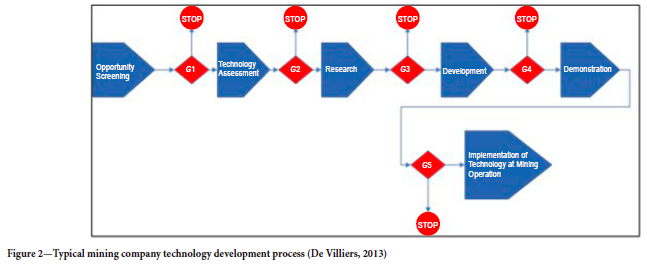
Mining companies usually adopt new technology development processes in-house, and although systematic, new technology development phases can typically be stopped at any time as the process progresses through the development stages, as depicted in Figure 2.
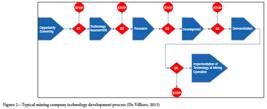
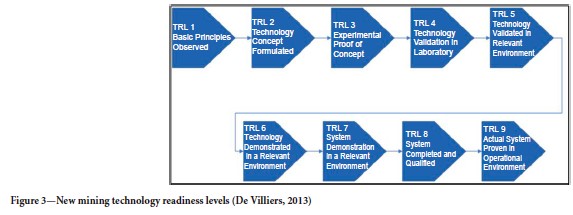
Borrowing from best practices in other industries, this paper proposes the use of a technology readiness levels (TRL) approach to guide the technology development process in mining companies. TRL is a type of measurement system used to assess the maturity level of a particular technology (Beck, 2013). The new mining technology development project (NMTDP) is evaluated against the parameters for each technology level and is then assigned a TRL rating based on the NMTDP progress (De Villiers, 2013). There are generally nine technology readiness levels. TRL 1 is the lowest, and TRL 9 is the highest, as illustrated in Figure 3.
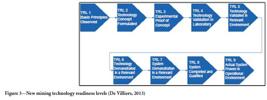
When a technology is at TRL1, scientific research of a concept will begin, and those outcomes will be translated into future research and development. TRL2 occurs once the basic principles have been studied and practical applications can be applied to those initial findings. When active research and design begin, a technology is elevated to TRL3. Generally, both analytical and laboratory studies are required at this level to see if a new mining technology is viable and ready to proceed further through the development process. Often, during TRL3, a proof-of-concept model is constructed. Once the proof-of-concept technology is ready, the technology advances to TRL4. During TRL4, multiple component pieces are tested with one another. Simulations should be run in environments that are as close to realistic as possible. Once the testing of TRL5 is complete, a technology may advance to TRL6. A TRL6 technology has a fully functional prototype or representational model. TRL7 technology requires that the working model or prototype be demonstrated in a mining environment. TRL8 technology has been tested and operationally qualified, and it is now ready for implementation in an already existing mining system. Once a technology has been operationally proven over an agreed time span, it can be called TRL9, or it is operational ready as a bankable technology or mining system.
Following this approach, a more progressive perspective is suggested, where companies need not stop and abandon their projects entirely every time there is a major challenge (see Figure 2). Rather, they should assess their level of readiness and the stage they are at in relation to the overall pathway and anticipate the next steps that need to be taken to eventually reach the final goal. Using this perspective, it should be possible for a given company to pause the progression of technology development at the current stage for a while without abandoning the project entirely and prepare for the next step in the technology development pathway.
Develop an executable technology implementation strategy
The technology implementation strategy should be developed for the specific mining operation and not be considered as one solution that fits all (Jacobs, 2016). For an appropriate technology implementation methodology, it is reasonable to consider the task as a project and draw from best practices in project management and general management, as these are tried and tested management systems applied during the implementation of projects of all types. Following project management best practices (Nickolas, Steyn, 2010), when engaging with mining operations, one needs to compile a technology charter (Nel, Burks, 1999). When the technology charter is completed and agreed upon by the various key stakeholders, it must be signed off. This signed-off document will mandate that the technology implementation team have access to the target orebody and mining operation.
The team should then compile a detailed scope of work (Nickolas, Steyn, 2010) for the specific new mining technology execution. This detailed scope of work must also be signed off by the key stakeholders at the operations, stating what is in the new mining technology (NMT) implementation teams' scope and what would be in the scope of the operations and should also include the OEM's task assignments. The NMT target site must be considered a mining section, comprising an organisation's structure with names, titles, and legal appointments clearly stating reporting lines.
Once the detailed scope of work is approved by the technology development teams and the mining operational team, the tender process for the appointment of engineering, procurement, and construction management (EPCM) can begin; it must be clearly stated to the shortlisted EPCMs that this scope will undergo continuous development as the implementation progresses. The EPCM will develop a detailed project schedule and estimate to monitor and control the work packages and specific activities.
New mining technology case studies highlighting major challenges
Several mining companies, in joint agreements with original equipment manufacturers, have funded large investments to develop new technology to excavate hard rock (Ridley, 2020). These investments mainly focused on developing mechanical complex rock-cutting machines to invent and implement continuous mining technologies (Macfarlane, 2001). One of the most dominant drivers in pursuing these investment programmes was the quest to achieve higher production rates, reduce operational costs, and transition away from the batch, unsafe aspects of drill and blast mining systems (Vogt, 2016).
Many of these joint development agreements (JDA) focused on adapting the existing dominant designs, such as tunnel boring machines, to develop mine access tunnels more quickly (Herrenknecht, 2011). Some companies have developed new cutting techniques, such as undercutting. These are improvements made to mechanical cutting techniques. This cutting system caused tensile rock failure to enhance production rates. While the art of mechanical cutting was optimised, engineers also investigated various material technologies to develop more efficient and wear-resistant cutting tools for hard rock excavation (Herrenknecht, 2011).
Some of the outcomes of the early development of mechanical excavation technologies included the mobile miner, continuous miner, mini full-facer, disc boom miner, oscillating disc cutter, activated disc cutting, narrow reef miner, mini mole, mini-disc drum cutterhead, roadheader, tunnel boring machine (TBM) for underground mining, and the mechanical surface miner for surface mining (Hartman,1992; Luxner et al., 2013; Karas, Wach, 2014). Some of these development efforts have been halted or entirely abandoned by the development teams, including the mobile miner, mini full-facer, the disc boom miner and the mini mole (Hassani, 2008).
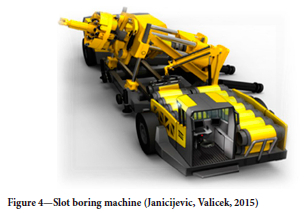
Two cases are selected to illustrate typical challenges encountered when introducing new technology developments in mines where the technology is initially embraced with enthusiasm and even progresses to implementation but later gets abandoned. The first example involves one of the joint development agreements (JDA), which included OEM mining equipment and a major platinum miner. These companies pulled all the stops to develop and test some of these technologies. This equipment aimed to achieve two objectives, namely, rapid access and rapid stoping. The JDA partners designed and developed a slot boring system, Figure 4, which adopted a raise boring technology that used TBM-styled steel discs as a cutting system, as stated by Janicijevic and Valicek (2015). The rock collection system was pneumatic rather than hydraulic to minimise water-related problems with the platinum ore.
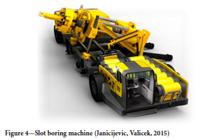
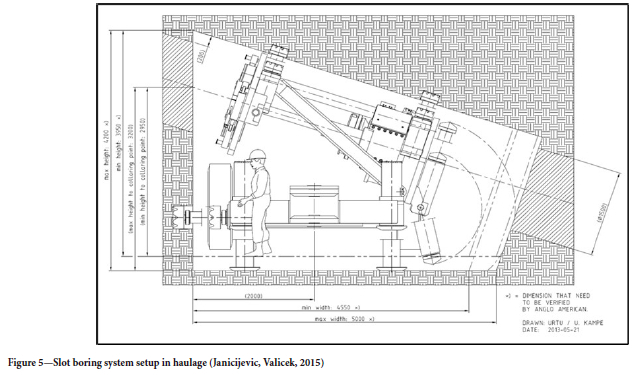
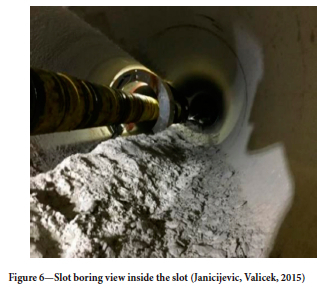
The slot boring system was designed to cut slots of 1.5 m dia at a rate of 11.4 m/h. The machine would be set up in haulage, as shown in Figure 5. The haulage needed to be drilled and blasted as a shanty back layout, as shown, 4.5 m high x 5 m wide. The pipes were fed into the machine from the bottom, pushing the cutter head into the reef, and the extracted material would be vacuumed out of the stope via a pneumatic extraction system, as shown in Figure 6. The improvement and advantage expected in using this equipment compared with existing drill and blast have many advantages, such as continuous mining can be much faster if set up correctly, safer as operators can be moved away from the mining face, and excavations are much more stable in the stope as no blast-induced fracturing is propagated into the surrounding rock mass.
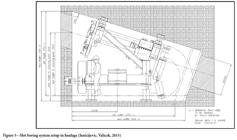
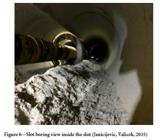
The system underwent a testing period but was later abandoned in 2018 after drilling six holes over a period of six months of testing. Some of the major shortfalls revealed from these tests were that the mine design and the drill and blast development were not considered a complete system, the machine experienced excessive vibration, excessive dust was experienced, the pneumatic system was under-designed, the extracted ore could not be loaded onto the strike belt system, material spill over into the adjacent slots occurred, and extreme flexing of push rods occurred. Due to the magnitude of the setup costs and the system not achieving its planned key performance indicators (KPIs), the project was abandoned, and the machine was scrapped.
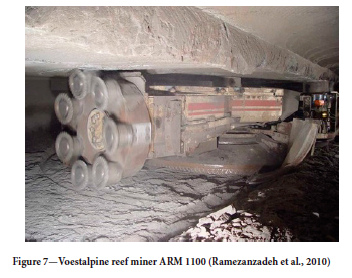
The second case involves the voestalpine reef miner, the ARM 1100, illustrated by Figure 7, which was developed for the South African platinum mining industry in 2001. The project was a joint development between voestalpine and a consortium of South African platinum mining companies (Moxhan, 2004). The reef mining machine went through several iterations from its inception in 2001 up until 2018, when it was eventually abandoned due to the age of the machine and the added cost of rehabilitation.
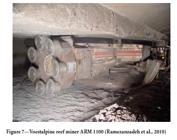
During the period of 2001 up until 2018, the machine underwent several modifications and upgrades. The dominant design of this machine was based on undercutting technology but with many cutting tool developments. The other modifications included the ore handling system, machine tramming, bolting, electrical cable handling system, and the steering system (Ramezanzadeh et al., 2010). These tests of the various systems were carried out as standalone tests as and when issues were noticed on these systems.
The final reef mining machine called the MN220, was abandoned in mid-2018 after the machine was tested using a pneumatic system for the extraction of the cut ore from the face to a test separator and filter system. Following this, a joint development agreement was initiated between an OEM and a major mining company to develop the next generation of this reef mining system. The lessons learnt over the almost twenty years of testing this machine were used as input to the new version of this stoping system, which not only considered the technical aspects of the stoping system but an entirely new mining layout to cater for this system. Although this system has been in development for over twenty years, it is still not regarded as a bankable technology or stoping system in the platinum mining industry. This is because the system can only be regarded as a bankable mining system once it has been vetted by a major mining company. These selected cases highlight the fact that major technology development in mining can take several years, involve major partnerships and protocols, and be costly to set up, and yet mining companies will be slow to adopt the new technology, or in the worst-case scenario, as often happens, it becomes abandoned.
Preliminary conceptual framework
The drivers of new mining technology build on traditional ones, such as productivity and cost reduction, and feature both technological, social, and competitive related issues like net zero, responsible mining and 4IR, among others. Barriers to mining technology are largely those identified by Ediriweera and Wiewiora (2021), augmented by experience from case studies in South Africa that highlight high R&D and setup costs, and long periods of return on investments.
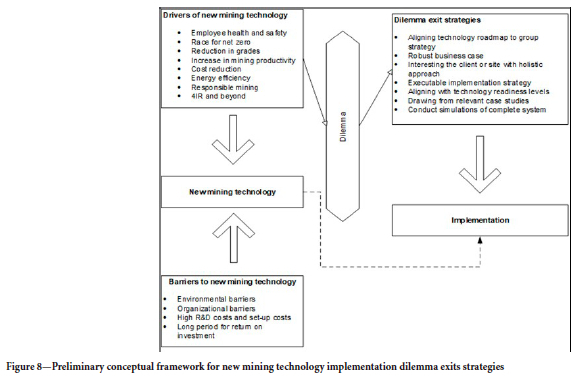
There is a dilemma in implementation, as mines are reluctant to adopt unproven mining technology until the technology is proven in an actual operation, where it can prove its planned KPIs over a set period. Nevertheless, a significantly small number of these technologies, which are either less costly to set up and implement or initially accompanied by high enthusiasm and substantial buy-in from stakeholders, are approved and implemented even if later abandoned. A substantial portion of the new mining technology, however, faces the dilemma of reluctance to be tried out and requires either robust return on investment or exit strategies, as shown in Figure 8, that can convince decision makers to take the risk of implementation. This hesitation is further compounded by operational inertia, regulatory uncertainty, and the high capital intensity of mining projects, which make experimentation on unproven technologies a costly option.
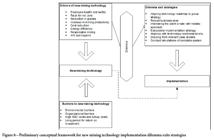
Additionally, the fragmented nature of mining operations often spread across geographies and governed by varying local policies creates inconsistencies in technology adoption. On the other hand, drivers such as increasing pressure for sustainability, digital transformation mandates, and competitive advantage through efficiency gains are beginning to shift the narrative. Technologies that align with ESG goals or demonstrate clear productivity enhancements are more likely to gain traction. Therefore, the dilemma is not merely technical but deeply strategic, requiring a framework that balances innovation with risk mitigation and provides clear exit pathways should the technology fail to deliver as expected.
Conclusion
This article notes key barriers and drivers for the implementation of new technology in the mining industry and proposes that a standardised technology development pathway applicable to other industries is adaptable to the mining sector. However, although lessons can be drawn by comparing the parallel features and similarity of pathways with other industries, the paper concludes that the mining industry has an outstanding characteristic to be confronted with, which may lead to a different outcome from others. Due to the capital-intensive nature and long periods before the return on investment (ROI) of mining investments can be realised, mining companies are reluctant to adopt new mining technology, as illustrated by the case studies discussed. The cost and time considerations, among others, are significant barriers to the adoption of new technology in mining. The article argues that for developers of new technology in mining, the approach used to present the business case to decision makers should incorporate both an economical and holistic perspective in addition to technical viability for a better chance of adoption. Such an approach is proposed in this paper as a preliminary conceptual framework to guide stakeholders on key areas to consider when presenting new technology to mining decision makers. As an initial framework, more work is required to test and pilot the concepts proposed.
References
- Amadi-Echendu, J., Lephauphau, O., Maswanganyi, M., Mkhize, M. 2011. Case studies of technology road mapping in mining, Journal of engineering and technology management.
- Beck, D.F. 2013. Technology development life cycle processes, Fuzing and instrumentation technologies, Sandia national laboratories.
- Bhappu, R.R., Guzman, J. 1995. Mineral investment decision making, Engineering and Mining Journal, vol. 7, pp. 36-38.
- Bitarafan, M.R., Ataei, M. 2004. Mining method selection by multiple criteria decision making tools, The Journal of The South African Institute of Mining and Metallurgy.
- BSC Incorporated. 2007. Mining Industry Energy Bandwidth Study, U.S. Department of Energy, Industrial technologies program.
-
Deloitte. 2016. Innovation mining Australia 2016, Monitor Deloitte. Available at: https://www.deloitte.com/content/dam/assets-shared/legacy/docs/gx-au-en-innovation-in-mining.pdf
» https://www.deloitte.com/content/dam/assets-shared/legacy/docs/gx-au-en-innovation-in-mining.pdf - De Villiers, R. 2013. Technology Development Handbook, Anglo American Plc.
-
Du Plessis M.J. 2017. Evaluation of Technology Strategy Application in the South African Mining Industry, researchgate.net/publication/274364033
» researchgate.net/publication/274364033 - Ediriweera, A., Wiewiora, A. 2021. Barriers, and enablers of technology adoption in the mining industry. Resources Policy, vol. 73.
-
Eleven. 2021. Technological Innovation - A challenge worthy of the mining industry available at: https://eleven-strategy.com/technological-innovation-a-challenge-worthy-of-the-mining-industry/
» https://eleven-strategy.com/technological-innovation-a-challenge-worthy-of-the-mining-industry/ -
Fagan, D. 2020. Real life examples of opportunity costs. Open vault blogs. Available at: Stlouisfed.org/open-vault/202/january/real-life-exmples-opportunity-costs
» Stlouisfed.org/open-vault/202/january/real-life-exmples-opportunity-costs - Filippou, D., King, M.G. 2011. R & D Prospects in mining and metals industry, Resource Policy, vol. 36, no. 3, pp. 276-284.
- Fordham, A.E, Robinson, G.M, Blackwell, B.D. 2017. Corporate social responsibility in resource companies - opportunities for developing positive benefits and lasting legacies. Resource Policy vol. 52, pp. 366-376.
-
General Kinematics. 2019. A brief history of mining: the advancement of mining techniques and technology. Available at: https://www.generalkinematics.com/blog/a-brief-history-of-mining-and-the-advancement-of-mining-technology/
» https://www.generalkinematics.com/blog/a-brief-history-of-mining-and-the-advancement-of-mining-technology/ - Gruenhagen, J.H., Parker, R. 2020. Factors driving or impeding the diffusion and adoption of innovation in mining: A systematic review of the literature. Resources Policy, Elsevier.
-
Hall, H. 2017. Exploring innovation in Northern Canada with insights from mining innovation systems in greater Sudbury, Ontario. The Northern Review, vol. 45, pp. 33-56. Available at: https://doi.org/10.22584/nr45.2017.003
» https://doi.org/10.22584/nr45.2017.003 - Hartman, H.L.1992. SME Mining Engineering Handbook, 2nd edition, vol 2.
- Hassani, F. 2009. Review of explosive free rock breakage technologies and expertise, Final report submitted to: The technical committee of the explosive-free rock breakage initiative. Submitted by McGill University Department of Mining and Materials Engineering
- Herrenknecht, A.G. 2011. Utility Tunneling, Traffic Tunneling, March.
- Humphreys, D. 2020. Mining productivity and the fourth industrial revolution. Mineral Economics Journal.
-
IntelliSense.io. 2022. An alternative approach to winning the race to net zero, available at: https://www.intellisense.io/2022/07/an-alternative-approach-to-winning-the-race-to-net-zero/
» https://www.intellisense.io/2022/07/an-alternative-approach-to-winning-the-race-to-net-zero/ - International Institute for Sustainable Development. 2021. New Tech, New Deal: Mining policy options in the face of new technology. The Intergovernmental Forum on Mining, Minerals, Metals and Sustainable Development (IGF), August.
- Jacobs, J. 2016. Creating a technology map to facilitate the process of modernisation throughout the mining cycle. M.Eng (Mining Engineering) thesis, Department of Mining Engineering, University of Pretoria, South Africa.
- Janicijevic, D., Valicek, P. 2015. A review of hard-rock cutting equipment technology development at Anglo American and Anglo Platinum. Proceedings of MPES 2015, Mine Planning and Equipment Selection, 'Smart Innovation in Mining', Sandton Convention Centre, Johannesburg, South Africa. Southern Institute of Mining and Metallurgy, Johannesburg.
- Jordaan, J.T., Hendricks, C. 2009. The challenge of technology adoption and utilisation in the mining industry - A focus on open pit mining technologies. SAIMM, Base Metals Conference.
- Karas, H., Wach, M. 2014. New mechanization and automation roads in continuous mining - KGHM's experience and future steps. Rapid Development Conference, Krakow, pp. 29-30 September.
- Khalil, T. 2000. Management of Technology - The Key to Competitiveness and wealth creation, McGraw-Hill International Editions, pp 1-3; pp. 192-195; pp. 207-216.
- Lane, A. 2016. Innovation state of play, Africa mining edition, Mining Indaba and Monitor Deloitte study
-
Lasley, S. 2022. Mining sector races to net zero by 2050. Available at: https://www.metaltechnews.com/story/2022/08/10/mining-tech/mining-sector-races-to-net-zero-by-2050/1030.html
» https://www.metaltechnews.com/story/2022/08/10/mining-tech/mining-sector-races-to-net-zero-by-2050/1030.html - Levesque, M., Miller, D., Paraszczak, J. 2014. Energy and mining the home truths. Journal of Cleaner Production ,vol. 84, no. 1, pp. 233-255.
- Luxner, T., Deen, J., Koske, M. 2013. Use of tunnel boring machines at the still water mining company's underground PGM mines. Rapid Development Conference, Sydney.
- Macfarlane, A.S. 2001. The implementation of new technology in southern African mines: Pain or panacea. Journal of the South African Institute of Mining and Metallurgy, vol. 101, no. 3, pp. 115-126
-
Mackenzie, W., Cusworth, N. 2007. The use and abuse of feasibility studies, Project evaluation conference, Melbourne Victoria. Enthalpy, available at: enthalphy.com.au
» enthalphy.com.au - Moxam, K.A. 2004. A hard rock narrow reef mining machine- ARM 1100. International Platinum Conference 'Platinum Adding Value, The South African Institute of Mining and Metallurgy.
- Muduli, K., Govindan, K., Barve, A., Geng, Y. 2013. Barriers to green supply chain management in Indian mining industries: a graph theoretic approach, Journal of Cleaner Production, vol. 47, pp. 335-344.
- Nanda, N.K., Kumar, S. 2013. Developments in mining machinery and systems, both surface and underground, for meeting the future challenges. Journal of Mines, Metals and Fuels, vol. 61, no. 7-8, pp. 163-169.
- Nasirov, S., Agostini, C.A. 2018. Mining experts' perspectives on the determinants of solar technologies adoption in the Chilean mining industry. Renewable and Sustainable Energy Reviews, vol. 95, pp. 194-202.
- Nel, l., Burks, S. 1999. The bateman approach towards achieving economic and financial requirements for feasibility studies. Journal of the Southern African Institute of Mining and Metallurgy, pp. 303-315
- Nicholas, J.M., Steyn, H. 2010. Project management for business, engineering, and technology principles and practices, 3rd edition, Butterworth-Heinemann.
- Norgate, T., Haque, N. 2010. Energy and greenhouse gas impacts of mining and mineral processing operations. Journal of Cleaner Production.
- Ntsoelengoe, B. 2021. Mining 4.0 - Modernization of mining in the fourth industrial revolution. Publication of CSIR Sciencescope, vol.17, no1.
- Nuur, C., Gustavsson, L., Laestadius, S. 2018. Capability creation in the natural resource-based sector: experience from Swedish mining. Innovation and Development, vol.8, no. 1, pp. 103-123.
- Olvera, B.C. 2021. Innovation in Mining: what are the challenges and opportunities along the value chain of Latin American suppliers, Mineral Economics, vol.3 5, pp. 35-51.
- Prno, J., Slocombe S.D. 2012. Exploring the origins of'social license to operate in the mining sector: perspectives from government and sustainability theories Resources Policy, vol. 37, no. 3, pp. 346-357.
- Raju, R.A. 2021. Comparison of the Business Case between Explosives and Non-Explosives Mining Methods for Underground Platinum Mining Projects, Research Gate, 2021.
- Ramezanzadeh, A., Wood, M. 2010. A state of the art review of mechanical rock excavation technologies, International Journal of Mining and Environmental Issues, vol 1 no1.
-
Responsible Mining Index. 2022. RMI Report, available at: https://2022.responsibleminingindex.org/en
» https://2022.responsibleminingindex.org/en - Ridley, M. 2020. How the innovation works, 4th Edition, Estate London.
- Runge, P. 2015. Minimum Engineering Requirements, Minarco Perspectives, Issue 128.
- Sanchez, F., Hartlieb, F. 2020. Innovation in mining industry: Technological trends and a case study of the challenges of disruptive innovation, Mining, Metallurgy and exploration.
- Schilling, M.A. 2017. Strategic management of technological innovation, 5th Edition, McGraw Hill Education.
- Soderholm, P., Svahn, N. 2015. Mining, regional development and benefit sharing in developed countries, Resources Policy, vol. 45, pp. 78-91.
- Stewart, J.M., Malatji, S.M. 2018. Development of the MOSH leading practice adoption system - a science-based system for managing behaviour change, Journal of Southern African Institute of Mining and Metallurgy, vol. 118, no. 3, pp, 259-277.
- Vogt, D. 2016. A review of rock cutting for underground mining: past, present, and future. Journal of The South African Institute of Mining and Metallurgy, vol. 116, no. 11, pp. 1011-1026.
- Vogt, D., Hattingh, T. 2016. The importance of people in the process of converting a narrow tabular hard-rock mine to mechanization, Journal of The South African Institute of Mining and Metallurgy, vol. 116, no. 3, pp. 265-274.

Revised: 13 May 2025
Accepted: 11 Sept.2025
Published: October 2025