Near-surface wave attenuation (kappa) of an earthquake near Durban, South Africa
Abstract
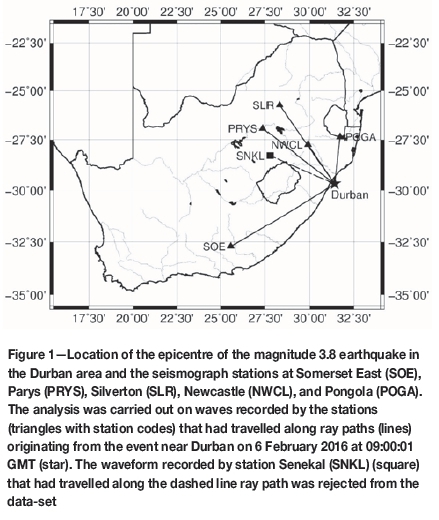
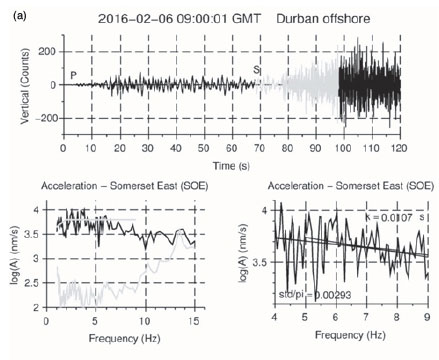
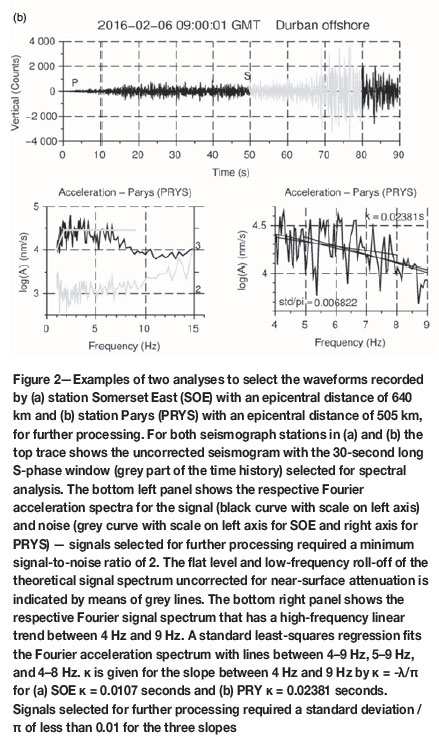
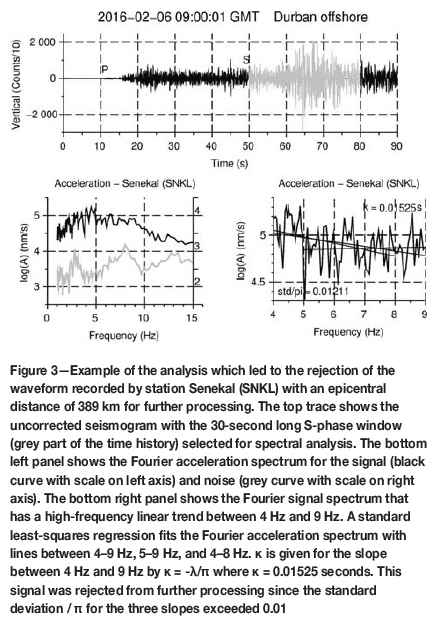
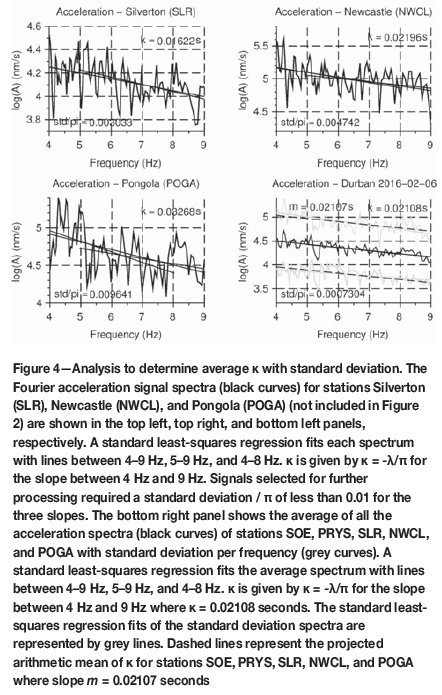
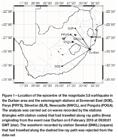
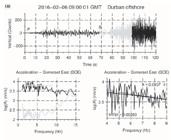
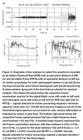
The near-surface wave attenuation factor κ (kappa), which describes the attenuation of seismic waves over distance in the top 1-3 km of the Earth's crust, was determined for eastern South Africa using data recorded by five stations of the South African National Seismograph Network. The author carried out the analysis on data from an earthquake with magnitude 3.8 that occurred off the coast of Durban on 6 February 2016 at 09:00:01 GMT. For the analysis, the author selected a 30-second window for the S-phase portion of the vertical component seismogram. The result was an average κ = 0.021 ± 0.0007 seconds, which is lower than κ = 0.048 seconds for micro-events in the Far West Rand and much lower than κ = 0.098 seconds for explosions at Sasolburg coal mines (Brandt, 2017). Kappa was found to be higher than for a stable continental region (κ = approx. 0.0006 seconds). This is likely due to the narrow frequency range between 4 Hz and 9 Hz, as well as the small data-set employed during this analysis.
kappa; near-surface seismic attenuation; tectonic earthquake; spectral analysis
 Thumbnail
 Thumbnail
 Thumbnail
 Thumbnail
 Thumbnail