Geometallurgical domain characterisation and process performance prediction for ferromanganese ores from the Paling Pan MnFe deposit, Postmasburg Manganese Field, South Africa
Abstract
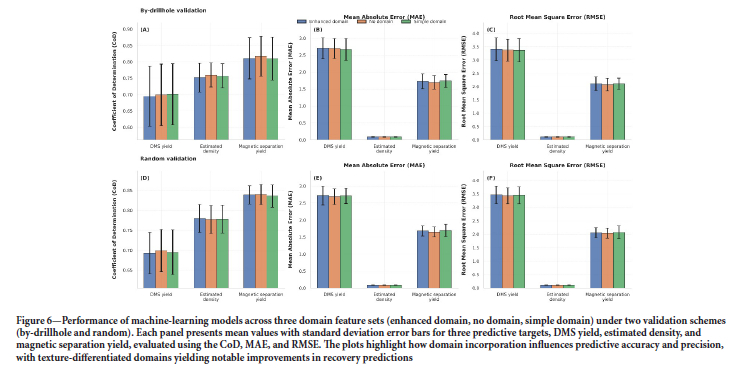
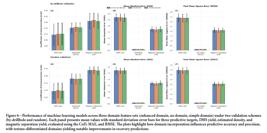
Manganese is a critical metal for the global steel industry, with South Africa as the leading producer of Mn ore. Efficient processing of its complex ores, particularly those in the Postmasburg Manganese Field, requires site-specific understanding of their variability. This study develops a geometallurgical framework for the Paling Pan Fe-Mn deposit, integrating mineralogy, geochemistry, and quantified ore texture to define domains that predict processing performance. Four principal ore textures, those being, massive, vuggy, layered, and conglomeritic, were characterised, each influencing beneficiation differently. A dataset of 256 samples was used to train predictive machine learning (XGBoost) models for magnetic separation and dense media separation. Incorporating texture-differentiated domains improved prediction accuracy, particularly for dense media separation yield (2.6% increase in chemical oxygen demand). Magnetic separation yields ranged from 72.3% to 92.3%, with massive ores performing best. SHAP analysis identified manganese grade, Fe grade, and ore texture as critical predictors for magnetic separation, while specific gravity and gangue content dominated dense media separation performance. This integrated, data-driven approach provides a robust methodology for optimising plant design, ore blending, and processing strategies, enhancing resource efficiency, economic viability, and sustainability in manganese ore exploitation.
geometallurgy; manganese ores; magnetic separation; dense media separation; XGBoost; process optimisation; Postmasburg Manganese Field
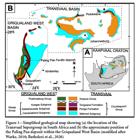 Thumbnail
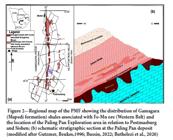 Thumbnail
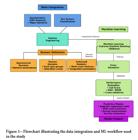 Thumbnail
 Thumbnail
 Thumbnail