Reduced order model for isothermal pre-reduction of chromite pellets with hydrogen
Abstract
Pre-reducing chromite with hydrogen offers significant benefits, including reduced energy consumption in downstream smelting and lower carbon dioxide emissions. To leverage these advantages, it is essential to develop computational models that facilitate the design, optimisation, and control of the process. Full scale models such as 3D computational fluid dynamics models are often used to investigate the multi-scale flow physics in heterogeneous reactors. However, these models impose prohibitive computational expense in the modelling of heterogeneous reacting flow systems. The high computational expense prevents the use of high dimensional systems in real time control and online optimisation of reacting flow systems. In order to facilitate incorporation of predictive models in the heterogenous reacting flow systems control loop, computationally efficient reduced order models are required. Owing to these requirements, a reduced order model for pre-reduction of chromite with hydrogen was developed with the view to rapidly predict the performance indicators for pre-reduction of chromite with hydrogen. The Thiele modulus method was used to develop the reduced order model, and the model results were compared to isothermal pre-reduction experimental results at a range of pre-reduction temperatures from 1200 oC to 1400 oC. The model predicts the degree of reduction, diffusion of gases through the product layer, unreacted core radius of the grain radius, and local and global conversion. The final conversion across all temperatures as predicted by the reduced order model deviate from the experimentally calculated conversion by a maximum relative error of 2.7% while the initial conversions differ significantly, reaching a maximum error of 65%.
Pre-reduction; hydrogen; chromite; reduced order model
Introduction
Design and optimisation of pyrometallurgical processes is supported by computation and simulations. These processes are characterised by high energy requirements and high greenhouse gas emissions. In an effort to develop sustainable pyrometallurgical processes, pre-reduction prior to smelting is one of the solution strategies employed to reduce energy consumption and greenhouse gas emissions. To leverage the benefits pre-reduction presents to the downstream smelting process, it is crucial to characterise several performance indicators of pre-reduction reactors to gauge the optimum operating conditions. However, the performance of heterogeneous reactions at high temperatures is difficult to measure during operation (Hamadeh et al., 2018). This shortcoming is addressed by using CFD models, which can predict the dynamic features of pre-reduction reactors. In order for CFD model predictions to be considered viable, they should couple reaction kinetics (with detailed reaction mechanisms) with transport phenomenon, flow field, reactor configuration, particle size and shape, etc. The underlying physics is complex, and this, coupled with longer temporal and spatial scales including non-linearity in the governing equations imposes significant computational expense in CFD modelling of pre-reduction processes. Therefore, CFD models cannot be used for real-time control due to prohibitive computational cost.
In order to capture dynamic features of this system, a mathematical model must relate the chemical kinetics and physical properties of the grain with local temperature and pressure. In addition, it should characterise mass transfer at the grain surface and heat and mass transfer in the porous bed. Lu et al. (1996) adopted a two-scale modelling approach to develop a phenomenological model that describes reactions in a fixed bed reactor. They considered modelling at microscopic level (grain level) and macroscopic level (pellet level). At the microscopic level, the chemical kinetic equations at the grain level are determined and at the macroscopic level, the global rate of reaction is determined by coupling heat and mass transfer with chemical kinetics from microscopic level.
There are several approaches adopted when modelling pre-reduction in a pellet by gaseous reductants and they include one interface shrinking core, three interface shrinking core, and a grain model. The one interface shrinking core model is a simplified model applicable only to dense pellets undergoing a one-step reaction and cannot be used for porous pellets where chemical reactions and diffusion happen simultaneously (Ghadi et al., 2020). On the other hand, the three interface shrinking core model uses succession of moving fronts to model the successive reactions. A grain model considers a pellet to be made of uniformly-sized nonporous grains and the reactions in each grain follow a microscopic chemical reaction-controlled shrinking core route and this approach is appropriate for gas-solid reactions in porous pellets.
The modelling of hydrogen (H2) reduction consists of either faster/slower transport phenomena and slow/faster chemical reactions and often requires using small time steps to resolve both the faster and slower processes, and this results in prohibitive computational expense. One approach to address the high computational expense is using an effectiveness factor approach, which can capture the essential physics yet remain computationally efficient. The effectiveness factor is defined in Equation 1, and it is evident from the equation that this approach defines the competition between reaction and diffusion. At steady state conditions, the effectiveness factor can be calculated by considering that the rate of external mass transfer from the bulk fluid to the surface is equal to the overall reaction rate.

The objective of the study is to develop a reduced order model (ROM) to allow for rapid evaluation of performance behaviour of pre-reduction of chromite pellets with H2. A validated and verified ROM will be used in real time control and online optimisation of reacting flow systems.
Model development
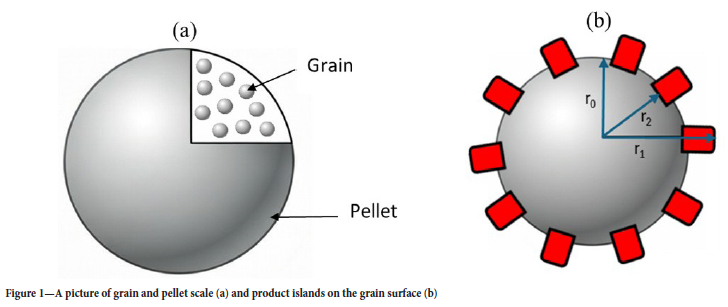
An approach for developing ROMs for gas-solid reactions by Wang et al. (2021) was used in the current study, as demonstrated by Equations 4 to 17. The assumptions made when developing a ROM are that there is a uniform temperature distribution at the grain level, porosity remains constant, and spherical grains maintain sphericity during the reaction. A picture depicting pellet and grain level scales and growth of product islands on the grain surface is shown in Figure 1. As opposed to a uniform product layer, the solid product is assumed to be dispersed nuclei and grows on the grain surface, as can be observed in Figure 1 (b). Before coalescing into a continuous layer and, consequently, the surface morphology appearing as pores, the solid product phases nucleate at discrete points on the surface of the grain (Bao et al., 2013). The general form for pre-reduction or direct reduction with H2 can be represented by Equation 2. Pre-reduction of chromite with H2 is represented by Equation 3.
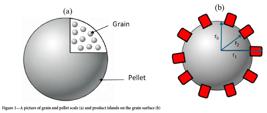

In the modelling of pre-reduction of chromite with H2, it was assumed that a chromite pellet is composed of micro-grains and that the reactions occur in the micro-scale pores resulting in micro-structural changes within the pellet (Li, 2020). Unlike the grain and shrinking core models that assume that the solid product forms a continuous layer covering the surface, the current model describes the solid product's discrete islands morphology on the solid reactant's surface. Notwithstanding the reaction regime, the shrinking core model assumes a shrinking reaction interface in a non-porous pellet while the grain model assumes that a porous pellet is made up of non-porous grains of reactant solid, with reactions taking place on the unreacted grain surface (Ahn, Choi, 2017). Compared to the shrinking core model, the grain model can describe the reaction front propagation throughout the reaction regime. This is because the grain model can describe the reaction front propagation as an interplay between mass transfer and reaction kinetics. Since the current model works on porous particles, it can characterise the effect of intraparticle diffusion through the pores and that, coupled with the ability to predict the discrete nuclei product growth morphology, renders this model crucial for describing the structural and chemical features of the reaction steps.
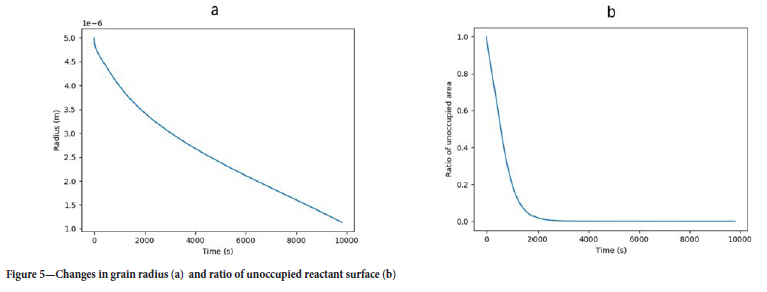
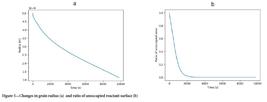
The rate of change of the ratio of unoccupied surface area (δ) and unoccupied grain radius (r2) is represented by Equations 4 and 5, respectively. In Equations 4 and 5, ra tracks how the grain radius shrinks while δ tracks how much grain surface area is unoccupied by the solid product phase. Since the current model does not assume that the solid product forms a continuous and uniform layer covering the grain surface, δ is used to track the available surface area before the solid-phase products coalesce into a continuous layer.
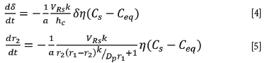
In these equations, hc is the critical reactant layer thickness, r1 is outward grain radius defined by Equation 6, Dp is gas diffusivity through the product layer, VRs is molar volume of chromite, k is the rate constant, a is the stoichiometric factor of H2,,Ceq is the equilibrium gas concentration, and Cs is the surface concentration.

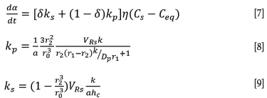
The grain conversion rate is defined by Equation 7, where α is grain conversion, ks is the reaction rate for surface reactions and is represented by Equation 9, and kp is the reaction rate based on species diffusion through a product layer, and r0 is the initial grain radius.
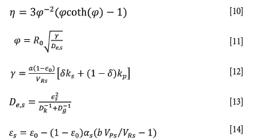
The effectiveness factor (η) defined in Equation 1 can be expressed as a function of Thiele modulus (φ), as shown in Equation 10. The Thiele modulus quantifies the ratio of chemical reaction rate to mass transfer rate by diffusion of reactants in a porous particle, as shown in Equation 11. This dimensionless number is used in scale-up of fixed-bed reactors and can be used to determine optimum pellet size. In Equations 11 to 14, γ represents rate constant, D(e,s) is effective gas diffusivity on the external pellet surface, and ε_s is porosity on the external pellet surface, εο is initial porosity, and b is stoichiometric of solid product and this case Fe.
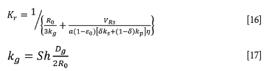
The pellet conversion rate is expressed by Equation 15, where Kr is the reaction rate constant and is represented by Equation 16, while kg is the external mass transfer coefficient and expressed by Equation 17.

Results and discussion
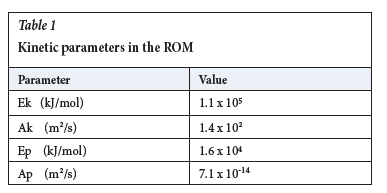
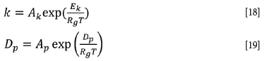
The adjustable parameters in the model calculations include reaction rate constant (k) and gas diffusivity through the product layer Dp. These parameters are defined using the Arrhenius form presented in Equations 18 and 19.
The kinetic parameters used in the model calculation are shown in Table 1.
Influence of particle size on reducibility
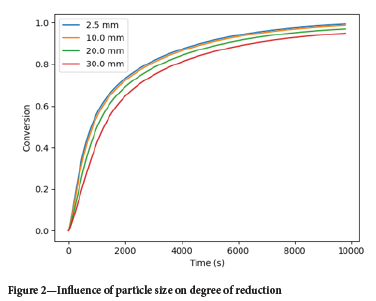
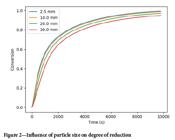
The effect of particle size on the degree of reduction, as predicted by the model, reveal that the degree of reduction increases with decreasing particle size, as shown in Figure 2. The enhanced reduction at small particle sizes can be attributed to topochemical reactions from the periphery to the centre of the particle and this is often the case with dense pellets. However, even with high porosity pellets, larger particle sizes result in increased diffusion path lengths and decreased rate of reduction. Smaller pellet sizes with high initial porosity reduce Thiele Modulus due to increased diffusive flux and increases in effectiveness factor, resulting in uniform utilisation as opposed to reactions confined to the outer shell.
Influence of temperature on reducibility
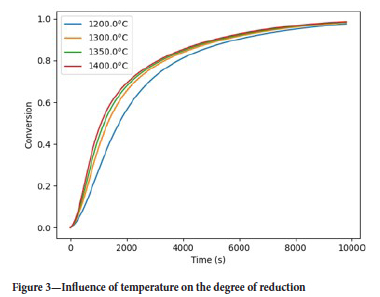
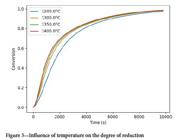
Chromite pre-reduction with H2 represents heterogeneous reactions where reactions occur at the phase boundaries and they depend on heat and mass transfer between the reaction interface and the bulk fluid. As can be observed in Figure 3, the rate of conversion increases with increasing temperature, however, the difference is not as pronounced as when different particle sizes are used, highlighting that the process is governed by diffusion limitations.
Influence of porosity on reducibility
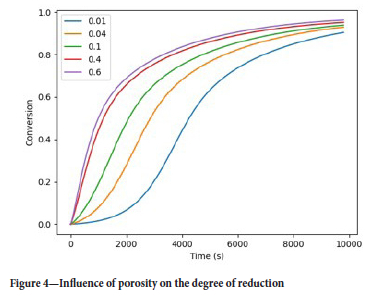
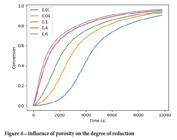
The influence of initial porosity on the degree of reduction is presented in Figure 4. Generally, species diffusion through a porous bed proceeds in parallel through macropores and micropores, however, in the current study, only the distribution of macropores was considered. As observed, the degree of reduction increases with increase in porosity due to enhanced H2 mass transfer. At low porosity, species transport becomes more tortuous, resulting in severe transport limitations and reduced rate of reduction. Reduction at high porosity is characterised by steep conversion gradients, as evidenced by the results in Figure 4. Increasing initial porosity to above 0.4 presents minimal benefit to the rate of reduction and this was also observed in the study of Wang et al. (2021).
Changes in core radius and unoccupied reactant surface
The results in Figure 5 show that the unreacted core radius of the grain decreases while the fraction of unoccupied reactant surface area(6) decreases. The formation of solid products Fe and G-2O3 result in the decrease of the fraction of unoccupied reactant surface area. Initially, the rate of reduction is rapid and reaches a plateau-type (Figure 4), indicating two rate controlling mechanisms. The decrease in reduction rate represented by a plateau-type is due to an increase in the fraction of occupied surface area, which could have resulted in diffusion limitations.
Model validation
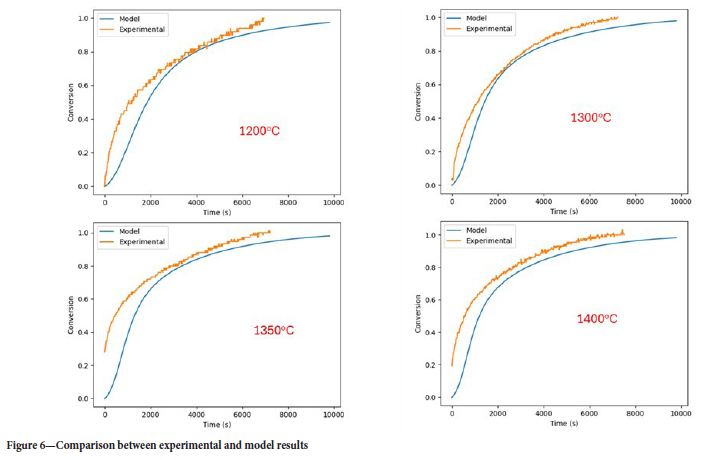
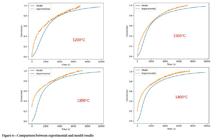
The model predictions for the degree of reduction were compared with experimentally determined degree of reduction, as shown in Figure 6. The isothermal reduction experiments were conducted with H2 over a temperature range of 1200 °C to 1400 °C . The number of chromite pellets used for each test was limited to 4 and the total mass of charge per test was 10 ±0 .5 g. The number of pellets used was chosen to facilitate enhanced mass transfer of H2 to the reaction sites. The furnace was heated at a rate of 10 °C/min under an Argon (Ar) atmosphere with a flow rate of 2 L/min. Upon reaching the target temperature, H2 was introduced at 1 L/min. Simultaneously, the Ar flow rate was reduced to 1 L/min to maintain a constant total flow rate of 2 L/min and a 1:1 (H2A) gas ratio. Upon reaching the targeted temperature, the furnace was maintained at temperature for 2 hours. At the end of 2 hours holding time, Ar flow rate was increased to 2 L/min, the reducing gas flow stopped, and immediately followed by stopping power input to the furnace to facilitate the cooling of the sample in Ar. The full details of the method used to obtain experimental data for isothermal pre-reduction of chromite pellets using a thermogravimetric furnace is described by Khama et al. (2026). While the overall behaviour and degree of reduction fairly agree, there are still some significant differences. For instance, the final conversion across all temperatures, as predicted by the ROM, deviate from the experimentally calculated conversion by a maximum error of 2.7% while the initial conversions differ significantly, reaching a maximum error of 65%. These are primarily due to the ROM neglecting sintering and bed non-uniformities caused by flow and heat transfer effects. Specifically, the model fails to account for flow maldistribution caused by surface friction and horizontal momentum transfer into the pressure field (Hollands et al., 1984). Experimental measurements indicate that sintering takes place at temperatures above 1400 °C and the ROM does not capture how sintering retards reaction rates by increasing grain size, reducing available surface area, and elevating mass transfer resistance within the product layer.
Conclusions
A ROM was developed from the effectiveness approach and used to predict pre-reduction behaviour of chromite pellets under H2 reducing environment. The final conversion across all temperatures, as predicted by the ROM, deviate from the experimentally calculated conversion by a maximum relative error of 2.7% while the initial conversions differ significantly, reaching a maximum error of 65%. Future work will integrate sintering effects and advection terms into the ROM framework to account for convective effects. Once fully validated, the ROM will be used for real-time control and online optimisation of reacting flow systems.
Acknowledgments
This paper is published with the permission of Mintek. The authors are grateful to Mintek for financial support under Science Vote Grant MCR0062604.
References
-
Ahn, H., Choi, S. 2017. A comparison of the shrinking core model and the grain model for the iron ore pellet indurator simulation. Computers and Chemical Engineering, vol. 97, pp. 13-26. https://doi.org/10.1016/i.compchemeng.2016.11.005
» https://doi.org/10.1016/i.compchemeng.2016.11.005 -
Bao, J., Li, Z., Sun, H., Cai, N. 2013. Experiment and rate equation modeling of Fe oxidation kinetics in chemical looping combustion. Combustion and Flame, vol. 160, no.4, pp. 808-817. https://doi.org/10.1016/i.combustflame.2012.12.010
» https://doi.org/10.1016/i.combustflame.2012.12.010 -
Ghadi, A. Z., Valipour, M.S., Vahedi, S.M., Sohn, H.Y. 2020. A Review on the Modeling of Gaseous Reduction of Iron Oxide Pellets. Steel Research International, vol. 91, no.1. https://doi.org/10.1002/srin.201900270
» https://doi.org/10.1002/srin.201900270 -
Hamadeh, H., Mirgaux, O., Patisson, F. 2018. Detailed modeling of the direct reduction of iron ore in a shaft furnace. Materials, vol. 11, no. 10. https://doi.org/10.3390/ma11101865
» https://doi.org/10.3390/ma11101865 - Hollands, K.G.T., Sullivan, H.F., Shewent, E.C. 1984. Flow Uniformity In Rock Beds. Solar Energy, vol. 32, no. 3, pp. 343-348.
-
Khama, M.I., Baloyi, B.MV., Reynolds, Q. G., Xakalashe, B.S., Chetty, D. 2026. Kinetics of Isothermal and Non-Isothermal Pre-Reduction of Chromite with Hydrogen. Hydrogen, vol. 7, (no. 1), pp. 21. https://doi.org/10.3390/hydrogen7010021
» https://doi.org/10.3390/hydrogen7010021 -
Li, Z. 2020. General rate equation theory for gas-solid reaction kinetics and its application to CaO carbonation. Chemical Engineering Science, vol. 227. https://doi.org/10.1016/j.ces.2020.115902
» https://doi.org/10.1016/j.ces.2020.115902 - Lu, H.-B., Mazet, N., Spinner, B. 1996. Modelling of gas-solid reaction-coupling of heat and mass transfer with chemical reaction. Chemical engineering science, vol. 51, no. 15, 3829-3845.
-
Wang, H., Li, Z., Cai, N. 2021. Reduced-order model for redox kinetics of oxygen carrier in chemical looping combustion. Proceedings of the Combustion Institute, vol. 38, no. 4, 5271-5279. https://doi.org/10.1016/j.proci.2020.08.002
» https://doi.org/10.1016/j.proci.2020.08.002
Published: July. 2026