Monitoring the performance of DMS circuits using RhoVol technology
Abstract
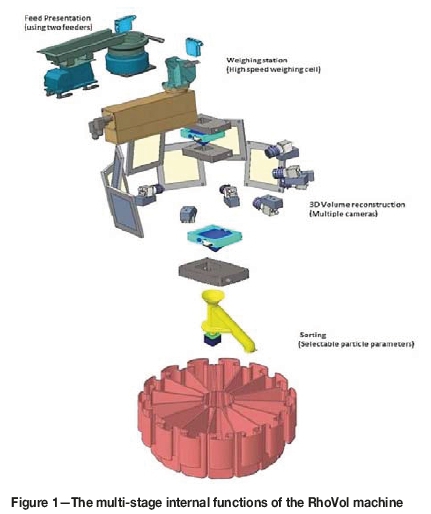
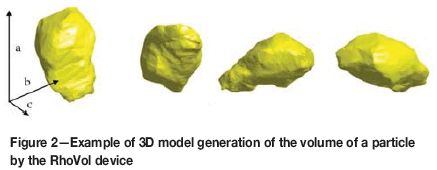
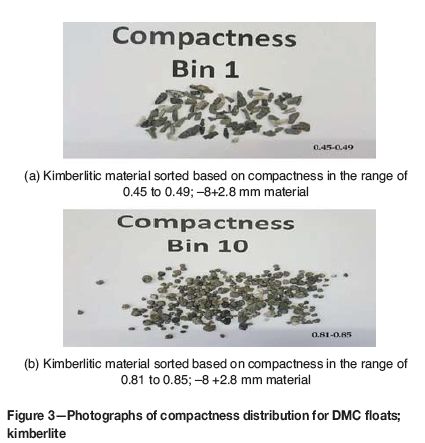
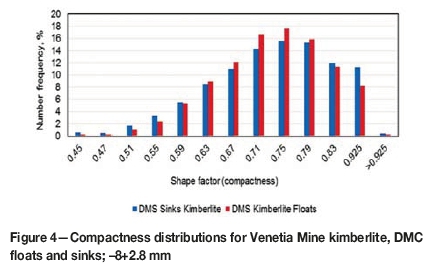
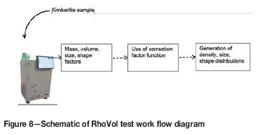
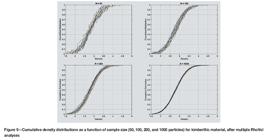
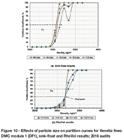
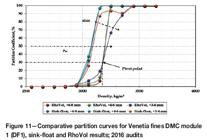
One of the most important performance indicators of a dense medium cyclone (DMC) circuit is the Tromp curve, and by extension the separation density and Ecart Probable (Ep) values. The densimetric profiles of DMC product streams have been traditionally acquired using heavy liquid sink-float analysis, which has certain disadvantages, such as the associated safety and health risks. More recently, non-toxic media such as lithium hetero-polytungstates (LST) have been used, with the desired densities being achieved by maintaining the solutions at specific temperatures. However, the high costs of these liquids can be prohibitive. The long turnaround time of the sink-float analysis is a further disadvantage for timeous interventions to the operating set-points of the DMC process. The RhoVol technology can generate the density distribution of a batch of particles in a rapid, accurate, repeatable, and safe manner. Additional data of interest, such as particle size and shape, are also measured and reported on a per-particle basis. Furthermore, samples can be sorted into discrete sorting bins based on any of the measured parameters of the particle, making further analyses of the material possible. This technology has applications across all commodities that use the DMC, particularly in the size fractions -25 +8 mm and -8 +3 mm. To date, laboratory results have proved very encouraging - separation densities are within 5% of traditional sink-float results, and the technology is being introduced to diamond DMC plants.
dense medium cyclone; RhoVol; particle size; particle shape; density
 Thumbnail
 Thumbnail
 Thumbnail
 Thumbnail
 Thumbnail
 Thumbnail
 Thumbnail
 Thumbnail
 Thumbnail
 Thumbnail
 Thumbnail