The role of mineralogy in predictive geometallurgy
Abstract
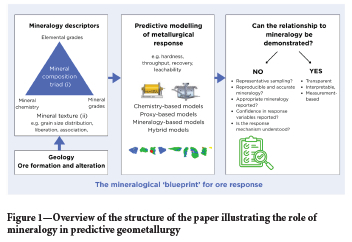
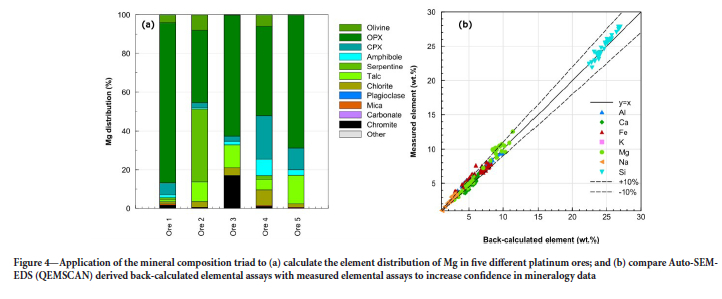
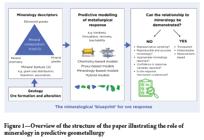
Since geometallurgy emerged as a discipline aimed at managing ore variability and reducing risk across the mining value chain, mineralogy has remained a fundamental descriptor. A review of the geometallurgical literature indicates that predictive geometallurgical modelling can be broadly classified into three approaches: chemistry-based models, proxy-based models, and mineralogical models, with a hybrid machine learning approach emerging. To appreciate these models, one must understand the relationship between mineral chemistry, mineral grade, and elemental grade - which is expressed as the mineral composition triad, together with mineral texture. Examples are presented to illustrate the application of the mineral composition triad for mineralogical data validation, calculation of quantitative elemental distributions, and estimation of mineral grades from elemental assays. These different modelling approaches are evaluated against the premise that mineralogy represents the geological blueprint of an orebody, preserving the signatures of ore-forming and subsequent alteration processes and, therefore, encapsulating the primary properties that govern metallurgical response. Consequently, predictive geometallurgical models should, either directly or indirectly, reflect the relationship between mineralogy and the response variable. Where such relationships cannot be demonstrated, the quality and representativity of both the primary and response variable measurements require critical assessment. This highlights the need for greater emphasis on measurement confidence within geometallurgical practice and suggests that important knowledge gaps remain despite decades of mineral processing and metallurgical research. Data-driven and machine-learning approaches offer considerable opportunities for modelling complex, non-linear relationships; however, their widespread adoption will depend on maintaining sufficient transparency and interpretability to preserve geological and metallurgical understanding.
geometallurgy; mineralogy; chemistry; modelling; quality assurance and quality control
 Thumbnail
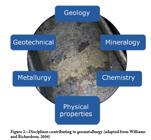 Thumbnail
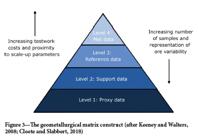 Thumbnail
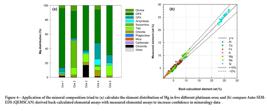 Thumbnail
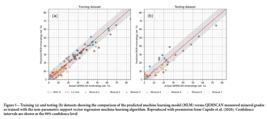 Thumbnail
 Thumbnail
 Thumbnail