The role of mineralogy in predictive geometallurgy
Abstract
Since geometallurgy emerged as a discipline aimed at managing ore variability and reducing risk across the mining value chain, mineralogy has remained a fundamental descriptor. A review of the geometallurgical literature indicates that predictive geometallurgical modelling can be broadly classified into three approaches: chemistry-based models, proxy-based models, and mineralogical models, with a hybrid machine learning approach emerging. To appreciate these models, one must understand the relationship between mineral chemistry, mineral grade, and elemental grade - which is expressed as the mineral composition triad, together with mineral texture. Examples are presented to illustrate the application of the mineral composition triad for mineralogical data validation, calculation of quantitative elemental distributions, and estimation of mineral grades from elemental assays. These different modelling approaches are evaluated against the premise that mineralogy represents the geological blueprint of an orebody, preserving the signatures of ore-forming and subsequent alteration processes and, therefore, encapsulating the primary properties that govern metallurgical response. Consequently, predictive geometallurgical models should, either directly or indirectly, reflect the relationship between mineralogy and the response variable. Where such relationships cannot be demonstrated, the quality and representativity of both the primary and response variable measurements require critical assessment. This highlights the need for greater emphasis on measurement confidence within geometallurgical practice and suggests that important knowledge gaps remain despite decades of mineral processing and metallurgical research. Data-driven and machine-learning approaches offer considerable opportunities for modelling complex, non-linear relationships; however, their widespread adoption will depend on maintaining sufficient transparency and interpretability to preserve geological and metallurgical understanding.
geometallurgy; mineralogy; chemistry; modelling; quality assurance and quality control
Introduction
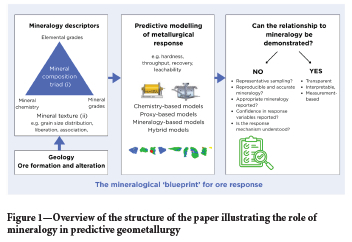
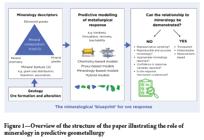
This concept paper reviews the central role of mineralogy in geometallurgy and its application in the development of predictive geometallurgical models. Key mineralogical descriptors and their application are outlined before exploring the premise that mineralogy is the blueprint that encapsulates all the primary ore properties governing metallurgical response. Important considerations that need to be interrogated where this relationship cannot be convincingly demonstrated are explored before a future outlook is proposed. The overall concept can be summarised, as in Figure 1.
The contribution of mineralogy to geometallurgy programmes
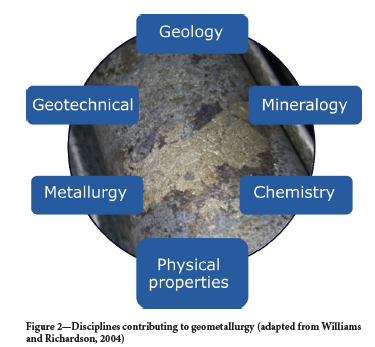
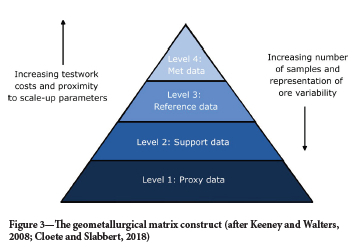
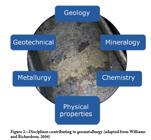
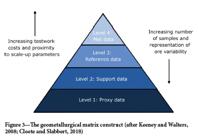
Although the contribution of mineralogy to mining, mineral processing, and environmental management has been recognised for several decades (Becker, 2023), formal integration of these activities into the discipline known as geometallurgy only came about in the late 1990s and early 2000s, e.g., Beniscelli (2011). In their seminal paper, Williams and Richardson (2004) explicitly mention mineralogy as one of the key disciplines contributing to ore characterisation in geometallurgy (Figure 2). The overview by Walters (2008) and Keeney and Walters (2008) of the AMIRA P843 Geometallurgical Mapping and Mine Modelling (GEM) programme and associated publications, similarly highlighted mineralogy but also, importantly, introduced the concept of the geometallurgical matrix. The geometallurgical matrix is a useful construct for representing the interplay between sample size, number of samples, cost, simplicity of testwork, and scale-up (Figure 3). Because geometallurgy requires abundant data that reflect ore variability, the initial emphasis of the GEM project was on the development of proxy data and predictive geometallurgical tests. These tests were designed to be simple, inexpensive, quick, and easy to implement. Some examples of proxy data that can be readily measured using drill core are the Equotip Leeb rebound hardness, portable multi-element XRF, and hyperspectral imaging, whereas small-scale tests may represent point load or bottle roll cyanidation tests (Lechuti-Tlhalerwa et al., 2018; Cloete, Slabbert, 2018). The incorporation of mineralogy measurements both at the micro- and mesoscales, as well as using mineralogy data for ore textural classification, was an important component of the GEM programme's research.
More recently, a special issue of the Elements magazine devoted to geometallurgy emphasised the role of mineralogy in Geometallurgy (Butcher et al., 2023), whilst simultaneously highlighting the emerging techniques in the field. The Global Mining Guidelines Group (GMG) also recently published a geometallurgy white paper (GMG, 2025) that recognises mineralogy as an important contributor to geometallurgy. The white paper brings an industry perspective in highlighting how the current operating context has changed since earlier publications - now with a greater focus on data-driven technologies, ore characterisation for future resources, waste management for closure planning, and reconciliation.
Having established that mineralogy is widely recognised as an important component of geometallurgical programmes, one must ask where mineralogy fits into geometallurgical programmes. Lishchuk et al. (2015) proposed three different approaches: traditional, proxies, and mineralogical. The traditional approach focuses on predicting metallurgical response using feed chemical assay data, such as the prediction of Bond work index and acid consumption (King, Macdonald, 2016) or flotation recovery and concentrate grade (Mangwiro et al., 2025). The proxies approach predicts metallurgical response from small-scale 'proxy' tests and may use correction factors for scale-up. This may be used in combination with the feed chemical assay data. The mineralogical approach is based on mechanistic or empirical models using mineralogy, such as the prediction of the bulk oxidation state of Mn smelter feed based on the deportment of Mn to minimise energy consumption (Chetty, Gutzmer, 2016) or predicting the grindability of iron ore pellet feed as a function of its crystallinity (Kwitko-Ribeiro et al., 2016). All three of the above-mentioned approaches continue to be used, especially with the increasing worldwide focus on machine learning and data analytics, e.g., Bedregal Aguilar et al. (2025).
A fourth approach that has emerged is the hybrid approach. Hybrid modelling combines empirical and fundamental models, essentially capturing the best of both (Von Stosch et al., 2014). Pereira et al. (2021) demonstrated the use of this hybrid approach to predict single-particle flotation kinetics. Here, quantitative mineralogy data describing the particle properties of the flotation feed, concentrate, and tails were initially used to train a recovery probability model. Thereafter, a first-order flotation kinetic model was fitted to every particle to ultimately predict its flotation kinetics. Although the approach of Pereira et al. (2021) has not yet routinely been incorporated into geometallurgical modelling, it is only a matter of time before this can be expected.
The mineralogical blueprint for ore response
The application of any mineral-centric approach to predictive geometallurgical modelling is ultimately based on the following theory statement:
Mineralogy is the blueprint that encapsulates all the properties of a rock (primary variables), carrying signatures of the ore-forming and subsequent alteration processes. These ultimately define the response to an applied process (response variables).
To apply our theory statement, we should first describe the mineralogy - this can be done using both the mineral composition triad and mineral texture. The mineral composition triad uses the interrelationship between bulk chemistry, mineral chemistry, and mineral grades (x) defined by Equation: 1

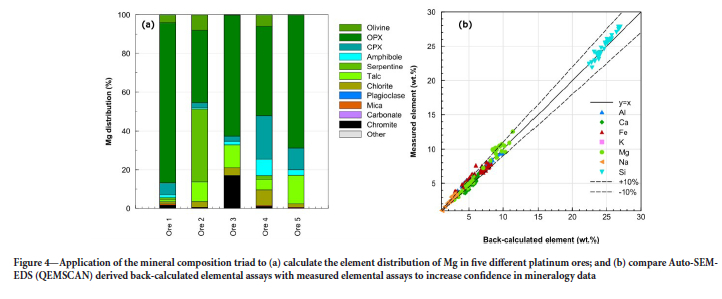
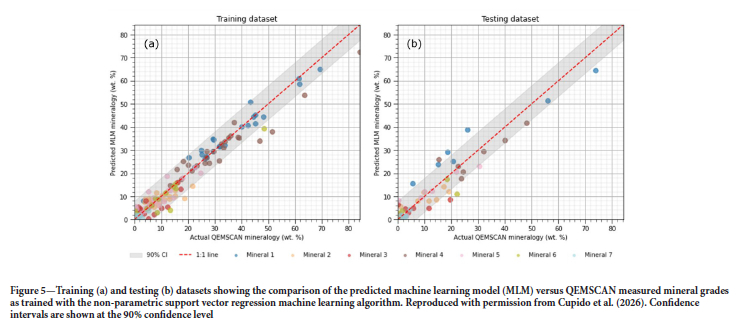
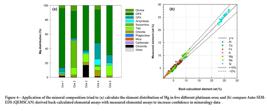
Where: bi is the bulk chemistry of element i; Aij is the proportion of element i in mineral j; and xj is the grade of mineral j in the bulk. The mineral composition triad underpins three important outputs (Figure 4 and Figure 5). Firstly, it can be used to determine the quantitative element distribution for both valuable and deleterious elements. The example provided in Figure 4a shows how the distribution of magnesium varies across the flotation feeds in 5 different platinum ores. In this case, knowing whether the main host of magnesium is talc or serpentine would require different treatment strategies. Talc requires depressant addition because of its natural floatability, whereas serpentine may require dispersant addition because of its potential to slime coat valuable minerals (Dzingai et al., 2021; Molifie et al., 2023). Secondly, it can be used to back-calculate elemental assays from measured mineral grades. The parity chart given in Figure 4b illustrates how the back-calculated and measured elemental assays can be compared with one another, and in the example shown, it is evident that all the data fall within a 10% error margin of the y = x line, thus providing the required degree of confidence. Thirdly, it can be used as the basis for calculating mineral grades from chemical assay data, also known as element-to-mineral conversion (EMC; Whiten, 1998).
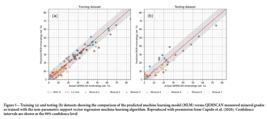
EMC has been used in various geometallurgical studies, e.g., Mena Silva et al. (2020). Its key advantage is that it provides a methodology to turn abundant chemistry datasets into comprehensive mineralogy datasets. The widespread availability of certified reference materials for elemental assays in accredited analytical laboratories contributes to a greater level of confidence in these large datasets. Generally, the number of mineralogy datasets is several orders of magnitude lower due to the costly and time-consuming nature of acquiring this data. Machine learning algorithms using input data from the mineral composition triad, which are not necessarily restricted to linear relationships, are also increasingly being used in geometallurgy to predict mineral grades, e.g., Figure 5 as per Cupido et al. (2026). The mineral composition triad allows us to understand how the readily available chemical assay datasets capture the core mineralogy information and why the traditional modelling approach has historically been, and remains, a popular approach to predictive modelling.
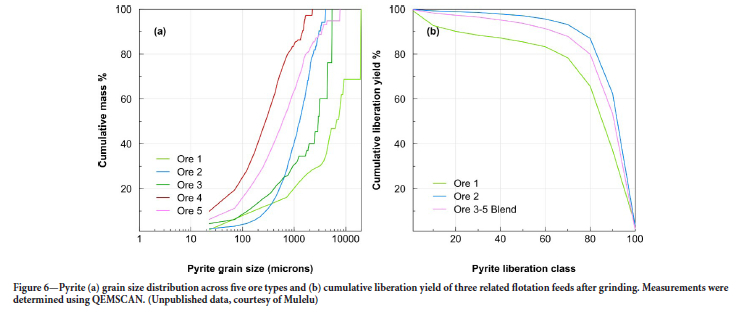
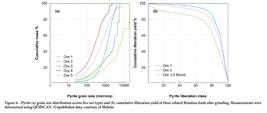
Secondly, we can describe mineralogy through mineral texture that defines the interrelationship between mineral grains. For unbroken rocks and particles, one is interested in defining grain size distributions, grain shape distributions, porosity, and mineral association. Figure 6a provides an example of the grain size distribution of pyrite measured on polished 70 mm x 70 mm slabs of five different ores from a single polymetallic sulphide deposit. The data show the extent of the variability of pyrite, with grain size d50 measurements varying between 270 (ore 4) μηι and 6700 (ore 1) μπι. Mineral texture attributes as a consequence of an applied process, such as the liberation of a flotation feed after grinding, can also be described. After milling these same polymetallic samples, the liberation data show that ore 1 with the coarsest pyrite grain size distribution has the best liberation (Figure 6b). Measuring quantitative mineral texture information is generally the costliest analysis and is often more readily incorporated into process mineralogical studies (Becker et al., 2016).
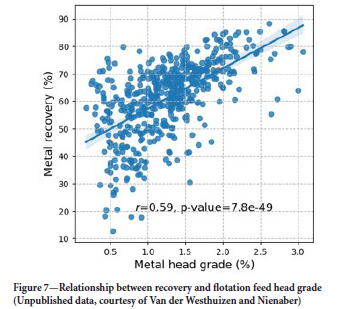
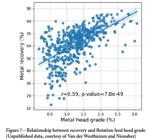
Inevitably, this raises the question as to whether a relationship exists between the mineral composition triad and mineral texture. For example, it has been an inherent heuristic in many flotation concentrators that higher-grade ores give better recovery. The example in Figure 7 supports this heuristic by demonstrating the correlation between metal recovery and flotation feed head grade of a polymetallic sulphide ore that achieved a Pearson correlation value of 0.59 (Figure 6). Given that higher-grade ores often have coarser grain size distributions of the valuable sulphide minerals, they will be more liberated at a given grind compared with the finer grain size distribution. Jameson (2012) showed that equivalent-sized particles have a higher flotation rate constant when they are more liberated. In combination with the fact that flotation is a probabilistic process, i.e., the more valuable particles in the system, the greater the flotation rate (Sutherland, 1948; Polat, 2000), these particles with higher flotation rate constants are more likely to be recovered. Although Von der Heyden et al. (2024) presented a relationship between the mineral composition triad and mineral texture for manganese ores, the lack of studies on this topic suggests these relationships may be more readily applicable to high-grade and bulk commodities. These relationships are also likely to be more deposit-specific rather than broadly transferable.
Application of the 'mineralogical blueprint' for ore response
To apply the theory statement, one must gather mineralogical measurements, but inevitably this also requires one to determine what types of geometallurgical samples will be analysed. In an ideal context, one would gather information on the mineral composition triad and mineral texture at every metre-interval of drill core, but this is not practical in terms of logistics, time, and cost. According to the guidelines presented by Scott (2025), geometallurgical samples can be divided into composite samples and variability samples. Composite samples dampen the geometallurgical variability, but because they are larger in mass, they allow metallurgical testwork at higher levels of the geometallurgical matrix and greater proximity to scale-up parameters (Figure 3). Variability samples preserve the variability of the ore, but due to the large number of samples that should be taken to capture this variability, only simple, inexpensive measurements can be acquired. A third type of sample could be proposed, namely, research samples in which comprehensive, detailed measurements are acquired on a small number of samples, but these would be considered more academic in nature. Once the samples have been collected and characterised, predictive geometallurgical modelling is initiated to develop models that allow one to describe the relationship between the mineral composition triad and metallurgical response, or the relationship between mineral texture and metallurgical response, or a combination thereof. Recent studies applying machine learning algorithms have highlighted the non-additivity in modelling response variables (Campos et al., 2024), therefore, linear relationships should not always be expected, but are often a good starting point in modelling. Should one not be able to demonstrate a significant correlation between the mineral composition triad, mineral texture, and metallurgical response, the following questions should be interrogated to advance the geometallurgical programme:
Was the sampling representative?
Firstly, one must consider whether the sampling is representative of the bulk material. The work by Scott (2025) is expected to be formally published as an accepted industry guideline by the Global Mining Guidelines Group, and such work provides instruction on how best to carry out representative sampling in data-scarce geometallurgy contexts (GMG, 2026a). Equally important is that, within the context of the material available, we follow subsampling best practice that promotes subsampling using spinning rifflers in conjunction with size and mass reduction (Lotter et al., 2018). Where this is not possible, for example, when the grain size distribution of unbroken particle textures needs to be mapped, then the uncertainty of the measurements must be communicated (Evans, Napier-Munn, 2013).
Are the mineralogical measurements reproducible and accurate?
Unlike the field of analytical chemistry, where quality assurance and quality control programmes coupled with the use of certified reference materials are standard practice, analytical mineralogy is not as simple due to the lack of reference standards for mineral textural measurements, coupled with the very complex nature of mineral chemical variations. This does, however, not preclude individual laboratories from developing their own in-house standards and protocols. The study by Lastra and Paktunc (2016) reported the results of an interlaboratory study comparing the automated SEM-EDS mineralogy results of a copper concentrate provided to each of the laboratories as a milled sample aliquot. Results of the chalcopyrite mineral grades reported across the individual laboratories had a 7.5% relative standard deviation and just under 4% relative standard deviation in chalcopyrite liberation, but only once the outliers had been removed. In this case, the outliers could only be identified where multiple datasets existed that could approximate the true value. For any individual mineralogy laboratory, accompanying chemical assay datasets and/or quantitative X-ray diffraction (XRD) must be generated to allow comparison and validation of the mineralogy measurements (see application of the mineral composition triad, Figure 4b). Without such practice, the user has little confidence in whether the mineralogy measurements are accurate.
Were the appropriate mineralogical attributes measured and reported?
Mineralogical instrumentation can provide a wealth of information, and close communication between the user and service provider is required to ensure that the appropriate measurements are run to quantify relevant mineralogical parameters. For instance, the work of Dzingai et al. (2021) showed how the amount of naturally floating gangue in a hydrothermally altered magmatic Ni-Cu PGE sulphide ore could be more readily estimated based on understanding the talc grain size distribution as compared to the grade of talc in the flotation feed. Here, the end-user would specifically need to request a mineral textural measurement instead of the bulk mineralogy, which would require the instrument scientist to run a specific type of Auto-SEM-EDS measurement routine. Another example, although not directly linked to geometallurgy, showed that the crystallite size of pyrite, quartz, and kaolinite in coal mine dust, as determined by XRD, was a contributing factor to the pneumoconiotic potency of the coal (Kamanzi et al., 2024). Yet, crystallite size measurement is not a standard output when doing the Rietveld refinement needed for phase quantification and would be something that needs to be specifically requested. One could extend these further to question whether the measurements were obtained on the correct scale. Most instrumentation tends to focus on the meso and microscales, but consideration should also be given to how nanoscale properties may also affect ore response (Butcher, 2020; Mânbro et al., 2025). A well-known example of this is the presence of solid-solution hosted and nano (colloidal) gold in pyrite, both of which require pretreatment prior to conventional cyanidation for gold extraction (Chryssoulis, McMullen, 2016).
Were the response variables measured correctly?
If the answer to all of the above questions is affirmative, attention must then turn to whether the appropriate response variable was measured, whether the measurement scale was suitable, and whether the measurement was performed correctly. Any experimental measurement is subject to a range of errors. For example, in the case of the laboratory batch float, these errors would include sampling error, feed preparation error, error associated with air flow, froth level or froth recovery, weighing errors, and assay errors (Napier-Munn, 2012; Runge, 2010). The user needs confidence that replicate testing under best practice conditions that minimise experimental error has been carried out, and that confidence in the results is reported accordingly (Lotter, Fragomeni, 2010). Confidence that ore characterisation test results are comparable across different laboratories is also required, especially since the geometallurgical programme may have run over several years (Tafur, 2025). Here, ongoing and active long-term relationships with a single service provider are most likely to deliver this level of consistency. A current project by the Global Mining Guidelines Group focused on guidelines for common data reporting in geometallurgy is expected to provide more transparency in this area and encourage reporting that allows the uncertainties to be understood (GMG, 2026b). There is also the possibility that the response variable of interest is overshadowed by other, more prominent features, such as in gold flotation, where the response is determined by the carrier particle (e.g., pyrite) rather than the gold (Chryssoulis, McMullen, 2016).
Is the mechanism of the response fully understood?
Should the questions raised in the aforementioned not provide insights that allow one to demonstrate the mineralogical blueprint for ore response, one is left with answering the difficult questions as to whether the response mechanism is fully understood. Nagaraj and Farinato (2016) focused a review on a century of research and innovation in flotation chemistry, but still acknowledged that there were new and emerging challenges to solve. The review of Mânbro et al. (2025) on the current status of research on mineral texture and non-random breakage also highlighted the need for further research, especially since the ability to exploit non-random breakage provides a key mechanism to reduce the energy consumption of breakage. A word of caution: although machine learning algorithms may allow the prediction of complex response features using state-of-the-art models on good quality datasets and may be advantageous due to their ability to cope with nonlinear relationships (Campos et al., 2024), these should always be grounded in the ability for these models to be explainable to those implementing them (Johnston, 2025). Otherwise, they run the risk of a lack of uptake, and the value of the work is not fully realised.
Concluding thoughts
Mineralogy has historically been, and continues to be, recognised as an important component of predictive geometallurgical modelling. Mineralogy can be described in terms of the mineral composition triad, which articulates the relationship between mineral and elemental grades with mineral chemistry, as well as mineral texture. Although there are heuristics linking the mineral composition triad with mineral texture, further investigating and articulating this relationship across a range of commodities through different ore-forming processes is an area of study expected to deliver valuable insights that can be further explored in geometallurgical modelling.
The three established approaches to predictive geometallurgical modelling, those being, traditional, proxy-based, and mineralogical (after Lishchuk et al., 2015), are widely recognised and are often complementary, forming the basis of an emerging fourth hybrid approach that incorporates fundamental and empirical models. Mineralogy is recognised as the blueprint that encapsulates all the properties of a rock that define its response to an applied process -this is used as the ultimate basis for all predictive geometallurgical modelling.
Should predictive geometallurgical modelling not be able to demonstrate the relationship between the mineralogy and the response variable, an assessment of the sampling and measurement of both primary and response variables is required. This calls for ensuring greater articulation of geometallurgical measurement confidence within the industry, but also highlights that, despite years of research in mineral processing and metallurgy, there is still more research to be done.
The application of data-driven modelling coupled with machine learning algorithms presents a valuable opportunity in predictive geometallurgy, particularly when non-additive relationships occur. However, to ensure uptake within the industry, these models should still be explainable and communicable to industry practitioners, and their underlying mechanisms should be understood. This will allow mineralogy to realise its potential in predicting geometallurgical responses, enabling us to process the complex and sometimes unconventional ores needed to generate the metals our future society demands.
CRediT author statement
MB: Conceptualisation and writing - reviewing and editing.
Acknowledgements
Thank you to various colleagues in the Centre for Minerals Research for useful discussions leading to the formulation of the ideas presented here. Various delegates from the SAIMM Geometallurgy Conference in 2025, where this concept was first presented. The journal reviewers are also acknowledged and thanked for their constructive feedback.
References
- Becker, M. 2023. The contribution of applied mineralogy to sustainability in the mine life cycle. Minerals Engineering, vol. 199, pp. 108121.
- Becker, M., Whiteman, E. Evans, C. 2016. Introduction. In: Becker, M., Whiteman, E., Evans, C. (eds.) Process Mineralogy. Queensland, Australia: Julius Krutschnitt Mineral Research Centre.
- Bedregal, A., M.Y., Torres-Guerra, J.A., Soto-Juscamayta, L.M. 2025. Machine learning in geometallurgy: A review of advances and case studies from Peru's mining sector. Ingénierie des Systèmes d'Information, vol. 30, pp. 2583-2594.
- Beniscelli, J. 2011. Geometallurgy - Fifteen years of developments in Codelco: Pedro Carrasco contributions. First AUSIMM International Geometallurgy Conference, 2011 Brisbane, Australia. Australasian Institute of Mining and Metallurgy, pp.3-7.
- Butcher, A., Dehaine, Q., Menzies, A., Michaux, S. 2023. Characterisation of ore properties for geometallurgy. Elements, vol. 19, pp. 352-358.
- Butcher, A.R. 2020. Upscaling of 2D mineralogical information to 3D volumes for geoscience applications using a multi-scale, multi-modal and multi-dimensional approach. IOP Conference Series: Materials Science and Engineering, vol. 891, pp. 012006.
- Campos, P.H.A., Costa, J.F.C.L., Koppe, V.C., Bassani, M.A.A., Deutsch, C V. 2024. Short-Term Schedule Optimization with Nonlinear Blending Models for Improved Metallurgical Recovery in Mining. Mining, Metallurgy & Exploration, vol. 41, pp. 1629-1643.
- Chetty, D., Gutzmer, J. 2016. Smelting of ores from the Northern Kalahari manganese deposit. In: Becker, M., Whiteman, E., Evans, C. (eds.) Process Mineralogy. Queensland, Australia: Julius Krutschnitt Mineral Research Centre.
- Chryssoulis, S.L., Mcmullen, J. 2016. Chapter 5 - Mineralogical Investigation of Gold Ores. In: Adams, M. D. (ed.) Gold Ore Processing (Second Edition). Elsevier.
- Cloete, L., Slabbert, W. Current geometallurgical initiatives at the Siguiri Gold Mine, Guinea. Geometallurgy Conference, 2018 Cape Town, South Africa. Southern African Institute of Mining and Metallurgy, pp. 133-150.
- Cupido, I., Burness, S., Becker, M., Nwaila, G. 2026. Predictive modelling of lithium mineral grades from chemical assays for geometallurgical applications. Minerals, vol. 16, pp. 139.
- Dzingai, T., Mcfadzean, B., Tadie, M., Becker, M. 2021. Decoupling the effects of alteration on the mineralogy and flotation performance of Great Dyke PGE ores. Journal of the Southern African Institute of Mining and Metallurgy, vol. 121, pp. 475-486.
- Evans, C.L., Napier-Munn, T. J. 2013. Estimating error in measurements of mineral grain size distribution. Minerals Engineering, vol. 52, pp. 198-203.
- Global Mining Guidelines Group (GMG). 2025. Introduction to Geometallurgy.
-
Global Mining Guidelines Group (GMG). 2026a. Representative Sampling Project Update_2026-03. Available at: https://www.youtube.com/watch?v=WEPEXVN1DWU. Accessed: 01/10/2026.
» https://www.youtube.com/watch?v=WEPEXVN1DWU -
Global Mining Guidelines (GMG). 2026b. Geometallurgy: Common Data Reporting Project Update_2026-03. Available at: https://www.youtube.com/watch?v=0kU7OFSmrxo. Accessed: 01/10/2026.
» https://www.youtube.com/watch?v=0kU7OFSmrxo - Jameson, G. 2012. The effect of surface liberation and particle size on flotation rate constants. Minerals Engineering, vol. 38, pp. 132-137.
- Johnston, A. Communicating uncertainty in geometallurgical models. Geometallurgy Conference, 2025 Muldersdrift, South Africa. Southern African Institute of Mining and Metallurgy. pp.45-46.
- Kamanzi, C., Becker, M., Von Holdt, J., Hsu, N.-J., Konecný, P., Broadhurst, J., Jacobs, M. 2024. Machine Learning Demonstrates Dominance of Physical Characteristics over Particle Composition in Coal Dust Toxicity. Environmental Science & Technology, vol. 58, pp. 1636-1647.
- Keeney, L., Walters, S. 2008. Geometallurgical modelling.
- King, G., Macdonald, J. 2016. The business case for early-stage implementation of geometallurgy - an example from the Productora Cu-Mo-Au deposit, Chile. Geometallurgy Conference, Brisbane, Australia. Australasian Institute of Mining and Metallurgy, pp. 125-133.
- Kwitko-Ribeiro, R., Andrade, V., Ferreira, R., Lima, N., Queiroz, L., Vieira, M., Zapparoli, A. 2016. Iron ore case studies. In: Becker, M., Whiteman, E., Evans, C. (eds.) Process Mineralogy. Queensland, Australia: Julius Kruttschnitt Mineral Research Centre.
- Lastra, R., Paktunc, D. 2016. An estimation of the variability in automated quantitative mineralogy measurements through inter-laboratory testing. Minerals Engineering, vol. 95, pp. 138-145.
- Lechuti-Tlhalerwa, R., Gilika, O., Field, M. 2018. Modelling geometallurgical variability of comminution parameters in Orapa kimberlite ore. Geometallurgy Conference, 2018 Cape Town, South Africa. Southern African Institute of Mining and Metallurgy.
- Lishchuk, V., Koch, P., Lund, C., Lamberg, P. 2015. The Geometallurgical Framework: Malmberget and Mikheevskoye case studies. Mining Science, vol. 2022, pp. 57-66.
- Lotter, N.O., Evans, C.L., Engström, K. 2018. Sampling - A key tool in modern process mineralogy. Minerals Engineering, vol. 116, pp. 196-202.
- Lotter, N.O., Fragomeni, D. 2010. High-confidence flotation testing at Xstrata Process Support. Mining, Metallurgy & Exploration, vol. 27, pp. 47-54.
- Mânbro, C., Parian, M., Rosenkranz, J. 2025. Exploring the role of ore texture in comminution and approaches to identify and promote non-random breakage. Minerals Engineering, vol. 230, pp. 109405.
- Mangwiro, J., Bayani, A., Kgotlele, K., Situmorang, R., Mosanga, G., Babusi, M. 2025. Geometallurgy in the Kalahari Copper Belt, Ngami district, Botswana. Geometallurgy Conference, Muldersdrift, South Africa. Southern African Institute of Mining and Metallurgy, pp. 61-65.
- Mena Silva, C.A., Ellefmo, S.L., Sandoy, R., Sorensen, B.E., Aasly, K. 2020. A neural network approach for spatial variation assessment - A nepheline syenite case study. Minerals Engineering, vol. 149, pp. 106178.
- Molifie, A., Becker, M., Geldenhuys, S., Mcfadzean, B. 2023. Investigating the reasons for the improvement in flotation grade and recovery of an altered PGE ore when using sodium silicate. Minerals Engineering, vol. 195, pp. 108024.
- Nagaraj, D.R., Farinato, R.S. 2016. Evolution of flotation chemistry and chemicals: A century of innovations and the lingering challenges. Minerals Engineering, vol. 96-97, pp. 2-14.
- Napier-Munn, T.J. 2012. Statistical methods to compare batch flotation grade-recovery curves and rate constants. Minerals Engineering, 34, vol. 70-77.
- Pereira, L., Frenzel, M., Hoang, D.H., Tolosana-Delgado, R., Rudolph, M., Gutzmer, J. 2021. Computing single-particle flotation kinetics using automated mineralogy data and machine learning. Minerals Engineering, vol. 170, pp. 107054.
- Runge, K. 2010. Laboratory flotation testing - an essential tool for ore characterisation. In: GREET, C. (ed.) Flotation plant optimisation: A metallurgical guide to identifying and solving problems in flotation plants. Australasian Institute of Mining and Metallurgy.
- Scott, T. 2025. A guideline for representative geometallurgical sampling. Geometallurgy Conference. Muldersdrift, South Africa: Southern African Institute of Mining and Metallurgy.
- Tafur, L. 2025. Establishing QAQC protocols for reliable geometallurgical modelling in bulk commodities. Geometallurgy Conference. Muldersdrift, South Africa: Southern African Institute of Mining and Metallurgy.
- Von der Heyden, B., Mathebula, I.P., Van Eeden, L., Tadie, M., Louw, T., Katsumbe, T. 2024. Quantifying chemistry-mineralogy-texture inter-relationships to predict manganese ore comminution response. MEI Process Mineralogy. Cape Town, South Africa.
- Von Stosch, M., Oliveira, R., Peres, J., Feyo De Azevedo, S. 2014. Hybrid semi-parametric modeling in process systems engineering: Past, present and future. Computers & Chemical Engineering, vol. 60, pp. 86-101.
- Walters, S. 2008. An overview of new integrated geometallurgical research. 9th International Congress for Applied Mineralogy, Brisbane, Australia. Australasian Institute for Mining and Metallurgy, pp. 79-82.
- Whiten, B. 1998. Calculation of mineral composition from chemical assays. Mineral Processing and Extractive Metallurgy Review, vol. 29, pp. 83-97.
- Williams, S.R., Richardson, J.M.L. 2004. Geometallurgical mapping: A new approach that reduces technical risk. 34th Annual Canadian Mineral Processors Meeting, Ottawa, Canada.
Revised: 26 Feb. 2026
Accepted: 02 Oct. 2026
Published: Oct. 2026