Scraper winch safety and alternative cleaning technologies in South African narrow reef hard rock mines
Abstract
Scraper winches remain the primary machinery for moving broken rock in underground narrow reef hard rock mines in South Africa. Despite their longstanding use, significant safety hazards and risks associated with these systems remain. Recent analyses of scraper-winch-related accident data (2015 - 2024) confirmed that scraper winch ropes remain the main hazard and are often linked to insufficient situational awareness and task supervision. A review of scraper winch technologies and alternative broken rock cleaning systems revealed that most potential solutions were previously recommended through research initiatives like the Chamber of Mines Research Organisation, Deepmine, and Futuremine. The implementation of these potential solutions has been constrained by factors such as cost, reliability, and infrastructure compatibility. Key recommendations for improving safety in existing scraper winch operations include proactive rope condition monitoring, improved anchor point rigging, and the integration of proximity detection systems to reduce risks related to worker exposure to the moving parts of the scraper winch system. The implementation of alternative cleaning equipment such as waterjets for face cleaning and ultra-low profile dozers can further improve safety and production. However, the implementation of ultra-low profile dozers is limited by geological and infrastructure constraints. The above solutions focus directly on enhancing the scraper winch system or replacing it with alternative cleaning solutions. Alternatives that would result in the elimination of scraper winch hazards require a change in the mining method. Such solutions include mechanical, ropeless mining methods such as reef boring and reef cutting. Although these technologies offer safety advantages and a means to eliminate scraper-winch-related risks, their economic viability in the South Africa's narrow reef tabular environments remains challenging.
scraper winch; narrow reef hard rock mining; cleaning; safety improvements
Introduction
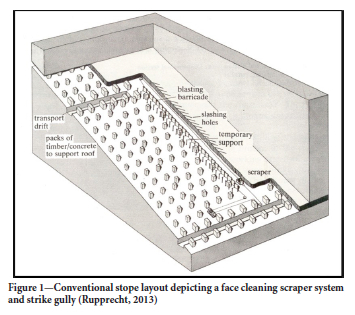
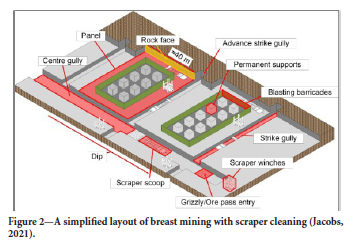
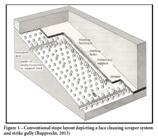
Scraper winches remain a fundamental aspect of ore handling in South African narrow reef hard rock mining operations. These systems are typically used to transport blasted ore from the stope face to the advance strike gully (ASG), then to the centre gully, and finally into the orepass (Rupprecht, 2013). Figure 1 represents a typical conventional stoping layout showing the face and the strike gully illustrating a scraper used for face cleaning. Figure 2 provides the layout of typical locations of scraper winches in a breast mining configuration. This figure shows two panels, their associated ASGs, and the centre gully pathways in which the broken material moves.
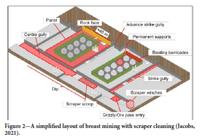
Cleaning operations are critical in underground mining, particularly in narrow reef hard rock operations, where efficient and safe ore transportation directly affect production continuity and personnel safety (Rupprecht, 2011). Effective cleaning ensures that a continuous flow of material minimises operator exposure to hazardous conditions and enables smooth drill and blast sequencing. Additionally, it reduces the risk of equipment damage by keeping the scraper path clear of rocks; thereby, minimising rope abrasion, fouling, and shock loading on the winch. The continued use of scraper winches is largely due to their durability, suitability, and adaptability to confined working spaces and irregular ground conditions characteristic of narrow reef mining environments, relatively low capital expenditure compared to other mechanised equipment, and historical reliance on established infrastructure (Coetzer, 2023; Kendall, Gericke, 2000; Rupprecht, 2019). This makes a shift to other technologies a significant undertaking. However, concerns remain regarding the ergonomic limitations and safety hazards posed by scraper winches.
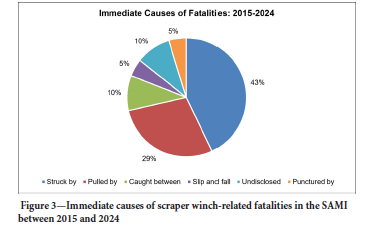
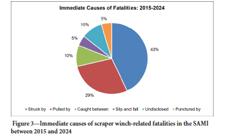
In conventional mines, scraper winches are operated manually using mechanical clutches, which demands considerable physical exertion and exposes operators to multiple hazards. Poor ergonomic positioning, obstructed lines of sight, and limited lighting in operational areas increase the risk of undetected hazards and the likelihood of incidents. The system's complexity, involving moving parts such as ropes, snatch blocks, scrapers and winches (drums) within confined environments, further compounds operational risk. An analysis of South African Mining Industry (SAMI) winch-related accident data for the period between 2015 and 2024 (Figure 3) revealed that being "struck by" an object is the leading cause, accounting for 43% (9 cases) of the incidents. This is followed by accidents where victims were "pulled by" winch components, contributing to 29% (6 cases) of the total. Fatalities categorised as "caught between" objects account for 10% (2 cases), while "slip and fall" and "punctured by" causes each represent 5% (1 case) of the total incidents.
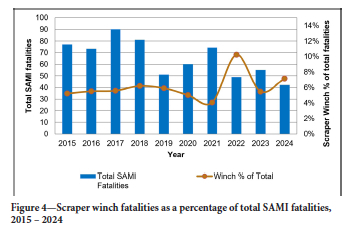
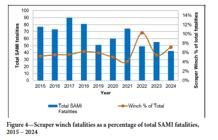
Between 1988 and 2002, Moseme et al. (2003) identified that scraper winches were responsible for approximately 5% and 9% of all accidents in underground gold and platinum mines, respectively. Accidents involving scraper winches have persisted at similar rates in the recent past in the narrow reef hard rock SAMI. Figure 4 shows the number of scraper winch-related fatalities recorded between 2015 and 2024, expressed as a percentage of total annual fatalities in the SAMI. Over this period, total fatalities in the SAMI declined significantly, from 90 in 2017 to a record low of 42 in 2024. However, this improvement is not reflected in scraper winch-related fatalities, which remain constant, at around 6.4%, peaking in 2022 with 10.2% of total annual fatalities.
The relatively high operational risk can be partially attributed to the limited innovation in the scraper winch design, functioning, and control systems compared to recent safety solutions such as collision prevention systems (CPS) and innovations in other mining functions.
Historical overview and technological maturity
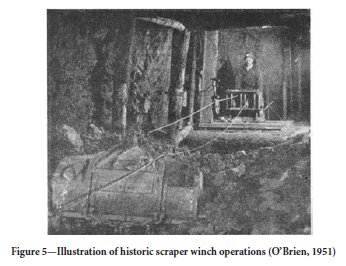
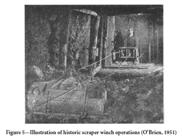
The earliest documented application of the transportation or handling of broken rock using scrapers was at the Bunker Hill and Sullivan mine in Kellogg, Idaho, in the United States of America (USA), where a slip scraper was used in the development of a tunnel (O'Brien, 1951). This is confirmed by Van Zyl (2022), who dates this first application back to 1898. In this region, a scraper winch, as it is known in South Africa, was referred to as a slusher, as illustrated in Figure 5. Developments in slusher and scraper technology peaked between 1920 and 1930, with the introduction of the two-drum hoist mechanism, the first electric-powered double-drum scraper and an increase in scraper capacities (Rhoades, 1982). In South Africa, mechanised rock handling using scraper winch technologies became prominent by 1932, and by 1946, their role in the SAMI was well established. The historic significance of the use and efficiency of scraper installations in the SAMI is captured in the volumes "Gold Mining on the Witwatersrand" by C. Biccard Jeppe, first published in 1946 (Jeppe, 1946).
The configuration of the scraper winch system and its functionality have remained fundamentally unchanged since its introduction (Van Zyl, 2022; Solomon, Van Niekerk, 1978). Furthermore, a review of historical literature reveals that many of the hazards associated with scraper winches today were already documented around 1950. O'Brien (1951), in the Canadian Mining and Metallurgical Bulleting, identified inadequate illumination as a persistent challenge for operators, who had difficulty seeing the scraper from a distance. This is similar to the working environment conditions in some South African narrow reef mines that continue to contribute to accidents today. Similarly, challenges associated with the anchoring of the tail-sheave (snatch block) to the hanging wall or footwall by means of eyebolts in drilled holes, was already identified by 1951 (O'Brien, 1951). In addition, breaking of the rope was identified as a frequent cause of delay and injury at that time, with ropes described as being subject to severe abrasion and sudden load application during the scraping cycle (O'Brien 1951). To address these and other challenges, safety improvements such as rope guards, enclosed drums, and operator shields were implemented in North American operations from at least the 1940s (Rhoades, 1982).
In contrast, there have been significant improvements in the use of technology solutions in other mining functions. Recent advances in the SAMI show innovation in mining functions including ventilation where the use of digital twins for hazard modelling and ventilation-on-demand systems are being implemented (Jacobs et al., 2022), rock engineering where light detection and ranging (LiDAR) is used and thermal and acoustic imaging for rock hazard identification is gaining momentum (African Mining, 2023), and underground communications including the use of through- the-earth (TTE) communication systems (Ngwenyama, Webber-Youngman, 2024), while comparable innovations in scraper winch systems remain limited.
Some of these advancements were borne out of research and development through initiatives such as COMRO, Deepmine, and Futuremine. These initiatives also resulted in recommendations for improving scraper winch safety, for example, innovation that included signalling systems, remote-controlled, automatic, and continuous scraper winches (Rupprecht, 2019). Despite the early foresight provided by Scott-Russell (1993), who stated that the scraper winch was a "mature technology" facing diminishing returns, its use is still prevalent in the narrow reef hard rock mining sector. Minimal technology has been implemented to improve its functioning and innovation in the holistic scraper winch system has been limited (Coetzer, 2023; Pickering, 2007; Scott-Russell, 1993). This limited innovation has contributed to continued scraper winch related safety incidents.
Safety risks and contributing factors
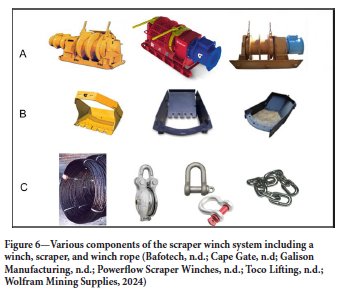
The scraper winch system comprises several components and key role-players: the scraper winch operator, additional personnel, the constrained and typically poorly lit working environment, the winch unit, the scraper or hoe, the blasted rock, the ropes, and associated rigging components. Figure 6 shows selected components of the scraper winch system, including three variations of winches (row A), three variations of scrapers or hoes (row B), and the winch rope, snatch block, D-shackle, and rigging chain (row C).
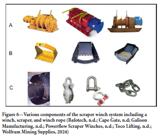
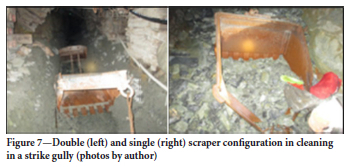
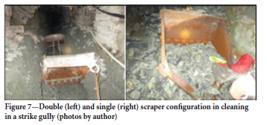
Figure 7 highlights the challenge associated with the location of cleaning equipment, that is, in a confined gully. The interaction between these elements introduces various hazards that result in injuries and fatalities. A review of the major causes of scraper winch accidents by various authors (Ilgner et al., 2009; Moseme et al., 2003; Rupprecht, 2011; Sibanye-Stillwater, 2020) identified the following as recurrent contributing human-related factors:
> inaccurate hazard identification and risk perception;
> substandard operational practices and poor procedural adherence;
> inadequate, non-contextualised training for winch operators;
> weak supervisory enforcement of safe work protocols.
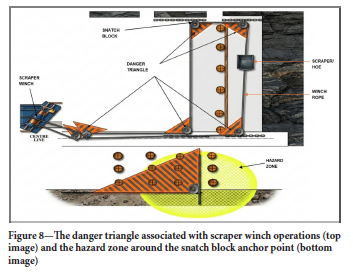
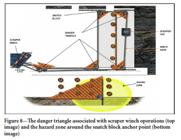
Safety incidents involving scraper winch operations are typically the result of a combination of primary and secondary causes that originate from the hazards associated with the components of the scraper winch system and this interaction with underground personnel and the environment (Coetzer, 2023). These hazards include the winch drum, rope, anchor point rigging, scraper or hoe, and the snatch block. A particularly significant hazard is created within the "danger triangle". This triangular zone is formed between the haul rope, return rope, and the snatch block anchor point, within which any personnel are at severe risk of being struck by a recoiling rope, a displaced rigging component, or a dislodged block of rock. Figure 8 illustrates danger triangle zones and the main components of a typical scraper winch system. The snatch block is a critical element in this system. The dynamic forces transmitted through the rigging setup, together with the confined and insufficiently lit underground conditions, make the proper installation and inspection of the snatch block rigging an ongoing challenge (Ilgner et al., 2009; Janicijevic, 2008). Additional causes of scraper-winch-related incidents include poor lighting and dust, which reduce visibility, lack of or inadequate preparation for cleaning by the day shift, blocked winch operator line-of-sight, and the pressure to achieve key performance targets (Coetzer, 2023; Ilgner et al., 2009; Moseme, et al., 2003; Rupprecht, 2011).
Regulatory and guideline frameworks
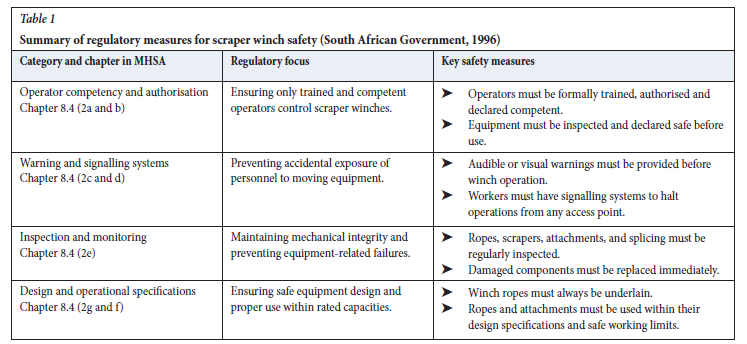
Despite the high incidence of scraper-winch-related accidents in the SAMI, comprehensive regulatory frameworks and best practice guidelines exist to govern their installation, operation and maintenance. Chapter 8.4 of the Mine Health and Safety Act (MHSA) No. 29 of 1996 establishes minimum safety and health requirements for the installation of scraper winches and mono-rope winches (South African Government, 1996). These regulations provide a foundation upon which mines develop their mandatory Codes of Practice (CoP), operational standards and training material to prevent safety incidents. Table 1 provides a summary of the key regulatory measures prescribed by the MHSA to prevent persons from being injured by scraper winches.
Complementing these legislative requirements, Ilgner et al. (2009) developed a best practice guideline for scraper winch systems. The best practice guideline expands on regulatory provisions by detailing recommended approaches for design, installation, operation, and maintenance. In preparing the best practice guideline, Ilgner et al. (2009) found that most COPs were aligned with the regulations, and recommended that these COPs, mine standards, and work procedures be always adhered to. In addition, it was recommended that supervisors should monitor compliance frequently, with any non-compliance being addressed in a way that would prevent re-occurrence, instead of blaming the suspected offender. Ilgner et al. (2009) noted that compliance with standards can be achieved through:
> Routine visual inspections and checklists that are aligned with regulatory standards.
> Preventative maintenance schedules supported by up-to-date maintenance logs.
> Thorough root cause analyses of incidents to implement sustainable corrective measures.
> Integration of monitoring technologies to identify potential hazards.
> Data-driven approaches to proactively mitigate risks.
The best practice guideline also recommends a shift in safety culture, encouraging supervisors to address non-compliance constructively by focusing on preventing recurrence rather than assigning blame. Although these frameworks are comprehensive, scraper-winch-related incidents persist across the sector, indicating a gap between regulation and implementation. This highlights the need for continuous evaluation of existing practices and the exploration of alternative cleaning technologies that inherently reduce operator exposure to hazards.
The continued reliance on scraper winches highlights their importance in underground hard rock mining operations but the inherent challenges and risks associated with their use cannot be ignored. Recognising these challenges and in response to persistent scraper winch-related incidents and stagnant technology progress, the Mine Health and Safety Council (MHSC) commissioned a study (Centre of Excellence (CoE) 210501) to investigate the current use of scraper winches and their accessories, assess the safety performance, and to identify viable alternative cleaning solutions and technologies suited to South African underground operations. This paper presents the outcomes of that study, summarises the key findings, evaluates opportunities to improve safety and efficiency in cleaning practices, and outlines recommendations aimed at improving safety and modernisation in underground narrow reef hard rock transportation and cleaning processes.
Broken rock cleaning solutions and technologies
This study investigated the current use of scraper winches and its accessories, assessed the safety performance, and identified viable alternative cleaning solutions and technologies suited to South African underground mining operations. The findings highlight persistent safety risks, implementation barriers, and opportunities for technological innovation. Analysis of accident data (2015 -2024) revealed that scraper-winch-related incidents accounted for approximately 6% of total accidents in the SAMI, with 22% of fatalities in the transportation and mining category (Department of Mineral and Petroleum Resources, 2023). Most incidents occurred in the stope face (33%), followed by the raise or winze areas (24%) and the strike gully (24%). Key hazards included rope failures (35% of incidents), struck-by incidents (28%), and improper rigging (20%). Root causes included inadequate supervision, reactive maintenance practices, and insufficient training, consistent with findings by Moseme et al. (2003) and Ilgner et al. (2009).
Methodology
The study used a mixed-methods research approach, incorporating both qualitative and quantitative techniques to investigate the use of scraper winches in underground mining operations, as well as evaluate alternative cleaning technologies. The mixed-methods approach was selected to combine the depth of qualitative insights into operational practices and stakeholder perspectives with the objectivity of quantitative analysis of accident data, ensuring a holistic understanding of the research problem.
Qualitative data was gathered through three primary methods. Firstly, semi-structured interviews were conducted with stakeholders from 10 organisations, including mining companies, original equipment manufacturers (OEM), and technology suppliers. Secondly, observations of cleaning-related activities were conducted at one narrow reef gold and one platinum mine during both day and night shifts. Thirdly, a workshop was held with various mining industry stakeholders (including OEMs, mining operation workers, safety and labour representatives, and technology suppliers) to gain their insights on the use of scraper winches and alternative cleaning equipment. The workshop, attended by more than 40 participants, discussed challenges with scraper winches and evaluated the feasibility of alternative cleaning technologies.
Qualitative data from interviews and observations emphasised systemic barriers to safety compliance. Despite established standards under the Mine Health and Safety Act (MHSA) of 1996, Chapter 8.4, adherence was inconsistent due to spare part shortages, production pressures, and rushed safety assessments. Operators reported visibility challenges in advance strike gullies due to obstructions and poor lighting, exacerbating risks of undetected hazards. It is notable that these challenges are still prevalent in the mining industry more than 20 years after being identified by Moseme et al. (2003). Training programmes were often generic, lacking context-specific problem-solving, leading to procedural deviations. Similarly to the observations of Rupprecht (2013) on maintenance lapses, manufacturers noted unauthorised equipment modifications, particularly to winch starter boxes and winch ropes, as a significant safety concern.
Quantitative data were obtained by analysing historical accident data related to scraper winches from 2015 to 2023 (Department of Mineral and Petroleum Resources, 2023) as well as industry reports. The dataset included more than 1 200 accidents, with variables such as accident type, cause, demographic information of employees (e.g., age, working experience), and location of accidents. This analysis aimed to identify trends, frequencies, and contributing factors to scraper-winch-related accidents. Quantitative data was analysed through descriptive statistical methods to identify trends, frequency distributions, and correlations between the types of accidents, their causes, and profile of the workers that were involved in these accidents. Graphical plots were used to visualise patterns and supplement the data interpretations. The results of the quantitative analysis were then integrated with the qualitative data analysis results to provide an aligned understanding of the underlying causes of scraper-winch-related accidents and potential solutions to addressing the challenges.
In addition to the qualitative and quantitative analyses, an option analysis approach was adopted to assess the potential solutions identified through literature and stakeholder inputs. Each of the solutions, categorised into enhancements to existing scraper winch operations, alternative cleaning technologies, and alternative mining technologies and layouts, were evaluated against criteria such as safety impact, implementation feasibility, operational efficiency, and cost effectiveness.
Ethical approval was obtained from the CSIR Research Ethics Committee. Informed consent was secured from all interview and workshop participants, ensuring anonymity and confidentiality.
Criteria for evaluating potential solutions and technologies
Potential solutions and technologies were evaluated against four criteria namely safety impact, implementation feasibility, operational efficiency, and cost-effectiveness. The choice of the criteria is briefly explained as follows:
> Safety - scraper winches are associated with high accident rates, including fatalities and injuries caused by entanglement, rope failures, and operator errors. Evaluating solutions based on their ability to mitigate these risks is crucial for compliance with safety regulations and achieving SAMI "zero harm" goals.
> Implementation feasibility - this refers to the practicality of implementing a solution within existing mining layouts, infrastructure, and worker skills and capabilities. Implementation feasibility is particularly important in old gold and platinum group metals (PGM) mines with limited shaft space for transporting bulky, non-modular equipment.
> Operational efficiency - underground mining operations rely on efficient rock handling systems to maintain productivity. Evaluating solutions for their impact on operational efficiency ensures that productivity is not compromised while implementing safety measures.
> Cost-effectiveness - mines, particularly those in the gold and PGM sectors where scraper winches are used, operate under tight financial constraints. Therefore, it is vital to evaluate solutions based on cost-effectiveness to ensure they are financially viable and of value.
Solutions to addressing these challenges are discussed in the context of three categories namely enhancements to existing scraper winch systems, adoption of alternative cleaning technologies, and transition to ropeless cleaning methods.
Enhancements to existing scraper winch operations
Improving existing scraper winch systems requires a comprehensive and balanced approach that enhances worker safety, operational efficiency, and adherence to standards. Enhancements to existing scraper winch systems were evaluated as short-term solutions to improve safety while leveraging current infrastructure. Van Zyl (2022) indicated that there is no one perfect solution to address winch-related accidents. Three notable interventions namely the installation of PDS on scraper winches, the introduction of scraper winch rope condition monitoring (and rope discard criteria), and improvements to the rigging of snatch blocks show good potential.
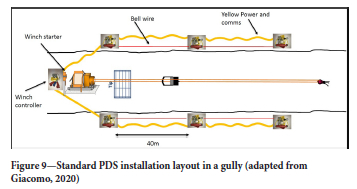
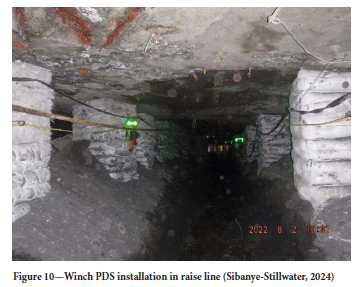
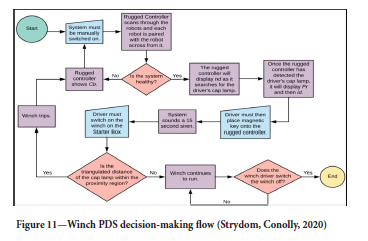
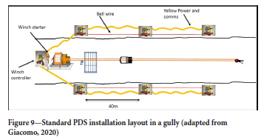
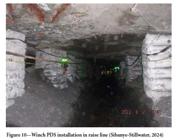
Firstly, a PDS-installed scraper winch system could potentially provide significant safety improvements, reducing the risk of accidents related to workers entering the scraper path by generating alerts and warnings, and shutting down the winch. Thus, PDS can mitigate "struck by" and "pulled by" incidents involving both the scoop and the rope, as the system detects personnel proximity to the entire hazard zone rather than to a specific component. Figure 9 illustrates the typical configuration of a modular PDS system including the placement of proximity signalling devices along the scraping path. The technology addresses the need for reliance on the winch operator or miner to stop the winch in case of an emergency. Although initial capital costs and integration challenges exist, this solution promises to have long-term benefits including reducing injuries and fatalities and the associated operational disruptions. Figure 10 shows the installation of such a PDS system in a raise line as part of a project at an underground PGM mine in South Africa where a proximity detection-enabled signalling system was installed on the centre-line winch and gulley winch. The scope of the project was to implement a winch PDS system that retains the normal functionality of the existing signalling system, and is able to detect the presence of persons within the scraper path (Sibanye-Stillwater, 2024). From Figure 11 it can be seen that a comprehensive decision-making process with various nodes is a key requirement for the successful implementation of a winch PDS system where the PDS functionality is intended to serve as a last-line-of-defence fail-safe function and not to replace manual signalling (Strydom, Conolly, 2020).
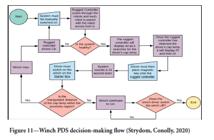
Key considerations for the introduction of a scraper winch proximity detection system (PDS) include clarity on exclusion zones, reaction times of the system, effects of system stoppages and start-ups, effectiveness of warning signals and alerts, visualisations to improve operator's line of sight, and data logging and analytics. Additionally, deployment of a PDS for scraper winches should consider the conditions of the operational environment, which include the presence of dust, water, and rock falls. The PDS components should therefore be ruggedised and positioned optimally, away from possible damage.
Secondly, implementing scraper winch rope condition monitoring through time-bound inspections or using sensor technology reduces the risk of accidents occurring due to rope breakages. Rope breakage causes fatalities or injury through the whiplash effect, resulting from the sudden release of stored energy. The broken rope is propelled towards the winch or anchor points at high velocity, striking any personnel in its path. While PDS is designed to detect personnel entering a hazard zone, the early detection of rope wear, damage, deformation, or tension anomalies can improve both safety and operational reliability through the prevention of fatalities and reduced downtime. Scraper winch-rope-conditioning monitoring would require the development and enforcement of discard criteria, which will address the current risk associated with using ropes until failure. Importantly, the criteria should specify the regularity of scraper winch inspections. In parallel with condition monitoring, research into improved rope materials and designs provides an opportunity for additional safety and operational benefits. Research conducted by Felber et al. (2024), shows that high-modulus-high-tenacity (HM-HT) fibre ropes are increasingly used in mining due to their corrosion resistance, high breaking force, good bending flexibility, and lower density compared to steel wire ropes. However, these technologies and other hybrid (steel-fibre) ropes require further testing and validation in the harsh narrow-reef environment, particularly regarding abrasion resistance and long-term durability under dynamic loading (Wang et al., 2024).
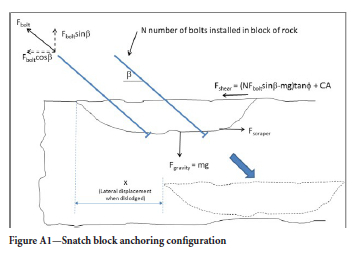
Thirdly, safely rigging the snatch block or return pulley of a scraper winch is a key safety control to mitigate the uncontrolled release of mechanical energy and prevent localised hangingwall failures. During cleaning operations, the scraper rigging exerts substantial horizontal forces. These forces directly transfer to the rock anchor and could dislodge unstable blocks of rock along planes of structural weakness. The geo-mechanical analysis, provided in Appendix 1, indicates that if an anchored rock is dislodged, the combination of gravity and constant scraper tension accelerates the rock. In a standard 1.4 m stoping width, a dislodged rock could be moved laterally by more than a metre before making contact with the footwall. Improved rigging design should consider the optimal tendon installation angle. Installing tendons vertically or perpendicular to a horizontal plane of weakness is not effective, as the tendons provide limited geometric resistance to the lateral pulling force of the scraper rope. Based on the geo-mechanical analysis provided in Appendix 1, the optimal installation angle is equal to the friction angle of the rock interface. Therefore, designing and implementing an angled tendon layout based on the MohrCoulomb stability criteria, accounting for rock cohesion, friction, and expected scraper-induced shear stresses, should ensure the integrity of the snatch block rigging point while minimising the localised hangingwall failures and the required number of bolts.
In addition to these solutions, other supporting measures such as remote-control winch operations, improved training quality, time-task allocation, and hazard identification and risk assessment further strengthen operational efficiency. These solutions are low cost and focus on human factors and operational discipline, which complement the technological solutions, thus, providing a holistic approach to enhancing existing scraper winch operations. However, the practical implementation of these solutions must consider an important factor, the limited face time available per shift. Site investigations (Mpofu et al., 2025) revealed that extended travel times from surface to underground working areas substantially reduce the effective time available for cleaning, compressing task schedules, and creating pressure to complete critical activities within the shift. This results in rushed risk assessments and machine inspections in order to allocate sufficient time for actual cleaning. This time-task constraint also affects shift supervisors, who are responsible for conducting planned task observations (PTO) in multiple areas. This could lead to the PTOs turning into a "paper exercise" defeating their intended purpose of proactive hazard identification and quality control.
Adoption of alternative cleaning equipment
Alternative cleaning technologies, such as waterjets and ULP dozers, significantly reduce direct worker exposure to dangerous scraper winch components, thereby lowering the risk of injuries caused by rope failures, snatch blocks, and moving scrapers. Replacing scraper winches with alternative cleaning equipment requires site-specific evaluation of feasibility, layout constraints, and operational readiness. Based on the options analysis, these solutions show significant potential to enhance safety by eliminating hazards associated with scraper winch ropes and operator exposure.
The use of high-pressure water jets, particularly for moving broken rock from the face, significantly reduces the need for face scraper winches (ASG and centre-gully winches are typically still required) and ropes; thus, eliminating related safety risks such as rope entanglement and scraper pathway incidents. However, water jets introduce new challenges such as flooding, high-pressure water hazards, and mud rushes, specifically in Upper Group (UG2) reefs. Additionally, water jets perform optimally on dipping reef and short faces of approximately 15 m (O'Beirne, 1979), thereby limiting their implementation feasibility. When considering water jets, the following factors must be assessed:
Mud rushes - Mud rushes are sudden inflows of water-saturated broken rock and fines from drawpoints or other underground openings (Butcher et al., 2005). Since water is one of the triggers for a mud rush, the use of waterjets increases the risk of mud rushes occurring.
> Water management - waterjets introduce additional water into the system. New operations should be designed to handle the water. In existing operations, the infrastructure may not be able to handle the increased water volumes, leading to flooding of some working areas. The FutureMine research programme (Peake et al., 2002) documented that many mines lack effective stope water management, with water demand exceeding 2.4 tonnes per tonne mined in some cases, which is above the industry rule-of-thumb of 1 tonne/t. This suggests that existing infrastructure may have difficulties in handling the additional water introduced by waterjets.
> Pumping costs - the additional water results in an increase in pumping costs and, as a result, energy consumption costs.
> Dip constraints - the mine layout and gully design inclination should not hold water. Flat dipping orebodies may not be compatible with the use of waterjets.
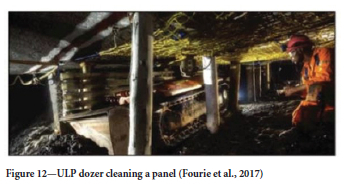
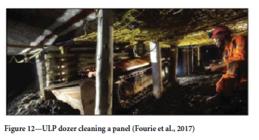
ULP dozers are a notable technological development for mechanised cleaning in narrow reef operations, with several OEMs having developed and trialled prototype and production units in South African and platinum mines (Fourie et al., 2017; Harrison, 2006; Olsen et al., 2008). However, their industry-wide adoption remains limited by various operational challenges. These dozers are designed to clean mined material from underground places of work and remove it into the ASG (Fourie et al., 2017). Figure 12 illustrates a ULP dozer cleaning the panel. By combining remote operation, PDS, and CPS, ULP dozers remove the workers from hazardous zones and thereby improve safety. Although this solution has long-term benefits, including higher cleaning rates and reduced exposure of workers, it requires high initial investment and significant changes to current access and transport excavations as well as mining layouts.
The use of ULP dozers could have a positive safety impact due to their integration with PDS and CPS. Introducing this technology requires considerable changes to mining layouts, specialised skills, and a relatively high initial capital investment. Similar to waterjets, the feasibility of adopting ULP dozers for stope cleaning in current operations needs to be validated and should follow a holistic approach since their use is affected by:
> Infrastructure limitations - current infrastructure in conventional mines is not suited for the transport of ULP dozers, from the shaft to the stope face. > Dip constraints - their functionality is limited by the dip of the orebody.
> Maintenance - routine maintenance activities should be scheduled, and adequate maintenance capacity and capability is required.
> Breakdown management - when ULP dozers break down in the stope environment they would need to be fixed in their position, meaning that other activities would be affected.
> Battery performance - the recharging duration of batteries may affect productivity.
> Remote-control capability - the ability to use remote control should not eliminate the need for the operator to have a clear line-of-sight while operating a dozer.
Transition to mining methods that eliminate the need for scraper winches
Several mining methods have successfully been used to mine and clean narrow reef orebodies without relying on scraper winches. The transition to ropeless mining methods, that eliminate the need for scraper winches, has the potential to provide the highest safety impact by removing workers from high-risk zones. Ropeless solutions face barriers such as capital costs, infrastructure modifications, and workforce upskilling requirements, particularly in established mines with legacy infrastructure. Transitioning to ropeless mining methods and layouts requires careful planning and substantial investment. The application of these alternative mining methods and technologies is site-specific and more suited for new mines or extensions of current operations. These operations would need to follow a holistic decision-making process and evaluate alternative designs that could eliminate the scraper winch and legacy infrastructure constraints.
A number of mining methods can result in the elimination of scraper winches. Reuse mining and selective blast mining techniques, primarily used to reduce ore dilution can be used with water jets or dozers, eliminating the need for scraper winches and the associated hazards. However, these methods require modifications to existing layouts and careful management of drilling and blasting accuracy (Bock, 1996). A related technique, known as throw blasting, where explosive energy is used to propel broken rock into an advanced strike drive (ASD), has been considered in mechanised narrow reef layouts. Pickering (2006), reported on trials conducted for longhole drilling and the use of throw blasting in combination with waterjets for cleaning at the Union Section of Anglo Platinum mines. Similarly, Fourie et al. (2017), detail a scattered breast mining layout that uses throw blasting to propel fragmented rock to ASDs, with the remainder thereof being cleaned using load-haul-dump (LHD) trucks. However, the widespread adoption of throw blasting as a means to improving cleaning has not been achieved. Mechanised breast mining, which incorporates machines such as conveyors or LHDs, and the associated integration of PDS and CPS completely removes the need for scraper winches, improving worker safety and operational efficiency. Implementation of this method is, however, limited by the associated high capital investment and the overhaul of existing mining layouts and infrastructure. In the PGM sector, mining operations are increasingly shifting from conventional narrow-reef stoping towards room-and-pillar (bord-and-pillar) mining (McGill, 2011; Watson et al., 2024). However, the introduction of this mining method is associated with relatively higher capital expenditure and wider mining widths. Furthermore, the method introduces new operational risks such as collision hazards related to trackless mobile machines and increased ventilation demands. Similarly, mechanised mining methods and technologies for breaking rock, such as reef boring and reef cutting remove the workers from hazardous areas and improve productivity and ore recovery. These methods, however, require substantial upfront investment and the redesign of mining layouts. Fundamentally, their introduction requires a substantial understanding of the site geology and geotechnical factors as these affect excavation parameters such as gradient of the excavation, fragmentation of the rock, and the types of support required (Van der Bijl, 2024; Roos, 2025). Reef boring and reef cutting can therefore be regarded as long term solutions in comparison to solution such as the incorporation of PDS to scraper winches or the adoption of winch rope condition monitoring.
Ultimately, eliminating scraper winches in underground mining requires a systemic, long-term approach. While mechanised alternatives promise safety and productivity benefits, their adoption must be aligned with site-specific geological and operational conditions to achieve sustainable results. Since mechanised alternatives have proven difficult to implement in deep-level narrow reef hard rock mining, despite decades of research and trials, critical evidence and lessons learnt should inform the evaluation of any future alternatives.
Conclusions
Scraper-winch-related challenges and accidents have remained consistent over many years in underground narrow reef hard rock mines in South Africa. This highlights slow progress in introducing innovation to address known safety and operational risks. Persistent hazards, including rope degradation and failure, inadequate rigging, and unsafe practices, continue to contribute to scraper-winch-related accidents. Although several safety improvement solutions have been proposed in the past, their adoption has been limited by factors such as high capital costs, perceived reliability issues, and infrastructure constraints.
Opportunities remain to improve safety and efficiency through the integration of practices such as proactive rope condition monitoring and improved rigging designs as well as technologies such as PDS. Introducing a proactive approach to scraper winch rope monitoring and replacement through an inspection routine and improved snatch block rigging designs and installations are examples of the adoption of a best practice approach to reducing accidents caused by scraper winches. The integration of PDS with scraper winches, although a mature technology in other sectors, is still in its early stages within the mining industry and has yet to gain significant traction as a viable solution to reduce scraper-winch-related incidents.
Several alternative cleaning equipment options that exist can be used either in conjunction with scraper winches or as complete replacements. Waterjets are considered one of the best alternatives for face cleaning, primarily due to their enhanced ropeless safety features. ULP dozers are also considered safer solutions for cleaning, however, they require major mine layout modifications, relative to conventional breast mining layouts, and substantial upfront investment. Further research and operational validation are required before ULP dozers can be considered a proven, viable technology for industry-wide adoption in South African narrow-reef mining. Considerations should be made on transitioning to mining methods that eliminate the use of scraper winches completely. Mechanical rock breaking methods such as reef boring and reef cutting remove the worker from hazardous working environments; however, their adoption requires further research, skills forecasting, and investment.
The dynamic nature of scraper winch operations necessitates a systemic, data-driven approach to safety improvements. By improving existing systems and integrating advanced technologies, the mining industry can achieve significant progress toward its "zero harm" goal while maintaining operational efficiency and sustainability.
Recommendations for future research
The following are recommendations for future research that can make an impact to the mining industry:
> Further research into the application of PDS technology for scraper winch systems, remote controlled winches, and enhanced visualisation and communication systems in underground mining environments.
> Investigation of scraper winch rope-and-rigging-related safety aspects including defining a scraper winch rope inspection and replacement protocol, and the evaluation of the long-term durability and cost-effectiveness of alternative rope types, such as synthetic fibre ropes, for narrow reef scraper winch operating conditions.
> Further work to investigate improved methods to attach gully scraper rigging is recommended.
> Supplementary research is recommended to quantify the capacity of existing mine water reticulation systems to handle additional water volumes from waterjet cleaning.
> Further research into the applicability, available technology solutions, key enablers, and benefits of mechanical methods such as reef boring and cutting as a safe and productive alternative to scraper winch operations.
Appendix 1
Introduction
Figure A1 illustrates a conceptual snatch block anchoring problem assuming a block of rock with mass m is anchored by N number of tendons installed at any arbitrary angle β to the horizontal. The block is separated from the hangingwall by a horizontal plane of weakness with a cohesion C and a friction angle φ. The contact area of the block is A. The scraper rigging is attached to the block and it exerts a horizontal force on the block. This problem posed, is considered as the worst-case scenario as there are no other kinematic constraints, e.g., no adjacent blocks to clamp it in place.
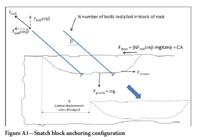
Problem statement
> Derive a general solution for the number of bolts with a capacity of Fbolt required to keep the block stable.
> If the block gets dislodged, how much lateral displacement will occur before the block makes contact with the footwall.
Number of bolts required
Assume the shear stress τ on the interface of the block is given by the Mohr-Coulomb strength criterion:

The contact area is A and therefore:

The normal force (positive value for compression) acting on the interface (if the bolts are prestressed and NFboit sinβ >mg) is:

When inserting Equation 4 in Equation 3, it gives:

For the block of rock to maintain stability, the forces need to be in equilibrium and therefore:
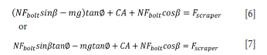
This can be rewritten as:

The number of bolts required is therefore:

For the case where it is a loose block (C = 0 MPa, φ = 0°) being suspended by the tendons, Equation 9 simplifies to:

Of significance is that if β= 90°, N is not defined (infinitely high). This implies that if the tendons are installed vertically and their bending strength is ignored (e.g., hydrabolts are weak when subjected to bending forces), they serve no purpose to resist the pulling force of the scraper. For securing the hangingwall in the area where the scraper rigging is attached, it is therefore counterproductive to install the tendons vertically.
Consider the following example
Fscraper = 2 tonnes = 20 kN (force exerted by the scraper on the block of rock)
m = 2.7 tonnes (mass of the block of rock)
β = 60° (installation angle of the tendons)
φ = 30° (friction angle of the rock interface)
C = 5 kPa (cohesion of the rock interface)
A = 2 m x 1.5 m = 3 m2 (contact area of the block of rock with the hangingwall)
Fboit = 1 tonne = 10 kN (force exerted by the tendon)
When inserting these values in Equation 9, it follows that:

This implies that at least three tendons need to be installed to keep the block stable (for the assumed parameters).
Lateral displacement of a dislodged block
Consider the example where the combined force of gravity and the scraper dislodge the block. The acceleration of the block is given by F = ma or a = F/m. The velocity ν of the block is:

The displacement, d, of the block is

From Equation 12, it follows that the lateral displacement of the block is

The time, t, is the time it takes for the block to fall from the hangingwall to the footwall (it is assumed the scraper force stays constant during the fall). This time can be calculated from Equation 12 using the gravitational forces on the block (h is the stoping width):

By rearranging Equation 14, the time it takes for the block to fall is:

For a stoping width of 1.4 m, it therefore takes t = 0.53 s for the block to fall from the hangingwall to the footwall.
By inserting Equation 15 in Equation 13, it follows that the lateral displacement is:

By using the parameter values of the example in the aforesaid, it follows that the lateral displacement of the block will be x = 1.06 m by the time it comes into contact with the footwall.
Pullout forces (critical bond lengths) of splitsets
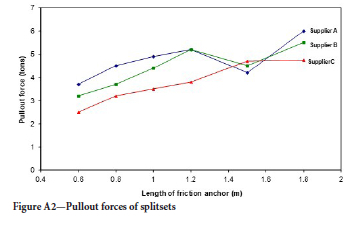
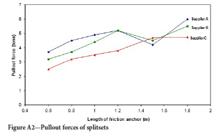
Figure A2 illustrates the pullout forces of splitsets. These in situ tests were conducted at a South African platinum mine. If only 300 mm of a splitset protrude through the block, it is estimated that the pullout force will be less than 2 tonnes. For the example above, 1 tonne was assumed.
Key insights
Regarding the stability of scraper rigging attachments, the analysis has indicated that installation of tendons normal to the dip of the reef in these areas (to reinforce the rigging point) is not necessarily the optimum angle.
The analysis also indicated that, even with moderate forces being applied by the scraper rope, a large dislodged rock can be displaced laterally for a considerable distance before it makes contact with the footwall.
CRediT Author statement
MM: Funding acquisition; Methodology; Investigation; Formal analysis; Writing - original draft preparation; Project administration
TJO: Formal analysis; Writing - original draft preparation; Supervision; Validation
SN: Methodology; Investigation; Formal analysis; Writing -original draft preparation
NZN: Supervision; Writing - review and editing; Project administration
FM: Supervision; Writing - review and editing; Project administration
NT: Supervision; Writing - review and editing; Project administration
Acknowledgements
We would like to thank the Mine Health and Safety Council (MHSC) for funding this project. We also thank the MHSC Programme Delivery Technical Committee (PDTC) and the Safety in Mines Research Advisory Committee (SIMRAC), and the Mine Occupational Safety and Health (MOSH) Transport and Machinery team of the Minerals Council South Africa for their guidance and technical insights. Finally, we are grateful to the mining industry, stakeholders and individuals who participated in this project at all levels.
References
-
African Mining. 2023. SA industry collaboration supports tech innovation in rock hazard identification/safe removal. [Online] Available at: https://www.africanmining.co.za/2023/02/24/sa-industry-collaboration-supports-tech-innovation-in-rock-hazard-identification-safe-removal/ [Accessed 2025 October 2025]
» https://www.africanmining.co.za/2023/02/24/sa-industry-collaboration-supports-tech-innovation-in-rock-hazard-identification-safe-removal/ -
Bafotech, n.d. Scraper winch LF230 [Photograph]. Available at: https://bafotech.co.za/images/gallery/Scraper-Winch-LF230.jpeg [Accessed 7 June 2026].
» https://bafotech.co.za/images/gallery/Scraper-Winch-LF230.jpeg - Bock, I. 1996. Selective blast mining in gold mines. The Journal of the Southern African Institute of Mining and Metallurgy, 96(September/October), pp. 183-186.
- Butcher, R., Stacey, T.R., Joughin, W.C. 2005. Mud rushes and methods of combating them. Journal of the Southern African Institute of Mining and Metallurgy, vol. 105, pp. 11, pp. 817-824.
-
Cape Gate, n.d. Scraper rope (haulage rope). Available at: http://www.capegate.co.za/wire/NewProductDetail.asp?Factory=Stranded+Products & ProductGroup=Scraper+Rope & B1=Show+Info [Accessed 7 June 2026].
» http://www.capegate.co.za/wire/NewProductDetail.asp?Factory=Stranded+Products & ProductGroup=Scraper+Rope & B1=Show+Info -
Coetzer, P. 2023. Safety challenge in use of double drum scraper winches. [Online] Available at: https://www.africanmining.co.za/2023/01/01/safety-challenge-in-use-of-double-drum-scraper-winches/ [Accessed 12 November 2024].
» https://www.africanmining.co.za/2023/01/01/safety-challenge-in-use-of-double-drum-scraper-winches/ - Department of Mineral and Petroleum Resources. 2023. Weekly Report, Pretoria: Department of Mineral and Petroleum Resources.
- Felber, A., Schmieder, A., Müller, C., Mischo, H. 2024. Fiber ropes in a mining environment. In: Proceedings of the innoTRAC Conference, Chemnitz, Germany, December 2024. Chemnitz: Chemnitz University of Technology.
- Fourie, F., Valicek, P., Krafft, G., Sevenoaks, J. 2017. Narrow-reef mechanised mining layout within Anglo American Platinum. vol. 117, no. 3, pp. 213-248.
-
Galison, n.d. LF230 scraper winches. Available at: https://galison.co.za/product/underground-mining-equipment/scrapers-scraper-winchers/scraper-winches/lf230-scraper-winches/ [Accessed 7 June 2026].
» https://galison.co.za/product/underground-mining-equipment/scrapers-scraper-winchers/scraper-winches/lf230-scraper-winches/ -
Galison, n.d. Scrapers. Available at: https://galison.co.za/product-category/underground-mining-equipment/scrapers-scraper-winchers/scrapers/ [Accessed 9 June 2026].
» https://galison.co.za/product-category/underground-mining-equipment/scrapers-scraper-winchers/scrapers/ - Giacomo, R. 2020, Presentation to Mine Health and Safety Council of South Africa by WPD Group, Johannesburg: Unpublished.
- Harrison, G.A. 2006. Implementation of Extra Low Profile (XLP) Mechanized Equipment in Anglo Platinum. The Southern African Institute of Mining and Metallurgy
- Ilgner, H. et al., 2009. Best Practice: Scraper Winch Systems Design, Installation, Operation and Maintenance, Johannesburg: Mine Health and Safety Council.
- Jacobs, J.A. 2021. Failure prediction of critical mine machinery. Potchefstroom: North-West University. (PhD (Eng.) thesis - Mechanical Engineering).
- Jacobs, D., Van Laar, J., Schutte, C. 2022. Strategy to identify and mitigate hazards in deep-level mine ventilation systems using a calibrated digital twin. South African Journal of Industrial Engineering, vol. 33, (no.3), pp. 204-217.
- Janicijevic, D. 2008. Scraper winch pull force investigation. Sun City, The Southern African Institute of Mining and Metallurgy.
- Jeppe, C.W.B.1946. Gold mining on the Witwatersrand. 2 vols. Johannesburg: Transvaal Chamber of Mines.
- Kendall, R., Gericke, M. 2000. Mechanization in stoping narrow tabular orebodies. The Journal of The South African Institute of Mining and Metallurgy, 2000(March/April), pp. 135-144.
-
McGill, J.E. 2011. Strategic and tactical determinants for South African platinum-groupmetals supply. Centre for Innovation in Mining, South Africa. [Online]. Available at: https://researchspace.csir.co.za/server/api/core/bitstreams/b25c144c-d472-4195-afd7-a87f861bb460/content.(Accessed: 1 July 2026).
» https://researchspace.csir.co.za/server/api/core/bitstreams/b25c144c-d472-4195-afd7-a87f861bb460/content - Moseme, R., Foster, P., Demana, R., Rupprecht, S. 2003. Investigation into the causes of accidents on scraper systems in the Gold and Platinum mining sectors, Johannesburg: Mine Health and Safety Council.
-
Mpofu, M., Ngobese, S., Otto, T. 2025. Investigations of the current use of winches and their accessories in cleaning operations and recommendations for possible future use of ropeless cleaning methods in underground mining operations. Final Report for Public Consumption, Project No. CoE 210501. Pretoria: CSIR. Available at: https://mhsc.org.za/wp-content/uploads/2025/07/MHSC-CoE-210501-Milestone-6-Final-Project-Report-For-Public-Consumption.pdf (Accessed: 3 July 2026).
» https://mhsc.org.za/wp-content/uploads/2025/07/MHSC-CoE-210501-Milestone-6-Final-Project-Report-For-Public-Consumption.pdf - Ngwenyama, P., Webber-Youngman, R. 2024. A review of the applications of through-the-earth (TTE) communication systems for underground mines. Mining, Metallurgy and Exploration, 41(October), pp. 2291-2323.
- O'Brien, W.N. 1951. A review of slushing equipment and some applications. The Canadian Mining and Metallurgical Bulletin. vol. 54, pp. 466-474.
- O'Beirne, D. 1979. The hydraulic cleaning of stopes. Journal of the Southern African Institute of Mining and Metallurgy, vol. 79, no. 8, pp. 207-216
- Olsen, S.G., Hall, R.A., Daneshmend, L.K., Murphy, P.F.R. 2008. Integrated design of an XLP dozer. Third International Platinum Conference 'Platinum in Transformation', The Southern African Institute of Mining and Metallurgy.
- Peake, A.V., Rupprecht, S.M., Fleming, D.R., Butterworth, M. 2002. In stope and crosscut water management. FutureMine Collaborative Research Programme, Task No. 3.3.3, Report No. 2002-0196. Johannesburg: CSIR Miningtek.
- Pickering, R. 2007. Presidential Address - Has the South African narrow reef mining industry learnt how to change?. The Journal of The Southern African Institute of Mining and Metallurgy, 107(September), pp. 557-565.
-
Powerflow Scraper Winches, n.d. Our products. Available at: https://www.powerflow.co.za/our-products/ [Accessed 9 June 2026].
» https://www.powerflow.co.za/our-products/ - Rhoades, W.A. 1982. Slushers. In W.A. Hustrulid (Ed.), Underground Mining Methods Handbook. Society of Mining Engineers of the American Institute of Mining, Metallurgical, and Petroleum Engineers.
- Roos, D. 2025. Herrenknecht Design Criteria, Johannesburg: Unpublished.
- Rupprecht, S. 2011. Safety considerations in underground logistics - a look at vertical, horizontal and in-stope transportation systems. The Journal of The Southern African Institute of Mining and Metallurgy, 111(January), pp. 45-53.
- Rupprecht, S. 2013. Loading and hauling of broken rock in a narrow tabular orebody utilising scraper winches. Johannesburg, The Southern African Institute of Mining and Metallurgy, Underground Load and Haul.
- Rupprecht, S. 2019. The potential of automatic scraper winches in underground narrow vein mining in South Africa. Antalya, International Mining Congress and Exhibition of Turkey (IMCET).
- Scott-Russell, H. 1993. Presidential Address - A strategy towards mining in the year 2000. Journal of the South African Institute of Mining and Metallurgy, vol. 93, no. 9, pp. 237-251.
- Sibanye-Stillwater. 2020. Sibanye-Stillwater Winch Signalling Journey, Johannesburg: Mine Health and Safety Council.
- Sibanye-Stillwater. 2024. Winch Proximity Detection System, Rustenburg: Unpublished.
- Solomon, V.J., Van Niekerk, P. 1978. The design of a stoping scraper scoop. Journal of the South African Institute of Mining and Metallurgy, vol. 79, no. 3, pp. 65-74.
-
South African Government. 1996. Downloads. [Online] Available at: https://www.gov.za/documents/mine-health-and-safety-act [Accessed 12 June 2024].
» https://www.gov.za/documents/mine-health-and-safety-act -
Strydom, R., Conolly, T. 2020. Safety Seminars and Presentations. [Online] Available at: http://www.amre.org.za/amre/admin-downloads/seminars/2020/AMANDELBULT%20COMPLEX%20SCRAPER%20WINCH-TO-PERSON%20PROXIMITY%20DETECTION.pdf [Accessed 23 April 2025].
» http://www.amre.org.za/amre/admin-downloads/seminars/2020/AMANDELBULT%20COMPLEX%20SCRAPER%20WINCH-TO-PERSON%20PROXIMITY%20DETECTION.pdf -
Toco Lifting, n.d. Bow and dee shackles. Available at: https://tocolifting.co.za/product/bow-dee-shackles/ [Accessed 9 June 2026].
» https://tocolifting.co.za/product/bow-dee-shackles/ - Van der Bijl, J. 2024. New developments in mechanised tunneling and shaft sinking for civil and mining industries. Johannesburg, Unpublished.
- Van Zyl, F. 2022. Scraper winch systems, Johannesburg: MOSH.
- Wang, P., Schultheis, H., Eelbode, A., Karedan, J. 2024. Development of steel-fibre hybrid ropes and the application in mining hoist systems. OIPEEC Conference.
-
Watson, B., Maphosa, T., Theron, W., Fernandes, N., Stacey, T., Morgan, A., Carpede, A., Betz, G. 2024. Establishing a UG2 Pillar Strength Formula in South African Platinum Mines. Minerals, vol.14, no. 11, 1161. doi:10.3390/min14111161.
» https://doi.org/10.3390/min14111161 -
Wolfram Mining Supplies. 2024. Underground mining equipment: scraper scoops, scraper winches, rock drills, snatch blocks. Available at: https://wolfram.co.za/underground-mining-equipment/ [Accessed 9 June 2026].
» https://wolfram.co.za/underground-mining-equipment/

Revised: .29 Mar. 2026
Accepted: 08 Sep. 2026
Published: Sep. 2026