Classification of tailings by clay minerals and pore water chemistry as a basis for safe tailings disposal
Abstract
Clay minerals are present in ores as either a primary or secondary weathering product and their colloidal behaviour in slurries impacts on the full metallurgical process from comminution until deposition into the tailings storage facility. Geotechnical classification of tailings has been based on parameters such as grain size, but this does not consider the rheological and plasticity. The use of methods such as determining the Atterberg limits is useful in initial characterisation, but does not consider other intrinsic components of active clay and chemical porewater.
Consolidation; Dewatering; Geotechnical; Pore water; Rheology; Tailings; TSF
Introduction
The ability to classify tailings into groups is an essential first step to understanding their behavioural and engineering properties. This is critical for designing and selecting the appropriate metallurgical process flow sheet and tailings storage facility (TSF) that is compatible to the tailing's dewatering and geotechnical behaviour. Tailings fundamentally consist of two-phases, namely solids and water, each of which have intrinsic characteristics, which in combination impart certain derived engineering properties to the slurry.
Tailings engineers have adopted a classification method originally developed for soils, that is based on tests, which measure a combination of both intrinsic and derived properties. Metallurgical engineers, on the other hand, currently have no accepted tailings classification method and generally rely on tests that measure a combination of intrinsic and derived properties specific to unit processes of interest, such as settling or filtration rate, and rheology.
The Global Industry Standard on Tailings Management (GISTM) calls for TSFs to be designed according to a performance-based design philosophy in which the operational performance of the TSF from design to closure is governed by instrument data driven decisions, rather than observational decisions (Tailings, 2022).
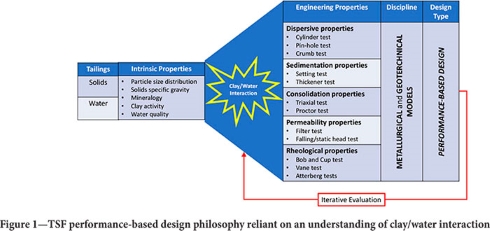
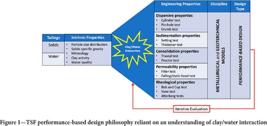
Viewed in this light, it becomes evident that the current tailings classifying system, based mainly on derived engineering properties of soils, is problematic for two reasons. Firstly, there is very little understanding of the interaction between the intrinsic properties of the tailings (clays and water) and secondly, how these will affect the engineering properties to reflect their ease or difficulty with respect to dewatering and geotechnical behaviour (Figure 1).
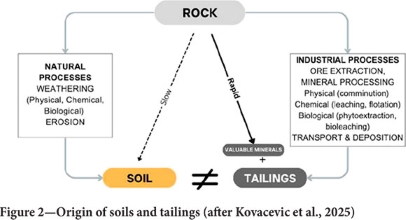
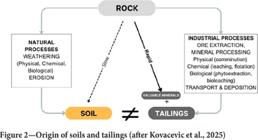
In addition, as Kovacevic et al. (2025) have highlighted, soils and tailings are not similar. Soils are defined as unconsolidated particulate geological matter formed by physical, chemical, and biological weathering of rock, while tailings are defined as crushed rock produced by mineral processing methods resulting after the recoverable metals and minerals have been extracted. Although soils and tailings share a common origin, the nature and duration of the disintegration process varies considerably and therefore, their engineering properties may not be directly comparable (Figure 2).
This paper attempts to provide an alternative view on tailings classification based on the intrinsic properties of the two-phase system. It further attempts to emphasise the importance of the interaction between the clay component and pore water chemistry in defining the engineering properties of the tailings.
Geotechnical test methods
Before discussing classification systems, it is worth considering the currently accepted geotechnical test methods used to measure both intrinsic and derived engineering properties - and to note that pore water chemistry is completely neglected.
IIn situ tests
n situ tailings properties are typically determined based upon field surveys: seismic cone penetration testing with pore pressure measurements (SCPTu), standard penetration testing (SPT), field shear vane tests, and beach slope measurements. The parameters used to characterise the tailing include a combination of intrinsic and derived engineering parameters, including void ratio, relative density, dilatancy index, and gamma ray absorption from downhole logging, but to name a few.
The most common approach to characterise TSF in situ, is to use the piezocone penetration tests (CPTu), where the in situ state parameter (ψ) is inferred, amongst others. The CPTu is capable of providing an accurate profile through the deposited material. The profile will also vary based on the location within the TSF, and depending on the method of depositing the tailings. It is possible to collect samples as part of the CPTu test by piston sampler, Monster Steek Apparaat (MOSTAP), or similar. The sampler is pushed to the test depth and then opened to recover the soil in the target zone. Sampling does not need to be at every CPTu sounding, but once the characteristic soils have been identified, sufficient samples need to be recovered to characterise the variability of parameters, such as grain size.
Laboratory tests
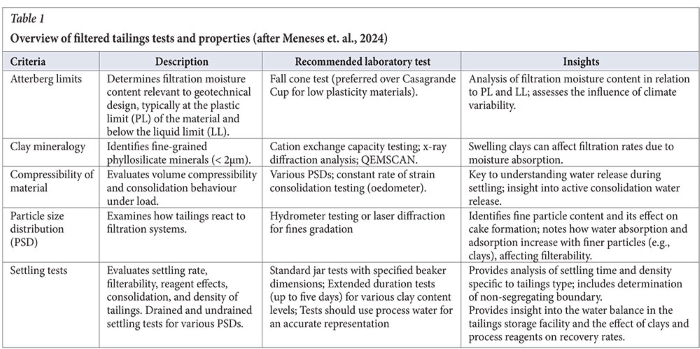
Laboratory tests include foundation index (including plasticity), shear strength, permeability and consolidation tests. An overview of the most common tests for a filtering geotechnical application is summarised in Table 1.
Current tailings classification systems
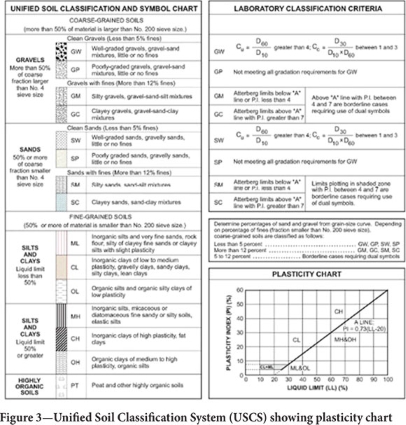
Soil types have traditionally been classified based on a combination of intrinsic and derived engineering properties, for instance, the Unified Soil Classification System (USCS) classifies soils based on their intrinsic particle size and derived plastic (rheological) properties using Atterberg limits as measured parameters (Figure 3). The Atterberg limits define the plastic behaviour of fine-grained soils by three key parameters:
➤ Liquid limit (LL): the water content at which soil transitions from liquid to solid-like state. The LL is understood as the water content at which the undrained shear strength (or yield strength) is in the order of 1.7 kPa (Sharma, Bora, 2003).
➤ Plastic limit (PL): the water content at which the soil changes from a ductile to a brittle state. The PL is understood as the water content at which the undrained shear strength (or yield strength) is about 170 kPa (Sharma, Bora, 2003).
➤ The plasticity index (PI) is the moisture content difference between the LL and PL. High PI is indicative of a high clay mineral content while a low PI is indicative of a high silt content.
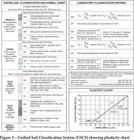
This system can conveniently classify soils into plastic or cohesive groups, with corresponding low permeability properties, and non-plastic or non-cohesive groups, with corresponding high permeability properties. Although the method is useful, it has inherent flaws, since these derived properties are dependent on interactions between intrinsic properties such as the active clay content and the pore water, which are often not considered, and which will affect the engineering behaviour of the soil or tailings.
Likewise, the ICOLD Bulletin 181 (ICOLD, 2021) proposes a tailings classification method based on a combination of intrinsic and derived tailings properties such as:
1. The solids specific gravity.
2. The solids particle size distribution using the ASTM definition of fines and sand fractions nominally at 75 µm. The fines fraction is further subdivided into silts and clay fractions at the conventionally accepted definition for clays of -2 µm.
3. The tailings 'activity' defined by the relationship between the PI and the clay size fraction.
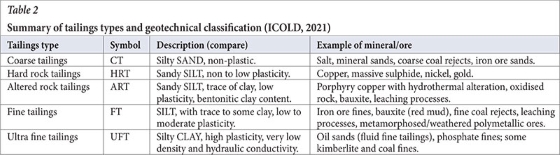
A summary of the ICOLD tailings classification scheme is provided in Table 2.
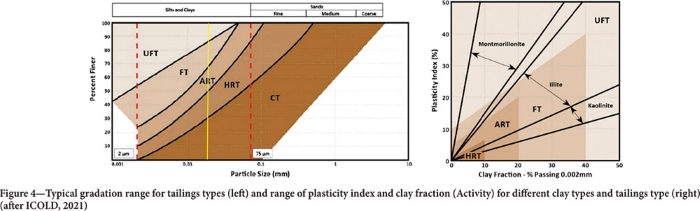
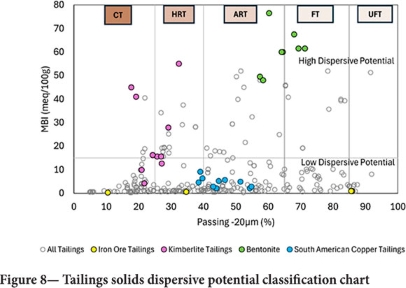
Although the scheme is useful for providing a descriptive framework for classifying tailings, it does have some shortcomings. Firstly, it assumes that tailings particle size distributions will fall into these groups, which is not always the case (Kovacevic et al., 2025). A more useful approach would be to define a suitable particle size parameter (such as the percentage -20 µm fraction) with which to classify the intrinsic particle size properties of tailings into one of the five groupings (Figure 4).
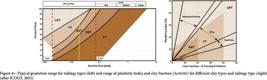
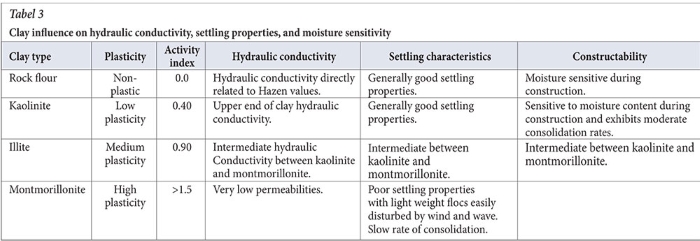
Secondly, although the scheme recognises the importance of clays as a key parameter in determining engineering properties such as consolidation and hydraulic behaviours, these are based on the PI, which itself is a derived tailings property and dependent on intrinsic properties such as the active clay content and the pore water chemistry (Table 3).
Alternative tailings classification system
An alternative tailings classification system is proposed based on the intrinsic properties of the solids and the water components separately.
Tailings solids component
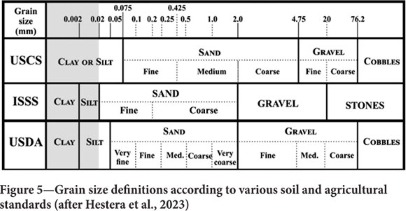
The fine solids component of a tailings is widely regarded as the fraction which determines its engineering properties and is also the fraction in which the clay minerals are concentrated. The ASTM grain sizing classification defines the -75 µm fraction as the fines component, while the USCS classification system defines the -2 µm fraction as the clay component. From practical experience using data derived from the laser diffraction sizing method, the 20 µm fraction appears to be a suitable size parameter to distinguish 'fines' from 'coarse' solids. This criterion therefore includes all solids defined as medium to fine silts and clays according to the USCS system (Figure 5).
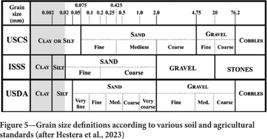
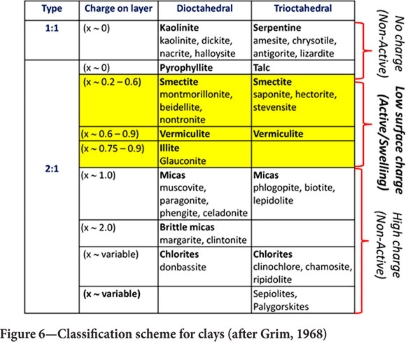
The second intrinsic solids parameter to consider is the clay minerals within the fines fraction. Clays are classified according to both crystal structure and surface layer charge (Figure 6).
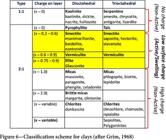
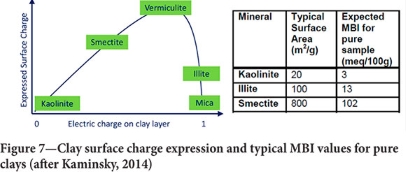
Surface charge expression does not follow a linear relationship when clays are suspended in water, and only certain clay types are able to absorb water molecules between the crystal layers and undergo swelling and dispersion. These clays are known as swelling or active clays and typically belong to the smectite, vermiculite and illite clay groups. Their intrinsic surface charge property can be measured indirectly by the methylene blue method to provide a methylene blue index (MBI) value in meq/100 g of solids (Kaminsky, 2014). The MBI value therefore provides an indirect measure of the intrinsic surface charge of the active clays and provides an indication of potential for the clay to swell or disperse within the tailings (Figure 7).
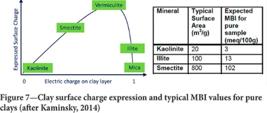
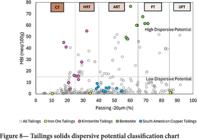
When these two intrinsic solids' properties are plotted together, mineral tailings can be grouped into classes based on their fines/silt content and their clay dispersive potential. This classification reflects the Skempton activity chart (Mitchell, Soga, 2005), however it is fully based on the intrinsic properties of the solids component of the tailings and can incorporate the ICOLD tailings classification nomenclature based on a 20 µm sizing criteria (Figure 8).
Tailings water component
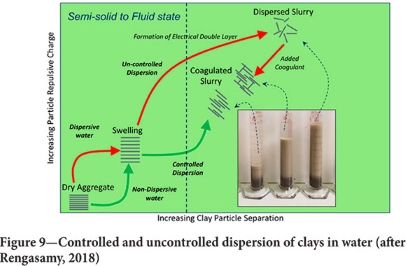
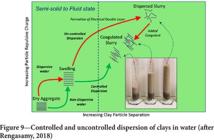
The dispersive potential of clays within tailings is only expressed when the clays are exposed to water and depends on the chemical properties of the water (process water or pore water). During processing, the dry ore is typically wetted at the milling or scrubbing step and should active clays be present, they will begin to undergo hydration and ion exchange to mimic the ionic profile of the contacting water. Consequently, the chemical properties of the water and the resulting ion exchanged nature of the clays will affect their dispersive behaviour within the slurry. This behaviour will in turn have a profound effect on the engineering properties of the tailings, from sedimentation and rheological properties in the dewatering circuit through to the consolidation and permeability properties at the TSF (Figure 9).
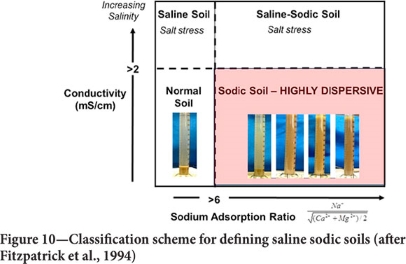
In many respects, the dispersive behaviour of tailings bears a striking similarity to the characteristics of a class of agriculturally problematic soils known as 'saline/Sodic' soils, which are classified on the intrinsic properties of two water chemistry related parameters (Richards, 1969):
1. Conductivity (in mS/cm) measures the total water-soluble salt content, i.e., the salinity of the water.
2. Sodium adsorption ratio (SAR), which is a calculated ratio of monovalent sodium ions to divalent calcium and magnesium ions, i.e., the sodicity of the water.
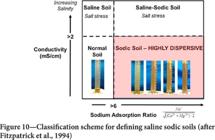
Using these parameters, agriculturalists have devised a classification scheme to define clay dispersive behaviour and to classify soils into four groups (Rengasamy, 2018; Fitzpatrick et al., 1994) (Figure 10).
1. Saline soils - In general soils with conductivities greater than 2 mS/cm (using the Australian standards). The high pore water salt content tends to prevent clay particle dispersion and therefore the soil structure and permeability are maintained.
2. Sodic soils - In general, soils with SAR values greater than 6 (using the Australian standards). The high pore water sodium ion concentration allows the active clays to become sodium-ion exchanged and highly dispersive, which destroys the soil structure and reduces permeability.
3. Saline/sodic soils - Behave in the same manner as saline soils.
4. Normal soils - the low pore water sodium ion concentration allows the active clays to become calcium- or magnesium-ion exchanged and non-dispersive, which maintains the soil structure and permeability.
Case study
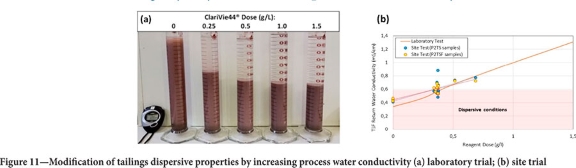
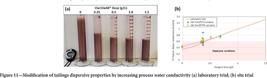
The mode in which tailings engineering properties are modified by the interaction between the active clay minerals and pore water chemical quality is demonstrated in a case study involving a kimberlite tailings originating from a diamond mine in Angola. Under natural conditions, the active clays within these tailings are known to undergo uncontrolled dispersion due to the exceptionally good quality of the mine process water (very low conductivity) and they remain non-settling when deposited into the TSF.
The behaviour of a naturally uncontrolled dispersive tailings sample was compared to a similar tailings sample, which had undergone controlled dispersion by suspending it in a process water, which had been modified using a chemical reagent to have a higher conductivity. In this case only a very small reagent dose (0.25 kg/l) was required to increase in the conductivity (salinity) from 0.4 mS/cm to 0.6 mS/cm for the clays to be altered from dispersive to non-dispersive conditions. The test was repeated at full-scale on the mine site and similar results were obtained, indicating that dispersion behaviour can be controlled and is scalable from laboratory tests (Figure 11).
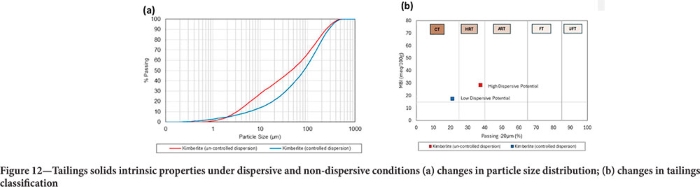
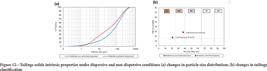
This change in pore water chemical state had a significant effect on the intrinsic properties of the solids within the tailings, with the controlled dispersive sample having a coarser particle size distribution, especially at the 20 µm size range and a reduced clay dispersive potential (MBI). Accordingly, the change in water chemistry shifted the classification of the kimberlite tailings from hard rock tailings (HRT) in the uncontrolled dispersive state to coarse tailings (CT) in the controlled dispersive state (Figure 12).
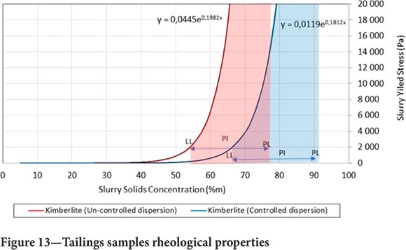
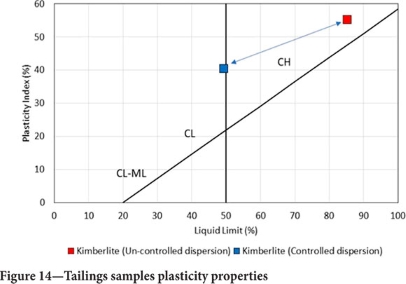
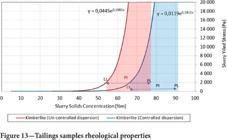
The rheological properties of both the uncontrolled and controlled dispersive slurry samples were measured using a rheometer with a bob and cup fitting, and the relationship between sheared yield stress and slurry solids concentration (%m) were described by derived exponential equations. Using these equations and extrapolating the data, slurry solids concentrations (%m), which corresponded to 1.7 kPa and 170 kPa were determined (Figure 13). These slurry mass solids concentrations were then converted to geotechnical moisture content (%) before the Atterberg limits (LL, PL, and PI) were determined and plotted on the Plasticity Chart (Figure 14).
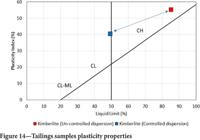
These results clearly show that the engineering properties of a single tailings material can be considerably altered by the interaction of the active clays and chemical state of the pore water. In this case, a slight increase in pore water conductivity changed the interactive state of the clays within the tailings from a high plasticity material to a medium plasticity material. It is also recognised that this effect may also be reversable with all of the negative-associated strength and permeability properties.
Conclusion
The effective classification of tailings is paramount for understanding its behaviour and ensuring safe disposal in TSF sites. For plastic and cohesive tailings, the intrinsic properties of the solids, particularly clay minerals, and the chemical characteristic of the pore water significantly influence the engineering and dewatering properties of tailings.
This proposed alternative classification scheme separates intrinsic solids and water components, using the 20 µm particle size threshold to define fines and employing the MBI to quantify active clay surface charge, indicating swelling and dispersive potential of the tailings. Expression of this potential is dependent on the pore water chemical properties, such as conductivity, SAR, and pH, which in effect imparts the macro-textural and strength properties to the tailings.
An understanding of the interactions between these fundamental components, in especially the clay-containing tailings, is an essential foundation for adopting a performance-based design philosophy.
References
- Fitzpatrick, R.W., Boucher, S.C., Naidu, R., Fritsch, E. 1994. Environmental consequences of soil sodicity. Australian Journal of Soil Research, vol 32. pp. 1068-1093.
- Grimm, R.E. 1968. Clay Mineralogy (2nd ed). McGraw Hill, New York.
- Hestera, H., Pahernik, M., Kovacevic Zelic, B., Maljkovic, M.M. 2023. The United Soil Classification System mapping of the Pannonian basin in Croatia using multinomial logistic regression and inverse distance weighting interpolation. Rudarsko-geološko-naftni zbornik (The Mining-Geology-Petroleum Engineering Bulletin). pp. 147-159.
- (ICOLD) International Commission on Large Dams. 2021. Bulletin 181: Tailings Dam Design Technology Update, CRC Press, Boca Raton.ww
- Kaminsky, H. 2014. Demystifying the Methylene Blue Index. 4th Int Conf. Oil Sands Proceedings. Lake Louis, Alberta. pp. 221-230.
- Kovacevic, Z., Burecic, S., Znidarcic, D. 2025. Geotechnical engineering knowledge base needed for the improvement of mine tailings safety. GEE 2025 - Geotechnical Engineering Education 2025 International Conference "Charting the path toward the future". Nancy, France. pp. 1-12.
- Meneses, B., Llano-Serna, M., Dressel W., Coffey P., Gerritsen T. 2024. A geotechnically derived screening method to assess the filterability of tailings. Paste 2024, Melbourne, Australia, pp. 115-126.
- Mitchell, J.K., Soga, K. 2005. Fundamentals of soil behaviour. 3rd Ed, Wiley & Sons. New Jersey.
- Morrison, K.F. 2022. Tailings Management Handbook - A life-cycle approach. Society for Mining, Metallurgy & Exploration, Colorado.
- Rengasamy, P. 2018. Irrigation water quality and soil structure stability - A perspective with some new insights. Agronomy. 8. pp. 72-85.
- Richards, L.A. (ed.) 1969. Diagnosis and improvement of saline and alkali soils. US Dept Agriculture Handbook No. 60.
- Sharma, B., Bora, P.K. 2003. Plastic limit, liquid limit and undrained shear strength of soil-reappraisal. Journal of Geotechnical and Geoenvironmental Engineering August. pp. 774-777.
-
United Soil Classification System (CSCS), California Department of Transport (Caltrans). https://dot.ca.gov/-/media/dot-media/programs/maintenance/documents/office-of-concrete-pavement/pavement-foundations/uscs-a11y.pdf
» https://dot.ca.gov/-/media/dot-media/programs/maintenance/documents/office-of-concrete-pavement/pavement-foundations/uscs-a11y.pdf

Published: April 2026