Challenges of extreme grades in resource estimation: Spatial capping as an alternative to domain capping of outliers
Abstract
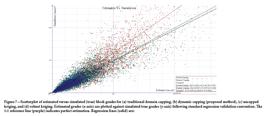
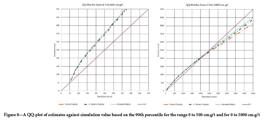
This study proposes that the moving search neighbourhood used in ordinary kriging selects a subset of data surrounding each estimation block, and that this subset represents a local subpopulation of which the distributional parameters can be used to determine local, spatially-adaptive outlier capping values. This paper introduces a distance-weighted capping method applied within the kriging search ellipse after kriging weight calculation, transitioning from one-dimensional point estimation to two-dimensional block estimation for Witwatersrand-type gold deposits. Accurate ore grade estimation is essential for mine planning and economic evaluation, particularly in deep-level gold mines where extreme grade values (outliers) may distort resource assessments. Traditional capping methods, which apply a uniform threshold to outliers, often fail to account for spatial and geological variability, leading to biased estimates. A high-resolution simulation generates a synthetic 'ground truth' orebody, subsampled to mimic real-world data scarcity. A two-parameter lognormal distribution models grade variability, with capping values optimised by minimising the mean squared error between estimated and simulated block grades. Comparative analyses against traditional capping techniques demonstrate that the dynamic method improves regression fit, reduces conditional bias, and aligns more closely with production reconciliation data. Validation using swath plots, QQ-plots, and mine call factor comparisons confirms that the spatially adaptive capping technique mitigates over- and under-estimation, particularly in high-grade zones. Results indicate superior performance over conventional domain capping, with higher R2 values and better alignment with actual production metrics. This approach offers a reproducible, scientifically rigorous framework for resource estimation, reducing reliance on rigid sub-domaining while enhancing decision-making in complex ore bodies. The study underscores the importance of integrating geological information with advanced geostatistics to optimise grade estimation and mine planning.
Conditional bias; grade capping; outlier mitigation; geostatistics; resource estimation; kriging; Witwatersrand
 Thumbnail
 Thumbnail
 Thumbnail
 Thumbnail
 Thumbnail
 Thumbnail
 Thumbnail
 Thumbnail
 Thumbnail