A modification of the zeta potential of copper sulphide by the application of a magnetic field in order to improve particle settling
Abstract
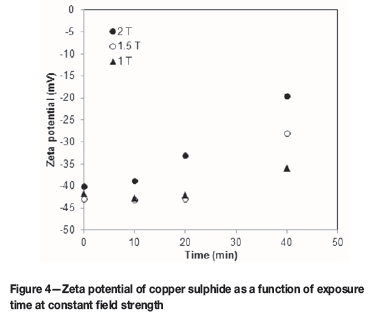
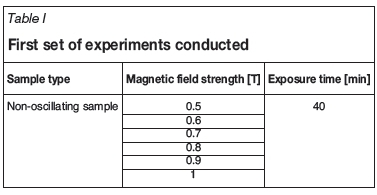
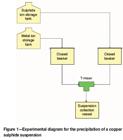
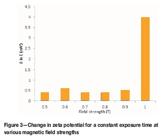
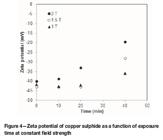
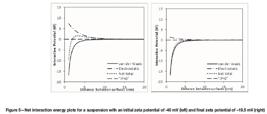
Gravitational sedimentation of suspensions in various precipitation processes is hindered by colloidal stability. This is due to the high surface charge of the suspension and results in strong attraction/interaction between the ions on the particle surface and counter-ions in solution. Moreover, this strong interaction results in a charge build-up that renders the suspension stable. In order to induce gravitational sedimentation of these particles, a redistribution of ions close to the particle surface is required. We therefore sought to redistribute ions close to the particle surface by applying a magnetic field. This results in the reduction of interparticle electrostatic repulsive forces and a subsequent increase in the zeta potential of a suspension. For the purpose of this study, a copper sulphide suspension was used. Copper sulphide particles were exposed to a range of field strengths for set exposure times and their zeta potential was measured before and after exposure. All particles had an initial zeta potential value equal to or less than -40 mV prior to magnetic field exposure. A significant increase in zeta potential was observed, with values reaching a maximum of -16.5 mV when exposed to a 2 T field strength for 40 minutes. This is due to Lorentz ion shifts resulting from the Lorentz force exerted by the magnetic field on the particle surface.
precipitation; sedimentation; copper sulphide; zeta potential; colloidal stability; electric double layer; charge destabilization
 Thumbnail
 Thumbnail
 Thumbnail
 Thumbnail