Analysis of pressure drop and hold-up during vertical transport of limestone slurry in lean phase and heterogeneous regime
Abstract
The aim of this paper is to study the characteristics of limestone particles (size varies from 4 mm to 20 mm) during its transportation from open cast mines through pipes. The influence of four different size fractions of limestone samples (4-6 mm, 6-10 mm, 10-15 mm, and 15-20 mm) on pipe flow characteristics during vertical transport in a 100 mm NB hose pipe was investigated. The flow velocities in the vertically lifting pipe was varied from 0.95 m/s to 2.78 m/s and a rotary feeder of 2 to 4 tonne/hr. capacity was employed to feed the limestone samples to the lifting pipe. The pressure drop data for the different size fractions of limestone samples at different mixture velocities were analysed. The effect of input volume fraction and superficial velocity of limestone samples on hold-up ratio were discussed. It was indicated that there was no substantial increase in pressure drop of slurry samples in the studied range of concentrations (Cw = 4.22% - 12.54%), particle size, and low to medium range mixture velocities with respect to water run head loss data. The hold-up for the larger size fractions (15-20 mm) of limestone samples was found to be significant as compared to smaller size fractions, which may be due to terminal settling velocities of individual fractions of the studied samples.
limestone; vertical transport; hold-up; pressure drop; heterogeneous regime
Introduction
The vertical flow of solid-liquid mixtures in pipelines finds applications mostly in mining industries. This provides a potentially cost-effective way of transporting crushed ore from opencast or underground mines to the surface. Extensive studies have been carried out to evaluate the pressure drop and other important operational parameters for designing of slurry pipeline systems, though very limited investigations have been carried out on the flow characteristics of solid-liquid mixtures in vertical pipes. Newitt et al. (1961) investigated the influence of particle size, density, size distribution, pipe diameter, slurry concentration, and velocity on the hydraulic gradient of sand-water mixtures and indicated the negligible influence of larger particles on the pressure drop during vertical transport of mixture slurry. The economic benefits of integrating the mine dewatering and hydraulic transport of solids in vertical pipes as an efficient way of using the groundwater have been investigated by Sellgren (1985). The effect of viscosity on the pipe flow behaviour of solid-liquid mixtures in a vertical pipe was studied by Tokanai et al. (2004). The contribution of both Bagnold force due to collision at the pipe wall, and liquid lifting force in the near-wall zone mainly, influencing the frictional pressure drop was explained by Matousek (2009), while conducting experimental studies on vertical transport of sand-water slurry. Using radiometric method, the phase velocities of artificial nodules and carrier fluid were measured during vertical flow of the mixture, and the interfacial slip for a particle of specific diameter was found to be of the same order as the free settling velocity of the particle (Sobota et al., 2013). A comparative evaluation of frictional pressure drop during horizontal and vertical transport of graded basalt pebbles water mixture in a 100 mm diameter steel pipe was carried out by Vlasak et al. (2014). It has been observed that the frictional pressure drop in vertical pipe were found to be less than in the horizontal pipe and the influence of larger particles on the frictional pressure drops for vertical transport of the mixture slurry could not be confirmed. Some studies on hydraulic lifting of manganese nodules have been reported in the literature (Xia et al., 2004; Park et al., 2004; Yoon et al., 2009; Chung, 2009; Song et al., 2017).
Most of the literature on solid-liquid flow are devoted to vertical transport of sand-sized particles in narrow sized pipes. Further, very limited studies have been conducted on vertical slurry transport of large-sized particles (> 4 mm size and above). Keeping in view the various aforementioned observations made on the subject, an attempt has been made in this paper to evaluate the pressure drop of large-sized limestone particles in a 100 mm NB hose pipe and the effect of solids concentration, mixture velocity, and the hold-up in vertical flow regime has been analysed.
Experimental procedure
Characterisation studies
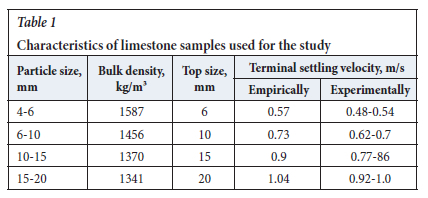
The crushed limestone ore samples for the studies were obtained from Lanjiburna mines, M/s Dalmia Cement Pvt. Ltd, Odisha. The material density of the samples were determined using calibrated standard specific gravity bottles and were found to be 2806 kg/m3. The chemical analysis of the bulk limestone samples was carried out by Philips PW2440-X-ray spectrometer manufactured by PANanalytical, Netherland and the composition of major elements present was CaO: 37.2%, MgO: 10.9%, SiO2: 6.85%, Al2O3: 2.5%, K2O: 0.9%, and Fe2O3: 0.97%. Limestone samples in four distinct narrow size ranges of 4-6 mm, 6-10 mm, 10-15, mm, and 15-20 mm were prepared in the laboratory by using standard sieves for the experimental studies and are shown in Figure 1. Table 1, presents the characteristics of these four graded limestone particles.

Description of the vertical pipe loop
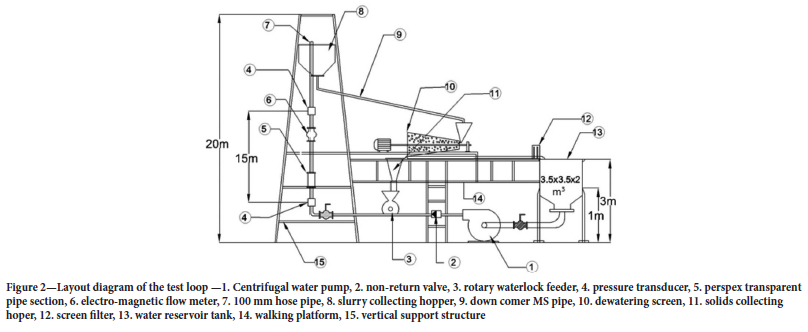
The experimental pipe loop test set-up facility at the CSlR-Institute of Minerals and Materials Technology, Bhubaneswar, consists of a flexible hose pipe of 100 mm nominal bore with 20 m vertical height. The layout of the test loop is shown in Figure 2. A high pressure centrifugal clean water pump (Model: CW50200, Make: Crompton Greaves Ltd.) of 60 m3/hr flow capacity and comprising a discharge pressure of 6 kg/cm2 was installed in the test loop to push the solid particles discharged from the rotary waterlock feeder for conveying through the pipe. The water flow rate is controlled by a variable frequency drive connected to the drive motor. A water reservoir tank of 30 m3 capacity feeds water to the centrifugal pump. The solid water mixture, after flowing through the vertical section of the pipe, gets discharged into a slurry collecting hopper.
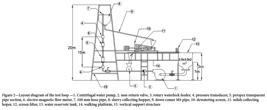
The solids are then separated from the water in a dewatering screen after the mixture is passed through a downcomer MS pipe. The solids and water are separately collected in a solids collecting hopper and water reservoir tank, respectively. The water collected in the reservoir tank can be further used to feed water to the water pump. In order to measure the delivered concentration of the mixture slurry, the sampling of the slurry can be carried out in a measuring bucket manually at the discharge point of the vertical pipe. An electromagnetic slurry flow meter (Krone Make, Model: OPTIFLUX 2000 DN 100) with an indicator was fixed to the vertical section of the pipe to measure the slurry flow rate. The flow meter can measure the slurry flow rates in the range of 0-125 m3/hr., with measuring accuracy of ± 0.3% mv with an IFC 100 converter and repeatability of ± 0.1 mv. The pressure drop in the vertical section of the pipe can be measured by pressure transducers (Jumo Make, Model: Jumo dTrans p30 404366) with a MASIBUS make indicator (0-6 bar), and the pressure tapping points, which are located 15 m apart. The pressure transducers can measure the pressure drop with an accuracy of 0.5%.
Pipe loop test studies
The experimental investigation on vertical slurry transport of limestone water mixture samples in a 100 mm NB flexible hose pipe was carried out using the aforementioned vertical test set up. The test rig is quite suitable for studying the effect of mixture velocity and concentration on pressure drop and mixture flow behaviour in vertical sections, as shown in Figure 2. Prior to conducting the pipeline studies with limestone water mixture, a water run test was conducted in the 100 mm NB flexible hose pipe (internal dia:102 mm) to determine the friction factor of the hose pipe and to ensure the satisfactory operation of the test rig and the experimental accuracy. The water run test data obtained for the 100 mm NB hose pipe were compared with the theoretical predictions using the Colebrook-White equation to validate the system. The limestone samples were introduced into the water flow system on the discharge side of the pump (1) by means of a specially designed watertight rotary waterlock feeder (3) with a 2-4 ton/hr. feeding capacity. The flow rate of both water and limestone samples were varied by variable frequency drives coupled to both the water pump and rotary waterlock feeder.
The slurry flow rate and pressure drop data for the four distinct limestone samples in solids with a concentration range of 4.22% to 12.54% by mass were collected in an AMBETRONICS make 8 channel data logger (Model No. TC 800D) by smart log software version 2.0-8. The mixture velocity, Vm of limestone water mixture slurry at varying slurry flow rates were then computed to be in the range of 0.85 to 3.21 m/s for the four different size fractions of the limestone samples. The settling velocities of the four distinct limestone fractions with top sizes of 6 mm, 10 mm, 15 mm, and 20 mm were ascertained by visual observations through the transparent Perspex piping sections (5) fixed to the flexible vertical hose pipe by adjusting the water flow rate to maintain the stones suspended in the Perspex section. The delivered concentration, 0sd of limestone water mixture was determined by collecting the limestone particles and water separately for a specific period of time using a stop watch at the dewatering screening point, and was calculated by taking the ratio of volume of solids delivered at the discharge point of pipe to the total volume of mixture delivered. The volume fraction of solids was determined from the ratio of volume of solids delivered at the discharge point of pipe to the total volume of mixture delivered.
Results and discussions
Pressure drop during vertical transport
In the case of vertical upward hydraulic transport of large particles (> 1 mm), dispersed regimes are encountered and the total pressure drop is the cumulative effects of hydrostatic weight due to the mixture column and the frictional forces due to the wall-fluid interactions. The frictional pressure drop, Hf of a two-phase solid liquid mixture can be expressed by the following equation:

Where, ΔΡ is the pressure drop measured from the tapping points of the differential mercury manometer attached to the upper and lower part of the vertical pipe, L is the distance between the tapping points, g is the acceleration due to gravity, Øst is the insitu transport volume fraction of solids, ps and pl are the density of solid and liquid, respectively. The density of the mixture slurry pm can be determined by the following expression:

The concentration of limestone mixture slurry by mass, being CW, was calculated by using Equation 3:

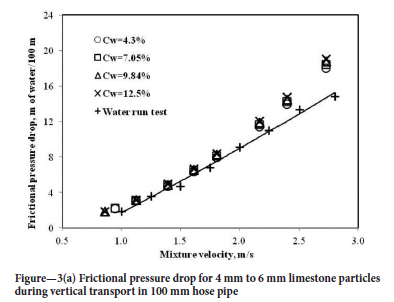
Thus, the pressure drop velocity curve for the limestone water mixture slurry for the two narrow size fractions (4-6 mm and 15-20 mm) of particles in solids concentration (range of 4.22% to 12.52% by mass), are plotted in Figure 3, after having removed the hydrostatic weight of the vertical column. The studied range of mixture velocities for the 4-6 mm and 15-20 mm sized particles were 0.86 m/s to 2.73 m/s and 0.98 m/s to 2.78 m/s, respectively.
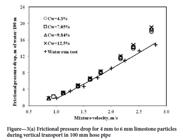
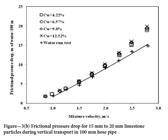
It is observed from the plots in Figures 3(a) and (b), that the frictional pressure drop for the two sized limestone particles increased with an increase in both solids concentration and mixture velocity. The difference in the frictional pressure drop data of both water and the limestone water mixture samples was found to be negligible at lower to medium range of mixture velocities. This may be due to the movement of the limestone particles from the pipe wall region to the core of the piping section, and the frictional pressure drop encountered mainly by pipe wall liquid friction and major contribution of particle wall friction during upward transport (Vlasak et al., 2014). Beyond a mixture velocity of 2 m/s, the difference between the water run and limestone water mixture slurry indicated a marked difference in the frictional pressure drop, which may be attributed to migration of some limestone particles to the pipe wall due to collisions among themselves and, as a result, the cumulative effect of particle wall friction and drag due to particle liquid slip increased.
Hold-up and slip during vertical transport
In a heterogeneous suspension, there is a tendency for the liquid phase to slip past the solids and there tends to be a 'hold-up' of solids. The existence of a velocity profile and concentration profile across the cross section of the pipe in addition to the local relative velocity between phases by gravitational effects influences the hold-up during vertical conveying of particles. The relationship between the average slip velocity Vslip, and the hold-up ratio H, for the limestone water mixture slurry was determined by using the following relationship (Govier, Aziz, 1972):

Where, Vsl and Vss are the liquid and solid phase velocities in the vertical piping section and can be computed as:
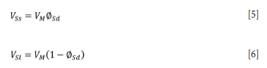
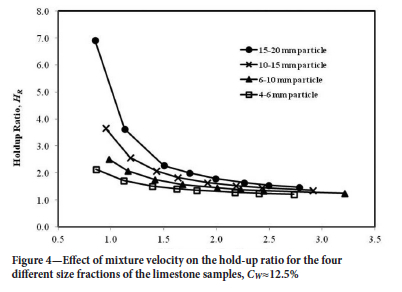
The plot of the holdup ratio HR, for the four different size fractions of limestone samples, is plotted against the mixture velocity Vm for the limestone water mixture slurry at a solid concentration of ~12.5% by mass and is presented in Figure 4.
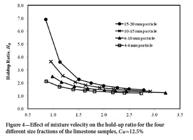
From Figure 4, it is observed that the hold-up ratio for the larger size fractions (15-20 mm) of limestone samples exhibiting terminal velocity in the range of 0.92 m/s to 1.0 m/s was found to be significantly higher, as compared to the other three smaller size fractions. It can be seen from Table 1, that the terminal settling velocity of 15-20 mm size fraction limestone samples is almost double that of 4-6 mm size fractions. Thus, it is expected that the large particles with higher terminal velocities will have a significant effect on the hold-up ratio. Further, with decreasing mixture velocities, the limestone water mixture flows as a heterogeneous suspension, and there is a tendency for the fluid phase, i.e., water to slip past the limestone particles in the mixture and hence, the predominance of hold-up persists. As the limestone mixture velocity increases and approaches the fluid velocity, the hold-up ratio tends toward unity for all the four size fractions of limestone samples, as observed in Figure 4.
During upward transport of limestone water mixture, the solid and liquid water move at different velocities in the vertical pipe. The different particle fractions of the solid phase move at different velocities. By using the following correlation of Shook and Roco (1991), the slip velocities for the four different limestone particle sizes were computed:

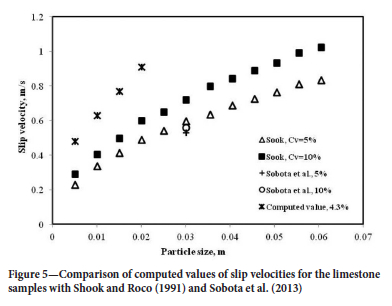
Where, Vo is the terminal settling velocity of particle, Øst is the transport volumetric concentration of limestone water mixture, and the exponent n is dependent on Reynolds number of the solid particle. The plot of slip velocity as a function of particle diameter for the four different limestone particle sizes at a mixture concentration of 4.3 vol% is presented in Figure 5.
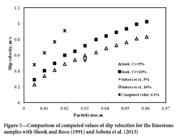
It is observed from Figure 5 that the computed values of slip velocities for the limestone particles indicated higher values as compared to those of Shook and Roco (1991), and Sobota et al. (2013). The slip velocities determined for the four different size fractions of limestone samples with top sizes of 5 mm, 10 mm, 15 mm, and 20 mm at a volumetric concentration of 4.3% were 0.48 m/s, 0.63 m/s, 0.77 m/s, and 0.91 m/s, respectively. The discrepancy in obtaining higher values of slip velocities may be attributed to the solid density and particle shape of limestone samples. Besides, the evidence of reduced drag coefficients in turbulent flow conditions might have led to higher slip for the limestone samples.
Conclusion
The investigation on vertical transport of limestone water mixture slurry in a 100 m NB hose pipe indicated the following:
> The frictional pressure drop for the limestone samples with varying particle size fractions increased with an increase in both solids concentration and mixture velocity, and the assumption about the almost negligible influence of large particles could not be ascertained. Under moderate to high mixture velocities, the particles may migrate to the pipe wall, contributing extra frictional pressure drops in addition to pipe wall liquid friction.
> The predominance of hold-up at lower mixture velocities persists during vertical upward transport of limestone water mixture slurry and the larger size fractions (15-20 mm) of limestone samples with higher terminal settling velocities indicated higher hold-up ratios.
> The correlation of Shook and Roco (1991) was employed to determine the slip velocities for the four different limestone particle sizes, and the discrepancy, in agreement with Sobota et al. (2013), was attributed to material density and shape of limestone samples. Further systematic investigation in this aspect may be carried out to measure the phase velocities precisely for determining the slip velocity accurately with even larger size particles at higher solids concentration in turbulent regime during ascending flow of solid liquid mixture.
Acknowledgement
The authors are thankful to the Director, CSIR-Institute of Minerals and Materials Technology, Bhubaneswar, India, for giving permission to publish the paper, and indebted to CSIR, New Delhi for supporting the investigation.
References
- Chung, J.S. 2009. Deep Ocean Mining Technology-III: Developments. Proceedings of the 8th ISOPE Ocean Mining Symposium, Chennai, India, September 20-24, 2009. pp.1-7.
- Govier, G.W., Aziz., K. 1972. The flow of complex mixtures in pipes. Van Nostrand Reinhold Co., New York.
-
Matousek, V. 2009. Pipe wall friction in vertical sand- slurry flows. Particulate Science and Technology, vol. 27, no. 5, pp. 456-468. https://doi.org/10.1080/02726350903133179
» https://doi.org/10.1080/02726350903133179 - Newitt, D.M., Richardson, J.F., Gliddon, B.J. 1961. Hydraulic Conveying of Solids in Vertical Pipes. Transactions Institute of Chemical Engineers , vol. 39, pp. 93-100.
-
Park, Y.C., Yoon, C.H., Lee, D.K., Kwon, S.K. 2004. Experimental studies on Hydraulic lifting of solid-Liquid Two-phase flow. Ocean and Polar Research Article, vol. 26, no. 4, pp. 647-653. https://doi.org/10.4217/OPR.2004.26.4.647
» https://doi.org/10.4217/OPR.2004.26.4.647 - Sellgren, A. Mine Water-A resource for transportation of ores from underground mines. In the Proceedings of 2nd International Mine Water Association Congress, Granada 1985, vol. 2, pp. 1027-1037.
- Shook, C. A., Roco, M. 1991. Slurry flow principles and practice, Butterworth-Heinemann Series in Chemical Engineering.
- Sobota, J., Petryka, L, Vlasak, P., Zych, M. 2013. Slip velocities in mixture vertical pipe flow. Proceedings of the 10th ISOPE Ocean Mining and Gas Hydrates Symposium, Poland, September 22-26, 2013.
-
Song, Y., Zhu, X., Sun, Z., Tang, D., 2017. Experimental investigation of particle induced pressure loss in solid-liquid lifting pipe. Journal Cent. South University, vol. 24, pp. 2114-2120. 10.1007/s11771-017-3620-8.
» https://doi.org/10.1007/s11771-017-3620-8 -
Tokanai, H., Harada, E., Hasegawa, J., Kuriyama, M. 2004. Turbulent Transition and pressure drop in solid-high viscosity upward flow through vertical pipe. Chemical Engineering, vol. 30, no. 4, pp. 509-514. https://doi.org/10.3390/en14123485
» https://doi.org/10.3390/en14123485 -
Vlasak, P., Chara, Z., Krupicka, J., Konfrst, J. 2014. Experimental investigation of course particle-water mixture flow in horizontal and inclined pipes. Journal of Hydrology Hydromech, 62(3), pp. 241-247. DOI: 10.2478/iohh-2014-0022
» https://doi.org/10.2478/iohh-2014-0022 -
Xia, J.X., Ni, J.R., Mendoza, C. 2004. Hydraulic Lifting of Manganese Nodules Through a Riser. Article in Journal of Off-shore Mechanics and Arctic Engineering, vol. 126, no. 1, pp. 72-77. DOI: 10.1115/1.1641385
» https://doi.org/10.1115/1.1641385 - Yoon, C.H., Park, Y.C., Park, J., Kim, Y.S., Kang, J.S., Kown, S.K. 2009. Solid-Liquid Flow Experiment with Real and Artificial Manganese Nodules in Flexible Hoses. International Journal of Offshore and Polar Engineering, vol. 19, no. 1, pp. 77-79.
Revised: 22 Mar. 2024
Accepted: 18 Nov. 2024
Published: March 2025