Exploring differences in various Nb(V)- and Ta(V) tropolonato complexes by a solid-state structural comparison study
Abstract
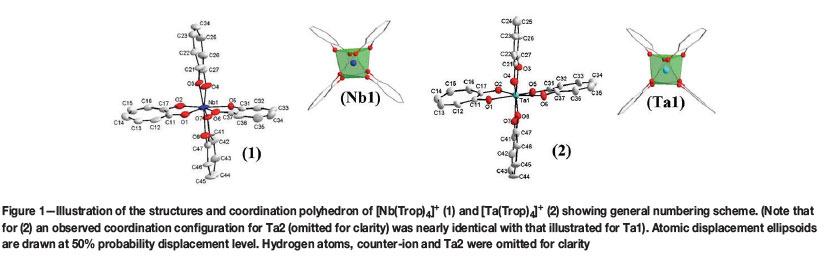
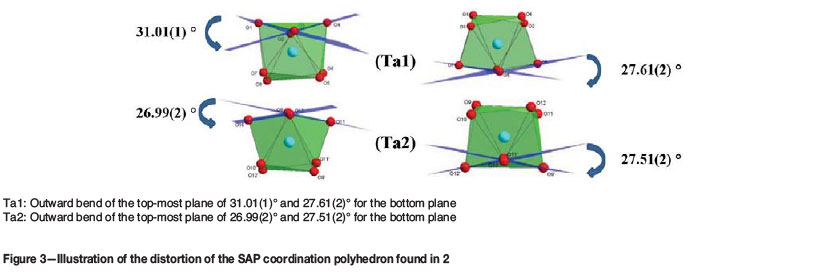
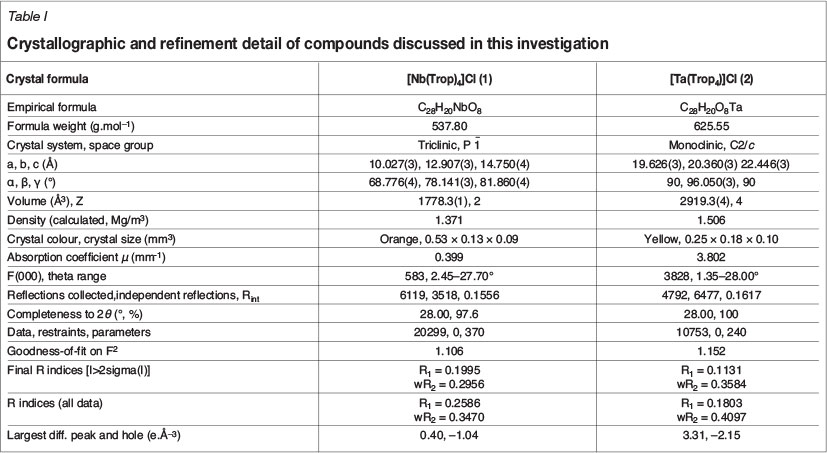
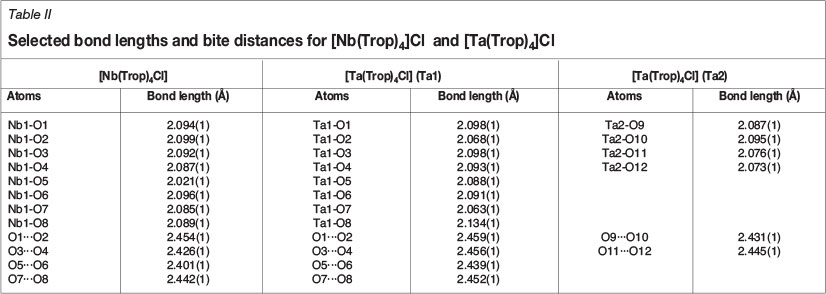
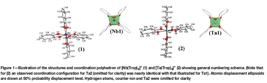
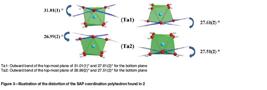
An in-depth crystallographic comparison of the crystal structures of tetrakis(tropolonato-;k2O,O')niobium(V) chloride ([Nb(Trop)4]Cl) and tetrakis(tropolonato-k2O,O')tantalum(V) chloride ([Ta(Trop)4]cl) was undertaken in an attempt to relate differences in complex stability previously noted in solution with solid-state characteristics such as coordination geometry, ligand bite angles and bond lengths. Significant differences of these parameters for the complexes of the two metal centres could translate to an ideal starting point for improved separation of tantalum and niobium. It was noted that the less stable Nb(V) compound, experiences a higher average degree of strain (71.39(2)°) within the bidentate chelate rings vs. the Ta(V) analogue (72.04(2)°). When considering the higher degree of strain, the Nb(V) complex more readily offers up one of its tropolone ligands to yield the more stable [NbO(Trop)3]. The [Ta(Trop)4]+ cation also exhibits a more distorted square antiprismatic geometry than [Nb(Trop)4]+. This coordination geometry is quite distorted and could be a reason that [Ta(Trop)4]+ is inclined towards an energetically favourable dodecahedral geometry, contributing to a more stable conformation.
tropolone; stability; geometry; tantalum; niobium
 Thumbnail
 Thumbnail
 Thumbnail