Review of gold reef sampling and its impact on the mine call factor
Abstract
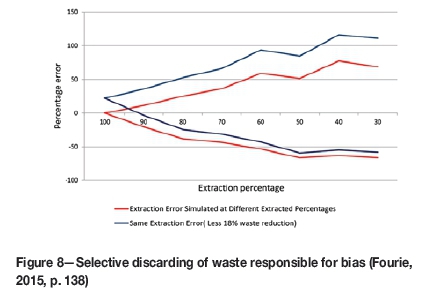
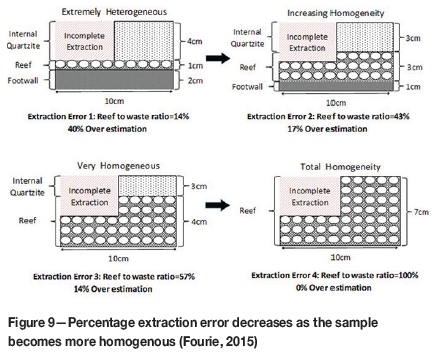
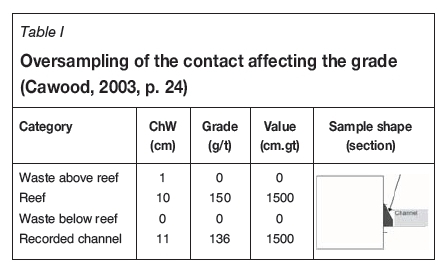
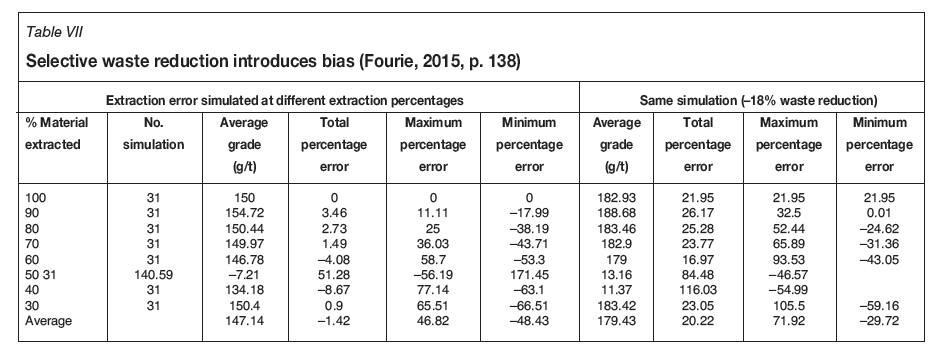
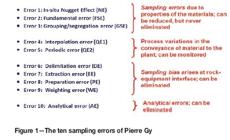
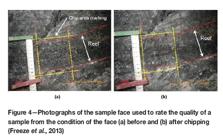
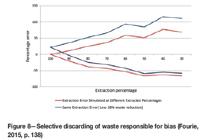
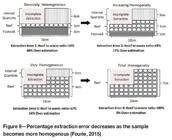
Sampling error and bias, especially the Increment Preparation Error (IPE), are introduced when the tool allocated to do the job fails to extract a representative sample. This is the case with chip sampling; the tool can only extract haphazard shapes of loose or fractured material and not always from within the demarcated sample area. Increment Extraction Error (IEE) and Increment Delimitation Error (IDE) could be severe, but are found to be relatively unbiased. The uncontrolled action of the sampler in discarding excess sample material after sample collection has a significant impact on the error and bias introduced with each and every extraction. A new type of bias, referred to as the 'waste discard bias', arises when samplers select what portion of the excess sample material to discard at the sample site. Material visually identified as waste is discarded in preference to mineralized broken ore if there is an excess of sample material. This results in a considerable error in the analytical results. The bias is proportional to the reef-waste ratio in the demarcated sample.
sampling; error; bias; mine call factor
 Thumbnail
 Thumbnail
 Thumbnail
 Thumbnail
 Thumbnail
 Thumbnail
 Thumbnail
 Thumbnail
 Thumbnail