Prediction and measurement of blast induced rock fragmentation - A case study of Kajiado County quarries, Kenya
Abstract
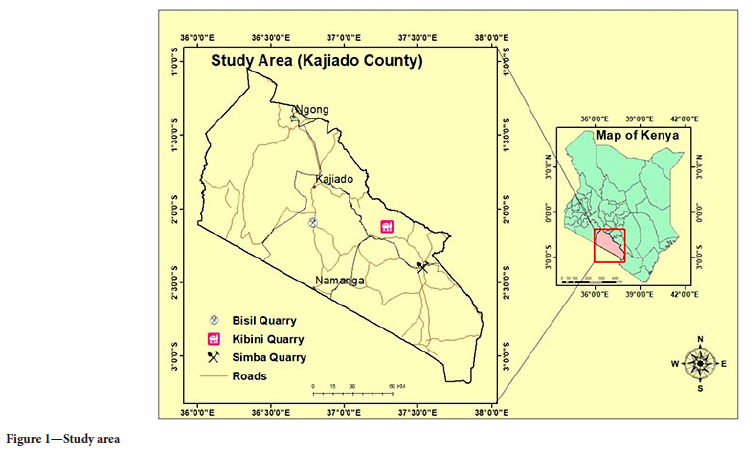
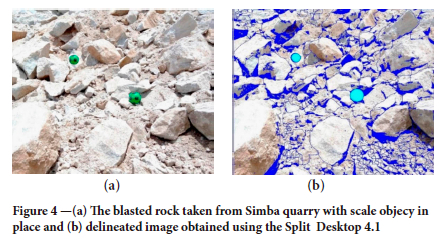
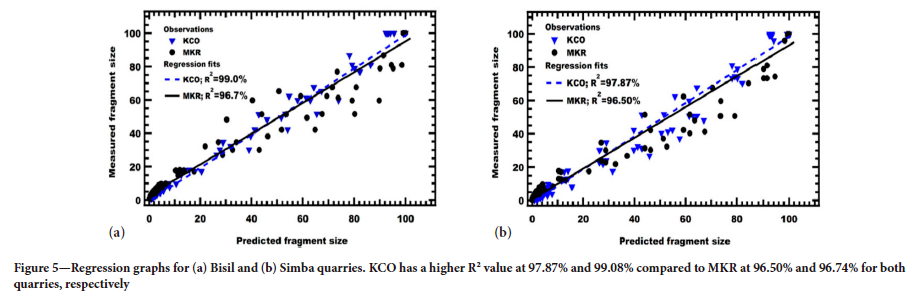
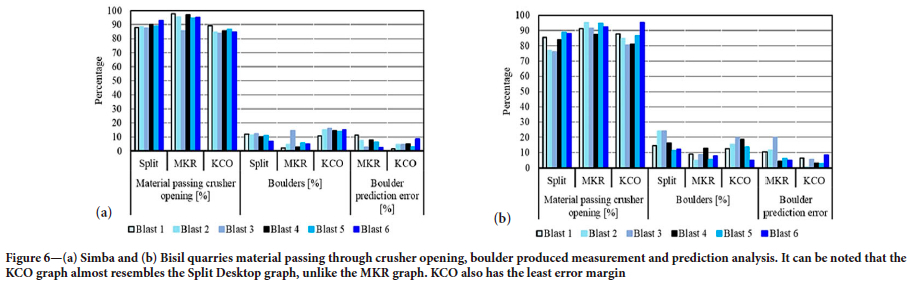
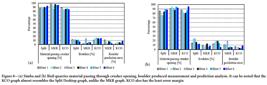
Driven by the necessity to improve blast performance regarding fragment size distribution in limestone mines, this paper introduces the prediction and measurement of blast fragmentation distribution through the modified Kuz-Ram (MKR) and Kuznetsov-Cunningham-Ouchterlony (KCO) models. Precise prediction and measurement of rock fragmentation resulting from blasting play a critical role in hard rock ore extraction. This is due to the substantial influence of post-blast ore size distribution on the efficiency of all subsequent downstream rock handling and processing operations. Additionally, employing secondary breakage of boulders, when necessary, leads to an unjustified rise in production costs. In this paper, the MKR and KCO models were utilised to identify the most appropriate model for application in Bisil and Simba quarries situated in Kajiado County, Kenya. Split-Desktop was used for blast fragment measurement by processing digital images obtained after blasting and computing the fragment size distribution of the blasted rock. As per the investigation, the recorded percentages of boulders generated at the sites ranged from 7% to 12.3% for the Simba quarry and from 11.2% to 23.9% for the Bisil quarry, respectively. Regression, correlation, and root mean square error (RMSE) were employed as the primary performance indicators. The study concluded that KCO outperformed MKR in accurately predicting blast fragment sizes in the examined quarries.
blasting; rock fragmentation; fragmentation model; split-desktop; particle size distribution
 Thumbnail
 Thumbnail
 Thumbnail
 Thumbnail
 Thumbnail
 Thumbnail