Investigation of the effect of mechanical, drillability, abrasiveness, and excavatability properties of Zonguldak Basin coal surrounding rocks on grindability
Abstract
For the more economical excavation of tunnels in underground mining activities, the selection of mechanised excavation machines (such as roadheaders, electro-hydraulic drills, etc.) and the analysis of performance prediction that can be used in estimating machine energy consumption have been subjects of research from past to present. One of the parameters to be considered in studies examining these methods, is the grinding process. The success of increasing efficiency in grinding is expressed by a reduction in energy consumption. The goal of a grinding process is to maximise the grinding amount at the appropriate grinding size while minimising the energy consumption per tonne of the fragmented material. Today, the depletion of high-grade ore deposits has largely directed the mining industry towards low-grade but large reserve ore deposits. This shift has particularly increased the importance of the grinding process, as it is dependent on particle liberation. Grinding is a critical step in reducing the mineral to the appropriate size, and energy consumption poses a significant challenge in this process. As a result, researchers have conducted various studies focusing on energy efficiency and cost optimisation in this field. In this study, the grindability of 7 different coal environment rocks (sandstone, siltstone) from the Zonguldak Basin, Uzulmez Region was investigated. For this, Hardgrove Grindability Index and Bond Work Index tests were conducted. While determining the relationships between grindability and other parameters, the results obtained from the Hardgrove Grindability Index (HGI) test were used. The energy values found in the Bond Work Index (BWI) test were used to evaluate the excavatability of the rocks. Additionally, tests for strength, hardness, drillability, and abrasiveness were conducted to observe the impact of other parameters on grindability. Considering the results obtained from the experiments, significant relationships were found between the grindability of the rocks and other parameters.
Hardgrove Grindability Index; Bond Work Index; Zonguldak Basin; drillability; abrasiveness; excavatability
Introduction
In recent years, the rapid depletion of easily extractable ores that could be economically produced using open-pit mining methods has directed the mining industry toward underground mining methods. In operations where high-cost underground mining methods are used, excavation activities during both the tunneling phase to access the ore and the processing phase of the extracted ore constitute a significant portion of the project costs. These costs include both the equipment and labour expenses related to excavation processes and the technological infrastructure and safety measures required for these operations. This contributes to a better understanding of the economic and technical challenges of the mining sector.
In mining operations, crushing, and particularly grinding processes in the ore preparation stage, are often the most expensive factors. Only a very small percentage (0.1% - 2%) of the energy spent in the size reduction process is used efficiently; a large portion is lost as friction, noise, and heat by the crushing and grinding equipment (Ozdag, 1992). Approximately half of the energy used in ore preparation plants is consumed in grinding processes (Yildiz, 1999).
The majority of studies in the literature to date have focused on the grindability of coal. In recent years, grindability indices have also begun to be applied to other types of rocks. However, no study has been conducted on the grindability of coal-surrounding rocks in this context. The difference of this study from similar ones is that it aims to demonstrate that grindability is also applicable to coal-surrounding rocks and to reveal the effects of other parameters on the grindability of these rocks.
Ozkahraman (2005), identified very high correlation coefficients between the rock fragility (S20), a key parameter of the drillability index (DRI) test commonly used for determining rock drillability, and Bond grindability parameters (BWI and Gbg).
Ozer and Cabuk (2007), in their study using four different limestone and two different chromite samples, investigated the relationships between Bond Work Index (BWI) and rock parameters. Based on the results obtained by determining the Bond Work Index and mechanical strength values of the samples, they stated that Shore hardness, point load index, and uniaxial compressive strength values provided the strongest relationships with the Bond Work Index.
Aras et al., (2020) used rock properties such as Schmidt hardness, uniaxial compressive strength, indirect tensile strength, point load strength index, ultrasonic velocity, and density in artificial neural networks to predict Bond Work Index (BWI) values.
In recent years, some researchers have utilised the Hardgrove Grindability Index (HGI) test as a simple and practical alternative for determining rock grindability and Bond parameters. Bond (1954; 1961) examined the relationships between HGI and Bond in his studies on coals. Hease et al. (1975) and McIntyre and Plitt (1980), separately adapted Bond's approach, developed for coal, to limestone and other brittle materials. A similar model was proposed for bauxite types by Csoke et al. (2004). Hower et al. (1992) demonstrated the relationship between HGI and Bond for carbonate-origin rocks.
Musci et al. (2008) explored relatively fast alternative methods for determining Bond Work Index using a universal Hardgrove mill for brittle materials. The HGI test method, while widely used for analysing the grindability of coal samples, has also gained importance in recent years as a practical and easily applicable method for determining the grindability of rock samples (Swain, Rao 2009; Abdelhaffez, 2012).
Swain and Rao (2009), in their study on rocks, found a very strong linear relationship (R2 = 0.99) between the Bond Work Index (BWI) values they calculated using HGI values and the BWI values obtained from experimental studies. These researchers demonstrated that the grindability of rocks can be easily determined using.
HGI, a practical test method. Especially when reviewing the studies conducted, it can be seen that the HGI test method has become increasingly important and offers ease of application in determining rock grindability.
Sakiz (2021a), in his study on 14 different rock samples, demonstrated that the drillability index (DRI) parameter could be practically predicted using the HGI property of the rock. However, he emphasised that the number of rocks studied should be increased, and rocks should also be evaluated based on their origin to propose a more reliable classification suggestion and prediction model. Additionally, he underlined the need to examine the precision of intervals for grindability classification.
Sakiz (2021b), in his study on seven different andesite rocks, examined the relationship between abrasiveness and grindability and found that the rock's wear characteristics could be easily determined using the Hardgrove Grindability Index (HGI) when considering three widely used wear test methods (Cerchar, Norwegian, Schizamek). However, he stated that the predictive models developed to determine rock abrasiveness based on the Hardgrove Grindability Index were limited by the wear value ranges of the rocks examined. He emphasised that to develop more reliable predictive models, the number of rocks studied should be increased, and different rock origins should be considered.
Data and methods
This study focuses on determining the factors affecting the grindability of coal surrounding rocks in the Zonguldak Basin, which is a subject of significant importance in the fields of rock mechanics and excavation efficiency. To assess grindability, the Hardgrove Grindability Index (HGI) test was applied as the primary experimental method. Additionally, although the Bond Work Index (BWI) test is conventionally used to evaluate grindability, it was employed in this study to assess rock excavatability, due to its ability to express energy consumption in units of kWh/t. This quantitative energy value allows for interpretation in terms of specific energy requirements during excavation. From a mechanical perspective, uniaxial compressive strength (UCS), Brazilian tensile strength (BTS), and the Equotip hardness index were conducted to evaluate the strength and hardness characteristics of the rocks. Moreover, the Drilling Rate Index (DRI) and Cerchar Abrasivity Index (CAI) were included, as they are essential indicators for determining excavation efficiency. By combining these parameters under the local geological conditions of the Zonguldak Basin and establishing correlations through statistical analysis, the study presents a comprehensive and original approach to evaluating the interrelationship between grindability and excavation-related properties. This multidisciplinary methodology aims to address the interconnectedness of mechanical behaviour, energy consumption, and rock-tool interaction, contributing a novel perspective to the literature.
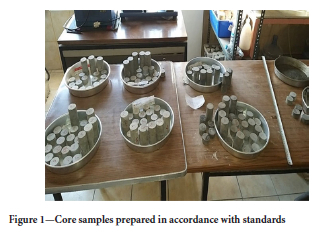
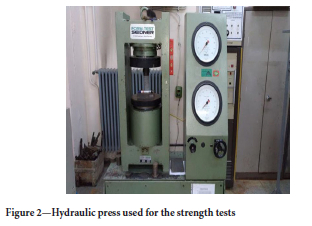
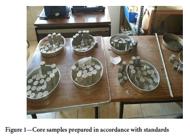
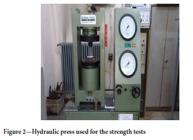
Experiments were conducted on 7 different sedimentary-origin sandstone and siltstone rocks collected from the Zonguldak Basin, Uzulmez Region. The samples, prepared according to the appropriate standards, are shown in Figure 1. First, the densities (d) of the rocks were determined. The strength values of the rocks were determined through uniaxial compressive strength (UCS) and Brazilian tensile strength (BTS) tests. The method proposed by ISRM (1981) was followed for the uniaxial compressive strength (UCS) test, while the method suggested by ISRM (1978), was used for the Brazilian tensile strength (BTS) test. The hydraulic press used in the experiments is shown in Figure 2.
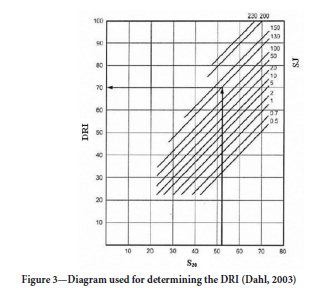
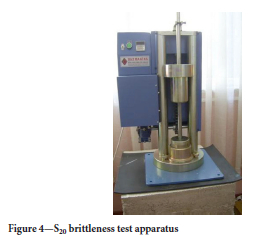
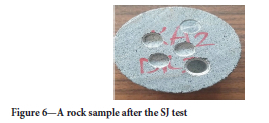
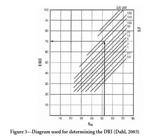
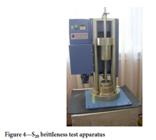
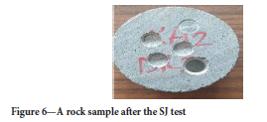
The drillability of the rocks was determined using S20 brittleness and SJ miniature drilling tests, and the drilling rate indices (DRI) were calculated using the chart shown in Figure 3. The equipment used in the drillability tests is shown in Figures 4 and 5. The appearance of a rock sample after the SJ test is shown in Figure 6.

The Hardgrove Grindability Index (HGI) test was conducted to determine the grindability of the rocks, and the results were compared with the strength, drillability, abrasiveness, and excavatability values of the rocks. The Hardgrove grindability is a measure of the mass of material that passes below 75 microns under a specific feed size and quantity, using a standardised laboratory mill for a specified number of revolutions.
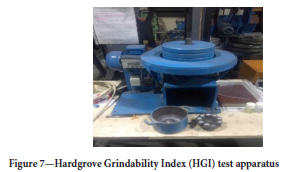
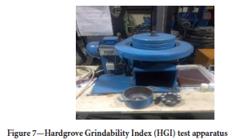
The laboratory mill developed by Hardgrove (1932) features a grinding chamber consisting of a fixed steel container. Inside this chamber are eight rotating steel balls, each with a diameter of 25.4 mm. Additionally, a total load of 29 kg is applied on the grinding ring, and the device rotates at a speed of 20 revolutions per minute for a total of 60 revolutions. The sample used for the test consists of 50 grams of material sized between 1.18 mm and 0.6 mm. After the test, the amount of material that passes below 75 μιη is weighed, and the Hardgrove Index value is obtained from a calibration chart appropriate for the specific material. The Hardgrove Grindability Index is calculated using Equation 1. The Hardgrove mill used in the test is shown in Figure 7.

Here;
HGI: Hardgrove Grindability Index,
D: The amount of rock that passed through the 200 mesh screen.
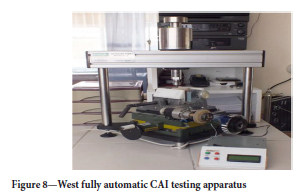
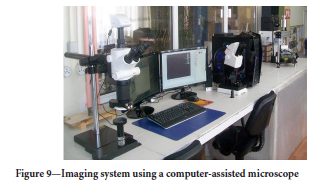
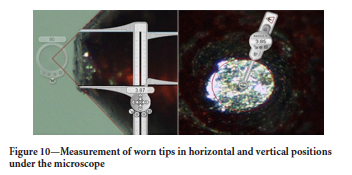
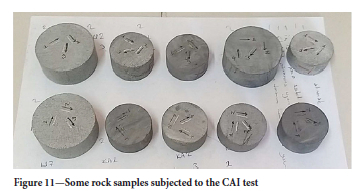
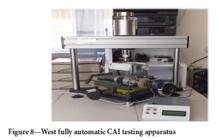
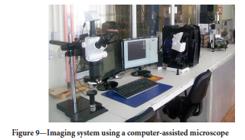
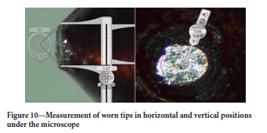
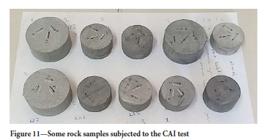
To determine the abrasiveness values of the rocks, Cerchar Abrasiveness Index (CAI) tests were conducted. The method proposed by Alber et al., (2013) was taken into consideration in the experiments. The testing apparatus used in the experiments is shown in Figure 8, the imaging system using a computer-assisted microscope is shown in Figure 9, and the measurements obtained from the imaging system are shown in Figure 10. Additionally, the appearance of the rocks after the experiments is shown in Figure 11.
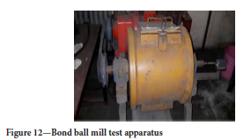
The standard Bond Work Index (BWI) test is a closed-circuit dry grinding and screening process conducted under fully controlled and fixed conditions. This test is performed using a special ball mill known as the Bond mill. The internal dimensions of the mill are 305 mm x 205 mm, it contains no lifters, and all internal corners are rounded. For charging purposes, there is a 102 mm x 204 mm lid on the outer shell. The mill operates at a fixed speed of 70 revolutions per minute (rpm) and is equipped with a revolution counter. The ball charge of the mill consists of 20.125 kg of steel balls (Deniz, 1996).
The test sample is composed of material crushed to a size of -3.36 mm. Approximately 8 kg to 10 kg of this sample is prepared for testing. For convenience, the sample is generally divided into 500 g - 600 g portions, which are practically determined for the work index calculated for 106 μιη particle size. Since the material is relatively fine, dry screening is difficult; therefore, the work index is typically determined for 106 μm. A volume of 700 cm3 of the sample is compacted and used for testing. This volume represents the initial charge in the mill and is maintained throughout the test.
For the initial grinding cycle, the mill is operated to obtain the product passing the test sieve and falling below the target particle size, typically using 100 to 150 revolutions. The material is then sieved, and the coarse fraction (above the test size) is returned to the mill for the second grinding cycle. Simultaneously, the amount of material passing the test size is weighed, and an equivalent amount from the fresh feed is added to the mill, maintaining the 700 cm3 charge. The quantity of material below the test size present in the original feed is subtracted to calculate the net ground material. This value is divided by the number of revolutions during that cycle to obtain the grindability value (Gbg). Based on a circulating load of 250%, this Gbg value is used to determine the required number of revolutions for the next grinding cycle. The cumulative product weight from the batch test equals 1/3.5 (or 28.57%) of the original ore charge.
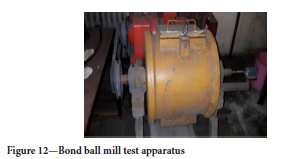
The closed-circuit test procedure typically continues until steady-state conditions are achieved, usually within 6 to 8 grinding cycles. To confirm equilibrium, an additional 3 cycles are conducted, and the average of the grindability values from these last three cycles is taken. Likewise, the products from these last three cycles are combined, mixed, and a sample is taken for sieve analysis. Then, the Bond Work Index value (in kWh/tonne) is calculated using Equation 2. The Bond ball mill is shown in Figure 12.

Here;
BWI: Bond Work Index (kWh/t),
P1: screen aperture of the test (μm),
Gbg: Bond's standard ball mill grindability value (g/dv),
P: screen aperture through which 80% of the final product passes (μm),
F: screen aperture through which 80% of the fed material passes (μm).
Although the Bond Work Index (BWI) test is primarily a method used to determine the grindability of rocks, in this study it has been employed to evaluate the excavatability of rocks. This is because the energy value obtained from the test represents the energy required to grind the rock. During excavation, one of the mechanisms that occurs after the cutting tool penetrates the rock, is grinding, which also consumes energy. From this perspective, it can be understood that the energy value obtained from the BWI test can also be utilised to assess the excavatability of rocks.
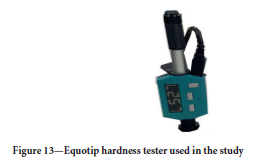
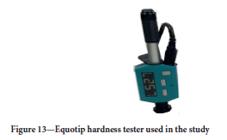
To determine the hardness of the rocks, a highly useful and portable Equotip hardness tester, developed for metals and powered by an electronic battery, is utilised. Depending on the tip width and the applied impact energy, this device is classified into types C, D, DC, DL, E, G, and S. The D type hardness tester, which features a tungsten carbide tip with a diameter of 3 mm and is used to measure the hardness of the rocks in this study, is shown in Figure 13.
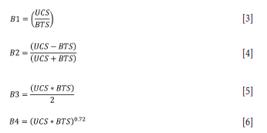
Another important parameter of rock properties is brittleness. Brittleness is one of the key mechanical properties of rocks and also plays a significant role in excavation mechanics. When rocks are examined from the perspective of excavation mechanics, they exhibit two types of excavation profiles: brittle and ductile. Although a precise definition of brittleness has not been established, it can generally be determined through the uniaxial compressive strength and indirect tensile strength of the rocks, and various brittleness criteria have been proposed (Copur et al., 2003). The literature recognises four fundamental brittleness criteria. B1 and B2 were proposed by Hucka and Das (1974). Altindag (2002) introduced the B3 brittleness criterion in his study. Yarali and Soyer (2011) discovered the B4 brittleness criterion through their research. The equations related to these criteria are presented in the following (Equations 3 to 6).
Results and analysis
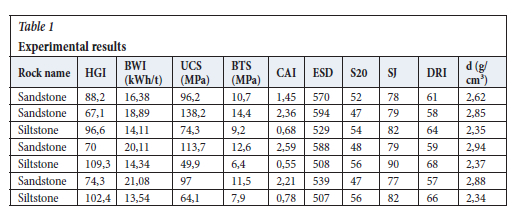
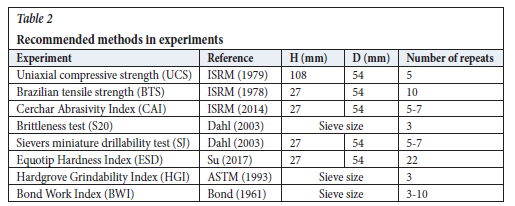
In this experimental study, a database was prepared using the Hardgrove Grindability Index (HGI), Bond Work Index (BWI), Drilling Rate Index (DRI), Cerchar Abrasiveness Index (CAI), Uniaxial Compressive Strength (UCS), Brazilian Tensile Strength (BTS), and Equotip Hardness Index (ESD) tests. The results obtained from the experiments are presented in Table 1. The rocks used in the experiments were obtained from the Uzulmez Region of the Zonguldak Basin. The standards adhered to in the experiments and the recommended methods are shown in Table 2. The relationships between the parameters were determined using simple regression analysis. In examining the relationships between the parameters, the relationships between HGI, as the standard parameter, and the other parameters were considered to be the most significant and are presented below. The interrelationships among the other parameters were not investigated in as much detail as many are infrequently used and are therefore of less relevance in the current case. For this reason, their relationships were not presented graphically, and R2 values were not tabulated.
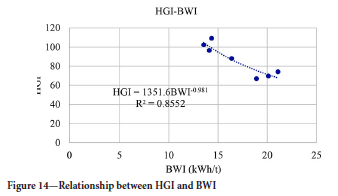
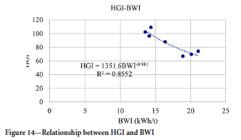
The relationship between the Hardgrove Grindability Index (HGI), which is used to evaluate the grindability of rocks, and the Bond Work Index (BWI), used to assess excavatability, has been examined (Figure 14). Upon reviewing the graph, a high negative exponential relationship between the two parameters was observed. It is understood that the easier it is to grind the rocks, the less energy is required for grinding. Based on this, it can be concluded that the energy values obtained from the Bond Work Index (BWI) tests can be utilised in future studies for evaluating the excavatability of coal-surrounding rocks in the Zonguldak Basin. Similar results have been obtained in previous studies (Bond, 1954; Bond, 1961; Hease et al., 1975; McIntyre, Plitt 1980; Hower et al., 1992; Csoke et al., 2004; Musci et al., 2008; Swain, Rao 2009; Abdelhaffez, 2012).
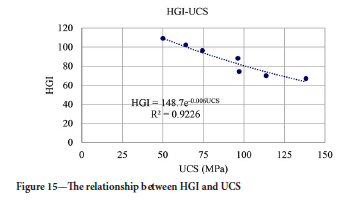
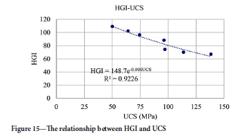
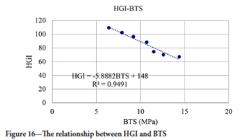
The relationships between rock grindability and strength tests (UCS, BTS) have been examined (Figures 15 and 16). Upon analysing the graphs, a significant relationship was found between the uniaxial compressive strength (UCS) of the rocks and their grindability (HGI). Strong relationships were observed between grindability (HGI) and indirect tensile strength (BTS). The results indicate that, as the strength of the rocks increases, it becomes more difficult to grind the rock. Similar results have been reported in previous studies (Ozer, Cabuk 2007; Aras et al., 2020).
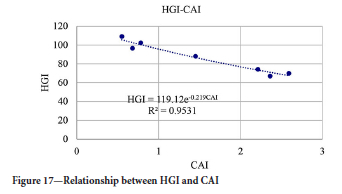
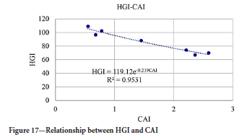
In this study, the relationships between the grindability and abrasiveness of the rocks were examined (Figure 17). The graph shows a negative relationship between the grindability of the rocks and their abrasiveness. It can be understood from the graph that the higher the abrasiveness of the rocks, the more difficult it is to grind them. In his study, Sakiz (2021b) found similar results.
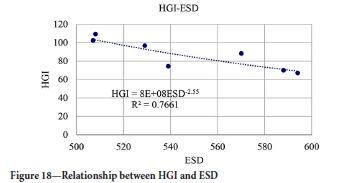
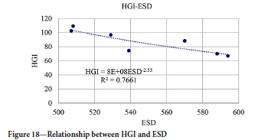
The relationships between the grindability and hardness of rocks have been examined (Figure 18). Upon examining the graph, a strong negative relationship between the grindability and hardness of the rocks was found. The higher the hardness of the rock, the more difficult it is to grind. Similar results have been reported in previous studies (Ozer, Cabuk 2007; Aras et al., 2020).
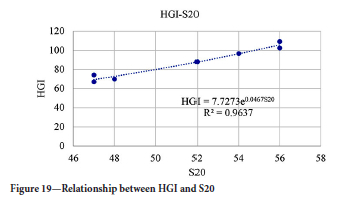
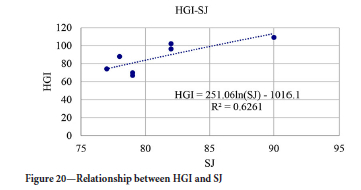
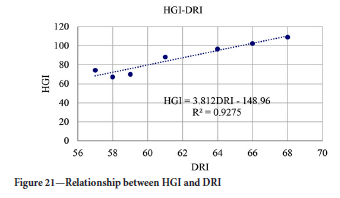
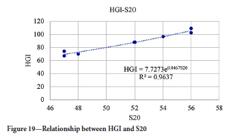
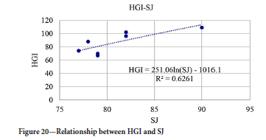
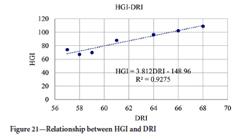
The relationships between the grindability of rocks and the two testing methods used to determine the drilling rate index (DRI) and drillability (S20, SJ) have been examined. Looking at the results between the S20, which is an indicator of percussion drilling, and HGI, there is a linear increasingly high relationship between HGI and S20 (Figure 19). The higher the fragility of the rock (S20), the easier it is to grind the rock. A similar high relationship has also been identified between SJ, which indicates rotary drilling, and HGI (Figure 20). A linear high relationship has been obtained between the grindability of the rocks and the drilling rate index (DRI) (Figure 21). Not as expected, the easier it is to drill the rock, the easier it is to grind it as well. Similar results have been obtained in previous studies (Ozer and Cabuk 2007; Aras et al., 2020).
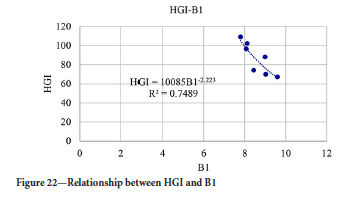
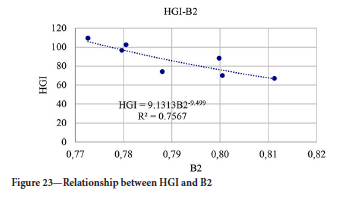
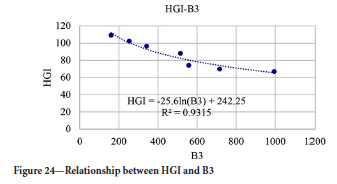
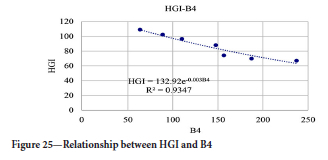
Finally, the relationships between the grindability of rocks and their brittleness were examined (Figures 22 to 25). Significant relationships were found between the brittleness measures B1 and B2 used to determine the brittleness of the rocks and their grindability (HGI) (R2 = 0.75 - 0.76). Negative high relationships were obtained between the brittleness values B3 and B4 and HGI. The higher the brittleness characteristic of the rocks, the easier their grindability becomes.
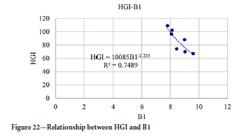
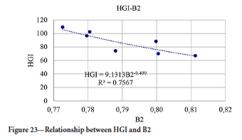
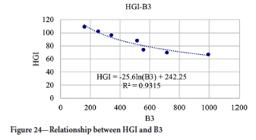
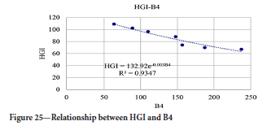
The brittleness level of rocks refers to their tendency to fracture without undergoing significant deformation under external loads, and it is one of the fundamental indicators of their mechanical behaviour. Brittle rocks exhibit sudden failure once they reach their elastic limit, without entering a phase of plastic deformation. This characteristic allows such rocks to be fragmented more easily with lower energy input. Therefore, brittle rocks generally exhibit higher grindability, as the fracture mechanism becomes more active during the grinding process. In this context, a positive relationship can be established between the brittleness properties of rocks and their grindability. The mechanical behaviour of rocks is influenced by several factors, including mineralogy, texture, fracture density, and the nature of the binding phases. When examining the graphs, the influence of mechanical behaviours can be clearly observed.
Conclusions
In this study, the relationships between the grindability of coal-surrounding rocks in the Zonguldak Basin and other experimental parameters were investigated for the first time within the context of local geological conditions. Upon reviewing the results, it was understood that the Hardgrove Grindability Index, which has been used primarily to determine the grindability of coal in the past, can also be used to determine the grindability of other rocks. Additionally, the energy value obtained from the Bond Work Index test, which has also been used in the past to evaluate the grindability of rocks, was utilised in this study to determine the excavatability of the rocks. As expected, negative relationships were obtained between the Hardgrove Grindability Index (HGI) and the Bond Work Index (BWI). The easier the rock is to grind, the less energy is required to grind it (R2 = 0.86). The Bond Work Index (BWI) test can be used in future similar studies to evaluate the excavatability of rocks. When examining the relationships between the grindability of rocks and strength tests, a particularly high relationship was found between HGI and uniaxial compressive strength (UCS) and Brazilian tensile strength (BTS) (R2 = 0.92-0.95). Again, as expected, strong negative relationships were found between grindability and abrasiveness, as well as hardness, respectively (R2 = 0.95 - 0.77). The higher the abrasiveness and hardness of the rocks, the harder they are to grind. High positive relationships were found between the grindability (HGI) and brittleness (S20) of the rocks (R2 = 0.96). The easier it is for rocks to break, the easier they can be ground. A high positive relationship was found between grindability (HGI) and the Drilling Rate Index (DRI). The easier the rock is to drill, the easier it is to grind (R2 = 0.93). Finally, the relationships between the grindability of rocks and their brittleness were examined. Significant relationships were obtained between the brittleness values (B1, B2, B3, B4) and HGI (R2 = 0.75 - 0.75 - 0.96 - 0.93).
All of the rocks used in this study are of sedimentary origin and belong to the coal-surrounding rocks of the Zonguldak Basin. In the basin, samples of other rock types (igneous and metamorphic) around the coal are not available in quantities sufficient for use in experimental studies. In future studies, comparisons should be made with studies conducted on igneous and metamorphic rocks from different regions using similar methods. Additionally, the effect of petrographic properties on grindability should also be considered in future research. The combined effect of other parameters on grindability should be examined using multiple regression analysis. However, due to the limited number of rock samples in this specific study, it was not possible to perform multiple regression analysis. Therefore, the relationships were evaluated using simple regression analysis. Increasing the number of rock types in future studies will enhance the reliability of the results and allow for the application of multiple regression analysis. A larger sample size will also lead to statistically more meaningful results.
Conflicts of Interest
The authors declare that they have no conflicts of interest.
Acknowledgments
The results presented in this paper are based on experimental studies. We would like to thank Dr Haşim Duru, Assistant Professor, Dr Utku Sakiz, Research Assistant, and Dr Barış Akkaya, Research Assistant, for their invaluable assistance in the experimental work.
References
- Abdelhaffez, G.S. 2012. Correlation Between Bond Work Index and Mechanical Properties of Some Saudi Ores, vol. 40, no. 1, pp. 271-280.
- Alber, M., Yaralı, O., Dahl, F., Bruland, A., Käsling, H., Michalakopoulos, T.N., Cardu, M., Hagan, P., Aydin, H., Ozarslan, A. 2013. ISRM suggested method for determining the abrasivity of rock by the Cerchar abrasivity test, Rock Mechanics and Rock Engineering, vol. 47, pp. 261-266.
- Altindag, R. 2002. The evaluation of rock brittleness concept on rotary blasthole drills. Journal of the South African Institute of Mining and Metallurgy, vol. 102, pp. 61-66.
- Aras, A., Ozsen, H., Dursun, A.E. 2020. Using Artificial Neural Networks for the Prediction of Bond Work Index from Rock Mechanics Properties, Mineral Processing and Extractive Metallurgy Review, vol. 41, no. 3, pp. 145-152.
- ASTM. 1993. Standard Test Method for the Hardgrove Grindability Index (HGI) of Petroleum Coke, Des. D5003 - 19.
- Bond, F.C. 1954. Crushing and Grinding Calculations, CIM Bulletin, vol. 47, no. 507, pp. 466-472.
- Bond, F.C. 1961. Crushing and Grinding Calculations I-II, Br. Chem. Eng., pp. 1-14.
- Csoke, B., Hatvani, Z., Papanastassiou, D., Solymár, K. 2004. Investigation of Grindability of Diasporic Bauxites in Dry, Aqueous and Alkaline Media as well as After High Pressure Crushing, Int. J. Miner. Process. 74.
- Dahl, F. 2003. DRI Standards, NTNU, Angleggsdrift, Trondheim. pp. 21
- Deniz, V. 1996. Bond Öğütülebilirliği ve İş İndeksi ile Statik ve Dinamik Parametreler Arasındaki İlişkiler, Doktora Tezi, Osmangazi Üniversitesi.
- Hardgrove, R.M. 1932. Grindability of coal. Transactions of the American Society of Mechanical Engineers, vol. 54, no. 3, pp. 37-44.
- Hower, J.C., Barron, L.S., Moshier, S.O. 1992. Application of the Hardgrove Grindability Index in Carbonate Characterization, Miner. Metall. Process.,vol. 9, no. 3, pp. 146-150.
- Hucka, V., Das, B. 1974. Brittleness determination of rocks by different methods. International Journal of Rock Mechanics and Mining Science & Geomechanical Abstract, vol. 11, pp. 389-392.
- ISRM. 1978a. Suggested method for determining tensile strength of rock materials. International Journal of Rock Mechanics and Mining Sciences and Geomechanics Abstracts, vol. 15, pp. 99-103.
- ISRM. 1978b. Suggested Methods for determining hardness and abrasiveness of rocks. International Journal of Rock Mechanics and Mining Sciences and Geomechanics Abstracts, vol. 15, pp. 89-97.
- ISRM. 1979a. Suggested method for determining water content, porosity, density, absorption and related properties and swelling and slake-durability index properties. International Journal of Rock Mechanics and Mining Sciences & Geomechanics Abstracts,vol. 16, no. 2, pp. 141-156.
- ISRM. 1979b. Suggested Method for determining the uniaxial compressive strength and deformability of rock. International Journal of Rock Mechanics and Mining Sciences And Geomechanics Abstracts, vol. 16, p. 135.
- ISRM. 1981. ISRM Suggested Methods: Rock Characterization, Testing and Monitoring, ed. E. T. Brown, Pergamon Press, London, 211 p.
- ISRM. 2014. ISRM Suggested Method for Determining the Abrasivity of Rock by the CERCHAR Abrasivity Test, The ISRM Suggested Methods for Rock Characterization, Testing and Monitoring: 2007-2014, pp. 101-106.
- McIntyre, L., Plitt, A. 1980. The Interrelation Between Bond And Hardgrove Grindabilities, CIM Bulletin, vol. 73, no. 818, pp. 149-154.
- Ozdag, H. 1992. Cevher Hazırlama-l. Anadolu Üniversitesi. Müh.-Mim. Fak. Yayım. No: 107. Eskişehir, 151 s.
- Ozer, U., Cabuk, E. 2007. Relationship between bond work index and rock parameters. Istanbul University the Journal of Engineering Faculty's Earth Sciences Review, vol. 20, no. 1, pp. 43-49.
- Ozkahraman, H.T. 2005. A Meaningful Expression Between Bond Work Index. Grindability Index and Friability Value, vol. 18, pp. 1057-1059.
- Sakiz, U. 2021a. Kayaçların Mekanik ve Delinebilirlik Özellikleri ile Öğütülebilirliği Arasındaki İlişkilerin İncelenmesi. El-Cezeri, vol. 8, no. 2, pp. 728-740.
- Sakiz, U. 2021b. Andezit Kayaçların Aşınma Davranışlarının Hardgrove İndeks (HGI) Deney Yöntemiyle Tahmini, International Conferences on Engineering and Natural Sciences, 9 s.
- Su, O. 2017. Kayaçlarda geri sıçrama mekanizmalı sertlik ölçme yöntemlerinin karşılaştırılması ve Equotip sertlik ölçerle delme hızının tahmini. Türkiye 25. Uluslararrası Madencilik Kongresi Bildiriler Kitabı, IMCET2017, 11-14 Nisan, Antalya, Türkiye, pp. 191-198.
- Swain, R., Rao, R.B. 2009. Alternative Approaches for Determination of Bond Work Index on Soft and Friable Partially Laterised Khondalite Rocks of Bauxite Mine Waste Materials, Journal of Minerals and Materials Characterization and Engineering, vol. 8, no. 9, pp. 729-743.
- Yarali, O., Soyer, E. 2011. The effect of mechanical rock properties and brittleness on drillability, Scientific Research and Essays, vol. 6, no. 5, pp. 1077-1088.
- Yildiz, N. 1999. Öğütme Teorisi, Uygulaması Değirmenler ve Sınıflandırıcılar, ISBN: 975-9677-0-3, Kozan Ofset Matbacılık, Ankara, 217 pp.
Revised: 29 Jan. 2025
Accepted: 6 Feb. 2026
Published: March 2026