Tailings storage facility-specific water balance as a standard practice
Abstract
Site-wide water balances provide valuable oversight of mining water management, but the complexity and critical role of tailings storage facilities require a focused, facility-specific approach. Tailings storage facilities often remain a 'black box' in conventional balances, particularly with respect to entrapped and interstitial water. Yet, understanding how much water is stored within a tailings storage facility, and how it changes over time, is fundamental to water optimisation, environmental stewardship, and dam safety. This paper highlights the advantages of developing tailings storage facility-specific water balances. By explicitly accounting for inflows and outflows, including slurry water, rainfall, evaporation, seepage, recovery processes, and entrapped water, operators can better characterise water dynamics that are typically underestimated in broader site-wide assessments. A case study illustrates how such focused analysis provides clearer insights into water storage and release, supporting improved conservation, regulatory compliance, and enhanced stability of tailings storage facilities. Given that tailings storage facilities evolve over decades, with changing tailings properties and seepage regimes, a robust water balance informed by up-to-date hydraulic data is essential for long-term management. It is proposed that tailings storage facility-specific water balances should be regarded as standard practice in mining. Such an approach not only strengthens operational decision-making but also supports sustainable water use and minimises environmental impacts, ensuring that tailings storage facilities continue to perform their essential function without compromising safety or integrity.
tailings storage facility; water balance; mining water management; water optimisation; TSF-specific water balance; environmental impacts
Introduction
Site-wide water balances provide a critical framework for understanding and managing water resources in mining operations. The complexity and significance of tailings storage facilities (TSF), however, necessitate a tailored, TSF-specific approach to water balance analysis. TSFs play a pivotal role in the overall water management strategy of a mine, yet their unique hydrological dynamics often remain underexplored in broader site-wide evaluations. While general water balances account for incoming flows, evaporation, percolation, and external outflows, the TSF presents distinct challenges. Entrapment of water within the TSF, for instance, is a critical factor that is not always fully quantifiable. Understanding the volume of water retained within the TSF, its spatial distribution, and its variations over time is vital for optimising water use, improving environmental stewardship, and ensuring the stability and safety of the facility.
This paper explores the advantages of developing a TSF-specific water balance, which focuses on the unique inflows, outflows, and internal water dynamics of TSFs. Through a detailed case study analysis, we demonstrate how this approach can provide insights that are often obscured in site-wide assessments. By examining key factors such as evaporation, seepage, recovery processes, interstitial water, and phreatic surface dynamics, mining operations can achieve a more comprehensive understanding of TSF water behaviour. This deeper insight supports the development of more effective water conservation strategies, enhances compliance with regulatory requirements, and promotes the long-term stability of TSFs.
A robust TSF-specific water balance requires the integration of up-to-date hydraulic data and an understanding of the evolving characteristics of tailings over the life of the facility. TSFs, which are constructed incrementally over decades, experience changes in tailings properties, internal seepage regimes, and storage capacities. Anticipating and adapting to these changes are critical for both existing and new facilities. The Global Industry Standard on Tailings Management GISTM, ICMM, 2020 underscores the importance of integrating design, economic, and environmental considerations into TSF management, further emphasising the need for innovative approaches to water balance modelling.
This study advocates for the adoption of TSF-specific water balances as a standard practice in the mining industry. By addressing the unique challenges and opportunities associated with TSFs, this approach promotes a more sustainable and responsible management of water resources. It ensures that TSFs can fulfil their essential functions without compromising environmental integrity, while also mitigating risks and enhancing operational efficiency. Through the implementation of tailored water management strategies, the mining industry can better align with sustainability goals and regulatory frameworks, safeguarding both operational and environmental outcomes.
Conventional water balances in mining operations
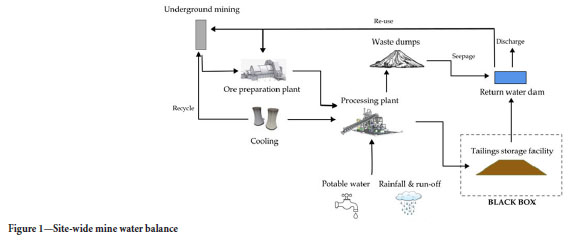
Water balances in mining operations are typically conducted at a site-wide scale, providing a high-level overview of water inputs, outputs, and storage within the mine's operational framework (refer to Figure 1). This site-wide approach provides a broad understanding of the mine's water use efficiency, compliance with regulatory requirements, and potential environmental impacts. However, within these overarching water balances, TSFs are often represented as a relatively small and simplified component. The focus on TSFs in conventional water balances is typically limited to what is added to the facility and what comes out.
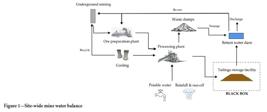
In most cases, TSFs are treated as a 'black box' in site-wide water balances, where the intricate internal dynamics of water movement within the facility are not explicitly modelled or quantified. The focus is primarily on the net water entering and exiting the TSF, with little attention given to the internal storage and redistribution of water within the tailings mass. By treating TSFs as a minor component of the overall water balance, site-wide assessments may fail to capture critical insights into the facility's water behaviour. This can lead to missed opportunities for optimising water recovery, improving TSF stability, and minimising environmental risks. Furthermore, the lack of detailed TSF-specific data may hinder compliance with evolving regulatory standards, such as the GISTM (ICMM, 2020), which emphasises the need for robust water management in TSFs.
Energy balance as a foundation for water balances
Understanding how potential energy converts to kinetic energy provides a useful analogue for water balance development. Just as water stored at elevation possesses potential energy that is released as kinetic energy when it flows, a TSF retains water, the movement and transformation of which must be carefully tracked. The shift between 'stored' and 'moving' water underpins the risks associated with phreatic surfaces, seepage, and stormwater response. Recognising this dynamic reinforces the need for a staged approach, that is, starting with simple storage checks, progressing to monitored flows, and ultimately building a three-dimensional picture of how water is stored and released within the facility.
Energy stored in a TSF
When water is stored in a TSF, it possesses gravitational potential energy. This is because it is elevated above the natural ground level. The higher the water level (phreatic surface) and the greater the volume stored, the greater the increase in potential energy. Figure 2 depicts the changes in energy when it is stored in a TSF.

Potential energy is given by:

Where m is the mass of stored water (kg), g is the gravitational acceleration (m/s2), and h is the height of the water surface above a reference point (usually downstream ground level) (m).
If seepage (piping), overtopping, or a structural breach occurs, this stored potential energy is released and transforms into kinetic energy as water flows downstream. The slurry water then accelerates under gravity, and its energy, KE is now expressed as motion:

With v as the velocity (m/s).
This conversion of energy explains why uncontrolled releases from a TSF can be so destructive, namely that stored potential energy is suddenly converted to accelerated moving flows with high erosive and transport capacity.
Potential energy is effectively stored under the pool area. This is called the passive zone. Over time, this volume of tailings increases in density, although it is saturated. From the pool area, a phreatic surface develops and tapers towards the lowest elevation of the dam. This area is where the kinetic energy is developed. This is the active zone. This is where the gravelly tailings material is stored. Void ratio is higher in this area and seepages develop rapidly. Phreatic surfaces can fluctuate significantly in this zone depending on the density and hydraulic conductivity (permeability). Volumetric changes can vary considerably, if not controlled effectively. Volumetric change in soils is linked to density changes that can be controlled by managing the deposition plan efficiently (thin lift deposition), rate of flow (% water: solids ratio), and maintaining effective beach slopes. The stored energy is released and converted into kinetic energy, which is the energy of motion. This is when failure starts to occur as typically occurs with piping failures.
In normal TSF operations, the potential energy of stored water is managed by discharge structures such as decant systems, spillways, seepage drains, and solution trenches that control the conversion of potential to kinetic energy in a safe manner. Failure scenarios develop if systems are not controlled and monitored. The rapid conversion of potential to kinetic energy represents a major risk factor, which is not clearly understood and, therefore, water balance modelling must consider this when evaluating storage levels and freeboard requirements.
Interconnection between degree of saturation, porosity, and void ratio
The degree of saturation (%), porosity (%), and void ratio are interrelated measures of a soil's void space and water content. Porosity describes the volume of voids with respect to the total volume of the material. Void ratio describes the volume of voids with respect to solids volume. The degree of saturation indicates the fraction of voids filled with water. Together, these factors govern the soil's water storage, density, and flow characteristics.
As the TSF fills with tailings, the material matrix particles become compressed, and the degree of saturation increases, resulting in a gradual increase in pore water pressure with depth. As water continues to infiltrate, a zone of fully saturated soil develops at the bottom, where all voids are filled with water. The upper surface of this saturated zone is the phreatic surface. The phreatic surface assumes a shape governed by hydraulic gradients, soil permeability, and boundary conditions.
Approach to a TSF-specific water balance
A critical issue in current practices is that water balances often do not explicitly state the current storage volume of water contained within the TSF, i.e., the 'black box'. If this volume cannot be quantified, it cannot be effectively managed. By adopting a three-staged approach, operators can move from simple checks to comprehensive modelling, thereby visualising how water storage changes over time. This progression allows for proactive management, ensuring that boundary conditions, such as phreatic surface levels and freeboard requirements, are continuously monitored and that trigger actions, such as halting deposition during extreme rainfall events, can be implemented effectively.
A typical water balance follows a fundamental equation given as:

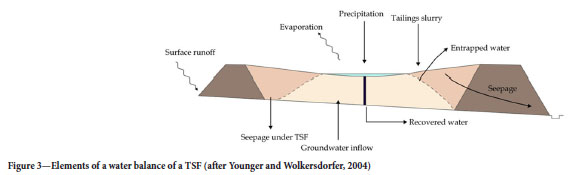
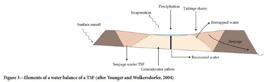
Where ΔS is the change in storage volume. Inflows include slurry water, precipitation on the TSF surface, surface runoff entering the TSF, and groundwater inflows. Outflows include evaporation from the TSF surface, seepage through the TSF base and walls, recovered water via decant systems and underdrains, and entrapped water within the tailings (Barthe et al., 2018). Refer to Figure 3 for the visual presentation.
Staged approach
Fundamentally, TSF design depends on the in situ ground conditions, and time of construction (given the ever-developing regulations and requirements), and the base treatment (lined or unlined). Furthermore, the choice of TSF will depend on whether it is designed as an upstream, centreline, or downstream construction.
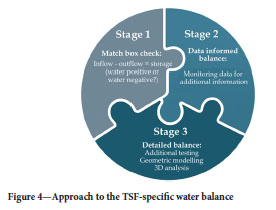
To develop a robust water balance for a TSF, a structured stage system is proposed. This will allow mines to assess the TSF's storage capacity in an effective realistic approach as follows:
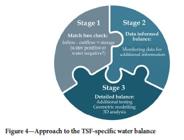
Stage 1: Matchbox approach
This approach begins with a basic 'matchbox' check, where inflows and outflows are compared to estimate changes in storage. This is based on current information at hand.
Stage 2: Informed approach
Current data-informed assessment. This incorporates site monitoring information such as slurry flows, rainfall records, evaporation records, pond levels, seepage flows, piezometer measurements, and phreatic levels to refine stage one estimates.
Stage 3: Detailed approach
Detailed analysis using advanced tools such as three-dimensional modelling, survey data, and geotechnical investigations to capture the spatial and temporal behaviour of water within the facility. It involves a detailed process to acquire spatially distributed hydraulic and geotechnical properties, bathymetry, survey grids, and running of 3D models and ensembles, all related to the stability of the facility.
By progressing through these stages, as shown visually in Figure 4, the water balance development evolves from a simple check to a comprehensive management tool, ensuring that both short-term operations and medium- and long-term risks are effectively addressed. However, prior to following these approaches, it is important that key information is gathered about the site and from its position in the regional context.
Basic parameter development and guidance for a three-stage TSF water-balance program
Identifying key parameters controls the focus of the water balance assessment. This will enhance the staged approach to ensure that a robust set of parameters is utilised effectively and realistically. The flow of data development should follow the staged approach described in the aforementioned.
Data gathering
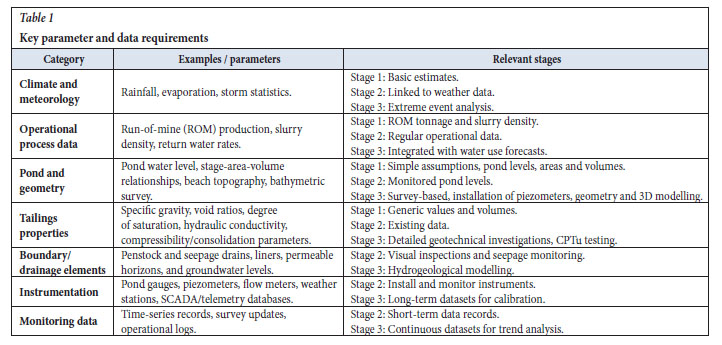
Data is essential at every stage of a water balance model to ensure accuracy and relevance. The data will include typical parameters such as actual type of mine, type of TSF and geometry (pool areas, footprint etc.), climatic inputs (local and regional), rainfall, storm statistics and evaporation/evapotranspiration rates, seepages (both groundwater into the TSF and seepage from the TSF base), deposition tonnages, slurry volumes and densities, specific gravity, dry density, void ratios, porosity, phreatic surfaces, and hydraulic conductivities, to name but a few. Some of the data will be readily available, others will require detailed investigations and analysis. These parameters and their mechanisms are detailed in Table 1.
Planning guidelines
Each stage in the water balance development will depend on the availability of data. Typical timelines for mine management to consider are:
-
Stage 1: Immediate (days → weeks)
-
Stage 2: Near term (weeks → 3 months)
-
Stage 3: Long term (3-12 months)
In addition to the aforementioned, procurement considerations of at least 3 months can be added to the current timelines.
Recommended practical tolerances
In developing and applying any stage for water balance models for TSFs, it is important to recognise that absolute precision is neither possible nor practical. Instead, tolerances and target levels of accuracy should be defined to guide data collection, model development, and decision-making. These tolerances acknowledge the variability of natural systems (e.g., rainfall, evaporation, and seasonal changes), the uncertainty in material properties (e.g., tailings hydraulic conductivity), and the operational challenges of measuring flows and volumes in real time.
Establishing realistic, accurate targets ensures that models remain both credible, flexible, and operationally useful, providing sufficient confidence for management decisions to be made without creating unrealistic expectations.
The following should be considered as a guideline:
-
Rainfall: ±2% - 10% (gauge siting and wind effects).
-
Evaporation: ±10% - 15% (seasonal considerations).
-
Pond WL: ±0.02 m - 0.05 m (regular surveys).
-
Bathymetry depth: ±0.1 m - 0.5 m depending on depth.
-
Stage-area-volume relationship: ±5% of volume (depends on survey resolution and frequency).
-
Slurry density: ±2% - 5% (continuous or frequent grab samples).
-
Tailings geotechnical parameters: order of magnitude (Stage 1) - initial assumptions, narrowing to ±20% (Stage 3) - based on targeted lab and field-testing refinement.
-
Piezometers: ±0.01 m - 0.05 m.
-
Hydraulic conductivity (field): reported as range; ensure order-of-magnitude confidence and quantify spatial variability.
-
Seepage/drainage flows: ±10% - 20%.
-
Return flow meters: ±2% - 5% reading.
Uncertainty handling and realistic notes
Uncertainty is unavoidable in water balance modelling due to variable climatic conditions, measurement errors, and limited data. The aim is not to eliminate uncertainty but to manage it transparently, focusing on the largest contributors and refining estimates as new information becomes available. Pragmatic notes help ensure models remain useful for decision-making despite these limitations. The following considerations are provided:
-
Stage 1: Default assumptions - use conservative retention (higher retained porewater) and low recovery to avoid underestimating pond development.
-
Stage 2: Progressive reduction of uncertainty - calibration should reduce key uncertainties (pond geometry, return flows, basic seepage).
-
Stage 3: Additional testing reduces hydraulic/geotechnical uncertainties and 3D modelling.
-
Data quality assurance procedures: Daily credibility checks (mass balance), monthly reconciliation, and correction of instrument errors.
Best practice parameters
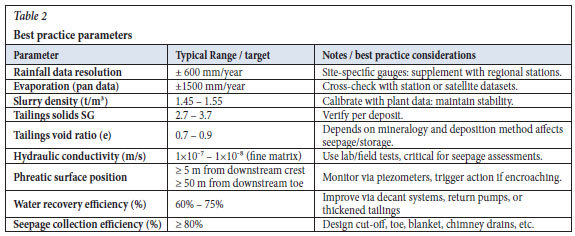
For illustrative purposes, the following parameter ranges are considered best practice for a typical platinum TSF in South Africa. These values provide a benchmark for design, monitoring, and operational management. They are not absolute but should be refined as site-specific data becomes available. The best practice parameters are summarised in Table 2.
Worked example
Matchbox check
The first step in developing a water balance is to carry out the simple 'matchbox' check as described in the aforementioned sections. The purpose of this first stage is not to deliver precise values, but rather to establish whether inflows and outflows are broadly consistent, and to identify any unexplained changes in storage.
This quick diagnostic tool highlights imbalances that indicate seepage losses, measurement gaps, or operational risks. This will enable the analyst to establish whether the TSF is water-positive or -negative. This foundational step builds confidence and provides a baseline for progressively more detailed assessments in later stages.
Inputs required for the matchbox check
To perform a Stage 1 matchbox check, the following key inputs must be identified. These values are typically available from mine records or can be estimated from site measurements and climatic data. While accuracy at this stage is not critical, using realistic values provides a meaningful first estimate of storage changes. Typical input values for a platinum mine in South Africa include:
-
Dry tonnages: 240 kt/month
-
Slurry density: 1.5 t/m3
-
Specific gravity (SG): 3.3
-
Slurry water: 1.2 m3 of water per dry tonne of tailings.
-
Direct rainfall: 800 mm/ year.
-
Evaporation: 1500 mm/year.
-
Areas: Dam 112 Ha, pool 7 Ha
-
Dam volume: 22 400 000 m3
-
Dam void ratio: 0.9
-
Other inputs: Catchment runoff onto TSF.
-
Return water: Pumped back to the plant, i.e., penstock, drainage systems.
-
Seepage losses: 10% of inflows (estimate) below seepage drainage system.
These values are then combined to check whether inflows and outflows balance within reasonable limits. Any unexplained difference is treated as a change in storage, which highlights whether the facility is gaining or losing water overall. From the above, the following was calculated:
-
Total inflows 486 000 m3/month
-
Total outflows 127 680 m3/month
-
Net storage 358 920 m3/month
It is therefore visible that the TSF is retaining water, and this creates a starting point for further development of Stages 2 and 3 investigations and assessments. To put this into perspective, an Olympic-sized swimming pool has a storage volume of 2 500 m3, this equates to ~ 144 pools being stored in the facility per month.
Development of order of magnitude of water factors for water balances
Through the development of a refined water balance, key order of magnitude of water (OMW) factors can be derived that can aid both mine management and the engineers to apply during the life cycle of the TSF. In the aforementioned example for a Stage 1 estimate, the volume of the TSF divided by the net storage is calculated as 1.36. These factors can then be calculated for each stage of the development of the TSF and ultimately for closure. The industry can then set limits to these factors based on the risk profile of the facility.
Critical water storage levels within a tailings storage facility
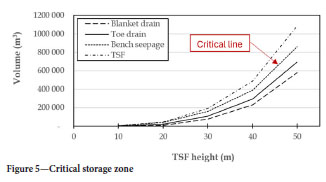
OMW factors will play a significant role in the strategic development of a water balance. A generic illustration is shown in Figure 5, whereby a frustum (circular TSF) is modelled against different heights versus the positioning of seepage drains, i.e., toe and blanket drains. Further, if seepage occurs at a bench, the figure highlights a critical boundary (critical line). The position of seepage drains forms an integral part of the design of TSFs.
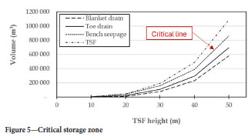
With further research, graphs such as nomographs and hydrographs, aided by computer programs, could form an evolutionary approach to understanding the knowledge base of site-specific TSF water balances.
Compliance regulations
In South Africa, dam safety guidelines are found in the National Water Act (NWA), 1998 (Act No. 36 of 1998) and its regulations regarding the safety of dams. The Act, together with these regulations, stipulate the registration of dams with a safety risk (wall height > 5 m, capacity > 50,000 m3). The dams are classified into Categories I, II, or III, based on size and hazard potential.
The Act further stipulates that owners must obtain a license for construction or modification, and for dams above a certain risk, a registered professional engineer must be appointed to be approved by the Department of Water and Sanitation, Dam Safety Office Directorate (DWS:DSO), i.e., an Approved Professional Person (APP) to conduct safety inspections and ensure compliance with the regulations and their own common law duty of care.
For TSFs, merely using the pool storage volume in safety checks is incorrect, as the interstitial and water contained below the phreatic surface should be considered. This could change the classification of the facility and its risk profile. Currently, it is unknown which volumes to use when registering a TSF at the DSO. In the past, only the pool volume was considered, and now, sometimes the whole capacity of the TSF is considered. Most TSFs have a storage capacity larger than 50 000 m3, but the volume of water inside this structure has not been quantified. This is where the site-specific water balance can fill the gap.
Key findings from a site-specific water balance
Carrying out a site-specific water balance for a TSF is essential for moving beyond assumptions and unknowns. The exercise allows operators to quantify, track, and manage the movement and storage of water, providing several important outcomes:
-
Clarity on water storage - It identifies how much water is contained in the facility, which is often poorly understood but is central to both stability and water supply planning.
-
Early warning of risks - Discrepancies between inflows and outflows highlight potential seepage, rising phreatic surfaces over time, or unmeasured discharges that may compromise dam safety. It also links phreatic surface dynamics to TSF stability and factor of safety.
-
Support for decision-making - Provides a structured basis for operational decisions such as assessing energy balance, reducing pond size, adjusting deposition, change of slope angle, enhancing drainage, or preparing for storm events.
-
Improved water efficiency - By quantifying return water and losses, it supports process water recovery and reduces reliance on external water sources.
-
Foundation for staged improvement - The simple 'matchbox' check develops into progressively more refined monitoring and modelling, creating a path towards continuous improvement.
-
Compliance and transparency - Demonstrate responsible management to regulators, communities, and stakeholders by showing that water is being actively monitored and managed.
-
Site-specific TSF water balances are to be conducted on a quarterly, biannual, or annual basis depending on life of mine (LOM) status.
-
Storing water on TSFs should always be avoided.
The site-specific water balance transforms the TSF from a 'black box' into a measurable system. This shift from uncertainty to quantifiable information is critical for safe operation, sustainable water use, and long-term risk reduction.
Conclusion
Water management in mining cannot be fully understood without accounting for the unique role of TSFs. Unlike other site components, TSFs store large and variable volumes of water of which the behaviour changes over time. If left unquantified, this storage represents both an operational unknown and a potential safety risk.
The three-stage water balance approach presented here offers a practical pathway to address this challenge. Starting with a simple 'matchbox' check of inflows and outflows, operators can establish a baseline understanding of whether the TSF is gaining or losing water. Building on this, Stage 2 incorporates measured data, such as pond levels, return water flows, and rainfall, refining the balance into a more reliable monitoring tool. Stage 3 then applies advanced modelling and geotechnical inputs to create a dynamic picture of water storage and movement, enabling predictive management.
The key message is that water balances should not stop at the site scale. By applying a TSF-specific focus, operators gain clearer insight into stored water volumes, improve water recovery, enhance dam safety, and align with al standards such as the GISTM (ICMM, 2020). Ultimately, adopting TSF-specific water balances transforms the facility from a 'black box' into a managed system (termed a 'blue box'), reducing risks while supporting sustainable and responsible water use.
Acknowledgements
The authors would like to thank SRK Consulting participants who assisted with the compilation of this paper.
References
-
Barthe, P., Eder, P., Savin, H. G. M., Orveillon, G., Garbarino, E. 2018. Best available techniques (BAT) reference document for the management of waste from extractive industries - In accordance with Directive 2006/21/EC, Publications Office. https://data.europa.eu/doi/10.2760/35297
» https://data.europa.eu/doi/10.2760/35297 -
Global Industry Standard on Tailings Management. 2020. International Council on Mining and Metals (ICMM), United Nations Environment Programme (UNEP), Principles for Responsible Investment (PRI). Available at: https://globaltailingsreview.org/global-industry-standard/
» https://globaltailingsreview.org/global-industry-standard/ - National Water Act (NWA). 1998. (Act No. 36 of 1998). Pretoria
-
Younger, P., Wolkersdorfer, C. 2004. Mining Impacts on the Fresh Water Environment: Technical and Managerial Guidelines for Catchment Scale Management, Mine Water and the Environment, 23, s2-s80. DOI:10.1007/s10230-004-0028-0
» https://doi.org/10.1007/s10230-004-0028-0
Published: April 2026