Presidential Address: From ambition to action: Delivering measurable impact
Abstract
Ambition, while necessary, is insufficient on its own. Material change depends on whether ambition is translated into purposeful action, whether that action takes place within an enabling system, and whether its effects can be demonstrated as meaningful impact. Drawing on experience from the Southern African Institute of Mining and Metallurgy, and in particular the development of the Young Professionals' Council, the argument is organised around five linked ideas: ambition, the enabling conditions for purposeful action, the distinction between activity, output, outcome and impact, the role of time in the development of impact, and the importance of measurement, learning and adaptation. Professional institutions should therefore judge their success not primarily by the volume of activity they generate, but by the extent to which they strengthen capability, widen participation, support knowledge exchange, and contribute to meaningful and measurable change in the professions and sectors they serve.
ambition; measurable impact; purposeful action; institutional effectiveness; organisational learning; adaptation; enabling conditions
Introduction
To serve a professional institute with a history extending back to 1894 is to inherit more than institutional continuity. It is to inherit a body of professional knowledge, technical contribution, and accumulated responsibility, as well as the obligation to ask how such an institution remains relevant as the profession and the industry around it continue to change.
One period in the recent history of the Southern African Institute of Mining and Metallurgy (SAIMM) particularly shaped my thinking about that responsibility. More than a decade ago, SAIMM's Career Guidance and Education (CGE) Committee was doing important work in encouraging learners and students to enter mining and metallurgy and in supporting their transition into the profession. Over time, however, it became clear that the challenges facing young professionals extended well beyond career guidance alone. Students needed access to practical experience, graduates faced uncertainty about employment, and young professionals needed mentoring, professional development, and more meaningful pathways for participation within the Institute itself.
What emerged in response was an ambitious institutional idea: not simply to expand an existing committee, but to create a structure through which young professionals could identify their own priorities, participate meaningfully in the affairs of the Institute, and take responsibility for developing and delivering programmes that addressed their needs. That process ultimately led to the creation of the Young Professionals' Council (YPC). Looking back, what matters most is not merely that a new set of activities was established, but what that period can teach about the relationship between ambition, execution, and meaningful institutional change.
The central argument is straightforward. Ambition matters, but ambition does not produce change on its own. It must be converted into purposeful action, and that action must ultimately be judged not by the volume of activity it generates, but by whether it produces meaningful change in the condition it was intended to address.
The argument develops through five linked propositions. First, ambition defines the future condition worth pursuing. Second, action depends on the enabling conditions within which execution takes place. Third, activity must be distinguished from impact. Fourth, impact develops over time and may do so in different ways. Fifth, measurement only becomes useful when it feeds learning and adaptation. These propositions are then considered in relation to SAIMM as a professional institution and illustrated through the case of the Young Professionals' Council.
This experience-based conceptual reflection proposes a practical framework for assessing how professional institutions convert ambition into measurable impact. It is intended to be analytically useful and relevant to professional institutions and the wider minerals industry. Its purpose is to support a more disciplined response to a simple but demanding question: What changed because we acted?
Ambition: Defining the change we seek
Ambition is a statement about the future we are trying to create. It gives direction by defining the change we seek. In that sense, ambition is not simply aspiration. It is a disciplined attempt to describe a future condition that does not yet fully exist, but that has been judged worth pursuing.
In mining and metallurgy, a number of ambitions are expressed with particular clarity, including zero harm, net-zero emissions, a just energy transition, local content, beneficiation and value addition, and technology-enabled mining.
Zero harm remains one of the defining ambitions in health and safety. It is more than a slogan or numerical target. It expresses an expectation that mining and metallurgical work should be organised, led, and improved in ways that make fatalities, injuries, and occupational disease progressively less likely (De Jager, 2018; Joughin, 2024).
Net-zero emissions and the just energy transition express ambitions to decarbonise mining and metallurgical systems while maintaining competitiveness and responding to the social consequences of transition. For Southern African producers, this challenge cannot be separated from energy availability and affordability or from the employment, skills, and livelihoods of the workers and communities most exposed to change.
Local content, beneficiation, and value addition reflect the ambition to retain a greater share of mineral value within the countries and regions where it is produced and for mining to create durable value in the communities in which it operates. The energy transition and supply-chain resilience have renewed attention on the minerals required for modern technologies. Southern Africa's opportunity lies not only in supplying these minerals, but in using its geological endowment, technical expertise, and infrastructure to create more value from them. South Africa's Critical Minerals and Metals Strategy links this ambition to exploration, localisation, research and innovation, skills, infrastructure, and energy security (Department of Mineral and Petroleum Resources, 2025). Understood in this way, the ambition concerns deepening industrial capability, not downstream processing alone.
There is also a strong ambition around technology-enabled mining. Automation, digital systems, artificial intelligence, advanced process control, and remote or data-driven operating models are being pursued globally as means to improve safety, decision-making, productivity, environmental performance, and competitiveness. The success of this ambition will depend not only on the technology itself, but also on the capability, leadership, systems, and learning culture needed to embed it in practice.
SAIMM has articulated an ambition of its own. It seeks to become a more integrated, responsive, and sustainable professional system, better able to serve its members and the profession as the world around it changes (Lane, 2026). That ambition is consistent with the Institute's broader role in supporting access to technical and professional knowledge in mining, metallurgy, and related sectors (Southern African Institute of Mining and Metallurgy, 2019).
These ambitions differ in scale and purpose, but they share an important characteristic. Each describes a condition that does not yet fully exist but that serves as a point of direction. That is the value of ambition: it clarifies intention, establishes orientation, and gives purpose to action.
The difficulty, however, is that ambition can be rhetorically strong while still being operationally weak. A well-phrased ambition may inspire, align, or signal seriousness of intent, but it does not by itself change systems, develop people, improve performance, or alter institutional behaviour. This is why some ambitions gain momentum while others remain little more than plans. What separates them is seldom the quality of the ambition itself, but the conditions under which it is pursued.
Enablers of purposeful action
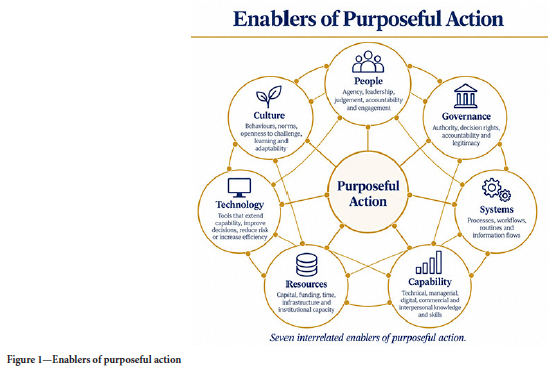
If ambition does not produce change on its own, the next question is what enables ambition to become purposeful action. I propose seven interrelated conditions that are particularly important: people, governance, systems, capability, resources, technology, and culture. I refer to these as the enablers of purposeful action (Figure 1).
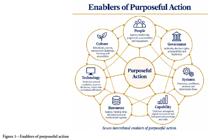
These should not be treated as sequential steps or as a simple checklist. They operate simultaneously, interact continuously, and vary in relative importance depending on the nature of the ambition being pursued. A weakness in any one of them may constrain execution, even where the ambition is sound and the intent to act is genuine. The contribution of each enabler to purposeful action is considered in what follows here.
People interpret information, exercise judgement, make decisions, accept responsibility, and coordinate effort. Even a technically sound initiative will struggle if those expected to deliver it do not understand its purpose, are not sufficiently engaged, or lack the authority to act.
Governance determines how authority, responsibility, and accountability are structured. It establishes the legitimacy through which action occurs. Good governance provides necessary discipline, but it must also enable appropriate and timely decisions. Where responsibilities are unclear or decision-making structures no longer suit the problem being addressed, execution can be constrained.
Systems are the processes, routines, workflows, and information flows through which work is coordinated. They determine how decisions are translated into action across organisational boundaries. Failures of execution are therefore not always failures of intent or competence; they may arise because information does not reach the right people, processes create unnecessary friction, or responsibilities fall between established structures.
Capability concerns whether the knowledge and skills required to perform the work exist. Technical competence remains fundamental in mining and metallurgy, but increasingly, it must be complemented by managerial, digital, commercial, and interpersonal capability. An organisation cannot reasonably expect new forms of performance without developing the capabilities required to deliver them.
Resources determine what can practically be delivered and sustained. These include capital and funding, but also time, infrastructure, specialist expertise, and institutional capacity. An initiative may be strategically important and technically credible, but its execution will remain constrained if the resources required to sustain it are unavailable.
Technology can extend capability, improve decisions, reduce exposure to risk, increase efficiency, and remove constraints that were previously difficult to overcome. But technology is an enabler, not an objective in itself. Its value lies not simply in implementation, but in whether it improves the condition it was introduced to address.
Finally, culture shapes the behaviours within which all the other enablers operate. It influences what people are willing to challenge, how accountability is exercised, whether uncomfortable information is surfaced, how failure is treated, and whether learning leads to change. Culture may be less tangible than a system or a resource allocation, but its effect on execution can be substantial.
The importance of these seven enablers lies not only in their individual contribution, but in their interaction. Technology without capability may be underused. Capability without resources may remain dormant. Resources without governance may be misdirected. Well-designed systems may still underperform in a culture that discourages challenge or accountability. And committed people can achieve only so much when the structures around them repeatedly make effective action difficult.
This leads to an important proposition:
Effective action occurs within an enabling system
The quality of execution depends materially on the condition of that system. This understanding has practical consequences for how we respond when execution falls short. The instinct is often to demand more effort, increase activity or introduce another initiative. But if the underlying constraint lies elsewhere in the enabling system, more effort may simply reproduce the same result.
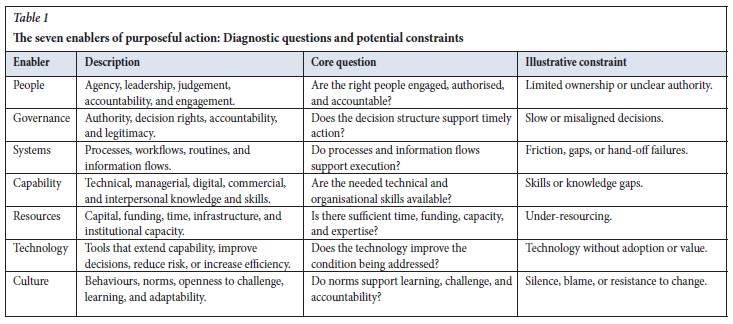
The more useful response is to diagnose the constraint (Table 1). Is the ambition clear and understood? Do people have the authority and accountability required to act? Does governance support timely decisions? Are systems aligned with the intended outcome? Does the necessary capability exist? Are sufficient resources available? Is technology solving the right problem? Does the culture support the behaviour required?
This does neither mean that all seven conditions must be equally strong before action can occur. Nor does it suggest that execution can ever be made entirely predictable. It means that the quality of action cannot be understood independently of the conditions within which it takes place.
Ambition, therefore, is converted into action not simply through effort, but through the alignment of the conditions that make purposeful execution possible.
The next question is whether that action actually produces the change intended.
From activity to measurable impact
If action is necessary to move from ambition towards delivery, then it is also necessary to be precise about what follows once action has been taken. One of the most common weaknesses in institutional and organisational practice is the tendency to treat visible activity as if it were evidence of meaningful change. Activity is easier to observe than impact, and it is therefore more easily mistaken for success.
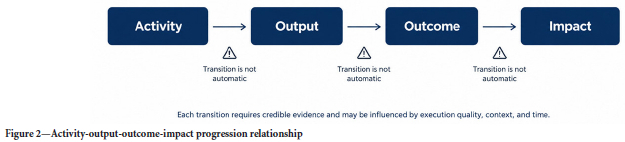
Four terms need to be distinguished: activity, output, outcome, and impact. An activity is what is done. An output is the direct product of that activity. An outcome is the change that follows from those outputs. Impact is the broader, higher-level change to which outcomes contribute and concerns whether the condition identified in the original ambition has changed in a meaningful way (Belcher, Palenberg, 2018).
This relationship can be expressed as a progression from activity to output to outcome to impact (Figure 2).

That progression, however, should not be understood as simple or automatic. An activity does not necessarily produce the intended output, an output does not guarantee an outcome, and an outcome does not inevitably translate into meaningful impact. That is why organisations can be very busy without necessarily being effective.
Most reporting systems naturally privilege what is easiest to count: meetings held, funds spent, participants reached, programmes launched, and milestones completed. These measures remain useful because they help establish whether something was done and whether it was delivered at scale. But they are incomplete if they become the primary basis on which success is judged.
This distinction guards against equating effort with effectiveness. High levels of activity may demonstrate commitment, and strong outputs may demonstrate competent execution. However, neither establishes that the condition the ambition was intended to address has changed.
If impact is to be more than a statement of intent, there must be some basis for determining whether meaningful change has occurred. That shifts attention from effort to consequence, and from delivery to significance. It also forces clarity at the beginning of an intervention, because if the desired change has not been defined with sufficient precision, it becomes difficult to determine later whether meaningful progress was made. In this context, measurable refers to the availability of credible evidence, meaningful refers to relevance to the original ambition, and material refers to the significance of the change achieved.
The more demanding discipline is therefore to demonstrate the claimed change rather than merely assert it. In doing so, it is important to avoid equating measurable with quantifiable. Not every meaningful change can be reduced to a single numerical measure, but the evidence used should be sufficiently clear and credible to support a reasoned judgement about whether progress has occurred.
Importantly, impact does not require the ambition to have been fully realised. Meaningful change may occur along the way. The relevant question is whether action has materially changed the condition it was intended to address, and whether that change represents progress towards the ambition that was established. We should therefore measure what matters, without allowing what is easy to measure to become what matters. As William Bruce Cameron observed, "Not everything that can be counted counts, and not everything that counts can be counted" (Cameron, 1963).
Time and the development of impact
One of the risks in discussing measurable impact is the tendency to equate what is measurable with what is immediate. Meaningful change does not always become visible within the same period in which the underlying activity occurs, and the absence of immediate evidence should not automatically be interpreted as the absence of impact.
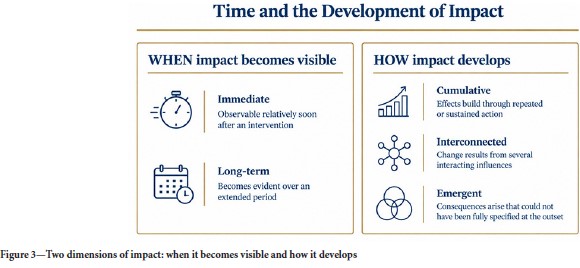
To understand impact more rigorously, two related but distinct questions need to be considered. The first is when impact becomes visible. The second is how impact develops. These two dimensions are connected, but they should not be conflated. These two dimensions are depicted in Figure 3.
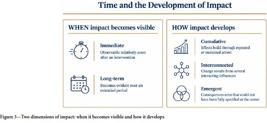
In terms of time, impact may be relatively immediate or become evident only over the long term.
Immediate impact refers to change that can be observed reasonably soon after an intervention. Some outcomes become visible relatively quickly, and in these cases the relationship between action, outcome, and impact can be reasonably direct. A safety intervention, for example, may reduce exposure to a known hazard, contributing to fewer injuries and improved safety performance. Where these changes are sustained and materially advance the original ambition, evidence of impact may therefore become visible within a relatively short period.
Long-term impact becomes evident over a more extended period. This is particularly important in fields such as education, research, professional development, leadership formation, and institutional capability, where some of the most consequential effects may take years to become visible.
Time, however, tells only part of the story. It is also necessary to consider how impact develops.
Cumulative impact results from repeated or sustained action of which its effects build over time. Safety improvement provides a useful example. Progress is seldom attributable to a single intervention. It accumulates through engineering improvements, operating practice, research, regulation, training, leadership, and sustained attention.
Interconnected impact arises where eventual change cannot reasonably be attributed to one action in isolation because several influences interact. Professional capability, for example, may be shaped simultaneously by formal education, workplace experience, mentoring, technical knowledge, professional networks, and opportunities to assume responsibility.
Emergent impact refers to consequences that arise from an action, or combination of actions, but could not have been fully specified or predicted at the outset. Research undertaken for one purpose may later find application elsewhere. An institutional initiative may create opportunities that were not part of its original design.
These dimensions are not mutually exclusive. An impact may be immediate and interconnected, long-term and cumulative, or cumulative in a way that eventually produces emergent effects.
This understanding has direct implications for measurement. If every intervention is judged against the same short reporting cycle, actions of which their benefits require time to develop may be undervalued. Conversely, long time horizons and complex causal relationships should not become a licence for vague claims unsupported by evidence. Therefore, the measures we select, and the period over which change is assessed, must be appropriate to the impact we are trying to understand.
Learning and adaptation
Measurement has limited value if it ends with recording what happened. Once evidence exists of what changed, the more important task is to interpret that evidence, understand why the observed result occurred, and determine what should happen next. The purpose of measurement is therefore not simply to prove success or identify failure, but to improve the quality of subsequent judgement and action. This is where learning and adaptation become integral to the impact process.
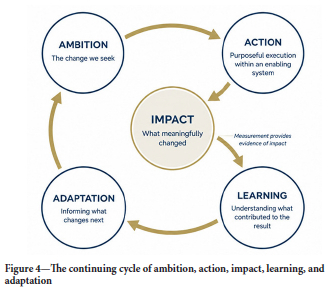
The relationship can be understood as a continuing cycle: ambition, action, impact, learning, and adaptation. This cycle is illustrated in Figure 4.
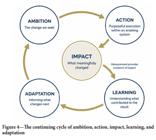
In this sense, impact is not the end of the process. It becomes an input into the next round of judgement and execution.
The next step following measurable impact is learning. Learning requires more than recording whether a target was met. It requires an attempt to understand why the observed result occurred. Organisational learning scholars have long argued that learning becomes organisationally meaningful only when insights move beyond individual awareness into shared interpretation, coordinated action, and institutionalised practice (Crossan et al., 1999; Basten, Haamann, 2018).
In engineering and mining practice, this is familiar territory. We reconcile plans against actual performance. We investigate variance. We examine whether assumptions were correct, whether conditions changed, and whether the systems we designed behaved as expected. The same discipline should apply to programmes, strategies, and institutions.
Where intended impact has been achieved, the task is to understand what contributed to that success and whether it can be sustained or replicated. Where the outcome has fallen short, measurement should not merely record the shortfall. It should help diagnose its cause.
That diagnosis is important because underperformance can arise at different points in the chain we have already considered. The ambition itself may have been poorly defined or based on incorrect assumptions. The action may have been inadequate. One or more of the enabling conditions may have constrained execution. The outputs may have been delivered without producing the expected outcomes. External conditions may have changed. Or the impact may simply require more time to become visible.
These explanations lead to very different responses. If capability is the constraint, repeating the same action with greater intensity is unlikely to solve the problem. If governance is preventing decisions, additional resources may have little effect. If the underlying assumption was wrong, improving execution may simply enable us to implement the wrong solution more efficiently.
The next step is adaptation. Adaptation is the deliberate adjustment of ambition, action, or enabling conditions in response to what has been learned. It may involve strengthening a weak enabler, redesigning a programme, revising a measure, extending the time horizon for assessment, or reconsidering the original objective.
Adaptation is not an admission that the original effort failed. In complex systems, some assumptions will prove incomplete and some interventions will behave differently from what was anticipated. The more important question is whether the response to the evidence is intelligent, deliberate, and timely.
A useful distinction can therefore be drawn between measurement, learning, and adaptation. Measurement provides evidence of what happened. Learning seeks to understand what contributed to it. Adaptation determines what should be changed, retained, expanded, or stopped. Without learning, measurement produces information but not understanding. Without adaptation, learning has little operational value.
The Young Professionals' Council as an illustrative case
The establishment of the Young Professionals' Council (YPC) within SAIMM offers a useful illustration of the framework advanced here. Its value lies not simply in the historical fact that a new structure was created, but in what that process reveals about the relationship between ambition, enabling conditions, action, and longer-term institutional effects.
The starting point was a recognised limitation in the Institute's existing approach to early-career development. By 2014, it had become evident that the needs of young professionals extended beyond career guidance alone. Students needed access to practical experience, graduates faced uncertainty about employment, and young professionals needed mentoring, professional development, and meaningful pathways for participation within the Institute itself (Mmola, 2015; Duke, 2016).
The ambition that emerged in response was therefore broader than the expansion of an existing committee. It was to create a structure through which young professionals could identify their own priorities, participate meaningfully in the affairs of SAIMM, and assume responsibility for developing and delivering programmes relevant to their stage of professional development. In September 2014, the CGE convened a Workshop on Youth Development at Sci-Bono, and from that process a group of young professionals was entrusted with taking the initiative forward. That process ultimately led to the formation of the YPC, of which its establishment and operating by-law were approved by the SAIMM Council in January 2015 (Mmola, 2015; Duke, 2016).
Viewed through the framework proposed earlier, the significance of this case lies in the fact that the initiative should not be judged only by the activity it generated. The more important question is whether it contributed to meaningful change in participation, professional development, institutional inclusion, and leadership formation over time.
The YPC illustrates the importance of enabling conditions. Its establishment required a recognised institutional need, sponsorship from the existing CGE Committee and the SAIMM Council, an agreed governance structure, opportunities for young professionals to assume responsibility, and sufficient institutional support to convert an initial workshop into a continuing platform for participation and programme delivery.
The effects of the actions to establish the YPC are better interpreted over a longer horizon. As the YPC's inaugural chairperson and now President of SAIMM, I am conscious that my progression could be read as a measure of the YPC's success. It is not presented as such here, nor as a sufficient measure of its institutional value. It is, however, one visible long-term outcome connected to an earlier decision by the Institute to create opportunity, responsibility, and space for young professionals to lead.
This case also illustrates the temporal and developmental character of impact. Some effects were immediate, some long-term, some cumulative, some interconnected, and some emergent. The case therefore reinforces the central argument: ambition became meaningful only when it was translated into action through an enabling institutional system, and the significance of the resulting activity lay in what it made possible over time.
Implications for the Southern African Institute of Mining and Metallurgy and professional institutions
The framework is not intended only as a way of analysing individual programmes. It also offers a way of thinking about the role and responsibility of a professional institution operating within a changing industry. For SAIMM, this matters because the Institute's influence is distinctive and enabling rather than operational.
SAIMM does not operate mines, allocate capital, or make production decisions on behalf of the industry. Its contribution lies in the generation and exchange of technical knowledge, the development of professionals, the convening of expertise, the strengthening of professional networks, and the stewardship of an institutional platform through which the disciplines of mining and metallurgy continue to evolve.
The more important assessment is therefore not the volume of activity undertaken, but whether that activity strengthens professional capability, supports knowledge transfer, widens meaningful participation, deepens technical exchange, and improves the ability of the profession to respond to changing conditions. This resonates with communities-of-practice and organisational learning thinking, which emphasises knowledge exchange, interaction, and institutionalisation rather than mere information distribution (Crossan et al., 1999; Jørgensen, Edwards, 2019)
Before initiating a programme, SAIMM and comparable institutions should be able to state the ambition, identify the required enabling conditions, define the intended outputs and outcomes, specify credible evidence of impact, and establish how the resulting evidence will inform adaptation.
The same logic can be applied more broadly to industry ambitions such as zero harm. In South African mining, the pursuit of Zero Harm has repeatedly been described not as a single intervention, but as a systemic and leadership-dependent undertaking requiring engineering controls, operating practice, culture, learning, and sustained institutional commitment over time (De Jager, 2018, 2019; Joughin, 2024).
For SAIMM, the practical implication is that "From ambition to action: Delivering measurable impact" should not be treated merely as a presidential theme. It should be understood as an institutional discipline. The test of that discipline will not be how much the Institute sets out to do, but whether its work produces changes that are material to the professions and communities it exists to serve.
Conclusion
Ambition, while necessary, is insufficient on its own. Ambition establishes the future condition worth pursuing, but it does not by itself produce change. Meaningful progress depends on whether ambition is converted into purposeful action and whether that action produces material change in the condition it was intended to improve.
Three related ideas help to clarify that process. First, action takes place within an enabling system shaped by people, governance, systems, capability, resources, technology, and culture. Second, activity must be distinguished from output, outcome, and impact, because visible effort and delivery are not the same as meaningful change (Belcher, Palenberg, 2018). Third, impact must be understood over time and interpreted through a cycle of learning and adaptation rather than treated as a once-off assessment.
The broader implication for SAIMM is that relevance cannot be maintained through activity alone. A professional institute must be clear about the change it seeks to enable, deliberate in the way it acts, rigorous in how it interprets evidence, and willing to adapt where learning requires it.
References
-
Basten, D., Haamann, T. 2018. Approaches for organizational learning: A literature review. SAGE Open, vol. 8, no. 3, article 2158244018794224. https://doi.org/10.1177/2158244018794224
» https://doi.org/10.1177/2158244018794224 -
Belcher, B.M., Palenberg, M. 2018. Outcomes and impacts of development interventions: Toward conceptual clarity. American Journal of Evaluation, vol. 39, no. 4, pp. 478-495. https://doi.org/10.1177/1098214018765698
» https://doi.org/10.1177/1098214018765698 - Cameron, W.B. 1963. Informal Sociology: A Casual Introduction to Sociological Thinking. Random House, New York, NY, p. 13.
-
Crossan, M.M., Lane, H.W., White, R.E. 1999. An organizational learning framework: From intuition to institution. Academy of Management Review, vol. 24, no. 3, pp. 522-537. https://doi.org/10.2307/259140
» https://doi.org/10.2307/259140 -
De Jager, E.J. 2019. A systems approach to improved safety in the South African gold and platinum sectors, post 2006. PhD thesis, Faculty of Engineering and the Built Environment, University of the Witwatersrand, Johannesburg. http://hdl.handle.net/10539/29407
» http://hdl.handle.net/10539/29407 -
De Jager, K. 2018. Safety and health leadership: A concise 'story line' to achieve zero harm. Journal of the Southern African Institute of Mining and Metallurgy, vol. 118, no. 4, pp. 431-437. https://doi.org/10.17159/2411-9717/2018/v118n4a13
» https://doi.org/10.17159/2411-9717/2018/v118n4a13 -
Department of Mineral and Petroleum Resources. 2025. Critical Minerals and Metals Strategy South Africa 2025. Republic of South Africa, Pretoria. Available at: https://www.gov.za/documents/other/critical-minerals-and-metals-strategy-south-africa-2025-12-may-2025
» https://www.gov.za/documents/other/critical-minerals-and-metals-strategy-south-africa-2025-12-may-2025 -
Duke, V. 2016. A Council for our Youth. Journal of the Southern African Institute of Mining and Metallurgy, vol. 116, no. 4, pp. iv-v. Available at: https://www.scielo.org.za/pdf/jsaimm/v116n4/01.pdf
» https://www.scielo.org.za/pdf/jsaimm/v116n4/01.pdf -
Jørgensen, R., Edwards, K. 2019. Communities of practice in healthcare: A framework to manage knowledge sharing in operations. Knowledge and Process Management, vol. 26, no. 4, pp. 300-314. https://doi.org/10.1002/kpm.1590
» https://doi.org/10.1002/kpm.1590 -
Joughin, W.C. 2024. President's Corner: Quest for zero harm in South African deep gold mines. Journal of the Southern African Institute of Mining and Metallurgy, vol. 124, no. 4, pp. vi-viii. Available at: https://www.scielo.org.za/pdf/jsaimm/v124n4/02.pdf
» https://www.scielo.org.za/pdf/jsaimm/v124n4/02.pdf -
Lane, G.R. 2026. President's Corner: From strengthening an institution to stewarding a system. Journal of the Southern African Institute of Mining and Metallurgy, vol. 126, no. 7, pp. v-vi. Available at: https://www.scielo.org.za/pdf/jsaimm/v126n7/02.pdf
» https://www.scielo.org.za/pdf/jsaimm/v126n7/02.pdf -
Mmola, T. 2015. The SAIMM Young Professionals' Council (SAIMM-YPC). Journal of the Southern African Institute of Mining and Metallurgy, vol. 115, no. 6, p. v. Available at: https://www.scielo.org.za/pdf/jsaimm/v115n6/04.pdf
» https://www.scielo.org.za/pdf/jsaimm/v115n6/04.pdf -
Southern African Institute of Mining and Metallurgy. 2019. Constitution and by-laws. SAIMM, Johannesburg. Available at: https://www.saimm.co.za/about-saimm/constitution-and-by-laws.
» https://www.saimm.co.za/about-saimm/constitution-and-by-laws

Revised: 9 October, 2026
Published: September 2026