Understanding the nature of challenges posed in PGM recovery from secondary tailings resources
Abstract
The retreatment of secondary tailings for platinum group metals recovery presents a range of potential challenges, which vary depending on the nature of the original ore and the type of pretreatment it was subjected to. These challenges include the prevalence of ultrafine particles, which promote slimes coatings on valuable minerals, hinder bubble-particle attachment, increase pulp viscosity, and lead to higher gangue entrainment; surface oxidation of minerals, which alters their floatability; and the presence of deleterious gangue minerals and residual platinum group metal species that are inherently difficult to recover by flotation. This study compares the batch flotation performance across a range of tailings samples from the eastern and western limbs of the Bushveld Complex. A complementary mineralogical analysis was conducted to gain deeper insights into mineral behaviour. The paper evaluates these findings to identify the key factors contributing to poor platinum group metal performance.
Platinum group metals; tailings reprocessing; sodium metasilicate; ultrafine particles
Introduction
The reprocessing of secondary tailings resources for platinum group metal (PGM) recovery has become an increasingly attractive option for both economic and environmental reasons. Large volumes of tailings from decades of chromite and PGM mining in the Bushveld Complex contain significant residual metal values, representing a secondary resource that can be exploited without the cost and environmental impact of new mining. Moreover, advances in mineral processing technology have created opportunities to recover PGMs from material once considered uneconomic (Ross et al., 2019).
The term tailings reprocessing can be misleading, as tailings may originate from a variety of sources, each with distinct mineralogical and metallurgical characteristics. Relevant resources for PGM recovery include legacy material stored in tailings storage facilities from PGM concentrators, which has already undergone primary PGM recovery, as well as from other plants, such as chromite operations, that have not been previously treated for PGMs. Current tailings streams from operating PGM concentrators and other processing plants can also be targeted, alongside smelter and converter slags generated during PGM smelting and refining. The origin of the material strongly influences its particle size distribution, mineralogy, degree of surface oxidation, and ultimately, its amenability to reprocessing.
These differences in origin and prior processing history may result in substantial variability in flotation behaviour but will almost invariably result in lower recovery potentials. Legacy tailings may contain partially liberated PGMs and relatively coarse particles but can also be highly oxidised or even contaminated with secondary minerals formed during long-term storage (Petrunic et al., 2009). In contrast, current tailings streams are typically finer and may contain a higher proportion of slimes (Baloyi et al., 2024). Smelter and converter slags present additional challenges related to their glassy, refractory nature and the encapsulation of PGMs within silicate matrices (Shen, Forssberg, 2003). Understanding how these characteristics influence bubble-particle interactions, pulp rheology, and gangue entrainment is critical to identifying the key factors limiting recovery in tailings reprocessing.
This study evaluates the laboratory batch flotation performance of four chromite tailings dams, comprising two from the eastern limb and two from the western limb of the Bushveld Complex. The flotation behaviour of these tailings is compared against that of run-of-mine (ROM) ores sourced from the corresponding eastern and western limb mining areas. Comprehensive mineralogical characterisation, including the bulk mineral identification and quantification, and PGM speciation, liberation and association for two selected samples, is employed to interpret differences in flotation performance. The study examines how tailings origin, mineral composition, and particle size distribution influence recovery and concentrate grade, providing insights into operational strategies for the processing of these resources.
Experimental
Ore types and preparation
Two run-of-mine (ROM) ores were investigated, one sourced from the eastern limb (EL) and one from the western limb (WL) of the Bushveld Complex. In addition, four samples were collected from chromite tailings storage facilities, comprising two from the eastern limb (designated EL Dam 1 and EL Dam 2) and two from the western limb (designated WL Dam 1 and WL Dam 2). All the ores are of the middle group (MG) reef type, except for WL Dam 2, which is derived from the lower group (LG) reefs.
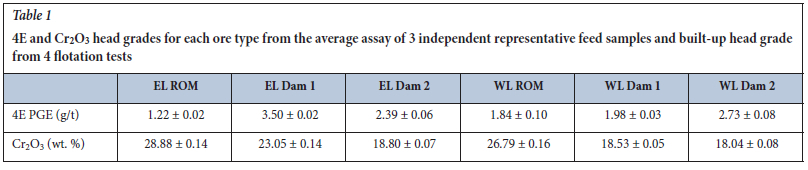
The head grades for the respective samples are summarised in Table 1. The ROM ores contained relatively low 4E (Pt + Pd + Rh + Au) grades of 1.22 g/t (EL) and 1.84 g/t (WL). By contrast, the tailings samples exhibited higher head grades, with EL Dam 1 reaching 3.5 g/t. The higher Cr2O3 head grades of the ROM samples compared to the tailings dams, are consistent with prior chromite recovery from the tailings dams.
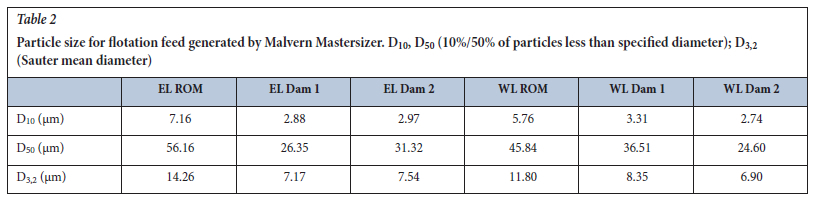
Samples were crushed to < 2 mm, if necessary, split into the required sample masses and milled to a target grind of 80% < 75 μm. Particle size distribution of the flotation feed (Table 2) showed that, not surprisingly, the ROM samples contained less fines than the dams, even though they had the same P80.
Mineralogical characterisation
Each of the samples was prepared into polished 30 mm diameter blocks for determination of the bulk mineralogy using quantitative evaluation of scanning electron microscopy (QEMSCAN) on a QEMSCAN 650F instrument. The PGM mineralogy was also investigated through the analysis of multiple polished sections for the EL Dam 2 and WL Dam 2 samples. Confidence in the data was obtained by comparing the back calculated elemental assays with measured assays determined through x-ray fluorescence spectroscopy (XRF) by an external service provider. Selected samples were also analysed on a Panalytical Aeris diffractometer, and the mineral grades quantified using the Rietveld method, before comparison with the QEMSCAN results. Good parity was obtained between these datasets.
Batch flotation
Batch flotation was performed at 35% solids (by mass) in an 8 L Barker flotation cell. Base case reagent conditions were SIBX (collector) at 300 g/t, Senfroth 200 (frother) at 20 g/t and Sendep 30E (depressant) at 40 g/t. Depressant dosage was increased to 100 g/t to improve grade and 400 g/t to depress all naturally floating gangue and calculate the entrainment function. The final condition was the 100 g/t depressant condition, with the addition of 1500 g/t sodium metasilicate (Na2SiO3, abbreviated NaSi). Standard conditions were maintained for reagent conditioning, impellor speed (1200 rpm), froth depth (2 cm) and air flow rate (12 L/ min). Froth scraping occurred manually every 15 seconds, and concentrates were collected at cumulative times of 2, 6, 12, and 20 minutes. Concentrates and tailings were dried, delumped, and sent for 4E (Pt, Pd, Rh, Au) and Cr2O3 assay to an external, accredited laboratory.
Results and discussion
Sample characterisation
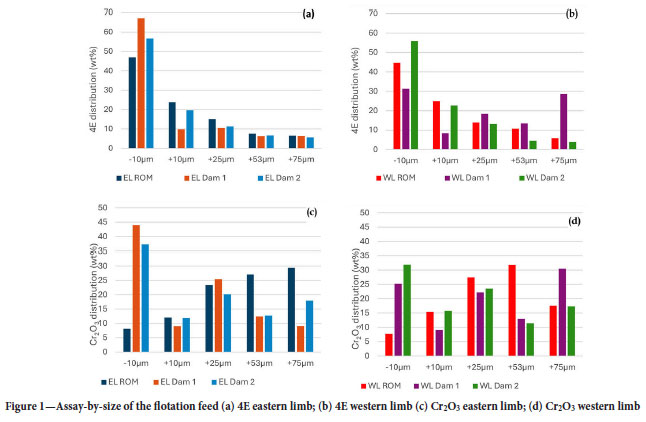
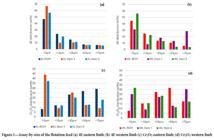
Assay-by-size showed that there were differences between deportment of value in the eastern and western limb ores (Figure 1). Eastern limb ores showed significant deportment of PGMs to the sub-10 μm size fraction, particularly for the tailings dams (57%-67%), whereas the western limb dams contained between 31%-56% of the 4E in the sub-10 fraction. WL Dam 1, in particular, showed a large amount of PGE in the + 75 μm size fraction, which may be locked and poorly floatable.
Mineralogy
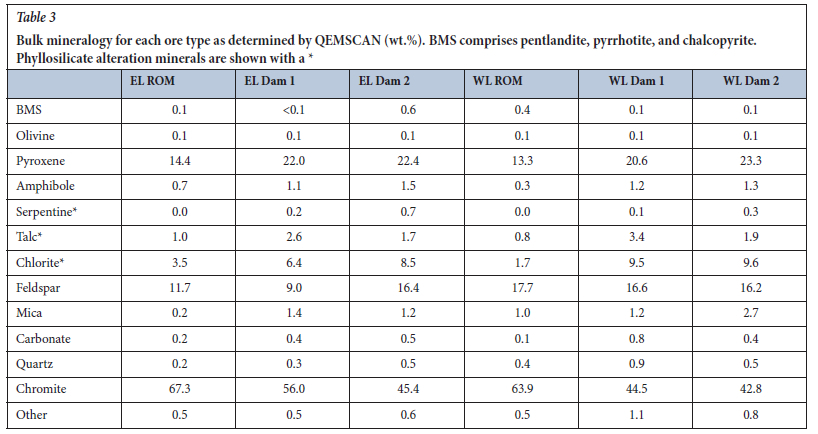
The bulk mineralogy for each ore type is shown in Table 3. Base metal sulphide (BMS) grade ranges from very low for EL Dam 1 (< 0.1 wt.%) to a reasonably high grade of 0.6 wt.% for the EL Dam 2. For the rest of the gangue mineral types that could be considered problematic, such as the phyllosilicate alteration minerals, talc and serpentine, these are found in relatively low quantities. Serpentine, a mineral well known for generating slimes coatings and increasing pulp viscosity, is present in very low quantities and should not be considered problematic at these concentrations. There are reasonable amounts of talc, up to 3.4 wt.%, but this should be controllable using carboxymethyl cellulose depressant. There are no clearly identifiable differences between the eastern and western limb ore samples, or between the LG and MG (WL Dam 2) samples (other than chromite content, already described, as per Table 1).
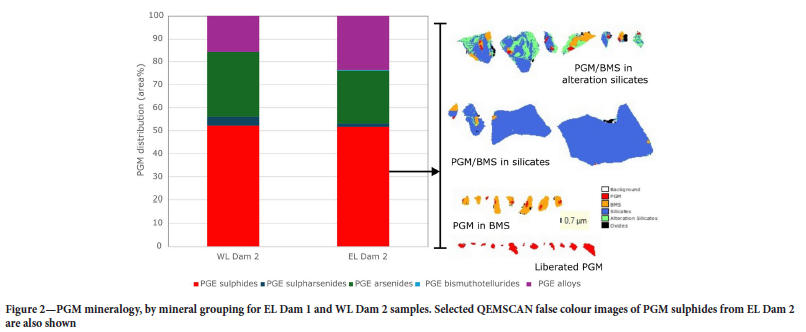
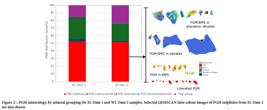
PGM mineralogy was assessed for EL Dam 2 and WL Dam 2 (Figure 2), and the results indicate broadly similar assemblages across the eastern and western limb samples. Approximately 50% of the PGMs occur as PGE sulphide minerals, which are generally regarded as fast floating and readily recoverable. The remaining ~50% comprise minerals that are less amenable to flotation, notably the PGE arsenides (Wali et al., 2024). The flotation response of the PGE alloys is less known in comparison to the sulphides, but available evidence suggests that they are more difficult to recover than the sulphides. Previous studies have proposed that the occurrence of alloys, such as ferroplatinum, reflects secondary processes, which may also produce associated alteration gangue minerals that can adversely affect flotation (McCall, 2016). In the present samples, chlorite appears to be the dominant alteration phase, with only minor talc and negligible serpentine, suggesting a comparatively less problematic alteration assemblage. False colour images of the PGM (see Figure 2) also show the presence of liberated PGM, PGM in base metal sulphides, PGM associated with BMS locked in silicates, and PGM associated with BMS locked in alteration silicates.
At the level of resolution available using the standard operating conditions of the QEMSCAN, no secondary minerals that had formed during the lifetime of the dam could be identified. These are minerals that may form due to the saturation state of the water being exceeded, or due to incongruent dissolution of primary minerals undergoing weathering reactions (Petrunic et al., 2009). Under alkaline conditions, a silicate-rich tailings deposit may be expected to form secondary silicates and clays from the alteration of feldspar and pyroxene, those being, carbonates such as dolomite or magnesite due to carbonation from atmospheric carbon dioxide reacting with Mg-rich silicates; sulphate minerals from oxidation of sulphide minerals; iron oxyhydroxides such as goethite, ferrihydrite, and hematite; and secondary PGM phases from micron-scale reprecipitation of Pt, Pd or Rh as secondary alloys, amongst others.
Laboratory batch flotation experiments
PGM performance
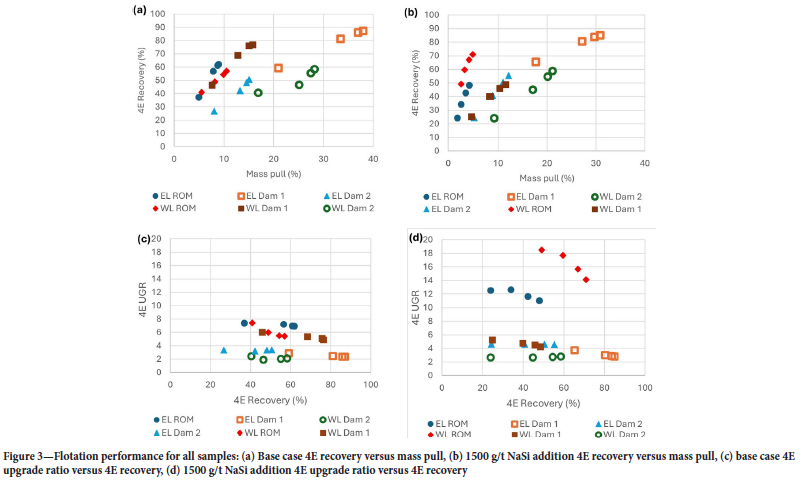
Figure 3 shows the flotation performance for all the individual samples. The base case recovery versus mass pull curves (Figure 3a) show that there are a range of floatabilities for the different samples, from the poorly floatable WL Dam 2, through to the better performing EL and WL ROM ores, with WL Dam 1 performing similarly to the ROM ores. The fact that these samples are positioned in a more favourable region of the recovery-mass pull domain does not necessarily translate to higher final recoveries under the conditions used. However, it implies that improved recoveries are possible at higher mass pulls, assuming this is operationally feasible. EL Dam 1 attains the highest final recoveries, but at extremely high mass pulls, which may be attributed to its notably fine particle size distribution and relatively high talc content.
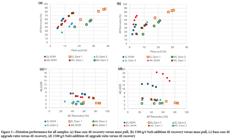
The addition of NaSi (Figure 3b) had a significant positive effect on the performance of most of the samples. In some cases, final recoveries were lower than those for the base case, but the recovery-mass pull curve shifted to a more favourable operating domain. WL ROM was an example of a particularly good response to addition of NaSi, shifting from 57% recovery at 10.5% mass pull to 71% recovery at 5% mass pull. WL Dam 1, however, was an example of a negative response to NaSi addition, where final recovery decreased from 76.5% to 48.7%, with an associated decrease in mass pull from 15.5% to 11.6%.
The upgrade ratio (UGR) versus recovery for the samples is shown in Figures 3(c) and (d). Figure 3(c) gives the base case curves, whereas Figure 3(d) shows the comparison when NaSi is added. These show more clearly the dramatic improvement in grade for the two ROM samples.
Cr 2 O 3 performance
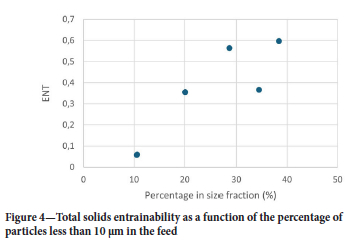
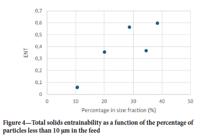
An important performance indicator for these ore types is the extent of Cr2O3 recovery to the concentrate by entrainment. Entrainability, which is defined as the slope of the recovery by entrainment versus water recovery plot, was the highest for EL Dam 1 and WL Dam 2 (Table 4). This is correlated with the higher proportion of fines contained in these ores. By contrast, the ROM samples displayed entrainability values about an order of magnitude lower, consistent with their coarser PSDs. This is most clearly indicated by Figure 4 that shows the rapid increase in entrainability parameter with an increase in the ultrafines content in the feed. The exception is EL Dam 2, which lies off the trend.
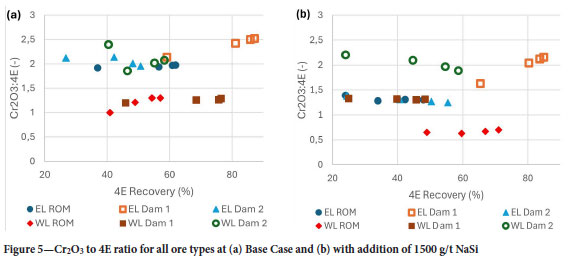
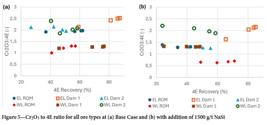
A key performance metric for chromite-bearing PGM concentrator is the Cr2O3 to platinum ratio as smelters inflict penalties when this value is too high. Figure 5 shows the Cr2O3 to 4E ratio versus the 4E recovery for the (a) base case and (b) with the addition of NaSi. The objective is to reduce the Cr2O3:4E ratio, while maintaining, as far as possible, the overall recovery. A comparison of the two datasets shows that, for some ores, this was achieved with the added benefit of an increase in 4E recovery. For example, the addition of NaSi to the WL ROM reduced the Cr2O3:4E ratio from above 1 to an average of about 0.65, while increasing recovery from a final value of 57% to 70%. Similarly, the EL Dam 2 experienced a reduction in the Cr2O3:4E ratio from above 2 to below 1.5, while increasing recovery from 51% to 55%. The Cr2O3:4E ratio was significantly reduced for all other ores, with the exception of the WL Dam 2, which remained relatively unchanged, although showing some variability. In the latter cases, the decrease in Cr2O3:4E ratio was accompanied by a loss in recovery. Whether such a trade-off is acceptable depends on economic considerations, particularly the balance between reduced recovery and the avoidance of smelter penalties for high Cr2O3 to platinum ratios.
Conclusions
This study examined the flotation performance of run-of-mine (ROM) samples and chromite tailings samples from the eastern and western limbs of the Bushveld Complex, with the aim of identifying the principal challenges encountered in PGM tailings reprocessing.
Mineralogical analysis revealed only minor amounts of problematic gangue minerals such as serpentine and talc, indicating that slimes coatings and pulp viscosity were unlikely to be major constraints on valuable mineral recovery. PGM speciation of a western and eastern limb dam, respectively, indicated that roughly half of the PGMs occur as readily floatable sulphide species, while the remainder are comprised of more refractory arsenides and alloys. While the ROM samples exhibited relatively low 4E grades (1.2-1.8 g/t), the tailings dam samples had significantly higher grades (up to 3.5 g/t), highlighting the potential of tailings as secondary PGM resources.
Assay-by-size data showed that the PGMs are heavily concentrated in the sub-10 μm size fraction, which suggests that there may be size-related constraints in the recovery of these minerals. While it is well known that fine particles have lower collision probabilities than coarser particles, the very high density of PGMs overcomes this problem, to some extent.
Fortunately, the Cr2O3 distribution by size was not as heavily concentrated in the ultrafine size fraction as the PGMs. However, the eastern limb ores showed higher concentrations of Cr2O3 in the < 10 μm fraction than the western limb. The ROM ores of both the eastern and western limbs showed an increasing concentration towards the coarser end of the distribution. These are all positive properties with regards to limitation of recovery by entrainment of chromite.
Although the bulk mineralogical characteristics did not immediately suggest significant processing challenges, both recoveries and upgrade ratios were lower than might typically be expected for fresh UG2 ores. The ROM samples consistently outperformed the tailings materials, offering some insight into the underlying causes. Key differences between ROM and tailings samples include: (1) ROM ores have a coarser particle size distribution, and therefore contain fewer problematic ultrafine gangue particles; (2) ROM samples generally exhibit a lower proportion of PGMs in the ultrafine size fractions; (3) unlike tailings materials, ROMs have not been subjected to prolonged storage on a tailings dam, where surface oxidation and secondary alteration can adversely affect flotation behaviour.
Among the tailings dam samples, several achieved relatively good recoveries that approached, or exceeded 80%, but only, in some cases, at extremely high mass pulls under base case conditions. This is reflected in their low upgrade ratios, which range from about 2 to 3.6 for three of the four dam samples. Exploring the possibilities for these poor performances, the high deportment of PGMs to the ultrafine (< 10 μm) fraction appears to be a common trend amongst these ores. The only tailings dam sample that achieved close to 80% recovery at a reasonable mass pull of 16%, was the WL Dam 1, which was also the sample that had the lowest PGM distribution to the ultrafine fraction from both the ROM and tailings dam samples. Interestingly, this was also the only sample that responded poorly to the addition of NaSi to the reagent suite. There were no obvious constraints evident in the bulk mineralogy of any sample, while the PGM mineralogy of the two dam samples that were analysed (EL2 and WL2) indicated ~50% content of PGM species that may be considered difficult to recovery. It may, therefore, be concluded that the combination of ultrafine PGM particles made up of refractory species, are the dominant factors in hindering the performance of the dam samples.
Recovery of chromite to the concentrate is a serious concern for the profitability of all PGM operations and furthermore, is a significant problem for these very fine ores. The entrainability values indicated how very sensitive the flotation process is to the amount of fines present in the samples. The Cr2O3:4E ratio could be reduced in most of the ore samples by the addition of NaSi, an effect attributed primarily to enhanced froth drainage. This is noteworthy because these ores contain only minor serpentine and would not typically be regarded as ideal candidates for NaSi application (McFadzean et al., 2023). Sodium metasilicate is generally employed as a dispersant to remove electrostatically attached ultrafine serpentine particles from valuable minerals, thereby improving PGM recovery. In the present study, NaSi appears to perform this conventional role for certain samples, most notably the WL ROM, but its dominant action is more likely through improved froth drainage and a consequent reduction in gangue entrainment.
These findings highlight the need for processing strategies that address ultrafine PGM deportment and refractory behaviour. Targeted measures, such as improved reagent and froth management schemes, can help limit chromite entrainment while maintaining PGM recovery. This could also include investigation of the effect of stirred milling. Incorporating these approaches provides a framework for more effective reprocessing of Bushveld tailings resources.
Acknowledgments
The authors gratefully acknowledge the funding of Sylvania Platinum and permission to publish this work, and extend thanks to various staff" members of the Centre for Minerals Research for their expert assistance.
References
-
McCall, M.-J. 2016. Mineralogical and geochemical variations in the UG2 reef at Booysendal and Zondereinde mines, with implications for beneficiation of PGM. SUNscholar digital archive, Stellenbosch University. https://scholar.sun.ac.za
» https://scholar.sun.ac.za - McFadzean, B., Domingues, T., Souza, D., Becker, M., Geldenhuys, S., Molifie, A., Nyaruwata, E., Tshinavhe, T., Souza, T. 2023. Analysis of dispersant efficacy in overcoming challenges posed by alteration minerals in flotation. Flotation 23.
-
Petrunic, B. M., Al, T.A., Weaver, L., Hall, D. 2009. Identification and characterization of secondary minerals formed in tungsten mine tailings using transmission electron microscopy. Applied Geochemistry, vol. 24, no. 12, pp. 2222-2233. https://doi.org/10.1016/j.apgeochem.2009.09.014
» https://doi.org/10.1016/j.apgeochem.2009.09.014 -
Ross, v., Singh, A., Pillay, K. 2019. Improved flotation of PGM tailings with a high-shear hydrodynamic cavitation device. Minerals Engineering, vol. 137, pp. 133-139. https://doi.org/10.1016/j.mineng.2019.04.005
» https://doi.org/10.1016/j.mineng.2019.04.005 -
Shen, H., Forssberg, E. 2003. An overview of recovery of metals from slags. Waste Management, vol. 23, no. 10, pp. 933-949. https://doi.org/10.1016/S0956-053X(02)00164-2
» https://doi.org/10.1016/S0956-053X(02)00164-2 -
Wali, A., Filippov, L., Fekry, A. M., O'Connor, C. T., McFadzean, B. 2024. An investigation into the effect of Eh and pH on the adsorption of a xanthate collector on sperrylite (PtAs2): A surface and solution characterization study. Minerals Engineering, 217. https://doi.org/10.1016/j.mineng.2024.108949
» https://doi.org/10.1016/j.mineng.2024.108949

Published: February 2026