Recovery of iron from red mud by high-temperature reduction of carbon-bearing briquettes
Abstract
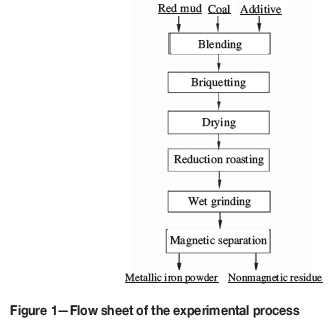
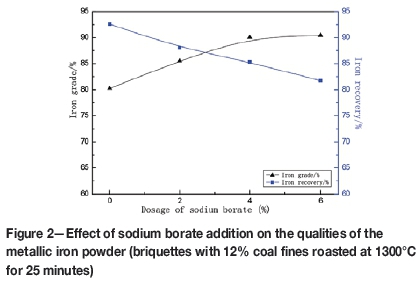
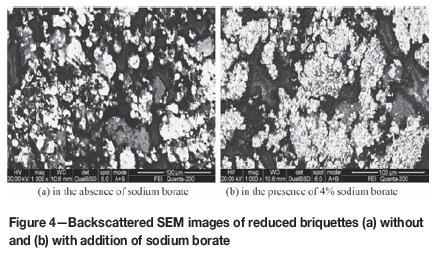
Red mud is the waste generated during the production of alumina from bauxite. The high-temperature reduction of red mud in the absence and presence of sodium borate was carried out to facilitate the subsequent recovery of iron by wet magnetic separation. Sodium borate was found to enhance the recovery of iron, as well as increasing the particle size of metallic iron significantly. High-temperature reduction in the presence of 4% sodium borate increased the iron grade of the metallic powder to 90.05%, compared to 80.24% without sodium borate under the optimum conditions of roasting at 1300°C for 30 min. Experimental evidence showed that sodium borate promotes the reduction of iron oxides and the growth of metallic iron grains, which leads to improved separation between iron and gangue during the subsequent magnetic separation.
red mud; sodium borate; high-temperature reduction; metallic iron powder
 Thumbnail
 Thumbnail
 Thumbnail
 Thumbnail
 Thumbnail
 Thumbnail
 Thumbnail